Authors Connecting With Readers

I read an article the other day telling writers they should be connecting with readers online instead of other writers. He gave a few suggestions like going on Goodreads, following people who read the same sort of book you wrote, leaving comments on their reviews or joining the same groups and responding to the same discussions they do.

Is this what online promotion has come to? Authors stalking readers like prey? Many readers do like to interact with authors, and perhaps they would be flattered if it were an author they knew, but an unknown author trying to connect with an unknown Readingreader seems tacky at best. I know I would hate it if I found myself in some author’s sights, and I can’t imagine I’m the only one who would.
I am not a reader who likes to connect with authors. (Though I love when readers connect with me!) To me, a book exists separate from its creator, a thing in and of itself. In fact, once I started coming in contact with writers, especially writers whose book I have read, I lost all interest in reading. It made me more cognizant of the person behind the story, and made the book much less personal.

I do have a group for connecting with readers on Facebook, the Genre Book Club, but most of the people who participate are authors in search of readers. The main problem is that I don’t seem to be able to get people to discuss the books they read. Everyone has different tastes, and few of the participants read the same books.

It is a conundrum, this online promotion. I do realize that connecting with other writers is not the way to sell a ton of books, but writers send me a lot more invitations to connect than readers do, and after all, many of us writers started out as readers.

The article also suggested attracting readers by blogging about the subject matter of your books. I do this, of course, when it comes to grief, but I said all I want to say about conspiracy theories, government intervention in our lives, and the scary possibility of an unstoppable epidemic in my novels. I don’t want to spend the rest of my life talking about such matters. The books were a way of my putting an end to those topics of research, and to keep them in the forefront of my mind and this blog would be appallingly boring. (For me, anyway.)

Still, this blog is a way of connecting with people, not as stalker and prey, but simply as two individuals who happen to be in the same place at the same time and like what each other has to say. And that’s more important than running after readers in the hopes they will buy my books.

***

Pat Bertram is the author of the suspense novels Light Bringer, More Deaths Than One, A Spark of Heavenly Fire, and Daughter Am I. Bertram is also the author of Grief: The Great Yearning, “an exquisite book, wrenching to read, and at the same time full of profound truths.” Follow Pat on Google+. Like Pat on Facebook.
Waiting Quietly For an April Time

It’s been three years and two months and two weeks since the death of my life mate / soul mate. It’s been a rough time for me, working through the pain of his death and our separation, adjusting to life without him, learning to think of him with gladness instead of sadness, searching for new ways of being and new reasons for living, realizing that he is he and I am I and we have separate paths in life.

Every once in a while now, beneath the bleak frozen ground of grief, I can feel the first green stirrings of hope, maybe even a promise of new life.

These feelings are right on time. Everyone I have talked to who has dealt with such a grievous loss has said it takes four years to find a renewal of life. (Apparently four years is the half-life of grief.)

As one woman who has been there told me, “Our partners are gone. We can either live in this world without them, experiencing a full, active life . . . or we can half live a life while we are still connected to our dead great loves through the ether, which we can’t navigate or understand this side of death.

It isn’t a choice; you can’t “just get there.” But you will get there. And everything will suddenly feel new again. You will see possibilities as something toward which you want to leap, and you will suddenly feel untethered and able to make that leap.”

In ten months, by next April, I will have passed my fourth anniversary. April. A time of renewal. Maybe a time of my renewal.

In her book The Stillwater Meadow, Gladys Tabor wrote: “People have seasons . . . There is something steadfast about people who withstand the chilling winds of trouble, the storms that assail the heart, and have the endurance and character to wait quietly for an April time.”

And so, I will continue dealing with the upsurges and downswings of grief, with the tears and loneliness, with the uncertainty and confusion, and wait quietly for my April time.

***

Pat Bertram is the author of the suspense novels Light Bringer, More Deaths Than One, A Spark of Heavenly Fire, and Daughter Am I. Bertram is also the author of Grief: The Great Yearning, “an exquisite book, wrenching to read, and at the same time full of profound truths.” Follow Pat on Google+. Like Pat on Facebook.

Paeans to Teachers, Mothers, and Ancient Civlizations

Mike Simpson, chief editor of Second Wind Publishing, posted a blog today about the heroism of the teachers of Moore Oklahoma using their bodies in an effort to protect their students from the wrath of nature, and teachers of Sandy Hook Elementary in Newtown, Connecticut, trying to shield their students from a gunman. He says, “Can you imagine such fierce love, such a totally unreserved willingness to perish for the children they taught? Servicemen and women go to combat knowing that they may be killed or desperately wounded. In the face of that, our nation recognizes their courage and lauds them with high honors—rightly so. Yet when a teacher goes into a classroom intending to impart a daily dose of education to a group of children and ends up putting herself or himself in the path of death for the sake of those kids, I ask myself: is there any individual anywhere who should be more highly honored? In moments of crisis and tragedy, our truest selves emerge. And if we ever wanted to know the “stuff” of which the teachers of Moore and Newtown are made, we found out with perfect clarity.”

“Where the Wind Comes Whistling Down the Plains, Teacher” by Mike Simpson is a blog post worth reading.

While you’re at the Second Wind blog, check out Mother’s Day 2013 by J. Conrad Guest and A Day in Turkey with the Hittites by Mickey Hoffman. Mickey’s travelogues are among the best I have seen/read, making me feel as if I were in these exotic places with her.

And, what the heck, while you’re there, you might as well also check out What is Your Character’s Favorite Color? — by Pat Bertram. It’s an older post, doesn’t really fit in with the theme of this article of paeans, but it is a perennial favorite of the Second Wind blog readers, so that’s sort of a paean.

***

Pat Bertram is the author of the suspense novels Light Bringer, More Deaths Than One, A Spark of Heavenly Fire, and Daughter Am I. Bertram is also the author of Grief: The Great Yearning, “an exquisite book, wrenching to read, and at the same time full of profound truths.” Follow Pat on Google+. Like Pat on Facebook 

My Aching Breaking Heart

My heart is breaking. I thought when my life mate/soul mate died that the organ had shattered beyond repair, but it must have healed because I feel as if it is breaking again.

When I first entered the world of grief, I was stunned by the constant assault of emotions, physical reactions, mental conflicts and torments because I’d never heard of such grief. Well, there was that one old woman who wore black the whole of her life, celebrating her widowhood, and occasionally there would be talk of someone keening in agony at her husband’s funeral. I thought those were isolated cases of unbalanced women, but I am not unbalanced. (And probably they weren’t, either.)

I wrote about what I was going through so I could try to make sense of the onslaught, and it helped. Blogging about grief also helped because I met many others on the same journey, which brought me comfort, and a few who were years ahead of me, which brought me hope.

Somewhere in the back of my mind, I thought this fathomless grief set me aside from everyone else, and perhaps I even thought I should have special consideration because of my situation. Then others I knew lost someone they loved, and I realized grief didn’t make me special. It just made me . . . bereft.

After three years, I am still sad. I tend to think I’m not making any progress, but then I hear from women who just lost their husbands, and I am drenched in tears, remembering what it was like when grief was new. And I can see how very far I have come. Sail AwayBut I also know what these women are feeling and how much they will have to deal with in the coming months and years, and my heart breaks for them.

How is it possible that so many of us have lost our mates and soul mates? It’s like a bizarre dance of butterflies, where those we love flit into our lives, bringing wonder and color and joy, and then they flit away, leaving us devastated. How can the world survive when it is so awash in grief? (Perhaps that’s where the oceans came from — the tears of the bereft. After all, throughout the ages, billions of people have mourned for their dead.)

Sometimes I see a photo of or an article about a couple who has been married for forty or fifty years. They always have helpful advice about how they stayed together for so long, but the truth is, despite all their ways of keeping love alive, the reason they were together so long is that one of them didn’t die. Not every loving couple gets that opportunity.

And my heart breaks for the ones left behind.

***

Pat Bertram is the author of the suspense novels Light Bringer, More Deaths Than One, A Spark of Heavenly Fire, and Daughter Am I. Bertram is also the author of Grief: The Great Yearning, “an exquisite book, wrenching to read, and at the same time full of profound truths.” Connect with Pat on Google+. Like Pat on Facebook.

Meet Malcolm R. Campbell and “The Seeker”

Malcolm R. Campbell is the author of the contemporary fantasies, The Sun Singer, Sarabande, The Seeker, and the satire, Jock Stewart and the Missing Sea of Fire. He is also a prolific blogger, posting interesting articles and reviews, and collecting Book Bits, the most fascinating and relevant book-related links on the internet.

I recently interviewed Malcolm to find out more about his new book and his writing practices. The interview is posted on my Pat Bertram Introduces . . . blog, but I’m posting a few responses here to whet your appetite to read more. I hope you will enjoy meeting Malcolm R. Campbell.

SeekerCoverMalcolm, What is your book about?

In The Seeker, David and Anne meet while working as seasonal employees at Many Glacier Hotel in Glacier National Park. He comes from the Montana high county where he is at home with totem animals, magic and mountain climbing. She comes from the Florida Panhandle where she is at home with botany, beaches and coastal swamps. Their intense summer romance leads them to believe they’ll be lovers forever. Typically, the realities of college life in separate towns get in the way. Then, when David’s intuition tells him Anne is in danger, he uses ancient magic to rescue her. However, cheating fate brings consequences and misunderstandings that threaten to drive them apart.

What inspired you to write this particular story?

The story was inspired by my work as a summer employee in Glacier National Park as well as my love of both the Rocky Mountains and the Florida Gulf Coast where I grew up. To my Florida friends, my going to Montana for summer work and Colorado for summer school was tantamount to traveling to another planet. The worlds are so different. So, I wondered whether two people from such diverse regions could maintain a relationship once the summer was fading away into the past.

How much of yourself is hidden in the characters in the book?

David Ward is very much like me. We both love climbing mountains, following our intuition, and consorting with totem animals. In the upcoming second and third books of the trilogy, my experiences are somewhat similar to David’s aboard a Vietnam-era aircraft carrier in The Sailor, and my work as a college journalism instructor leads to David’s teaching work in The Betrayed.

Tell us a little about your main characters. Who was your favorite? Why?

David’s grandparents, the medicine woman Katoya, and the sheep rancher Jayee, are very influential in his life. Katoya teaches in magic. Jayee teaches him logic and the practical work labor-intensive jobs. Katoya and Jayee come from different worlds, having married for reasons of necessity, so they’re at odds with each other about almost everything. I had fun writing about their love/hate relationship and how it impacted their grandson. Yet, I don’t let them steal the show from protagonist David Ward, a mountain climber who really would refer working on the railroad to going to college, and Anne who is a very earth-centered, environmentally conscious young woman who doesn’t like what we’re doing to the planet.

Click here to read the rest of the interview: Malcolm R. Campbell, Author of “The Seeker”

You can find Malcolm on his website at http://www.malcolmrcampbell.com as well as on his Facebook author’s page at https://www.facebook.com/Malcolm.R.Campbell.Author

image001

Is There Life Without the Internet?

I spent most of yesterday updating my virus protection software. For some reason known only to the computer gods and gurus, simple tasks that should be done in a matter of minutes take hours upon hours. I ended up downloading the program and removing it twice, talking to several different billing and tech people (and some I’m not even sure work for the company — if you google “Trend Micro contact”, you get all sorts of phone numbers, only some of which go the to actual company.) And because they couldn’t simply credit my account with a refund and use that money for the second download I had to pay twice (though they did promise a refund for one of the downloads. Wink. Wink.).

Although I could write a whole post (perhaps even an amusing one) about my experiences with the update, mentioning it is by way of a prologue. I’ve used Trend Micro from the beginning, and it’s been good protection, so I’ve been sticking with them, but yesterday, halfway through the process, I told them I was so unhappy with their service, I was ready to throw away my computer. For just a second, I meant it, and I felt free. And then the truth hit me.

untiledMy life is almost all online. Sure, I could take walks, but who would I tell about my insights? I could write my thoughts, but who would read them? Who would talk to me about Is Introspection Possible? and What Is Luck?, my Soul’s Journey and Living Light and Free? This blog has seen me through some terrible times in my life, and some good ones. It was here that I first announced I’d found a publisher, first promoted my books, first talked about the agony of my grief, had my first inklings that there might someday be happiness for me again. I cannot imagine my life without it. But this is not the only thing I’d have forego.

Without the internet, I’d have no life as an author. I could still write books, but who would talk to me about them? I could perhaps still check with bookstore owners and see if I can do book signings, but what if I wanted to publish another book? Book files are all digital now. How would I get the manuscript digitalized so I could send to my publisher?

There is too much of my life I’d have to do without. I have friends in the real world, which is nice, but I also have friends in the cyber world — people from all around the world — that I’d never get to talk to or email again. I’d never get to check in Facebook again. Well, maybe that wouldn’t be such a loss, but still, it is a part of the online experience, and I’d miss all the people I’ve friended and those I haven’t yet met.

And Rubicon Ranch — the collaboration/serialization I’m writing with other Second Wind authors — I’d have to give up on that, too, just when all the authors are learning to have fun with it and run with it.

Every day online offers the possibility of something wonderful happening. So, after my whole online life flashed before my eyes along with the vision of what my life would be like without the internet, I girded my loins, gritted my teeth, stepped once more into the fray, (feel free to add whatever other clichés you wish), and finally got the job done. Now I just have to wait to see if they follow through on their side with the refund.

Either way, I’ll still be here.

***

Pat Bertram is the author of the suspense novels Light Bringer, More Deaths Than One, A Spark of Heavenly Fire, and Daughter Am I. Bertram is also the author of Grief: The Great Yearning, “an exquisite book, wrenching to read, and at the same time full of profound truths.” All Bertram’s books are published by Second Wind Publishing. Connect with Pat on Google+

A Great Blog to Check Out

Recently there have been some fascinating articles posted on the Second Wind Publishing blog that are worth checking out. All the articles on the blog are great, of course. These are just the most current ones.

grayblognewreleases copy

The Importance of Locations by Deborah J Ledford. Deborah describes the wonder of her childhood summers spent in North Carolina, and how they have colored her writing.

Spring by S.M. Senden. Sue talks about the importance of spring cleaning, cleaning out the old, clearing out closets as well as old notions that no longer work, in order to make room for the new.

Air Travel in the 1950′s, a kid’s memory by Juliet Waldron. A fascinating look back at the way air travel used to be. This was of particular interest to me, considering my recent flight via “Sardine Airlines.”

The Day of the Trickster by J J Dare. J J muses on the origins of the April Fool, postulating that perhaps it originated in the old days of Rome. As she said, “these guys and their mythological gods loved to party.”

Headed for adventure by Nichole R Bennett. Nichole tells us about the life of an active-duty military couple. But now she and her husband are headed for adventure by themselves.

Peaches Peppers & Pork Chops by Ginger King. Who would have thought that peaches, peppers, and pork chops would have made a good combination? Ginger King, that’s who! Sounds like a great recipe. I’ll have to try it some day.

Writing a Collaborative Mystery Serial — by Pat Bertram. I wasn’t going to include this since it’s a reprint of an article I did for this blog, but I am proud of our collaborative efforts and the authors who are participating, and couldn’t bypass the opportunity to shout about it.

rangel

Deborah J Ledford, S.M. Senden, Juliet Waldron, J J Dare, Nichole R Bennett, Ginger King, and Pat Bertram all have books published by Second Wind.

***

Pat Bertram is the author of the suspense novels Light Bringer, More Deaths Than One, A Spark of Heavenly Fire, and Daughter Am I. Bertram is also the author of Grief: The Great Yearning, “an exquisite book, wrenching to read, and at the same time full of profound truths.” All Bertram’s books are published by Second Wind Publishing. Connect with Pat on Google+

Writing a Collaborative Mystery Serial

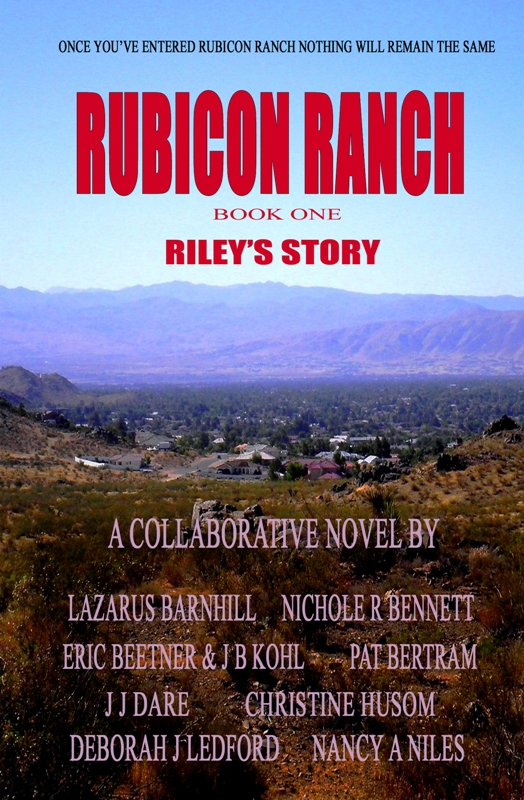
I’m collaborating with several other Second Wind Publishing authors to write a series of mystery novels online. We are posting the chapters on a blog so everyone who wants to can follow the serial as we write it. Actually, collaboration is a bit of an over-statement. Rubicon Ranch is more of a cross between a role-playing game and round robin or campfire tale, with each of us authors taking turns adding to the story without knowing where we are going except toward the solution of the murder. We each create and control a POV character, show who s/he is, what relationship s/he has with the deceased, and why s/he might want the victim dead.

I have it easy — my character, Melanie Gray, is a photographer/writer who wanders the desert taking photos for the coffee table books she used to write with her dead husband. (He wasn’t dead when they were working together, of course.) He died in a one-car accident while texting his mistress, though there are suspicious circumstances leading investigators to think that perhaps he was killed. Melanie has a talent for finding strange things in the desert, such as the child’s body stuffed in an abandoned television console in the first book, Rubicon Ranch: Riley’s Story, and the scattered body parts that were found in the second book, Rubicon Ranch: Necropieces. Her presence at these crime scenes is all that leads the sheriff to suspect her, though I do try to add a bit of intrigue to make it seem as if she could be guilty.

The other authors, however, have to simultaneously prove that their characters are the murderer, yet also have a plausible explanation for why the characters acted guilty if they weren’t the murderer. (That’s because we don’t know whodunit until all the end of the book. So not only do readers of the ongoing story not know who the villain is, neither do we.)

In the first book, the authors solved the problem of simultaneously setting their characters up to be murderers while allowing for the possibility that they were innocent by giving their characters strange characteristics, such as sleepwalking, to keep the characters themselves from knowing if they were the killer.

In the second book, there was no way the killer could be unaware of having killed the victim. Even if by chance the character killed in some sort of fugue state, the character was still faced with a dead body, which he or she cut in small pieces and distributed around the area. The authors created some wonderfully devious characters with strong motives for killing the evil man who damaged them for no reason other than because he could. Any of them could be the murderer. And any of them could simply be innocent (or not so innocent) red herrings.

We are through with the second book and are in the process of organizing the third installment of the series. In this one, Melanie won’t find a body in the desert since understandably she’s a bit leery of walking in such a deadly place, so she will have to find it elsewhere, perhaps beneath the wheels of a blow up figure of a Santa Claus on a motorcycle.

We have a victim — a real estate agent, the same one who found the disembodied head of the victim of the second book inside the house where the victim of the first book once lived. Apparently she likes to snoop, and since so many residents of Rubicon Ranch have a secret they are willing to kill to protect, it sounds like the potential for a lot of mayhem!

I’m looking forward to seeing what the other authors come up with. I hope you will follow along with us as we continue this innovative crime serial.

Meantime, if you haven’t checked out Rubicon Ranch, and wish do so, click here: Rubicon Ranch.

***

Pat Bertram is the author of the suspense novels Light Bringer, More Deaths Than One, A Spark of Heavenly Fire, and Daughter Am I. Bertram is also the author of Grief: The Great Yearning, “an exquisite book, wrenching to read, and at the same time full of profound truths.” Connect with Pat on Google+

Finding My Place in the Publishing World

UntitledpI’ve been reading promotional materials (again!) looking for ways to increase book sales, and one of the articles, in a rehash of the idea of positive thinking, said that if you’re not satisfied with the way your writing career is going, don’t ever let it be known but speak and act as if you were a bestselling author.

In other words, don’t ever let people know the truth, and that goes against the spirit of this blog. I suppose it isn’t smart of me to talk about my struggles to find my place in the publishing world because it probably does show me in a negative light. In fact, one friend emailed me and said, “If you want to stop writing and pity yourself because you think you are a failed author, go ahead. That’s your choice.”

Regardless of how I come across, I am not negative or pessimistic. I have every intention of making my living as a writer, and if I thought claiming I were a bestselling author would get me there, I’d do it. Or maybe not. There are so many authors out there claiming to be more than they are that the world doesn’t need another one.

Despite the contention of my friend, I do not consider myself a failed author. In fact, I am a successful author. I’ve written five books that I’m proud of and that many people love. I just haven’t been able to turn them into financial successes yet.

I see myself on a writer’s journey, though I admit I’m going through a crisis of faith, struggling to find reasons to write. (I’m also struggling to find reasons to live, but that doesn’t make me a failed human being.) For some writers, writing is their reason for living, but although that isn’t my reason for living (I am not compelled to write; it’s something I choose to do), I have a hunch that my reason for living is tied up somehow with my reason for writing. (Writing fiction, that is. I do write every day for this blog, partly for the discipline of it and partly to help me figure out my place in the world, the world of grief, and the publishing world.)

I began writing fiction more than a decade ago as a means of bringing my dying life mate/soul mate in close. Someone who is dying drifts away until finally he begins to disconnect himself totally from life, and I couldn’t bear to let the disconnect from me happen sooner than it needed to. For several years, until he drifted too far away, I wrote at night, then read the passages to him in the morning, and he’d let me know if I nailed the scene, usually with a small, impish smile. If I didn’t get a passage quite right, I didn’t get a smile, but I got help figuring out where I went wrong.

That’s why I used to write — to see his smile. And that’s why writing has become such an angst-ridden subject for me. My reason for writing died when he did.

A friend (the same friend mentioned above now that I think of it) once sent me a snippet of a poem:

A voice calls, “Write, write!”
I say, “For whom shall I write.”
And the voice replies,
“For the dead whom thou didst love.”

—John Berryman

Maybe someday writing for the dead whom I didst love will be reason enough to write, but for now, I’m still searching for my place in the world and the publishing world. And if the search — or my angst — comes across as negative, so be it. Besides, when I start acting as if I am a bestselling writer, I want it to be for real.

***

Pat Bertram is the author of the suspense novels Light Bringer, More Deaths Than One, A Spark of Heavenly Fire, and Daughter Am I. Bertram is also the author of Grief: The Great Yearning, “an exquisite book, wrenching to read, and at the same time full of profound truths.” Connect with Pat on Google+

Grief and Lingering Feelings of Resentment

Desert CactusDuring the past three years, I have chronicled my journey through grief, trying to make sense of the myriad emotional and physical stresses one has to deal with after a major loss, such as the death of one’s child or life mate/soul mate. I’ve explained that grief is not the simple and almost clinical state that Kübler-Ross’s five (or seven) stages of grief seems to indicate. Instead, there seems to be an infinite shading of emotion in the process we call grief.

Some of us do feel shock, denial, anger, guilt, sadness, depression, and acceptance, but most of us also feel anxiety, frustration, loneliness, confusion, despair, helplessness, panic, questioning (both as a need to know why and as a cry of pain), loss or gain of faith, loss of identity, loss of self-esteem, resentment, bitterness, isolation, inability to focus, suspended animation, waiting for we know not what, envy of those who are still coupled or who have yet to suffer a loss. And we suffer myriad physical symptoms such as queasiness, dizziness, sleep problems (too much or too little), eating problems (too much or too little), bone-deep pain, inability at times to breath or swallow, exhaustion, lack of energy, restlessness, and seemingly endless bouts of tears.

Except for sadness, I thought I’d pretty much dealt with most of grief’s effects, but recently I’ve become aware of lingering feelings of resentment. I’m mostly over the resentment of those who are still coupled, with only an occasional twinge of self-pity when I see couples out walking together, and I thought I’d come to terms with my resentment of his long illness and his leaving me here to deal with grief alone, but apparently a pool of resentment still lies deep within.

I am thin-skinned, taking offense at things that were not meant to be offensive, feeling hard done by when things do not turn out my way, railing against real or imagined unfairness. Of course, we all feel this way at times, but grief seems to take minor faults and magnifies them into major stumbling blocks. The death of the one person who connected us to life also makes us (well, me anyway) feel as if life should be granting us special privileges to make up for that great loss, but life doesn’t work that way.

I’m not proud of this resentment, but there it is. The good thing is that grief’s effects are now mostly making themselves known one at a time rather than all at once in a horrifying and cloudy kaleidoscope of feelings so that I can pay attention to the resentment, and perhaps get beyond this stage to a more even-tempered state.

***

Pat Bertram is the author of the suspense novels Light Bringer, More Deaths Than One, A Spark of Heavenly Fire, and Daughter Am I. Bertram is also the author of Grief: The Great Yearning, “an exquisite book, wrenching to read, and at the same time full of profound truths.” Connect with Pat on Google+