Rubicon Ranch: Secrets — My Current Chapter

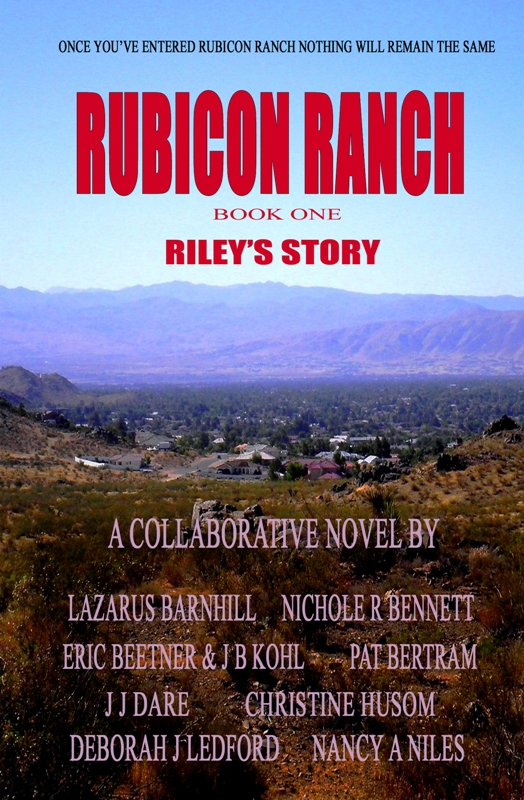
RRBookThreemidsizeRubicon Ranch is a collaborative and innovative crime series set in the fictional desert community of Rubicon Ranch and is being written online by the authors of Second Wind Publishing.

In the current story, the  body of a local realtor is found beneath the wheels of an inflatable figure of a Santa on a motorcycle. The realtor took great delight in ferreting out secrets, and everyone in this upscale housing development is hiding something. Could she have discovered a secret someone would kill to protect? There will be suspects galore, including a psychic, a con man, a woman trying to set up an online call-girl service, and the philandering sheriff himself. Not only is the victim someone he had an affair with, but he will also have to contend with an ex-wife who has moved back in with him and a jilted lover, both with their own reasons for wanting the realtor dead.

We hope you will enjoy seeing the story develop as we write it. Let the mystery begin! Whodunit? No one knows, not even the writers, and we won’t know until the very end! If you don’t want to miss further chapters, please go to the blog and click on “sign me up” on the right sidebar to get notifications of new chapters.

(If the Christmas theme seems unseasonal, well . . . considering how long it takes to write a book at the rate of a chapter a week, in a few months, the season will catch up to us!)

Chapter 25: Melanie Gray
by Pat Bertram

Sunday, December 24, 9:00am

Melanie stayed up most of the night sending emails to people on Alexander’s and her contact lists, asking what they knew about her husband. She told them—untruthfully—that she planned to write his biography, and so needed to know anything that could help explain his life and especially his death

She didn’t really expect to discover his secrets this easily, but she hoped that she could at least find a place to start looking for answers. The immediate responses were condolences from those who hadn’t known about his death and from those who hadn’t taken the time to write five months ago when he’d died in what had seemed to be a car accident. A few responses included an anecdote about Alexander, but no one dropped a hint about what he could have done to trigger an assassination.

Only one response surprised her. She’d expected their agent to gush with delight at the prospect of the book, but Dottie wrote: Are you sure this is a wise idea, darling? You might not like what you find out. And isn’t it better to remember him as a real man rather than a character in a book, even one as brilliant as I’m sure yours would be?

Too tired to think of a response to her agent’s message, Melanie dragged herself to bed. She dozed off but jerked herself awake to escape the shadowy creatures who chased her into a building with no windows and no way out.

She thought she’d been asleep for only a few minutes, but the brightness of the room told her she’d slept far into the new morning. She lay in bed, unwilling to face another day in the horror that Rubicon Ranch had become, when she realized she heard something strange for this neighborhood—silence.

She jumped out of bed, ran upstairs to her loft office, and glanced out the window. No tour buses, no streams of cars with gawking passengers, no young people (or old people for that matter) dressed as Halloween ghouls. The only things out of the ordinary were the sheriff’s department vehicles cruising the street—at least four of them. One of the tan vehicles pulled up to the curb in front of her rented house, and Sheriff Seth Bryan climbed out.

Melanie dashed down the stairs to the bathroom, splashed water on her face, ran a brush through her hair, and grabbed a dress from the closet. The off-shoulder peasant dress wouldn’t have been her choice for the first encounter with the sheriff in two months, but she didn’t have time to rummage in her closet for something more appropriate.

The doorbell rang. Barefoot, she went to answer it.

The sheriff’s jeans and white shirt still fit his lean, flat-bellied body as if they’d been tailored for him. As when they first met, he wore a blue ball cap with “Sheriff” embroidered in yellow, but his hair curled around the cap as if it had been awhile since he’d taken the time to get it cut. For once he’d left off the mirrored sunglasses, and he looked as if he’d aged two years since she’d seen him last. Apparently, his attempt to make his marriage work hadn’t succeeded. Or maybe the marriage was succeeding, and his haggard expression and weary dark eyes came from too much time in bed with his wife.

Why do you care?

“Good morning, Ms. Gray,” Sheriff Bryan said, his tone as formal as his words.

“Good morning, sheriff.” Melanie stepped outside, put a hand above her eyes to shade them, and made a show of peering up and down the street. “What happened?”

“The people’s right to free expression and lawful assembly destroyed our crime scenes and impeded our investigation, so we cleared the area of anyone who didn’t live here.”

The chill of the concrete crept up Melanie’s bare legs, but she held herself in place. “You call that lawful assembly? So, if there hadn’t been a murder, you’d have just let all those necrophiliacs continue overrunning the neighborhood?”

“Not murder, Ms. Gray. Murders—two of them. And arson.”

“How did you get rid of all the ghouls and gawkers?”

“We have a deputy stationed on Delano Road and Tehachapi, checking to make sure only people who belong here enter the street. And those who were already here—well, we told them we’d arrest them as accessories to murder. When that didn’t work, we reminded them that tomorrow was Christmas, and that Santa didn’t deliver presents to bad little boys and girls in jail.”

“So, you’re the UnSanta Claus?”

The sheriff quirked one eyebrow as if surprised to discover she had a sense of humor, but Melanie had to admit to herself that in their relationship—if a few meetings and a couple of meals could be called a relationship—there’d been no room for humor. There’d been too much death, too much pressure, too many unanswered questions.

“Have you found out anything more about Alexander’s assassination?” Melanie asked.

“We’re doing what we can, Ms. Gray, but there’s nothing to go on. Just skid marks on an open road.”

“What about Alexander’s missing cameras? If someone stole them from the car right after the accident, there might be a witness.”

“We haven’t found a witness, but if a bystander took the opportunity to steal what you said were expensive cameras, I’m sure he or she wouldn’t be interested in informing us of that fact. Have you looked for the cameras? Maybe they’re inside the house somewhere.”

Melanie wanted to stamp her foot, but she refrained. She didn’t want the sheriff to see her acting so childishly, especially since he was being so damned formal. Besides, it would hurt her bare foot. “I told you. I put the cameras in the car myself.”

“Did he drive off immediately?”

Melanie gazed at the driveway where the car had been parked that morning. She’d put the cameras in the trunk. Alexander had yelled at her from inside the house that she had a phone call. She’d slammed the trunk shut and hurried inside.

The call had been from Dottie, their agent, wanting to know if they’d get the book done by the deadline. Melanie had been annoyed with Alexander for not talking to their agent himself because it would have taken him less time to assure Dottie than to shout for Melanie.

When she hung up the phone and went outside, she found that Alexander had left. She never saw him again, never got to say good-bye.

“Ms. Gray?”

The sheriff’s voice, smooth as melted chocolate, startled her.

“Stop calling me that,” she snapped.

“What would you like me to call you?” he asked.

“Nothing. Stop using my name every sentence as if you’re some kind of used car salesman with a lemon you want to get off your hands.”

“Yes, ma’am.”

Melanie clamped her mouth shut, refusing to rise to the bait.

The sheriff smirked, and the haggardness disappeared from his face. “I need you to tell me what you know about Nancy Garcetti, Clark Bailey, and the fire.”

Melanie glanced back at the door of the house, wondering if she could slip inside for shoes to warm her icy feet, but she didn’t want to have to invite the sheriff into the house. It would feel too much like a fly inviting a spider to visit.

“Go put your shoes on, I’ll wait out here.”

Melanie ran inside, put on socks and shoes, and then sedately ambled back outside. The sheriff hadn’t moved.

“I wish I could help you, sheriff,” she said. “But I don’t know much.”

“I asked you once to call me Seth.”

Melanie shook her head. “Not exactly appropriate.”

“Ah, yes, I’d forgotten how very ‘appropriate’ you always were.”

Melanie narrowed her eyes, wondering if that had been a dig, but he continued as if unaware of her reaction.

“Had you ever met Nancy?”

Melanie tried to remain as still as the sheriff. Or was that the wrong way to act? Did her stillness indicate guilt? Crap, being a maybe murderer was hard.

“I met her once, but we only exchanged a few words.” I know you killed your husband.

“And what about Clark Bailey?”

Melanie relaxed, knowing she had nothing to do with anyone by that name. “Never met him.”

“Oh, but you did. You met him last night. After the fact, so to speak. He’s the man you found wearing the Santa hat.”

“I guess maybe I should have called it in—”

“Ya think?” the sheriff interjected.

Melanie winced at his sarcastic tone. “But I just could not face being known once again as the cadaver dog. I suppose Moody had no choice but to tell you.”

Sheriff Bryan gave her an avuncular smile. “Moody didn’t tell us. She left you out of it. Be careful. She has her own agenda, and she eats innocent women like you for breakfast.”

Melanie straightened her shoulders. “I can take care of myself.”

“Perhaps. Be careful, anyway.” The sheriff turned to leave, then glanced back. “What do you know about Lydia Galvin?”

“Lydia Galvin?” Melanie frowned. “Your Lydia?”

“It’s not how I’d put it, but yes, that Lydia.”

“I don’t know anything about her. Why, is she here?” Melanie laughed, feeling suddenly lighthearted. “She is, isn’t she? Oh, poor Seth. All his chickens coming home to roost. Your wife. Now Lydia. Maybe you’re the one who needs to be careful.”

When Seth cut across her property to the Sinclair house, Melanie realized he hadn’t asked her about the arson. He didn’t forget such matters. Like Moody, he had his own agenda, kept his own counsel.

Melanie went inside, locked the door behind her, and climbed the stairs to the office to see if she’d received any new emails. There was just one from an unfamiliar gmail address:

You never know when to leave well enough alone, do you? Alexander Gray is dead. Let him rest in peace.

***

Pat Bertram is the author of the suspense novels Light Bringer, More Deaths Than One, A Spark of Heavenly Fire, and Daughter Am I. Bertram is also the author of Grief: The Great Yearning, “an exquisite book, wrenching to read, and at the same time full of profound truths.” All Bertram’s books are published by Second Wind Publishing. Connect with Pat on Google+

Help Prevent the Disappearance Of Native American Languages

Deborah J Ledford, an award-winning author and one of my very first online (and later offline) friends, has come up with an innovative way to finance her next project. IOF Productions Ltd. established the NatAmGoGo crowd funding campaign on Indiegogo to produce and distribute the audiobook version of her latest thriller novel, Crescendo from Second Wind Publishing.

The NatAmGoGo campaign will also benefit The Blue Feather Corporation, a Native American language and culture nonprofit organization.

The professional audiobook presentation of Crescendo will be narrated by TV and film actress Christina Cox, who has appeared in a variety of films and television episodes including NCIS, Dexter, 24, Castle, Chronicles of Riddick, Better Than Chocolate and Nikki & Nora. IOF Productions Ltd will record Crescendo in November at Costa Mesa Studios in Southern California for download and to purchase as CDs for a December 2013 release.

CRESCENDO_CD“We are thrilled to have Christina Cox set to perform Crescendo. Her exquisite voice and acting prowess will truly bring my words to life,” Ledford says. “The audiobook will be recorded by an experienced staff, with the quality that will equal narrated books presented by top publishing houses.”

Contributor packages for the Indiegogo/ NatAmGoGo project include a PDF version of Staccato, the first book in the Steven Hawk/Inola Walela mystery series; autographed poster of the Crescendo audiobook cover signed by Christina Cox and Ledford; print versions of book series, including Staccato, Snare and Crescendo, signed and personalized by the author; a leather bound package containing all discs of the Crescendo audiobook with booklet signed by Cox and Ledford; a full content edit by Ledford of a manuscript up to 90,000 words, and hand-crafted jewelry created by a renowned Navajo, Hopi and Taos Pueblo artists.

Ledford spent her summers growing up in the Great Smoky Mountains of western North Carolina, where her novels are set. She met Floyd “Mountain Walking Cane” Gomez in 2006 while doing research for her award-winning novel, Snare. Several years later, Floyd expressed the need to protect languages and culture on reservations throughout the United   States, which is why he is establishing the Blue Feather Corporation.

“The storytelling campaign is an effort to prevent the disappearance of Native American languages and culture,” says Arizona author Ledford, who is part Eastern Band Cherokee.

“Native tribal languages and ancient ways are dying on our nation’s reservations,” Ledford explains. “We want to ensure that ancient societies survive.”

The Native American nonprofit foundation will receive 50% of the royalties from downloads and sales of the Crescendo audiobook. “But once the funding goal is reached, any excess will benefit the foundation 100 percent,” Ledford adds. “We can’t let another language or culture disappear,” Ledford concludes. “‘Wado,’ which means ‘thank you’ in Cherokee.”

Creating the Fictional Town of Chalcedony

I needed a special setting for my latest novel Light Bringer. It needed to be part of the world but isolated, a place where people were free to be themselves without ridicule, where UFOs sightings could have had a major impact, where a secret government-sanctioned project could be hidden. Luckily, I had to look no further than out my living room window.

At the time, I was living in the shadow of the Grand Mesa, in ranching country, and much of that terrain formed the backdrop of my story. Chalcedony is the name of a fictional county sandwiched between Mesa County and Delta County. It is a beautiful place with mountains and valleys, wide-open spaces, cattle and horses, new buildings and old.

But beneath the mountains in this peaceful fictional world, unpeaceful things are happening.

Grand Mesa (The view from my living room window)
~~~

Calcedony County
~~~

Road Into Chalcedony
~~~

Mountain View
~~~

Another view of Grand Mesa
~~~

Chalcedony County
~~~

Luke’s Ranch
~~~

Pasture Gate
~~~

Ranch House in Chacedony
~~~

What lurks beneath these mountains? Read Light Bringer, and find out!
~~~
LBLight Bringer: Becka Johnson had been abandoned on the doorstep of a remote cabin in Chalcedony, Colorado when she was a baby. Now, thirty-seven years later, she has returned to Chalcedony to discover her identity, but she only finds more questions. Who has been looking for her all those years? Why are those same people interested in fellow newcomer Philip Hansen? Who is Philip, and why does her body sing in harmony with his? And what do either of them have to do with a shadow corporation that once operated a secret underground installation in the area?

Click here to read the first chapter of: Light Bringer

***

Pat Bertram is the author of the suspense novels Light Bringer, More Deaths Than One, A Spark of Heavenly Fire, and Daughter Am I. Bertram is also the author of Grief: The Great Yearning, “an exquisite book, wrenching to read, and at the same time full of profound truths.” Connect with Pat on Google+. Like Pat on Facebook.

Rubicon Ranch: Secrets — My Newest Chapter

RRBookThreemidsizeRubicon Ranch is a collaborative and innovative crime series set in the fictional desert community of Rubicon Ranch and is being written online by the authors of Second Wind Publishing.

In the current story, the  body of a local realtor is found beneath the wheels of an inflatable figure of a Santa on a motorcycle. The realtor took great delight in ferreting out secrets, and everyone in this upscale housing development is hiding something. Could she have discovered a secret someone would kill to protect? There will be suspects galore, including a psychic, a con man, a woman trying to set up an online call-girl service, and the philandering sheriff himself. Not only is the victim someone he had an affair with, but he will also have to contend with an ex-wife who has moved back in with him and a jilted lover, both with their own reasons for wanting the realtor dead.

We hope you will enjoy seeing the story develop as we write it. Let the mystery begin! Whodunit? No one knows, not even the writers, and we won’t know until the very end! If you don’t want to miss further chapters, please go to the blog and click on “sign me up” on the right sidebar to get notifications of new chapters.

(If the Christmas theme seems unseasonal, well . . . considering how long it takes to write a book at the rate of a chapter a week, in a few months, the season will catch up to us!)

Chapter 15: Lydia Gavin
by Pat Bertram

Sunday, December 23, 5:25pm

Seth sat tall behind the desk in his tidy office, like a king receiving a subject. “What are you doing here?”

Lydia Galvin leaned back in the uncomfortable metal chair and gave the sheriff a serene smile, surprised to find that she felt no fear at facing him. “Your deputies brought me here.”

Seth glowered. “You know that’s not what I meant.”

“You want the whole story? I needed to get some groceries, so I walked up Delano Road to where I’d parked my car, and apparently your deputies found it and staked it out, because even before I could unlock the door, they jumped out of their vehicle, arrested me, and brought me here.”

“They didn’t arrest you. They just offered you a ride. I wanted to talk to you.” Seth gave Lydia one of his oh-so-familiar looks, the one that said she meant no more to him than an annoying insect.

“How did you know I was in the area?” Lydia kept her voice neutral, not wanting to seem confrontational. No point in arousing the beast in him until absolutely necessary.

“We checked out the bystanders’ videos of the burning crime scene, and there you were.” He drew in a quick breath as if upset with himself for responding. “But you’re supposed to be answering my questions. What are you doing in Rubicon Ranch?”

“Having fun. It’s quite a spectacle out there, you know.” Lydia crossed her legs, and felt a flash of satisfaction when he cut a glance at her thighs. All that running since she’d been fired had paid off—she now had the body she’d always wished for.

He remained calm, but his thinned lips and tensed shoulders told her how much that unruffled air cost him. “Why did you come to Rubicon Ranch?”

“Why do you think I came? To see what other lives you were ruining, of course. I had no intention of staying, I just wanted to check out Melanie Gray—according to the newspapers you two were quite a team—but then I met Nancy and when she let slip that you and she were sleeping together, I thought I’d hang around to see how you got out of that affair when it turned against you.” Lydia made a show of inspecting a fingernail. “I guess I’m lucky. You only ruined my career. Poor Nancy ended up in the morgue.”

“You think I killed Nancy?” Seth cocked his head like an eagle and stared at Lydia for a moment. Then he nodded. “I see. You think that by accusing me, I will assume that you’re innocent, because if you believed I killed her, then you couldn’t have.”

“Did you kill her?” Lydia waited for an answer that didn’t come. “She would have ruined you. She loved nothing but herself and power and money. She loved secrets, too, of course, but only because the secrets gave her power over people and were a source of great income. She said she used to be an actress and a model, but once when we had a few drinks, she admitted that was a front. She’d really worked as a call girl. I figured she gave up the life when she realized how much more lucrative secrets were than her body.”

Seth rose to his feet and paced the office. “You say she would have ruined me. Like you ruined me?”

Lydia forced out a small laugh. “I ruined you? No. You manipulated me. You began by treating me as if I were the most important woman in the world. You flattered me, paid attention to me, offered me words of love and the endearments I hungered for. When I was hooked, you stepped back, left me feeling bereft. And every time I spoke of leaving you, you’d pay attention to me again.” She felt tears beginning to gather behind her eyes. He doesn’t matter. Think of fire. Flames. Heat.

She drew in a deep breath, surprised Seth didn’t jump in to defend himself. He kept pacing the office as if she weren’t even there, which made it easier for her to confess. “You were my grand passion. I know you don’t believe that, but it’s the truth. I never expected you to leave your wife. I just wanted you to notice me. To put me first once in a while.”

Seth stood over her, his eyes icy as they locked onto hers. “But you turned me into the department. Said I misused my authority.”

“You did abuse your authority. I never wanted an affair with you. I had enough trouble with my husband. I didn’t need another abusive man in my life. You never knew about my husband, did you?” Lydia didn’t even try to modulate her bitter tone. “The great detective never noticed that his girlfriend had a husband who beat her. I wouldn’t have told your wife about us. Even though I threatened to tell her, I couldn’t have made our affair public. My husband would have beat me when he found out. And after you dragged your wife to my house so she could confront me, my husband did beat me. I had to go to the emergency room that time. But oh, no, everything that happened was my fault.”

“Good story,” Seth said. “Too bad none of it is true.”

“The all-wise Seth Bryan says it isn’t true, so that means it isn’t true?” Lydia shook her head sadly. “The law might be about what you can prove, but life isn’t like that. Some things are true no matter how much we don’t want to believe them.” Things like her husband’s abuse. Things like Seth’s disregard. Things like death and fire. “You men are all so blind you can’t see what’s in front of your eyes. I loved you but you threw me away, calling me a vituperative bitch. Yet Nancy, who didn’t love you at all and who truly was a vituperative bitch, you kept. But I’m through with all of you now.”

Seth sneered. “Turning into a lesbian?”

“That’s beneath even you, Seth, my love.”

“True. Perhaps the only true thing you’ve said today.” The phone rang. Seth took two long strides to the desk, and grabbed the receiver. “Yes?” A pause, then, “She’s home now? Stay there. Make sure she doesn’t leave. I’ll be there in just a few minutes.”

He hung up the phone, and turned to face Lydia.

She quirked her lips in an unamused smile. “Still on your wife’s leash? I’m surprised you haven’t killed her, too.”

“Just go,” he said wearily. “Keep my office informed of your whereabouts. We still have lots to talk about.”

Lydia rose, straightened her skirt, and settled the strap of her purse firmly on her shoulder. “There’s nothing left to say but good-bye. I didn’t kill Nancy. You did. But don’t worry, I won’t testify against you.

***

Pat Bertram is the author of the suspense novels Light Bringer, More Deaths Than One, A Spark of Heavenly Fire, and Daughter Am I. Bertram is also the author of Grief: The Great Yearning, “an exquisite book, wrenching to read, and at the same time full of profound truths.” All Bertram’s books are published by Second Wind Publishing. Connect with Pat on Google+

For Love of the Story

I watched For Love of the Game last night, but a different version than the one that was released in theaters or on tape or DVD.

My deceased life mate/soul mate was sick for many years, and one way kept himself busy when he hadn’t the strength to do much else was to tape movies. He started with our favorites, then went on to taping good parts of bad movies, and finally edited movies that we didn’t like. (It’s rather amusing — he turned a few dreadful serial killer movies into sweet romances by ending the movie before the charming killer showed his evil side.)

baseballThe problem we both had with For Love of the Game was the constant intrusion of the backstory. Billy Chapel is pitching the last game of his career and he keeps stopping to reflect on his past — detailed flashbacks that would take up more than a few seconds between his pitches. Would fans in the stands really care that he was pitching a perfect game if he spent most of his time on the mound staring glassy-eyed into the past? Would he really be able to “clear the mechanism” so easily if his mind wasn’t on the game?

My version is told in chronological order, from the meeting of the girl in the beginning to the remeeting at the end. When Chapel is pitching, then, his pauses are short, and seem more evidence of exhaustion than anything else.

So why am I mentioning this? I’ve been working sporadically on my novel about a grieving woman. A few years ago I wrote many scenes or parts of scenes, and I’m trying to figure out the best way to arrange the scenes and tell the story. As it stands right now, the story begins when the funeral people deliver the urn with her husband’s ashes, which is a good place to begin. (In a classic beginning, either a stranger knocks on the door or the character goes on a trip.) The only trouble is, there is a vast backstory that needs to be told, which is okay because it is about a woman grieving, after all, and much of grief is about unwinding the backstory, figuring out who you are, where you are, and how you got to that point.

Sometimes — most times, actually — stories need to be told in chronological order. It might serve my story better if I began when the husband got sick. It would show her dealing with his illness and would explain how she ended up in love with someone else while her husband was dying. This way, there would need to be only a few mentions of the past, such as when the met, what happened to her parents, etc, and not the constant intrusions into the past that are required if I were to start with the knock on the door.

But . . . a gun plays a role in the story. Finding the gun and eventually discovering the significance of the gun makes the grieving wgunoman realize that she put so much of herself into the marriage, and if she doesn’t know who her husband is, then how can she know who she is? If I told the story chronologically, the gun wouldn’t show up until the middle of the book, and it would lose its significance.

I suppose the best thing for me to do is to forget about the chronology and just type up the scenes. Afterward, if necessary, I can edit the book and put everything in chronological order. Either way, it’s all for love of the story.

***

Pat Bertram is the author of the suspense novels Light Bringer, More Deaths Than One, A Spark of Heavenly Fire, and Daughter Am I. Bertram is also the author of Grief: The Great Yearning, “an exquisite book, wrenching to read, and at the same time full of profound truths.” Follow Pat on Google+. Like Pat on Facebook.


Creating Incredible but Credible Characters: Names Matter

Scarlett O’Hara was originally called Pansy. If Margaret Mitchell had kept that name, would her epic novel ever have become so popular? A character with the name of Pansy could be sweet and biddable with rare moments of stubbornness, but since “Pansy” lacks the harsh consonants of “Scarlett,” the name doesn’t sound as if it belongs to an iron-willed character who could catch and keep the attention of such a worldly man as Rhett Butler.

ThUncertaintyough Scarlett fits the name of the character in Gone with the Wind, it could not be the name of a medieval heroine. In those days, the most popular name was Mary, with Elizabeth coming in a distant second. I suppose if Gone with the Wind were written in the 1980s, Scarlett’s name would have been Heather. Odd to think that in another forty years, youth will scorn that name as being old-fashioned, fit only for elderly women, like the name Effie is today.

I had fun naming my aged gangsters in Daughter Am I. In keeping with the times of their youth—bootlegger times, that is—I gave them nicknames that matched their characters. I called my wise old conman “Teach,” my dapper little forger “Kid Rags,” my ex-wrestler “Crunchy.”

And then there’s my hero, poor Mary. She starts out so young and innocent, and ends up on a road trip with six feisty old gangsters and one ex-nightclub dancer. I had not intended for her to keep the name Mary. It’s so not the name of a heroine of today! Nor is my Mary a medieval maiden. I named the character Mary Stuart after Mary Stuart Masterson in the film Bed of Roses because both Marys were strong but vulnerable when it came to love, both were very smart yet a bit naive. I never did change my Mary’s name. By the time I finished the book, the character and the name were inextricably entwined. At least it’s fairly innocuous. Like Margaret Mitchell, I could have named my heroine Pansy. Ouch.

***

This article is anthologized in the Second Wind Publishing book: NOVEL WRITING TIPS AND TECHNIQUES FROM AUTHORS OF SECOND WIND PUBLISHING, which was the 100th book released by Second Wind.

“As someone who constantly evaluates novels for publication, I was astonished at the breadth and clarity of the wonderful advice contained in this handbook. It addresses concerns as grand as plot development and as simple but essential as formatting your submission. It offers crucial advice on literary topics ranging from character development to the description of action. Virtually every subject that is of great concern to publishers — and therefore to authors — is covered in this clear, humorous and enormously useful guide.” –Mike Simpson, Chief Editor of Second Wind Publishing

***

Pat Bertram is the author of the suspense novels Light Bringer, More Deaths Than One, A Spark of Heavenly Fire, and Daughter Am I. Bertram is also the author of Grief: The Great Yearning, “an exquisite book, wrenching to read, and at the same time full of profound truths.” Connect with Pat on Google+. Like Pat on Facebook.

Creating Incredible but Credible Characters: Gender

To create a character, we begin with gender. If your character is of the opposite gender than yours, make sure you know how the other half thinks, feels, and speaks, otherwise your character might seem more of a caricature than a real person.

There are basic differences between the genders. For example, women have better peripheral vision, so while both men and women ogle each other with the same frequency, men are caught gazing more often than women are.

Brain scans show that women have between fourteen and sixteen areas that evaluate others’ behavior, while men have only four to six. Because of this, women are better at juggling several unrelated topics in a single conversation. They also genderuse five vocal tones to make their points. Since men can only identify three of those tones, they often miss what women are trying to say. So men accuse women of not being direct and women accuse men of not listening.

Women ask questions to show interest in the person; men ask questions to gain information. Women find that talking about a problem provides relief; men feel that talking about a problem is dwelling on the negative. Women think that continuing to discuss the problem demonstrates support; men want to make a decision and forget it. Women provide peripheral details because they want to be understood; men just want them to make their point. Women think that talking about a relationship brings people closer; men generally think it’s useless.

There is a wide spectrum of both male and female behavior, though, so you can write a character however you wish as long as you can make it work.

You make it work by ensuring there is a reason—a motivation—for your characters behavior. We learn much about characters from their actions, but what the character does is not the defining element. The defining element is why the character does what he does. Characters can do anything, though the actions must be psychologically true and consistent. A character who is cowardly but does not hesitant to rescue someone from danger without any reference to fear or a believable reason for the action is not a well-written character.

When it comes to storytelling, character is all. The characters and plot (what the characters do and why) should be so intertwined that we never see them as separate.

***

This article is anthologized in the Second Wind Publishing book: NOVEL WRITING TIPS AND TECHNIQUES FROM AUTHORS OF SECOND WIND PUBLISHING, which was the 100th book released by Second Wind.

“As someone who constantly evaluates novels for publication, I was astonished at the breadth and clarity of the wonderful advice contained in this handbook. It addresses concerns as grand as plot development and as simple but essential as formatting your submission. It offers crucial advice on literary topics ranging from character development to the description of action. Virtually every subject that is of great concern to publishers — and therefore to authors — is covered in this clear, humorous and enormously useful guide.” –Mike Simpson, Chief Editor of Second Wind Publishing

***

Pat Bertram is the author of the suspense novels Light Bringer, More Deaths Than One, A Spark of Heavenly Fire, and Daughter Am I. Bertram is also the author of Grief: The Great Yearning, “an exquisite book, wrenching to read, and at the same time full of profound truths.” Connect with Pat on Google+. Like Pat on Facebook.

Creating Incredible but Credible Characters: Resist the Urge to Explain

People often tell me they feel they know my characters, as if my story people were a part of their lives, which is always wonderful to hear. It means I did my job. And it means the readers did their job. Incredible but credible characters are a combined effort. Characters are conceived in the author’s imagination, but they come alive in readers’ imaginations.

A character’s story begins with a gleam in her parents’ eye and ends with her death. The story we telistenll is but a fraction of that life, and where we choose to begin and where we, the writer, choose to end defines the story. If we begin with a crime and end with a resolution of that crime, we have a mystery. If we begin with a girl meeting a boy or a woman meeting a man and end with happily ever after, we have a romance. If we chronicle the rise and fall of the character’s fortunes, we could have a tragedy, a family drama or any number of stories.

The illusion of a well-told story is such that, whatever the genre, by the end of the book readers know the character as well as they know themselves and their friends. Readers know, or think they know, everything in the character’s life that brought her to crisis and how everything in the character’s life will work out after the story problem is resolved. By giving readers the essence of the character, we give them the means to continue the character’s story long after the book has come to an end.

How do we work this sleight of hand? By showing the character in action and in relationships. By defining the character through decisions in moments of crisis.

In the prologue of Light Bringer, Helen comes home from working a double shift at the hospital to find a baby on her doorstep. She shows her nurturing characteristics by taking care of the child, Rena. She shows the beginning of a metamorphosis from staid nurse to loving mother by putting off calling the authorities so she can enjoy the child bit longer. But what really defines her is how she acts in a moment of crisis. Rena, a magical child, or at least a precocious one, tells Helen they have to leave, that her invisible playmate says “they” are after Rena and when they find her, they will kill Helen. Helen doesn’t hesitate. She packs up her car and her life and escapes with the baby.

Helen’s decision defines not only her own character, but also the character of the baby, the character of the invisible playmate, and perhaps even the story itself. It is through such defining moments that we can create a character so real readers believe they know more about the character than was ever actually written.

In older novels, especially the classics, authors wrote page after page of character description, telling us who their characters are. Those authors dissected their characters’ motivations, told us their every thought, explained every feeling. Today’s readers, myself included, have no patience for such long drawn-out static passages. We want to get right into the heart of the story. We want to learn who the character is by what she does, who she knows, and how she acts and reacts.

Showing, not telling, is a basic axiom of writing for today’s market, but it is often hard to resist the urge to explain since you know far more about your characters than you can or should put in your novel. Still, by restraining yourself and letting readers be part of the creation process, letting them find their own explanations for what your characters do, you give them a stake in the characters and the story. And so your characters come alive.

***

This article is anthologized in the Second Wind Publishing book: NOVEL WRITING TIPS AND TECHNIQUES FROM AUTHORS OF SECOND WIND PUBLISHING, which was the 100th book released by Second Wind.

“As someone who constantly evaluates novels for publication, I was astonished at the breadth and clarity of the wonderful advice contained in this handbook. It addresses concerns as grand as plot development and as simple but essential as formatting your submission. It offers crucial advice on literary topics ranging from character development to the description of action. Virtually every subject that is of great concern to publishers — and therefore to authors — is covered in this clear, humorous and enormously useful guide.” –Mike Simpson, Chief Editor of Second Wind Publishing

***

Pat Bertram is the author of the suspense novels Light Bringer, More Deaths Than One, A Spark of Heavenly Fire, and Daughter Am I. Bertram is also the author of Grief: The Great Yearning, “an exquisite book, wrenching to read, and at the same time full of profound truths.” Connect with Pat on Google+. Like Pat on Facebook.

Suspense/Thriller Writers Self-Promotion Extravaganza!

Every Saturday, I host a self-promotion extravaganza for my Suspense/Thriller Writers Group on Facebook. The extravaganza takes place in a separate group page since there is no promotion allowed on the wall of the Suspense/Thriller Writers group. So if you are an author with a book to promote or a reader who likes to find new books and great blog posts,  you can find the find the event here: Suspense/Thriller Writers Self-Promotion Extravaganza! Just click on “join” and tell us about your book. It’s an open group, so unless you want to post something, you’re free to roam among the selections. I hope you will join us today!

You already know my books, but I’m listing them here as a reminder. If you’d like to read the first chapter of any of the books, just click on the cover.

Light Bringer: Becka Johnson had been abandoned on the doorstep of a remote cabin in Chalcedony, Colorado when she was a baby. Now, thirty-seven years later, she has returned to Chalcedony to discover her identity, but she only finds more questions. Who has been looking for her all those years? Why are those same people interested in fellow newcomer Philip Hansen? Who is Philip, and why does her body sing in harmony with his? And what do either of them have to do with a shadow corporation that once operated a secret underground installation in the area?

DAIDaughter Am I: When twenty-five-year-old Mary Stuart learns she inherited a farm from her recently murdered grandparents — grandparents her father claimed had died before she was born — she becomes obsessed with finding out who they were and why someone wanted them dead. Along the way she accumulates a crew of feisty octogenarians — former gangsters and friends of her grandfather. She meets and falls in love Tim Olson, whose grandfather shared a deadly secret with her great-grandfather. Now Mary and Tim need to stay one step ahead of the killer who is desperate to dig up that secret.

More Deaths Than One: Bob Stark returns to Denver after 18 years in Southeast Asia to discover that the mother he buried before he left is dead again. He attends her new funeral and sees . . . himself. Is his other self a hoaxer, or is something more sinister going on? And why are two men who appear to be government agents hunting for him? With the help of Kerry Casillas, a baffling young woman Bob meets in a coffee shop, he uncovers the unimaginable truth.

A Spark of Heavenly Fire: In quarantined Colorado, where hundreds of thousands of people are dying from an unstoppable disease called the red death, insomniac Kate Cummings struggles to find the courage to live and to love. Investigative reporter Greg Pullman, is determined to discover who unleashed the deadly organism and why they did it, until the cost — Kate’s life — becomes more than he can pay.

***

Pat Bertram is the author of the suspense novels Light Bringer, More Deaths Than One, A Spark of Heavenly Fire, and Daughter Am I. Bertram is also the author of Grief: The Great Yearning, “an exquisite book, wrenching to read, and at the same time full of profound truths.” Connect with Pat on Google+. Like Pat on Facebook.

Rubicon Ranch: Secrets — My Newest Chapter

RRBookThreemidsizeRubicon Ranch is a collaborative and innovative crime series set in the fictional desert community of Rubicon Ranch and is being written online by the authors of Second Wind Publishing.

In the current story, the  body of a local realtor is found beneath the wheels of an inflatable figure of a Santa on a motorcycle. The realtor took great delight in ferreting out secrets, and everyone in this upscale housing development is hiding something. Could she have discovered a secret someone would kill to protect? There will be suspects galore, including a psychic, a con man, a woman trying to set up an online call-girl service, and the philandering sheriff himself. Not only is the victim someone he had an affair with, but he will also have to contend with an ex-wife who has moved back in with him and a jilted lover, both with their own reasons for wanting the realtor dead.

We hope you will enjoy seeing the story develop as we write it. Let the mystery begin! Whodunit? No one knows, not even the writers, and we won’t know until the very end! If you don’t want to miss further chapters, please go to the blog and click on “sign me up” on the right sidebar to get notifications of new chapters.

(If the Christmas theme seems unseasonal, well . . . considering how long it takes to write a book at the rate of a chapter a week, in a few months, the season will catch up to us!)

Chapter 17: Melanie Gray
by Pat Bertram

Sunday, December 23, 2:45pm

A sharp rap broke Melanie’s concentration. She pushed herself away from the computer where she was working on the rewrites her editor had emailed—the last ones, thank heavens—went to the front door, and opened it.

A round little woman gazed anxiously up at her. “A lady is being held prisoner. You have to call the sheriff,” she said all in a rush.

Melanie gave her head a shake to clear it. Was this someone’s idea of a joke? The woman’s purple wig and the colorful chiffon scarves that fluttered around her body made her look like one of Cinderella’s fairy godmothers. The only things lacking were a wand and a sprinkling of fairy dust. But maybe the fairy dust filled the woman’s head?

“You don’t believe me.” The woman sighed. “There’s no reason you should. She is tied up, though. The sheriff won’t listen to me, but he’ll listen to you.”

“Who’s tied up? Where?”

The woman waved a hand toward the desert, her many rings flashing in the winter sun. “On this street somewhere.”

“And that’s what you want me to tell the sheriff? That a lady is tied up on this street somewhere? If that’s all the information you have for him, no wonder he won’t listen to you. And he certainly won’t listen to me.”

“He will. The two of you have a bond that even distance and distaste can’t break.”

Melanie peered at her. Perhaps the woman did know something. She’d summed up Melanie’s relationship—or rather non-relationship—with the sheriff perfectly. Distance and distaste. He was distant, and she had developed a distaste for him, though months ago, when they had met over the body of little Riley Peterson, it had seemed as if there were some sort of bond between them. Of course, she’d been vulnerable then, still so new to this thing called grief.

The woman gazed steadily back at her, and a feeling of unease crept over Melanie. “A lady is tied up. For real?”

“Yes.”

“Can you find her?”

“Maybe. The feeling is strongest toward the desert. That’s why I know she’s up the street somewhere.”

“Are you . . .” Melanie hesitated. Would the woman be insulted at being asked if she were psychic?

“Yes. I am psychic,” the woman said. “I’m sorry. I forgot to introduce myself. Celeste Boudreau. I live on Tehachapi Road. The house with the pyramid. And I know you, of course. You’re Melanie Gray. Your husband was killed by . . .” Celeste’s eyes clouded and then cleared after a second or two. “I’m sorry. I thought I saw who did it, but couldn’t catch the vision. It’s the way my powers work, you see.”

Melanie nodded. “Clairvoyance” meant clear seeing, but so often the seeing was hazy and not at all clear, which made it an easy con. In her travels with Alexander, she had met many truth seekers and true psychics, many fakirs and fakers, and though she didn’t know what powers, if any, Celeste might have, she could tell that the self-styled psychic believed in them.

Melanie grabbed a coat, and locked the door behind her. “Let’s just walk. Maybe you’ll get a sense of where she is.”

Celeste stood still, spread out her arms, took a deep breath, and brought her hands to her chest as if praying. Then her praying hands slowly moved downward until they were parallel to the ground. She started moving up Delano Road, pausing every dozen yards or so to repeat the procedure. They walked the whole length of the street that way, until finally they stood before the second to the last house.

“Here,” Celeste said, a quiet note of triumph in her voice. “I see her. Upstairs. Older woman. Pretty. Big eyes. Tied to a chair. Gagged. Rope burns.”

Melanie didn’t even have to ask if Celeste were sure. Sincerity had accompanied every word. She walked up the curving driveway and rang the doorbell.

Celeste scurried to catch up to her. “What are you doing? What if the guy who did this to her comes to the door?”

“Then I’ll ask him if I can see the lady of the house.”

“And if he gets rough?”

“I’ll take care of him. Maybe grab him by the throat and lift up his larynx a bit. That’s enough to make a grown man cry.”

But no one answered the door.

Now what? Call the sheriff? Break in?

Melanie looked at Celeste and held a finger to her lips. From deep within the house, she thought she’d heard a clank, but even though she strained her ears, she didn’t hear a repetition of the sound. She rang the bell again. And again. And again.

Finally, the door swung open. An attractive lady in her late fifties or early sixties wearing heavy makeup and long sleeves stood framed in the entryway. Her large hazel eyes opened wide in the guileless manner of someone with nothing to hide—or someone who wanted others to believe she had nothing to hide. She said pleasantly, if a bit hoarsely, “Yes?”

Melanie shot a puzzled glance at Celeste, but Celeste kept her gaze on the woman standing stiff-shouldered before them.

“Are you the lady of the house?” Melanie asked. The question sounded foolish, even to her own ears, as if the line were straight out of a bad nineteen-fifties film, but for the moment, it was all she could think to say.

“Yes?” the woman said again.

“We’re starting up a neighborhood watch.” Melanie forced a small laugh, and gestured to the vampire-wannabe that had crept close to the house. “We’re a bit late, but it’s time we reclaimed the neighborhood from the ghouls.”

“Sorry, not now. Late for an appointment.” The woman’s hoarseness grew more pronounced, and it seemed to Melanie as if she could see red marks around her mouth beneath the heavy makeup.

“May we speak with your husband?” Melanie asked.

“No husband. Live alone.” The woman shut the door.

“It’s her,” Celeste said. “I know it is. I saw her.”

“Well, she’s free now. So that’s good, right?”

“But she’s lying.”

Melanie shrugged. Maybe the woman had been tied up. Maybe she’d been involved in some sort of sex game. Maybe she’d even been held prisoner as Celeste had claimed. But if the woman didn’t want help, there was nothing they could do about it.

She trudged back down the driveway and after a moment, Celeste followed.

“There’s something strange going on,” Celeste said.

A pack of goth girls stood giggling in the middle of the street while two zombie boys circled them, making leering remarks.

Melanie took a deep breath and blew it out slowly. “There’s a lot of something strange going on.”


Melanie had just returned home and settled herself at the computer when her phone rang. “Yes?” she said, not at all graciously.

“I know you killed your husband.”

“Who is this?” Melanie demanded. “What do you want?”

“Money. I’ll let you know where and how much.”

The line disconnected. Still clutching her cell phone, Melanie ran out of the house, cut across the yard to the Sinclair house, and rang the bell.

Moody didn’t answer, so Melanie banged on the door. Finally, the door opened, and Moody stood there, giving her a wide-eyed innocent look. “Yes?” she said.

Feeling as if she were in a nightmare, forever doomed to repeat the same scenario of knocking on doors and being greeted by seemingly guileless women, Melanie glared at Moody.

“Are you okay?” Moody asked

“What do you know about my husband’s death?” Melanie demanded.

“I don’t know anything. Before she died, little Riley Peterson told me that she’d seen someone messing with your car, but that’s all I know. And I don’t really even know that. I always assumed it was another of her stories until you mentioned once that the sheriff thought the accident looked suspicious.”

“So then, why did you call me and tell me you know I killed my husband?”

Again that oh-so-innocent look. “Call?”

“Oh, for cripes sake. When you deepened your voice to disguise it, you sounded just like your father. And I happen to know for a fact Morris is dead—I found his foot, remember?”

Moody tilted her head. “Hmm. I sounded like my father? This has possibilities.”

“That doesn’t answer my question.” And then all at once, Melanie knew. “You have Nancy’s book of secrets, don’t you? What did she write about me?”

Moody didn’t even have the grace to look sheepish at being caught out. She simply smiled. “Nothing that I can read yet. The book is in code, though Nancy did jot down a few notes in her own version of shorthand. I saw the initials MG and a few words in quotation marks, ‘I know you killed your husband,’ as if it she were reminding herself to say that to you. She did, didn’t she?”

Melanie’s shoulders slumped. Every time she thought she’d found a clue to unraveling the mystery of her husband’s death, the clue dissolved into nothingness. Turning to leave, she caught a glimpse of a figure on the porch next door.

The house belonged to Eloy Franklin, an old man who had spent his days sitting on the porch in his rocking chair, watching everyone in the neighborhood. He had given Melanie the creeps at first, the way he had just brooded there like some baleful landlocked amphibian, but after a while, she had gotten the sense that he was more than he seemed. A protector of the neighborhood, perhaps. Eloy had moved away, and now the neighborhood had become overrun with even creepier characters than the old man.

Melanie turned to Moody. “Is Eloy back?”

Moody shook her head. “No. He’s gone for good. I heard that Nancy bought his house. Why?”

“Maybe nothing.”

Melanie picked her way across the fifteen-foot no man’s land that separated the Sinclair house from the Franklin house, and crept close to the porch. A figure sat sprawled against the white porch railing, a Santa hat on his head and a Santa beard on his chin.

No! Not again. Please. No.

Last night she had found Nancy’s body. This morning the crime scene had gone up in flames. Just a while ago she had gone to rescue a damsel not in distress. And now another body.

She couldn’t call the sheriff again. She just couldn’t.

Moody came and stood beside her. “You do have a talent for death, don’t you? I should make you an honorary Sinclair.” She bent over the figure. “He looks like he could be about six feet. Thin. Silver hair with a bit of black running through it. Maybe in his fifties or sixties. Does that sound like anyone you know?”

Melanie backed away.

“You want me to call the sheriff?” Moody asked, an unexpected note of sympathy in her voice.

Melanie couldn’t bring herself to respond. She took one last look at the ersatz Santa, and fled back to her house.

***

Pat Bertram is the author of the suspense novels Light Bringer, More Deaths Than One, A Spark of Heavenly Fire, and Daughter Am I. Bertram is also the author of Grief: The Great Yearning, “an exquisite book, wrenching to read, and at the same time full of profound truths.” All Bertram’s books are published by Second Wind Publishing. Connect with Pat on Google+