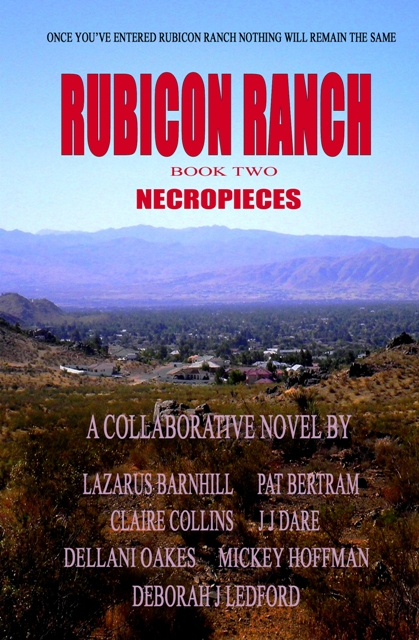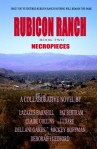
Rubicon Ranch: Necropieces — The Story Continues

Rubicon Ranch is a collaborative and innovative crime series set in the desert community of Rubicon Ranch and is being written online by the authors of Second Wind Publishing. Seven authors, including me, are involved in the current story — Rubicon Ranch: Necropieces.

Residents of Rubicon Ranch are finding body parts scattered all over the desert. Who was the victim and why did someone want him so very dead? Everyone in this upscale housing development is hiding something. Everyone has an agenda. Everyone’s life will be different after they have encountered the Rubicon. Rubicon Ranch, that is.

Although some of the characters were introduced in Rubicon Ranch: Riley’s Story, a previous collaboration, Rubicon Ranch: Necropieces is a stand-alone novel. The first chapter will be posted on Monday, June 11, and one chapter will be posted every Monday after that.

We hope you will enjoy seeing the story develop as we write it. Let the mystery begin! Whodunit? No one knows, not even the writers, and we won’t know until the very end!

Chapter 17: Melanie Gray
by Pat Bertram

Melanie stood at the window of her upstairs office, waiting for the photos of Eloy’s dog to finish printing.

Waiting. Always waiting.

Still waiting for Alexander to come home or call, though he had been dead for more than three months. Still waiting for the sheriff to investigate her husband’s accident—if in fact it had been an accident that killed Alexander. Still waiting for her grief to end and her life to begin.

The printer chugged as if deliberating over each line of data. Finally, it spit out the last photo of the puppy. Melanie shook her head at the amateurish product. She’d used high-grade photo copy paper, and the image was a good one, but the picture didn’t have the hard finish of a professionally developed photo.

This was the first place they’d lived where Alexander hadn’t set up a darkroom. She wouldn’t have known how to use the equipment even if she had it, but the absence of the chemical smells underlined the absence of her husband. They were only going to stay in this rental property a short while, just long enough to do the job and move on, and setting up a darkroom wouldn’t be worth the trouble, or so Alexander had claimed. He’d never said where their next job would take them, but he’d seemed anxious about the assignment. And now it didn’t matter. He was dead and she was . . . waiting.

Melanie fanned out the printed photos. Four eight-by-eleven pictures of the puppy, each a different pose, each charming. She printed a fifth page with smaller versions of the images, gathered up the papers, stuffed them in a large Manila envelope, and headed outside.

The cloudless sky was pale blue, and though not particularly hot, the air felt oppressive and humid. The small effort of walking the few steps to Delano Road made Melanie’s skin feel sticky. Normally she would have taken this as a sign that a storm would soon be passing through, but nothing appeared to work normally in Rubicon Ranch.

A curtain in the front window of the Sinclair house twitched. Was someone watching her? Melanie quickened her steps and let out a sigh of relief when she’d passed the house. She hesitated in front of Eloy’s place. The old man’s empty chair stood empty. She’d planned to hand him the photos and slip away before he could get awkwardly avuncular again. So, now what? Wait for him?

Waiting. Always waiting.

Melanie marched to the front door and rang the bell. Silence. Not even a bark or a yip from the puppy. Had something happened to the old man? Maybe he’d meddled in something he shouldn’t have.

In the months she’d lived here, she hadn’t seen Eloy do anything but sit on his front porch and glower at everyone who went by, and the recent change in him seemed suspect. If he’d wanted a dog, a monstrous canine would have better fit his image, but he’d gotten a puppy, for cripe’s sake. And what did he mean when he’d said Morris wouldn’t be bothering her any longer? Why would he make her welfare his concern? Besides, she knew how to take care of herself—Alexander had made sure of that, insisting she take lessons in self-defense and weaponry before they started traveling to dangerous locales. They’d lived in a whole alphabet of perilous countries, from Afghanistan to Zambia, and she’d survived them all.  When they’d moved here to Rubicon Ranch, she’d felt safe for the first time in years, but this quiet community had turned out to be the deadliest place of all.

Melanie pressed the doorbell once more on the off chance the old man and young pup were simply napping, but the chimes still elicited no response. Grateful she didn’t have to talk to the old man, she slipped a corner of the envelope beneath the welcome mat to anchor it. Wondering why that most unwelcoming man had a welcome mat on his porch, Melanie trudged to the street.

Moody half walked, half trotted toward her, a hand raised in greeting. “I need to talk to you.”

Melanie waited for her neighbor. “I need to talk to you, too. A couple of weeks ago Morris told me—”

“That Alexander had been taking photos of necropieces for him? I overheard my father talking to you that day. I’m sorry he upset you. He won’t bother you again.”

Anger surged through Melanie, temporarily displacing the sorrow that weighed on her. “Why does everyone think I need protection? I’ve dealt with worse things than a nasty old man who needed to be exterminated.”

Moody held up her hands, palms out. “Sorry. I didn’t realize protection was an issue with you.”

Melanie gritted her teeth to keep from blurting out a denial. She remembered that Moody had once been a psychologist, and any further discussion would give the woman fodder for more assumptions. She pivoted on one foot, getting ready to walk away, then turned back. Her neighbor might be a psychologist and a Sinclair, but she was the only one who could explain why Morris had accused her of killing Alexander.

“Your father mentioned something else that day. He said Riley told you she’d seen me messing with our car.”

Moody blew out a breath. “The bastard lied. Riley only said she’d seen someone messing with the car. That’s all. Never mentioned a name. I didn’t believe her, though. If you knew Riley, you’d know she loved to cause mischief. Even I found it hard to discern when she was telling the truth.”

“But could she have seen someone messing with the car?”

Moody put a finger to her chin and said slowly, “It’s possible. Generally, Riley’s lies were quite detailed—more like stories—but she made the remark about the car in an offhand manner. Are you thinking someone deliberately caused your husband’s accident?”

“Sheriff Bryan told me the accident looked suspicious, but . . .”

“You don’t trust him.”

Melanie focused on the peak of a distant knoll. Did she trust the sheriff? She lowered her gaze to meet Moody’s. “I think he has . . . agendas.”

Moody nodded. “That’s my take on the sheriff, too. I also think he’s on a quest for redemption, whether he’s aware of it yet or not. I’ll let you know if I recall anything else Riley said about your car or Alexander.”

“Thank you.” Melanie turned and started walking up Delano Street toward the desert.

“Wait. Please?”

Melanie stopped.

Waiting. Always waiting.

“I need to warn you about Jake,” Moody said, a new urgency in her voice.

Melanie spun to face the woman. “Are you trying to protect me again? I can take care of myself.”

“Yes. You said. But Jake . . . Jake’s my brother. He wears a cloak of righteousness, but his heart is as black as the rest of the Sinclairs’.”

Melanie frowned at her neighbor. Moody was a Sinclair, too. Could she be warning Melanie that as Morris’s daughter, Moody also had a black heart? A lifetime with Alexander should have prepared her to deal with the Sinclairs, but she sensed nuances of evil in the family next door that made Alexander’s machinations seem like child’s play.

“You don’t believe me,” Moody said flatly.

“Why are you worried about me all of a sudden?”

“I haven’t seen Jake in years, and he just showed up. Supposedly he’s been in the area for several weeks participating in some sort of revival, and he heard about Morris being missing. So now he’s come to . . .”

Interested despite herself, Melanie said, “So now he’s come to—what?”

Moody shrugged, a strange look on her face. Fear, maybe? She glanced toward her house, then fixed an intense gaze on Melanie. “He knows about you. Knows you found the foot yesterday. Don’t believe a word he says. And whatever you do, don’t get yourself in a situation where you are alone with him.”

Melanie watched her neighbor hurry back to Morris’s house. As Moody walked up the driveway, the door opened, and a man walked out.

Melanie gave a start. Morris! Couldn’t be. This man looked younger than the writer. Must be Jake, the son.

Jake glared at Moody, then turned his head toward Melanie. He seemed to study her, the Sinclair dead-fish stare frozen on his face.

And then he smiled.

Melanie fled to the desert. She inhaled the humid, creosote-scented air, trying to remove the stench of the Sinclairs from her nostrils, but no cleansing breath could remove the memory of that evil leer.

Forget the Sinclairs. Focus.

Melanie took a swig of water from her canteen, screwed the cap back on, and reached in her pocket for her little digital camera. Thinking of the last photos she took, the photos of Eloy’s dog, she wondered if her photos would be better if she had professional equipment. She made a mental note to ask the sheriff about her husband’s cameras—Alexander had taken them when he left on that fatal car trip, and they hadn’t been returned to her.

Melanie shot a few photos at random—a jogger in red shorts, a wadded fast food wrapper that looked like a yellow rose nestled in the scrub, a frisky puppy running circles around an old man. Captain and Eloy. Seeing Eloy in the desert again made her shoulders itch. Too much strangeness. Too much change.

She picked her way up the steep rock-strewn track to the top of the knoll, past the place where she’d found Riley’s body stuffed in a television console, past the place where she’d found the foot. She stopped to snap a few shots of the vast desert wilderness spread out before her, a sight that never failed to bring her comfort.

Distant shouts rising above the whine of idling motors caught her attention. She cut to the left until she glimpsed the altercation. Two people, one in red racing gear and one in silver, were standing by a canoe, balancing motor bikes with one hand while gesturing with the other.

“No!” bellowed the red-garbed racer. He hopped on his red bike and sped toward Melanie.

The silver racer got on his bike and chased after his companion. “Someone got chainsaw massacred. We have to call the cops and tell them we found a part of a body.”

“No,” yelled the red racer again. “We can’t. My mom will kill me. I’m supposed to be home looking after my little sister.”

They hurtled past Melanie, still shouting. She took pictures of the two boys, then of the canoe. She’d often seen the abandoned canoe in her treks, but until today, the boat had always been turned upside down. Apparently the boys had found something hidden beneath the canoe. A necropiece.

Could she take a chance that the boys hadn’t seen her, and so pass on calling the sheriff? She hadn’t found the body part, but she felt sure the sheriff would use her presence as an excuse to lay the blame at her feet. She sighed and pulled her phone out of a pocket. Even if the boys didn’t say anything, the sheriff would eventually find out she had been in the vicinity of more death. Not notifying him would seem more suspicious than making the call.

She talked to the dispatcher, explained the situation, described the boys and gave directions on how to find the canoe from Tehachapi Road.

“Wait right there,” the dispatcher said. “Someone will arrive as soon as possible.”

Melanie shoved the phone in her pocket, and shifted from foot to foot.

Waiting. Always waiting.

To hell with that. If the sheriff wanted her, he knew where to find her.

Melanie turned away from the canoe and tramped across the desert expanse, heading toward the storm clouds gathering on the horizon.

Novel Writing Tips and Techniques From Authors of Second Wind Publishing

Novel Writing Tips and Techniques from Authors of Second Wind Publishing is the 100th book published by Second Wind. I am thrilled to be a part of this extraordinary project.

“As someone who constantly evaluates novels for publication, I was astonished at the breadth and clarity of the wonderful advice contained in this handbook. It addresses concerns as grand as plot development and as simple but essential as formatting your submission. It offers crucial advice on literary topics ranging from character development to the description of action. Virtually every subject that is of great concern to publishers — and therefore to authors — is covered in this clear, humorous and enormously useful guide.” –Mike Simpson, Chief Editor of Second Wind Publishing

Table of Contents

A Publisher’s Top and Bottom Five: What We’re Looking For vs. What We’re Watching For by Mike Simpson
On Becoming an Author by Susan Surman
Finding Time to Write & Overcoming Writer’s Block by Mairead Walpole
Creating Incredible but Credible Characters by Pat Bertram
How to Begin and End a Story by Lazarus Barnhill
Plot Twists: Three Little Questions by Norm Brown
Points of View by Juliet Waldron
Moving Smoothly: Transitioning in Writing by Jan Linton (JJ Dare)
Captivating Settings by Deborah J Ledford
Foreshadowing by Nancy A Niles
Timing by Claire Collins
Don’t Keep Me Dangling by Sherrie Hansen
Sex SCENES not SEX Scenes by Pat Bertram
Film as Literary Influence on the Novel: How to Approach Scenes by Eric Wasserman
How Much Narrative is Too Much by J. Conrad Guest
A Jerk’s Guide to Comedy Writing by Noah Baird
The Challenges and Joys of Writing a Novel Series by Christine Husom
Creating a Believable Science-Fiction Environment by Dellani Oakes
Write it Right by Dellani Oakes
The Importance of Formatting by Deborah J Ledford
Writing Aids and Organizational Tools by Coco Ihle

Novel Writing Tips and Techniques is available from Second Wind Publishing, Amazon (Print & Kindle), Barnes and Noble (Nook), Smashwords (all ebook formats including palm devices)

Click here to Help Us Celebrate the Publication of Our 100th Book!!

So, Why Are We Supposed to Care?

The above-the-fold story on the front page of the newspaper today was about the hardships of small marijuana farmers. That once fabulously lucrative crop now only nets one-fourth the money that it did in its heyday (or perhaps I should say “hayday”). Industrial growers, new seeds geared toward indoor plants, and the push for legalization have made things tough for small, independent growers.

This seemed sort of a tactless (I’m being kind here) article to publish after a summer of droughts when food crops dried up and family farms disintegrated to dust, but beyond that, why are we supposed to care about the small independent marijuana farmer? This is like having to feel sorry for burglars because corporate greed has left nothing for them to steal. Marijuana may someday be legal, but it is not now (except for a few isolated instances) and it certainly wasn’t back in the seventies when these people started their “farm.”

It’s a good object lesson for writers, though. If you want readers to care about the plight of your characters, you have to give them something and someone to care about. In this case, the writer tried to paint a sympathetic picture — after the crop is cashed in, the farmers won’t have enough left to take their usual celebratory trip to Hawaii. Again — why are we supposed to care? They worked outside the law for decades, and while the law never caught up with them, the laws of supply and demand finally did. Seems like justice to me. So, why are we supposed to care?

This is a good question to keep in mind when you are writing your books. Too often people take short cuts, for example, relying on a mother character with rebellious teenagers to garner empathy. Such a character may gain immediate sympathy from women in that same situation, but readers who have never had children need something more than a flat insert-self-here-character to make them care. The character needs to be struggling with something more universal, such as the character’s feelings of rejection or abandonment from her almost-adult children, or conflicting loyalties between her husband and her children, or her struggles to deal with her own rites of passage.

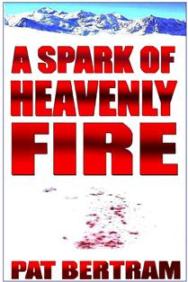
Sometimes all you need to do to make a character sympathetic is to give them simple wants. In A Spark of Heavenly Fire, all Kate wants is a good night’s sleep. She’s been haunted by her not always thoughtful behavior during her husband’s long dying, and sleep eludes her. Ideally, her plight should gain empathy — most of us have struggled with insomnia, most of us struggle with regrets, and most of us have dealt with loss. At one point in the story, Kate does step outside the law (though the law of survival took precedence over the interim laws of the quarantine), but by then, you know the character, her motivations, her struggles, and, you don’t have to pause in your reading to ask, “So why are we supposed to care?”

Are you writing to reach a particular kind of reader?

I am the reader I was writing for. There were stories I wanted to read and couldn’t find, so I wrote them. The dichotomy of this is that I always wanted to reach a large readership and make a living by writing, so it would have been more practical to write books that a large number of people would like. To be honest, though, I don’t like what the majority of readers like, so it would be impossible for me to write such a book. At least, if I write for myself, I know that one person will like the book. But I’m lucky — I’ve found others who like my books.

Here are some responses from other authors about the particular kind of reader they are trying to reach. The comments are taken from interviews posted at Pat Bertram Introduces . . .

From an interview with Alan Place, Author of “Pat Canella: The Dockland Murders”

I am not writing to any particular readers as my works cross genres. I think if you write to a type of reader you raise the chance of missing your target. Take Pat Canella, is she for the Mike Hammer fans, is she a ghost story or is she ladies who want a strong female lead?. OR is she all to everybody?

From an interview with Chuck Barrett, Author of “The Toymaker”

Absolutely. I like to write what I like to read—thrillers, with a touch of mystery thrown in just to keep the reader off balance…but enthralled. I like when a writer throws me a curve ball, so in like fashion, I throw a few myself.

From an interview with J. Conrad Guest, Author of One Hot January

The reader I wish to reach seeks something a little different—something that combines or mixes genres. A reader who enjoys the turn of a phrase, who believes how a story is told is as important as the story itself. I hope my readers remember the stories I tell long after they’ve closed the cover for the last time.

From an interview with Sandy Nathan, Author of Tecolote: The Little Horse That Could

Yes. I write for readers who are interested in making a difference and growing personally and spiritually. My readers also want a well written, fast paced, and extraordinary read that takes them to places they never imagined.

What about you? Are you writing to reach a particular kind of reader?

(If you’d like me to interview you, please check out my author questionnaire http://patbertram.wordpress.com/author-questionnaire/ and follow the instruction.)

Who gave you the best writing advice you ever received and what was it?

The best writing advice I ever received I read in an old book called The Practical Stylist by Sheridan Baker: “Clarity is the first aim; economy the second; grace the third; dignity the fourth. Our writing should be a little strange, a little out of the ordinary, a little beautiful with words and phrases not met everyday, but seeming as right and natural as grass.”

Isn’t that beautiful? I paid particular attention to that advice when writing Light Bringer. I wanted the style itself to show that the characters were a little strange, a little out of the ordinary, a little beautiful. For example, “And then there it was, spread out before her in a shallow thirty-foot bowl. A lake of flowers — chrysanthemums and tulips, daisies and daffodils, lilies and columbines and fuchsia — all blooming brightly, all singing their song of welcome.”

Here are some responses from other authors about how the best writing advice they ever received. The comments are taken from interviews posted at Pat Bertram Introduces . . .

From an interview with Sheila Deeth, Author of “Flower Child”

I met Jane Kirkpatrick shortly after we moved to Oregon. She told me to keep writing. In fact, she’s told me several times to keep writing. It’s probably the most valuable piece of advice I’ve had.

From an interview with Eric Wasserman, Author of Celluloid Strangers

Frederick Reiken’s literature course on the short story was my very first graduate school class. The very first thing he said to all of us was, “If you’re not willing to submerge yourself in the world of reading fiction, give up now on being a serious writer of fiction.” I wrote this down the moment he said it, went back to my dingy Boston studio apartment that evening, and taped it across the screen of my TV.

From an interview with Sandra Shwayder Sanchez, Author of “The Nun”

The best advice I ever received was from J.R. Salamanca (Lilith, A Sea Change, Embarkation, Southern Light and more) who said the permanence of the written word has more influence on readers than spoken words and to take that influence seriously and try to create a good influence and that is the advice I would give aspiring writers.

What about you? Who gave you the best writing advice you ever received, and what was it?

(If you’d like me to interview you, please check out my author questionnaire http://patbertram.wordpress.com/author-questionnaire/ and follow the instruction.)

A Place Where I Can Connect With Myself And The Mystical World

It’s amazing we ever manage to communicate with each other, considering that different words mean different things to different people. We do have common ground, though, so perhaps that keeps us connected. We know basically what words mean, such as “desert,” “reading,” “writing,” but we also imbue the words with our own connotations, and that’s where it gets interesting.

For most people around where I am staying, “desert” means a place of rattlers, a place to ride dirt bikes, ATVs, and other noisemaking machines, a place to honk their dogs. (That’s what I call it anyway. They let their dogs run free and drive behind them, honking to keep the animal from straying too far.). But for me, “desert” means a place away from the bustle of everyday life, a place where i can connect with myself and the mystical world around me, a place where I get in touch with the truth inside me (the truth that resides in all of us.) Even those who do see the desert as a place away from every day life, see it as a place to run, all the while connected to an ipod or whatever is connected to those wires coming out of their ears.

For most people, “reading,” fiction, in particular, means entertainment, a way to kill a few hours, an indulgence in fantasy. There’s nothing wrong with that, of course — it makes people happy and fuels the book industry — it’s just not what reading means to me. For me, “reading” means a place away from the bustle of every day life, a place where I can connect with myself and the mystical world of books, and get in touch with the truth inside me. It came as a real shock when I discovered that’s not what reading means to others. It’s often true that people see reading as a place away from the bustle of every day life, but for most people it’s an escape from themselves, not an escape into themselves.

Writers each have their own meaning for the word “writing.” Most often it’s the same as reading — to entertain, to communicate with readers. Sometimes they don’t know what it means to them, except that it fulfills a need. Occasionally, it means a way of making money. It should come as no surprise that writing, for me, means a place away from the bustle of every day life, a place where I can connect with myself and the mystical world of my own story, and get in touch with the truth inside me. Writing bloggeries, such as this one, helps me figure out what I think, but writing fiction puts a “face” on what is inside me, creating a metaphor or a parable for my thoughts and experiences.

I’ve never been one to count words since the number of words don’t count. What counts is what the words say, what they mean. I’ve never been one to inform others of how my writing is going since the writing is for me. Once the book or bloggerie is published, however, it becomes something else, not something that was written so much as something to be read. Does that make sense? I might have walked too long in the desert this morning, and brought some of its mysticism back with me.

Writing the Tough Stuff (Or Killing the One You Love)

Please welcome my friend, fan, and fellow author, Aaron Paul Lazar, who will be discussing killing the one you love — metaphorically and literarily speaking, that is. Aaron writes to soothe his soul. An award-winning, bestselling Kindle author of three mystery series, Aaron enjoys the Genesee Valley countryside in upstate New York, where his characters embrace life, play with their dogs and grandkids, grow sumptuous gardens, and chase bad guys.  Aaron says:

It’s not easy writing a scene where you kill the one you love.

Of course I don’t mean your actual spouse or lover. I mean the wife, husband, or sweetheart of your main character.

I’ve done it in FOR KEEPS. Thinking about it tears my heart out every single time.

That’s what I mean by “writing the tough stuff.” Sam Moore—a retired family doctor who is our resident hero in Moore Mysteries — is very much like me, except he’s twelve years older and retired with enough money to putter around in his gardens all day. Let me repeat that. All day!

I hate him for that.

Okay, so maybe that’s a little extreme, considering he’s fictional. Shall we say, I am exceedingly jealous of his lifestyle? Although Sam was a family doctor and I am an engineer, we’re still a lot alike. We both love to plunge our hands into the soft earth and grow things. We both love our grandkids so much it hurts. And we both have spouses with multiple sclerosis. There are plenty of differences, too. I cook, I write, and I take photos. Sam doesn’t. But of course, it’s not a competition. At least I don’t think so…

In spite of the fact that he’s not real (at least not in the traditional sense, LOL), I relate to this man and feel his pain when he’s hurting. Sure, you say, writers should feel ALL their characters’ pain. We have to, to get into their heads and nail the characterization. Don’t we?

But I’ll bet some characters are closer to your heart than others.

Sam’s wife, Rachel, shares many qualities with my dear wife, Dale. They both endure MS, they both love to read, they are both chair-caning artists. Some of their symptoms are the same, but that’s where they split apart. Rachel loves to cook (that’s my job in our marriage), she’s in a wheelchair, and she stays pretty upbeat, considering her challenges. They both adore their grandchildren and both love to read. Rachel’s a tribute to Dale, in all honesty. But she also has morphed into her “own woman,” too, and I love her deeply. Er . . . through Sam, of course. (Honey, don’t be jealous!)

In the first two books of theMoore Mysteries series, Rachel sticks by Sam’s side, supports him when he’s overcome with grief and is plagued by strange paranormal events, and loves him deeply enough to keep him sane.

That’s why it really hurt when I had to kill her.

In For Keeps, the third book in the series, life takes an awful turn. When Rachel is murdered by a serial killer, it puts Sam back in the psych ward, the same place he was thrown when his little brother disappeared without a trace fifty years earlier. Desperate to fix things, he calls on the power of the green marble, the talisman his little brother Billy controls from afar that whisks him back and forth through his past.

Unlike those of us in real life, Sam gets a “do over.” He flies back in time to desperately try to fix the problems that lead to this gruesome act, and over and over again, he attempts to tweak the past to bring his dear Rachel back to life.

How do you write such a scene without losing it? How do you make it feel authentic to your readers? How much is too much? And how can you be certain that your character’s reaction will ring true?

It’s not easy. Matter of fact, since I loosely base Rachel on my own wife, and since Sam and I are really quite alike, it was close to torture.

I called upon my darkest, most powerful emotions experienced when my father died and also when my own dear wife almost died several times in the past few years. I’ll never forget the time the nurse in the ER called the nun on duty to bring me to a little room where no one would see my reaction to her impending news that Dale might not make it. She carried a box of Kleenex under one arm and a bible in the other. She was so sweet. Yet it was one of the scariest moments of my life. Thankfully, my wife pulled through and is doing okay today.

That hollow-gut, black-sludge-in-your-heart feeling is horrible when you lose someone dear to you, isn’t it? It’s all encompassing. Sometimes you just want to deny that awful truth, and pull away — far away — like Sam does in the following excerpt. (Click here to read the Excerpt From “For Keeps” by Aaron Paul Lazar.) I tried to channel those feelings when getting inside Sam’s head.  Let me know if you think it worked.

For Keeps is book #3 in Moore Mysteries, and is now available through Twilight Times Books and Amazon.com. The series can be read in any order.  Free dates of “For Keeps”: Sept 14, 15, 16th and October 12, 13th.

copyright 2012, Aaron Paul Lazar

A Dream Come True For Bibliophiles

My publisher, Second Wind Publishing, is going to be at the Bookmarks Festival of Books in Winston-Salem on Saturday, Sept. 8, 2012 and I’ve been trying to get information about the festival to write a promo for the Second Wind blog. It’s hard. I don’t want to mention all the big names that will be there because . . . well, because it’s a Second Wind company blog, and it just doesn’t seem right to promote non-Second Wind authors, especially when they don’t need the promo. A lot of new Second Wind authors will be there signing books, but since they are so new I don’t know yet who they are, and since I’ve never attended the festival, it’s difficult to write an exciting article.

I must have been more focused on the article than I realized, because last night I dreamt I was at the festival. (Well, a festival anyway. Mine was a nightmare, and I’m sure the real Bookmarks Festival is a dream come true for bibliophiles.) I set up my computer at a side table, and left it there while I busied myself with other tasks, and whenever I turned around, someone was using my computer. The last time I turned around, the computer was gone. Someone had taken mine and left a piece of junk in its place. Of course, since this was a frustration dream, I dashed around, looking for the computer, getting more and more lost nd frustrated by the minute. Every time I found someone to tell of the theft, they’d make scathing comments about leaving something so valuable unattended. My response, “But it’s never happened before,” sure didn’t win me any friends.

I woke up thinking that the sleeping me sure was stupid. I would never in a million years leave my computer unattended in a crowd. I would never even set it up in a crowd. It’s too valuable to me, being an eye into the electronic world where I have friends and even a smattering of respect.

But all’s well that ends well. Despite the frustration of the dream, I awoke rested, I did not get my computer stolen, and the Bookmarks Festival will carry on without me.

Even though I will not be at the festival, my books will be. So, if you are going to be in Winston Salem this Saturday, be sure to check out the Bookmarks Festival of Books. It’s from 10 a.m.-5 p.m. in the Downtown Arts District in Winston-Salem, centering on Trade and Sixth Streets. And don’t forget to stop at the Second Wind Publishing booth and check out my books. Even better, buy one!

(In case you don’t know what books I’ve written, check out the right sidebar of this blog. They are all listed.)

Who Decides What Books are Worthwhile?

I watched Incognito the other day, a story about an art forger. One of the most interesting bits of dialogue was when a gallery owner says (screams it, actually) that whatever he says is art, that is art. The comment caught my attention because lately I’ve been blogging about the publishing industry, the writing community, and where (or how) I fit into this modern world of books. And a big part of that equation is the meaning of art as it applies to writing.

I have no fondness for the corporate publishers. For the most part, the books they’ve been publishing for a long time now seem boring and trivial, and hold no real truth for me. I am not one who can read the zillionth book in a series and still maintain my interest in the characters. The writers I have always liked are non-literary authors, such as David Westheimer and Nevil Shute, who wrote stand-alone books that did not fit into any particular genre. (To me a literary author is one who is more focused on how something is said than on what is said, and who is more focused on what is said than on the story itself.) In fact, the very reason I decided to write my own books was that I could no longer find the sort of novels I liked to read.

On the other hand, I have no special fondness for self-publishers. Many write the same sort of drivel that the major publishers put out — trivial books that lack individuality and truth. Even worse, many are badly written, and the plethora of errors shows a complete disregard for readers. Originally, I assumed these writers who go it alone were better than those published by the corporations, since the major publishers seem to specialize in a high degree of mediocrity, but unfortunately, the reverse is too often the case. Worst of all, in an effort to get noticed and make a living, many authors write a book every three or four months. Without time to think, without the grueling months of rewriting, editing and copyediting, authors will be foisting increasing numbers of less than stellar books on the market.

In this avalanche of books, what distinguishes one from another? Who decides what is worth reading? Who decides what books will succeed? The critics? Just because they say a book is worthwhile doesn’t mean that it is. Some of the books that have won major awards stun me with their ghastliness. The corporate publishers? The books they choose aren’t picked for worth; they are chosen for salability. The masses who self-publish? The masses who read? (I hate using the word “masses,” because really, who among us ever considers themselves one of the masses? But I can’t think of a better one to describe huge numbers of people who do the same thing as everyone else.) Look at the self-published books that have achieved icon-hood — few have little value as literature or art, few have a modicum of “truth.”

So who is to decide what is art or literature? My books are published by a small press, and so are the books by many writers I have met online. Someday, maybe, these small presses will provide a literary haven between the two extremes of self-publishing and corporate publishing, but the truth is, no one has to decide what books are art, which books have merit. It doesn’t matter.

In the beginning, stories were told wherever humans gathered. It is one of the very few things that separate us from any other species — our ability to tell stories. It is what makes us human. Perhaps even what makes us divine. We are a species of mythmakers, telling ourselves the story of our lives, telling each other the stories of other lives, both real and imagined.

The pen was the first great technological advance in story telling, followed by the printing press. The printing press allowed certain businesses to control what stories were told, and that control held true for centuries. Now, in this electronic age, the control is gone, and anyone can publish anything, no matter how terrible. This puts a burden on readers since often they get stuck buying something that is poorly written and badly edited, if edited at all, but this is the way things are going to be for a long time to come.

And perhaps the situation is not such a bad thing. We could be moving away from literature as art (as defined by self-styled critics) and returning to our very beginnings . . .

Storytellers.

Do Writers Need To Be Supportive Of Each Other?

Do writers need to be supportive of each other, as if we are all part of one big dysfunctional family, as if all writers are the same, or at least connected in some way? I can see that it’s important not to be envious of those who make it big, since envy destroys the envier, but I see no reason to be glad of the success some writers attain, especially those who write books I would not read if they were the last books left on the face of the earth. Nor do I see any reason to celebrate the success of someone I have never met or have never exchanged so much as a single eword. Nor do I see any reason to encourage writers to write. Those who want to write, write. It’s as simple as that.

To some extent, almost all people are writers, even if they just jot shopping lists, post status updates, and respond to email messages, but this doesn’t make me connected to them except in the cosmic sense that we are all connected. (To be crankily honest, some who call themselves writers should have stayed with writing shopping lists.)

I’ve never felt any great bond to other writers, perhaps because I never really considered myself a writer. I don’t always write — sometimes I do, more often I don’t. I have no great passion or deep need for writing, no burning desire to create, no characters that scream to be born, no story that demands to be written or that writes itself. I don’t define myself by what I’ve written or what I might plan to write. My books are not my children, my characters are not my friends. When I write, I do have moments of being in the “zone,” but mostly I have to dig for each word, which is okay since that’s the part of writing that’s fun for me — finding the perfect word to say exactly what I mean. (The other day someone posted a question in a writing group asking for help figuring out a word since he didn’t have time to find it for himself. To me, that’s not a writer. Words make a writer. If you have no time for words, what’s the point of writing?)

Speaking of words, I don’t understand why so many writers brag about their word counts. What does a word count mean? It doesn’t impart anything about the quality of writing. For all I know, the authors could have been stringing nonsense syllables together or writing shopping lists, so why should I care how many words they wrote? Word counts mean nothing, what counts is the meaning of the words.

I really do sound cranky, don’t I? Well, perhaps I am, but it does irk me that just because I’ve written a few books and gotten them published, I am supposed to accept other writers as my “family.” Someone who slaps together a draft and posts it on Amazon as a published book doesn’t have anything in common with me. Someone who sits down and spews out thousands of words — good or bad — doesn’t have anything in common with me. Someone who scribbles an erotic book that catches the fancy of the masses doesn’t have anything in common with me. (Nothing I write will ever go viral. I have taste.)

Still, I do what I can to be supportive of other writers. I have two blogs that cater to writers — one is for book excerpts, and one is for interviews. (Feel free to send me an interview or book excerpt according to the instructions on the blogs.) I also have a writing discussion group on Facebook to help writers develop their craft, and I host a self-promotion extravaganza every Saturday to give writers a forum to promote. So maybe this is a case of my actions speaking louder than my words.