Being Where I am Supposed to Be

I was happy today. I didn’t feel giddily gleeful, just a quiet peace that came from knowing I was where I was supposed to be.

I’d been walking in the desert, ruminating over my petty concerns. I have no major problems at the moment — I have a place to stay and food to eat, and I feel no great lingering sorrow over the death of my life mate/soul mate — but there are small matters that niggle at me. I seem to have crossed some invisible line where I no longer attract people through my words, but am actually starting to repel them — people have been blocking me on Facebook, and often it’s because of a simple non-combative comment I made in one of my discussion groups. I also wonder how to entice people to read my books, and I still ponder the whole issue of my writing. Although I am coming to an accommodation with continuing to write despite lackluster sales, I still am not comfortable with the idea of being a writer among millions of other writers — never have liked being a face in the crowd.

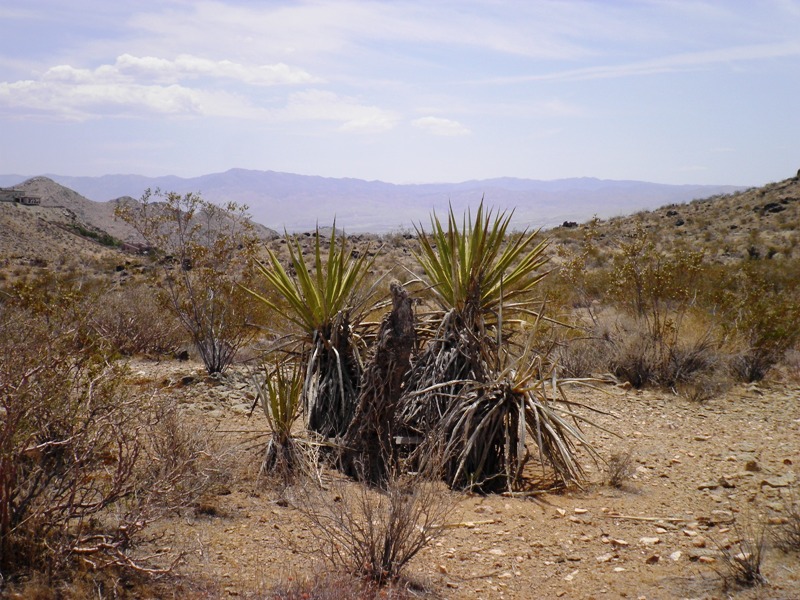
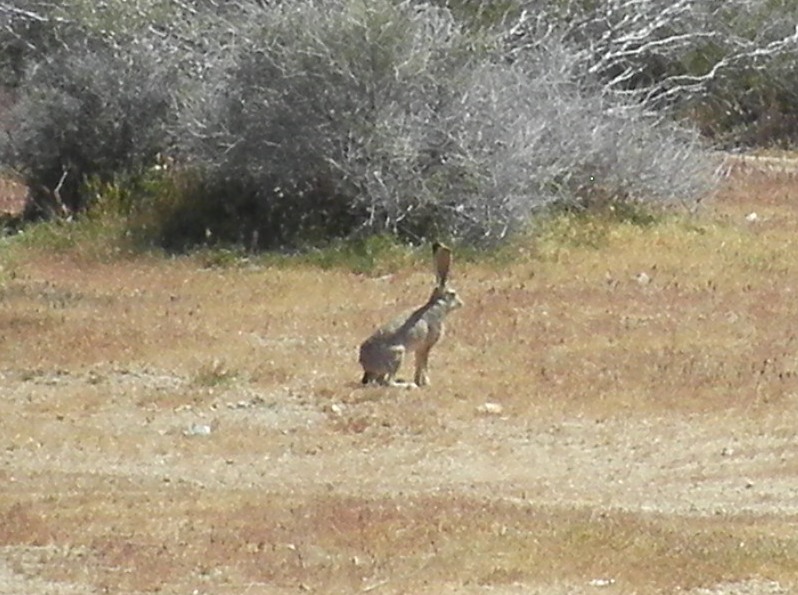
So there I was, walking, thinking, talking a bit to my deceased mate, when it suddenly dawned on me that at that very moment, I was not a face in the crowd. There was no crowd — just me. I stopped and looked around. A jackrabbit loped by, but other than that, no creature made itself known. I felt the breeze cooling my sweat, heard the air whistling faintly as it passed my ears. I stilled my thoughts and simply stood there in the middle of the desert, deep blue skies above, sun-warmed soil beneath the soles of my shoes, desert knolls surrounding me and blocking any view of the nearby city.

A friend who has endured far worse grief than I have, told me that she is finding peace by telling herself that she is happy. Alone out there in the desert, I decided I was finally ready to take the next step in going on with my life, so I thought, “I am happy.” And I realized that was the truth of it. Right then, I was happy. I had no sense of longing for something or someone, no sense of waiting. My entire life — all the joys and pains, the learning and creating, the loves and losses — had led to that very moment, and I felt as if I had arrived where I was supposed to be. There was no reason for me to be there, nothing to for me to do, no task to accomplish. All I had to do was simply . . . be.

One cannot stand in the middle of the desert forever, so eventually, I continued my walk, still feeling the effects of that moment. There are few perfect moments in life, but that was one of them. (I’m smiling as I write this. Can you tell?)

Is it Better to Write for Yourself or to Write for Readers?

For many writers, maybe even most, finding a readership is crucial. They write to entertain, which they cannot do without readers. Or they write to communicate, which they also cannot do without readers. Or they write to sell so they can continue to write, and for that, they need not only readers but customers — readers who are willing to buy books.

The lucky writers are those who write the books they love and the books they love just happen to be the books readers want to read and buy. The rest of us have a conundrum to deal with — do we write the books we need to write, regardless of what readers want, or do we try to write the books we think readers will read?

In discussion after discussion, writers put forth the idea that to get readers, one must write what readers want. And perhaps that is the smart and lucrative way to write, but it’s not the only way.  Besides, if I look at the situation from my point of view as a reader, it seems a cheat. I want a story filtered through the writer’s life/voice, not something the author thinks I would like.

In my case, I have no choice — I can only write the stories that speak to me. Even if I wanted to write solely in the hopes of getting a large readership, I’m not sure I could do it. Readers can tell when they are being pandered to, though there are exceptions to this, most notably a couple of now very wealthy men who write romances for women. For some reason, most women don’t feel the manipulation of those books and so fall in love with the stories, while others, perhaps less interested in the romance genre, hate the feeling of someone trying to tug on their emotions by writing books they think women would like. To a certain extent, all books are manipulation — authors write in such a way to elicit emotional reactions from readers — but sometimes, like with these men, the tugs are quite apparent.

Writers who also read the genre they love know the nuances of the genre (assuming, for example, there are nuances in category romance) and so can more easily write to their readers tastes. But what if you can’t write genre fiction (or, more probably, can’t force yourself to write it)? You end up writing for yourself.

There might not be money to be made by writing for oneself, but there are other advantages. For one thing, you can make your writing as intelligent as you wish without having to worry about losing your audience. For another, there will always be one person who loves your work — you. And there is a third reason, perhaps the most important: We are so much more than we know, and writing is a way of communicating not just with readers, but with the unknown us. If we just write what we know we know, we are the poorer for it. And maybe, just maybe, by writing the book only we can write, we will end up writing something spectacular.

My Dirty Little Secret

When my life mate/soul mate died two and a third years ago, something in me broke wide open, leaving me exposed and willing to talk about that great soul quake. As I heal and settle back into being me, I’m not sure I will have the courage to continue exposing myself, so I’m going to tell you my dirty little secret before I wimp out.

Part of me misses my grief.

Bizarre, isn’t it? For two years I’ve screamed my pain into the depths of the blogoshere, totally confused by the vastness of my agony and the enormity of my loss. I don’t miss the pain at all, it truly was almost more than I could handle, and I truly hate that he is gone, but I miss feeling as if I were on the edge of something important, something vital . . . something eternal.

It’s as if for the past few years, during his dying, his death, and my grief, I was on stage in the middle of a great tragedy. That it wasn’t my tragedy didn’t matter — I still had a major role, that of the chief mourner. Now, the curtain is down, the audience is gone, the lights are off, the stage is empty, and I, no longer a tragic figure, just an actor with no role left to play, am heading home alone down the dark empty streets.

If my grief had been supplanted with something else — a new love, a new focus, a new outlook even — I might not feel so
. . . diminished. But the truth is, my grief seems to have burned itself out, and since I have not yet rebuilt my life, I am in a sort of limbo. I still have moments of sadness, still have moments of tears, still miss him, still want to go home to him, but all of this is not the focus of my life as it has been for so long.

I suppose it’s just as well I don’t know what I want to do with my life alone since I still have obligations, and so could not act on any desires, but someday I will need to find a new focus. I am doing what I can to prepare. I take long walks, exercise, try to eat right. I’m even doing a bit of writing. And of course, I’m still doing a lot of thinking, though I’m trying to curtail the mental activity and simply be, and more specifically, simply be me. (I haven’t a clue what that means, but since I am the only me the universe has to offer, I might as well make use of the opportunity, right?)

A lot of the angst and questioning is dissipating along with my pain. Most recently I wondered “why something instead of nothing?” and found an answer I am satisfied with: because something is possible. Maybe in the end, that’s the whole point of life — possibility. When my current obligations come to an end, my whole life opens up into one huge possibility. I have no where to be, no one to be with, no task that needs to be done. Sounds to me as if my life will be opening up to endless possibilities. But until then, it’s just a matter of heading down those dark empty streets and seeing where I end up.

Becoming a Curmudgeon

Are writers as a group less willing to read rules and follow directions than the rest of the populace, or is it that I am mostly connected to writers online who don’t know how to follow directions?

I have a book blog, Dragon My Feet, where I post excerpts from books to help authors with a bit of promotion. I thought it was a good idea, but I’m getting exhausted having to explain over and over again that I cannot post what I do not have. For example, in the instructions for Dragon My Feet, I say:

“Please include a short synopsis (blurb) of the story, short bio, a link where I can find a photo of you and one of your book cover, and whatever links you would like me to add. Post the excerpt along with the rest of the information/links as a comment/reply on this page.”

Despite those clear instuctions. I get bios with no information about the book and no excerpt. I get blurbs without any other information, not even the title. I get excerpts without a title letting me know what book it’s an excerpt from. I get dozens of comments/replies by people who say they can’t figure out how to get their excerpt to me since I didn’t leave an email address.

When I’ve mentioned this lack of communication, I’ve had writers tell me flat out, “I don’t follow directions.” Is this part of the creative process? Make up your own rules and expect the world to follow along? Quite frankly, I don’t care if people follow my instructions or not, but as I said, I cannot post what I do not have.

I’m not the only one with such problems. My publishing company sponsored a short story contest with the winner to be published in an upcoming anthology. Some writers mistook the contest for a call for submissions, though the rules clearly stated it was a contest. Others were upset that their submissions were “published” on the site, though the rules clearly stated the submissions would be posted. (According to the vagaries of the internet, once a story has been posted it’s considered published. It doesn’t make sense to me that just because something was posted for a month and then deleted, it’s considered published for all time, but then, I don’t get to make those particular rules.) There was nothing underhanded about the contest — everything was stated up front — and if people didn’t like the way the contest was run, they didn’t have to submit a story.

Maybe I have it all wrong. Maybe writers can follow directions. Maybe they just can’t read.

(Do I sound curmudgeonly? There is a good reason for that — I’m rapidly turning into a curmudgeon. I no longer have the desire to embrace the absurdities of humanity, and I see no reason why I should, especially if it causes more work for me.)

Trying to Fill The Void Of His Absence With Remembered Joy

All of a sudden, it seems, there have been changes in my life pertaining to my grief for my life mate/soul mate. For about a week after the Fourth of July, I endured a heavy upsurge in sorrow, but in its wake, I have found a semblance of peace midst the sadness.

Saturday was his birthday, and I started out the day feeling almost upbeat, gladder that he’d spent so many years with me than sadder that he is gone from my life. I’d never sung Happy Birthday to him when he was alive, so I sang to him out in the desert, where no one could hear. (Believe me, you do not want to hear me sing!) I planned to get a cake, too, but sometime that afternoon, the sadness returned. Next year, perhaps, I’ll bake a cake to celebrate his life.

I’ve also had some stray thoughts that indicate a shift in my perspective. A couple of days before his birthday, I found myself thinking, “He beat the system. He’s out of it now.” I don’t know where that idea came from because he didn’t beat the system. He didn’t have to grow elderly, but he was sick for so long it seemed as if he’d skipped a couple of decades of middle age and went straight to old age. But still, he is out of this life. He won’t have to worry about the coming changes in medical insurance or any other such foolishness, won’t have to watch himself age further, won’t have to continue suffering. Wherever he is (if he is) he is safe. And free.

To a great extent, our life together now seems unreal. I’ve been trying to live in the moment, and in the moment, he is not here. I’m still sad, still want to go home to him, still yearn to talk to him, but wanting such things seems to speak more of longing than of recollection, as if somewhere in the back of my mind I had conjured up a mate and a life and time of togetherness. But the truth is, if I had conjured up such a fantasy out of nothing but loneliness, I would have created happier memories. Too much of our life together was steeped in sickness and failure. Still, there were joys. The astonishing beginning of our relationship when he was radiant with youth and strength and health, the electricity of our long-lasting discussions, the sweetness of our final hug, the beauty of his smile, his wonderful gift of appreciation, his vast courage, and his determination to accomplish something each day despite his waning health.

I came across these words today from “Remembered Joy,” an Irish prayer:

I could not stay another day,
To love, to laugh, to work or play;
Tasks left undone must stay that way.
And if my parting has left a void,
Then fill it with remembered joy.

He stayed as long as he could, and it would pain him to know that his death brought me so much sorrow. I don’t know if I’ll ever be able to fill the void of his absence with only remembered joy, but I’m continuing with my life, filling it with new experiences, and for now that’s the best I can do.

Death Certificate Error

My mother, far right, on her 60th wedding anniversary

I found out something today that shocked the heck out of me, and after the horrendous shock of my grief after the death of my life mate/soul mate, I’m not very shockable any more.

My mother died of lung cancer four and a half years ago. Her cause of death surprised me a bit since she’d never been a smoker, but at 85, one is susceptible to many forms of cancer, so I mostly found it ironic that a woman who’d never even been around second hand smoke (except for my father’s very occasional cigars) should die in such a manner. However, as I found out today, her death certificate says that she’d contributed to her death because she’d been a smoker for thirty years.

What???? How is that possible? She’d never smoked as long as I knew her, so if she’d been a smoker for thirty years, she would have had to start puffing away a couple of years before she was even a glint in her parents’ eyes, found a way to sneak smokes before she could crawl, and keep up the habit while enduring the privations of growing up in a coal mining town.

I hope this mistake on her death certificate was simply that — a mistake — rather than someone’s agenda to prove that smoking causes lung cancer. My sister doesn’t want to take a chance on upsetting my father during his final years, so she’s waiting until after he’s gone to get the death certificate changed. Until then, it’s a wonder my mother isn’t haunting us. My mother was a very exact and truthful woman, who believed in choosing the right words. (I can’t tell you how often we argued with her about “almost exactly.” She insisted things were either almost or exactly, while we were just as insistent that there were gradations of almost.) And this error on her death certificate is a more grievous transgression than a simple misuse of words.

To be honest, I doubt she cares any more what her death certificate says, but it will be good for the rest of us when the record is set straight. It isn’t only smokers who die of lung cancer. Non-smokers die of the disease, too, and their deaths should not be dismissed because of errors on their death certificates. Nor should non-smokers smugly go on about their lives feeling secure in the belief that they will never get lung cancer. They can, and they do.

Thursday the 12th — A Day of Bad Luck

After yesterday, Friday the 13th holds no horrors. I started the day at an outdated dentist’s office that seemed like something from the inquisition rather than a modern tool of torture. It wasn’t so bad since I was not the patient, though I did have to be patient to sit through his political diatribes. (He’s British and thinks there are so few USA-born doctors because Americans are lazy, and he thinks our schools should be based on the British model, but he came here to dentistry school because he wanted a first-rate education and stayed because he couldn’t make money in Britain as a dentist.) I’ll stick with my Vietnamese dentist. At least he keeps the torturous chatter to a minimum.

Next, when I went online and checked Facebook, I discovered that someone had plagiarized me. I pointed out the word-for-word passages she used. She apologized, agreed to comply, since I was “so obviously offended.” Offended? You think? Then, after she finally removed the plagiarized bits, she said, “I assure you that this won’t be discussed with anyone.” Why would I need that assurance? I did nothing wrong. I don’t care who knows that she’s a plagiarist. I unfriended her, of course, since obviously, she was no friend. (She’s an author I only knew through Facebook, so I’m not losing a real friend.)

And then the real horror began. Something happened to my blog. The right sidebar with my covers sank to the bottom of the page, and the admin bar, the black bar across the top that takes me from the blog page to the dashboard and back again, stopped working. It turns out WordPress offers support only to those who pay for upgrades, which I don’t, so I spent all day on the WordPress Forums looking for a solution. One person suggested, Go to Settings > Writing and select “ ___ WordPress should correct invalidly nested XHTML automatically” and then scroll down and click “Save Changes.” Now, starting with your latest post, open it in the editor, make one minor change such as adding a space and then deleting it, and then click “Update Post.” Check your blog and see if it is back to normal.

The problem is on all five of my blogs that use the same theme, so the problem couldn’t have stemmed from anything I did. Still, I followed their instructions on the off-chance that it would help. It didn’t help me, but if you have a wordpress blog, I would suggest changing the setting. Any stray bit of html can wreak havoc on your blog.

Another person had me disable “infinite scrolling.” It used to be that you could choose how many posts would be displayed when people came to your blog, but now, when you reach the bottom of the page, you get more blog posts. In other words, there is no bottom of the page. If you want to dismantle infinite scrolling, here are the instructions: http://wpbtips.wordpress.com/2012/06/05/disabling-infinite-scrolling/

Dismantling infinite scrolling did not correct the problem, so the next task they had me do was change all the images in the right sidebar (which of course you can’t see if you are using IE9) to smaller ones that fit the width of the sidebar. Supposedly, IE9 doesn’t make the conversions from larger images to smaller ones very easily, though until yesterday, I never had a problem. But even going through all that trouble didn’t make a difference.

I hoped that things would miraculously be back to normal today, but alas, the blog is still broken. So . . . Friday the 13th? It doesn’t scare me. But Thursday the 12th? Yikes.

Is Facebook Still Cool?

For years now, writers have been told that to promote their books, they need to sign up for Facebook, mostly because when Facebook was new, very few authors used social networking sites to engage with readers so those who did found a goldmine. Ever since then, authors by the hundreds of thousands have joined Facebook to find readers and found only other writers. Why? Unless you are a known writer, readers aren’t searching you out. Writers try to connect with everyone FB suggests or anyone they come in contact with, but readers don’t. They have no reason to connect because they have nothing to gain by it.

Because of the peculiarities of Facebook, I am connected to very few people outside the writer’s community (and those few non-writer connections are mostly family or real life friends). It’s hard to believe that with over 900 million users, I can’t break out of this tight enclave into the mainstream of Facebook, but I have nothing to say to anyone besides what every other author says, “Buy my books,” and even I know that doesn’t sell books. Mostly what I do is use Facebook as a bulletin board to post links to my blog posts. I also scan my feed to see if anything interesting is going on, (so-and-so’s book is being given away free on Amazon, such-and-such a book is on sale for 99¢ . . . yawn) and finally check in with my writing discussion group.

Shouldn’t there be more to such a vast network than a writer’s group? But then, I have made a lot of online friends through Facebook, I keep up with many of my fellow Second Wind authors on Facebook, and I try to get to know the people I am connected with. Considering that joining Facebook used to be a coming-of-age ritual for thirteen-year-olds, it’s amazing I’ve found anything to do on the site! I mean really, what could I possibly have in common with such new and untried persons?

Along with all the other problems Facebook is having (such as not finding enough ways to gouge money out of us via ads), they now have to contend with the loss of their youngest members. Among some young teens, it’s no longer considered cool to join facebook — they prefer to text or to join sites where they are not pressured to connect to everyone in their class. No wonder there are so many offline traumas instigated by online life. The unpopular kids can never get away from their unpopularity. And anyway, why would they join a network that is aging? Facebook is eight years old, which in online years has to be closing in on 57. (Assuming web years are equivalent to dog years.) Even worse, from the point of view of a young teen, is that more than one-fourth of FB users are 50 to 64 years old.

I’m not sure where I’m going with this post. It started out as a light-hearted commentary about the whole Facebook phenomena, and I planned to end up with saying that there are worst things that joining Facebook to connect with readers and finding only writers of a certain age, but I’ve since discovered a fb author friend plagiarized something I posted on Facebook, which is so not cool. So now I have no end to this post. Except maybe to say that I need to stop spending so much time online.

Upsurges in Sadness Are Like Shortness of Breath After Exercise

I’m fine. Truly I am. For all of you who have expressed concern over my current upsurge in grief, I just want to tell you there is nothing to worry about. Upsurges in sadness do not in any way affect my life or my dealings with other people. They are just there, a fact of my life like shortness of breath after exercise. If I didn’t write about my feelings, no one would know about my times of sadness. There is so much bad advice given to people about grief, such as acceptable durations and ways of grieving, that I want to provide a counterpoint, and I wouldn’t do much good if I kept silent about what I happened to be feeling at any given moment.

Many people have told me that after the death of their husband, they never found happiness until they married again. People have told me that even after they got married, they still experienced upsurges in grief, sometimes years afterward. People tell me they never got over grief at the loss of a life mate, it just got different. The death of a cousin or even a brother doesn’t affect us the same way as the loss of a child or a soul mate, so the severity of the loss has to be taken into affect before you start wondering if someone is grieving inappropriately. Some people do fall in a pit of depression and cannot get out without help, but I am not one of them. Nor am I ruining my health by riding out the sadness. That’s what tears are for — to release the stress. Walking, exercising, and blogging also relieve the stress of trying to create a new life for myself out of the embers of the old one.

For me, an upsurge in grief usually comes right before or right after a new level of acceptance or a greater understanding. This latest upsurge began on Independence Day. It’s a day for families to get together, to have fun, to do whatever it is that families do when they get together, and I was alone. I understood that this could be the way holidays will be for the rest of my life, and I found it difficult dealing with the unwelcome understanding. Also, while walking in the desert recently, I’ve had several revelations that are helping me with my search to find a new focus for my life, and such forward motions bring on an upsurge of sadness because they take me further away from the past I shared with my deceased life mate/soul mate.

And anyway, even though I am no longer a child in the world of grief, I’ve not yet achieved full growth, either. Therapists who have studied grief and grievers admit that it takes three to five years to find your way back to life, and I am just past two years. I still have a long way to go. Besides, what’s a few tears among friends?

The truth is, though, I am more exhausted than sad. I’m tired of living in an alien world, tired of having to figure out where to go from here, tired of not feeling like me, but mostly, I’m tired of his being dead. Whether I continue to be sad or find happiness, whether I continue floundering of find new focus, he will still be dead. And absolutely nothing I do or say or feel will ever change that.

Grief and the Double Standard of Love

It seems as if our whole culture revolves around and reveres couplehood. Most songs, novels, movies, are either about people looking for someone, finding someone, losing someone, or getting a second chance at love. A large percentage of non-fiction books are written to help people find a mate or help them stay mated. Hundreds of websites are devoted to matching people with their true love or a reasonable facsimile. Many holidays are geared toward love — Valentine’s Day, anniversaries, kissing your love at midnight on New Year’s day.

Clichés about love abound, mostly because they are true (or feel true). When you meet the right person, your life suddenly make sense. Whatever has been missing now is found. Love fulfills you. Love makes the world go round. All you need is him/her. Love is all that matters. Two hearts beating as one. Soul mates. Everlasting love.

It’s so inbred in us, this need for true love, that few people question it. In movies (and maybe even life) when someone has an affair and ends their marriage to be with the new love, all they ever feel the need to say is, “I fell in love,” and that explains everything.

But . . .

When you lose your one true love to death, all of a sudden you are supposed to be able to slough it off as if love didn’t matter, and go on with your life. Everyone else is celebrating their love, but you are supposed to accept that yours is over and you are supposed to have a good attitude so you inconvenience others as little as possible.

This double standard is hard to deal with. Not only do we bereft have to contend with the effects of suddenly being deprived of love, companionship, fulfillment, not only do we have to contend with being alone in a coupled world, we have to deal with our culture’s belief that love is all important. Other people can continue to have the benefits of a living love, but somehow we bereft are supposed to be able to make do with memories.

My life mate/soul mate and I didn’t have an easy life, in large part because of his illness and other setbacks beyond our control, but like most couples, we hoped for a payoff sometime in our golden years, and his death killed our hopes.

I’m finally to the point where seeing couples doesn’t bother me, but for many months, just the sight of two people, middle-aged or older, holding hands brought me to tears. I realize some people never find anyone to love, but others have been married for forty, fifty, even sixty years. I try not to compare, try to accept my situation, but the truth is he was my home, and now I am homeless. When I was with him, I had a sense of belonging, but now I belong nowhere, especially not in this coupled world.