Facing My Dreads

Yesterday was Saturday, typically a sadder day for me, but today I felt strong enough to face some of my fears. Or at least my dreads. Facebook has been threatening to switch me over to their new timeline format and today I decided to run toward my dread so I could get it out of my head. I wasn’t sure what photo I wanted to feature. I’d planned to use photos of my books, but since I used them for my page, I didn’t want to confuse the issue by using the same image for my profile. I’d played around with word art once, so I decided to use that. Spent a couple of hours getting it just right. So now I have timeline. And I have overcome one dread.

Then I decided to go after the big one. Watching a movie.

My life mate and I used to watch movies together — all kinds, from westerns to serial killer movies to comedy to romance. He taped hundreds of movies for us, and they’ve been packed away since his death two years ago. I just could not bring myself to watch the movies, especially the romantic ones because I knew how much it would hurt.

Flush with the success of overcoming the dreaded timeline, however, I decided to watch Notting Hill. I’d pulled it out of storage to view on the one-year anniversary of his death, planning to celebrate his life, but I couldn’t do it. I couldn’t even put it away. The tape has been sitting on the shelf, waiting for me to watch for a year and two weeks. And it is again sitting on the shelf.

I put the tape in the VCR, watched for about forty-five minutes, and then came the gusher. Not just tears but sobs and gasps for breath and a yearning to see him one more time that clawed at me with a ferocity I haven’t felt in months.

I know two years isn’t that long, but I never imagined I would still have such upsurges of grief. Mostly I can handle being alone, though I do have times of gargantuan loneliness. I even have times now, such as when I’m focused on completing a task, where my missing him gets pushed into the background. And sometimes I can even look forward to the future. But the one thing I can never seem to get a grip on is the thought of his being dead. I have come full circle to a realization of how necessary it was for him to die. He was in such pain and could no longer function that continued life would have been torture. But even so, I hate knowing that he will never eat another meal. Never read another book. Never plant another tree. Never watch another movie.

I do still have the ability to watch movies, and someday I will finish watching this one.

Just not today.

Creativity Has No Price

A couple of days ago, I posted a bloggery What is the Price of Creativity, where I lamented the devaluation of books. What everyone believes they can do, no one values, and so readers today expect to get ebooks for a nominal sum, or even free.  Mickey Hoffman, author of School of Lies and Deadly Traffic, wrote such an insightful rebuttal to that article that I thought it deserved to be featured here (though truthfully, everyone made important  points). Mickey wrote:

Rembrandt died poor. He’s now regarded as one of the creative geniuses of the art world. This stuff has been going on forever. In ancient times the people who carved the famous statues in Greece didn’t even put their names on their work. Creativity has never been as useful to humans or held as high a value as the ability to make money, to manipulate others, to convince the masses that one is a god, etc.

The ability to write used to be admired only because for centuries most people could not even read or write their own names. And only the Bible was deemed worthy of reading. When reading no longer was such a mysterious process done only by a monk or priest and people realized it wasn’t so difficult to learn to do it for themselves, then they began to read, but still mostly religious tomes. If you look at many countries today, the kids are taught to read only for the purpose of reading the Koran. So it still happens.

In the West, as the ability to read became more common, writing became more common. Letter writing was the rage and those who could write creatively were held in high esteem. But were they actually paid well for it? Not often. Rich people had books but didn’t read them, they used them like trophies to show they were cultured. Writers still struggled to make a living and always have. Only a few have been able to support themselves that way. There have always been trashy publications and well written ones. Just more of both now.

You could argue against public libraries too, and make an argument that the ability to read for free would devalue writing. I don’t think the availablity has much to do with it. What’s changed are two things. One is the cultural idea that’s infected education: Everyone’s a winner. No one can be told they’re not good at something for fear of damaging their self-esteem. Kids aren’t reading well-written books in elementary or high school anymore so they have no means of comparison. They don’t have to learn how to write well either unless it’s on a test. College professors are getting essays with abbreviated text messaging words in them. My brother, a professor, used to read me some of the stuff his students wrote. These things were so unintelligible I didn’t know whether to cry or laugh. Somehow they made it into college anyway.

Second, television and films. Need I say more? I think we’ve all noticed that best sellers read like they’ve been written to be made into an action/thriller movie. And if they are, then they’re actually composed with different elements in mind than a writer puts into a story made for reading only.

So how is the public to know they’re reading garbage? Just throw in a vampire or a ghost or a serial killer or a few sex scenes and that’s enough to find an audience. And the agents and publishers know this. Don’t blame Amazon or anyone else, blame US.

What Type of Person Experiences Profound Grief?

Everyone experiences grief in different ways, yet there are patterns to grief that help us survivors understand and connect to one another. For example, when one loses a life mate, most of us experience the shock of the loss, the pain of separation, the physical reactions, the bewilderment at the wreckage of our lives. Then, as the first year progresses, we have to deal with all the firsts such as the first birthday and first Christmas without, and we have to deal with the anniversaries such as a wedding anniversary and the anniversary of his death. During the second year, we come out of the emotional fog to a greater understanding that he is truly gone and we will have to live the rest of our lives without him. There is generally an excruciating upsurge of grief around eighteen months, which often comes as a shock because while consciously we might not consider that a milestone, apparently our psyches do. By the fourth year, most of us will have found a renewed purpose, a deeper acceptance, or a new appreciation of life. Some of us might even find happiness or new love.

And yet . . . not everyone who loses a mate goes through such a profound or protracted grief process. For some, their religious convictions are so strong that after a few weeks of grief, they skip immediately to the final stage of renewed purpose or appreciation of life. Some people with dependent children or a dependent parent also experience a short period of grief and then find a renewed focus on and commitment to those who need them. Some people seem to be able to slough off their grief and go searching for a new mate within a few months. It could be these people couldn’t stand the loneliness any more and wanted to feel alive again. Or maybe they didn’t feel much grief other than a sense of loss. There are hundreds of thousands of people who are incapable of truly connecting to another human being, who are incapable of feeling deep emotions.

So what type of person experiences such profound grief that it rocks them to the very core of their being? To a certain extent, it has to do with the strength of the commitment to and the connection with another person. Obviously, if a person is in a marriage for money, and their spouse dies leaving them what they want, the person would not feel the same grief as someone who had a deep emotional commitment to their mate.

Profound grief also has to do with how complicated the relationship is and if there were unresolved issues. When you are both alive, your relationship is always in the present day, so you basically just have to deal with what is going on at that time. When one person dies, the relationship is always in the past, and so you have to deal with the whole thing, decades of good and bad, ups and down, connections and disconnections, understandings and misunderstandings. It can be overwhelming.

And profound grief has to do with whether you’re an extrovert or an introvert. Extraverts generally have other people in their lives they can rely on for friendship and support. Introverts, for the most part, don’t have an extended support system. Their mates were their support system, their friend, the one person who understood them. (I’m not saying extroverts don’t experience profound grief, just that they might not experience it in the same way that an introvert might.)

The difference between introverts and extraverts is not so much how shy or outgoing you are, but how your mind works. Introverts prefer the inner world of their own mind. Extroverts prefer the outer world of sociability. Introverts get overwhelmed during social occasions because there is so much information to process. Extroverts get bored with their own minds and need the external stimuli. This could explain why some people can work through grief quicker than others can. The introverts need to process all the permutations of their grief, which could take years, while extroverts might not be aware of (or care about) all the implications of their grief, might not feel any need to process the information beyond what it would take to survive it. A therapist friend wrote me, “We introverts are quieter souls; process differently; miss little in the inner and outer world…more grist for the mill; our friends tend to be introverts…birds of a feather….; Frankly imho I believe we feel more and feel more deeply…”

Grief and Our Lizard Brain

Last August I posted a couple of bloggeries about the American Psychiatric Association’s decision to consider grief a medical disorder that needs to be treated as major depression. (Grief is Not a Medical Disorder and One Woman’s Grief.) As I explained, there used to be a bereavement exclusion in the description of major depression in the APA’s Diagnostic and Statistical Manual of Mental Disorders, but they have taken that exclusion away, and now more than a few days of pain after losing even a life mate or a child is considered a crisis. There can be “a few days of acute upset and then a much longer period of the longing, the tearfulness. But typically sleep, appetite, energy, concentration come back to normal more quickly than that.”

A therapist friend who also lost her mate reminded me of this recently. She wrote, “The DSM-V team is still trying to say that someone two weeks after a huge loss of any kind who is still showing symptoms (like depression) is mentally ill. That is the world of Psychiatry. Lots of mental health folks including me are rebelling as that book is the bible and they are desecrating people who grieve. . . .”

After studying grief from both the inside (my grief) and from the outside (communicating with hundreds of others who have suffered grievous losses), I’m not certain that grief is a psychological matter, let alone a medical one. I have suffered a couple of severe depressions in my life, so I am familiar with that black pit, but grief is something completely different (though depression can be a side effect at times).

Grief seems to be more visceral than mental, coming from somewhere far beneath conscious or even subconscious thought, perhaps from a place known informally as our “lizard brain.” The lizard brain is the pre-verbal part of us that communicates with the rest of the body by means of chemical and electrical signals. It automatically controls our bodies and our survival mechanisms, such as breathing, heartbeat, body growth and maintenance, establishing territory and nesting, the fight/flee/freeze response to threats, and the ability to adapt.

Perhaps most grief could be considered emotional or mental distress. When my brother and then my mother died, my “acute upset” lasted a few days, and within a month, I was back to normal, so my grief fell right in line with the American Psychiatric Association’s guidelines. But when my life mate/soul mate died, I felt such grief I had no words for it. (I’ve spent the last two years looking for the words, hence all my writing about grief.) I felt a feral, animalistic pain, from somewhere so deep inside I’d never been there before. I felt as if my psyche was a bloody stump where he had been ripped away.

When you are profoundly connected to another person; when their well-being is as important to you as your own; when the two of you share the air you breathe, the electrical emanations from your hearts and brains, the atoms in the atmosphere, the cell information that gets passed one to the other via viruses, you grow so entwined that in many ways you become a unit. And your lizard brain adapts.

When your loved one dies and the unit is dissolved, your lizard brain goes into a panic. Where is the rest of you? What happened? What do I do? Do I freeze you? Make you run? Make you fight? It sends so many chemical and electrical signals throughout your body, setting off a cascading series of hormonal reactions, that it leaves you feeling bewildered and traumatized. This is all in addition to your so-called “normal” grief. (Since the lizard brain also controls reproduction, this could account for the overwhelming arousal some people feel when dealing with a mate’s dying.)

When your loved one remains dead, the lizard brain comes to understand that it, too, will die. And then it really goes into a panic. Until that moment, it only knew survival. Life. But now it also knows death. It feels what death means. And consequently, so do you. Despite the psychiatric world’s belief that grief needs to be treated as major depression, no amount of drugs or therapy or medical intervention can undo this new knowledge.

So much of grief is about pain, yearning, angst, loneliness, but it is also about panic — that falling-elevator feeling you get when you remember you will never see your loved one again in this life. It is the panic of finding yourself in a suddenly alien world. And it is the panic of a creature who has no words to communicate what it feels. At the beginning, I used to scream. It was the only way I had of giving voice to the realization of my mate’s death, but the screams did not come from my lungs. They were visceral, like the screams of a tormented beast.

Grief has taught me many things. I’ve learned how to bear the unbearable. I’ve discovered that by daring to be vulnerable I can reach out and touch strangers as they touch me. And I know, with utter certainty, that beneath my conscious mind, beneath my subconscious, there lies a creature so primal that until two years ago, it did not know it was finite. And now it grieves.

When Grief Has You

People tell me I shouldn’t dwell on grief, on death, on life without my life mate/soul mate, but I don’t dwell on any of those subjects — they dwell in me. His death broke something inside me, so now there is a crack where the abyss seeps in. Unlike other people who have lost a mate, I never get signs that I might perceive as coming from him, no signs of any kind, just this abyssmal feeling.

A friend who lost her husband a year ago kept a journal all through his dying, and during the past year, she has used her journal to remind her of the various anniversaries of his dying and death, but I don’t need such reminders. My reminders dwell in me, in my body. I’ve been very sad the past couple of days, and I couldn’t figure out why the upsurge in grief, and then it came to me. Yesterday was the anniversary of the day I got the call that he’d been cremated, and today is the anniversary of the day I picked up his ashes. What a terrible, terrible day that was and so fresh in memory, it feels as if it were two weeks ago instead of two years.

I’d stopped by hospice to get a pillowcase of ours they had misplaced (I’d brought a bunch of pillows for him since he liked being propped up). I was frantic to get that pillowcase back, not that it had any sentimental value, but I felt so shattered and scattered, I needed to bring everything together as much as I could. From hospice, I went to pick up his ashes. I had to wait for the funeral director. She’d been attending a children’s party, and was late for our meeting. The urn I’d ordered had been discontinued, which she neglected to tell me, so she handed me his ashes in an ugly brown plastic box (she called it a temporary urn, but it was just a box). It was much heavier than I expected. People talk about ashes (except in the funeral business where they are too cutely called “cremains”), so I expected them to weigh almost nothing, but the “ashes” are actually bits of bone and other inorganic matter, the part of the body that was never alive. And they are heavy.

I drove the sixty-five miles home with tears streaming down my face. I brought him inside, set him on the bed, but I couldn’t bear to see the naked box or to be reminded it contained all that was left of him. I finally wrapped his robe around the box. And I haven’t unwrapped it since.

Time does not heal all wounds, but time does pass, and I’m letting it. I don’t hold tightly to my memories, don’t hold tightly to my grief in an effort to feel close to him, but still, grief does surface, often when I don’t expect it. Like yesterday. Like today.

Some people have expressed admiration for the way I analyze grief, but mostly I’ve just tried to put into words what we are all feeling. When grief has you, you can only go along for the ride. There is no analysis, no thought, just feelings. For months after he died, I kept dropping things. I could not get a grip on anything. Couldn’t get a grip on my thoughts, either. Just had to let grief flow.

One of my blog readers is worried about how she will deal with her grief after her husband dies, but the truth is, you don’t deal with grief. It deals with you.

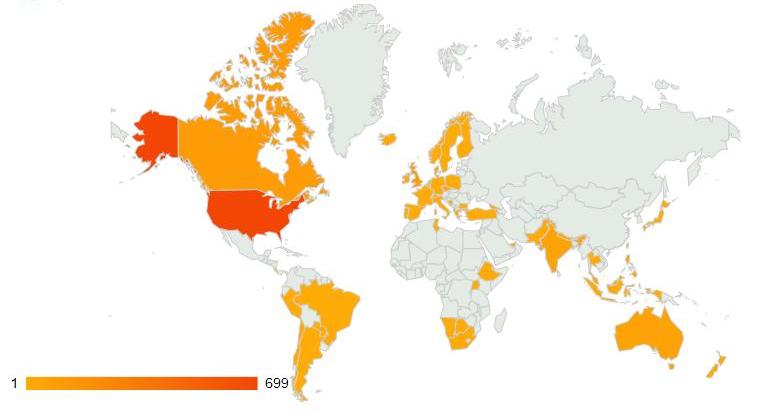
Way Cool Global View of My Blog!

Here is a global view of the views of my blog for the last week:

As you can see, the vast majority of my blog views come from the United States, but here are the number of views I’ve had from other countries during the past week:

United Kingdom FlagUnited Kingdom 111
Canada FlagCanada 106
India FlagIndia 59
Australia FlagAustralia 55
Philippines FlagPhilippines 19
Singapore FlagSingapore 18
New Zealand FlagNew Zealand 11
Malaysia FlagMalaysia 10
Viet Nam FlagViet Nam 8
Germany FlagGermany 6
Pakistan FlagPakistan 6
Botswana FlagBotswana 6
Denmark FlagDenmark 5
Nepal FlagNepal 5
South Africa FlagSouth Africa 5
Switzerland FlagSwitzerland 5
Turkey FlagTurkey 4
Taiwan, Province of China FlagTaiwan 4
Japan FlagJapan 4
Greece FlagGreece 3
United Arab Emirates FlagUnited Arab Emirates 3
France FlagFrance 3
Lebanon FlagLebanon 3
Thailand FlagThailand 3
Finland FlagFinland 3
Norway FlagNorway 3
Georgia FlagGeorgia 2
Czech Republic FlagCzech Republic 2
Belgium FlagBelgium 2
Qatar FlagQatar 2
Iceland FlagIceland 2
Bulgaria FlagBulgaria 2
Bosnia and Herzegovina FlagBosnia and Herzegovina 2
Sweden FlagSweden 2
Hong Kong FlagHong Kong 2
Ethiopia FlagEthiopia 2
Portugal FlagPortugal 2
Russian Federation FlagRussian Federation 2
Netherlands FlagNetherlands 2
Korea, Republic of FlagRepublic of Korea 2
Jamaica FlagJamaica 2
Trinidad and Tobago FlagTrinidad and Tobago 2
Poland FlagPoland 2
Brunei Darussalam FlagBrunei Darussalam 1
Uganda FlagUganda 1
Ireland FlagIreland 1
Spain FlagSpain 1
Bahamas FlagBahamas 1
Indonesia FlagIndonesia 1
Albania FlagAlbania 1
Brazil FlagBrazil 1
Armenia FlagArmenia 1
Tunisia FlagTunisia 1
Cyprus FlagCyprus 1
Paraguay FlagParaguay 1
Argentina FlagArgentina 1
Namibia FlagNamibia 1
Peru FlagPeru 1
Chile FlagChile 1
Costa Rica FlagCosta Rica 1

There was also one view from Italy, which didn’t show up on the table for some reason.

If you have a WordPress blog, you too can see these amazing statistics for your blog. Just go to http://wordpress.com, log in, then click on the My Stats tab on the WordPress home page, then scroll down a bit to find the global stats. If you’d like to see your views by country for a week, click on summaries. Isn’t that cool?

So, where do your viewers come from?

Excerpt From “Grief: The Great Yearning” — Day 3

So many people have told me lately that I should write a book about grief, that I realized somehow I’m not getting the point across — I did write a book about grief, and it is now published.

I never actually set out to write a book, never planned to make any of my writing public (except for the blog posts, of course), but I was so lost, so lonely, so sick with grief and bewildered by all I was experiencing, that the only way I could try to make sense of it all was to put my feelings into words. Whether I was writing letters to my deceased life mate/soul mate or simply pouring out my feelings in a journal, it helped me feel close to him, as if, once again, I was talking things over with him. The only problem was, I only heard my side of the story.  He never told me how he felt about his dying and our separation. Did he feel as broken as I did? Did he feel amputated? Or was he simply glad to be shucked of his body, and perhaps even of me?

People always mention how my pain shines through my words, yet at the beginning, I was in such shock, I didn’t feel much. Two years later, I still miss him, still hate that he’s dead, though I don’t have the physical trauma that I did, and I have regained some of my energy. It truly shocked me how exhausting grief is, but then, most of what I experienced shocked me. I never expected to feel this sort of grief. Never knew it was possible.

Excerpt from Grief: The Great Yearning

Day 3, Grief Journal

This was a hard day, though I don’t suppose any of them will be easy for a while. It’s amazing how little energy I have. I can’t do much at all. Today I rewound some of Jeff’s video tapes, the ones we watched toward the end. Perhaps tomorrow I will find the strength to put them away.

The hospice nurse came and got rid of the drugs. (Dumped them in a plastic bag of kitty litter, which turned them into a solidified mess, and took them with her.) The medical supply people are supposed to come tomorrow to pick up the oxygen tank. It’s like I’m rewinding his life. I wish I could rewind it back to the good times. We did have good times. I know we did. But everything got so muddled at the end. All we were doing was struggling to survive.

I can’t believe there was ever a time I wished the struggle were over so I could start my new life. How could I not have known I’d feel such pain? I heard today that losing a long-time mate was like an amputation, and that’s exactly what this feels like.

Good, bad, indifferent—it was all the same. We were together. We took care of each other. And now he’s been amputated from me and my life.

I got furious on his account today. It’s so unfair that he had such ill health, that his life ended too soon and too terribly. It seems unreal, now, that we took for granted he would die young. Shouldn’t we have railed against it more? But he was so disciplined, focusing his energies on trying to prolong his life and be productive.

I don’t know which is worse, the times I miss him dreadfully or the times I concentrate on doing something and he drifts from my thoughts. It seems such a betrayal. If he only exists in my memory and I don’t think about him, it’s as if he’s dying again. And once was hard enough. It takes my breath away when I realize I will never talk to him again. Well, I will talk to him, and I do, but we will never converse. I will never hear his voice.

I thought I was through telling people our sad little tale, but I’ve remembered a few others I have to notify about his being dead. I hope I don’t start crying when I talk to them. I’m tired of crying, tired of feeling sick to my stomach, tired of the hole in my chest. How do people endure such grief for months on end? I truly hate that he’s gone. Hate it!!

***

Click here to find out more about Grief: The Great Yearning

Two Years and One Day of Grief

Today I embark on my third year of grief since the death of my life mate/soul mate, and I am now in uncharted territory.

The first year of grief passes in a blur of angst, emotional shock, myriad physical reactions, painful surprises about the nature of loss and grief, and the almost impossible effort of going through the chores of living.

The second year of grief is one of learning to deal with the truth that he is dead, and that there is nothing you can do about it. No matter how well you deal with your grief, no matter how you rise to the challenge of life without him, he is not coming back. You knew this, of course, but now it has seeped deeper into your consciousness, and you feel it with every breath you take. Because of this, the second year (or at least parts of it) can be worse than the first. What makes the second year even harder to face is that you’ve used your grief card. Everyone thinks you should be over your grief, and they have little patience for your continued tears. They urge you to get on with your life, but they don’t understand that this is how you are getting on with your life.

The third year of grief is . . . I don’t yet know since this is only the first day of this new year. Today feels no different from yesterday or the day before, and I don’t imagine tomorrow will feel any different.

During the past two years, I’ve been looking for the bedrock of my new life — the thing, the idea, the place, whatever that bedrock might be — that gives me a foundation on which to build a future. Mostly, I’ve been waiting for my grief to dissipate so I can find my way, but the truth is, I will always grieve for him, though perhaps not as actively as I have been, because he will always be dead.

Acceptance is supposed to be one of the stages of grief, but I’ve never actually reached that stage (nor did I experience most of the supposed stages of grief). I cannot accept that he is dead for the simple reason that it’s not my place to accept it. Acceptance to me suggests that it is okay, and I will never believe that it is okay for him to be dead (even though I do understand the necessity of it). Perhaps acceptance only means that I accept the reality of my continued sorrow and loneliness.

People tell me that you never do get over such a grievous loss, but that after three to five years you rediscover the importance of living. It might be easier to meet the future head-on if I’m not expecting my sadness to dissipate. Maybe this is my bedrock — the missing, the yearning, the sadness, the loneliness. If so, I just need to accept that they are part of my life, and build from there.

Two Years of Grief

A year ago today, my life mate/soul mate died of inoperable kidney cancer. Wait . . .  what am I saying? One year? No. It’s been two years since he died. What a strange error to have made, yet perhaps it’s understandable. The night he died is still so very clear, as if he’s been gone only months, not years.

On the recommendation of his hospice nurse, I’d taken him to the hospice care center in the hopes that they could figure out how to regulate his drugs to give him the most lucidity and the least pain. It crushed my heart to take him there. I never got to talk with him again — he was in a drug-induced coma for those last five days of his life. I think he was at peace the final two days, though. All the time he was there, his breathing sounded like moaning, and I worried that he was in pain, but during his next-to-last day he exhaled a few melodious-sounding breaths, as if he wanted to reassure me he was okay.

He once told me that if it ever came to his being in a facility, he didn’t want me to visit, but how could I not? Even though the care center was sixty-five miles away, I went there every day, but I left early enough so I could get home before dark. The irony is he agreed to go so I could get some rest, but I never did sleep those nights. I was too worried about him.

His last night, Friday night, I didn’t go home. A few snowflakes fell and I used that as an excuse to stay. Also, I was restless, sensing the end was near. So I waited.

Around 1:30 in the morning, his breathing changed. Became harsher. I went to his side, said it was okay for him to leave, that I would be all right. At 1:40, he took a breath. His Adam’s apple bobbed once. Twice. And then he was dead. I kissed him by the side of his mouth. Waited a few minutes before I went to get the nurse.

I like that I got to tell them he was gone rather than have them tell me.

The nurse confirmed that he was gone. She called the funeral home, and I sat there in the room with him for two hours, just waiting. I might have cried. I might have been numb. I don’t really remember. I couldn’t even see his face — they had cleaned him and wrapped him in a blanket — so I just sat there, thinking nothing until almost dawn, when they came for him. (They came in an SUV, not a hearse. And they used a red plush coverlet, not a body bag.)

I followed them outside, watched them put him in the SUV and drive away, then I left. The highway was dry, but about halfway home, I skid. (I must have hit a patch of black ice, because there was no indication that patch of road was any different from what I’d already traveled.) I went careening, around and around, back and forth, my car totally out of control. I thought I was going to die, but oddly, I never left the road. The car finally came to a halt facing the wrong way on the highway. I was fine. So was the car. I remember wondering if he had stopped by on his way out of this world to leave me a final reminder to be careful, or maybe he was shaking his ghostly head, thinking that after his being gone only two hours, I was already getting careless.

He always worried that I wasn’t careful enough. I’m trying to be careful. Trying to take care of myself. I hope he’s taking care of himself.

The past two years have been agony for me. I know there was no way he could have continued to live considering the vast extent of the tumors. I know death was the only way to set him free from his excruciating pain. When he died, I truly was relieved. And yet . . . he was my best friend, my playmate, my business partner, my life companion. He was the one person who listened to me, who was always there for me. (As I was for him.) Even though I can see the necesssity of his death, I hate that he’s gone from this earth.

Not one of the previous 731 days have passed without my missing him. Even as I go on with my life, even as he and my grief recede further from me, I will continue to miss him. He was a good man. The earth is poorer for his death.

Grief — Two Years Minus Five Hours

In five hours, it will be exactly two years since my life mate/soul mate died of inoperable kidney cancer. He and I shared so much that even as I am getting to where I can accept the situation, even accept that I might find peace or possibly happiness, I can’t forget that it’s at his expense. I wonder what this feels like from his perspective. I know he wants me to go on, to get what I can from life — he told me that — but still, where is he in all this? At some point, our separation has to be complete, doesn’t it? I have to realize that whatever I say or think or do has no affect on him — it can’t change anything that happened. It can’t bring him back. And I don’t want him back — his death was too hard-won.

Iron Sam, the dying hit man in my novel Daughter Am I, told my hero Mary that a person experiences death only once. Well, my mate’s dying was my experience of death. The utter undoableness of it — the finality — shocked me to my core (and still gives me that falling-elevator feeling of panic when I think of his being dead). That shock must be what can only be experienced once. A prognosis of my own death probably won’t have the same impact on me as his diagnosis. Will I have his strength, his courage? I won’t have him, and that might not be a bad thing. Maybe my death will be easier to handle if I know I’m not going to devastate anyone when I go. (I think about that, how hard it must have been on him to know he wouldn’t be here to comfort me after he was gone.)

People always talk about finding someone to grow old with (and oh! I so do not want to grow old alone), but I’m not sure growing old with someone is a blessing. Lately, I’ve been seeing a lot of very old couples (this area is filled with hospitals, doctors offices, oncology clinics, pain treatment centers, nursing homes) and I try to imagine what it would be like for the two of us to deal with each other’s old age infirmities. I’m glad he’ll be spared that. It was hard enough for him to die without having to worry about my dying, too.

I wish he were waiting for me on the other side of grief so we could start a new life together, and in a way he will be there — he is still so much a part of me. Maybe literally a part of me. If we’re all made of stardust, if everything is commingled, how much more commingled are we who spent so many decades in each other’s company! The biorhythms of people who live together ebb and flow in sync. Benign and not so benign viruses carry cell information from one to the other, intermingling physical bodies on a cellular level. As one of my fellow bereft reminded me yesterday, “The heart puts out an electrical field which is measurable and it intertwines with the electrical field of the other loved one and when that is gone, the body knows it and feels the loss.”

I’ve heard that every seven years a person’s cells completely turn over, so that in seven years you become a different person. In seven years, then, maybe I won’t feel such yearning for him since he will no longer be written into the fabric of new cells. But beyond the physical commingling, there are all the movies we watched together, the books we shared, the thousands upon thousands of hours of electric conversation, the ideas we developed, the businesses we created — all those are part of me.

But  there is so much that will never be part of my life again. His smile nourished my soul, his laughter warmed my heart, his voice soothed my ears, his wise counsel eased my mind.

How have I survived such enormous losses? One day a time, that’s how. Sometimes one tear at a time. And so two years (minus five hours) have passed.