Does It Matter to Anyone What I Think?

I’ve been thinking about what I wrote yesterday, my being afraid to say what I think. I’m not sure it’s fear, like hiding-under-the-bed fear, that keeps me from talking about the things that worry me. It’s a healthy sense of self-preservation, but even more than that, it’s that I don’t think it matters what I think. It is interesting to talk to people, to get other points of view, to broaden one’s outlook, but when such a discourse is not available, when all people want is to propound their own point of view (emphasis on “pound”), talking doesn’t advance any cause. (Nor does burning buildings, or even oneself, but that’s a discussion for a more benign and less uncivil era.)

In a gale force wind, a puff of breath is not noticed, and certainly won’t help to calm the forces creating the wind. In a ship violently crashing from side to side because of insanely high waves, nothing one can say will rock the boat any further, and certainly won’t help to steady the craft or the people in it.

If what I said (or wrote) really mattered, I might be courageous enough to tell my truth, but when so many people have already made up their minds, locked their mental door behind them, and pulled up the drawbridge against critical thought, a single word or a thousand will not batter down those fortifications.

A greater problem than closed minds is that people hear what they want to hear, filtered through their own value system. They hear a slogan, process what it means to them, and then head out to defend that slogan without ever finding out what that slogan means to the people who wrote it and what their agenda really is. Which means sometimes well-intentioned people fight against their own interests without knowing it.

This is a relatively short blog. I’d written a lot more, even going so far, despite my reservations, as to talk about many of the issues at stake, but in the end, I deleted all that because I realized it truly doesn’t matter what I think. I’m not sure it even matters to me. Nothing I think will change anything. Nothing I say will change anyone’s actions, so is there any point in even thinking about the current situation? It’s not as if I’m young and still have a whole lot of ideological formation ahead of me. I’m pretty much a done deal. I’ve mostly lived my life in my own head, and a lifetime of thinking and reading and researching and studying and writing and being can’t be undone by new/old emotionally-charged slogans or radical groupthink.

Besides, nothing in this new world is more redundant than an old woman, no matter how perspicacious her thoughts might be.

***

Pat Bertram is the author of Grief: The Inside Story – A Guide to Surviving the Loss of a Loved One. “Grief: The Inside Story is perfect and that is not hyperbole! It is exactly what folk who are grieving need to read.” –Leesa Healy, RN, GDAS GDAT, Emotional/Mental Health Therapist & Educator

Being Afraid to Say What I Think

Malcolm R. Campbell, author and fellow blogger, posted an article yesterday entitled, Are you afraid to say what you think?

He mentioned, among other things, penalties imposed on people for exercising their right to free speech, the lack of civility, allowing violence under threat of more violence, and mob-enforced political correctness. He was also brave enough to say that most of us see and hear enough stuff daily to know how and why the problem is larger than what can be put in single blog. And he admitted that he no longer felt safe enough to say how much larger the problem is.

I responded to his blog: I’m certainly afraid to say what I think. I study everything, including both sides of an issue, and often my views end up being on the quiet end of the spectrum rather than the burning-down-buildings end. When I was on FB and shared something interesting that a conservative non-white said, people accused me of being racist rather than seeing that I had just found an alternative point of view interesting especially since it didn’t follow the official narrative. Some people don’t mind causing conflagrations, either real or virtual, but I don’t have the stomach for it. I brood too much. In fact, I’ve been wanting to write a blog mentioning some of the ironies of the current situation, and I simply don’t want to have to deal with the backlash. Or even worse, the quiet condemnations that I don’t hear about until much later. Even more than that, mobs scare the hell out of me, and I certainly don’t want to bring myself to the attention of a flame-wielding, rock-throwing, gun toting mob with but a single mind.

This being loath to speak my mind started long before the current volatile situation, and was a direct result of Jeff’s death.

Jeff was the only person I ever met who I could talk to without censoring myself in some way. No matter how outrageous my opinion might have been, no matter how much it went against the current belief and what we were taught, he always treated my remarks with respect and in fact could come back at me with a clarifying point, a different way of looking at the situation, perhaps even the title of a book I could read that would take my points a step further.

I hadn’t realized how spoiled I was being able to say anything, think out loud, express what to others might be unpopular opinions. It was a freedom I hadn’t found before Jeff and certainly have never found after him.

Some of the things I want to say to people I am conversing with aren’t full-fledged ideas, but rather the beginning of a complex thought buried somewhere in the back of my mind, but even the most intelligent person seldom can get beyond my inciting comment, so we end up arguing a point I didn’t even wish to make until I finally tell them to forget it, to ignore what I said, and let’s agree to disagree. This makes them uncomfortable and leaves me with a nest-full of half-formed ideas with no place to fly.

After a few such misunderstandings during the first years of being without Jeff, I’ve gotten good at gauging what ideas people will accept or not accept. Sometimes, I put a toe (or a claw if I want to keep up with the bird metaphor) in the conversational waters, and quickly draw it back if I find resistance, so generally, I end up listening to people way more than I speak. Because of this, not only can I gauge what people might be willing to accept, I also learn how they think. And all too often how they think is an indication that they don’t think at all; they simply react.

If people today can get killed by doing nothing but wearing the wrong hat or the wrong tee shirt or the wrong smile, then it’s no wonder so many of us are afraid to tell the truth even in our personal online spaces. (Because when it comes to an online space, there is no personal space with unbounded freedom from rancor to say what one wills.)

If I weren’t fearful of hurting people’s feelings or having hatred rained down on my head, I really would like to write a blog discussing some of the ironies of the minority rights issue, such as the way successful minorities, especially conservatives, are called “Uncle Tom”s, as if a person can’t be anything other than the color of their skin, which itself is the basis of racism, right? Adding to the irony, the original Uncle Tom wasn’t an Uncle Tom in the sense it’s used today, meaning a racial sellout, but was instead based on a real life heroic character who died to protect two runaway slaves.

There are many such instances where anti-racists turn out to be more racist than proclaimed racists, sometimes by infantilizing minorities as if they can’t think or do for themselves, which makes it even harder to say anything about the melanin issue without being tarred with the “r” word.

But oops. I’m straying from the point, and perhaps disproving my point in the process, which is being afraid to say what I think.

***

Pat Bertram is the author of Grief: The Inside Story – A Guide to Surviving the Loss of a Loved One. “Grief: The Inside Story is perfect and that is not hyperbole! It is exactly what folk who are grieving need to read.” –Leesa Healy, RN, GDAS GDAT, Emotional/Mental Health Therapist & Educator

Imagined Future

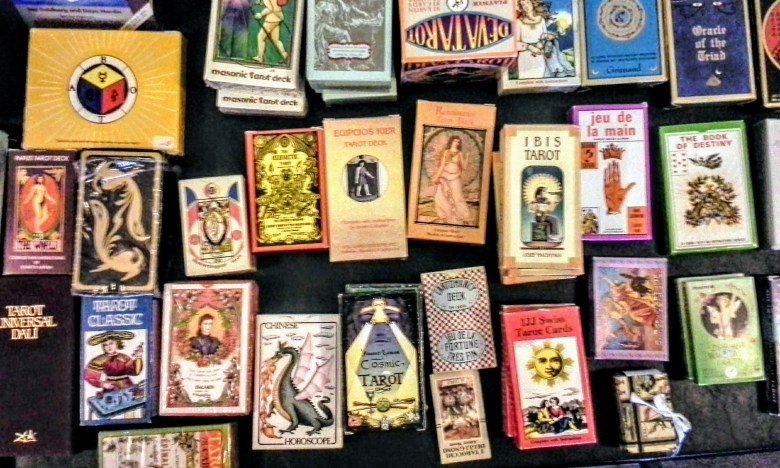
I’ve been continuing my practice of picking one tarot card every day, not so much to learn what is in store for me in the future or to delve into the secret places of my soul, but simply to get familiar with the idea of the tarot. I mean, I have all those decks of cards that my deceased brother collected, so I should do something with them, right? Besides, it’s a way of honoring him and all he wanted but was never able to accomplish.

The most interesting thing I’ve found while doing this exercise is how often I get one of the dire cards one day, such as the nine or ten of swords, and one of the most fortunate cards the next day, such as The Sun.

So far, I haven’t learned much about the cards themselves or myself, just that I refuse to see bad in the bad cards, though I do enjoy seeing good in the good cards. If I get a card that seems to spell disaster, then I keep searching for meanings until I find an interpretation that portends something better. For example, the ten of swords can mean violent accident or death or misfortune on a grand scale, which I won’t accept. It also means that no matter how much we try, we cannot control everything, which I will accept. Not being able to control everything is a truth that can be applied to any situation and a lesson that behooves us all to learn.

Beyond that, I hadn’t realized why I objected to anything to do with foretelling the future until I read this quote:

People didn’t want to know their real future. They wanted to know their imagined future, the one they cherished instead of fearing. — “The True Secret of Magic,” a short story by Joe Edwards

I realized then that foretelling the future is like writing a story. Every story, taken to its logical conclusion leads to death because we all die. If we write the story all the way to that end, the story is a sad one. To make a happier story, we end at a pleasant time in the character’s life. Perhaps a wedding and a belief in happy ever after. Or the solution to a crime and justice for a victim.

Telling the future would be the same. Almost any fortune that doesn’t include specifics, such as telling someone they will be divorced within the year, will fit practically any situation. Almost any future will include happiness and sorrow, success and failure, sickness and health, betrayal and forgiveness. And every future, no matter how sunny and felicitous, ends in death. At least an earthly future does, and that’s what concerns us: how our life will be.

We want the pretty story, a belief that no matter how bad things are, things will work out to some sort of satisfying conclusion. (Isn’t that what we want from fiction, too? A satisfying end to a story, a belief that all the horror the character went through was worth it in the end?)

I know my end, perhaps not the specifics of my expiration date, but that there will in fact be an end to me. Meantime, I try to create my fortune — my future — every day. Even knowing that I can’t control everything, I try to control something — my attitude, my actions, my interactions with people — in such a way that I will have a felicitous fortune.

I don’t need to be told a bright future, and I certainly don’t need to be told a bleak one. Both will happen. Both will affect me. Both will be processed and I will move on to another day, another future.

I suppose if I were young, I would want to know if I’d be pretty, if I’d be rich, if I’d find love and happiness, but those wishful, youthful days are long gone. I once loved greatly, once was loved. I once felt immense joy and experienced vast sorrow. I once shared my life with someone. And now I don’t.

But just as I shy away from foretelling, I shy away from backtelling. In the first case, whatever will be, will be, though my actions today can affect what will be. In the second case, whatever was, was, and my actions today won’t change any of it.

But neither case really matters. What matters is . . .

What matters is . . .

Hmm. I’m not really sure what matters. That I am determined to cherish whatever my future might be rather than fearing it? That right now I am living a future I could never have imagined even a couple of years ago? That I am trying to imagine a comfortable future for myself? (Though if a great present came from nothing I ever imagined in the past, would anything I imagine in the present affect the future?)

Maybe what matters is that I am living as fully as I can, which, apparently includes picking and learning about one tarot card every day.

***

Pat Bertram is the author of Grief: The Inside Story – A Guide to Surviving the Loss of a Loved One. “Grief: The Inside Story is perfect and that is not hyperbole! It is exactly what folk who are grieving need to read.” –Leesa Healy, RN, GDAS GDAT, Emotional/Mental Health Therapist & Educator

Stocking Up

I was talking with friends the other day about our various philosophies of stocking up on food and other necessities. Some of them prefer a huge walk-in pantry, full of all sorts of comestibles. Me? I have a shelf in a small cupboard. I suppose that’s not entirely accurate if you include spices and seasonings as pantry items because that sort of thing resides in a separate cupboard. But for actual foods, those are all but missing.

My refrigerator is mostly empty, too, as is the freezer, which could be why it doesn’t work all that well. In the summer, it’s hard to keep the temperature in the refrigerator compartment below 45 degrees, and in the winter, it’s hard to keep it above 35 degrees, but I am careful about what I keep in the refrigerator so that it doesn’t really matter. I do keep some things in the freezer, but there have been too many times in my life when the electricity went out and food spoiled, so I’m careful not to keep too much frozen food on hand.

Although I think I do have enough food in the house to last me a week if a major storm hit (apparently, storms have closed up the town before, with snow so high people couldn’t get out of their houses), but just in case, I stocked up. Bought two whole cans of beans and two of tuna. (Besides, if I could get out of the house and walk just a bit, I know someone who has a whole larder full of food!)

Apparently, the last such major storm that hit here blanketed all of Colorado. This was a couple of years before Jeff died, and I don’t remember having a problem with food. (Though we did have a problem with the horrible neighbors who plowed the lane and dumped all the snow in front of our driveway so it took us a week to dig ourselves out.) But back then, we did stock up. It was after he died, and I had to try to find a place to donate all the food I couldn’t take with me, that I developed an aversion to excess food storage. The senior center didn’t want the canned goods, the churches didn’t want it, it was the wrong time of year for food banks. I finally found an old woman who said she knew people who could use the food.

Even if the worst happened and I couldn’t get any other food but what’s in the house, I wouldn’t starve. I have a peasant metabolism that is the result of centuries of systematic starvation — the people who survived such times were those whose metabolisms slowed way down when food intake was reduced. Such a metabolism is a curse in times of plenty, but a blessing in times of scarcity.

Despite all this, I wouldn’t have stocked up even to the extent that I did, but this weekend we are going to have record high temperatures followed immediately (immediately meaning within a twelve-hour period) by record lows. A fifty to sixty degree temperature drop. Yikes.

I still have a couple of days before this historic occasion in case I want to stock up even more (maybe buy some mayonnaise to go with that tuna), but I figure I’ve been dealing with The Bob all this time without stocking up, so I’m not worried.

Just out of curiosity, do you stock up or do you just sort of wing it?

***

Pat Bertram is the author of Grief: The Inside Story – A Guide to Surviving the Loss of a Loved One. “Grief: The Inside Story is perfect and that is not hyperbole! It is exactly what folk who are grieving need to read.” –Leesa Healy, RN, GDAS GDAT, Emotional/Mental Health Therapist & Educator

A Feast of Friendship

Some Asian cultures have a tradition of preparing an elaborate meal for their deceased loved ones on the anniversary of their deaths. Those left behind spend all day cooking the loved one’s favorite foods, lay out a fabulous feast and let the deceased partake as they will. Afterward, family and friends gather around the table and eat the “leftovers.”

I was invited to such a feast yesterday by my very dear Thai friend. Although the occasion could have been a somber one, it was in fact a delightful family affair. My friend and her husband have embraced me and another woman who lost her husband as family, and truly, it does feel that way.

The food was beyond awesome, though I am ashamed to admit I didn’t catch the names of some of the dishes, and those I did pay attention to, I couldn’t even begin to spell. But there was chicken; duck; a sort of pork dumpling; cellophane noodles with shrimp; soup; Thai style hard-boiled eggs; a medley of mangosteen, rambutan and litchi fruit; fresh mangos, bananas, grapes. Oh, so many delicious foods!

What really struck me though, were the long journeys each of us had taken — both geographically and metaphysically — that brought us all to the same place at the same time. One from Denver, one from Dallas, one from Thailand, one from Malaysia. For me, that was the true feast — an international feast of family and friendship.

***

Pat Bertram is the author of Grief: The Inside Story – A Guide to Surviving the Loss of a Loved One. “Grief: The Inside Story is perfect and that is not hyperbole! It is exactly what folk who are grieving need to read.” –Leesa Healy, RN, GDAS GDAT, Emotional/Mental Health Therapist & Educator

The Long View

I’m reading a sort of romance written a hundred years ago. I say “sort of” because I don’t think there was a romance genre back then, at least not the way we know the genre. But it’s irritating me in the same way that modern romances irritate me. So much of the story is based on non-communication. If the people involved simply talked to each other, there wouldn’t be a problem (or a story). I suppose it makes sense for such an old book to be based on communication problems because that era was the beginning of it being acceptable for women to speak their minds, especially around men. But for modern stories to be based on the same stupid theme? Not acceptable.

That’s not the only thing impinging on my life right now that I find unacceptable. Rich, successful black politicians, politician’s wives, celebrities, sports figures who are feted and adored by blacks and white alike are telling their story with the same old racist rhetoric. “White people don’t see me.” “White people hate me.” Um . . . did it ever occur to these folks that maybe it is not their racial heritage that some people might object to, but them specifically? Not everyone likes everyone. Not everyone sees everyone. Not everyone cares about everyone. (Though we often pretend to.)

This reminds me of what Jack Nicholson said to Michelle Pfeiffer in the movie Wolf. “You know, I think I understand what you’re like now. You’re very beautiful and you think men are only interested in you because you’re beautiful, but you want them to be interested in you because you’re you. The problem is, aside from all that beauty, you’re not very interesting. You’re rude, you’re hostile, you’re sullen, you’re withdrawn. I know you want someone to look past all that at the real person underneath but the only reason anyone would bother to look past all that is because you’re beautiful. Ironic, isn’t it? In an odd way you’re your own problem.”

Other than that, I find nothing objectionable about my day. Well, I do find it objectionable that a couple of my Kentucky coffeetrees seem to be fading away. But if they all die, I’ll wait until fall or next spring, and beg my neighbor for another of the tree’s “volunteers” that will be growing in her yard. (There is one thing about the beans that bothers me. They are poisonous if eaten raw, but when roasted, they once served as a coffee substitute for prairie folk. My question is how did they discover that? If you eat the seeds, you get sick and maybe die. So why would you roast the seeds and try again? And how would you know they would make a coffee substitute if they made you sick before you could learn that?)

Although it’s uncomfortably humid today, it’s also cloudy and cool enough that I was able to plant my new plants. Perhaps they will do okay, but I won’t really know until next spring. Gardening is a hard occupation for a person who likes to see quick results, but then, it’s probably a good occupation for such a person — it teaches one to look at the long view.

Unfortunately, a long view isn’t necessarily different from a short view— look at the 100-year-old romance: the same today as it was then.

I suppose it’s possible that the folks who learned to roast the coffeetree beans took the long view, thinking that some illness and a few deaths were worth the long-term gain, in which case the long view paid off.

In other cases, such as the ongoing violence, burning, and looting that’s been going on for months now, the long view isn’t worth contemplating because what’s going on now can’t portend anything good for the future.

So maybe taking the long view isn’t necessarily a good thing to learn. Maybe I don’t need to learn anything when it comes to gardening — just do what I can, and see what happens.

***

Pat Bertram is the author of Grief: The Inside Story – A Guide to Surviving the Loss of a Loved One. “Grief: The Inside Story is perfect and that is not hyperbole! It is exactly what folk who are grieving need to read.” –Leesa Healy, RN, GDAS GDAT, Emotional/Mental Health Therapist & Educator

The Glad Game

When I was a girl, I often got hand-me-downs from a much older and thinner cousin, which gave me a bad body image way too young and many years before it became a “thing.” My books, most of which had been published in the early part of the twentieth century, were also hand-me-downs from her. Looking back, some of the books themselves seemed old even then, so they might have been handed down to her first — odd to think I never thought to ask where the books originated.

I read as much then as I do now, so whenever I got sick and had finished reading all my library books as well as those of my siblings, I’d reread these novels. I had a few Nancy Drew, a lot of Judy Bolton, some miscellaneous stories, and a boxed set of five Pollyanna books that chronicled her life way past childhood. One year I was absent from school so often that I must have read these books three or four times. (I remember thinking I was pretending to be sick so I didn’t have to go to school, but once when I told my mother this, she said, “You really were sick.” But silly me, I never asked what my illness was.)

Way into my late teens, whenever I wasn’t feeling well, I’d reread these books. I don’t know what happened to the mysteries, but a friend wanted the Pollyanna books, and so I gave them to her. (She doesn’t remember this, but it was a long time ago, and I’m sure her receiving the books wasn’t as emotionally charged as my giving them.)

I was particularly enthralled with Pollyanna and her glad game, and I even tried playing it myself, but being the pragmatist and realist that I am, I couldn’t always see “gladness” even in the things she found to be glad about. The game began when her missionary parents received a “missionary barrel” of donated items, and the only thing for a little girl was a pair of crutches. Her father told her, and she believed, that she could be glad she didn’t need them.

To my way of thinking, she could have been just as glad not to need them if she had also received the doll she wanted, and the doll would have lasted a lot longer than the gladness for not needing the crutches. But then, of course, if it had worked out my way, there wouldn’t have been a story.

What made me think of all this is that my co-worker is a real-life Pollyanna, though her key words are not gladness but “this is a good thing because. . .” I’d seen her in action before, trying to keep our charge from descending into a funk, but her skill really struck home yesterday.

The client (for lack of a better word) and I had spent our time together grumping about the things going on in the world today. Being a grump has its place, I think. Facing the reality of widowhood and age certainly has its place. Mostly we just acknowledged the various situations we talked about, and then went on to something else without dwelling on the issues.

When our friend and coworker came home with her gladness, it struck me how very different two valid points of view can be. I’m ashamed to admit that I burst out with, “You’re a real Pollyanna!” Not only is it rude to make personal remarks like that, but the word “Pollyanna” is also sort of trite and meaningless nowadays, devoid of any literary context, especially since others have used the word to describe her. I tend to think it’s different for me, steeped as I have been in the whole Pollyanna literary mystique for so much of my life, not an offhand comment so much as a reflection of the hundreds of times I’d read the Pollyanna books. I could actually see my co-worker in that dauntless girl, changing the world around her with her attitude.

For a few minutes, I considered emulating her, but then I remembered my previously failed Pollyanna-isn-ness. And I remembered how much good I’ve done by dealing with certain realities — such as grief — in all their stark horror, bleakness, and pain by saying, “yes, this is hard, and it will always be hard.”

One thing that I can be glad about — because of this episode, I downloaded the first two Pollyanna books (the two written by the original author) as well as a couple of others she’d written with that same “life is beautiful” attitude.

And the author is right — life is beautiful.

Even when it’s not.

***

Pat Bertram is the author of Grief: The Inside Story – A Guide to Surviving the Loss of a Loved One. “Grief: The Inside Story is perfect and that is not hyperbole! It is exactly what folk who are grieving need to read.” –Leesa Healy, RN, GDAS GDAT, Emotional/Mental Health Therapist & Educator

Seedling Forest

We’ve talked before on this blog about the changes that are happening or might be happening because of having to wear masks. Without being able to see smiles, we don’t connect as well with others. Without being able to see mouths forming words, we don’t hear as well. (Which is a serious problem for the hard of hearing.) Without the humanization of faces, we are in danger of becoming dehumanized. And, as I’ve been discovering, they make us cranky, especially me.

I’ve been shopping at the local market partly as a rebellion against the closures — it seems so wrong to keep Walmart, Home Depot, Lowes, and other corporate businesses open, but forcing smaller businesses to close their doors. You’d think the local grocer would be pleased to have such a loyal customer, but what was once a pleasant experience has become decidedly less so. Out of the last three visits, twice I was overcharged, twice the clerk was rude, twice I ended up fuming and thinking that maybe shopping at Walmart isn’t so horrible after all.

(This rudeness is something I’ve often wondered about when it comes to small independent stores. They don’t offer the discounts that the major stores do, they don’t offer service, they don’t smile or make the visit anything more than a ho-hum shopping trip. They act as if they’re that pretty girl who knows she’s pretty and so has to do nothing to foster a relationship but accept one’s homage.)

Today the shopping experience was especially unpleasant, and I know it was the crank factor.

The skies are cloudy, though there are no clouds — that cloudiness is the smoke drifting here from the fires in Colorado and California. Because the air is still, the smoke just hangs around. (Such irony! There have been strong winds most of the summer, and now that we need to move out the smoke, the winds have disappeared.) Although I can see (and taste) the smoke, I can’t smell the air — I am allergic to smoke, so my poor aching sinuses have closed off my smeller. It’s hard enough to breathe without the mask, but once that’s added, oh, my. So not fun! (Hence the tendency toward crankiness.) I should, of course, have thought of this before I went to the store, but I needed to drive my car and I wanted to get various healthy snacks to take to work tomorrow. (We always have an afternoon snack, so I’ve been eating things that are in her house but aren’t on my diet, such as cookies. I don’t have to have them, but the sharing of a meal is even more important than the snack itself.)

So what does all this have to do with my seedling forest? Not a whole lot, really, except that it pleases me to be growing trees at a time so many trees are being destroyed. Admittedly, these seedlings will not in any way offset the millions of trees being burned, but then, there’s not much any one person can do about any of the horrors that are defining our world today — the fires, the riots, The Bob, wearing masks. Still, it’s something.

Most of the seedlings are locusts that planted themselves in my yard, though one was grown from a seed in the pot itself. Previously, I’ve tried transplanting the seedlings into the ground directly, and they just died. (I have a hunch it has to do with the harsh sun burning their tender shoots before they got over their transplant shock). Oddly, the seedlings seem to like the pots. A couple of the seedlings are Kentucky coffeetrees, new additions from my next-door neighbor. Apparently, these trees are rare in this area, and her next-door neighbor ending up cutting down his coffeetree (to the horror and sorrow of the tree cutter) as well as a couple of my neighbor’s trees (a property line dispute, which makes me even happier that I had my property surveyed), so she and I are trying to repopulate the area with these gems.

Planting trees seems such a hopeful, non-cranky thing to do, and best of all, I don’t need to wear a mask to tend to my seedling forest.

***

Pat Bertram is the author of Grief: The Inside Story – A Guide to Surviving the Loss of a Loved One. “Grief: The Inside Story is perfect and that is not hyperbole! It is exactly what folk who are grieving need to read.” –Leesa Healy, RN, GDAS GDAT, Emotional/Mental Health Therapist & Educator

The Shadow of Family Trees

I live in a small town where people tend to stay when they’re grown, or if they leave, they come back to retire. I thought there would be a problem, since the residents of many such towns tend to stick together and not welcome newcomers, but not here. Everyone (well, almost everyone — there’s always that one person who aggravates) has been kind and welcoming. Now that I’m sorting out the family trees just a bit, this welcome amazes me even more. It seems as if almost everyone is related within one or two degrees of separation.

For example, I met the grandson of the woman I am working for (with?) and today, talking to another friend, she mentioned her grandson of the same name. Turns out, it’s not a coincidence of names — the same boy is the grandson of both women. In another case, one friend’s grandfather is another friend’s uncle. I can’t even wrap my mind around that!

I may never get all these relationships straight, but it doesn’t matter. The shadow of their family trees doesn’t fall on me like it does with those who grew up here. I can take people are they are, rather than what limb they came from.

Another thing I discovered (that has nothing to do with family trees, though it does have to do with plants) is that at one time, 92% of all zinnia seeds came from this area. It must have been beautiful, driving down a highway lined with jewel-toned fields, all the colors mixed together in a riot of joy. It certainly explains why zinnias seem to like me — it’s not me so much as that they feel at home.

It would be nice to think that the zinnias I found growing in my yard were descendants of the original flowers, but I doubt it. Although I was surprised to find the zinnias, it’s only because I forgot that I planted them. Well, in a way, I planted them. I had some old seeds that I threw out into the yard instead of tossing the unopened packet in the trash. Most of the seeds did nothing, but the zinnias decided to grow. So nice of them!

I’ve never really had any special feeling for zinnias, but after this summer, seeing the cheerful blooms and knowing they belong in the area, might even belong to the same family tree as those original zinnia fields, I’m considering planting a yardful of them next year.

One of my new friends (one of the grandmothers) told me about a seed store in a town up the road a piece. They might even have seeds grown around here, which would be nice.

What is also nice is being able to plan for next year, knowing that unless something traumatic happens, I’ll still be here in this small town. And probably still trying to sort out the shadows of all those family trees.

***

Pat Bertram is the author of Grief: The Inside Story – A Guide to Surviving the Loss of a Loved One. “Grief: The Inside Story is perfect and that is not hyperbole! It is exactly what folk who are grieving need to read.” –Leesa Healy, RN, GDAS GDAT, Emotional/Mental Health Therapist & Educator

Dilemmas

The women I work with and for invited me on a drive this afternoon. We went out in the country and saw where the one woman grew up, where their relatives once lived, where various other people I don’t know once lived, as well as a lesson on the water dynamics of the area. Some of the big farmers and ranchers saved their water rights, but people with smaller acreages and adult children who didn’t want to farm, sold their rights to be able to stay in their houses.

I understand this was a tough decision for people, but not being a rancher/farmer, all I can do is shake my head and wonder if they’d ever seen a western movie. It seems that a huge number of westerns revolve around water rights, generally, with the evil banker trying to corner the valuable water market, and so the idea that anyone would sell their water rights seems self-defeating. Money now, of course, but not later when/if it comes time to sell the property. Still, not my dilemma.

My dilemma is a different one, though still in the financial realm. A relative had some very bad luck, and my first inclination was to send her a check to help her out. Then I got to thinking about it, and realized that I accepted a job to help my own financial situation, and if I sent her anything, in essence, then, I would be working for her benefit, not mine, that all the money for the work I will be doing for the next several months would be going in her pocket.

Oddly, the tarot card I picked today — The King of Pentacles — reminded me to stay in control of my energies and resources in pursuit of a larger goal (such as a solution to my own precarious financial situation). Although this is also a card of generosity, I am tending toward the less generous outcome, more because of the job than anything. Still, I feel bad for her, so who knows.

Since these dilemmas are not pleasant to contemplate (if they were pleasant, they wouldn’t be dilemmas, I’m sure), I’m adding photos my zinnias. They might not have anything to do with anything I’m writing about today — they pose no dilemmas — but they do make me smile, and I can use a few smiles right about now.

***

Pat Bertram is the author of Grief: The Inside Story – A Guide to Surviving the Loss of a Loved One. “Grief: The Inside Story is perfect and that is not hyperbole! It is exactly what folk who are grieving need to read.” –Leesa Healy, RN, GDAS GDAT, Emotional/Mental Health Therapist & Educator