A Welcome Rejection

Usually rejections are accompanied by regret or demorialization, but I can honestly say this rejection comes as a welcome relief.

I had applied for a Pacific Crest Trail sponsorship, and today I got this message:

Thanks for applying to our mYAMAdventure program.  This is the part of the program that I hate: I’m afraid we’re not able to extend an invitation to you this year.  We received over 100 applications, and narrowing them down to just five was a true challenge.  It’s a shame we can’t work with all of you.

I wish you all the best in your pursuits on the PCT!  If you haven’t already, check out the following resources for a start with your planning:

Yogi’s PCT Handbook: http://www.yogisbooks.com/pacific-crest-trail/pct-yogis-pacific-crest-trail-handbook
pct-l mailing list: http://mailman.backcountry.net/mailman/listinfo/pct-l
Postholer forums: http://postholer.com/

Yay! Making the starting date for the hike would have put too much pressure in my already stressed-to-the-limit life. And it would not have brought me the simplicity I crave. As I have learned, thru-hiking the Pacific Crest Trail is an athletic event where participants challenge themselves to complete the hike within the allotted weather window, more of an obstacle race than the transcendental walk I had envisioned!

So, where does this leave me? When I figure that out, I’ll let you know.

***

Pat Bertram is the author of the suspense novels Light Bringer, More Deaths Than One, A Spark of Heavenly Fire, and Daughter Am I. Bertram is also the author of Grief: The Great Yearning, “an exquisite book, wrenching to read, and at the same time full of profound truths.” Connect with Pat on Google+. Like Pat on Facebook.


Using Dance

When I told an acquaintance I was taking classical dance lessons — ballet, jazz, tap — she gave me a blank-eyed stare and said, “How do you use it?” From her point of view, the question apparently seemed logical. She had once taken ballroom dancing, and she could use her skill if/when she went to a ballroom or nightclub or wherever such dancing takes place. I have no corresponding “use” for classical dancing, though I have been invited to participate in a few performances so I have used some of the dances I know.

danceStill, in the year and a third that I’ve been going to class, I never once considered whether there was a use for dancing. If anything, it’s more that dance has a use for me. It takes me beyond myself and at the same time, takes me into myself, making me more comfortable with who I am than I’ve ever been in my entire life. (I think it has something to do with living in front of a mirror for all those hours each week.) It’s the only thing I’ve ever done that demands all of me — mind, body, spirit, strength, dedication, loyalty. (I listed “mind” first without even thinking about it, and I was going to change the order to put body first, but this is the right order. Without the mind — learning, memory, imagining — there is no dance.)

Dance is a generous taskmaster and gives back more than it demands. Although I am nowhere near as graceful, balanced, and strong as I would like to be, I have come a long way since I began taking lessons. I can feel muscles now where there used to be . . . whatever there used to be. And I am a bit more balanced and graceful than I was before. Best of all, these benefits will remain with me even when I can no longer take dance classes.

There’s no need to “use” dance. Dance is its own reason for being.

***

Pat Bertram is the author of the suspense novels Light Bringer, More Deaths Than One, A Spark of Heavenly Fire, and Daughter Am I. Bertram is also the author of Grief: The Great Yearning, “an exquisite book, wrenching to read, and at the same time full of profound truths.” Connect with Pat on Google+. Like Pat on Facebook.

You Matter

I received this letter yesterday:

Dear Pat,

Give more than presents this holiday season, share the gift of caring with those who matter to you most!

With the holidays around the corner, the USC School of Social Work believes that there is no better time to encourage random acts of kindness. The simple act of telling someone why they matter could have a bigger impact than you know. For that reason, you’re invited to participate in You Matter, a grassroots campaign designed to foster well-being and bring back some much-needed human connection. We are on a mission to spread as much positivity as possible, and we hope that you’ll join us!

There are four easy steps to participate in #YouMatter:

1) Download a Care Card from the MSW@USC blog.

2) Write a message with someone in mind.

3) Snap a picture of your card and share on social media using the hashtag #youmatter and tag us @youmatterbc to inspire others.

4) Give the Care Card to someone and make that person’s day!

There’s never a better time than now to show others that that they matter in this world. If you love this campaign as much as we do, we ask that you please pay it forward by featuring #YouMatter on your blog.

Wishing you a wonderful and safe holiday season,

Gaby Acosta

####

Sounds like an interesting campaign, even if she did neglect to tell me I matter!

If you’re interested in participating in this project, here is a “you matter” template to use. (Just right click and “save image as…) I was going to fill in the template, but in the end decided there was no “because.” You matter. It’s as simple as that.

you matter

***

Pat Bertram is the author of the suspense novels Light Bringer, More Deaths Than One, A Spark of Heavenly Fire, and Daughter Am I. Bertram is also the author of Grief: The Great Yearning, “an exquisite book, wrenching to read, and at the same time full of profound truths.” Connect with Pat on Google+. Like Pat on Facebook.

Stressed to My Limits

I’m sitting here, wondering if I should write this post. I don’t want to make anyone feel bad, so I’m hoping the women involved don’t read this or if they do that they don’t fret, and yet, ever since my life mate/soul mate died, I’ve tried to write my truth.

I had lunch today with some friends after dance class. (Got to replenish those expended calories!) I was the only single woman at the table. All the rest were divorced and remarried. Not that their marital state is a problem for me anymore. I’ve gotten used to being the only uncoupled person in most situations. Nor did I think anything of their topic of conversation at first. I’ve heard it before — they all contend that losing a husband to divorce is worse than losing him to death because with divorce, he’s still around, especially if there are offspring involved.

But today I am feeling fragile. It’s only been a month since my father’s death, and although I am not grieving him the way I grieved for Jeff, my life mate/soul mate, my father’s demise has upset my equilibriumtugofwar. I am aware of his empty place at the couch, his books, reading glasses, and magnifier stacked neatly the way he left them. I know he led a long and happy life, but his absence still is ever present.

Even worse, this is the second time in less than five years that my living situation has been thrown into upheaval by death, and this time I do not have a fall back position. The whole world lies open before me, but I don’t know what to do with it. To add to the complications, I need to pack in anticipation of leaving this house, which will be put on the market in a few weeks. I’d already gotten rid of the bulk of Jeff’s things before I came here, but what remains are “our things” along with what is left of his effects — things so emotionally laden that I simply could not dispose of them during that worst day of my life when I cleaned out his closet and drawers and prized possessions. And now I have to figure out what to do with it all. Oddly, the only thing so far that set off an emotional storm was the container of refrigerator magnets we used to use. Other things, like his favorite jacket and the sweater he wore when we met, I stoicly repacked because I still can’t deal with them.

Did I mention the sun sets at 4:30 around here? And I am prone to SAD (seasonal affective disorder).

So this was my state of mind as I listened to my lunch companions talk. And oh, my poor heart ached. I would give anything to see Jeff one more time. Even if he had gone to be with another woman and left me destitute in the process, I would still be glad to know that he was alive and well. I’d be angry, of course, heartbroken and humiliated, but I so loved him that his well-being meant more to me than my own. (I’m only now learning to put myself first, but that could be because there’s no one left in my life to care about that deeply. I’ve lost them all one way or another — Jeff, the two brothers closest to me in age, my parents, a very special friend.)

I no longer know who has it worst when it comes to grief — the divorced, the widowed, those who lost a child, parent, lover, sibling, best friend, pet. I no longer care. We all suffer heartache and grief in our lives. We all deal with it as best as we can (or let it deal with us). In my case, this conversation mostly served to show me how vulnerable I still am, how much I still miss him, how much his being dead is still a part of my life.

God may provide, the universe might be unfolding as it should be, everything could be falling into place, my destiny might be waiting, life could be what is happening while I am making other plans (or whatever aphorism it is that you believe), but the truth is, at the moment, I am stressed to the limits.

I keep saying that however things turn out, I’ll be okay. And I mean it. Just not today.

***

Pat Bertram is the author of the suspense novels Light Bringer, More Deaths Than One, A Spark of Heavenly Fire, and Daughter Am I. Bertram is also the author of Grief: The Great Yearning, “an exquisite book, wrenching to read, and at the same time full of profound truths.” Connect with Pat on Google+. Like Pat on Facebook.

Sorting and Storing and Stewing

I’ve spent the last couple of mornings sorting through my stuff, disposing of some, repacking the rest.

It’s hard because I need to be hard on myself. Do I really need three sets of pots and pans, a dozen assorted knives, and two sets of flatware? (His and mine.) Do I really need six lamps? (All ours.) What do I need to pack for long-term storage? What might I need in the next few months?

And it’s hard because I don’t know what life I am packing for. I plan to stay in this vicinity for a while longer, though I have no idea what that “stay” will involve since I don’t know how long I will be allowed to live in my father’s house, and the very thought of renting an apartment and settling down for the duration of a lease gives me the willies.

[Just spent an hour looking for the origin of the phrase “gives me the willies.” Apparently, it’s been around for hundreds of years since it shows up in print in the nineteenth century. Though there is much speculation about the origins of this particular phrase, no one knows for sure. One possibility comes from William Morris, the Word Detective, who speculates that willies might come from the name of a Slavic sprite called a vila (plural vili “sprites”) sometimes translated as wili.]

Nor do I know what my life will be like a few months from now. Will I give in to the need to be mobile and deal with the discomforts and dangers of being a nomad? Will I give in to the need to be warm and comfortable and deal wstewith the stagnation and entropy of being settled? If I opt to be a nomad, will I get a camper, or set out on foot? If I opt to settle down, will I find a place here or in Colorado?

Still, despite the difficulty of sorting through my stuff (and despite detours to look up unfamilar etymologies), I am making progress. I figure several months after the house is sold and the new people have moved in, I’ll be ready to leave here. I wonder if the new people will mind that their guest room comes with a ready-made guest. I’m thinking yes, they’d mind, so I’d better get back to my sorting and storing and stewing over my future.

The way I figure it, though, however things turn out, I’ll be okay. It’s the uncertainly of getting to where things have turned out that gives me something to try not to stew over.

***

Pat Bertram is the author of the suspense novels Light Bringer, More Deaths Than One, A Spark of Heavenly Fire, and Daughter Am I. Bertram is also the author of Grief: The Great Yearning, “an exquisite book, wrenching to read, and at the same time full of profound truths.” Connect with Pat on Google+. Like Pat on Facebook.

Bah Humbug

I went to see a movie at a theater today, the first time in maybe thirty years. (Yeah, came as a shock to me too when I realized that.) And it might be another thirty years before I go to a movie theater again — for sure the friend I went with will not invite me a second time. I didn’t have the proper attitude, I guess.

We saw a kid’s Christmas movie that was cute enough, but it seemed like just another stale story with an emphasis on the importance of believing in Santa Claus. Maybe the problem for me is that I never did get the whole Santa Claus thing, don’t understand why it is so vital to believe that particular myth especially since Santa has nothing to do with what used to be a religious celebration.

Although I never thought of Santa as real, I didn’t feel any less magic during the season because of the lack. In fact, I do not know of a single classmate who did believe the Santa Claus myth. There really was no way to believe since our parents insisted on our writing thank you notes to everyone who gave us a present. And for me, since I have always had a need to understand and an overweening sense of fairness, it made sense that the rich kids got a lot of presents and the not so rich only a few. But if Santa really did bring the gifts — well, he played favorites and so wasn’t worth believing in.

Mostly, for us, Santa was a store decoration, a cartoonish symbol of the season. What occupied our childish imaginations were the lights, the tree, the stockings, the crèche, the department store windows, the bustle to buy what gifts we could, making a Christmas list for our parents, the wonderful smell of holiday treats baking, the speculation of what the gifts under the tree might be, and even sometimes, the majestic church service.

And yet almost every kid’s Christmas movie emphasizes the need to believe in Santa Claus. Often, the child character is starting to disbelieve, but after meeting Santa or going to the North Pole or getting a visit from an elf, magically the child’s belief in the red-garbed gent is reinstated, which to me negates the whole theme of believing. If you see that something exists, it’s not “believing” — it’s “knowing.” If the child character sees such a mythical place as the North Pole peopled with elves and flying reindeer, then the belief would be fortified even if the kid didn’t see Santa, so again, a choice to belief in Santa is no stretch of the imagination.

I suppose belief is an important attribute, but what one believes should be more significant than a once-a-year mythic character.

Yeah, I know — I don’t have the proper attitude. It was just a kid’s movie, after all, and not at all worth mulling over. And yet, here I am, bah humbugging.

***

Pat Bertram is the author of the suspense novels Light Bringer, More Deaths Than One, A Spark of Heavenly Fire, and Daughter Am I. Bertram is also the author of Grief: The Great Yearning, “an exquisite book, wrenching to read, and at the same time full of profound truths.” Connect with Pat on Google+. Like Pat on Facebook.

An Easy Hike

I haven’t been on any hikes recently. I’ve been taking a couple of extra dance classes and also preparing for a show (my class will be doing two numbers at a dance performance put on by the local college next weekend), and I wanted to make sure I didn’t jeopardize that privilege by overdoing it. My body is used to the extra classes now, so when a friend invited me to go on an easy group hike with her this morning, I accepted. It didn’t seem like it would be a very scenic hike — it was more to explore a water system from the 1800s than to enjoy the scenery — but I’ve been trying to walk more in preparation for . . . I still don’t know what. Some sort of long, long, long walk perhaps. And this seemed a perfect opportunity to stretch myself a bit.

We met at a nearby dam and signed in. Since the Sierra Club sponsored the hike, we had to sign a waiver. I didn’t think anything of it — after all, I’d done Sierra Club hikes before, and anyway, it was an easy hike, only three miles, according to the English chap who led the group.

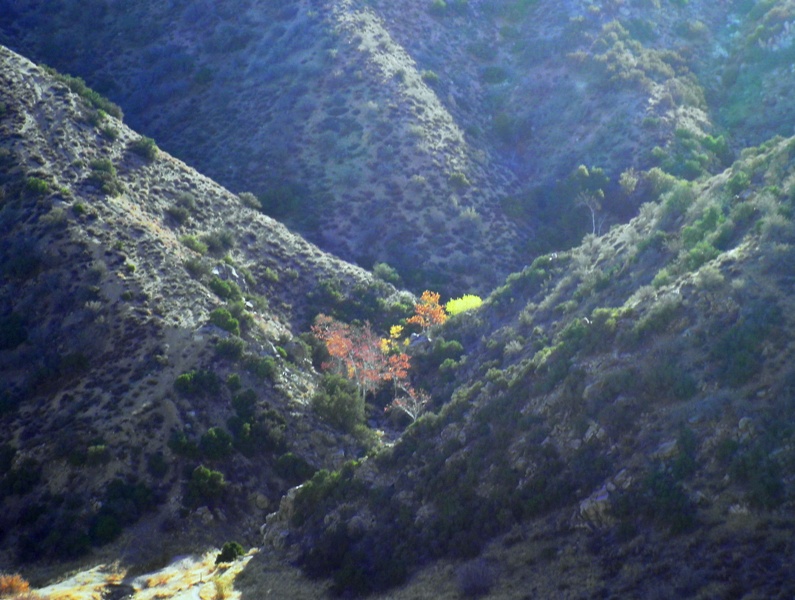
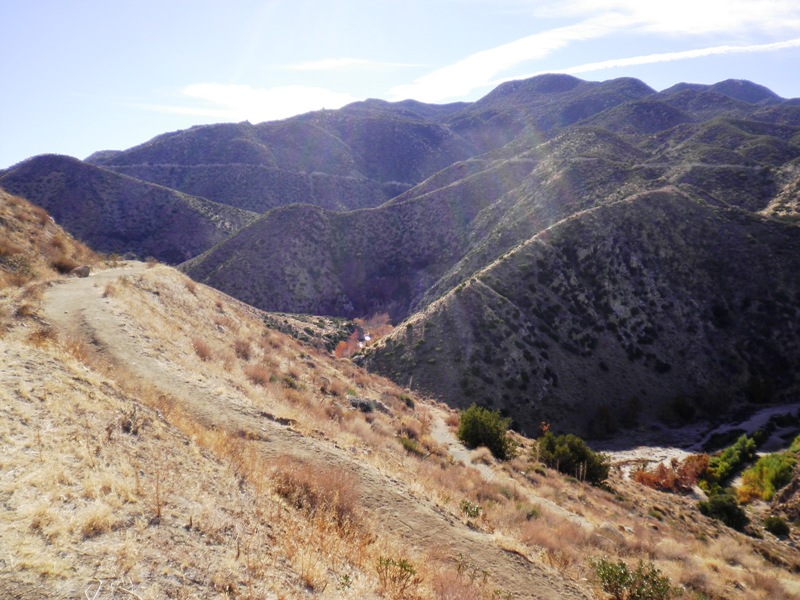
The scenery at our meeting place wasn’t very inspiring — just a lot of dirt bike trails carved haphazardly out of the desert floor by bikers — but after we climbed through the gate meant to keep out cars, and walked leisurely across the top of the dam, there were some pretty sights, including this rare example of fall colors in the desert.

desert fall

We took a break so everyone could catch up to the leader, and then we continued up the path. The operative word here is “up.” The path started with a gentle incline that got steeper and steeper as we climbed. At one point, the only way I could make it up a sharper than 45-degree angle was on hands and knees. Embarrassing, but effective.

Our leader promised us that was the hardest part of the hike, but then we started our even steeper descent on sand and scree. (I had to pause here and reflect. I don’t think I’ve ever used the word “scree” in my entire life, never had reason to. Amazingly, I was able to dredge the correct word out of my magpie brain.) I wish I could announce that I descended that hill gracefully, but once (okay, I admit it — twice) my feet slid out from beneath me and I ended up “bum sledding” as the English chap called it.

“It’s easy from here,” the chap said when we all made it (one way or another) to the bottom of the path. “Easy from here?” I responded. “Wasn’t the whole hike supposed to be easy?” He said, “When we get back, it always seems to have been so easy.”

But we weren’t yet back. There was still a rusted and rotted water pipe to hike along for several yards (someone suggested that I use my trekking pole as a balancing pole, and it worked! Or maybe it’s all those relevés I’ve been doing in ballet class.) After the water pipe episode, we had to wade through a sand field where my legs sunk halfway up to my knees, ford a river, and climb one last 45-degree hill.

We returned to the cars three and a half hours after we started. Allowing a generous hour for breaks and a snack, we’d been hiking for at least two and a half grueling hours. Even at my slowest uphill pace, I walk a mile in thirty minutes, so I have no idea how long the hike really was. At least four, but probably closer to five miles.

We gathered around for a brief post-hike retrospective. The English chap asked if anyone was hurt. We all took stock and admitted we were fine.

He beamed at me and said, “See? An easy hike.”

***

Pat Bertram is the author of the suspense novels Light Bringer, More Deaths Than One, A Spark of Heavenly Fire, and Daughter Am I. Bertram is also the author of Grief: The Great Yearning, “an exquisite book, wrenching to read, and at the same time full of profound truths.” Connect with Pat on Google+. Like Pat on Facebook.

Thank You, My Friend

Of all the things I am grateful for today and every day, my friends (both online and off), rank the highest. You, my friend, have made these years of transition a special time for me, showing me that grief isn’t just about sadness and broken connections, but about growth, wonder, and new links to life.

Table settingIt’s odd to think about, but if my currently deceased life mate/soul mate were somehow to return whole and healthy, I’m not sure I’d go back to him — I’d be leaving too much behind. Oh, heck, who am I kidding? I’d go back to him in a minute! But the truth is, I’m glad I don’t have to make that decision. I still have dances to learn, friends to enjoy, places to go, adventures to undertake.

I panic at times about the uncertainty of my future, but even that uncertainty is something to be grateful for — uncertainty hides a plethora of undiscovered joys, friends as yet unmet, and untold possibilities. More than that, by your friendship, you have taught me that the future is not an unfriendly place. Once upon a time, you were part of an unknown future of mine, and now you are a significant presence in my life.

Thank you, my friend, for the blessings you have bestowed on me.

Wishing you a very happy day of thanksgiving, even if you don’t celebrate the American tradition of Thanksgiving Day.

***

Pat Bertram is the author of the suspense novels Light Bringer, More Deaths Than One, A Spark of Heavenly Fire, and Daughter Am I. Bertram is also the author of Grief: The Great Yearning, “an exquisite book, wrenching to read, and at the same time full of profound truths.” Connect with Pat on Google+. Like Pat on Facebook.

The Length of the Chain Between the Imagination and the Stake of Reality

Last night I rewatched The Long Way Home, a 1998 Hallmark movie starring Jack Lemmon. While this is not his best movie (oh, wait — maybe it is. I never particularly liked most of his movies), it certainly spoke to me considering my present situation.

In a way, our circumstances are the opposite — I have too few loved ones left and he has too many. In my case, the house where I am living (my father’s house) will soon be sold out from beneath me, and I will be left to fend for myself. In his case, his children made the decision to sell his home after the death of his wife and have him move in with them. He is lost, doing not much of anything but sitting around, having accepted their belief that he needs to be protected from the death sentence supposedly conferred by old age. (He is only 75, which might be old, but not in my world where my mother lived strongly to 85, my father did it “his way” until he was 97, and my forever young dance teacher is 78 going on 48.)

But both Jack and I are poised on the precipice of a new life, struggling to find meaning, purpose, focus in the light of our losses.

I’ve been trying to envision various ways of continuing my life, perhaps traveling, and that is what Jack does — goes on a road trip. After a minor accident where he couldn’t make it home, he meets a college student on her way to Monterey where she will have to deal with her own family situation. Impulsively, instead of going back to his son and daughter-in-law, he decides to go with her, taking the long way home to his children in Kansas. (Kansas — a possible homage to the Wizard of Oz, the ultimate road trip / long-way-home movie?)

The main theme of this movie for me is freedom. The college student tells Jack, “Freedom is the length of the chain between the imagination and the stake of reality.” (She says it in such a way that it sounds like a quote rather than a spontaneous outburst, but I haven’t been able to find the citation anywhere.)

I never quite understood this quote, despite having seen the movie two or three times, but now I’m getting an inkling of what it means. Reality imposes such harsh rigidity on us, tying us to the necessities of taking care of others and ourselves, and keeping us bound to the inevitablity of death. And yet, and yet . . .

Our imaginations take us elsewhere, enabling us to envision other possibilities, which lengthens the chain that binds us, and sets us free to live not in the darkness left behind by our loved ones who are gone, but “in the light” of them.

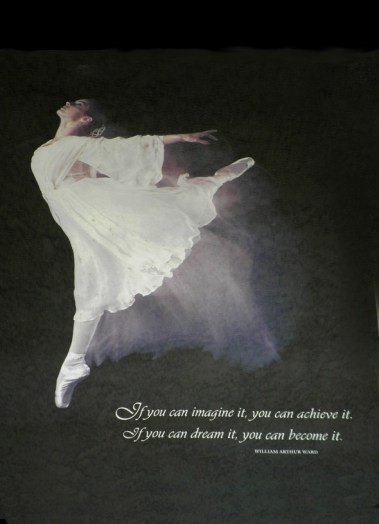
The poster that hangs above the door of “my” dance studio.


***

Pat Bertram is the author of the suspense novels Light Bringer, More Deaths Than One, A Spark of Heavenly Fire, and Daughter Am I. Bertram is also the author of Grief: The Great Yearning, “an exquisite book, wrenching to read, and at the same time full of profound truths.” Connect with Pat on Google+. Like Pat on Facebook.

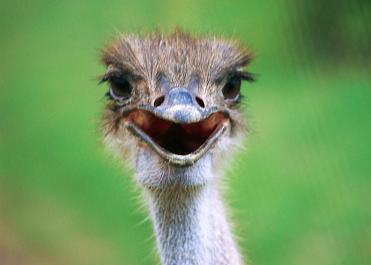
The Thing With Feathers

Hope seems to be the theme of my day. Though I’m not sure what hope is or what I am hoping for, Emily Dickenson’s poem Hope is tiptoeing around my mind:

Hope is the thing with feathers
That perches in the soul,
And sings the tune–without the words,
And never stops at all,

She seems to think hope is necessary, maybe even eternal, but what is hope?

OstrichThe freedictionary defines hope (the noun) as: A wish or desire accompanied by confident expectation of its fulfillment. The same dictionary defines hope (the verb) as: To look forward to with confidence or expectation. Both of these forms of hope seem to indicate a specific thing that is hoped for, though not everyone who has hope has a wish for something specific.

Hope is also a theological virtue, and hope the virtue is defined as the desire and search for a future good. And yet, as that most prolific author, Anonymous, says: “Do not spoil what you have by desiring what you have not; but remember that what you now have was once among the things you only hoped for.”

So hope, but don’t hope? Very confusing, this concept of hope!

For many of us, we have hope of the archaic kind (hope used to mean trust or confidence), but even that definition seems to leave us with questions — Trust in what? Confidence in what? Others of us know hope only by the lack of its opposite — despair, which interestingly, is defined as the absence of hope. (So hope is a lack of despair, and despair is a lack of hope. The epitome of circularity.)

Still, hope is more of a thing, with feathers or not, than simply the lack of something else.

So what are we hoping for when we hope to have hope?

Scott Russell Sanders says: “In order to have hope we needn’t believe that everything will turn out well. We need only believe we are on the right track.”

I’ll leave it at that, and not ask “on the right track to what?” We are all on some sort of journey through life, and the hope that we are on the right track makes hope about today, not some mythical future, and perhaps that is enough.

***

Pat Bertram is the author of the suspense novels Light Bringer, More Deaths Than One, A Spark of Heavenly Fire, and Daughter Am I. Bertram is also the author of Grief: The Great Yearning, “an exquisite book, wrenching to read, and at the same time full of profound truths.” Connect with Pat on Google+. Like Pat on Facebook.