Is the Handwriting on the Wall for Cursive?

Some schools no longer teach handwriting beyond kindergarten or first grade and some teach it not at all. It seems strange to think that few children growing up now will ever write anything by hand, but they won’t need to. Computers, tablets, phones are all just an itch away. Kids today are in constant contact with their peers, using a form of language — textspeak — that would have been anathema just a generation or two ago, but it is their world, not ours. They will have to be living in their “modern” world when we who are adults now are long gone. (I put quotation marks around modern because people in every age going back thousands of years have considered themselves as living in the modern world. And of course, they were right. To people in each era, their contemporary world is like the head of a comet with past trailing along behind. Someday a future era will be at the head — the new “modern” world — and our current modernity will be lost in its tail.)

I read once that the only place besides the brain where we have grey matter is in our fingertips, and perhaps that is true. I seem to have a better hand/brain connection when I am writing longhand than when I am typing on the computer — or at least I did. I wrote my novels long hand because that is the easiest way for me to delve into into myself for the story. I’m not one of those writers who can sit down and let the words flow. I have to sit and think about everything I want to say, and to figure out the best words to show what I decide to say. I’m getting used to writing on a computer since that’s how I write blogs, but I have a hunch that longhand is still the way to get deeper into my mind, where buried insights might have a chance of showing up on paper. And research bears this out. Apparently, writing by hand helps generate ideas.

In school, I always did well on tests without much studying because I took copious notes during class while other students daydreamed, talked, or doodled. New research explains why that was so — supposedly we have a better chance of retaining what we learn if we write it longhand rather than printing it or using a keyboard.

Other research shows that writing longhand, printing, and keyboarding all produce different brain patterns. For optimum brain usage, then, it would seem necessary to use all forms of writing. And yet, learning is not necessarily about optimum brain usage; it’s about standardizing not just information, but the students themselves. (That’s why they’re called standardized tests. If school was about teaching children to be independent or to develop their unique skills, they would be called something else like “Unique skills tests.”

When I started writing this bloggery, I intended to show that cursive was still important, but considering that kids today will have a different world to deal with than we do, maybe it’s better that they learn computer skills early on. But what do I know? Perhaps if I had written this essay by hand instead of typing it, deeper insights would have shown on the page, and I’d have a better grasp of what I think.
A Spark of Heavenly Fire

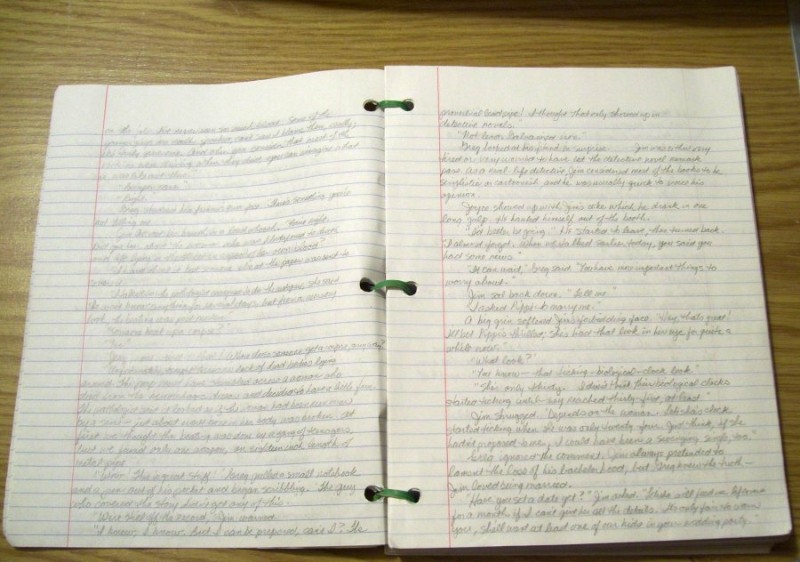
Handwritten copy of A Spark of Heavenly Fire

***

Pat Bertram is the author of the suspense novels Light Bringer, More Deaths Than One, A Spark of Heavenly Fire, and Daughter Am I. Bertram is also the author of Grief: The Great Yearning, “an exquisite book, wrenching to read, and at the same time full of profound truths.” Connect with Pat on Google+. Like Pat on Facebook.
Point Where You Want to Go

At ballet class the other day, I was practicing chaine turns and not doing a very good job of it. Chaine turns, in case you don’t know, are those often rapid turns performed in a straight line across the floor or a stage, moving from one foot to the other as you go. To keep from getting dizzy, you need to “spot” — to find something to focus on as you’re turning, and when you rotate out of sight of that spot, you need to whip your head around so that you can again focus on the spot. Trying to learn such a step after a certain age is difficult because one’s head does not whip around fast enough, so not only do you get dizzy, you end up not going where you want to go.

Seeing my difficulty, the teacher suggested pointing to the spot as well as looking at it on the assumption that where you are pointing, there you will go. And it worked. I mostly got to where I wanted to go. Still dizzy, but I got there.

twists and turnsIt seemed to me such a profound bit of advice, “Point where you want to go.” If you’re not pointed toward where you want to go, it’s hard to get there because we tend to go where we are looking. If we’re looking behind us or are distracted by side roads, it’s hard to keep focused on the goal. (It seems to me this is both metaphoric and physical, pertaining to actual physical movements and also pertaining to one’s journey through life.) Even something simple like gesticulating as we’re walking tends to keep us from walking in a straight line because we’re pointing everywhere but where we want to go.

One obvious image comes to mind as an example of pointing where you want to go. I’ve seen baseball players sometimes point their bat, in a grandstanding pose, toward the outfield where they aim to hit a home run. (Well, seen it in movies; I don’t know if they actually do it.)

Writers do the same thing, pointing where they want to go. In writing, such pointing is called foreshadowing. We writers need to know where we are going so we don’t get off track. and we need to know where we are going so we know to stop when we get there. We also need to give readers hints of where the story is pointing so they can find their way to the end, but we need to make sure readers don’t know where they are going until they get there, otherwise the suspense is lost. Hence, in writing, dizzying chaine turns keep the reader focused on the constantly changing twists and turns of the plot and not the end.

I feel so very cultured using a ballet term, but ironically, my very use of term is an example of the importance of sometimes not pointing where you want to go. I would never have made a point of taking ballet classes. It would never even have occurred to me, but when the option was offered, I grabbed hold of it. And now I am focused on the classes. (And yet I was looking for something to focus on, so maybe that counts.)

Twists and turns.

It’s what life, dance, and writing is all about.

***

Pat Bertram is the author of the suspense novels Light Bringer, More Deaths Than One, A Spark of Heavenly Fire, and Daughter Am I. Bertram is also the author of Grief: The Great Yearning, “an exquisite book, wrenching to read, and at the same time full of profound truths.” Connect with Pat on Google+. Like Pat on Facebook.

A Perfectly Fair Day

When I mentioned there were no single riders allowed on the Ferris wheel at the county fair and lamented having no one to ride with me, a woman from my dance class volunteered to accompany me if we went on Saturday. Such a lovely surprise, that offer, and I accepted eagerly.

Today, Saturday, turned out to be perfect. Perfect weather. Perfect fair. Perfect company. Usually when I go to a fair with people, they want to spend most of their time at the merchandise booths inside the pavilions, which to me seem like walking into one bad late-night television commercial after another. My friend had no interest in such exhibits. (See? Didn’t I say the day was perfect?) Instead we admired the quilts and, for a small contribution, we had the fun of making pins at the Quilts of Valor booth. 

Sporting our new finery, we looked at the handcrafts and collections, searched for the model of the U.S Constitution a walking buddy had made, and enjoyed the African violet display, especially this lovely flower that was smaller than my thumbnail:

We marveled at a cougar visiting from the zoo, checked out the artwork, passed by the haunted house.

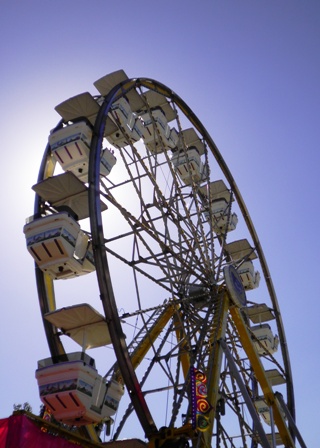
Finally we went searching for the Ferris wheel and found not one but two wheels! (Well, three if you include the kiddy Ferris wheel.) Although there was no apparent difference between the two Ferris wheels, we decided (okay, I decided) to ride both wheels.

For some reason, one ride was both longer and faster, and the polite young man who operated that wheel let us stay on for a second ride. (See? Perfect!)

Afterward, we bought drinks and a taste of the fair. Every year, it seems they come up with something more esoteric to deep fry and this year it was cheesecake. Not something I’d recommend, but then, that’s what fair food is all about, tasting something outlandish, and so that, too was perfect.

We couldn’t find the picnic tables, so we sat on a curb like little girls to eat and rest and chat.

Can you tell I’m smiling as I write this?

Wait! I almost forgot! There was another treat. We drove to the fairgrounds in her convertible. I have no idea how it is possible that I have never ridden in a convertible before, so my first ride with the top down added the exclamation point to my perfect day.

***

Pat Bertram is the author of the suspense novels Light Bringer, More Deaths Than One, A Spark of Heavenly Fire, and Daughter Am I. Bertram is also the author of Grief: The Great Yearning, “an exquisite book, wrenching to read, and at the same time full of profound truths.” Connect with Pat on Google+. Like Pat on Facebook.

To Dance Is to Live

At lunch after a dance class a couple of days ago, a friend and I were discussing why we don’t have bucket lists. We agreed there are too many things in the world that either we’re not aware of, or if we are aware of the things, we’re not aware that we would like to try them.

For example, we’re both taking dance classes, which have become lifesavers to us. (Like me, she’d been mired in grief and took dancing as a way of moving on with her life.) Neither of us ever had such an inclination before, so dancing would never have been on our bucket lists. I’m not even much for dancing around the house, though for a while, I did what I called “dance therapy” in an effort to overcome the lingering grief after the death of Jeff, my life mate/soul mate. This therapy worked to a certain extent, but . . . I don’t know . . . maybe it was too soon, maybe the songs were too sad, maybe it was simply that I didn’t know how to dance.

I took therapy yoga for a whileUntitled-2, which did help with grief. When those classes were canceled after the teacher got an offer of a fantastic job, I played around with learning Tai Chi, which incidentally was something that would have been on my bucket list since I’d always wanted to do it, but I didn’t feel the connection with Tai Chi that I’d expected. And it must not have been in the cards for me anyway. When I went to sign up for classes after the free introductory lessons were over, I found the office closed. (They are closed every other Friday, but since they never said which was the other other Friday, I had no way of knowing what the right day would have been.)

A few days after my aborted attempt to sign up for Tai Chi, I’d planned to meet a friend for lunch. As I waited for her, I paced the sidewalk in front of the row of shops, and there I saw a dance studio. On a whim, I stopped in to see if classes were being offered to adults, what the classes were, and how much they cost. The prices were so cheap it seemed a shame not to try at least one of the classes before I settled for Tai Chi. The only class that didn’t need any props or special clothes was jazz, so that’s what I started with.

And I came alive.

In an effort to find a renewed interest in life, I’d been doing many things I would never have had a chance to do before Jeff’s death, but everything I did was like dropping pebbles in the sand of grief. Although I enjoyed my excursions and activities while I was doing them, none of that momentary happiness rippled through the rest of my life. Yoga did to a certain extent, but with dance . . . oh my. Ripples galore.

By the middle of the following month, I was taking ballet, Egyptian belly dance, tap, and Hawaiian in addition to jazz, and recently I started Tahitian.

Dancing is hard for me. I’m not naturally rhythmic, not naturally musically inclined, not naturally poised or balanced. Nor am I one for doing anything in a group. (Do I need to mention that I am far from having a dancer’s body?) And yet, it was love at first . . . not sight. Feel maybe.

A lot of the joy of dancing for me comes from learning something completely new, since more than anything I love to learn, but it’s the whole of the dance experience I’m enamored with — the music, the various steps, the choreography, dancing as one with the rest of the group, the other women in the class. Most of the women are a lot older than I am, but they are a heck of a lot more graceful and agile. Actually, they are a heck of a lot more graceful and agile than most women half my age.

It seems strange now that I’ve never mentioned my dance classes on this blog, but since I also once took a couple of exercise classes at the same studio, I’ve just lumped all the activity under “exercise classes.” Dancing seemed too sacred almost to use for blog fodder.

So why am I mentioning it now? The teacher, a remarkable woman just a few years short of eighty, is always having to explain to her family why she continues to teach. (You know how older people are often called “spry”? That is not a word you could ever use to describe her. To see her dance, you’d never guess her age. She dances like a girl, looks like she’s in her forties, and is still beautiful.)

Because she was born two minutes before midnight on Friday the thirteen, she laughingly calls herself a witch. And she is — a good witch with remarkable powers of bringing people to life. Bringing people happiness. Bringing people dance.

As Snoopy says, “To dance is to live. To live is to dance.”

I know you’re reading this, Ms. Cicy. So — thank you for teaching me a new way of living.

***

Pat Bertram is the author of the suspense novels Light Bringer, More Deaths Than One, A Spark of Heavenly Fire, and Daughter Am I. Bertram is also the author of Grief: The Great Yearning, “an exquisite book, wrenching to read, and at the same time full of profound truths.” Connect with Pat on Google+. Like Pat on Facebook.

Searching for a Cause

When I mentioned to a hiker friend that I am thinking of walking up the coast from San Diego to Seattle, she suggested that I walk for a cause because if you have a cause, people are more willing to help supply food, water, a shower or even transportation if you need it, and they might even get others to help.

It’s a great suggestion. The Peace Pilgrim walked for peace. She was walking in response to a spiritual awakening, and she’d taken a vow to “remain a wanderer until mankind has learned the way of peace, walking until given shelter and fasting until given food.” Her pilgrimage began in 1953 when she was 44 and ended with her death in 1981. She carried only a pen, a comb, a toothbrush, and a map, trusting to those she met to supply what she needed, though she never asked for anything. (She was also the first woman reported the have thru-walked the Appalachian Trail, which she did in preparation for her pilgrimage.)

Following her example or following their own spiritual wakening, others have walked for peace. Some women have walked for women’s freedom since so many women (perhaps rightfully) are afraid to travel, hike, or camp on their own. These women causewant to show that it is possible to claim one’s freedom and follow one’s adventurous heart. And then there are short walks/runs to raise money and awareness for all sorts of causes and organizations.

My friend suggested I walk for widows or the grief-stricken. Widow Walker. Grief Walker. Or . . . whatever. Her other suggestion, which actually is a fun idea, is to hang a small portable chalkboard on my pack, and change my “cause” as I felt like it.

Having a cause would give people a personal stake in my quest, but I wonder if it’s a bit of a cheat. If the idea of the cause came first, then the walk would be because of the cause. If the idea of the walk came first, as it did, then the cause would be because of the walk.

Still, I would need some sort of support group because I want to walk, not hike, which means no heavy backpacks, no bulky gear, no great stores of food and water. I do understand the need for taking more than The Peace Pilgrim’s sparse kit because I do not want to walk to certain death, but I simply do not want to take everything on a hiker’s “must” list. Of course, if I hike along the coast, there would be plenty of towns or beaches to get provisions and find a motel (and a computer!) for the night if necessary, but there will also be long stretches of wilderness, and in one case, a fifty-mile stretch of highway-shoulder walking.

Grandma Gatewood, like The Peace Pilgrim, was a minimalist hiker, the first woman to solo thru-hike the Appalachian Trail. Although she hiked the Trail three times, beginning when she was 67, she had no special gear. She wore Keds sneakers and took only an army blanket, a raincoat, and a plastic shower curtain which she carried in a homemade bag slung over one shoulder. My kind of hiker! Nor did she have a cause — at least not one that I can find. She simply thought it would be a nice lark. Sounds like my kind of hiker.

My true cause is a soul quest, a mystical journey, a response to a barely heard question deep inside — “Is this all there is to my life here on Earth?” I would like to find a deeper connection to both myself and the world, maybe even to go through some sort of spiritual transformation. I originally planned my journey as a car trip, which is still on my list of possibilities, but walking might give me more of the mysticism I am looking for. (Feet on the ground trumps feet on the accelerator pedal any time.)

So, here’s my question. Do I need a cause? And if so, what should that cause be?

***

Pat Bertram is the author of the suspense novels Light Bringer, More Deaths Than One, A Spark of Heavenly Fire, and Daughter Am I. Bertram is also the author of Grief: The Great Yearning, “an exquisite book, wrenching to read, and at the same time full of profound truths.” Connect with Pat on Google+. Like Pat on Facebook.
Nomadic Women

There are so many women in my grief age group — those who lost their mates around the same time mine did — who are starting nomadic adventures, or who dream of starting them, that it makes me wonder how many of us rootless women there are roaming the world.

Richard Grant, author of American Nomads: Travels with Lost Conquistadors, Mountain Men, Cowboys, Indians, Hoboes, Truckers and Bullriders, estimates that 500,000 people travel the US without a permanent home. (Others estimate there are over a million nomadic Americans.) To be honest, I wouldn’t include people who travel around in $300,000 motors homes as “nomads.” They might not have a fixed address, but they do have a home, and a luxurious one at that. They just take it with them. Still, the nomadic life appeals to people at both ends of the financial spectrum, some because they have the means to live on permanent vacation, and others because they can’t afford any other lifestyle, so I shouldn’t judge on the basis of income.

A good percentage of modern American nomads are women. Some women simply want to see the world, so become rootless by choice. Other women started out looking for a different life after a divorce, a death, or other loss uprooted them, and so ended up traveling the world. (Being nomadic must be a popular obsession — not only is it a designer brand, there is even a perfume named “Urban Nomads.”)

It seems to me women are the ones who become nomadic after the death of a partner. Men generally stay put, and often remarry quite quickly. (This is entirely anecdotal, of course, gleaned from my interactions with other bereft, but the Census Bureau does estimate that 10 times as many widowers as widows over 65 remarry, though there are fewer older men than older women. And there are fewer widowers than widows. I couldn’t find remarriage statistics for younger people, or those in their late fifties and early sixties.)clean

Oddly, it seems that traditionally men were the cave dwellers while women roamed about, making me wonder if this male “cave” instinct, more than a need to be taken care of, is the impetus for widowers to remarry. By the same token, a nomadic instinct could be what takes grieving women out of the nest, leads us to adventure, and maybe helps us find a new life.

I have no interest in being a nomadic RV dweller. The upkeep alone seems more trouble than it’s worth, though I can understand the pull — wherever you are, you are home. To be honest, I don’t really have an interest in being any kind of nomad, but I have no inclination to settle down, either. For one thing, I wouldn’t know where to settle or why to settle there — without my life mate/soul mate, one place is the same as another. For another thing, settling seems too much like stagnation. It’s entirely possible that by the time I’m free of responsibilities, I will also be free of my disinterest in settling down, but I doubt it. It will be so much easier to put my stuff in storage and hop in the car or start walking, than to find an acceptable apartment somewhere in the country, move all my stuff into it, set up the utilities, get my computer connected, change addresses, and all the other necessities of moving. Nope. Too much trouble.

Either way, whether I take to the road or settle down, I’ll still be rootless. My life mate/soul mate was my home, and with him gone, the only home I have is whatever home I can find within.

***

Pat Bertram is the author of the suspense novels Light Bringer, More Deaths Than One, A Spark of Heavenly Fire, and Daughter Am I. Bertram is also the author of Grief: The Great Yearning, “an exquisite book, wrenching to read, and at the same time full of profound truths.” Connect with Pat on Google+. Like Pat on Facebook.
Midnight, Meteors, and Mockingbirds

There was supposed to be a meteor shower last night, the first of its kind. Since I’d never seen shooting stars, I made sure to go outside at 11:00 pm PT to see what I could see.

Clouds. That’s what I saw. No shooting stars. No stars of any variety, for that matter.

I went out again at midnight. The clouds had moved away by then, and I saw the usual scattering of stars. (The city lights out here are too bright to show the true beauty of the night sky.) I didn’t see any part of the meteor shower, though perhaps I gave up too soon. Instead of the spectacle of hundreds of meteors an hour the news media had tantalized us with, there were actually only about five to ten per hour. Maybe if I had known where to look, or that I would have had to be out for longer than a few minutes, I would have waited.

Still, it was a joy to be out in the midnight air since it’s something I seldom do. I stood in the middle of the driveway, and listened. There was no sound of cars, no human voices, and oddly, no dogs barking. Most of the houses were dark. It was just me, the chirping of crickets and other incessant insect noises, and . . . birds singing.

mockingbirdBirds singing? At midnight? I’d never heard such a thing. I’m used to birds singing reveille, urging the sun to rise above the horizon. I’m used to birds singing sporadically through the day, or calling as they pass overhead. I’m even used to a few warbles as the sun goes down, but when night falls, the birds fall silent. (I just though of something — the sun falls below the horizon at the end of day, so how can night fall, too? Shouldn’t night rise?)

Hearing birds at midnight was so out of my ordinary, I checked online for night birds in this part of the world. I’ve heard owls, of course, but owls tend to hoot or screech. They don’t warble, and they don’t crow. (Besides the warblers, I heard ravens. I don’t remember ever hearing ravens crow at night, but that doesn’t mean they don’t.)

Apparently, what I heard were mockingbirds. Maybe there were no ravens last night. Maybe the mockingbirds were pretending to be ravens. For all I know, the mockingbirds were the whole dang chorus — crooning, cawing, and chirping.

The noise level surprised me, making me wonder about the feasibility of taking some sort of epic walk. I’d stay in hotels when possible since I’m not much of a wilderness sort, but there would be times I would have to find a place outside to bed down for the night, and how the heck would I ever be able to sleep with all that racket? And what about all the other nocturnal creatures slinking around without making noise? Could be more than I am prepared to handle.

If I remember, I’ll go out again tonight to look for meteors. It’s possible, some astronomers say, that the shower didn’t fizzle, but was simply delayed. I’ll also listen for mockingbirds and enjoy the unaccustomed sound of birds singing at midnight.

***

Pat Bertram is the author of the suspense novels Light Bringer, More Deaths Than One, A Spark of Heavenly Fire, and Daughter Am I. Bertram is also the author of Grief: The Great Yearning, “an exquisite book, wrenching to read, and at the same time full of profound truths.” Connect with Pat on Google+. Like Pat on Facebook.

Wake Up and Die Right

At an exercise class today, we talked a bit about the murder mystery I’m going to write about the class (assuming I get myself in gear), and then we did warm up exercises while the teacher sorted through her music to find the recording she wanted to play. When she couldn’t find the right DVD, she muttered, “Wake up and die right,” which stopped me in my tracks.

“What did you say?” I asked, not sure I heard correctly. She repeated the phrase, and I laughed. I’d never heard the saying before, and coming as it did right after a discussion about our fictional murder, it seemed even more amusing. And a bit gruesome.

Wake up and die right. Oh, my.

Odd words, phrases, and sayings often stay with me, rattling around in my brain until I can make sense of them. (In fact, just yesterday I railed against the appalling sentiment, “He deserved to die.”) The more I thought about “wake up and die right,” the more it made sense. We die right if at the end, we have no regrets. We die right if we’ve lived life to the fullest and used ourselves up, if we’ve danced and laughed, if we’ve enjoyed the company of those who enrich us, if we feel the sunsets and smell the rain-washed air. (If you live in the desert, of course, that rain-washed air comes so infrequently you better smell it when you can because it might be many months before you get another chance.)

Wake up and die right. Oh, yes.

Apparently, the saying came from World War II. Soldiers who let their attention wander were told to “Wake up and die right” — to pay attention, to fight, to get a grip, to die like a soldier if necessary. The adage migrated to the general population and seems to have been prevalent during the late forties and early fifties, but its use faded as memory of the war years became supplanted by other invasions with other jargons — the Beatles, the Viet Nam “police action,” the drug wars.

Today, more than sixty years after the maxim had been laid to rest, it came to life once again. I suppose in a way, it’s reminding me to just sit down and write the book about the class because, of course, I would regret not having written the story. I just need to wake up and do it so my designated victim can die right.

***

Pat Bertram is the author of the suspense novels Light Bringer, More Deaths Than One, A Spark of Heavenly Fire, and Daughter Am I. Bertram is also the author of Grief: The Great Yearning, “an exquisite book, wrenching to read, and at the same time full of profound truths.” Connect with Pat on Google+. Like Pat on Facebook.

He Deserved To Die

I watched a movie the other day, not paying enough attention to be able to tell you the name of the film or any of the plot, but one line caught my attention. “He deserved to die.” We’ve heard that sentiment so often that it’s become all but imperceptible, and yet, for that brief moment, I actually heard the words and now the phrase keeps rattling around in my head.

He deserved to die.

The “he” in question was a bad guy, that I remember. So is death a punishment? Is that why he deserved to die? Since most people seem to believe in some sort of paradisiacal afterlife, it would make more sense to say that he didn’t deserve to die.

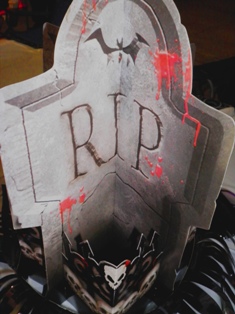
RIPEither way, there should be no “deserving” when someone talks about death. Death comes for all of us — young, old, middle-aged, saintly, wicked, average. We don’t really know what is in people’s hearts and mind, so perhaps everyone is deserving of death. And yet, stillborn infants have not done anything to deserve death — have not done anything at all, in fact — but they are doomed to die before they’re even born.

If the dead deserved to die, does that mean the rest of us deserve to live? But there is no deserving when it comes to life, either. We’re simply born. What we do with our life is up to us — at least in theory. Often we have no choice as to our circumstances, so we do the best we can.

Deserved to live.

Deserved to die.

After the death of my life mate/soul mate, I used to get lost in the conundrum of death, wondering which of us got the worst end of the deal. If life is a gift, why was it denied him? If he is in a better place, why am I still here?

I still don’t know the answer, but I do know he didn’t do anything to deserve to die, and I did nothing to deserve to live. It’s just the way things are.

Deserved to live.

Deserved to die.

Strange words that don’t mean much of anything.

***

Pat Bertram is the author of the suspense novels Light Bringer, More Deaths Than One, A Spark of Heavenly Fire, and Daughter Am I. Bertram is also the author of Grief: The Great Yearning, “an exquisite book, wrenching to read, and at the same time full of profound truths.” Connect with Pat on Google+. Like Pat on Facebook.
In a Cavern, in a Canyon, Excavating for . . .

Unlike Clementine’s father, I haven’t been excavating for a mine, but I have been excavating in the caverns and canyons of my workspace.

I turned on the computer a couple of hours ago to write my daily blog. Although I began this blog in 2007, I’ve only been daily blogging for the past 966 days. The miracle is that I’ve found something important to say each of those days (important to me, anyway), but today I’m dragging my feet. I don’t want to talk about what is most on my mind — the insanity of my life. My 97-year-old father is continuing to decline, and my crazy brother is getting increasingly crazy, blaming me for everything wrong in his life. He claims I am the one who’s crazy, tells me I am a jealous, revengeful bitch, but the truth is, I am too tired to be anything but what I am — a person who is doing the best she can under burdensome conditions.

Not wanting to go into the particulars of today’s insanity, I’ve been procrastinating writing this blog, cleaning around my computer and sorting through all the notes that accumulate.

I found a ndeskote indicating that, as of right now, Jeff — my life mate/soul mate — has been dead for 1513 days. Although I am not actively grieving for him, I still feel a blankness inside that his presence once filled.

I found an information sheet from my poppy trip that I hadn’t yet read. Apparently, the local Indians believed the Great Spirit sent this Fire Flower to drive away the evils of frost and famine, and to fill the land with warmth and plenty.

I found a phone number, and when I googled the number, discovered it was for a dollar store, though why I have the number, I can’t say. I also found an address for the county jail, and I do know why I have that. I had to go pick up my brother one day after he’d been arrested for public intoxication.

Barely discernible on a paper with many strange hieroglyphics — long forgotten calculations and cryptic notations — I found a great quote: Screw Romeo and Juliet. I want a love like Gomez and Morticia. Oh, my, yes! Now that was a great love affair, albeit unsung. It’s only those who die for love who become fodder for the bards. To be honest, though, I don’t want any love affair. One excavated note reminded me that my subscription to the dating site OurTime expires at the end of the month, and I don’t intend to renew it. I considered asking the one guy who didn’t pose with a motorcycle if he’d like to go to lunch just so I could say the subscription wasn’t a total waste of money, but I only sent him a brief lob to see if he’ll return my serve. (What I know about tennis is almost nothing, so I have no idea why I used a tennis metaphor, especially since I don’t know if I used it correctly.)

The most interesting thing I found in my excavations were notes about Blackwell’s Island. Apparently my family comes by its insanity naturally — we inherited it. Our great-grandfather, who once worked with Edison, and who invented the postmarking machine that continued to be used until the digital age made it obsolete, had been married twice. One wife he threw down the stairs. The other he consigned to the Lunatic Asylum on Blackwell’s Island (renamed Roosevelt Island in 1973). The asylum was supposed to be a state of the art facility, with patients classified as to their illness, rather than all thrown in together, the violent and harmless alike. The Asylum was also supposed to be moral, treating the patients like humans rather than like depraved animals. This humane mental institution never materialized. Instead, the asylum was a dreadful place that journalist Nellie Bly described as a “human rat trap.” Even worse, since convicts from the nearby penitentiary were used as guards and attendants, the patients were “abandoned to the tender mercies of thieves and prostitutes.”

No one knows which of my great-grandfather’s wives is my great-grandmother, but even if she weren’t the one committed (especially since there’s a chance he had her committed for his own reasons rather than her mental state), the insanity could come from good old great-grandfather himself.

The best part about this excavating through the caverns and canyons of my workspace is that now the space is neat and clean. And I did write a blog after all.

***

Pat Bertram is the author of the suspense novels Light Bringer, More Deaths Than One, A Spark of Heavenly Fire, and Daughter Am I. Bertram is also the author of Grief: The Great Yearning, “an exquisite book, wrenching to read, and at the same time full of profound truths.” Connect with Pat on Google+. Like Pat on Facebook.