I Don’t Want Your Sympathy

If you think I write about grief to elicit sympathy or to look for a shoulder to lean on, well . . .  you just don’t get it.

As I’ve said so often, I started writing about grief to make sense of my own feelings, and I kept doing so as a rebellion against a society that reveres happiness at all costs.

Although I am a private person, not given to airing my problems in public, I thought it wrong to continue the charade that life goes on as normal after losing the one person who makes life worth living. So, over the past three years, I have made it my mission to tell the truth about grief. Even though I have mostly reached the stage of peace, and life is opening up again, at least a little bit, grief is still a part of my life. There is a void in my world — an absence — where he once was, and that void shadows me and probably always will. Although his death changed the circumstances of my life, thrusting me into an alien world, grief — living with it, dealing with it, accepting it — changed me . . . forever. It has made me who I am today and who I will become tomorrow — strong, confident, and able to handle anything that comes my way. (And maybe even a bit tough to deal with at times.)

Would I prefer to have him in my life? Absolutely. But that is not an option. All I can do, all any of us can do, is deal with what lies before us, regardless of a society that frowns on mourning.

But I don’t need sympathy, I don’t need you to bleed for me, and I don’t need your shoulder to lean on. So what if I’m unhappy? Does that diminish your happiness? If it does, then that’s your problem, not mine. And you miss the point of these grief blogs —  to survive a horrifyingly grievous loss by finding my footing in an unbalanced and alien world.

I do want something from you, though. If you are still coupled, I want you to smile at your loved one tonight instead of kicking him or her in the shin as you might prefer to do. I want you pause to hug him or her, and maybe give an extra kiss. This is an incredible gift I am giving you — a memory to cling to if ever you should become one of us bereft.

***

Pat Bertram is the author of the suspense novels Light Bringer, More Deaths Than One, A Spark of Heavenly Fire, and Daughter Am I. Bertram is also the author of Grief: The Great Yearning, “an exquisite book, wrenching to read, and at the same time full of profound truths.” Connect with Pat on Google+. Like Pat on Facebook.


Grief Archives

I’ve had so many people stopping by to read one of my grief posts and then staying to read more, that I’m making it easy for everyone. I set up a separate page for all the articles I posted about grief. You can find them here:  Archives — Grief Posts.

These are not the only writing about grief that I did. As you can see from the list, I hardly posted anything at all those first few months, but I still wrote. I was so lost, so lonely, so sick with grief and bewildered by all I was experiencing, that the only way I could try to make sense of it all was to put my feelings into words. Whether I was writing letters to Jeff (my deceased life mate/soul mate) or simply pouring out my feelings in a journal, it helped me feel close to him, as if, once again, I was talking things over with him.  Those were such private moments, meant only for me (and him) that I never intended making any of it public, but when I found out how much it helps the bereft to hear about someone else’s grief and understand that their anguish is normal, I published them in my book Grief: The Great Yearning.

If you know someone who is grieving for a husband or a mother or a child, I hope you will consider gifting them with a copy, or at least sending them the link to my grief posts.  Thank you.

Grief:  The Great Yearning

***

Pat Bertram is the author of the suspense novels Light Bringer, More Deaths Than One, A Spark of Heavenly Fire, and Daughter Am I. Bertram is also the author of Grief: The Great Yearning, “an exquisite book, wrenching to read, and at the same time full of profound truths.” Connect with Pat on Google+. Like Pat on Facebook.

My Aching Breaking Heart

My heart is breaking. I thought when my life mate/soul mate died that the organ had shattered beyond repair, but it must have healed because I feel as if it is breaking again.

When I first entered the world of grief, I was stunned by the constant assault of emotions, physical reactions, mental conflicts and torments because I’d never heard of such grief. Well, there was that one old woman who wore black the whole of her life, celebrating her widowhood, and occasionally there would be talk of someone keening in agony at her husband’s funeral. I thought those were isolated cases of unbalanced women, but I am not unbalanced. (And probably they weren’t, either.)

I wrote about what I was going through so I could try to make sense of the onslaught, and it helped. Blogging about grief also helped because I met many others on the same journey, which brought me comfort, and a few who were years ahead of me, which brought me hope.

Somewhere in the back of my mind, I thought this fathomless grief set me aside from everyone else, and perhaps I even thought I should have special consideration because of my situation. Then others I knew lost someone they loved, and I realized grief didn’t make me special. It just made me . . . bereft.

After three years, I am still sad. I tend to think I’m not making any progress, but then I hear from women who just lost their husbands, and I am drenched in tears, remembering what it was like when grief was new. And I can see how very far I have come. Sail AwayBut I also know what these women are feeling and how much they will have to deal with in the coming months and years, and my heart breaks for them.

How is it possible that so many of us have lost our mates and soul mates? It’s like a bizarre dance of butterflies, where those we love flit into our lives, bringing wonder and color and joy, and then they flit away, leaving us devastated. How can the world survive when it is so awash in grief? (Perhaps that’s where the oceans came from — the tears of the bereft. After all, throughout the ages, billions of people have mourned for their dead.)

Sometimes I see a photo of or an article about a couple who has been married for forty or fifty years. They always have helpful advice about how they stayed together for so long, but the truth is, despite all their ways of keeping love alive, the reason they were together so long is that one of them didn’t die. Not every loving couple gets that opportunity.

And my heart breaks for the ones left behind.

***

Pat Bertram is the author of the suspense novels Light Bringer, More Deaths Than One, A Spark of Heavenly Fire, and Daughter Am I. Bertram is also the author of Grief: The Great Yearning, “an exquisite book, wrenching to read, and at the same time full of profound truths.” Connect with Pat on Google+. Like Pat on Facebook.
Doxxing Is Not What a Doxy Does

It’s amazing all the redundant terms people come up with to describe the invasive activities they do on the internet. The latest is doxxing. Sheesh. Sounds like something a doxy would do, but doxxing is the barely legal practice of scouring through public documents, finding persofloozynal information about people, and posting it on the internet. Doxxing stems from the .dox ending for documents, and is a form of cyber stalking and even identity theft.

In this era of “sharing” so often things only we used to know are now available to everyone courtesy of sites like Facebook. Banks used to ask for your mother’s maiden name as an identity check, but now if you list your mother as a relative on FB, everyone knows her name. And, unfortunately, social security numbers are prevalent and easy for those in the know to find. For many years, social security numbers were used freely as sort of a national identity number, and were required for most documents, even if the paper had nothing to do with social security. A case in point — my optometrist always demanded the number even though I didn’t have insurance for eye exams and was going to pay cash. (I finally wised up and instead of fighting it, gave him a scribbled and unreadable number.)

And of course, if you have the above information, you can use it to log into credit bureaus, pretending to be the person you are stalking (Let’s call it what it is, and forget the oh-so-cute appellation of “doxxing”). And the credit bureaus yield even more information.

Luckily for us non-celebrities, chances are we will never be subject to such behavior. I mean, what prurient interest would posting my phone number arise in those who have never heard of me? (Or in those who have heard of me, for that matter.) None. Zero. Zilch.

Just in case I ever do become a celebrity (it could happen even if only in an alternate universe), I protect myself the best I can by posting only information I want people to have, such as my name, books, blog, and web addresses. And you can too. Even though some sites demand your true birth date, who’s to say if you give a phony one? And why do you have to list your mother’s real name or your pets’ names, especially if you use either of them in security questions or passwords?

Things to think about to keep from pondering on the preponderance of cyber appellations . . .

***

Pat Bertram is the author of the suspense novels Light Bringer, More Deaths Than One, A Spark of Heavenly Fire, and Daughter Am I. Bertram is also the author of Grief: The Great Yearning, “an exquisite book, wrenching to read, and at the same time full of profound truths.” Connect with Pat on Google+. Like Pat on Facebook.

Thirty-Seven Months of Grief

Today it is 37 months since my life mate/soul mate died. It is also a Saturday, and for more than two and a half years, Saturday was my sadder day. He died late Friday night or early Saturday morning, depending on how you look at it, and often my mind/body saw it both ways, with an upswing of grief on Friday that grew to a crescendo on Saturday and didn’t dissipate until sometime on Sunday. Even if I paid no attention to the calendar, grief surged, which always mystified me — how could my body know when I didn’t? And when the date of his death (the 27th) fell on a Saturday, that was always a double whammy of grief.

But today, I don’t feel much of anything. Well, the usual thread of sadness that bastes my life together, but other than that, I am mostly . . . blank. And tired. I am tired of his being gone. Tired of being sad. Tired of being lonely. Tired of this alien world that still, after all this time, doesn’t quite seem normal with him out of it. Tired of trying to be positive and open to new experiences. Tired of trying to find a way to live through the rest of my life. (Hmmm. Maybe I’m just tired?)

Those who still have their mates simply live. We live without. It colors our world and depletes our energy.

I’m sitting here staring at the page, too blank to think of anything to say about grief that I haven’t already said a dozens times before: I miss him. I yearn for one more smile from hm. I hope he is happy. I hope he is. That’s just the way it is, and probably always will be.

***

Pat Bertram is the author of the suspense novels Light Bringer, More Deaths Than One, A Spark of Heavenly Fire, and Daughter Am I. Bertram is also the author of Grief: The Great Yearning, “an exquisite book, wrenching to read, and at the same time full of profound truths.” Connect with Pat on Google+. Like Pat on Facebook.

The Surprise and Sadness of Grief’s Journey

Every step I take on grief’s journey brings with it surprise and sadness. I’ve come far enough that I am no longer wracked with pain and sorrow at the death of my life mate/soul mate, though sadness and loneliness do shadow my life, and tears are sometimes needed to wash away my yearning to see him once more. Now that the trauma of his years of dying has dissipated, I remember more of what he once was, and those memories have both given him back to me in an oblique sort of way (which surprises me), while separating us even further because of the profound reminder that he is no longer here (which saddens me).

For so long, the two images I had of him in my mind were the last time I saw him, right after he died, before the nurses enshrouded his body in a white blanket and first time I ever saw him when he was young and vibrant. The juxtapositioning of those two images shattered my already broken heart. I could not understand how that strong, radiant being became the wasted unbeing who barely made a dent in the bed.

I had a lot to process during those first years of grief and now that I’m past the shock and disbelief and have even managed to come to terms with the anger, guilt, and regrets, those two images are fading to the same sepia tones as the rest of our thirty-four years together. His goneness — the very void of his absence — haunted me for almost three years, but now I’ve become modesert roadre used to his absence (though I still do not like it at all!), and that too, serves to give him back to me, at least in memory.

But the truth, that I will never again see him in this lifetime, is still incomprehensible. How is it possible that he is gone? How is it possible that I am still here?

Maybe I have tasks to undertake that he cannot help me with, and that is why I am here — to complete these tasks by myself. Maybe it’s simply chance that he died and I didn’t. And maybe the reason (or absence of reason) is as unfathomable as death itself. But in the end, the reasons don’t matter. It’s the reality I have to deal with, and the still unpalatable reality is that, however near he sometimes seems in memory, he is immeasurably far from me.

***

Pat Bertram is the author of the suspense novels Light Bringer, More Deaths Than One, A Spark of Heavenly Fire, and Daughter Am I. Bertram is also the author of Grief: The Great Yearning, “an exquisite book, wrenching to read, and at the same time full of profound truths.” Connect with Pat on Google+. Like Pat on Facebook.
Uncertainty Is the Only Certainty

I started yesterday by seeing a quote online:

Uncertainty is the only certainty there is, and knowing how to live with insecurity is the only security. –John Allan Paulos

I thought Paulos’s words were interesting in light of the way I’d like to live after my present responsibilities end. Since I can’t bear the thought of settling anywhere, I am planning to live on the go, at least for a while, and see where serendipity and spontaneity take me. The uncertainty and insecurity of such a life style makes me a bit nervous, but I’d come to the same conclusion that John Allan Paulos did — that there is no certainty, and learning how to live with insecurity is the only security you can ever truly have.

Later, I read Malcolm R. Campbell’s blog Everything That Can Happen, Does Happen where he quoted Jane Roberts “The soul can be described for that matter, as a multidimensional, infinite act, each minute probability being brought somewhere into actuality and existence; an infinite creative act that creates for itself infinite dimensions in which fulfillment is possible.” – “Seth Speaks” (1972)

I read thUncertaintye Seth books once upon a time, but lost interest in Seth’s words when I realized that most of what he supposedly said had already touted in quantum physics, such as humans existing as possibility and electronic waves, which meant that his pronouncements could have come from Jane Roberts herself rather than from an all-knowing entity. (I also was disturbed by the assertion that Hitler was in a deep sleep for a thousand years. If time doesn’t exist outside of our material universe, then what difference does it make how long he was put to sleep?)

Although this might not seem to have anything to do with uncertainty, the idea that humans exist as possibilities, as an act rather than a physical being, is a variation of quantum mechanic’s uncertainty principle, which as far as I can tell says that everything exists in a state of infinite possibilities until it is observed or otherwise interacted with by another quantum object. (Actually, it says that either momentum or position of a particle can be precisely measured, but not both, and that the very act of measuring disturbs the measurement.)

And then, last night, quite coincidentally, I watched the 1994 movie IQ — just picked it blindly from a collection of movies. And there again, the uncertainty principle raised its head and took a long hard stare at me when Einstein and his cronies discussed the nature of the universe.

What does this mean? Probably nothing, though it does seem to show that uncertainty is the only certainty.

***

Pat Bertram is the author of the suspense novels Light Bringer, More Deaths Than One, A Spark of Heavenly Fire, and Daughter Am I. Bertram is also the author of Grief: The Great Yearning, “an exquisite book, wrenching to read, and at the same time full of profound truths.” Connect with Pat on Google+. Like Pat on Facebook.

Nothing is Trivial When Dealing With Grief

It’s amazing to me how the most trivial things can take on significance when it comes to the loss of the person who connected you to the world.

Yesterday I was clearing out a mini in-basket where my life mate/soul mate kept stamps and related items, such as postage rates and receipts. Up until now, I’ve just left the basket intact. In those first months after his death, I couldn’t bear to use the last stamps we ever bought together, so I set the basket aside and ignored it. Enough time has passed that those stamps now seem like ordinary, insignificant postage, so I dug them out, sorted through the papers in the basket, and threw away the outdated rates and receipts.

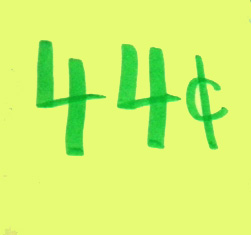
One of the things I found in the basket was a simple note he had written: 44¢. That’s all it said. He wrote it in green ink on yellow paper about two-and-half-inches square, so that despite his worsening vision, he could see at a glance what the current postage rates were.

I hesitated a moment before tossing out the note. As unimportant as the paper was, it seemed to be a symbol of how bit-by-bit, his erstwhile place in the world and my life was disappearing. Most of his things are gone now, and attrition has eliminated many of “our’ things — towels worn out, spoons lost, cups broken.

The first time I broke a cup, it about devastated me. I remember crying as if it were my heart and not a piece of crockery that had shattered. As I wrote back then, “I broke a cup today, one more thing gone out of the life we shared. Our stuff is going to break, wear out, get used up. I’ll replace some of it, add new things, write new books, and it will dilute what we shared. Is there going to be anything left of ‘us’? I feel uncomfortable in this new skin, this new life, as if it’s not mine. As if I’m wearing clothes too big and too small all at the same time.”

Still, I did throw out the paper. It seemed foolish to keep it, especially considering that postage rates have gone up since then. And I’m no longer newly bereft, clinging to anything of his to bring me comfort.

If the paper had remained in the trash, there would be story, but a little later, I retrieved the paper and put it back in the basket. My rationale was that someday, perhaps, I’d like to know what the postage rate was on the day he died. But grief has no rationality. I simply could not let go of that newly significant slip of paper.

***

Pat Bertram is the author of the suspense novels Light Bringer, More Deaths Than One, A Spark of Heavenly Fire, and Daughter Am I. Bertram is also the author of Grief: The Great Yearning, “an exquisite book, wrenching to read, and at the same time full of profound truths.” Connect with Pat on Google+. Like Pat on Facebook.

What Would You Like to Ask a Bookstore Owner?

In an effort to combat a certain online megastore from taking total control of the book world, I am going to initiate a program to interview book store owners and give them a bit of exposure on my Pat Bertram Introduces . . . blog,  To do this, I will need questions to pose. Obviously, I will need to ask where their store is located, hours, directions so people can find them. I’ll also need to ask what sort of books they carry and if they special order.

Basic information like that gets boring after a while, so I need some exciting or at least fresh and interesting questions to ask.

For example:

askingWhat book do you wish would sell better?

What little-known book would you like to see make it big?

What is your reading preference?

As you can see, I am having a hard time coming up with interesting questions. If you were going to interview a book store owner, what would you ask? (Ask as a reader, I mean. I know what you’d like to ask as an author!) If you were reading such an interview, what would you like to know? If you are a book store owner, what would you like someone to ask?

Thank you for your help!

***

Pat Bertram is the author of the suspense novels Light Bringer, More Deaths Than One, A Spark of Heavenly Fire, and Daughter Am I. Bertram is also the author of Grief: The Great Yearning, “an exquisite book, wrenching to read, and at the same time full of profound truths.” Connect with Pat on Google+. Like Pat on Facebook.

Excerpt From “Grief: The Great Yearning” — Day 23

So many people have told me lately that I should write a book about grief, that I realized somehow I’m not getting the point across — I did write a book about grief, and it’s been published now for over a year.

I never actually set out to write a book about grief, never planned to make any of my writing public (except for the blog posts, of course), but I was so lost, so lonely, so sick with grief and bewildered by all I was experiencing, that the only way I could try to make sense of it all was to put my feelings into words. Whether I was writing letters to Jeff (my deceased life mate/soul mate) or simply pouring out my feelings in a journal, it helped me feel close to him, as if, once again, I was talking things over with him. The only problem was, I only heard my side of the story.  He never told me how he felt about his dying and our separation. Did he feel as broken as I did? Did he feel amputated? Or was he simply glad to be shucked of his body, and perhaps even of me?

It’s been three years now since the following piece was written, and though I don’t have the physical trauma and emotional agony, I’m still lost, still miss him, still pinning my life mostly on “perhaps.” How did I get through three years of such great yearning? I honestly don’t know other than by taking life one step at a time.

Excerpt from Grief: The Great Yearning

Day 23, Grief Journal

I was lonely last year with Jeff spending so much time in bed, but now I am so lonely I feel bleak. And bereft. There seems to be little reason to live. No, I am not suicidal, but if I were to die today, I would not care.

I feel as if I am disappearing, fading from life, and all that is left is pain. How anyone gets through this, I do not know. And for what? Life didn’t seem foolish when Jeff was alive. I always knew we were meant for each other, but I never realized that he was my tie to life, to wanting to live. Finding that desire in myself right now is next to impossible. All I see are tenuous hopes and promises of pain. It’s not enough. Not nearly enough.

Do I need someone in order for my life to have meaning? Sounds weak. But isn’t love a major component of life? I know people survive quite nicely on their own, managing to find purpose, but I am so lost. So unhappy.

Perhaps the future holds something good for me, but that is such a silly word to pin my life on, yet that’s all I have—“perhaps”. Jeff no longer even has that. I’m trying to find comfort in knowing he is no longer suffering, and for a moment yesterday I even envied him. I wish my pain were over, too.

I’ve developed a terrible fear of dying. I could not handle dying the way Jeff did. It took him so long—years of getting sicker and weaker. Years of pain. I’m truly glad he isn’t suffering any more; I just wish he never had to suffer at all. Wish he were here, happy and healthy.

So many foolish wishes. Nothing I can say or do will change anything. The past is done. Finished. It scares me that I have no clear image of him in my mind, but my mind has never been a pictorial one—it’s more about feelings and impressions.

I miss him. Miss his fleeting sweet smiles. He had so little to smile about, yet he did smile at me. Did I return his smiles? I hope so. I loved him. Even when I could barely tolerate him (and there were such moments), I still loved him.

Click here to find out more about Grief: The Great Yearning

***

Pat Bertram is the author of the suspense novels Light Bringer, More Deaths Than One, A Spark of Heavenly Fire, and Daughter Am I. Bertram is also the author of Grief: The Great Yearning, “an exquisite book, wrenching to read, and at the same time full of profound truths.” Connect with Pat on Google+




