Dreaming of a White . . . Everything

horseI hate dreaming. I hate that feeling of bizarre, unexplainable things happening, and I hate remembering my dreams because they are most often unpleasant. Even more than dreaming, I hate hearing about other people’s dreams, but . . . (you knew there’d be a “but,” didn’t you?) this blog doubles as a journal — one with a search function — and someday perhaps I might want to use last night’s dreamscape in a story, so I decided to recount it. Feel free not to continue reading. I won’t mind. Truly.

In my dream, I was walking in the desert under a clouded white sky. The sand was pure white and windswept. The desert wasn’t flat, but looked hilly like the desert I’m familiar with, and those knolls were also covered with white sand. No vegetation grew in that desert. No dark rocks relieved the expanse of white. The ground seemed hard, but still I left deep footprints in the sand as I walked. I hadn’t gone far, just about a quarter of a mile or so, and when I looked back, I could barely see my footprints, which were quickly being refilled by the white sand. With no vegetation or rocks standing out as landmarks to help me find my way, I feared getting lost, so I turned and followed my footprints back the way I came.

As I walked, three white horses sped across my path, then four white bunnies in a bunch, then one at a time, two small white squarish creatures I could not identify, and then finally, one immense white owl.

I thought, “I must be dreaming because such magical and mystical things don’t happen in real life,” but that world and my feelings of reality were so solid it didn’t feel like a dreamscape. Still, I tried to peel back the veneer of the dream and wake myself up, and when I didn’t wake, I figured it was no dream.

All the creatures passed into the whiteness of the desert except for the owl, who stood watching me. I stood, too, and looked at the work being done on a nearby fenced-in building — a small domed structure that apparently was a relic of conquistador days. Some boys had found a stash of lances and spears, and a woman was saying to the project manager, “We can let them have a couple. It won’t hurt anything.”

I laughed at that, which made my dreaming self think I really was awake since I had never heard myself laugh in dreams.

Eventually, I did awake from that dream, but into another dream where I told the man who’d been the project manager in the previous dream about the strangely solid and realistic-feeling dream I had. I woke from that dream into a third one that was muddled and nightmarish the way my dreams usually are, and then, at long last, I woke into the real world.

Or did I? Perhaps this is just another dream from which one day I will awaken.

***

Pat Bertram is the author of the suspense novels Light Bringer, More Deaths Than One, A Spark of Heavenly Fire, and Daughter Am I. Bertram is also the author of Grief: The Great Yearning, “an exquisite book, wrenching to read, and at the same time full of profound truths.” Connect with Pat on Google+

96 Candlepower — Don’t Try This Without a Fire Extinguisher Handy!

Yesterday was my father’s ninety-sixth birthday. I never had any intention of putting candles on the cake, but my brother brought four boxes of 24 birthday candles which added up to exactly 96, so it seemed a fitting sign. Besides, there didn’t seem to be very many of them when they were sitting side by side so innocuously in the boxes. Luckily (or maybe unluckily) we had fireplace matches, which are about eight inches long, otherwise those candles would never have been lit. Still, it took four people to light the candes before they burnt out.

Once the candles were lit, they became a single flame, so I never did get to see ninety-six tiny candle flames cheerfully paying homage to all those years.

As my brother said, “In retrospect, maybe this wasn’t such a good idea.” Next year, we’ll get the candles with numbers, but when my father hits 100, we’ll go for 100-candlepower, but maybe a bigger cake  . . .

***

Pat Bertram is the author of the suspense novels Light Bringer, More Deaths Than One, A Spark of Heavenly Fire, and Daughter Am I. Bertram is also the author of Grief: The Great Yearning, “an exquisite book, wrenching to read, and at the same time full of profound truths.” Connect with Pat on Google+
Who Wants to Live to Be Ninety-Six?

I don’t want to live to be ninety-six, and chances are you don’t either, so who wants to live to be ninety-six? Ninety-five year olds, that’s who!

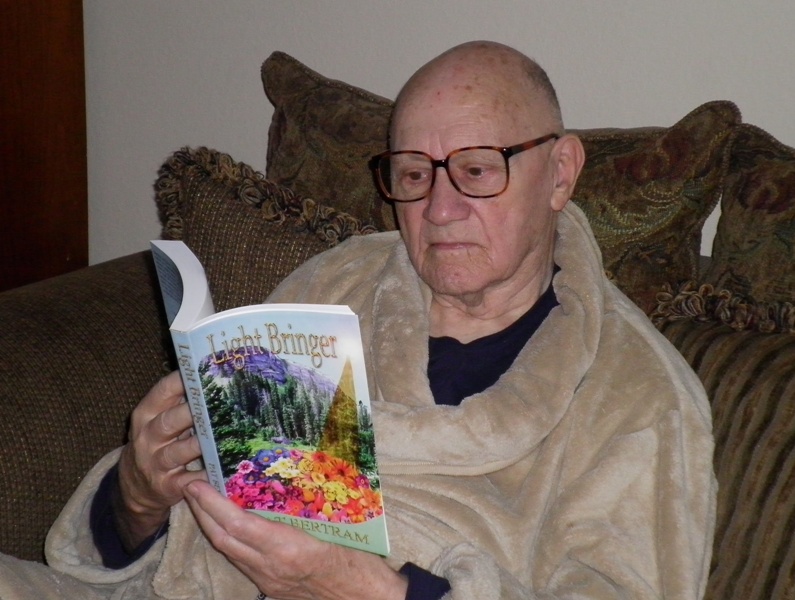
Today is my father’s ninety-sixth birthday. He’s one of the lucky ones. He is still living in his own house with a daughter (me) helping keep him independent.

We get along well for the most part, but he doesn’t understand my sense of humor. He asked me the other day if it was normal for someone his age to sleep so much. I said, “I don’t know. Most people your age are dead.” In the long drawn-out explanation that followed (I meant only that most people don’t live to such an advanced age), any vestige of humor was lost.

A couple of my brothers will be stopping by for a small party. There will even be cake, but without the candles. Can you imagine the heat generated by 96 candles? Or how long it would take to light them? Besides, blowing them all out would probably kill my father and bring the festivities to an end. And anyway, that whole tradition of having someone blow on a cake before you eat it is unsanitary at best.

In case you’re wondering, 96 years is 35065 days.


***

Pat Bertram is the author of the suspense novels Light Bringer, More Deaths Than One, A Spark of Heavenly Fire, and Daughter Am I. Bertram is also the author of Grief: The Great Yearning, “an exquisite book, wrenching to read, and at the same time full of profound truths.” Connect with Pat on Google+

My New New Year

desert knolls2013  began with tears. I’m still not sure why, though it probably has to do with a deeper acceptance of my life mate/soul mate’s goneness coupled with the slide toward the third anniversary of his death. You’d think with such a sad beginning to the year that things would ony get better, but my life went downhill from there until I felt as if I were drowning in sadness. So, in an effort to change my outlook, I decided to start the year over.

Last night at midnight, I toasted in my new new year. It seemed such a silly thing to do, yet almost profound at the same time, that it made me smile. I have to admit, I did mist up briefly a little later when I put his photos away. Sometimes seeing them bring me comfort, but sometimes they only serve to remind me of what I have lost, and there is no place for the past in this new new year of mine. (At least not yet. I’m sure there will come a point when I need the small bit of comfort those photos can bring and will set them out again.)

I have to focus on what is, and what “is” is me alone. It’s hard to carry on any kind of relationship with someone who is dead. He doesn’t respond when I talk, doesn’t offer comfort when I need it, doesn’t hug me or smile at me. Not a very fulfilling relationship!

I’m not being entirely facetious, just trying to face the truth.

I’ve read that people who manage to have a relationship with their deceased loved ones are happier than those who shut out any memory of those who are gone, but still, it’s a one-sided relationship. And, to be honest, for me it’s better that way. Since I have to find my own path through the rest of my days, I’d just as soon not have a ghost hanging around, hampering whatever fulfillment I might find. (Hmmm. Is there a story in that?)

I started my new new year in an effort to gain a new focus (or do I mean a new new focus?) And so far, this new new year is going great. Not only can I still feel the effects of that midnight smile, but the weather is gorgeous — blue skies, warm air, the faintest of breezes — which was perfect for my long walk in the desert.  Even better, I can feel a slight shift in my outlook, a turning away from the way I wish things were to the way things are and maybe even to the way things are meant to be.

I’m hoping I can continue this new new year the way it has begun, but if I begin drowning in sorrow again, I’ll just start over with a new new new year.

***

Pat Bertram is the author of the suspense novels Light Bringer, More Deaths Than One, A Spark of Heavenly Fire, and Daughter Am I. Bertram is also the author of Grief: The Great Yearning, “an exquisite book, wrenching to read, and at the same time full of profound truths.” Connect with Pat on Google+

Happy New Month’s Eve!

champagneWhen I looked at the day on my cell phone today and noticed it was the 31st, my first thought was, “New Years Eve, already?” It felt good thinking that this year was over, and that a new one would begin in just a few hours, and then the truth sunk in — this year would not be over for another eleven months.



This has not been a good year so far — not the worst by a very wide margin, but not good, either. It began inexplicably with tears, and grief has been with me most of the month. (In less than two months, it will be three years since the death of my life mate/soul mate, and that anniversary looms large on my emotional horizon.)

It’s not just the grief upsurge that has made this a hard month — there have been too many disappointments and setbacks for such a new year. Friendships have ended, a project with other authors has come to an ignoble conclusion, new hopes have not been realized, blog and book ratings have fallen. There have been some good things. For example, I was notified that Grief: The Great Yearning came in second place for a book award, but any pleasure in that recognition was destroyed when I got a follow-up email telling me I’d been demoted to third place. (I’m still reeling from that one. I’ve never heard of anyone being demoted before.)

I need a new start, and I’m going to make one. In a way, every day is the eve of a new year, but today is also the eve of a new month, which seems an auspicious time to begin. So, Happy New Month’s Eve! Wishing you a great new start and much happiness during the coming month.

***

Pat Bertram is the author of the suspense novels Light Bringer, More Deaths Than One, A Spark of Heavenly Fire, and Daughter Am I. Bertram is also the author of Grief: The Great Yearning, “an exquisite book, wrenching to read, and at the same time full of profound truths.” All Bertram’s books are published by Second Wind Publishing. Connect with Pat on Google+

Saying Good-bye

100_0876bDuring the past three years, I’ve met way too many people who have lost their mates. (Until I became one of them, I had no idea the vast numbers of people living with such grief). Some, like me, lost their mates through a long dying. Others lost them instantly. I’ve never been able to figure out which is worse for survivors to deal with. The quick deaths bring such shock and disbelief that it seems impossible to survive, but we who have plenty of time to get used to the idea have to deal with the memories of our lack of generosity toward our long-dying mates. The trouble is that when someone dies slowly, as the months and maybe even years pass, we get used to their dying. The dying itself becomes a way of life, so that a flash of irritation here or a lack of empathy there means little in the fullness of the days. It’s only when they are gone that these things loom large, and we wonder why we couldn’t have held to our equanimity just a couple of months longer.

But of course, we did not know how short a time we had to be with him. It felt like a new low is all, and at the end, death came in an instant, as all deaths do, bringing shock and disbelief.

In the world of grief, I am one of the lucky ones — I got to say good-bye. That is the thing that haunts so many bereft — their inability bid farewell to the person who meant more to them than any other. It’s not just those whose spouses died suddenly in an accident or from an unnexpected heart attack who never got a chance to say good-bye. I’ve heard sad stories of hospital personnel cleaning out the emergency room too quickly so that the person left behind never even got a chance to see their beloved one last time. I’ve heard of nurses who demanded the bereft to be quiet in their weeping or quick in saying those few final precious words. I’ve heard of doctors who insisted the ill one would get better, giving the couple no reason to believe they would need to say good-bye.

One woman, whose husband died in a vehicle accident, was particularly sick with regret. After she’d been notified of the tragedy, she’d gone to the hospital to find him already on the way to the morgue, leaving her  with no way to say good-bye. She too, is one of the lucky ones. He came to her in a dream, and told her it was okay, that he’d already been gone from his body, and that he loved her. And in a way, he had already said good-bye. Shortly before his accident, he had called family and friends he hadn’t talked to in a while and chatted with them for no real particular reason, and then a day or two later he unexpectedly invited her to a special lunch. Two hours after that lunch, he was dead.

Such pre-good-byes are fairly common, as if something in us knows the time of our death and prepares for it, but many bereft are left without even such a farewell to bring them comfort. Since parting words seem so important to the grief process, the unfarewelled bereft have to find other ways to say good-bye such as writing letters to the one who is gone, talking to him, or taking a memorial trip to a place that had special meaning. Actually, these are good ideas even for those of us who did get to say good-bye. I’ve written him and talked to him. Maybe one day I’ll take a memorial trip to a place with special meaning, though to be honest, everyplace we ever went — even the grocery store — was special because we were together.

***

Pat Bertram is the author of the suspense novels Light Bringer, More Deaths Than One, A Spark of Heavenly Fire, and Daughter Am I. Bertram is also the author of Grief: The Great Yearning, “an exquisite book, wrenching to read, and at the same time full of profound truths.” All Bertram’s books are published by Second Wind Publishing. Connect with Pat on Google+

The Doors of Grief

Years before my life mate/soul mate died, I wrote a character who grieved for her dead husband. It astonishes me that I got any of the effects of grief right since at the time, I hadn’t a clue what the loss of a mate really did to you, how it turned you inside out and upside down and left you reeling with shock and disbelief, regrets and sorrow. A Spark of Heavenly Fire begins:

Kate Cummings counted backward from one hundred, though she knew it wouldn’t help her sleep. Dead people didn’t slumber, and she hadn’t felt alive for a long time. Not since before Joe’s funeral, anyway.

Three. Two. One. She raised her head, squinted at the illuminated face of the alarm clock, and flopped back against the pillow. Five-fifteen. Six hours of thrashing around in bed. She blinked away the sting in her eyes. All she wanted was one good night’s sleep. Was that too much to ask?

One hundred. Ninety-nine. Ninety-six. . . . A sound startled her awake. A siren’s scream, fading now. She checked the time. Five-thirty. Even if she could doze off again, she’d have to rise in less than an hour. Not worth the effort.

She hauled herself upright and groped for her eyeglasses. After sitting on the edge of the bed for a moment, gathering her strength, she dressed and wandered through the house. She hesitated by the closed door of the second bedroom where her husband had lived during the last years of his protracted illness, touched the knob with her fingertips. Yanked her hand away.

This is ridiculous. Joe’s been gone for thirteen months.

Taking a deep breath, she grasped the knob, but could not force herself to turn it. She rested her forehead on the door for a minute, wondering if she’d ever be able to face the ghosts of sorrow and regret locked inside, then squared her shoulders and headed for the front closet to grab a coat and hat.

***

Later, she explains to a new friend:

“About two weeks after the funeral, I decided to clean Joe’s room. I didn’t feel up to sorting out his things, but I thought I should dust and vacuum in there. I cracked opened the door, as if expecting Joe, or at least his spirit, to inhabit the room. I stepped inside, but seconds later I scrambled out again and slammed the door.

“Memories of all the shameful, petty, inconsiderate things I had done over the years haunted the room, and I couldn’t bear to face my own mean spirit. Too many times I snapped at him or purposely waited a few minutes before going to see what he wanted when he called out. Other times I felt so angry at the way life had treated us, I stomped around the house, slamming doors and kicking furniture. Usually, though, I pounded my pillow, or cried. I’m embarrassed to admit how many times I cried, wishing I had a normal life with healthy children to take care of instead of an uncommunicative and disabled man. Sometimes I even hated him for what he had become, as if he chose to get sick. Can you believe that?”

She didn’t pause for a response, but hurried on, wanting to get it all out.

“Worst of all, I realized I was not a strong woman who had shouldered her burden with courage, but a weak woman who lacked generosity of spirit.”

***

doorI didn’t have a real door to close — I had to leave our home and come look after my aged father — but there are plenty of doors in my head that I slammed shut. It’s only now, after thirty-four months that I’m able to open them a crack, peek at the ghosts of my ungenerous and petty moments, and understand.

For the most part, I handled the stress of his dying well, but there were times I resented him, even hated him, though now I know it wasn’t he I resented or hated, but his dying. Everything that irked me — his skinniness, his rocking when he stood talking to me (he was so weak, it was the only way he could keep his balance), his inability to carry on a conversation, and his testiness — were all facets of “dying man” not the man himself. To a certain extent, he died long before his last breath. He never blamed me for my resentment because he too hated what he had become. He once admitted he didn’t even recognize himself anymore.

Death does appalling things to people, not just to those who are dying, but to those who have to continue living. Whatever our problems, those last terrible months, we had a chance to reconnect for a few weeks before he died, and I got to say good-bye to the man I love, not just the shadow of that man he had become.

And that is what I will remember — not all the petty secrets I’m gradually bringing out from behind closed doors, but our sweet good-bye.

***

Pat Bertram is the author of the suspense novels Light Bringer, More Deaths Than One, A Spark of Heavenly Fire, and Daughter Am I. Bertram is also the author of Grief: The Great Yearning, “an exquisite book, wrenching to read, and at the same time full of profound truths.” All Bertram’s books are published by Second Wind Publishing. Connect with Pat on Google+

Thirty-Four Months of Grief

desert roadThirty-four months ago today, my life mate/soul mate died of inoperable kidney cancer. For thirty-four months now, I have been posting updates on my progress through grief, and that astounds me. Thirty-four months? How is that possible? Written out, it seems such a short time for him to have been gone, and yet it feels immeasurably vast — so many minutes, hours, days, weeks, months, and now years, spent trying to come to grips with what happened to us. For most of our lives we were connected by some mystical bond, a cosmic twinning, that kept us together even when times were rough. And then suddenly, in a single breath, that connection was broken. I am here, alone, and he is . . . well, I don’t know where he is or even if he is.

I never had survivor’s guilt for the simple reason that I wasn’t sure which of us got the worst end of the deal, but I have felt uncomfortable going on without him, as if somehow I were being disloyal. We helped fight each other’s battles, sticking up for each other, caring for each other, waiting for whichever of us happened to be lagging behind, always taking the other into consideration, and it feels as if I should still be doing so. But he is beyond my reach, beyond my care, beyond my consideration.

I have come to see that continuing the disconnect that began with his descent into death is one of the tasks of my grief. (Grief seems to be not so much about passing through stages, but more about completing tasks, such as processing the loss and learning to live again.) Until I understand within my depths that for all practical (earthly) purposes we are not one, I will never be able to embrace fully what life has in store for me. We are separate persons, each with our own experiences, our own journey, and our own destination. For a while, our paths crossed, but now, I have to continue as me, alone. No matter what I do, or think or feel, it cannot change the past. No matter how much I hate that he is dead, no matter how much I rail against the unfairness, no matter how much I miss him or wish desperately for one more word or smile, he is no longer in my life.

For most of those thirty-four months, this disconnect has seemed an impossible task, but there is a bit of light illuminating my path. Last week, when I went to my Yoga class, they asked how I was, and I said, without thinking, “I’m doing great.” It stunned me to hear those words come out of my mouth, because for more than five years, during the last of his dying and these many months of grief, I have had times of feeling okay, and I thought that was the best I could do. But at that moment, I did feel great. It didn’t last long, only about an hour before I began sliding into sadness again, but that hour stands as a beacon for what might be.

Up until that class, this year has been one of increased sorrow and tears, and such grief upsurges often precede or follow a deeper level of acceptance. It’s not so much that I am learning to accept his death — I accepted the truth of it from the beginning, though I hate it and will never be able to comprehend it — but I am learning to accept that I am alive, and that is a much harder thing to accept.

***

Pat Bertram is the author of the suspense novels Light Bringer, More Deaths Than One, A Spark of Heavenly Fire, and Daughter Am I. Bertram is also the author of Grief: The Great Yearning, “an exquisite book, wrenching to read, and at the same time full of profound truths.” All Bertram’s books are published by Second Wind Publishing. Connect with Pat on Google+

Are People More Gullible Now Than They Used to Be?

badgeI got a notice from my bank telling about some of the latest scams to be aware of. In one such scam, a man claiming to be from the Social Security Administration in Georgia told the old woman that they would be sending her a new social security card. Then he asked for personal and bank information to verify that he was talking to a real person. The woman felt certain it was a scam and hung up the phone.

A friend of mine got a call from a woman claiming to be from the police fraud division, who then told her that her AOL account had been hacked. My friend also hung up, feeling certain it was a scam, but it turned out to be the truth.

Some people think we’re more gullible now, especially on the internet where we tend to take people at face value, but still, most people do have a healthy dose of skepticism when they receive messages such as, Hi Linda, my name is John. I came across your profile and was taken by your smile. I must confess you are a very beautiful lady….I would love to get to know you please be nice enough to tell me a thing or two about you ok?” Calling me Linda was my first clue that this email wasn’t directed at me personally, but even without that, I knew it wasn’t on the level. If they were truly interested in me, they would have referenced an article I wrote or mentioned one of my ideas. I am much more susceptible to flattery about my writing than I am about my looks! Well, not susceptible. Let’s say appreciative.

I have a hunch it’s not that we’re more gullible now but that the scams are more detailed and often seem as if they could be true. If someone dressed as a cop came to your house and flashed a realistic-looking badge, wouldn’t you assume that he or she really was a cop? We all have a vague idea of what a cop’s shield looks like — we’ve seen thousands of them in movies and TV shows. Many of us have even seen them up close when we had to report a burglary or car accident, but we probably couldn’t tell the difference between a real badge and a fake one, especially if it were dark and we were scared. And chances are the badge wouldn’t be fake anyway — it could have been stolen.

Dick Clark once did a show called TV’s Bloopers & Practical Jokes, where they played tricks on people. I didn’t watch it very often because I truly hated it. I remember one scheme they pulled on Corbin Bernsen that was so elaborately detailed, they got real producers and directors to take him to lunch and make him believe he got a big part. I still remember his blank look when they laughed at him for being gullible. How could he not believe it was the truth? It was exactly the way it would have happened for real. That blank look remained only for a moment, but I remember it more than his good-natured laugh that came afterward.

Whether people are more gullible or not, we authors hope for at least some gullibility. If it weren’t for readers’ ability to believe in things that are not true, we’d be out of a job.

***

Pat Bertram is the author of the suspense novels Light Bringer, More Deaths Than One, A Spark of Heavenly Fire, and Daughter Am I. Bertram is also the author of Grief: The Great Yearning, “an exquisite book, wrenching to read, and at the same time full of profound truths.” All Bertram’s books are published by Second Wind Publishing. Connect with Pat on Google+

Reality and Truth, Fantasy and Lies

untitledvYesterday I proposed the idea that online we are who we say we are, that the truth of us comes out in our writings and postings. This topic is interesting to me because of something else I’ve been thinking about — reality and truth, fantasy and lies. I’ve always wanted to know what is real, but what if nothing really is? Then isn’t fantasy the same as truth?

So many of us still love men or women who are dead. For all practical purposes — since they are not here on Earth and do not respond to our attempts at having a relationship or even just a simple conversation — what is the difference between that and someone creating a fantasy lover for oneself? Or a reader getting immersed in the fantasy of a romance novel? Or a writer falling in love with her hero?

Yes, I know there is a difference on a cosmic level, assuming the person still exists somehow. And even if there is nothing beyond this, there is the difference that they once were real while a fantasy never was. But here, now, in an everyday sense — is there a difference?

The other day I watched the Goldie Hawn/Steve Martin movie Housesitter, and though it gets silly in spots, the story of a woman who created a fantasy life that became real intrigues me.

Hawn’s character changed herself all the time, which made me wonder, do we have to be ourselves, or can we recreate ourselves on whim? And if we do recreate ourselves — recreate the story we tell ourselves of our past, our backgrounds, our way of acting — is it a lie or just a pre-truth?

A corollary to my question is how much truth do we owe people? If we lie to con them or cheat them, of course that is wrong, but is it the lie that is wrong or simply the con that is wrong? If you recreate yourself because it seems like fun or because you’ve come to hate yourself, if the game goes beyond a certain point, do you owe people the truth? But by that time, what is the truth? What if you’ve become the person you were pretending to be?

Sometimes I get the impression that life is eternally elastic, a kaleidoscope of ever dizzying permutations that we rein back with our collective fantasy of life here on earth. If it were possible to break out of that collective fantasy, what then can we become?

***

Pat Bertram is the author of the suspense novels Light Bringer, More Deaths Than One, A Spark of Heavenly Fire, and Daughter Am I. Bertram is also the author of Grief: The Great Yearning, “an exquisite book, wrenching to read, and at the same time full of profound truths.” All Bertram’s books are published by Second Wind Publishing. Connect with Pat on Google+