Being Real Online: The Truth of Me

shadowIn a recent blog interview, someone asked me what I would do differently if I were invisible for a day, and I responded that for all practical purposes I am invisible. “Practical purposes” meaning “offline.” Some people responded that I was very visible, and they are right. I am visible online, but they (and you) don’t know if I’m visible offline, so basically, nothing would change if I were. I’d still be the same person — whoever that is.

I started out online with a certain persona — not fake exactly, but not entirely me. More of a slightly idealized version of me. The odd thing is that over the years, I have grown into that persona, so I don’t know which is the real me any more, but I think the fake one is the real one.

There’s been a lot of talk online lately about the truth of what we hear and see on the Internet, mostly because of Manti Te’o’s story. To be honest, I haven’t a clue he is or what is story is, but it did make me wonder if the people I meet are real.

I tend to take people at face value online, even though I suspect some of them are not who they say they are. For example, there are a few authors portraying themselves as hulking men with biceps and tattoos that I suspect are really women who are using not only pseudonymous names but also pseudonymous personas, but it doesn’t matter as long as they add a bit of color to otherwise staid discussions. And if they really are those men, that doesn’t that matter, either.

If the people who comment frequently on this blog — the ones I have come to think of as online friends — turn out to be not who they say they are, it wouldn’t change anything. Their insights add depth to the conversation and make me think. That is real even if they are not. But I would be willing to bet they are exactly as they seem.

I have met several people offline that I first became friends with online, and they were who and what I expected. In most cases, there wasn’t even a moment of uncomfortableness — we just continued our online relationship offline.

Of course, online we talked about books and writing, ideas and dreams, and that is hard to fake. I mean, if you don’t have ideas it’s hard to pretend that you do, or if you haven’t read books, it’s hard to make an intelligent remark about literary matters.

Maybe the point is that online we are who we say we are. Offline, we get so used to being what we’re not so that we don’t get in fights or so people don’t get angry with us or to get our way or so we can get a promotion or for any number of reasons, but online, what we are really doing is stream-of-consciousness writing, and that taps into the inner us.

If we are creatures made of stardust and electrons, if all our thoughts are particle waves or energy or whatever, maybe it’s easier to plug in to the essential spirit of people online since the Internet is an electronic medium. Online, you get a feel for people, for who they really are, not how they look or what they do for a living. Online, you’re not obese or crippled or ugly. Online, you don’t repel people with your awful smell or your terrible disease. Online, you’re just you.

Sometimes people take the freedom of the internet too far and, hiding behind fake personas, spew invective at the world. But that is true, too. It’s who they are. It’s the real people who are bogus, pretending to be affable when in fact, they are filled with anger and hate.

Are you wondering if I am real? You already know the answer. Whether I’m visible or invisible, fake or real, it’s my words that matter. My words tell you the truth of me.

***

Pat Bertram is the author of the suspense novels Light Bringer, More Deaths Than One, A Spark of Heavenly Fire, and Daughter Am I. Bertram is also the author of Grief: The Great Yearning, “an exquisite book, wrenching to read, and at the same time full of profound truths.” All Bertram’s books are published by Second Wind Publishing. Connect with Pat on Google+

Sharp Writ Book Awards Winner!

GTGYthmbLast night I was notified that Grief: The Great Yearning has been awarded 2nd Place in the 2012 Sharp Writ Book Awards Memoirs / Biography category. They said I’ll be getting a Certificate of Achievement and gold foil ribbon labels stating “Sharp Writ Book Awards Winner” that can be affixed to book covers, but today I got an email telling me it was a mistake, and I’ve been awarded 3rd place, which leaves me feeling ambivalent about the whole thing.

To be honest, I was already feeling ambivalent about winning an award for a book that I wish I’d never had occasion to write in the first place. Still, it’s an important book, and I’m pleased to see it getting any sort of recognition. More than that, I hope the increased visibility for Grief: The Great Yearning will help people find it when they need it. Grief is such an isolating experience, we need to know that whatever we feel, others have felt. Whatever seemingly crazy thing we do to bring ourselves comfort, others have done. And, as impossible as it is to imagine at the beginning, we do survive.

A fellow author and sister in sadness wrote: “Grief: The Great Yearning by Pat Bertram is a book of empathic understanding. How many recently bereft have looked to society’s guidelines for grieving and found these “norms” did not correspond to what they were feeling? How many were left confused and even more depressed because they were not “progressing” like the experts said they should? Bertram’s book is a comfort to those of us tossed into the grief whirlwind of disbelief and agony. The entire book is raw and real. Grief: The Great Yearning is a companion guide from someone who has already been there. It is a forever love letter.” —J J Dare, author of False Positive and False World.

A staunch supporter who works with the bereft wrote: “The grief journey is one of unbelievable pain to the psyche, to every part of our being. It’s a journey of missing the individual; spewing at the injustice of death, our powerlessness over death, our absolute lack of knowing what exists beyond death (despite claims to the contrary); replaying over and over our relationship with the deceased. All the while trying desperately to function in a world forever changed.

“If people were to ask me for an example of how grief can be faced in order for the healthiest outcome I would refer them to Grief: The Great Yearning, which should be the grief process bible. Pat Bertram’s willingness to confront grief head on combined with her openness to change is the epitome of good mental health.” —Leesa Healy, Consultant in Emotional-Mental Health.

***

Pat Bertram is the author of the suspense novels Light Bringer, More Deaths Than One, A Spark of Heavenly Fire, and Daughter Am I. Bertram is also the author of Grief: The Great Yearning, “an exquisite book, wrenching to read, and at the same time full of profound truths.” All Bertram’s books are published by Second Wind Publishing. Connect with Pat on Google+

Why Can’t I Plagiarize Myself?

twinsYesterday I got spammed by someone trying to sell me software to help me keep from plagiarizing myself. Huh? What’s the big deal? Why can’t I plagiarize myself? Who’s going to sue me if I do so — me?

Coincidentally, I’ve been planning to write a facetious post about plagiarizing myself, thinking to be clever — I mean, really. Self-plagiarism? Is there such a thing? I did a bit of research, and it turns out there is an epidemic of self-plagiarism going on. Successful authors who combine bits and pieces from different articles or previous books into one supposedly new article without citing the original sources. Fiction writers who copy and paste descriptions of characters and places from one novel to the next. Academics who use sections of old papers for new ones. (Called double-dipping.) Researchers who recycle old research into new documents. (Called salami-slicing.) Bloggers who repurpose old posts.

If someone is paying for new articles or new books, either as an editor or a reader, and they get recycled hash, there is a matter of ethics involved. But blogging? Who even cares?

A couple of times I have recycled old posts, and that’s what my facetious confession was supposed to be about — going back to some of my early posts that got a few views when they were first published and none since, updating or adding to them, and posting them as new. Why should my old writings go to waste? I wrote some good pieces that no one read. Why should I have to let such treasures get lost in the depths of the blogging garbage dump? They were my words. I should be able to dig them out and recycle them if I wish.

Sometimes I cut and paste a paragraph or so from a previous post to maintain consistency from post to post, especially if I’m writing about how I felt back then. I’d trust my blog posts more than I’d trust my memory. Is that self-plagiarism?

Occasionally, I’ve sent other bloggers an old post to use as a guest post (they knew it was an old post — in some cases they chose the article themselves). Is that self-plagiarism, too?

In my novels, I have been very careful not to reuse any part of one book in another (except in the case of Light Bringer where I paid homage to More Deaths Than One by letting Bob Stark appear briefly). Readers pick up echoes in books — if writers repeat themselves within a novel, readers sense the echo even if they are not consciously aware of it. And readers can pick up echoes from one novel to the next, which is why I don’t like series — too often, the writers recycle bits from one book to the next and the echoes are deafening.

But blogging? Does anyone really care? There are a handful of people who have read almost all 1111 of my posts, but most people who have stopped by read only a few. So who, besides me, would ever even notice if I repeat a section of a previous post for consistency’s sake or rework one of my first bloggeries?

Still, now that I’m aware of the problem, if ever I rewrite an old post, I will either link to it or mention that it’s a revision. You never know — someday I could get litigious and decide to sue myself, and I couldn’t afford the lawyers since I’d have to foot the bills for both sides of the case.

***

Pat Bertram is the author of the suspense novels Light Bringer, More Deaths Than One, A Spark of Heavenly Fire, and Daughter Am I. Bertram is also the author of Grief: The Great Yearning, “an exquisite book, wrenching to read, and at the same time full of profound truths.” Connect with Pat on Google+

The Sad Song of Grief

MusicI started crying at the grocery store yesterday.

The last time I cried in public was a year and a half ago at that very supermarket, which reminds me of where my deceased life mate/soul mate and I used shop. I don’t often go to this store, but it’s the only place I can get the salad dressing I use. After I picked up the salad dressing bottle, I looked for some other flavors in that same store brand, wondering if I should try something new, and I saw a dressing he liked. It struck me as being unbearably sad, and right there, in the salad dressing aisle, I started to weep.

The tearfulness caught me by surprise, but I should have expected the flare-up because I’ve been struggling with sorrow for the past two weeks. This year was the third New Year since his death, and inexplicably it began with tears. Grief had been leaving me alone, and I hadn’t had a strong upsurge for a long time — I thought I was through with grief, to be honest — but when the calendar rolled over from 2012 to 2013, grief came calling once again.

This new phase of grief is different from all the others. There is no great pain, no bewilderment, no shattered heart, but sorrow is always with me like a sad song playing in the background of my life. I don’t notice it all the time or pay much attention to it, but still, it’s there.

Last night I watched A League of Their Own (the version he taped, where he cut out the bickering between the two sisters to make it more of a baseball movie) and it affected me more than I thought it would. When one girl got a telegram about her husband dying in the war, I realized that never again would I have to deal with the horrendous shock and sorrow of seeing my mate die, and when Bill Pullman came back from the war, I realized never again in this life would I have such a reunion with my mate. And Madonna’s “Playground” at the end about tore me up.

This used to be our playground (used to be)
This used to be our childhood dream
This used to be the place we ran to
I wish you were standing here with me

It dawned on me then that this latest version of grief feels like sorrow for the end of childhood. I am a long way past childhood, but there was an innocence to our relationship, a belief that no matter how bad things got, we would survive because we had each other. As I discovered though, my love for him couldn’t make him well, couldn’t take away a moment of his pain, couldn’t keep him from dying. The innocent belief that love conquers all, the belief in “us,” is destroyed forever, and I will never get it back, not until I’m dead, too.

It’s ironic — so much was destroyed by his death, but the one thing I thought would be destroyed (me) is still going strong. Sad, but strong.

I got through everything else grief has thrown at me, and I’ll get through this sad song, too. Just, apparently, not yet.

***

Pat Bertram is the author of the suspense novels Light Bringer, More Deaths Than One, A Spark of Heavenly Fire, and Daughter Am I. Bertram is also the author of Grief: The Great Yearning, “an exquisite book, wrenching to read, and at the same time full of profound truths.” Connect with Pat on Google+

Come See My Etchings!

I couldn’t resist using the old come-on line for the title of this article, but etchings I’m referring to aren’t my etchings. They are the work of Mickey Hoffman, a talented artist and author. (She wrote the mysteries School of Lies and Deadly Traffic, published by Second Wind Publishing.) The first etching is one Mickey did of Beijing, and the second is Myanmar.

If you’d like to see how involved the etching process is, check out Mickey’s blog, What the heck is an etching? She shows step-by-step what exactly goes into the making of her etchings.

If you are more interested in travel than in how to make an etching, here are a few of Mickey’s wonderful travel blogs:

Up and Down, More from Tibet

Myanmar: Bagan, a City for Dreamers

The Islands and the Death Railway

And while you’re at it, don’t forget to check out Mickey’s books:

SCHOOL OF LIES: by Mickey Hoffman is a funny mystery novel about a dysfunctional public school. http://tinyurl.com/783sq7r

DEADLY TRAFFIC: The local sex trade flourishes and girls are disappearing from Standard High http://tinyurl.com/83crtzh

Willpower vs. Won’t Power

tugofwarI got spammed by a company that wants me to go to its site and take some sort of psych test to assess my willpower. The comment said their studies show that “when it comes to being disciplined and making healthy lifestyle changes, men tend to have a stronger resolve than women” and that “women may have a little more difficulty staying away from temptation and sticking to healthy habits this year.” Apparently, 46 percent of women rated their willpower as good compared to 61 percent of men.



Since the company has obviously made up its minds about my determination to stick to my resolve based on my gender, there doesn’t seem much point in following through. But besides that, the study seems dubious.

Their sweeping statements about men and women’s relative resolve was based on approximately 200 self-assessments, which isn’t exactly a “study” but more of a poll. Many things could skew the results. Perhaps men who didn’t have a strong resolve when it came to health resolutions didn’t want to go on record as having a weak resolve and so didn’t respond. Perhaps women are harder on themselves than men are, and see any infraction as a lack of resolution where men let it slough off. Perhaps men overrate themselves. Perhaps women have a better knowledge of themselves. Or perhaps men and women interpret their resolve differently. For example, if someone vows to eat healthier and passes on a second piece of cake when normally they would eat three pieces, that could be interpreted as sticking with their resolve and having willpower.

The poll revealed that “if pressured by a friend to “pig out” (after eating healthily for an entire week), 7% of women would totally give in, 46% would only share some of their friend’s junk food, and 47% would stay disciplined and eat healthy. For men, 8% would give in, 41% would share, and 51% would stay disciplined.” Not exactly a resounding indictment of women or a pat on the back for men. Assuming that the participants in the poll were equally divided between men and women, only four more men than women claimed they would stay disciplined. Which means that almost half of both sexes say they won’t. (The poll didn’t reveal if in fact more men would stay disciplined, only that they said they would.)

New Year’s resolutions are always difficult. By making a big yearly resolution, you’re setting yourself up to fail because it’s very difficult to make a major change all at once and stick with it. For one thing, habit is too strong. For another thing, you have to retrain your family and friends so they don’t pressure you back into your pre-resolve lifestyle. For still another thing, once you’ve broken the resolution, there seems less impetus to re-resolve.

Willpower in action seems more like “won’t power,” — “I won’t eat potato chips. I won’t go off my diet. I won’t sleep in instead of exercising.” For myself, I stay away from “won’t power.” The more I say I won’t do something, the more I want to do it. As for willpower, I think it’s highly overrated. I try to do the right thing for my health most of the time, and if I get side-tracked, I don’t beat myself up for it.

One thing for sure — I won’t go to the spammers site and rate my willpower. And I won’t even need any willpower to stick with that resolution!

***

Pat Bertram is the author of the suspense novels Light Bringer, More Deaths Than One, A Spark of Heavenly Fire, and Daughter Am I. Bertram is also the author of Grief: The Great Yearning, “an exquisite book, wrenching to read, and at the same time full of profound truths.” Connect with Pat on Google+

Grief and the Empty Timeline of Death

Route 66My life mate/soul mate died 33 months ago. He was 63 at the time, a few months shy of his 64th birthday. Today, his mother called and during the conversation she mentioned that he would now be 66. This revelation stopped me in my mental tracks. 66?

During all these months, not once have I ever stopped to calculate what his age would have been had he lived. It felt as if time stopped when he died — not all time, just his time. And yet, his time continues. The timeline that began with his birth is still going on. When she mentioned his age, I got the mental image of a shadow of his ghost continuing to ride that timeline. Not him, not his spirit (because if he does still exist somewhere, he is outside of time) but simply the shadow of what might have been.

Normally such a thought would have swept me back into grief, but this image (at least for now) has me befuddled.

I’ve been thinking of him as 63 years old. As such, he is still older than I am, but I’ve been wondering how I will feel when I get to the age he was when he died, or later, when I grow older than he ever did. Will I feel foolish as a raddled 86-year-old, still yearning for such youthful-looking man? (The only photo I have of him was taken when he was not yet 50. And as my memories fade, that will be the only image I remember him by.)

And yet, there is his continuing timeline. What is growing older? Well, me, of course. I am aware that I will continue to age, but he will be forever a relatively young 63. Yet something — some shadow of him or his life — continues to grow older.

Or is his just an empty timeline now?

I spent most of last night learning how to use Microsoft Movie Maker and putting together a video blurb of Grief: The Great Yearning. The music piece was supposed to be thirty seconds, and it was, but there were also seven blank seconds on the end of the music clip, so that when the video finished playing, the timeline continued blankly for another seven seconds.

Perhaps it’s the coincidence of the two blank timelines that unsettles me, but I truly do not know how to grasp the concept of his empty timeline. He can’t continue to age, and yet his birthdays will come, year after year.

The emptiness of it all makes me want to weep; yet strangely, I am dry-eyed.

***

Pat Bertram is the author of the suspense novels Light Bringer, More Deaths Than One, A Spark of Heavenly Fire, and Daughter Am I. Bertram is also the author of Grief: The Great Yearning, “an exquisite book, wrenching to read, and at the same time full of profound truths.” Connect with Pat on Google+

Is Grief a Medical Disorder or a Part of Life?

California sunriseEvery once in a while I write a post that really strikes a chord with people, and such a post was The Half-Life of Grief. It’s garnered over 126 shares on Facebook alone, so apparently it’s an important message: grief is not simply emotional, but it’s physical, too. And if it’s physical, then no amount of sublimating our emotions will get rid of the grief. It’s in our very cells.

This is a message that the American Psychiatric Association doesn’t get. According to the updated Diagnostic and Statistical Manual of Mental Disorders to be released by the American Psychiatric Association, grief is considered a medical disorder, and should be treated as major depression. There used to be a bereavement exclusion in the description of major depression, but they have taken that away, and now more than a few days of pain after the loss of a loved one is considered a crisis. There can be “a few days of acute upset and then a much longer period of the longing, the tearfulness. But typically sleep, appetite, energy, concentration come back to normal more quickly than that.”

As I said in 2010 when I first posted the information about the APA getting rid of the bereavement exclusion: In whose world is grieving a medical condition that needs to be treated? Not my world. In my world, grief is one of the bookends of a relationship. Love. Grief. If grief is a medical condition, then watch out. One day love is going to be considered a treatable disease.

During the past couple of years, there has been a concerted effort by grief counselors, therapists, and other health professionals to rectify this gross misrepresentation of grief, but the American Psychiatric Association is sticking to their decision that grief is a medical disorder.

A medical disorder? For cripes sake, it doesn’t take a fistful of degrees to understand that for the majority of people who have lost someone important in their lives, grief is a completely sane and healthy reaction. So what if grief is hard? Someone we loved dearly is gone from our lives and will never return. What do they expect us to do, just blithely continue with our lives as if nothing important happened? As if the dead had never even existed? As if we’re happy about the situation? And even if we wanted to be joyful despite it all, there is the simple matter that our bodies also grieve, and we’d have physical reactions even if we were drugged into placidity.

I realize that in certain cases people do entertain thoughts of suicide, but those thoughts are part of the grief process. It’s only when people start stockpiling pills or buying guns or starving themselves on purpose that grief might become a medical concern.

Admittedly, some people do manage to continue after a major loss as if nothing happened, and to be honest, I thought I would be one of those people, but death and loss have a way of making themselves felt even in the strong and stoic.

It might seem from these grief posts that I dwell on grief, but I don’t. I dwell on life. And grief is part of life. I understand that. And so should the American Psychiatric Association.

***

Pat Bertram is the author of the suspense novels Light Bringer, More Deaths Than One, A Spark of Heavenly Fire, and Daughter Am I. Bertram is also the author of Grief: The Great Yearning, “an exquisite book, wrenching to read, and at the same time full of profound truths.” Connect with Pat on Google+

The Half-Life of Grief

SRecently I’ve been coming across a lot of articles and books touting the idea that people don’t need to grieve — it’s detrimental to their happiness and it doesn’t really gain them anything. These writers believe that when sad thoughts enter your mind, you should simply observe them and let them go. They are only thoughts, nothing real, nothing that can hurt you. The same goes for feelings of sadness. Examine them and let them go. In themselves, the feelings have no power. The only power is what you give them.

Sounds good, right? And to a certain extent this method works. But . . .

First of all, thoughts are real. When you study particle/wave physics and even quantum physics, it’s hard not to believe that at rock bottom, we are all just thoughts. Together, we think our current world into existence. Maybe we even think ourselves into existence. Or perhaps we are thoughts of the eternal Thinker. Who knows, certainly not me. But the point is, thoughts may not be something that can be touched with your fingers, but they are still tangible.

Second of all, grief is important. It’s a way of honoring those who have died, a way of pulling our world around us to accommodate the void they left behind, a way of learning to live with their absence and without their presence, a way of developing into our own person and renewing our reasons for living. Of course, we can develop and renew without grief, but being so familiar with death brings an urgency to the process.

Third of all, not all grief is emotional and mental. Sometimes grief is visceral. Physical. If you have lost a child or a soul mate, you literally lose a part of your physical self. Your child is connected to you by shared genes, and in the case of mothers, a shared body. With soul mates, you are connected by your very being. A lifetime of living together also connects you physically by the air you breathe, the foods you eat, the cellular materials that are exchanged via viruses and microbes, the energy fields that overlap.

One of the reasons such grievous losses as that of a child or a mate are so devastating is that not only do we grieve, so does our body. There were many times I could keep from feeling the loss emotionally or mentally, but I could still feel it in the marrow of my bones, in my cells.

People tell me that it takes three to five years to get past the worst of such a loss. Most people I know woke on their fourth anniversary to find a sense of renewal, and it makes sense that four years would be the half-life of grief. Our cells are continuously dying and being renewed. If it takes seven years for all the cells in one’s body to be renewed, then at my current stage of grief — 2 and 2/3 years — most of my cells still bear his imprint. By four years, less than half my cells will bear his imprint. And so gradually, the physical grief fades.

From the beginning, I was determined to get through my grief as quickly as possible so that I wouldn’t dishonor him (and me) by mourning his death for the rest of my life. I thought I was so strong and emotionally stable that I’d whiz through the process, but that did not happen, partly because I never took physical grief into consideration. I never even knew such grief existed, and neither, apparently, do writers who say that all you have to do to be happy is to let the feelings of sadness pass without feeding them.

***

Pat Bertram is the author of the suspense novels Light Bringer, More Deaths Than One, A Spark of Heavenly Fire, and Daughter Am I. Bertram is also the author of Grief: The Great Yearning, “an exquisite book, wrenching to read, and at the same time full of profound truths.” Connect with Pat on Google+

Believing Impossible Things

In an effort to see life in a new light, I’m going try to believe impossible things. I’ve always wanted to know the truth, but grief has thrown so many of my perceptions out of whack that I don’t know the truth of anything any more, so I’ve decided to believe things that are untrue. For example, I’m going to believe I am at the perfect weight. And maybe that’s the truth. Who’s to say? Only me, and I’m not talking.

And hey. Why stop at weight? Maybe I’ll believe that I myself am perfect. Now that I think about it, that is the truth. Since I am the only me in the world, whatever I am is perfectly me.

I’ve always been very self-aware — knowing both my good points and my bad points, my successes and failures — but if the universe is unfolding as it should be and I am where I am supposed to be, then there can be no good points and bad points. There can be no successes and failures. There is just me, a creature born of stardust, the culmination of billions of years of creativity and change. Odd to think that I (well, all of us) are a part of this process.

Maybe we are the process.

This thing called grief has given me an interesting perspective on life. A day or two after my life mate died, I couldn’t visualize him, so I looked at the only photo I have of us, and I wept because I did not recognize him. When that photo was taken, it was an exact likeness of him, but during the subsequent years of illness, he lost the fullness in his face, first becoming distinguished looking, then gaunt. When he died, I an idea/image of him in my mind, perhaps a composite of him through the years, perhaps what he actually looked like near the end, and that single photo I have of him does not resemble the person I knew. Now, however, the photo is how I remember him since it’s the only image of him I have. (Occasionally I can remember his smile or the way he looked when he died, but mostly he has faded from memory.) The way he looked in the photo and the way he looked at the end are both parts of his process, so I’m content remembering him when he was still relatively young and healthy.

It’s not just our internal images of a person that changes to accommodate the vagaries of age; our internal image of the relationship itself changes to accommodate the vagaries of life. Most of the transformation of a relationship from youthful and passionate to aged and (perhaps) wise and companionable goes unnoticed. We are always who we are. We are always in the present.

In other words, we are a process. Do we have an existence beyond the process? Someone told me recently that we can’t prove we exist. Maybe this is why we can’t prove it — whatever we try to pin down is already gone, lost in the past.

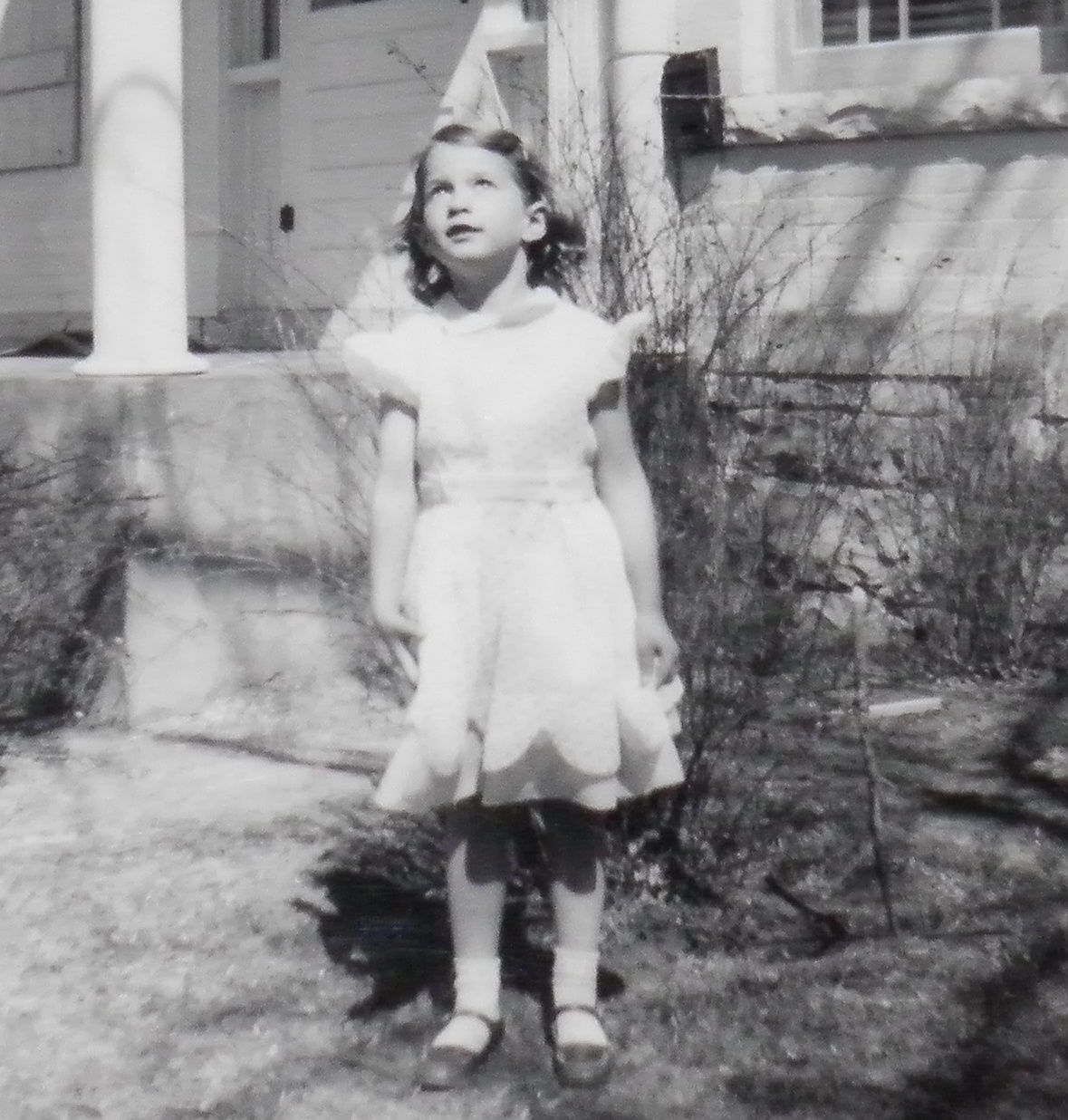
I never had much use for photographs of myself, but after my mother died, I inherited a bunch of photos taken of me when I was young. I put them in an album and I leaf through it occasionally, seeing the progression of myself from a baby to a young woman, trying to figure out what those girls have to do with the me of today. I’ve always felt like just me, and yet, (for example) I cannot remember this little girl in the photo, cannot remember being her. She has receded far into my past. Or perhaps she’s become subsumed into my current persona. Either way, she no longer exists even in memory.

But she is part of the process of me.

(Hmmm. Maybe there is something to this idea of believing impossible things. I’ve already found one new way of looking at life.)

***

Pat Bertram is the author of the suspense novels Light Bringer, More Deaths Than One, A Spark of Heavenly Fire, and Daughter Am I. Bertram is also the author of Grief: The Great Yearning, “an exquisite book, wrenching to read, and at the same time full of profound truths.” Connect with Pat on Google+