MS. CICY’S NIGHTMARE — Chapter 1a

Ms. Cicy's NighmareMs. Cicy’s Nightmare is a fictional work in progress. All the characters have real life counterparts (except perhaps me as the narrator. I’m not sure how real I am). I have everyone’s permission to use their names. Here’s hoping I end up with as many friends at the end of the project as I have now.

***

I didn’t want to kill Jan — it was her idea. I’ve literarily killed hundreds of thousands of people, so it shouldn’t have been difficult to murder one dainty older woman, but the truth is I couldn’t think of a single reason to kill her. She is charming, kind, with a smile for everyone, and the ghost of her youthful beauty is still apparent on her lovely face.

It’s not that I object to killing, you understand. I could easily kill my verbally abusive alcoholic brother, and as a matter of fact, I almost did so today. He broke my bedroom window and screamed obscenities at me while I cleaned up the glass. At one point, I hefted a platter-sized piece of glass and considered Frisbeeing it at his neck, but it seemed like too much trouble. There would not only be the glass to clean up, but all the blood and his dead carcass. So not worth it!

Besides, there’d be no mystery to his death — anyone who heard that relentless verbal assault would understand my need to kill him. The only mystery would be if I could get away with the crime.

Killing someone no one would ever have a reason to kill, like Jan — now, that would be a true mystery. And a challenge.

I blogged about the possibility of murdering Jan, of course. I blog about everything — blogging is my outlet, my support, my discipline. Readers expressed the opinion that killing off one’s friends is a good way of losing those friends, and I had to agree. Alive, Jan is so much sweeter — and sweeter smelling — than she ever would be dead. Besides, I enjoy dancing with Jan, both in the classroom and onstage. (Okay, so our class danced together on stage only once, but it was special for all that.)

The day after I decided not to kill Jan, several of us dancing classmates went to lunch together. When we turned to leave the restaurant after munching on salads and sandwiches, I accidentally swung my dance bag and narrowly missed hitting Corkey, a tanned, elegant blonde a couple of years older and a couple of inches shorter than me.

Corkey deadpanned, “I’m not the one who volunteered to be the murder victim.”

That cracked me up, and right then I decided I had to follow through with the project. I mean, really — how could I not use such a perfect line?

To be continued here: Chapter 1b

***

Pat Bertram is the author of the suspense novels Light Bringer, More Deaths Than One, A Spark of Heavenly Fire, and Daughter Am I. Bertram is also the author of Grief: The Great Yearning, “an exquisite book, wrenching to read, and at the same time full of profound truths.” Connect with Pat on Google+. Like Pat on Facebook.

Cliché, Classic, Cheat, or Convention?

I’ve been collecting mystery genre clichés to use in a whimsical mystery story. Some of the suggestions people have given me are true clichés — clues, characters, or plot devises that have been so overused they hold no surprise anymore. For example, “the butler did it.” The butler was such a ubiquitous character in older mysteries, and such an unobtrusive character, that the choice of the butler for villain was innovative the first time or two, but it quickly became clichéd. After the butler as villain became prevalent, there came a series of mysteries where the butler was the first suspect, but he was so obvious because evebutlerryone knew the butler usually did it, that he was quickly dismissed as a suspect, but the wily detective eventually discovered that it was, in truth, the butler. Then there were the mysteries where the butler became the detective. Now, of course, any use of a butler is clichéd, but it doesn’t matter because no one has a butler anyway. I suppose it would work if a character was named Butler. Hmmm. Might be a possibility for my mystery. Could be a fun gag if nothing else.

A convention is the way something is done. For example, in a mystery there must be a mystery, otherwise it wouldn’t be a mystery. There must be someone trying to unravel the mystery, and there must be clues, false trails, and various other common conventions that make up a mystery novel. And especially there must be a satisfying ending to tie up all the story threads. Just because these elements are in all mysteries, it doesn’t make them clichés. A cliché is something that has become so overused that it no longer holds any meaning or surprise, and the whole point of the mystery genre is meaningful and surprising revelations.

The mystery itself, or a specific type of ending could be clichéd, though. For example, the ending where a detective gathers all the suspects together has become a cliché, mostly because everyone today has at least a modicum of an idea of how the police really work, and the cops simply do not gather all the suspects together to unravel their case in public. Even amateur sleuths, such as the clichéd old lady who noses around because she thinks the police are bumbling idiots, don’t do such clichéd gatherings because they should be smart enough to know that’s how people get killed. And anyway, even if she does do a group unveiling, what difference does it make? Any unveiling of the killer or any confession wouldn’t hold up in court. (We did such a gathering for the end of Rubicon Ranch: Riley’s Story, a collaborative novel I wrote with several other authors, but what made it tolerable was my character’s derision of the whole idea.)

The only ending worse than the clichéd gathering is when the villain has the hero cornered, but spends so much time bragging about how he (or she) did it that the hero gets the upper hand. (Or vice versa — the hero has the villain cornered, but spends so much time congratulation himself that the villain gets away.)

Some clichés aren’t really clichés, but are more of a classic story element. For example, a locked room. Locked room mysteries are a subgenre of murder mysteries, and in fact, I will be using a locked room in my story. Locked rooms add a separate element to the mystery, because not only do you have to figure out who killed the victim and why, you also have to figure out how the heck they got into the locked room. And, of course, the locked room has to be an integral part of the story, otherwise it becomes a cheat with no other reason for being than to add cheap suspense. In my case, I can’t do anything but the locked room mystery. The mystery will revolve around a dance studio, and the only time the studio is unlocked is when people are there. It’s hard to commit a murder unseen in a crowd, though it has been done.

Occasionally clichés are cheats. Someone gets a letter from the victim or killer at the beginning of the story, the person puts the note in a pocket or desk drawer unread, but finds it at the end in time to keep the killer from killing again. It’s a cheat because if the fool had read the letter at the beginning, there would be no story.

In a mystery, the main characters have to act to the best of their ability at all times. A woman who is told not to go some place where danger lurks, and she goes simply because she was told not to, is someone who is not acting to the best of her ability. Stupidity is not a plot ploy. It is a cheat.

So, there you have it, a brief primer on the differences between clichés, classics, cheats, and conventions.

**

Pat Bertram is the author of the suspense novels Light Bringer, More Deaths Than One, A Spark of Heavenly Fire, and Daughter Am I. Bertram is also the author of Grief: The Great Yearning, “an exquisite book, wrenching to read, and at the same time full of profound truths.” Connect with Pat on Google+. Like Pat on Facebook.

Let’s Play the Cliché Game!

My exercise class suggested I write a book about them. One woman even volunteered to be the victim, though I can’t imagine why anyone would want to kill her. She is lovely, charming, and utterly delightful. I wasn’t going to write the story since it seemed a good way to lose a lot of friends, but at the lunch the other day, I almost whacked one of my classmates with my exercise bag, and she deadpanned, “I’m not the one who volunteered to be the murder victim.” So I decided to write the book. I mean, how could I not use such a perfect line?

I’d like to do the book campy with exaggerated uses and sly mentions of mystery clichés. For instance, I could get a call from one of the women who says she has information, but won’t give it to me over the phone. I immediately rush over there, of course, since such a call is a precursor to being murdered in cheap mysteries, but when I get there I find . . . I don’t know. Something innocuous. That the cell phone battery went dead. (Or better yet, I call the cops, and they think I’m hysterical.) Then there’s the “Don’t Go There” ploy, advice that a character ignores. When she does Go There, she almost gets herself killed. (Someone suggested this should be a buxom blonde, and of course, I know the perfect person for the role — a lady in red who is a buxom blonde or rather a buxom sometimes-blonde, and she definitely would Go There.) Of course I would also mention the old fictional women from small towns who stumble on so many murders, there couldn’t possibly be anyone left alive in the vicinity. Perhaps even use the alcoholic, donut-eating cop, misogynous cop.

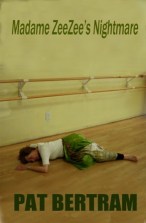
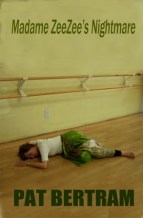
I’m going to start out writing the book the way the idea unfolded in real life, beginning with the suggestion of my writing the book, our planning the murder, etc. leading up to the day we go to class and find her dead for real. The victim is such a good sport, she let me take a photo of her being dead to use for the book cover. (She sank to the ground gracefully, and fell into the perfect pose. Hmm. Maybe she is an eminently suitable victim after all. In the mystery world, she would be too good to be true.)

For now, I’m collecting clichés to use in the book. What do you think are the top clichés in mystery/suspense/thriller fiction? Who are the stock characters? What clichés and other mystery genre conventions do you absolutely hate?

But be careful! You might just end up in the book.

***

Pat Bertram is the author of the suspense novels Light Bringer, More Deaths Than One, A Spark of Heavenly Fire, and Daughter Am I. Bertram is also the author of Grief: The Great Yearning, “an exquisite book, wrenching to read, and at the same time full of profound truths.” Connect with Pat on Google+. Like Pat on Facebook.

Break Time Now Available on Amazon!

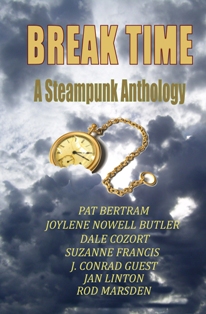
Break TimeBreak Time, the steampunk anthology I’ve been collaborating on with six other authors has now been published. You can find the kindle edition here:  Break Time on Kindle And the print edition here: Break Time in print. Soon it will be available on Smashwords and on Barnes and Noble.

To whet your appetite for the story, here is an excerpt from Break Time:

***

(Interim) Florence Giston, 1966 by Pat Bertram

Five minutes after the time machine winked out in a rainbow of light and harmonious sounds, it still hadn’t returned. Flo had watched the machine leave and arrive back within minutes during Al’s journeys to their shared past, so she thought she knew what to expect, but she hadn’t experienced this lag time before. Maybe something had gone wrong?

She waited another minute, then slowly turned around in a circle, hoping that the machine had somehow appeared behind her, but the black pyramid remained absent.

She’d felt helpless after the death of her husband, knowing there was nothing she could do to bring him back to her, but even that feeling of powerlessness paled in comparison to this new conundrum. Death, despite its awesome mysteriousness, was still somehow ordinary. Except for those alive today, everyone who had ever been born was now dead.

Could Al be dead? Her father-in-law had said he was going to kill steam, but could someone have killed him before he could accomplish his task? Could the time machine have somehow gone off course, or crashed? If Al was lost somewhere in the break in time, how would she ever find him?

She took a deep breath. No matter how long Al might have been traveling in time—misplaced or not— he’d only been gone a few minutes.

No need to panic.

Just wait. See what happens. Believe he will return.

***

Pat Bertram is the author of the suspense novels Light Bringer, More Deaths Than One, A Spark of Heavenly Fire, and Daughter Am I. Bertram is also the author of Grief: The Great Yearning, “an exquisite book, wrenching to read, and at the same time full of profound truths.” Connect with Pat on Google+. Like Pat on Facebook.

Rubicon Ranch: Riley’s Story — Review by Sheila Deeth

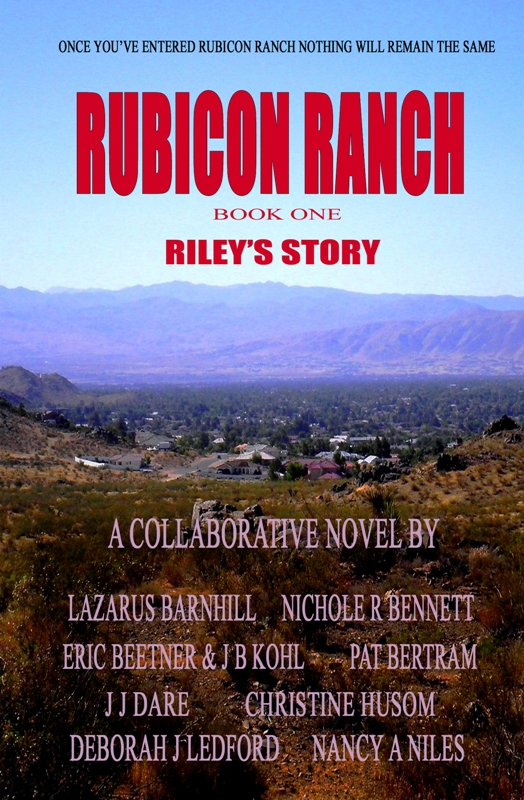
Rubicon Ranch is a collaborative trilogy that was written online by me and several other authors from Second Wind Publishing. We started out with the murder of a little girl, and though we never knew where we were going (the murderer wasn’t chosen until the very end) or what the other writers were doing, we actually ended up with a book that seemed as if it had been planned from the beginning.

Sheila Deeth, inveterate reviewer (she’s rapidly becoming one of Amazon’s top reviewers) and author in her own right (Divide by Zero, Infinite Sum, and Imaginary Numbers, are all coming soon from Second Wind Publishing) had this to say about Rubicon Ranch: Riley’s Story:

Rubicon RanchI read occasional chapters of this novel online while it was being written. But now, at last, I’ve been able to read the whole thing in one setting, and I thoroughly enjoyed it. Different authors pen chapters from the points of view of different characters. But the end of each tale meshes perfectly with the next, and the story progresses, through twists and turns (and death), to its mysterious, perfectly logical conclusion, while the reader is left to guess, imagine, wonder, and reflect.

The inhabitants of Rubicon Ranch are a mixed bunch, with accidental killers, accused pedophile, angry son, angry widow, and singularly dubious strangers staying at the local B&B. In classic Agatha Christie style, they might all have reasons to kill, and to hide, in a desert development where even the sheriff has his secrets. But which one, or ones, did the deed?

Feisty widow Melanie teams up, reluctantly, with the handsome sheriff. Seeing the world through a camera’s eye, and describing it with a writer’s sense of detail, she’s either the best at hiding her motives, or else she just hasn’t looked in the right place yet. Their tense relationship is fun, filled with promise for future books in a series that’s most un-traditionally written, but classically cool and enticing.

The desert’s pretty cool too—seriously hot, beautifully described, thoroughly genuine, and with snakes in the grass. I really enjoyed this delightfully traditional, thoroughly modern mystery.

Disclosure: I bought this when it was free and can hardly believe it took me so long to get around to reading it. —Sheila Deeth

You too can download a copy of Rubicon Ranch: Riley’s Story. Just click here: Rubicon Ranch on Smashwords to download in the ebook in the format of your choice. Or you can read it online here: Rubicon Ranch: Riley’s Story.

Or you can sample the first chapter here: Melanie Gray. Melanie Gray is my character, and is the character who connects all the books.

Excerpt from LIGHT BRINGER by Pat Bertram

Description of Light Bringer:

Becka Johnson had been abandoned on the doorstep of a remote cabin in Chalcedony, Colorado when she was a baby. Now, thirty-seven years later, she has returned to Chalcedony to discover her identity, but she only finds more questions. Who has been looking for her all those years? Why are those same people interested in fellow newcomer Philip Hansen? Who is Philip, and why does her body sing in harmony with his? And what do either of them have to do with a shadow corporation that once operated a secret underground installation in the area?

Excerpt from Light Bringer:

Philip woke in the dark of early morning, forehead damp with perspiration, heart pounding from unremembered nightmares. When calm settled over him, he listened for the sound of Rena’s even breathing on the other side of the thin wall. Hearing only an indigo silence, he rose and went to check on her. Because he didn’t take the time to put on his braces, he made sure to plant one foot on the floor before swinging the other forward.

Rena’s bed was empty.

He found her on the porch, sitting on the single step, her strange cat beside her.

She turned a smile on him, as bright as the starshine.

He sat next to her. “What are you doing out here?”

“Listening to the music of the spheres.” As one, she and the cat tilted their faces to the sky. “Can you hear it?”

He angled his head. He heard crickets chirping nearby, dogs barking in the distance, and farther away a train clattering on its tracks. As he isolated each sound, he set it aside until there were no more noises. Then, as if from some vast remoteness, he heard a faint silvery tone that seemed to swell, bursting into a thousand jewel-bright notes. Every note sounded clean and sharp, a thing unto itself, but melodized into an aural patchwork quilt of intricate design.

After a timeless interval—minutes or hours, he had no way of knowing—heavy clouds rolled in, turning off the sky.

He shivered in the cooling air. Rena inched closer, put an arm around his waist, and nestled against him.

Warmth and sweet harmony enveloped them as if that aural quilt had settled on their shoulders.

***

Where to buy Light Bringer:

Second Wind Publishing

Amazon

Barnes & Noble Nook

iStore (on iTunes)

Palm Doc (PDB) (for Palm reading devices)

Epub (Apple iPad/iBooks, Nook, Sony Reader, Kobo)

Excerpt from LIGHT BRINGER by Pat Bertram

Description of Light Bringer:

Becka Johnson had been abandoned on the doorstep of a remote cabin in Chalcedony, Colorado when she was a baby. Now, thirty-seven years later, she has returned to Chalcedony to discover her identity, but she only finds more questions. Who has been looking for her all those years? Why are those same people interested in fellow newcomer Philip Hansen? Who is Philip, and why does her body sing in harmony with his? And what do either of them have to do with a shadow corporation that once operated a secret underground installation in the area?

Excerpt from Light Bringer:

The trail was a gentle decline, hard-packed, and free of rocks, as if it had been well traveled since time out of mind. It ended at a stream so clear its cobbled bed looked like a mosaic of semi-precious stones. On the other side of the stream, the tall meadow grasses, lavender in the mountain’s shadow, whispered softly among themselves.

Laughing, Rena caught Philip’s hand. “They’re inviting us to come play.” She ran the last few steps toward the edge of the water.

He pulled his hand away, hearing in his mind the sickening sound of ripping ligaments and tendons, and feeling the pain.

Walking carefully, he joined her by the stream.

“Too bad there’s not a bridge,” she said, “but the water isn’t deep. We can wade across.”

He put out a foot, drew it back. “You go. I’ll wait here.”

She nodded in understanding, and took his hand again. “That’s okay. I can go another time.”

They sat on the forested slope, listening to the whispering of the grasses increase in pitch as the day came to an end. After the sun set, they headed home in a rich, warm alpenglow that turned the world to gold.

***

Where to buy Light Bringer:

Second Wind Publishing

Amazon

Barnes & Noble Nook

iStore (on iTunes)

Palm Doc (PDB) (for Palm reading devices)

Epub (Apple iPad/iBooks, Nook, Sony Reader, Kobo)

End of the Trail

Poor old Santa looks like he hit the end of the trail.

End of the Trail

If he conked out before he brought you one of my novels, you can download 20-30% free at Smashwords.com in the ebook format of your choice. Or you can read the first chapter online before deciding which one you’d like to buy.

***

More Deaths Than OneBob Stark returns to Denver after 18 years in SE Asia to discover that the mother he buried before he left is dead again. At her new funeral, he sees . . . himself. Is his other self a hoaxer, or is something more sinister going on?

Click here to read the first chapter: More Deaths Than One

***

A Spark of Heavenly FireIn quarantined Colorado, where hundreds of thousands of people are dying from an unstoppable, bio-engineered disease, investigative reporter Greg Pullman risks everything to discover the truth: Who unleashed the deadly organism? And why?

Click here to read the first chapter of: A Spark of Heavenly Fire

***

DAIWhen twenty-five-year-old Mary Stuart learns she inherited a farm from her recently murdered grandparents — grandparents her father claimed had died before she was born — she becomes obsessed with finding out who they were and why someone wanted them dead.

Click here to read the first chapter of: Daughter Am I

***

Thirty-seven years after being abandoned on the doorstep of a remote cabin in Colorado, Becka Johnson  returns to try to discover her identity, but she only finds more questions. Who has been looking for her all those years? And why are those same people interested in fellow newcomer Philip Hansen? And what do they have to do with a secret underground laboratory?

Click here to read the first chapter of: Light Bringer

***

Pat Bertram is the author of Light Bringer, More Deaths Than One, A Spark of Heavenly Fire, and Daughter Am I.All Bertram’s books are available both in print and in ebook format. You can get them online at Second Wind Publishing, Amazon, B&N and Smashwords.  At Smashwords, the books are available in all ebook formats including palm reading devices, and you can download the first 20-30% free!

Excerpt From More Deaths Than One

More Deaths Than OneYesterday, while searching More Deaths Than One for references to the scent of frangipani for my post Justifying Our Sex Scenes, I happened to find the passage below. It’s been so long since I’ve looked at the book, the story seemed fresh and new, and something I’d be interested in reading. (Which, actually, is why I wrote the book — to write something I’d like to read.) Note: ISI is Information Services, Incorporated, a corporation with ties to US intelligence agencies.

Description: Bob Stark returns to Denver after 18 years in SE Asia to discover that the mother he buried before he left is dead again. At her new funeral, he sees . . . himself. Is his other self a hoaxer, or is something more sinister going on?

Excerpt:

“Here, put this on.” Bob held out a brown two-inch-wide belt.

Kerry lifted her shirt and showed him the waistband of her dark cotton slacks. “It’s elastic, see? I don’t need a belt.”

“It’s a money-belt. I got two of them yesterday, one for me and one for you. There’s ninety-five hundred dollars in each of them—”

“Ninety-five hundred dollars?” Her eyes grew round. “In cash?”

“Yes. I would have liked to get more, but that’s all we’re allowed to bring into the United States without having to fill out forms, and in our situation, that can get sticky.”

“What would happen if we brought in more than that and didn’t declare it?”

“Maybe nothing unless we got caught, but since we’re traveling with fake IDs, I’d prefer not to complicate matters. When the problem with ISI goes away, I can have some of my money wired to an account in Colorado or wherever.”

“Just some? Not all?”

“It’s safe where it is.” When she gave him a narrow-eyed look, he laughed. “I don’t seem to be able to keep anything from you. It’s in a private bank in Chinatown. Hsiang-li sponsored me, otherwise I’d have to use the same banks as everyone else, and ISI would probably have found my account by now.”

“Wouldn’t ISI have already traced the bank through your traveler’s checks?”

“My bank doesn’t offer that service. I paid cash for them at another bank that does, and since they don’t know me, that’s a dead end for ISI.”

Becoming aware he still held out the money-belt, he said, “Well, are you going to put it on?”

She took it from him, fastened it around her waist, and smoothed her shirt over it. Turning sideways to look in the mirror, she asked, “Does it make me look fat?”

“I don’t even notice it.”

She gave him a laughing glance. “Aren’t you afraid I’m going to run off with your money?”

“No. In fact, you can have it.”

She looked at him aghast. “I can’t take your money.” Reaching under her shirt, she started to remove the belt.

He put a hand on her arm. “Keep it for now. If we get separated, or if anything happens to me, you’ll need it to get back home.”

“Nothing’s going to happen to you,” she said fiercely.

He nodded as if he agreed and did not mention the sense of foreboding that made his shoulder blades itch.

***

Pat Bertram is the author of the suspense novels Light Bringer, More Deaths Than One, A Spark of Heavenly Fire, and Daughter Am I. Bertram is also the author of Grief: The Great Yearning, “an exquisite book, wrenching to read, and at the same time full of profound truths.” Connect with Pat on Google+. Like Pat on Facebook.

“Ordinary People Becoming Extraordinary”

Sometimes we have to laugh at ourselves and our conceits. Yesterday I wrote a blog post Whose Book Is It? about readers who saw something different in my books than I intended. I wrote:

A Spark of Heavenly FireA reader once pointed out that A Spark of Heavenly Fire was about love in all its guises. He was right, that is a major theme, though that hadn’t been my intention. I wanted to write a big book, an important book with ordinary people becoming extraordinary in perilous times. Since I didn’t want to do a war story, I did the next best thing — created an epidemic so deadly that the entire state of Colorado had to be quarantined to prevent the spread of the disease. To “personalize” the catastrophe, I told the story from several points of view, not just character POV, but the various ways the characters viewed the epidemic. And what shone through, by the time all the stories were told, was the theme of love in all its guises.

It wasn’t until this morning that I remembered that I hadn’t intended to write an important book with ordinary people becoming extraordinary in perilous times. Well, the important book part is right — I wanted to write a classic story that most people would be able to identify with. But I never used the phrase about ordinary people becoming ordinary until I received a rejection letter from an agent, in which the agent thanked me for sending them my excerpt since they “were always looking for such stories about ordinary people becoming extraordinary, but . . .”

Oddly, I don’t remember what followed the “but.” There was always a “but.” “We liked the concept of your story but we didn’t fall in love with your characters as we had hoped.” “Your book is excellent, but we only publish literary books and yours is more commercial.” “We loved your book, but we don’t know how to sell it. It has too many science fiction elements to be mainstream fiction and not enough to be science fiction.”

But I digress. The point is, that is where I got the idea of A Spark of Heavenly Fire being a story of ordinary people becoming extraordinary. I figured if I got a personalized rejection letter rather than a badly Xeroxed form letter or even just a “no thanks” scribbled on my query, that maybe I was on to something. So I started using the phrase “ordinary people becoming extraordinary” to describe the book in subsequent query letters. I did it so often that it stuck even after I learned the truth — the rejection letter that had so impressed me had been a form letter after all. (I thought that since they had expressed an interest in my writing, I’d query them about another book and got the exact response as I did the first time.)

The truth of why I wrote A Spark of Heavenly Fire is that I wanted to write about society turned upside down. I wanted to create conditions where the successful folk didn’t have the skills to be successful in the new world, but the unhappy, the failures, and the outcasts were able to find happiness, success, and fulfillment. I mostly achieved that, but one character — a beautiful young woman — turned out to have good coping skills, which gave the book more of a dimension than if she’d ended up in the gutter.

***

Pat Bertram is the author of the suspense novels Light Bringer, More Deaths Than One, A Spark of Heavenly Fire, and Daughter Am I. Bertram is also the author of Grief: The Great Yearning, “an exquisite book, wrenching to read, and at the same time full of profound truths.” All Bertram’s books are published by Second Wind Publishing. Connect with Pat on Google+