Finding a Reason to Write

Okay, here I am. The fourth day of My Novel Writing Month. I take a deep breath, trying to remember why I wanted to write, why I needed to.

Several years ago, when I couldn’t find the books I liked anymore — story and character driven novels that can’t be slotted easily into a genre — I decided to write my own. The one obvious flaw to this reasoning is that if publishers weren’t publishing non-genre novels written in a genre style (as opposed to a “literary” style), then how did I expect them to publish my books? But I did. And they didn’t. When I’d written (and rewritten) four novels, adding another didn’t seem compelling. Four unpublished novels were bad enough, but five seemed . . . pathetic.

Now that two of those novels are about to be published by a small press with looser definitions of genre than the multi-national publishers, I am down to two unpublished books. And all of a sudden, that seems too few. So now I have the need to write, and I have the itch, but I am out of the habit.

That’s what MyNoWriMo is supposed to give me — not the 50,000 words necessary to complete NaNoWriMo, but the habit of writing.

So here I sit, waiting for the words to come, and they do. But not the right ones.

I’m supposed to be getting my hero back to his neighborhood (after finally letting him stop running from the volcano), yet here I am, writing about writing rather than writing. Though I suppose it depends on one’s definition of writing, because technically, I am writing. Or am I blogging? Either way, I am not working on my novel.

So, I got the poor guy away from the volcano, let him drink his fill at an hour-old river, let him indulge in a bit of light-headed musing (after all, it’s been months since I fed the poor guy), and now he’s on his way home.

The shadows are lengthening, and in this strange new apocalyptic world, anything can happen . . .

My Novel Writing Month

Chip, the hero in my WIP (work-in-pause), has been running from a volcano for several months now while I spend my words writing articles and commenting on other people’s articles. Poor Chip is getting pooped. (Does anyone use pooped any more to mean tired? Or am I dating myself?)

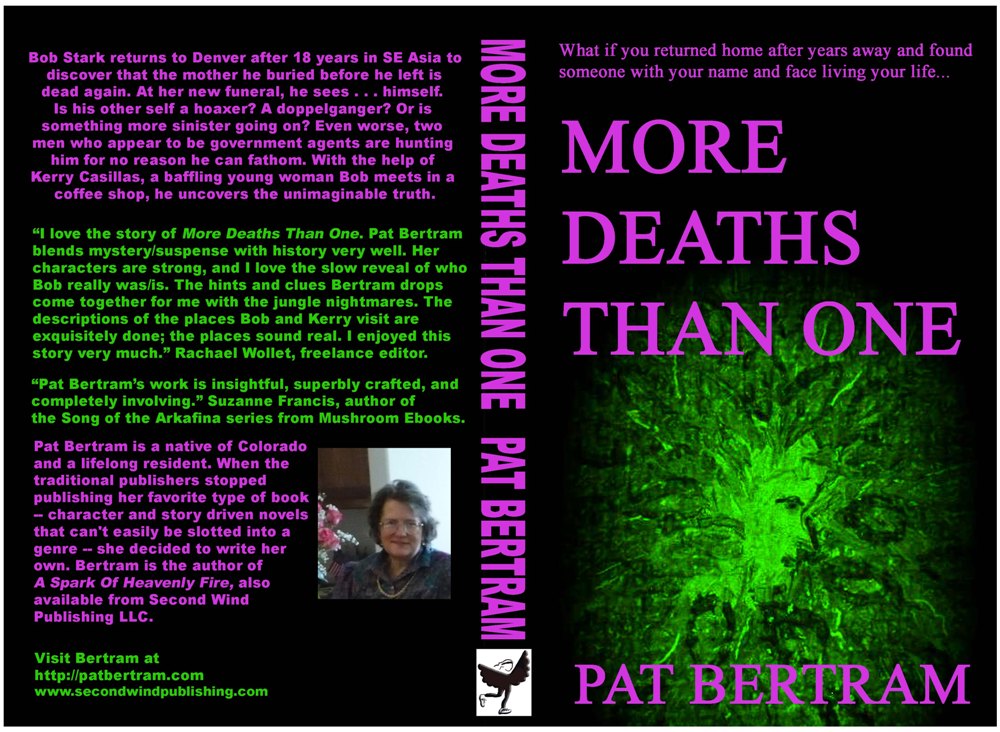
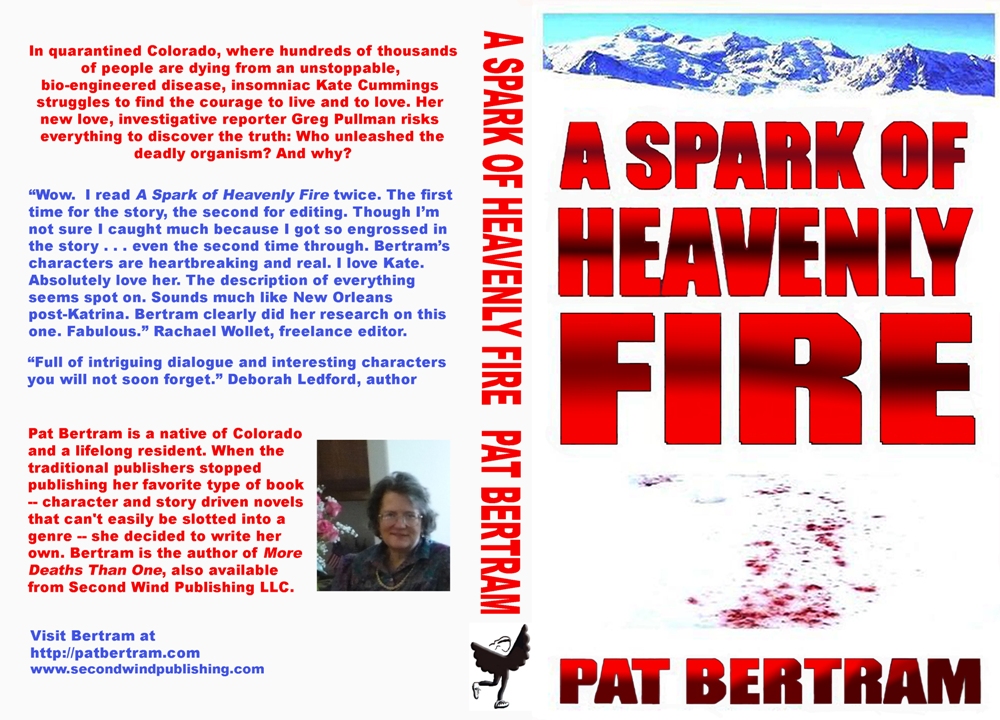
November is NaNoWriMo (National Novel Writing Month); aspiring writers from all over the world pledge to write a 50,000-word novel or add 50,000 words to an existing work during those thirty days. (Had to say that silly little grade school rhyme — thirty days has September, etc., to get the number of days correct.) I planned on doing NaNoWriMo this year to get me focused on my novel again, but then I realized if I wait another month to start, I would find other ways to procrastinate, such as promoting my books. (Shh. I haven’t told my family yet, but two of my novels — More Deaths Than One and A Spark of Heavenly Fire — are going to be published in November.)

So, I am declaring October MyNoWriMo (My Novel Writing Month). I’ve never been able to write 1,000 words in a day let alone the 1,670 words I’ll need to achieve my goal, but apparently the point is to let the words flow without censoring oneself, and that is what I want to learn how to do. I’m one who edits as I go, and that does tend to cut the output.

I decided to get a head start last night (I already know that I won’t be writing on Thursday because that’s when I have my live writing discussion at No Whine, Just Champagne on Gather and I wanted to make up for it), but I fell asleep. Makes me wonder how I ever managed to write and rewrite and edit and re-edit four novels!

Let’s hope my falling asleep isn’t a sign of things to come.

I’ll let you know what happens.

(Could I have used more parentheses?)

Would You Like Me to Interview Your Characters?

I am starting a new blog, Pat Bertram Introduces . . .  where I will be posting interviews with fictional characters. The first interview has been posted: Pat Bertram Introduces Siegfried Marggrander, close friend and brother-in-law of Gus LeGarde, of the LeGarde Mystery series, written by Aaron Lazar.

If you wish a character to be interviewed by Pat Bertram, please answer fifteen to twenty questions from the Character Questionaire Page and submit them in the comment section along with whatever links you’d like included. Be sure to answer in your character’s voice, and be sure you mention the title of the book and who wrote it. If an answer to a question is yes or no, please explain why. (Example: Do you run away from conflict? Yes. Why? I don’t like fighting. See, there was this time in third grade where I got in a fight and . . .) Feel free to include your own questions. The character interviewed does not have to be the hero. Even if you don’t want your character interviewed, you can ask your characters these questions to help you profile them.

  1. What is your story?
  2. Who are you?
  3. Where do you live?
  4. Are you the hero of your own story?
  5. What is your problem in the story?
  6. Do you have a problem the wasn’t mentioned in the story?
  7. Do you embrace conflict?
  8. Do you run from conflict?
  9. How do you see yourself?
  10. How do your friends see you?
  11. How do your enemies see you?
  12. How does the author see you?
  13. Do you think the author portrayed you accurately?
  14. What do you think of yourself?
  15. Do you have a hero?
  16. Do you have a goal?
  17. What are your achievements?
  18. Do you talk about your achievements?
  19. Do you keep your achievements to yourself?
  20. Do you have any special strengths?
  21. Do you have any special weaknesses?
  22. Do you have any skills?
  23. Do you have money troubles?
  24. What do you want?
  25. What do you need?
  26. What do you want to be?
  27. What do you believe?
  28. What makes you happy?
  29. What are you afraid of?
  30. What makes you angry?
  31. What makes you sad?
  32. What do you regret?
  33. What is your biggest disappointment?
  34. What, if anything, haunts you?
  35. Are you lucky?
  36. Have you ever failed at anything?
  37. Has anyone ever failed you?
  38. Has anyone ever betrayed you?
  39. Have you ever failed anyone?
  40. Have you ever betrayed anyone?
  41. Do you keep your promises?
  42. Are you honorable?
  43. Are you healthy?
  44. Do you have any handicaps?
  45. Do you have any distinguishing marks?
  46. What was your childhood like?
  47. Do you like remembering your childhood?
  48. Did anything newsworthy happen on the day you were born?
  49. Did you get along with your parents?
  50. What in your past had the most profound effect on you?
  51. What in your past would you like to forget?
  52. What in your past would you like others to forget?
  53. Who was your first love?
  54. Who is your true love?
  55. Have you ever had an adventure?
  56. What is the most important thing that ever happened to you? Why?
  57. Was there a major turning point in your life?
  58. Was there ever a defining moment of your life?
  59. Is there anything else about your background you’d like to discuss?
  60. What is your most closely guarded secret?
  61. What is your most prized possession? Why?
  62. Do you have any hobbies?
  63. What is your favorite scent? Why?
  64. What is your favorite color? Why?
  65. What is your favorite food? Why?
  66. What is your favorite beverage? Why?
  67. What is your favorite music? Why?”
  68. What is your favorite item of clothing? Why?
  69. Name five items in your purse, briefcase, or pockets.
  70. What are the last five entries in your check registry?
  71. What are the last three books you read?
  72. If you were at a store now, what ten items would be in your shopping cart?
  73. If you had the power to change one thing in the world that didn’t affect you personally, what would it be?
  74. What makes you think that change would be for the better?
  75. If you were stranded on a desert island, would you rather be stranded with, a man or a woman?
  76. How do you envision your future?

Getting a Word in Edgewise

DeLauné Michel, author of Aftermath of Dreaming and The Safety of Secrets, is hosting my blog again today. She let me choose which of her articles to post, and I couldn’t bear to pass up either “How Do You Choose? Or Why I Wrote This Novel,” which I posted yesterday, or this article, so she graciously agreed to let me use both. I hope you enjoy her story as much as I do.

In the French Catholic world where I grew up in South Louisiana, there was only one ritual more important than Sunday Mass, and that was the dinner hour. True to our heritage and locale, in the house that I grew up in, dinner was the most important time of day, partly for the food – my Momma’s incredible Creole cuisine – but mostly for the conversation. Or should I say storytelling. Because that’s what it was: long, detailed, funny, and illuminating stories. And God forbid you didn’t have one.

My father started first. Every night, my four older sisters (yes, four, and no brothers!) and I would sit quietly, eating our dinner while Daddy told Momma about his day. We were expected to pay attention. We were expected to learn and understand what Daddy did running the insurance company, which I never did until a few years ago. But we were not expected to be part of that conversation.

Then Momma talked about her day. My mother had her own life of running the Arts Council and working on her Ph. D. and writing, but at this point, we were more than just a silent audience because we were actually players in some of the stories of her day.

Then finally it was our turn. All five of us. And let’s just say that with four extremely verbal, intelligent and expressive older sisters, getting a word in edgewise was not an easy feat. So I didn’t. At all.

Finally when I was about six, Momma and Daddy realized that I rarely-to-never spoke at the dinner table, so in an effort at equality and to stave off me being a future dinner-party-mute, they enforced a new rule: Every night, I was to get my own time to talk with no interruptions, no cutting off, no shouting over. Ready? Go!

There I was: the youngest at the table, the one with the least schooling, the least experience, and the least stories as it were, but with the time to talk. I cannot think of this memory without a visceral sense of four bodies literally sitting on their hands with their mouths clamped shut. And possibly bored. Or indulging. But regardless, I got to talk, to tell the story of my day. And boy, did I. From the beginning. Because to me it was very clear that each event flowed to the next and the next wasn’t possible without what proceeded it so how could I tell them about the red-headed woodpecker at the park with Gracie Mae if I didn’t tell them how hard it was to decide which shorts to wear that day, purple or pink?

It never really got much easier to talk at that dinner table, and when I got older, the enforcing of that nightly rule fell away, and I either fought my way in to the conversation or I didn’t, but something amazing had happened. I was able to feel what it was like to have the time and the space to be heard.

As far back as my memory goes, I always knew that I would be writer. I come from a family of writers: my mother, my first cousin Andre Dubus (House of Sand and Fog), and another cousin is James Lee Burke, so that world has always been around me. But that experience at the dinner table is what made me need to write, and made me keep writing. I need to be heard, and doesn’t everyone? Even if it is only on a piece of paper or a computer screen. And if I’m not interrupted, if someone reads my stories, that is a glorious bonus. But what’s most important is that I give that time and space to myself in the dinner party of my life.

It’s no surprise that Spoken Interludes, the reading series that I produce in NY and LA, is basically a reconstruction of the dinner table. People come together, have a meal, and writers tell a story by reading their work.

So, if you pick up The Safety of Secrets, I’d love to hear what you think. And it’s okay to interrupt me. Promise.

How Do You Choose? Or Why I Wrote This Novel

DeLauné Michel, author of Aftermath of Dreaming and The Safety of Secrets, has graciously agreed to guest host my blog today. Michel says:

I was at a dinner party once when someone threw a question out to the group, “If you were stranded on a deserted island, would you rather be stuck with a man or a woman?”

My first response was, “A man, of course.” But then I started to think about it. And as much as I love my husband, I can talk to my best friend in a way that I never can with a man because I know she has felt exactly the way I have. But I still need my husband, so whom would I chose?

After I got married, a significant friendship in my life underwent a shift. It was as if just by signing that paper and walking down that aisle, things with my friend had changed, even though I really hadn’t, other than the option of Mrs. that I didn’t even use! As my friend and I struggled to get our friendship back, and to redefine what it meant, it forced me to think about that question, about being torn between a husband and a best friend. I wondered what sort of situation would make a woman be more loyal to her best friend than to her husband. Maybe a childhood trauma locked away with a life-long pact to never tell? And what if a woman lied to her husband to protect that secret? Could that ever be okay?

I realized that I didn’t know the answers to those questions, and that’s when I knew that they were the basis for my second novel. I wanted to explore deep-rooted loyalty between women, and how sometimes it can be a sword that cuts both ways, opening up whole worlds of safety within the friendship while exacting a price, as well.

When I started looking at loyalty, I also had to look at betrayal. And it occurred to me that one currency of intimacy in a best friendship is shared secrets, so I wanted to see what would happen to that relationship when its most powerful secret is given away, and given away thoughtlessly, like so many pennies dropped on the floor. There is such stark and deep knowledge of one another in an ages old friendship that I wondered about how some secrets are used to protect ourselves, while others are used to try to continue to be the person we think our best friend needs.

Then I realized that if there is any world in which secrets are at a premium, it is Hollywood. All of that shielding and hiding are essential tools in that town. I think one trait that distinguishes stars from other actors is their ability to appear completely exposed while in fact they presenting only and exactly what they want us to see. I felt that making my main characters, Fiona and Patricia, actresses in LA (though part of the novel occurs in flashbacks in south Louisiana where they grew up; I can’t let go of my roots!) would deepen their connection to secrets and revealing truths. Besides, my first novel, Aftermath of Dreaming, was mostly set in Los Angeles, and after living there for so long, I wasn’t ready to leave such a rich and provocative backdrop yet.

By working through Fiona and Patricia’s friendship in The Safety of Secrets, I learned a lot about loyalty and secrets between women. But I still have more to go. If you get a chance to read it, I’d love to hear what you think about how those issues play out in the book and in your own life.  And if I’m in your area on my book tour, come by and tell me in person. I’m traveling to Portland, LA, Albuquerque, Santa Fe, pretty much all of Louisiana, Jackson MS, Natchez, Memphis, Boston, Newburyport, and the New York area. The tour schedule is on my gather page.

Oh, and who would you chose for that desert isle, a woman or a man? Or is it a secret you’ll never tell?

On Writing: Food

Sex and violence are visceral activites, but so is eating. Food is at once primitive and sophisticated, animalistic and human. We need to eat, but to a great extent we get to choose what we eat. And we get to choose for our characters. In fact, the characters of our characters lie in that choice. Are they vegan, omnivore, or something in between? Do they binge out or are they ascetic? When alone, do they take the time to cook a meal for themselves, or do they eat it standing over the sink? For me, a big question is what characters do with leftovers. Whenever characters in books throw away perfectly good food, I lose all sympathy for them and start rooting for the villains. Even in a world of abundance, food is precious. Or should be.

Wasted food gripes the heck out of me; I despise real and fictional food fights. Shows disrespect for life, a total lack of sensitivity, and people who never knew want. Another movie/book scene I absolutely hate is when a guy proposes to a woman by putting a ring in her drink, in a desert, or any other comestible. All I can think of is broken teeth when she bites into it or a punctured gut when she swallows it. Very romantic!

Besides describing character, food can be used as a theme, a plot point, a symbol. Food can be used to define the emotion of a scene or to delay the action and add suspense. Food helps create a setting in historical novels. The way a person eats tells a lot about character. You don’t need to describe food. Everyone knows what hamburger tastes like, or ice cream or jello. The whole ambience of food is much more important. I have one character who chews each mouthful of food exactly twenty-five times. His fiance finds herself counting his jaw movements, and by that you can tell that there relationship is doomed.

Just think of all the conflict attached to a family feast, such as a Thanksgiving dinner. The drama of several women competing to make their own favorite dressing, the trauma of a burnt pumpkin pie, the complication of children running underfoot, the conflicts of . . . You know the story. You’ve been there.
 
Movies and television shows are filled with great food scenes. The best Golden Girls shows were the ones where they sat at the kitchen table eating everything in sight, and talking about their lives. And who can forget the breakfast scene in My Stepmother Was an Alien, where she cooked up an entire menu. Or the breakfast scene in Uncle Buck when John Candy made pancakes as big as a table and used a snow shovel as a turner. All great food visuals, but also much going on beneath the scene.  

What role does food plays in your novels, in novels you have read, or in movies you have seen?

Fun food related websites:

The Food Time Line

History and Legends of Favorite Foods

History of Food and Food Products

Food History Resources

Food and Drink in Regency England

Medieval Recipes

To Outline or Not Outline

Dellani Oakes, today’s guest blogger, is the recently published author of Indian Summer, a unique regency novel of a young girl’s coming of age. Dellani says:

I continue to be amazed by people who make outlines of their stories, know where the story line is going and most of all know the ending before even writing the book. Who are these godlike folk and why am I not like them? I am a very off the cuff writer, I don’t know where the story is going to go, although I like to have a general idea before I begin. I usually start with an idea or, more often than not, a sentence that seems to resonate in my mind until I get it down on paper. Novels and short stories start the same way, a compelling first sentence.

When I was a member of the Science Fiction and Fantasy Writers, I read an article in the newsletter that caught my interest. It was an interview with Tim Powers. I read snippets to my husband asking him (like he knows), “How can he do that? How can anyone do that?” Outlines? Those are things you write after a term paper is written and only because the teacher requires it. If they had a crown for that, I’d be Queen.

I rarely know where my stories are going. I don’t always know what I’m going to do with a character after I’ve introduced him, but I know he’d not be there if he weren’t important in some way. For me, writing is an exploratory process. I can’t sit down knowing what will be, I have to let it unfold. I think the idea of outlines is very intimidating for some writers, especially new ones. To know everything in advance takes some of the fun out of my process. Don’t misunderstand, I think it’s marvelous that some people can do that. I find it incredible that they are organized enough to work their way through the entire book before actually writing it. It is a matter of preference and personality.

Having tried the outline, I can honestly say it doesn’t work for me. I can’t even write a short synopsis of a book because I put in too much detail. I got half way through my first outline and thought, “If I am going to spend this much time on it, I might as well just write the book.” The outline hit the trash and I put all that creative energy into the novel instead.

What I think I was trying to say when I started is this: Don’t be intimidated by the idea that you must outline. Don’t think you can’t start the novel you’ve been dreaming about because you have no clue how it’s going to end. Go with what is comfortable for you and find your way. By all means, try outlining because it is a wonderful tool, but don’t lock yourself into the thinking that you have to follow it once it’s there. Nothing is cast in stone, everything is malleable Thenwhen the creative juices flow and the words pound at the inside of your skull demanding to be set free, you can give them the outlet they need, hammering away at your keyboard or pouring from your pen. Whatever you do, just keep writing and let the outlines take care of themselves.

Indian Summer is available from Second Wind Publishing.

The Very First Book. The Very First Time.

Claire Collins, author of Fate and Destiny and Images of Betrayal, writes across many genres. She loves reading when she gets the time around her family and her work schedule. Collins, my guest blogger, speaks of how it feels to hold your published book in your hands for the first time:

The very first book…
 
Years of hard work, my heart and soul translated into words on a page, open for the world to see. This is the leap of faith for a writer. A manuscript is a very private thing until I let that first person read it. After the first person, I allowed other eyes to see my words. With encouragement and tons of edits, my private world that I created is sent out into the world. I almost cried when it made its debut on Amazon. I hadn’t even seen a copy of the book yet and I couldn’t control myself. Before I even knew what I was doing, I was clicking the “Complete order” button with overnight shipping. I paid full price plus expedited shipping for a book that I would soon receive multiple copies of thanks to my publisher. My friends laughed at me sympathetically but they all nodded with understanding. Most of them would do the same thing.
 
I was at work when my skinny little box arrived from Amazon. My family could hardly contain themselves as they waited at the front door for me to come in the house. They presented the box to me like it was a priceless family heirloom, meant to be handled with care. I tore the box open and held my book in my hands. A tear slid from the corner of my eye, but I was laughing at the same time. Those were really my words on the pages I flipped through. That was my title, my photo, my blurbs. This was my book. My husband was downright giddy watching me hold my book. It was better than Christmas. He got the camera and took a picture of me holding my book. In the quiet evening after the excitement died down and the children wandered off, I sat looking at my book, flipping through the pages. What if people hated it? Then again, what if people loved it? Since I am a first time author with a small publisher, most people will never even see my book or know it exists. Maybe when I write the fiftieth novel, people will be clamoring to own these first novels. I don’t know what the future holds in terms of book sales. I only know that nothing will ever replace the feeling of opening the box and seeing the very first copy of my book.

Claire Collins’s books are available from Amazon and Second Wind Publishing.

I Do Not Have Writer’s Block

My hero is running from a volcano and has been running from the dang thing for at least three months. I can hear him panting from exhaustion, but I sit at the computer and spend my words writing articles, leaving comments, sending emails. I have no words left to get him out of his predicament.

In the end, that’s why I write. Not for the fulfullment, not because of a compusion, but because the words gang up on me, using all available brain space. The only way to free myself is to let the words out. But the words I’m letting out now have to do with the mechanics of writing, and so my poor hero runs. And runs.

I thought for sure by getting guest bloggers to do my work for me that the words would begin to weigh heavy on my mind, but I wasted those words on other websites. And I used to be such a thrifty sort. 

I did come up with another idea for getting me back on track with my WIP: start another blog, one just to let my hero run free. Maybe I’ll post my research, notes on character, anything that pertains to the WIP. It seems like such a great idea, but here I am, planning to waste more words while not writing my novel.

But it could work. Especially if I can put one of those widgets on the site that shows how much of the book I’ve finished. Could shame me out of my not writer’s block.

On Writing: Choosing Your Subject Matter

Warren Adler has generously consented to host my blog today and to share his expertise. Adler is the world famous author of 30 novels, including The War of the Roses and his latest, Funny Boys. Adler says:

Subject matter is an important element in novel writing.  What, who and when are issues that can determine the impact a novelist makes on the publishing community. For a publisher, marketing issues are paramount. Since the public is notoriously fickle in its interests, the publishing marketer often has to anticipate what will most engage the public mind in the twelve to eighteen months it will take for a mainstream publisher to produce and market a book. For non-fiction it is a lot easier to anticipate. For fiction, publishers need to consult a psychic. 

It is an antiquated system and much debated, but not on trial in this space. For the novelist, basing one’s work on marketing prognostications, can, I suppose, be useful for one’s career prospects. I wish I could be helpful in this regard, but, alas, I admit surrender. Unfortunately, I have taken the path less traveled. I guess my compass is not set to the magnetic north of commercial blockbusting. 

Getting published and staying publishable is based primarily on other issues. A publisher’s first question is “will a title sell?” At times he will base his bet on what has sold before or check the computer numbers of an author’s track record assuming that after one or two outings a novelist who has not developed a base of readers will never find a niche. It is highly unlikely that a publisher will nurture a novelist through more than two, maybe three, books if he or she does not meet the bean counter’s goals. To a publisher a book is a commodity and we all know that a commodity, a product, must make a profit. I am not being critical of the process, merely realistic. 

The fact is that I cannot write a novel based on a publisher’s marketing systems. My choices of subject matter are too eclectic. I write what I must write, based on my own instincts and inner navigational system. Since I believe that writing is a calling, I heed the clarion of my interior compass. I write to meet my own needs to tell stories and base the menu of my choices on the bedrock proposition that human nature is constant and unchanging and real stories cannot be made to measure.

Nevertheless, by dint of pluck and luck, I have managed to attract publishers to 27 novels, with translations in 30 foreign languages so far and through my pioneering electronic publishing enterprise, I hope to expand my coterie of devoted readers. I ply my merry way, having stumbled upon a comfortable place for such a counter intuitive writing journey. 

For the budding novelist hungry for fame and fortune, I am probably not a very good role model. Forgive me not providing a magic bullet for recognition and mass readership. And who knows? Lightening might strike, and you will find that your novel fulfills your hopes and dreams for recognition and, with luck, lots of money. 

Indeed, the most commercially successful novelists have branded themselves by hewing to the boundaries of various genres. Writers have made millions following the rules of creating stories that fit into preordained slots. Sometimes they have invented new slots such as “the woman in jeopardy,” a genre pioneered by Mary Higgins Clark, or “the good lawyer,” a genre practically invented by John Grisham or the “strong woman family dynasty,” genre stumbled upon by Barbara Bradford Taylor. Or the wildly successful Christian based series Left Behind. Cheers and congratulations to them. They have found the secret of a successful and sustained novel writing career. 

My effort here is far more parochial, advising how to create a novel that is as important to its creator as it is to the potential reader. Above all, the reader must be engaged, from beginning to end of the writer’s effort. I am assuming, of course, that a pipeline from storyteller to story reader exists. Constructing that pipeline is a related subject that will be dealt with in another time and place. My website is a prime example of finding an alternative road to readership. 

Thus, you will find my discussion about subject matter for a novelist inconclusive. I will not resort to clichés about writing what you know, since intuition often trumps experience. Having written what many have cited as the most realistic and accurate divorce novel in recent memory, The War of the Roses, the point is made. I have never been divorced and am happily married to the same lady since I was barely out of adolescence. But whatever the subject be sure to choose wisely before too much effort is expanded on the work. 

Sometimes it takes writing many words before a novelist can be comfortable about the story path he has chosen. I have often abandoned an effort after a hundred or more pages, having discovered that the subject, the plot, the characters, the emotional mood, the idea itself can no longer engage my interest. 

My advice is to think long and hard before choosing the subject matter of your novel. I have found that a story grows in one’s mind like a potato in a water glass, creating many sprouts that are always popping up. Indeed, even as the novel takes shape on the page, ideas continue to sprout setting off new paths to revision and rewriting. I will often think about every element of the story long before I begin the act of creation. Even then, the work might pale as it progresses. 

The trick is to embark upon a writing road that sustains your interest and keeps you excited and engaged throughout the process. If you can’t wait to get down to work every morning and approach your composition with excitement and enthusiasm you are on the right track. If not, as the saying goes, don’t give up your day job.