An Instrument of Anarchy

Everything that slows us down and forces patience, everything that sets us back into the slow circles of nature, is a help. Gardening is an instrument of grace. ~ May Sarton

A friend sent above quote to me today. It’s a lovely sentiment — gardening as an instrument of grace — and I do agree with it. To an extent. And that extent is where the ruthlessness begins.

To be honest, I’m not ruthless enough to be a good gardener, but I am learning to be heartless when necessary, or rather, I should say I am trying to learn, though it’s hard. I really do prefer to think of my garden as a place of peace — and grace — but I am committing enough atrocities in even in the most innocent-looking of my garden spaces to satisfy a whole slew of criminals and mystery writers.

For example, the other day, I hacked a few plants almost to death to protect a few shy plants from being choked into extinction by those more aggressive organisms. I beheaded a few plants — cut off the spent flowers — and justified my actions by telling the poor headless plants the decapitation would encourage more flowers to bloom. I tried poisoning some plants that resisted any other of my attempts at controlling their behavior, but those plants have such strong constitutions they even resisted the poison. I’ve murdered weeds, kidnapped baby plants from the mama plants to give the mama room to grow, and even worse, I was so callous, I did not even hear her cries of distress. I’ve stolen the fruits of some plants — admittedly, that’s what I grew the tomato and cucumber plants for, but that does not mitigate the cruelty to the poor plants.

You’d think with all that mayhem (deliberately maiming a living organism) and herbicide (deliberately causing the death of a plant in the same way that homicide is the deliberate act of causing the death of a person), my plants would behave, turning my various gardens places into places of law and order. I suppose they are places of law — the law of nature — but they are rapidly losing any sense of order. Not only do I lack whatever authority or criminal tendencies might be necessary, I also lack the energy and strength to whack my garden spaces into submission, so the plants — flowers and weeds alike — do whatever they wish.

Apparently, for me, rather than gardening being an instrument of grace, it has become more of an instrument of anarchy.

***

What if God decided S/He didn’t like how the world turned out, and turned it over to a development company from the planet Xerxes for re-creation? Would you survive? Could you survive?

A fun book for not-so-fun times.

Click here to buy Bob, The Right Hand of God.

Gardening Game

I’d just decided that gardening is simply a game I am playing so there’s no need for me to fuss about anything that grows or doesn’t grow, when I went out to work on the yard and was greeted with several unpleasantnesses: more stinkhorn mushrooms and eggs, a mess of cat diarrhea, a scourge of spurge, and tarantula wasps. I suppose I should consider these things part of the game, because a game is not a game if there are no challenges to overcome. On the other hand, a game is something you do for amusement, and my “challenges” today were far from amusing.

The tarantula wasp, a two-inch monstrosity, isn’t really unpleasant . . . unless you’re a tarantula, that is. The wasp seems to have little interest in humans — at least not this human — so they don’t pose a threat. Seeing the wasp, though, reminded me that despite a return to temperatures in the nineties, fall really is coming. And it reminds me to see if I can find any tarantulas as they begin their wandering to find a mate. Although this area is known for the so-called tarantula migration, the past couple of years these arachnids have been scarce. Perhaps this year things will be different. Other things sure were different (plants that grew enormously, for example, and weeds that moved into new territories), so why not the tarantulas?

If gardening is a game (though it seems to be more of a creative endeavor than a true game), then any wins come from the good things one finds in the garden, and today there were some beauties. A monarch butterfly that flitted about so much I couldn’t get a picture, a yellow coreopsis, a cucumber, sunflowers, and amaranth.

I wasn’t sure if I liked this foxtail amaranth, but it is growing well as well as growing on me (euphemistically speaking), so I might get some more seeds for next year. (They were in a packet of wildflower seeds, most of which didn’t grow perhaps because the seeds were old, so that makes me even more impressed with the amaranth.)

There really isn’t a score to keep in this gardening game, but if there were, taking into consideration the unpleasantness situations as well as the pleasantness ones, I’d have to call today a draw.

***

What if God decided S/He didn’t like how the world turned out, and turned it over to a development company from the planet Xerxes for re-creation? Would you survive? Could you survive?

A fun book for not-so-fun times.

Click here to buy Bob, The Right Hand of God.

Live and Let Live?

If I gleaned another pithy life lesson from my garden today — which I didn’t — it for sure would not be “live and let live.” It’s a good sentiment, and one I would love to follow, but certain garden aggressors, not just weeds, tend to turn the adage too much to their advantage, overshadowing and choking out shyer plants. I do understand aggression is the way of the world, especially in a garden, but that doesn’t mean I have to like it. Nor do I have to like getting aggressive myself, but sometimes it’s necessary to become destructive in order to give less aggressive plants a chance.

Today was my day to try to control some of the aggressors that are way too successful at growing beyond their allotted boundaries. As I mentioned before, I got so tired of battling the Bermuda grass all summer that I broke my no-chemical resolve and purchased an herbicide a couple of weeks ago that’s supposed to control Bermuda grass. The first application didn’t do anything, nor did the second, so I sprayed again today. I’m keeping my fingers crossed that the herbicide will work this time, though I have no real hope of it doing so. Belatedly, I read the FAQs, and found out that this product might take up to seven applications, which means to me that using the stuff is an expensive ploy to make them money and give me something to do while I wait until the weedy grass goes dormant for the year.

I also hacked off some of the far-reaching branches of my tomatillo plant. I wasn’t particularly interested in growing tomatillos, but I was gifted with a seedling, so I stuck it in a bare spot in my garden. Until I pruned the plant, it seemed to have taken over the entire area. It completely buried my violets, and it smothered my chrysanthemums just when the mums are starting to bud and need to see the sun. The tomatillo plant had grown so big that even after my hatchet job, most of the plant is still there, so hopefully all I did with my destruction was restore a bit of balance.

At the beginning of mosquito season, I’d sprayed my yard with a repellant, but it seems to have worn off because my arms are now decorated with several hugely swollen areas where the bugs feasted. Of course, if I had worn my magic anti-mosquito shirt, I would still be itch-free, but I didn’t bother to put on the shirt before stepping outside for just a minute early yesterday, and now I am paying for my lapse. (There really is such a thing as a mosquito repellant shirt. You can buy them, or you can buy permethrin and make your own, which is what I do.)

Because of all that, I should have also sprayed my yard with a mosquito repellant today, but after dealing with the herbicide, I didn’t want to inundate the place with yet another chemical, so maybe I’ll do it another day.

Live and let live? Apparently not.

***

Pat Bertram is the author of intriguing fiction and insightful works of grief.

The Big Picture

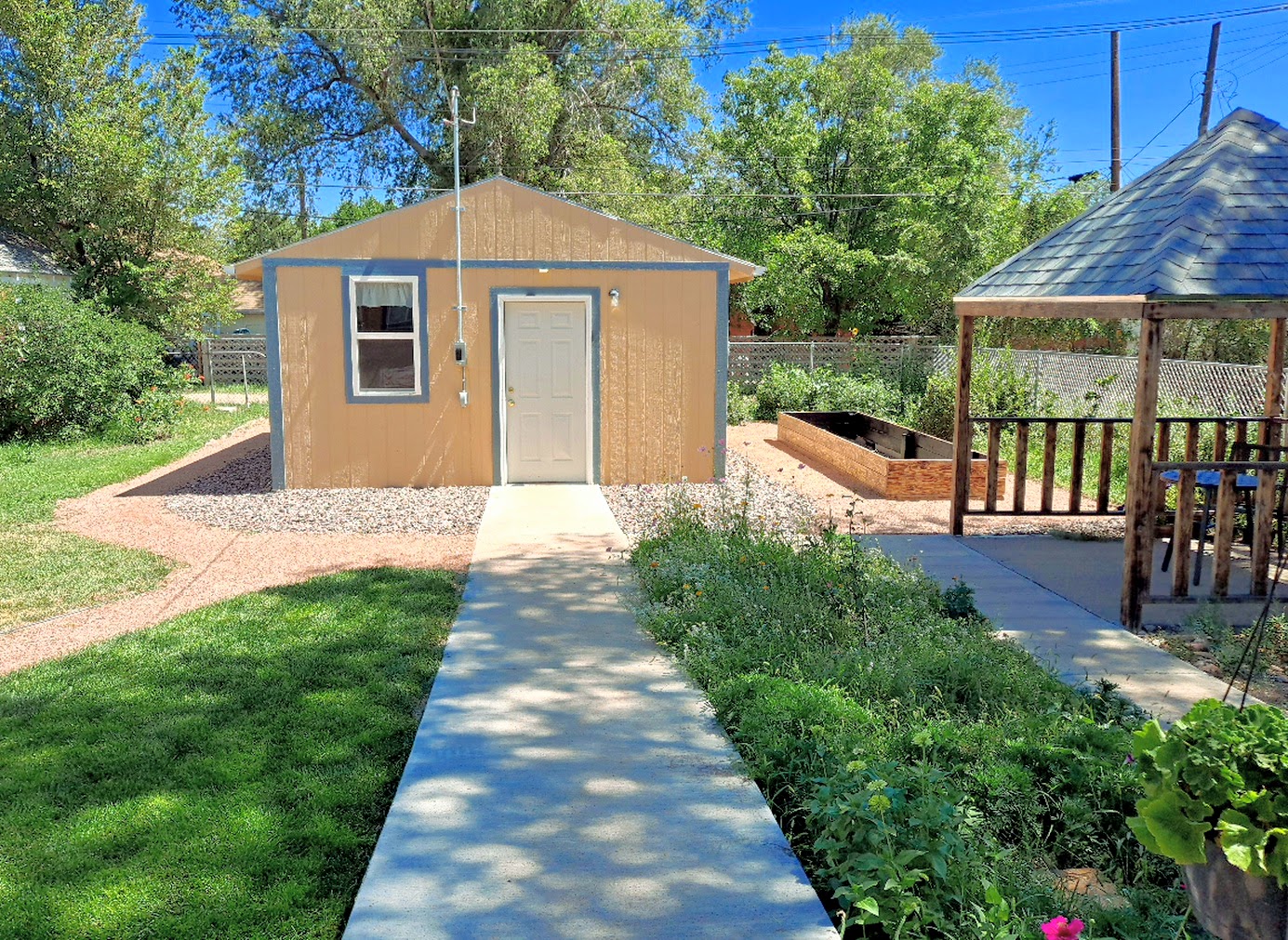
I spend so much time focused on the individual aspects of my garden, both the delightful things like the flowers that bloom, the butterfly that flitted through the yard one day, the hummingbird that sipped nectar from my hanging plant, then stared at me through the window as if to thank me, as well as the undelightful things like stinkhorn mushrooms, encroaching weed grasses, and swaths of brown lawn, that sometimes I forget to look at the big picture. Well, today, I was skirting the house after my morning stint of watering, and the “big picture” suddenly took my breath away. I went inside for my camera, stood at the back door and shot this photo. Wow! This is my back yard? Really?

Even the left side of the red pathway (as you are viewing the photo) looks good although the green comes from freshly mowed weeds. The gorgeous greensward just to the left of the sidewalk is the area that I dug up last fall for a wildflower garden, and since there was sod left over, we decided to sod that area, too. I felt silly for having done all that work for no reason, but as it turns out, it was essential. That’s the best patch of grass on the whole property. The worst patches are where they simply laid the sod over the existing weeds and weedy grasses. The grass in those areas started out bright green, but now have now surrendered their precarious place to the original occupants. With any luck, this fall when the weeds die off, I can reverse the trend, but who knows? I sure don’t. Despite my pretty flower photos, I’m still pretty much of a neophyte gardener. (A neophyte photographer, too, but it looks as if I am more accomplished than I really am because I only post the photos that turn out. The rest end up in the trash.)

The green on the right side of the sidewalk is what’s left of the wildflower garden. It looks green but there is a lot of white from the copious alyssum. It’s called a carpet of snow, and from a certain angle you can see all the white, but obviously not from the angle the back yard photo was taken.

I friend had once suggested that I take a photo from the same place every day so I could see the changes, but I never did. For most of my tenure here, things were in such a state of disarray that there was no day I thought would a perfect time to start such a project. I realize, of course, that was the point, but I also had no concept of how the yard would turn out or even if it would turn out. For all I knew, there would forever be a heap of junk in the middle of a field of weeds. (This particular junk pile is just to the left of what is now the sidewalk. It isn’t really junk, just all the stuff that had to be moved to make room for the new garage.)

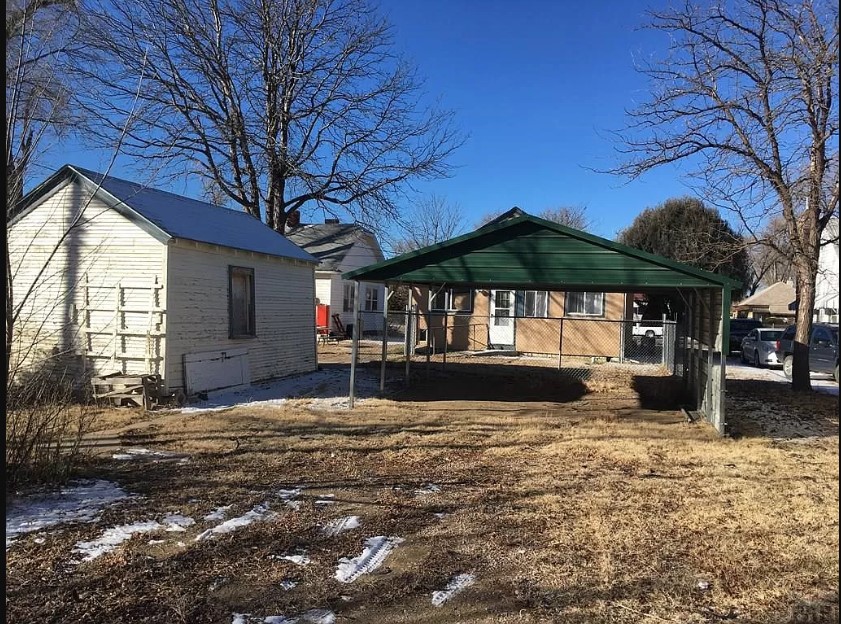
The only photo I have of the original yard is one from the opposite angle, looking toward the house instead of away from it. The old garage is where the raised garden now is, and the new garage is in front of where the carport was, which gives me a rather large yard!

I do have a few photos of the back yard that I took as work was being done, which gives me (and you) an idea of how much has changed over the years. Oddly, going by these older photos, it looks as if this yard was just a patch of dead dirt, but that was seasonal. Come spring and a little rain, and yikes . . . so many very tall weeds!

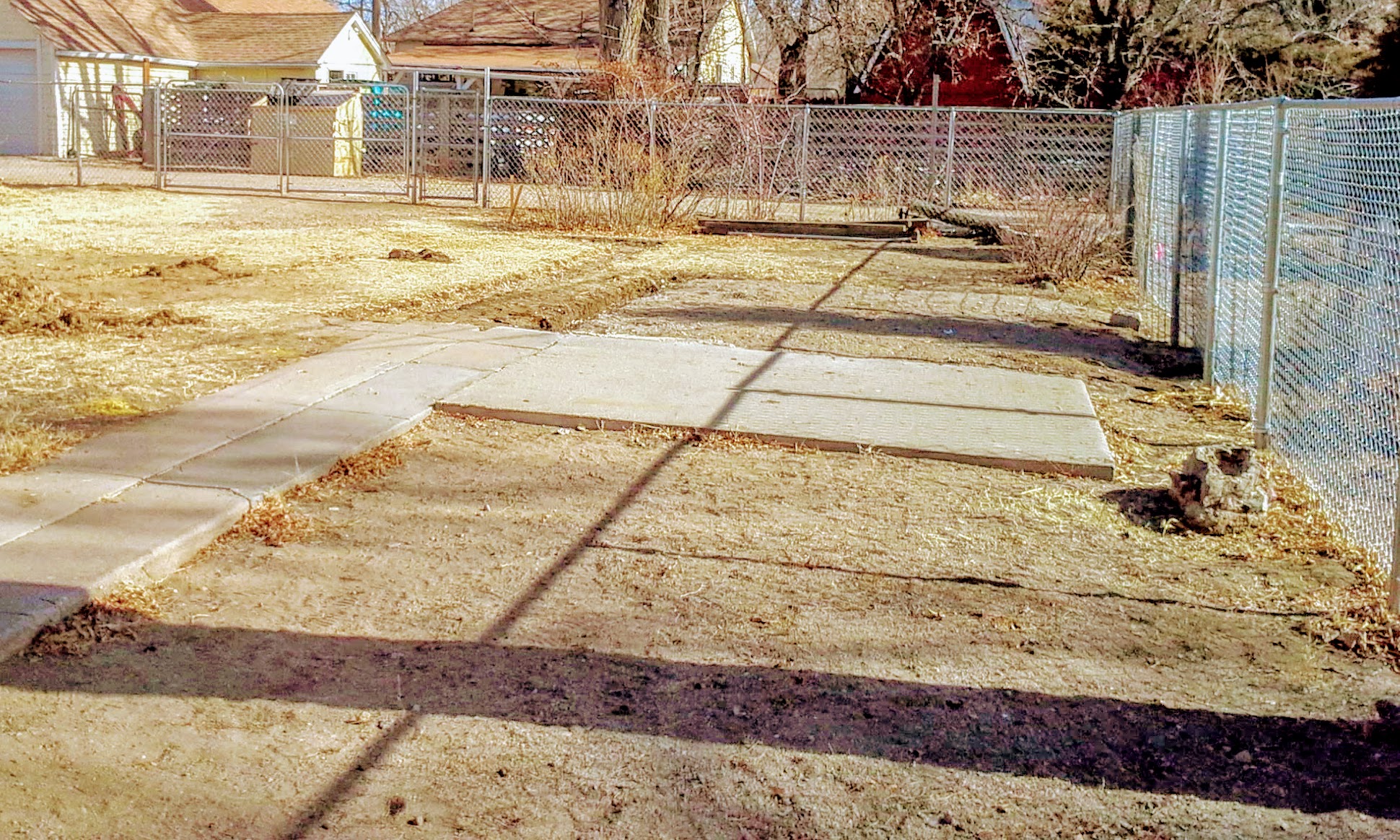
The above photo was taken in January, shortly after the old garage was torn down and the fence put up. The gazebo was erected over the existing concrete pad that once was in front of the garage. Eventually, the garage was built in front of the double gate, and the gate was removed. The brown bushes next to the pedestrian gate had to be dug up, and they were replanted in the angle formed by the sidewalk and the concrete pad. Looking at this photo, I am amazed at all that has been done in two-and-a-half years, not just what the builders did, but what nature and I did. No wonder I feel as if I work hard on the yard. I do!

It just goes to show that in gardening, as in life, it’s good to focus on the details, because that’s where the work is done — one detail at a time — but it’s even better to stop occasionally and look around to see all that you have accomplished.

***

Pat Bertram is the author of intriguing fiction and insightful works of grief.

Raised Garden

Lucky me! More stinkhorn mushrooms today. I tried to dig up the mushrooms and found a whole nest of stinkhorn eggs under the rocks. Now that was a treat! I hope you know I’m being ironic. Stinkhorn, as I mentioned yesterday, has a horrible smell. I’m not sure if the eggs have a smell because the stench of the mushroom is so strong, it overrides any other odor. And anyway, I dug up the eggs as quickly as I could, bagged them, and threw them in the dumpster.

The eggs, from what I can figure, are what the adult mushroom grows out of, but I don’t know how the eggs got in my rocks. Just grew there, I guess. If you, too, would like to participate in the stinkhorn experience, you can buy stinkhorn eggs (the price I saw was $15.00 per pound). People actually eat the eggs; apparently, the taste — and texture — is like a cross between a radish and a water chestnut, but frankly, there is no way I would ever put one of those things anywhere near my mouth, no matter how hungry I am or how delicious it might be. I couldn’t even get beyond the slime factor to simply touch them with bare hands. Besides, if I want something that tastes like a radish, I’ll eat a radish.

I was being ironic about the “lucky me” introduction, but this really was a lucky day for me, stinkhorns aside.

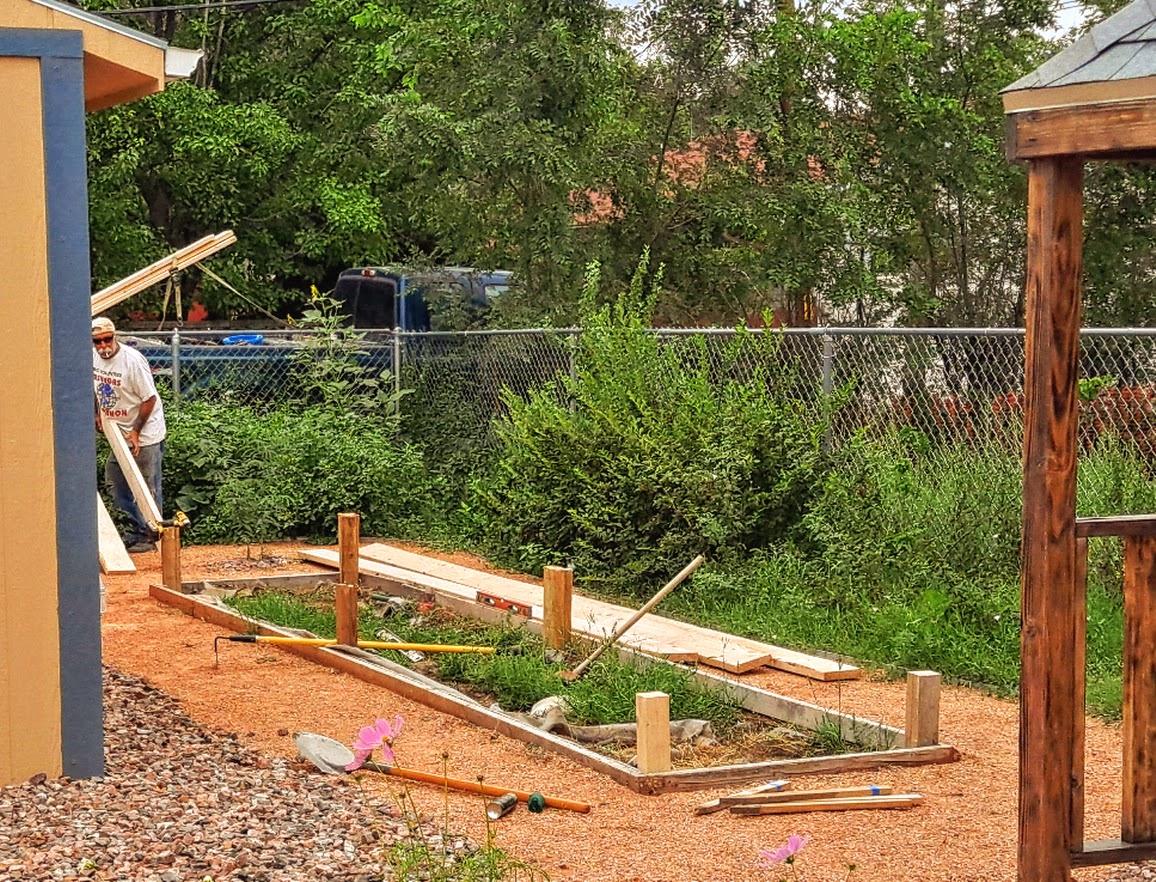
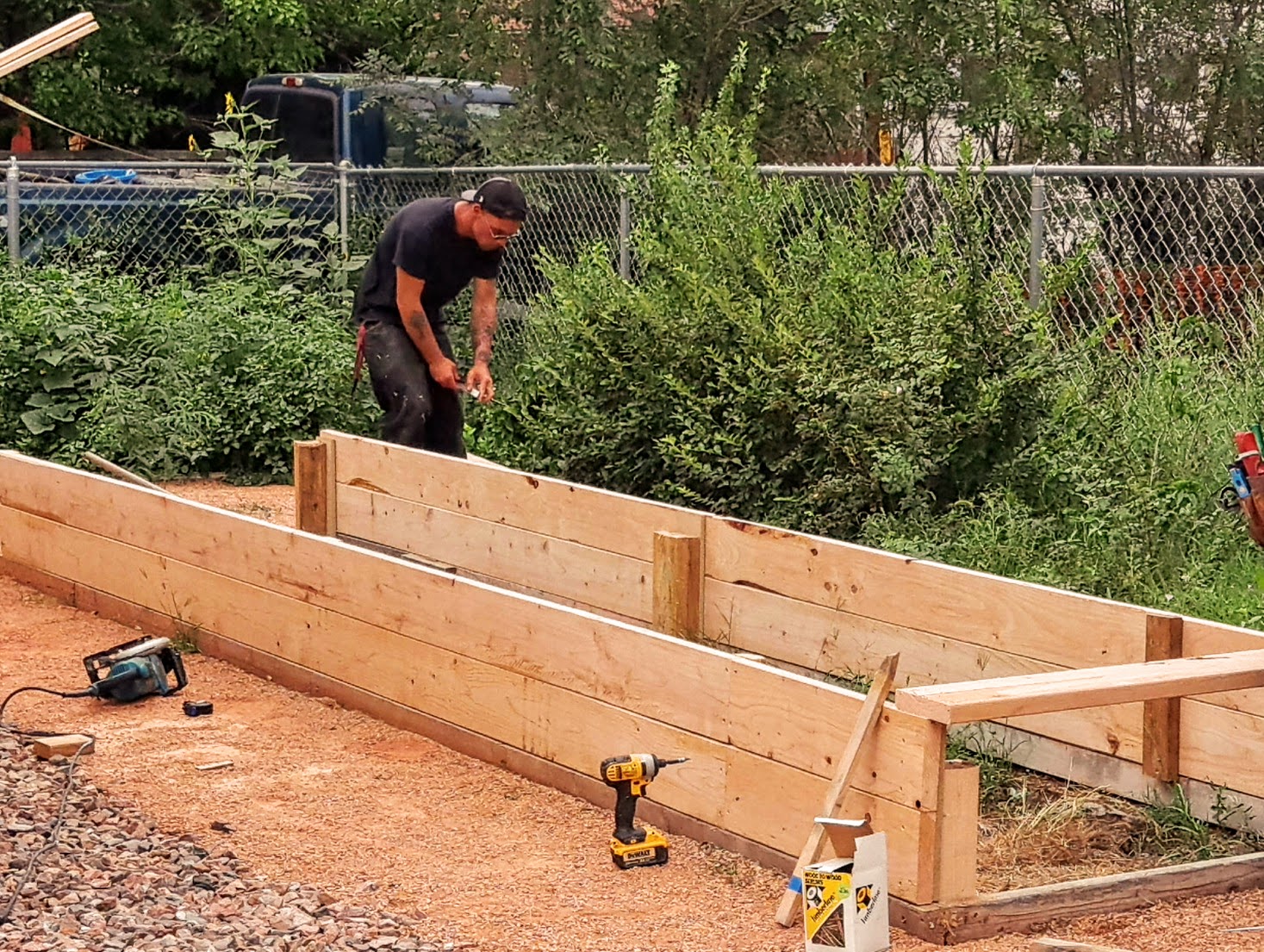
A couple of workers came to finish building my raised garden bed in preparation for the fill dirt this weekend. The bed looks a lot larger than when it was just a frame on the ground, and it seems to crowd the pathway. Of course, the plants bordering the path around the raised garden have grown and spread beyond what they were when the frame was set a couple of years ago, which makes the path seem narrower, but that’s not a problem. Come fall, I’ll trim back the plants so that I won’t feel claustrophobic.

I still don’t know what I will be planting in the raised garden. Most probably, next spring I will plant tomatoes and cucumbers and other simple vegetables, and not many at that. If the growth of the tomato and cucumber plants this year is anything to go by, a mere four to six plants will fill the entire garden. If it feels too much like a jungle when everything is grown, then I might switch to a different plant the following year — an evergreen groundcover, perhaps.

All I know for sure is that I will not purposely plant stinkhorn eggs!

***

What if God decided S/He didn’t like how the world turned out, and turned it over to a development company from the planet Xerxes for re-creation? Would you survive? Could you survive?

A fun book for not-so-fun times.

Click here to buy Bob, The Right Hand of God.
Complicated Times

Life feels complicated recently, though I don’t know why. I’m not the one dealing with major issues: floods, droughts, mysterious ailments, car accidents, death. Looked at from that angle, my life is simple right now. Still, what life is and what life feels like are two different things, especially since I tend to empathize with other people and feel unsettled by their troubles.

I suppose I should be grateful that the worst thing that happened to me today is finding several patches of stinkhorn, a mushroom with a distinctly fecal and intensely fungal odor. I plucked them (not using my bare hands, I will have you know) and tossed them out, though from what I’ve read, doing so merely removes the visible part. The hyphae (filaments) remain in the soil and will generate more stinkhorn.

So how do you get rid of such things? You don’t. Nothing — no fungicide or weedkiller — gets rid of them, so it’s been suggested that people who were gifted with such fungi in their yards learn to accept them and to embrace their unique beauty. Yeah, right. They are absolutely not my idea of beauty. In fact, I think they are a bit frightening looking, though apparently, despite their nauseating stink, these mushrooms are not harmful to people, animals, or vegetation. (Which makes me wonder about people — in looking for information about stinkhorns, I came across people asking if stinkhorns were edible. Who cares? Anyone who has such a lack of smell as to be able to put that thing anywhere near their mouth has bigger problems that the edibility of the mushroom. But yes, if you are one of those whose curiosity runs in that vein, stinkhorns are edible.)

On a list of the worst life has to offer, stinkhorn is nowhere near the top, though it’s still nothing I want to deal with on a regular basis. Luckily (or unluckily) we will soon be back to our near-drought dryness, so the mushrooms should be making themselves scarce, though like so many things that complicate life, they will never be completely gone.

Life does seem to circle back on itself, bringing better times as well as more complicated ones, so as with stinkhorn, the best thing to do is . . . I don’t know . . . wait for the worst to pass, I suppose.

***

Pat Bertram is the author of Grief: The Inside Story – A Guide to Surviving the Loss of a Loved One. “Grief: The Inside Story is perfect and that is not hyperbole! It is exactly what folk who are grieving need to read.” –Leesa Healy, RN, GDAS GDAT, Emotional/Mental Health Therapist & Educator.

A Mangled Ditty

Oh, what a tangled mess we leave when first we practice to believe . . . that we know what we’re doing.

This little mangled ditty came to mind earlier when I looked around my yard and saw the jungle-like garden areas that once were filled with dainty wildflowers. Because of all the moisture this year, gardens that, in the past, have barely managed to survive the summer, have grown into . . . well, into tangled messes. Green messes, for the most part, though a few flowers do manage to bloom.

The grass weeds, like Bermuda grass and foxtail, are growing out of control, choking the plants I want. I didn’t know there were so many types of grass here in this yard because when I came, the “lawn” was a field of broadleaf weeds with some patches of Bermuda grass. If there had been more Bermuda grass and fewer weeds, I would simply have watered the Bermuda grass so that it would spread, but unfortunately, the weeds spread faster than the grass, so I took the easy way out and sodded a large part of the yard.

As it turns out, sodding the yard wasn’t the easy way of solving the weed issue. Now I have a lawn that the Bermuda grass is invading and flowerbeds that the various foxtail grasses — as well as broadleaf weeds, of course — are taking over. I was doing well for a while, keeping on top of the weeds, but with the last couple of rains, there was such an explosion of green (everywhere except the brown swath of my lawn that still remains brown), that I’ve mostly given up. I’d spent the past month or so pulling Bermuda grass out of my lawn, yanking up kochia and ragweed as tall as my knees from the still uncultivated areas, and gathering foxtail seedheads from places in my garden when I couldn’t reach the whole clump of grass, and now my knees are protesting.

With my knees on strike, I’ve been trying to break the habit of pulling up weeds when I see them, but it’s a hard habit to break since the weeds are hard to ignore, and they need to be taken care of before they can do serious damage. Still, the hiss of pain when I stoop helps remind me to take it easy, which is good for my knees, but not so good for the tangled mess I’m left with.

I keep reminding myself that eventually the summer will end and the summer grasses and weeds will die no matter what I do or don’t do now, and then I’ll be able to clear away everything at once (weeds and defunct annuals) to get ready for next spring.

Meantime, that little mangled ditty keeps looping around in my head, taunting me. Last spring, and into the summer, I did begin to believe that I knew what I was doing, but now, not so much.

On a happier note: zinnias! Or rather, one lovely green zinnia.

***

Pat Bertram is the author of Grief: The Inside Story – A Guide to Surviving the Loss of a Loved One. “Grief: The Inside Story is perfect and that is not hyperbole! It is exactly what folk who are grieving need to read.” –Leesa Healy, RN, GDAS GDAT, Emotional/Mental Health Therapist & Educator.

Love Lies Bleeding

There is an interesting plant in my yard that everyone who sees comments on. I had a couple of those plants last year, too, but I didn’t know if the plants were friends or foes (flowers or weeds, in other words), so when they grew too tall for where they were planted, I pulled them up.

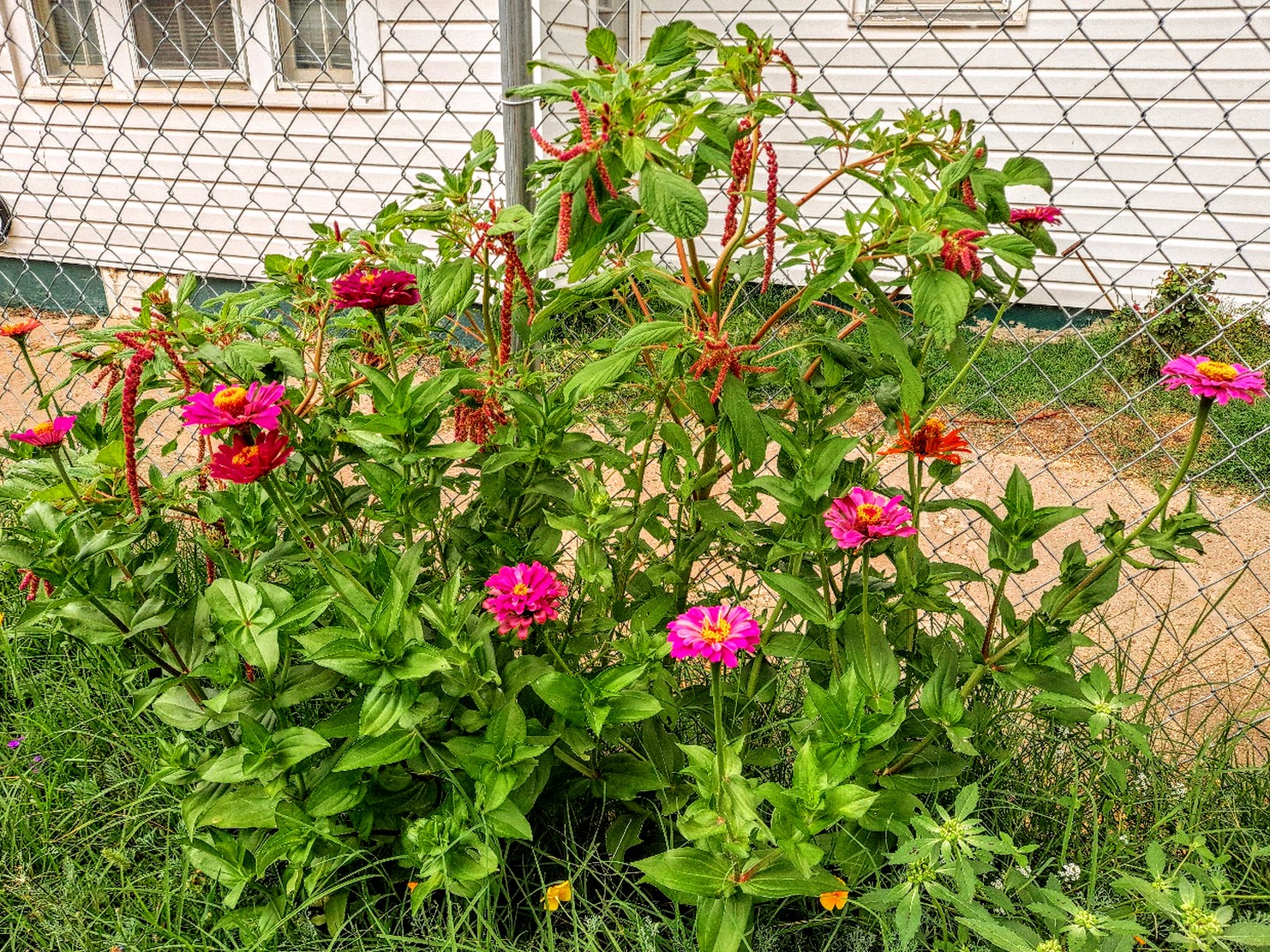
This year, instead of pulling them up, I left them in place for a conversation piece. A couple of times I tried to track down the name of the plant, but apparently, I put in the wrong search terms because I tried again today, and the answer popped right up. The weird looking ropy red flowers are called foxtail amaranth. It’s an annual that seems to have been included in a wildflower seed mix that I threw out there last winter, so unless I buy more seeds, this is the only time I will have the flowers.

Here they are, along the fence behind the zinnias:

And here is a close-up:

The flowers are also called Love Lies Bleeding, a holdover from the Victorian era, when flowers were used to send messages. The message of this flower is hopelessness or hopeless love, which seems a mean thing to want to say to someone in words, let alone in flowers.

I was going to plagiarize another of my posts to fill out this tale of “talking” flowers, but instead, I’ll just direct you to this link if you want to find more “Meanings of Flowers”.

Love Lies Bleeding would be a great title for a book since the phrase could be used to set scenes and develop themes throughout the story: my loved one is lying there bleeding; you broke my heart, and now it lies bleeding; my lover lied and now is bleeding.

Unfortunately, many other authors had the same idea — that Love Lies Bleeding would be a great name for a book — because a quick check on book sites showed a whole library’s worth of books using that title or a variation thereof.

Of course, if I really wanted to use the title, there’s no reason I couldn’t since titles aren’t copyrighted (I could also legally name a book Gone with the Wind if I wanted to, but that would be nothing short of author suicide). I prefer using less trite titles, however, and anyway, there is no book in me at the moment, so a title is the last thing I need.

Not so the plant itself. There are a lot of “last things I need” in my garden — weeds and weedy grasses top that list — but even though the foxtail amaranth isn’t on that list, it doesn’t add much to my yard except as a conversation piece, which, come to think of it, is actually a good thing to have. And now that I know the name of this plant, it not only will serve as a conversation starter, but can become the whole conversation, because truly, Love Lies Bleeding is an evocative name with an interesting history.

***

Pat Bertram is the author of intriguing fiction and insightful works of grief.

The Good Today

I had a lovely surprise today. I heard a knock on the back door, which was unusual — visitors come straight to the front door rather than meander through my yard to the back. I opened the door, and one of the workers employed by my contractor was standing there with a shovel. “I’ve come to build your raised garden,” he said.

Although the garden has been on their do-to list for a year or two, it hasn’t been a priority. It was more important to me to have these people replace the roof of the house I am looking after for an absent friend. And then today, apparently, my raised garden did become a priority. It’s not really important in the grand scheme of things — the area could just as easily have been a ground-level garden like my other garden spots, but I wanted a different sort of accent in the yard. I have no idea what the finished “box” will look like — my only instructions were to build it 18” high with boards across the ends that I could use as a bench.

The worker was also one who laid my sod, so I cornered him to ask about my brown grass. It did surprise him, the contrast between the bright green healthy area and the dead-looking swath a mere three feet away. He does think, though, that since the sod is well seated and the grass doesn’t yield to being pulled on, the grass is still alive, just dormant. This pleases me in a “grass half full/half empty” sort of way. (Sorry, couldn’t resist the pun.) There is a chance the grass will green up, but meantime, it’s not very pretty.

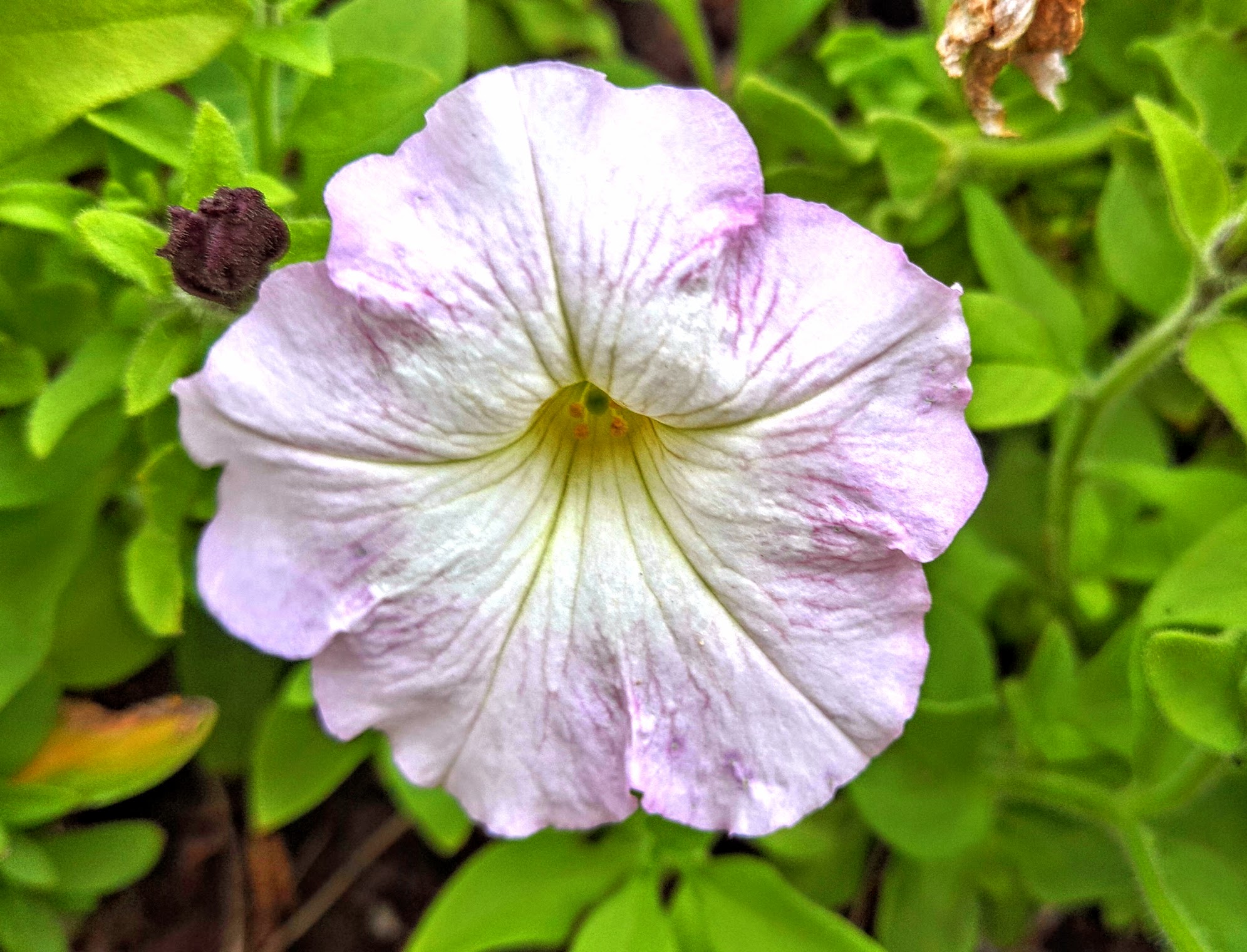
What I do find pretty are some of the flowers that showed their faces today, especially this petunia. This is one that planted itself and is completely different from the original dark red flower that went to seed.

Speaking of pinks, this one is not only pink but is called a pink, which is another name for dianthus.

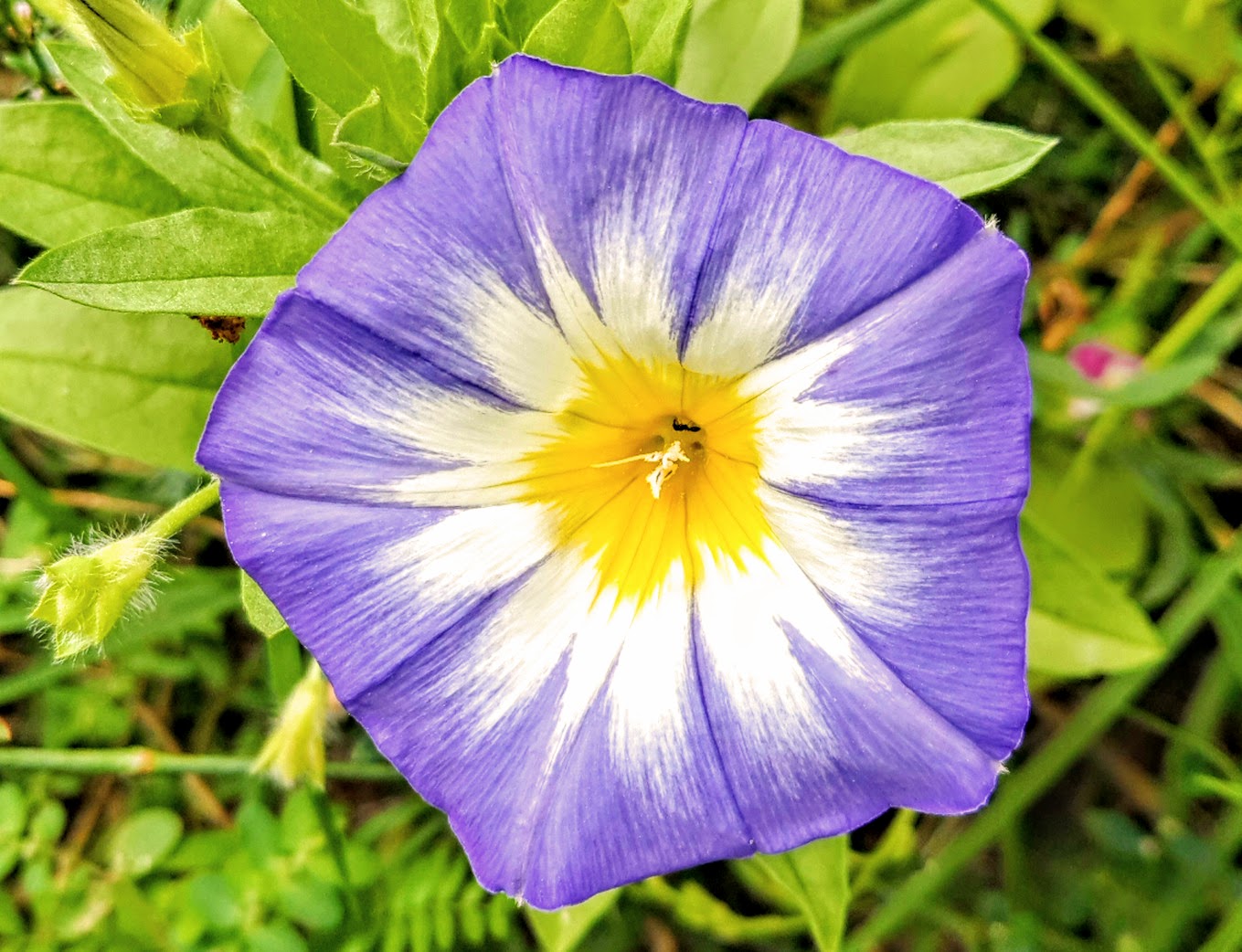
And another Heavenly Blue morning glory bloomed. I still don’t know where they came from, but they are welcome all the same.

What aren’t welcome are the mushrooms. We haven’t been getting any more rain, but the humidity is so unusually high that the dew on the ground in the morning is dense, and apparently, such wetness is the perfect environment for mushrooms and toadstools of all kinds. Most pull right up, but a couple were so entrenched I had to dig them out, and a couple even grew in the ornamental rocks around the foundation around the house.

And in the interest of truth — I did spray the herbicide to try to control the Bermuda grass, but nothing happened. Oh, well. As I said once before, it’s about accepting the bad with good, and today, so far, the good has been very good.

One last item: another worker also showed up, and when I opened the garage to show him some boards he could use, this second worker just stopped and stared. It took me a minute to realize he was staring at my car, thoroughly entranced. Gotta love car guys!

So yes, the good today was very good.

***

What if God decided S/He didn’t like how the world turned out, and turned it over to a development company from the planet Xerxes for re-creation? Would you survive? Could you survive?

A fun book for not-so-fun times.

Click here to buy Bob, The Right Hand of God.

Lessons From a Garden

A garden is a lot like life. Come to think of it, on a list of silly things to say, that would rank quite high because a garden is life.

Perhaps what I really want to say is that the lessons one learns in a garden are lessons that pertain to the rest of one’s life, too.

Lesson one: You get what you get and what you get is not always what you deserve. You can work hard and do everything right — or as right as you know how to do — and still get the wrong results. I have mentioned that on one side of my path, the grass is bright green and healthy, while on the other side of the path, a mere three feet away, the grass is dead. Both areas of grass were treated exactly the same, and yet the results were completely different.

Lesson two: If you’ve done everything you know how to do, then you have no other recourse except to accept what you have. For now, I have no choice but to accept the dead grass because I can’t do anything about it. Come fall, I can reseed, but until then, I have to accept that, whether I enjoy the looks of the grass or not, it’s what I have. I can be glad, I suppose, that the grass is simply brown and not overrun with weedy grasses like the section of lawn right next to the dead patch.

Lesson three: Take care of that which you can, and if things grow out of your control, do the best you can with that, too. I got rid of some of the sunflowers that planted themselves in my yard because they grew around one of my baby plum trees, but other sunflowers I let go, and now they are too big to deal with. The stalks are as big as my arm and taller than the garage next door. The best thing I can do, I suppose, is wait until fall and hack them off at the base when they die.

Lesson four: Be patient. So many things are growing out of control (my tomato and tomatillo plants are growing so big and so fast they seem to be taking over the garden areas where they were planted) that I feel like ripping them out in preparation for fall clean-up, but we still have a lot of summer left, and despite the relatively cool days we are currently experiencing, I’m sure there is a lot of heat ahead of us. And anyway, there are still blossoms on the tomato plants, so perhaps I will still have a small harvest. On the other hand, some plants grow so slowly they don’t seem worth having, but again, there is still a lot of summer left, so if I am patient, there might still be some color to show for all my care.

Lesson five: Don’t be intimidated. I must admit, plants that seem to be growing hugely due to the rain and the other growth-inducing weather we’ve been having, intimidate me. I’m not sure what I think they can do other than tower over me, but apparently, I’ve read too many plant-based horror stories over the years to be comfortable with looming plants. Still, in the real life of my garden, I tend to think I have the upper hand.

Lesson six: Some things live, and some things die. Eventually, of course everything dies, but no matter how much we might want something to live, its survival is not always in our control. Actually, this is a lesson I learned in life that I am applying to my garden rather than a lesson I learned in my garden that I am applying to my life, but either way, it’s a good thing to remember.

I’m sure there are other lessons, but these are the lessons that seem to concern me most right now. Let’s hope I learn what I need to.

***

Pat Bertram is the author of Grief: The Inside Story – A Guide to Surviving the Loss of a Loved One. “Grief: The Inside Story is perfect and that is not hyperbole! It is exactly what folk who are grieving need to read.” –Leesa Healy, RN, GDAS GDAT, Emotional/Mental Health Therapist & Educator.