
Negativity Is in the Ear of the Beholder

People who tell me I’m negative make me feel . . . well, they make me feel negative, and for no good reason. I might not be a sunny person, always looking on the bright side, and I might not be one of those who believe you fake it until you make it, but I’m not negative. I’m pragmatic. A thinker. A truth seeker. And the truth is, people who call others negative often want things their own way and are peeved if the others don’t like it.

For example, a friend invited me to go to lunch, so I arranged my schedule around the time she chose. An hour before we were to meet, she called and changed the time. The new time would interfere with my plans for later in the afternoon, so I told her I wasn’t sure I could make it. She called me negative.

Another friend often emails me and asks if I’m available at such and such a time so we can talk, and many times I wait for a call that never materializes. If I express my disappointment or say I’d appreciate being informed of a change of plans, I get called negative.

The other day I mentioned I couldn’t do something, and a person I’d met a scant hour earlier, said, “I hate negativity. Don’t ever say you can’t do something in my presence again.” Huh? I couldn’t do it. That didn’t mean I wouldn’t try to do it or wouldn’t try to learn to do it. Nor was I being negative. It was a simple statement of fact. Being positive and saying I could do it would be a falsehood — a negativity — which is anathema to a truth seeker.

During those horrendous first days, weeks, months, after the death of my life mate/soul mate, grief would so overwhelm me at times that I would scream to the heavens, “I can’t do this!” And at that very moment, I couldn’t. Sometimes it took everything I had to simply breathe, let alone attempt one of the myriad end-of-life chores. Sometimes the pain of grief would well up, obliterating everything but raw agony and angst. But . . . I did what I needed to do. I used the heat of my anger and despair as fuel to accomplish such impossible tasks as clearing out his “effects” or boxing our things to be stored.

Two months after he died, I got up early, cleaned out the few remaining items I’d been using, packed my car ready for the trip to my nonagenarian father’s house so I could look after him. I walked through our rooms, remembering with what hope my mate and I had moved there, remembering the good times, remembering the more frequent bad times. Remembering his last hug, his last kiss. His death.

As I was shutting the front door, I thought of all that lay ahead of me. Pain welled up in me, and I cried out, “I can’t do this.” Then, it dawned on me: Yes. I can. Because I did. I got out my camera, and went through the house one last time, taking photos of the empty rooms to prove to myself that all those things I thought I couldn’t do, I did.

I still have times of screaming “I can’t do this” when life overwhelms me, but it’s not a sign of negativity. It’s merely an expression of the moment. And if someone doesn’t like my saying I can’t do something without finding out why I think so, it’s too bad. I can’t live my life to suit those who call me negative.

***

Pat Bertram is the author of the suspense novels Light Bringer, More Deaths Than One, A Spark of Heavenly Fire, and Daughter Am I. Bertram is also the author of Grief: The Great Yearning, “an exquisite book, wrenching to read, and at the same time full of profound truths.” Connect with Pat on Google+. Like Pat on Facebook.

My Tree Bark Heart

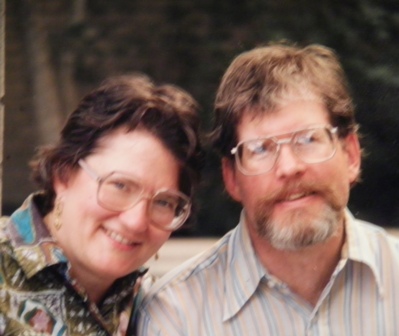
When I lost my life mate/soul mate to inoperable kidney cancer a little more than three years ago, people told me that my shattered heart would heal, and that it would grow back bigger. In this respect, apparently, hearts are like tree trunks. The bark on a tree is where the trunk breaks to allow new growth. So now I have a tree bark heart, but instead of being more receptive to love, I seem to be more receptive to grief. Or maybe the bark hasn’t hardened yet, and the soft, easily hurt trunk is still showing through.

IBroken heart’ve been going through a series of upheavals in my life recently, most of which I can’t talk about. One is a family situation and the people involved would be terribly hurt if I were to make the drama public. It’s a sadly inevitable predicament, with roots dating back to my childhood, and it grieves me deeply.

The other situation has weaker roots since it dates back only a couple of years, but still, it saddens me. I’d agreed to do the online promotion for an internet company in return for a percentage of the profits, and those hopes disappeared this weekend in a series of emails and a cloud of dust as some of the major players decamped, leaving me rootless. I hadn’t realized until it was over how much I needed feeling as if I were part of something, even if it was more hope than reality.

I’ve also lost a couple of friends who have moved beyond me, either into committed relationships or . . . whatever. I still am not sure what is going on with one friend.

When my mate died, I played endless games of computer solitaire. It was a mindless way of passing the time, and I find myself doing that again. Just game after game after game.

Restless. Sad. Lost. Expanding that poor shattered tree bark heart.

***

Pat Bertram is the author of the suspense novels Light Bringer, More Deaths Than One, A Spark of Heavenly Fire, and Daughter Am I. Bertram is also the author of Grief: The Great Yearning, “an exquisite book, wrenching to read, and at the same time full of profound truths.” Follow Pat on Google+. Like Pat on Facebook.

Camping on the Edge of Life

Too often now I feel as if I am camping on the edge of life. To a certain extent, this feeling comes from my current living situation. I am staying with my 96-year-old father to make sure he retains his independence as long as possible, but since his house is fully furnished, that means most of my stuff is in storage. I have my clothes, of course, my computer, my own towels, a few kitchen items, a couple of furniture pieces (such as the table and chair I’m presently using for my desk) — just enough to connect me to the past but not enough to make me feel settled. I won’t be staying here once my father is gone campingand that knowledge also keeps me from feeling settled, makes me feel as if I am just camping in. (Rather than camping out.)

More than that, though, this feeling of camping on the edge of life comes from being single in a coupled world. It’s been three and a third years since the death of my life mate/soul mate, and I’m still not comfortable with his being gone. Despite that, quite inexplicably I’m forgetting that I once shared my life, once loved deeply, once felt as if I lived smack dab in the middle of life. As my grief continues to wane, as I move further from him, it seems as if this is lonely existence is what my life has always been — and it should be enough, but it isn’t. Not yet.

We live in a world where movies, books, songs, videos, shows, ads and commercials all extol the virtue of being in an intimate relationship. Love makes the world go round. You’re nobody till somebody loves you. All you need is love. Love makes you feel complete. Love makes you feel fulfilled. Love makes life worth living.

This constant barrage of coupled love and happily ever after is a sad message for many of us — either we lost our love too soon through death or divorce, or never found someone in the first place.

Intellectually, I know that whatever I am doing or feeling is life. Being together or being alone, feeling fulfilled or feeling unfulfilled — all of it is life. And yet, I can’t help feeling that something is missing.

It might sound as if I’m looking for someone to share my life with, but I’m not. I’m just aware of the realities of being uncoupled in a coupled world. I suppose there will come a time when I embrace the freedom of my alonehood, and plunge deep into the heart of life, but for now, all logic to the contrary, I feel as if I am camping on the edge of life.

***

Pat Bertram is the author of the suspense novels Light Bringer, More Deaths Than One, A Spark of Heavenly Fire, and Daughter Am I. Bertram is also the author of Grief: The Great Yearning, “an exquisite book, wrenching to read, and at the same time full of profound truths.” Connect with Pat on Google+. Like Pat on Facebook.

Excerpt From “Grief: The Great Yearning” — Day 115

I never actually set out to write a book about grief, never planned to make any of my writing public (except for blog posts, of course), but I was so lost, so lonely, so sick with grief and bewildered by all I was experiencing, that the only way I could try to make sense of it all was to put my feelings into words. Whether I was writing letters to Jeff (my deceased life mate/soul mate) or simply pouring out my feelings in a journal, it helped me feel close to him, as if, once again, I was talking things over with him. The only problem was, I only heard my side of the story.  He never told me how he felt about his dying and our separation. Did he feel as broken as I did? Did he feel amputated? Or was he simply glad to be shucked of his body, and perhaps even of me?

It’s been more than three years now since the following piece was written. I still don’t understand the purpose of pain, loss, suffering. Still don’t understand the nature of life or death. Still don’t know how energy can have cognizance, if in fact, consciousness survives death. The main difference is that the wound where he was amputated from me has healed. I don’t worry about him — at least not much — but I still miss him and I probably always will.

Excerpt from Grief: The Great Yearning

Day 115, Dear Jeff,

Did you use the phrase okie-doke one night at the end when you were saying all those jaunty things like “adios, compadre”? You must have. Every time I see or hear the expression, I start crying. Good thing it’s not in common usage any more.

I am hurtling away from you at incredible speeds. Maybe I’ll come full circle and meet with you again when my end arrives? I wish I believed that, but it makes no sense. How do sparks of energy have cognizance, character, memory? How would we know each other? At least I would no longer have to deal with your absence since I’d be absent too.

You came into my life so rapidly. One day you weren’t there, and the next you were. You went out the same way. One day you were there, the next you weren’t.

Yesterday someone told me that life on earth was an illusion and so you still existed. But if life is an illusion, why couldn’t it be a happy figment? A joyful one? What’s the point of pain? Of loss? Of suffering?

You’ve been gone one-hundred and fifteen days, and I still can’t make sense of it.

Adios, compadre. I hope you, at least, are at peace.

Click here to find out more about Grief: The Great Yearning

***

Pat Bertram is the author of the suspense novels Light Bringer, More Deaths Than One, A Spark of Heavenly Fire, and Daughter Am I. Bertram is also the author of Grief: The Great Yearning, “an exquisite book, wrenching to read, and at the same time full of profound truths.” Connect with Pat on Google+. Like Pat on Facebook.
No More Saturday my Sadder Day

During the past three and a third years, ever since the death of my life mate/soul mate, the date and the day he died have brought an upsurge of grief. Every 27th of the month and every Saturday I felt an increased sadness even when I wasn’t aware of the date and day. And when the 27th fell on a Saturday, I got a double dose of grief.

Last Saturday was the 27th, but there was no sadness. I simply noted the date and day, and went on with my life. Not that there was much to go on with — a walk in the desert, a movie (one of the movies he taped for us), some online activity.

Part of me wanted to feel sadness just out of habit — habits are comfortable even when they aren’t particularly productive. Part of me wanted to feel sadness because it was a link to him and to a life that is rapidly receding from me. Mostly it didn’t matter. I’d come to see that being sad or unsad didn’t make much of a difference — it was just a part of my life in the same way the sun rises and sets or the moon grows full and wanes.

It’s been several days since Saturday the 27th, and I still don’t know what to think about the lack of sadness. Three and a third years ago, I was in such pain, I couldn’t have believed this time would ever come. Some people who have lost their spouses still feel connected, but I don’t. I talk to him, of course, but never feel as if he’s listening, let alone responding. Whatever we once meant to each other, whatever we shared, I now know he’s on his own journey, just as I am.

The main problem continues to be emptiness. I don’t feel anything as dramatic as the bleakness I once felt, don’t feel much at all, to tell the truth. I do feel lonely, of course, but I’m getting used to that. I even think it might be my destiny—to be alone so I can . . . and that’s where the thought always ends. So I can do or become . . . what?

I don’t much believe in destiny, and yet it’s hard to completely disbelieve when two such inexplicable and awe-full events helped define my world: the day he came into my life and the day he left.

From somewhere deep inside, “want” is starting to seep up into my consciousness. It’s an indefinable want, perhaps a desire for life, whatever that might be. I’ve been steeped in death and aging for too long (still am — I’m currently looking out for my mostly independent 96-year-old father), and something in me is crying out for more.

Despite a growing restlessness, I need to be patient since my life is not yet entirely my own. But someday, when I am free, I hope I have the courage to run to meet my destiny, whatever that might be. I hope I have the courage for “more.”

***

Pat Bertram is the author of the suspense novels Light Bringer, More Deaths Than One, A Spark of Heavenly Fire, and Daughter Am I. Bertram is also the author of Grief: The Great Yearning, “an exquisite book, wrenching to read, and at the same time full of profound truths.” Follow Pat on Google+. Like Pat on Facebook.
A Novel About a Grieving Woman

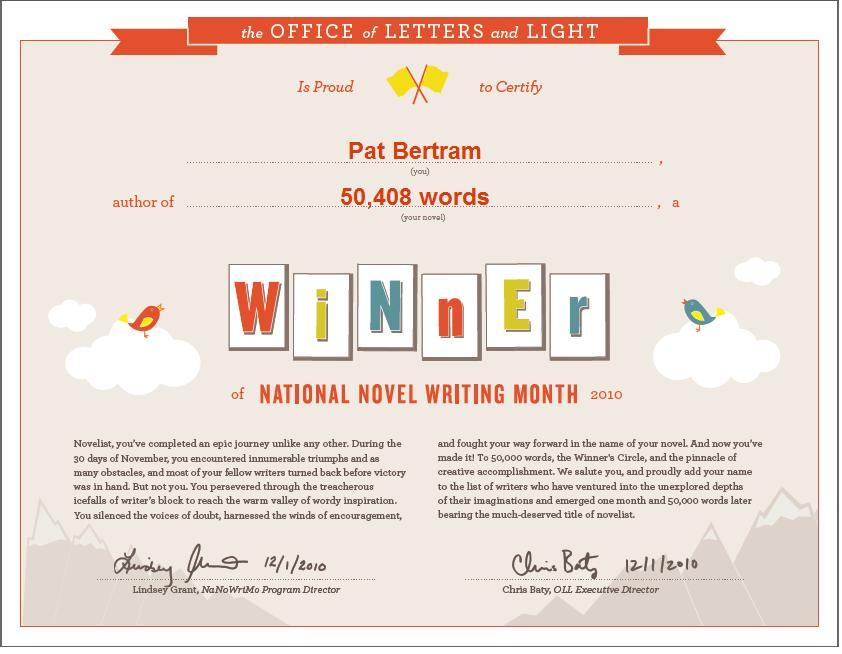
Several months after the death of my life mate/soul mate, I participated in the National Novel Writing Month. I’ve never seen the point of NaNoWriMo — if you want to write, write. You don’t need to be part of an international campaign to foist more hastily written tripe on an unsuspecting public. Still, in an effort to deal with my grief, I’d been trying all sorts of new things, and NaNoWriMo seemed like a challenge. I’ve always been a slow writer, and I wanted to see what would happen if I wrote without regard for any sort of cohesiveness or literary merit. Other people who had participated told me that when you let NaNoWinneryourself go, wonderful things happened, which, in my case, was not at all the truth.

Still, I did finish the word count. (And forgive me if I add that I see no benefit to counting words. What difference does it make if one person can write 10,000 words in a day, while another can only write 100?) What I mostly ended up with at the end of the month were disconnected scenes of a novel about a grieving woman. I wanted to get the emotion down on paper before I forgot the horror and agony of new grief, and that I did.

Well, now I’m typing up those long-fallow pages, and it’s been a surprise. The angst is there, but so is humor. How did I manage to write anything but the most sorrowful prose while still in the depths of grief? For example, here is a passage I typed up this morning:

Amanda made her way to the buffet table. The merry widows were huddled together, poring over the selection.

“Make sure Paula brings her meatballs to my funeral lunch,” Jackie said. “Katherine’s lime mold is something I’d just as soon not see.”

“You wouldn’t see it anyway,” Muffie cackled. “You’ll be dead. I like a good Jell-O mold, especially with marshmallows. Put that on my list.”

“Buffalo wings are my favorite,” Barb said. “They’re messy, so be sure to bring some of those wet wipes. Everyone will be dressed in their best, and I don’t want the men remembering me by stains on their ties.”

Amanda slipped away from the three long-time widows before they could see her. No way could she deal with them today. Usually she saw them as the fairy godmothers in the Disney version of Sleeping Beauty—brightly dressed, rotund, and into everyone’s business—but today they struck her more like the witches in Macbeth.

Would she become like them now that David was gone, with nothing better to look forward to than her own funeral? But there was Sam . . .

Okay, so it isn’t laugh-out-loud funny, but it is a lighthearted respite from the rest of the story. I wonder what other gems I’ll find that I’ve forgotten?

At the time I conceived the story, I wasn’t sure where to go with it — hence the disconnected scenes — but I don’t think I need to go anywhere with it other than finishing what I already have: a grieving widow, an angry daughter, a cyber lover, a gun, and hints of evil-doing by the dying husband (a preacher, incidentally, who supposedly led an exemplary life.) Sounds like an interesting story!

***

Pat Bertram is the author of the suspense novels Light Bringer, More Deaths Than One, A Spark of Heavenly Fire, and Daughter Am I. Bertram is also the author of Grief: The Great Yearning, “an exquisite book, wrenching to read, and at the same time full of profound truths.” Follow Pat on Google+. Like Pat on Facebook.

Another Stage of Waning Grief

Yesterday I wrote about how I am now feeling three and a third years after the death of my life mate/soul mate. I admitted I wasn’t feeling much. My life seems empty. There’s no oomph. No spark.

I wish I wanted something, was in love with something, felt something besides ever-fading sorrow. But I don’t know how to go from where I am to where I need to be.

And it’s not just me who feels this way. From the comments and emails I received, it seems as if many others who also lost their mates in 2010 feel the same as I do. Some people who lost their mates that year are in new relationships, have done something opening roseequally significant to jump-start their life, or have children to raise by themselves, but unless fate intervenes, the rest of us have to figure out how to accomplish a new beginning by ourselves. And we haven’t a clue how to do it.

I basically live the same way now as I did when I was coupled, but what took on significance when it was for “us” seems lame when it’s just for me. It’s not that I don’t think I’m worthy — of course I do because I am. It’s more that when the two of us were together, everything we did somehow seemed to help build our shared life. Every idea seemed to expand “us.” Every finished project seemed to fulfill “us.” Even something as simple as jointly preparing a meal was for “us.” Each of those things was also an act of love, a commitment to each other, even if it didn’t seem so at the time, which made them doubly or triply significant.

Now a meal is just a meal. A project finished is nothing more than a task completed. A bright idea is simply blog fodder.

If I were new, starting out in life for the first time, none of this would be a problem since everything is new and exciting when one is young, but I’ve done most of what I wanted to, or at least tried to do it. To be honest, the things I wanted to do were essentially cerebral — reading, researching, thinking, writing. I haven’t traveled the world but never wanted to. Haven’t lived lavishly but see no need for it. Haven’t partied till I dropped but never had the energy for it. I have done volunteer work but now there’s no cause I’m passionate about. (I’m still doing volunteer work, but it’s mostly online, so it doesn’t do much to give me something to live for.)

It’s possible this oomphlessness is simply another stage of waning grief — it generally takes four to five years to fall in love with life again (assuming one was ever in love with life) and most of us 2010ers are still many months away from that magic number. If this is the case, the emptiness will disappear by itself once I’ve come to term with it, or it will metamorphose into another equally confusing phase.

But it’s also possible this is what my life is, in which case I’ll have to find a way to make the insignificant happenings significant again, because frankly, spending the rest of my days feeling like this is unthinkable.

***

Pat Bertram is the author of the suspense novels Light Bringer, More Deaths Than One, A Spark of Heavenly Fire, and Daughter Am I. Bertram is also the author of Grief: The Great Yearning, “an exquisite book, wrenching to read, and at the same time full of profound truths.” Follow Pat on Google+. Like Pat on Facebook.
Three Years, Three Months, Three Weeks, and Three Days of Grief

It’s been three years, three months, three weeks, and three days since the death of my life mate/soul mate. With all those threes, this should be a mystical day, but it’s a day like any other. I’m not especially grieving, though I’m not ungrieving, either. It’s just me and my normal underlying sadness, my missing him, my wondering about the future.

I’m to the point where I need something more, something beyond the bleakness of my daily life, but that “something more” comes in small doses and is not enough to sustain me. I take quick trips, go out to lunch occasionally, write a little, go walking in the desert. Although my 96-year-old father is doing well and is still quite independent, I am on a short leash (or at least it feels that way) since he likes having someone around in case of emergency.

But, that is just an excuse. The truth is, I don’t know what to do and wouldn’t know what to do even if I weren’t here looking Low tideafter my father. I’d travel, of course, but it seems to me that taking an extended trip by myself would be terribly lonely and perhaps even feel pointless. I drove by the ocean the other day and couldn’t think of a single reason to stop. I’ve been to the ocean, so it wasn’t anything new. Just a lot of water. (In my defense, it was very late and I was very tired.)

I try to be upbeat, try to believe in endless possibilities (because of course, that is the nature of the universe), but I don’t yet see those possibilities in my daily life. I try to think differently, to feel differently, to open myself up to change, but I’m always just me. Alone. Waiting.

Maybe things will be different when I’m totally alone, when I am free of responsibilities, but I no longer know if that will make a difference. I feel self-indulgent at times even mentioning any of this, considering what terrible lives some people are forced to live, but I can’t live any life but my own. And my own feels empty.

If it sounds as if I’m feeling sorry for myself, there’s perfectly good explanation for that. Today I do feel sorry for myself. I have managed to get through three years, three months, three weeks, and three days since his death, and I will continue managing, but I wish I wanted something, was in love with something, felt something besides ever-fading sorrow.

***

Pat Bertram is the author of the suspense novels Light Bringer, More Deaths Than One, A Spark of Heavenly Fire, and Daughter Am I. Bertram is also the author of Grief: The Great Yearning, “an exquisite book, wrenching to read, and at the same time full of profound truths.” Follow Pat on Google+. Like Pat on Facebook.
Grief: “It was a long time ago.”

Last night I watched the 2002 movie Heaven Must Wait. In one scene, Andrew McCarthy tells Louise Lombard that his mother died. She told him she was sorry. He said, “It was a long time ago.”

And I started crying.

I don’t know why that line struck me as being so poignant since I’ve heard the same sentiment in dozens of movies during the past few years. Maybe it was the sadly resigned way McCarthy delivered the line. Perhaps it was the underlying truth of the words — that time passes. Probably it was the reminder that my life mate/soul mate is moving further and further away from me. Or am I moving away from him? Either way, time is separating us.

Certain parts of our shared life are still very fresh in my mind: the day we met, the last time I held him in my arms, the moment of his death. It sometimes seems we parted such a short time ago that he could still be at home, waiting for me. But the years are passing. That first year crept by slowly, as if time itself were reluctant to let him go, but the years are beginning to pass swiftly now. It’s been more than three years since he died. Soon it will be four years, then five. And some day, I too will say, “It was a long time ago.”

Who will I be then? What will I have done? Will I still miss him? Of course I will miss him. I will always miss him. He was a major part of my life for thirty-four years, but with the passing years, his influence on my life might wane. Other experiences will have an impact on me. Other thoughts will change the way I view life. And he will have no part in any of it.

I don’t cry much for him any more. Days, weeks go by dry-eyed, though I have occasional upsurges of sadness. “Long time ago” is still a long way away, and yet last night I had the first inkling that such a time is approaching. And so, I cried for the coming years when he will be so very far from me that the tears will no longer come.

***

Pat Bertram is the author of the suspense novels Light Bringer, More Deaths Than One, A Spark of Heavenly Fire, and Daughter Am I. Bertram is also the author of Grief: The Great Yearning, “an exquisite book, wrenching to read, and at the same time full of profound truths.” Follow Pat on Google+. Like Pat on Facebook.

Excerpt From “Grief: The Great Yearning” — Day 112

I never actually set out to write a book about grief, never planned to make any of my writing public (except for the blog posts, of course), but I was so lost, so lonely, so sick with grief and bewildered by all I was experiencing, that the only way I could try to make sense of it all was to put my feelings into words. Whether I was writing letters to Jeff (my deceased life mate/soul mate) or simply pouring out my feelings in a journal, it helped me feel close to him, as if, once again, I was talking things over with him. The only problem was, I only heard my side of the story.  He never told me how he felt about his dying and our separation. Did he feel as broken as I did? Did he feel amputated? Or was he simply glad to be shucked of his body, and perhaps even of me?

It’s been three years now since the following piece was written. The wound where he was amputated from me has healed. I don’t worry about him — at least not much — but I still miss him, still feel as if I’m waiting for my life to begin. And though I don’t feel as scattered,  I understand more than ever that wherever I am, there I am.

Excerpt from Grief: The Great Yearning

Day 112, Grief Journal

I’m going through a numb phase right now. I only cried briefly yesterday. That came after I finished watching the Paul Hogan/Michael Caton movie Jeff taped—Strange Bedfellows—and I realized I’d never watch movies with him again.

Cry, not cry. Feel, not feel. It’s all the same. Just different aspects of grief. One thing they’re right about. This is WORK! I’m tired, have little energy, don’t seem to be able to think or to do anything but the most basic chores. And I can’t make myself believe anything is important. I’m still waiting to get a grip on my grief. Still feeling as if I’m in a transitional stage, waiting for my life to start.

Except that I had a life. We had a life.

People talk about “healing” when it comes to surviving a death, and it’s as good a term as any. It does seem as if the wound where Jeff was amputated from me is still bloody and gaping, though it is “healing” somewhat. It’s not as constantly raw as it was at first.

I always felt scattered when we were apart, worried about something happening to one of us when the other wasn’t there. Well, something did happen. And I was there. Now it’s just me. Wherever I am, there I am, but I still feel scattered. Fragmented. As if parts of me are strewn all over the universe. There’s no reason to worry about him, but I still do.

Click here to find out more about Grief: The Great Yearning

***

Pat Bertram is the author of the suspense novels Light Bringer, More Deaths Than One, A Spark of Heavenly Fire, and Daughter Am I. Bertram is also the author of Grief: The Great Yearning, “an exquisite book, wrenching to read, and at the same time full of profound truths.” Connect with Pat on Google+. Like Pat on Facebook.



