No More Saturday my Sadder Day

During the past three and a third years, ever since the death of my life mate/soul mate, the date and the day he died have brought an upsurge of grief. Every 27th of the month and every Saturday I felt an increased sadness even when I wasn’t aware of the date and day. And when the 27th fell on a Saturday, I got a double dose of grief.

Last Saturday was the 27th, but there was no sadness. I simply noted the date and day, and went on with my life. Not that there was much to go on with — a walk in the desert, a movie (one of the movies he taped for us), some online activity.

Part of me wanted to feel sadness just out of habit — habits are comfortable even when they aren’t particularly productive. Part of me wanted to feel sadness because it was a link to him and to a life that is rapidly receding from me. Mostly it didn’t matter. I’d come to see that being sad or unsad didn’t make much of a difference — it was just a part of my life in the same way the sun rises and sets or the moon grows full and wanes.

It’s been several days since Saturday the 27th, and I still don’t know what to think about the lack of sadness. Three and a third years ago, I was in such pain, I couldn’t have believed this time would ever come. Some people who have lost their spouses still feel connected, but I don’t. I talk to him, of course, but never feel as if he’s listening, let alone responding. Whatever we once meant to each other, whatever we shared, I now know he’s on his own journey, just as I am.

The main problem continues to be emptiness. I don’t feel anything as dramatic as the bleakness I once felt, don’t feel much at all, to tell the truth. I do feel lonely, of course, but I’m getting used to that. I even think it might be my destiny—to be alone so I can . . . and that’s where the thought always ends. So I can do or become . . . what?

I don’t much believe in destiny, and yet it’s hard to completely disbelieve when two such inexplicable and awe-full events helped define my world: the day he came into my life and the day he left.

From somewhere deep inside, “want” is starting to seep up into my consciousness. It’s an indefinable want, perhaps a desire for life, whatever that might be. I’ve been steeped in death and aging for too long (still am — I’m currently looking out for my mostly independent 96-year-old father), and something in me is crying out for more.

Despite a growing restlessness, I need to be patient since my life is not yet entirely my own. But someday, when I am free, I hope I have the courage to run to meet my destiny, whatever that might be. I hope I have the courage for “more.”

***

Pat Bertram is the author of the suspense novels Light Bringer, More Deaths Than One, A Spark of Heavenly Fire, and Daughter Am I. Bertram is also the author of Grief: The Great Yearning, “an exquisite book, wrenching to read, and at the same time full of profound truths.” Follow Pat on Google+. Like Pat on Facebook.

A Novel About a Grieving Woman

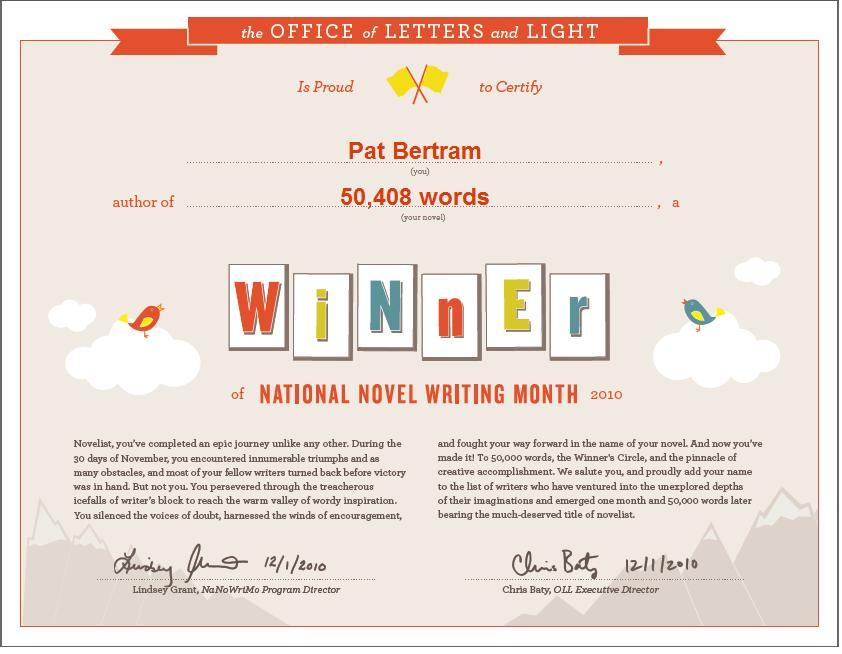
Several months after the death of my life mate/soul mate, I participated in the National Novel Writing Month. I’ve never seen the point of NaNoWriMo — if you want to write, write. You don’t need to be part of an international campaign to foist more hastily written tripe on an unsuspecting public. Still, in an effort to deal with my grief, I’d been trying all sorts of new things, and NaNoWriMo seemed like a challenge. I’ve always been a slow writer, and I wanted to see what would happen if I wrote without regard for any sort of cohesiveness or literary merit. Other people who had participated told me that when you let NaNoWinneryourself go, wonderful things happened, which, in my case, was not at all the truth.

Still, I did finish the word count. (And forgive me if I add that I see no benefit to counting words. What difference does it make if one person can write 10,000 words in a day, while another can only write 100?) What I mostly ended up with at the end of the month were disconnected scenes of a novel about a grieving woman. I wanted to get the emotion down on paper before I forgot the horror and agony of new grief, and that I did.

Well, now I’m typing up those long-fallow pages, and it’s been a surprise. The angst is there, but so is humor. How did I manage to write anything but the most sorrowful prose while still in the depths of grief? For example, here is a passage I typed up this morning:

Amanda made her way to the buffet table. The merry widows were huddled together, poring over the selection.

“Make sure Paula brings her meatballs to my funeral lunch,” Jackie said. “Katherine’s lime mold is something I’d just as soon not see.”

“You wouldn’t see it anyway,” Muffie cackled. “You’ll be dead. I like a good Jell-O mold, especially with marshmallows. Put that on my list.”

“Buffalo wings are my favorite,” Barb said. “They’re messy, so be sure to bring some of those wet wipes. Everyone will be dressed in their best, and I don’t want the men remembering me by stains on their ties.”

Amanda slipped away from the three long-time widows before they could see her. No way could she deal with them today. Usually she saw them as the fairy godmothers in the Disney version of Sleeping Beauty—brightly dressed, rotund, and into everyone’s business—but today they struck her more like the witches in Macbeth.

Would she become like them now that David was gone, with nothing better to look forward to than her own funeral? But there was Sam . . .

Okay, so it isn’t laugh-out-loud funny, but it is a lighthearted respite from the rest of the story. I wonder what other gems I’ll find that I’ve forgotten?

At the time I conceived the story, I wasn’t sure where to go with it — hence the disconnected scenes — but I don’t think I need to go anywhere with it other than finishing what I already have: a grieving widow, an angry daughter, a cyber lover, a gun, and hints of evil-doing by the dying husband (a preacher, incidentally, who supposedly led an exemplary life.) Sounds like an interesting story!

***

Pat Bertram is the author of the suspense novels Light Bringer, More Deaths Than One, A Spark of Heavenly Fire, and Daughter Am I. Bertram is also the author of Grief: The Great Yearning, “an exquisite book, wrenching to read, and at the same time full of profound truths.” Follow Pat on Google+. Like Pat on Facebook.

Another Stage of Waning Grief

Yesterday I wrote about how I am now feeling three and a third years after the death of my life mate/soul mate. I admitted I wasn’t feeling much. My life seems empty. There’s no oomph. No spark.

I wish I wanted something, was in love with something, felt something besides ever-fading sorrow. But I don’t know how to go from where I am to where I need to be.

And it’s not just me who feels this way. From the comments and emails I received, it seems as if many others who also lost their mates in 2010 feel the same as I do. Some people who lost their mates that year are in new relationships, have done something opening roseequally significant to jump-start their life, or have children to raise by themselves, but unless fate intervenes, the rest of us have to figure out how to accomplish a new beginning by ourselves. And we haven’t a clue how to do it.

I basically live the same way now as I did when I was coupled, but what took on significance when it was for “us” seems lame when it’s just for me. It’s not that I don’t think I’m worthy — of course I do because I am. It’s more that when the two of us were together, everything we did somehow seemed to help build our shared life. Every idea seemed to expand “us.” Every finished project seemed to fulfill “us.” Even something as simple as jointly preparing a meal was for “us.” Each of those things was also an act of love, a commitment to each other, even if it didn’t seem so at the time, which made them doubly or triply significant.

Now a meal is just a meal. A project finished is nothing more than a task completed. A bright idea is simply blog fodder.

If I were new, starting out in life for the first time, none of this would be a problem since everything is new and exciting when one is young, but I’ve done most of what I wanted to, or at least tried to do it. To be honest, the things I wanted to do were essentially cerebral — reading, researching, thinking, writing. I haven’t traveled the world but never wanted to. Haven’t lived lavishly but see no need for it. Haven’t partied till I dropped but never had the energy for it. I have done volunteer work but now there’s no cause I’m passionate about. (I’m still doing volunteer work, but it’s mostly online, so it doesn’t do much to give me something to live for.)

It’s possible this oomphlessness is simply another stage of waning grief — it generally takes four to five years to fall in love with life again (assuming one was ever in love with life) and most of us 2010ers are still many months away from that magic number. If this is the case, the emptiness will disappear by itself once I’ve come to term with it, or it will metamorphose into another equally confusing phase.

But it’s also possible this is what my life is, in which case I’ll have to find a way to make the insignificant happenings significant again, because frankly, spending the rest of my days feeling like this is unthinkable.

***

Pat Bertram is the author of the suspense novels Light Bringer, More Deaths Than One, A Spark of Heavenly Fire, and Daughter Am I. Bertram is also the author of Grief: The Great Yearning, “an exquisite book, wrenching to read, and at the same time full of profound truths.” Follow Pat on Google+. Like Pat on Facebook.
Three Years, Three Months, Three Weeks, and Three Days of Grief

It’s been three years, three months, three weeks, and three days since the death of my life mate/soul mate. With all those threes, this should be a mystical day, but it’s a day like any other. I’m not especially grieving, though I’m not ungrieving, either. It’s just me and my normal underlying sadness, my missing him, my wondering about the future.

I’m to the point where I need something more, something beyond the bleakness of my daily life, but that “something more” comes in small doses and is not enough to sustain me. I take quick trips, go out to lunch occasionally, write a little, go walking in the desert. Although my 96-year-old father is doing well and is still quite independent, I am on a short leash (or at least it feels that way) since he likes having someone around in case of emergency.

But, that is just an excuse. The truth is, I don’t know what to do and wouldn’t know what to do even if I weren’t here looking Low tideafter my father. I’d travel, of course, but it seems to me that taking an extended trip by myself would be terribly lonely and perhaps even feel pointless. I drove by the ocean the other day and couldn’t think of a single reason to stop. I’ve been to the ocean, so it wasn’t anything new. Just a lot of water. (In my defense, it was very late and I was very tired.)

I try to be upbeat, try to believe in endless possibilities (because of course, that is the nature of the universe), but I don’t yet see those possibilities in my daily life. I try to think differently, to feel differently, to open myself up to change, but I’m always just me. Alone. Waiting.

Maybe things will be different when I’m totally alone, when I am free of responsibilities, but I no longer know if that will make a difference. I feel self-indulgent at times even mentioning any of this, considering what terrible lives some people are forced to live, but I can’t live any life but my own. And my own feels empty.

If it sounds as if I’m feeling sorry for myself, there’s perfectly good explanation for that. Today I do feel sorry for myself. I have managed to get through three years, three months, three weeks, and three days since his death, and I will continue managing, but I wish I wanted something, was in love with something, felt something besides ever-fading sorrow.

***

Pat Bertram is the author of the suspense novels Light Bringer, More Deaths Than One, A Spark of Heavenly Fire, and Daughter Am I. Bertram is also the author of Grief: The Great Yearning, “an exquisite book, wrenching to read, and at the same time full of profound truths.” Follow Pat on Google+. Like Pat on Facebook.

Grief: “It was a long time ago.”

Last night I watched the 2002 movie Heaven Must Wait. In one scene, Andrew McCarthy tells Louise Lombard that his mother died. She told him she was sorry. He said, “It was a long time ago.”

And I started crying.

I don’t know why that line struck me as being so poignant since I’ve heard the same sentiment in dozens of movies during the past few years. Maybe it was the sadly resigned way McCarthy delivered the line. Perhaps it was the underlying truth of the words — that time passes. Probably it was the reminder that my life mate/soul mate is moving further and further away from me. Or am I moving away from him? Either way, time is separating us.

Certain parts of our shared life are still very fresh in my mind: the day we met, the last time I held him in my arms, the moment of his death. It sometimes seems we parted such a short time ago that he could still be at home, waiting for me. But the years are passing. That first year crept by slowly, as if time itself were reluctant to let him go, but the years are beginning to pass swiftly now. It’s been more than three years since he died. Soon it will be four years, then five. And some day, I too will say, “It was a long time ago.”

Who will I be then? What will I have done? Will I still miss him? Of course I will miss him. I will always miss him. He was a major part of my life for thirty-four years, but with the passing years, his influence on my life might wane. Other experiences will have an impact on me. Other thoughts will change the way I view life. And he will have no part in any of it.

I don’t cry much for him any more. Days, weeks go by dry-eyed, though I have occasional upsurges of sadness. “Long time ago” is still a long way away, and yet last night I had the first inkling that such a time is approaching. And so, I cried for the coming years when he will be so very far from me that the tears will no longer come.

***

Pat Bertram is the author of the suspense novels Light Bringer, More Deaths Than One, A Spark of Heavenly Fire, and Daughter Am I. Bertram is also the author of Grief: The Great Yearning, “an exquisite book, wrenching to read, and at the same time full of profound truths.” Follow Pat on Google+. Like Pat on Facebook.

Excerpt From “Grief: The Great Yearning” — Day 112

I never actually set out to write a book about grief, never planned to make any of my writing public (except for the blog posts, of course), but I was so lost, so lonely, so sick with grief and bewildered by all I was experiencing, that the only way I could try to make sense of it all was to put my feelings into words. Whether I was writing letters to Jeff (my deceased life mate/soul mate) or simply pouring out my feelings in a journal, it helped me feel close to him, as if, once again, I was talking things over with him. The only problem was, I only heard my side of the story.  He never told me how he felt about his dying and our separation. Did he feel as broken as I did? Did he feel amputated? Or was he simply glad to be shucked of his body, and perhaps even of me?

It’s been three years now since the following piece was written. The wound where he was amputated from me has healed. I don’t worry about him — at least not much — but I still miss him, still feel as if I’m waiting for my life to begin. And though I don’t feel as scattered,  I understand more than ever that wherever I am, there I am.

Excerpt from Grief: The Great Yearning

Day 112, Grief Journal

I’m going through a numb phase right now. I only cried briefly yesterday. That came after I finished watching the Paul Hogan/Michael Caton movie Jeff taped—Strange Bedfellows—and I realized I’d never watch movies with him again.

Cry, not cry. Feel, not feel. It’s all the same. Just different aspects of grief. One thing they’re right about. This is WORK! I’m tired, have little energy, don’t seem to be able to think or to do anything but the most basic chores. And I can’t make myself believe anything is important. I’m still waiting to get a grip on my grief. Still feeling as if I’m in a transitional stage, waiting for my life to start.

Except that I had a life. We had a life.

People talk about “healing” when it comes to surviving a death, and it’s as good a term as any. It does seem as if the wound where Jeff was amputated from me is still bloody and gaping, though it is “healing” somewhat. It’s not as constantly raw as it was at first.

I always felt scattered when we were apart, worried about something happening to one of us when the other wasn’t there. Well, something did happen. And I was there. Now it’s just me. Wherever I am, there I am, but I still feel scattered. Fragmented. As if parts of me are strewn all over the universe. There’s no reason to worry about him, but I still do.

Click here to find out more about Grief: The Great Yearning

***

Pat Bertram is the author of the suspense novels Light Bringer, More Deaths Than One, A Spark of Heavenly Fire, and Daughter Am I. Bertram is also the author of Grief: The Great Yearning, “an exquisite book, wrenching to read, and at the same time full of profound truths.” Connect with Pat on Google+. Like Pat on Facebook.

Saying Happy Birthday to the Dead

Today is the birthday of my life mate/soul mate. I suppose I should say “was” the birthday — he’s been dead for more than three years. We never celebrated our birthdays, and for some reason, that seems sad to me now. I never told him “Happy birthday,” never made him a birthday cake, never gave him a birthday present.

He didn’t believe in continued life after death, and yet, when I went through his “effects” a couple months after he died, I found a quote he had saved: “Life is rather a state of embryo — a preparation for life. A man is not completely born until he has passed through death.”

cakeDid he believe those words? Did he want to believe them? Or was the quote something that caught his attention once upon a time, and he kept it whether he believed it or not? Still, I wonder — if he continues to exist somewhere, does he celebrate his death day as his birthday? Or does he still not believe in celebrating such rites of passage?

We were alike in our disinterest in such celebrations, but ever since he died, I’ve been making a point of celebrating life’s moments. So today I got the birthday cake I never got for him while he was alive. (And hey, if he doesn’t want any, then there’s more for me!) I will watch one of the movies he taped and remember when he used to sit by my side and watch with me. I will think of him, not as he would be today, 67 years old, or even as he was at the end, but as he was when we met — young, radiant, and be-coming.

I will give thanks that he shared his life with me.

And I will say those words I never spoke before, “Happy birthday, Jeff.”

***

Pat Bertram is the author of the suspense novels Light Bringer, More Deaths Than One, A Spark of Heavenly Fire, and Daughter Am I. Bertram is also the author of Grief: The Great Yearning, “an exquisite book, wrenching to read, and at the same time full of profound truths.” Follow Pat on Google+. Like Pat on Facebook.

Grieving For Grief

A woman who lost her life mate/soul mate around the same time as I lost mine told me about an insignificant event that briefly stirred up her low-lying grief, and then she said, “I wonder if I were grieving for grief.”

It sounds strange, but the truth is, we do grieve for grief. Grief for a spouse or a soul mate is so all-consuming, that it fills, in a strange sort of way, the hole they left in our life. Grief, as hard as it is, makes us feel, which makes us feel alive. Grief keeps us connected, if only by pain, to our mates. Grief reminds us that we once loved, and perhaps were loved in return. Grief gives us a glimpse of the vastness of life and the void of death and makes our existence feel important, makes us feel important. When grief passes, we have none of those things, just an emotional and spiritual emptiness. And so we grieve for the loss of our grief. Eventually, I hope, we will find something to replace grief, as grief replaced our love, but who knows what that will be and when or if it will come.

One of the tasks of grief is to help disconnect us from the past so that we can embrace the future while living as fully in the present as possible without being stuck forever in the half-life of loving someone who is dead. Then, of course, we have the problem of disconnecting ourselves from the grief. Disconnecting from grief is a much easier task, of course, since we don’t bridgereally thrive on pain (I don’t, anyway. Never have been much of a masochist), but still, whether we welcomed it or not, grief does become our life. It’s how we connect to the world and ourselves. It’s how we move past the trauma of losing the one person we loved more than anyone else in the world. It’s how we bridge the gap between the meaninglessness of death and finding new meaning in life.

I can see that as my grief is waning, I am disconnecting from my life mate/soul mate. Or maybe it’s the other way around, as I’m disconnecting from him, my grief is waning.  Either way, I’ve come to the realization that although it seemed we were connected soul to soul, my mate and I are/were two separate people. For a while we traveled the same road, but now we are on separate journeys. After he was gone, I had grief as a constant companion, urging me forward, but now, with the waning of grief, I see the bleakness of myself alone, fading, dying.

But that’s not all there will be, nor is it necessarily the truth. I have years, maybe decades of life in me still. It’s just a matter of finishing the tasks of grief, of grieving briefly for the loss of grief, then heading out on the highway of life and seeing what comes my way. Sounds easy and life-affirming, doesn’t it? I wonder if the coming leg of the journey will be as hard as all the rest.

***

Pat Bertram is the author of the suspense novels Light Bringer, More Deaths Than One, A Spark of Heavenly Fire, and Daughter Am I. Bertram is also the author of Grief: The Great Yearning, “an exquisite book, wrenching to read, and at the same time full of profound truths.” Follow Pat on Google+. Like Pat on Facebook.

Dreaming Time is Here

After profound grief winds down, there should be a more noble state than the period of disgruntlement and dissatisfaction I am now experiencing. It’s possible this dissatisfaction is a precursor to taking action as some people have suggested, but the truth is, I still have no idea what action to take. I have no real dreams, no list of wants left unfulfilled, no idea of where to go with my life.

To be honest, I can’t go anywhere, not yet. I am still looking after my 96-year-old father, which limits me to some extent, yet at the same time offers me enough freedom to roam the nearby desert, to indulge myself in small ways, to dream.

One benefit of having let myself feel every cyclonic and cyclic aspect of my grief is that I have experienced the worst it can throw at me (at least I presume I have), so I don’t have to keep busy to prevent myself from thinking. I am free to let my mind roam without fear of where it will take me. Sometimes I think of where I’d like to travel, what I’d like to do, what I’d like to be. Other times, I let the cool desert winds blow all thoughts out of my head and wait to see what flows back to me.

Someday I will travel. Someday I will finish my poor work-in-pause. Someday I will set up my barbells. Someday I will . . .

But today, now, I am content to let the thoughts flow, dreaming up possibilities, like a child, with no regard to probability.

I am in no shape to trek the length of the Pacific Crest Trail and yet I can dream and perhaps one day I will hike a small part of it. I don’t have the knees for running anymore, yet I can still dream of the freedom it once gave me. I am basically a hermit, yet I can dream of making friends and charming people wherever I go.

Perhaps fantasizing is a more noble state to follow the waning of profound grief than disgruntlement. Or not. Either way, dreaming time is here.

***

Pat Bertram is the author of the suspense novels Light Bringer, More Deaths Than One, A Spark of Heavenly Fire, and Daughter Am I. Bertram is also the author of Grief: The Great Yearning, “an exquisite book, wrenching to read, and at the same time full of profound truths.” Follow Pat on Google+. Like Pat on Facebook.

A New and Embarrassing Stage of Grief

I’ve gone through so many stages of grief since the death of my life mate/soul mate that I’ve lost track. To be honest, I’m not sure there really are such things as “stages.” There simply seem to be varying states of mind that come around repeatedly in an ever-loosening spiral. Still, “stage” is an understandable term for an incomprehensible process, so I use it to describe each new phase of my grief, such as this latest manifestation.

A couple of things have happened lately to catapult me into a new and embarrassing stage of grief.

The first thing that happened was I finished watching the movies my deceased mate had taped. Viewing the movies was the final task of my Grief Work, and it exacted an emotional toll I hadn’t expected. As I watched each of tapes, I was aware that the last time I saw the movie, he was by my side. I remember the things we said, the looks we gave each other, the connection we felt. These once-loved movies now seem dull and bland as if a vital spark is missing. And it is missing. He is missing. Watching wasn’t hard at the beginning, when I started my self-imposed grief task, but it took more than two years to go through all the tapes, and the sadness built up, sort of like a cinematic water torture.

But that is finished. In the future, whatever feelings the movies instill in me when I watch them won’t be so achingly raw. Time, life, and new experiences will pad the movies, and separate me from him just a bit more. Once that thought of increased separation would have brought me pain, but now I know it’s necessary if I ever hope to live a full life.

The second thing that happened is that I do not have as many mixed feelings about his death as I once did. Many people insist that grief is for us, not for the deceased, but I’ve been greatly troubled by his death — for him. He didn’t seem to have much of a life. He’d been sick for so long and in such pain that he was often housebound and couldn’t do much. He was also relatively young. Hadn’t reached retirement age. Even worse, too many of his dreams never came true. It seemed to me that he got cheated out of so much, which was hard for me to bear. On the other hand, I was glad his suffering was over. Sometimes I even thought he got the better part of the deal since he didn’t have to hang around as I do to pick up the pieces of a shattered life. But when those pieces are roughly pasted together, I will get a chance to start over, and he won’t. Conflicts such as these complicate grief. But the other day while walking in the desert, I had a revelation — well, two revelations — that helped alleviate these particular conflicts.

First, I realized that when I was dead, I’d no longer care that he died before me, so if it is inevitable that someday it won’t matter that he died so soon, perhaps it doesn’t matter as much now. Second, I realized that if somehow we are eternal, existing before this life as well as afterward, then his death and mine would happen simultaneously in a cosmic sense. (If life is eternal, then there is no time, right? It all exists now. And so right now we are both alive/dead, though he is . . . perhaps . . . more dead than I am. Or thinking of it a different way: my potential extra decades of life will happen in an eye blink of eternal time, so from his current point of view, I will follow immediately after him.)

Finishing my final grief task and resolving my mixed feelings has more or less ended my sorrow. (At least for now. Sorrow at the death of the person who connected you to this earth never completely disappears.)

And after the sorrow? Well, this is the part I am embarrassed to admit. I am disgruntled and dissatisfied. It seems as if such profound grief, great yearnings, and impenetrable sadness should dwindle into something more noble than discontent. Besides, disgruntlement should be something I can control, but as with every other stage of grief, it seems to be outside of me. Or inside of me. Either way, it’s not of me. It’s just a stage to pass through on my way to whatever lies on the other side of grief.

***

Pat Bertram is the author of the suspense novels Light Bringer, More Deaths Than One, A Spark of Heavenly Fire, and Daughter Am I. Bertram is also the author of Grief: The Great Yearning, “an exquisite book, wrenching to read, and at the same time full of profound truths.” Follow Pat on Google+. Like Pat on Facebook.