Why I Write About My Grief

I started writing about grief not only to make sense of my own feelings, but also as a rebellion against a society that reveres happiness at all costs. I’d never heard of the sort of all-consuming grief that I experienced except for those who were considered unstable, but I knew I was completely well adjusted, so anything I felt had to be normal.

To be honest, I never had any intention of getting personal in this blog. I launched it to establish an online presence for when I got published. (After starting this blog, it took a year to find a publisher, although I’d already been on the quest for several years. After acceptance, it took another six months for my books to be published, but I made it!) Those first years of blogging, I wrote about my efforts to get published, what I learned about improving my writing, the novels I read and what I learned about writing from their inadequacies.

After my life mate/soul mate died, everything changed. I’d intended to keep my grief to myself and continue writing innocuous little posts, but I kept stumbling over people’s ignorance of grief. I found this ignorance in people I knew. (I will never forget those blank looks of incomprehension in people’s eyes when, sobbing, I told them about my loss. Sometimes they looked at me as if I were an alien species, or some kind of strange bug.)

And I found this ignorance in books I read.

One novelist dismissed her character’s grief at the death of his wife with a single sentence, “He went through all the five stages of grief.” Anyone who has gone through the multi-faceted grief of losing a soul mate knows that there are dozens of stages of grief (or none at all). You spiral round and round, in a dizzying whirl of emotions, not just shock and anger and sadness, but frustration, bitterness, yearning, hope, helplessness, confusion, loneliness, despair, guilt, questioning, angst over loss of faith, and you keep revisiting each of these emotions, hanging on the best you can, until ideally, you reach a place of peace and life opens up again.

Another novelist had her widow cry for a night then put aside her grief and get on with her life. Believe me, you can’t put aside such grief. It’s not just emotional but also physical, a ripping away of his presence from your soul, a deep-seated panic when your lizard brain realizes that half of your survival unit is gone, a body/mind bewilderment so great you can barely breathe. You don’t control raw grief. Grief controls you.

Not only did I discover that few people had any idea of the scope of such grief, most people selfishly urged the bereft to get on with their lives because they couldn’t bear to see their mother/sister/friend’s sadness.

There is something dreadfully wrong with a society that expects the bereft to hide their grief after a couple of months simply because it makes people uncomfortable to see outward shows of mourning. Seeing grief makes people realize how ephemeral their lives really are, and they can’t handle it (which leaves the bereft, who already feel isolated, totally alone with their sorrow.) It also cracks the facade of our relentlessly glass-half-full society.

Although I am a private person, not given to airing my problems in public, I thought it wrong to continue the charade that life goes on as normal after losing the one person who makes life worth living. So, over the past two-and-a-half years, I have made it my mission to tell the truth about grief. Even though I have mostly reached the stage of peace, and life is opening up again, at least a little bit, grief is still a part of my life. There is a void in my world — an absence — where he once was, and that void shadows me and probably always will. Although his death changed the circumstances of my life, thrusting me into an alien world, grief — living with it, dealing with it, accepting it — changed me . . . forever. It has made me who I am today and who I will become tomorrow — strong, confident, and able to handle anything that comes my way.

Would I prefer to have him in my life? Absolutely. But that is not an option. All I can do, all any of us can do, is deal with what lies before us, regardless of a society that frowns on mourning. It takes three to five years to find a renewed interest in life after such a grievous loss, so the next time you see your mother, father, sister, daughter crying for her/his spouse, deal with it. Just because you’re no longer tearful, be aware that even though you have lost the same person, you have not lost the same connection. If it makes you sad to see her mourning, think how much sadder it is for her to experience that sorrow. Hug her, be there for her. Don’t hurry her through grief. She’ll find her way back to happiness in her own time.

***

Pat Bertram is the author of the conspiracy novels Light Bringer, More Deaths Than One, A Spark of Heavenly Fire, and Daughter Am I. Bertram is also the author of Grief: The Great Yearning, “an exquisite book, wrenching to read, and at the same time full of profound truths.” All Bertram’s books are available both in print and in ebook format. You can get them online at Second Wind Publishing, Amazon, B&N and Smashwords. At Smashwords, the books are available in all ebook formats including palm reading devices, and you can download the first 20-30% free. Print books can be ordered from your favorite bookstore.

Meeting the Challenges of the Third Year of Grief

The challenges we face during the first year after the death of a life mate/soul mate (or any other significant person in our lives who connects us to the world), are too great to enumerate. It’s all we can do to cope with the seemingly endless chores of laying our beloved to rest while dealing with the emotional shock, the physical pain, the psychological affront that are our constant companions. Sometimes the first anniversary of his death is one of peace when we realize that we managed to survive the worst year of our life, but then we wake up to the second year and find a whole other set of challenges to meet.

The five main challenges we face during the second year after the death of a life mate/soul mate are:

1. Trying to understand where he went.
2. Living without him
3. Dealing with continued grief bursts.
4. Finding something to look forward to rather than simply existing.
5. Handling the yearning.

There are other challenges, of course, some unique to each individual, but all the challenges are dealt with the same way: by continuing to feel the pain when it erupts rather than turning away from it to satisfy the concerns of those who don’t understand; by taking care of ourselves even when we don’t see the point; by trying new things.

In other words, we meet the challenges of the second year by living. It sounds simple, but nothing about grief for a life mate/soul mate is simple. By living, we begin to move away from our pain, but we also move away from the person we loved more than any other. For some bereft, this feels like a betrayal of their love — how can you continue to live when life on this earth is denied him? For others, it seems like a betrayal of themselves — how can you become the person you need to be without betraying the person you once were?

The third year of grief seems to be a year of transition with only one new challenge — beginning to rebuild our lives. (We still have upsurges of sadness, still miss our loved one, still yearn for him, but these feelings are not as prominent as they once were.) Most of us no longer feel that continued life is a betrayal of our love because we understand that we had no choice in the matter, either in his death or in our continued life. Nor do we feel we are betraying the person we once were — we are no longer that person, though we have not yet developed into the person we are to become. Most of us are still trying to figure out who that person is and what that person wants and needs.

Many of us third-year bereft are caught in circumstances beyond our control — we are taking care of aged parents, new mothers, grandchildren. Although this transition between our old coupled life and our new life alone seems to be a time of stasis, we are still rebuilding our lives day by day, becoming who we need to be. We are also beginning to look beyond this transitional stage to what will come after, which is a sign of life and hope for the future even if we are not yet feeling hopeful.

By now, some bereft are ready to be in a new relationship, and they too seem to be in a transitional stage — not yet in a relationship but looking for possible partners. In other words, dating. I can’t even begin to go into the challenges such bereft face; it seems an impossible task, to go from where they are to where they want to be.

A few people jump into a relationship too soon, and then have the added grief of an aborted love affair. Some find that while they want emotional intimacy, the would-be partner only wants physical intimacy. Complicating the typical adult dating woes of ex-wives, grown children, incompatible schedules, is the date’s incomprehension of the bereft’s grief. Too often, he doesn’t want to hear about the deceased, which leaves the bereft dangling in an emotional limbo, because how can you have a meaningful relationship with someone who denies that which once gave your life meaning?

Others in this third year of grief are not looking for a new relationship, though they wouldn’t turn love down if it came their way.

Whatever the challenges we bereft have to deal with in this third year of grief, we will meet them as we did all the other challenges we have faced: with courage, perseverance, and strength.

***

Pat Bertram is the author of Grief: The Inside Story – A Guide to Surviving the Loss of a Loved One. “Grief: The Inside Story is perfect and that is not hyperbole! It is exactly what folk who are grieving need to read.” –Leesa Healy, RN, GDAS GDAT, Emotional/Mental Health Therapist & Educator.

Like Pat on Facebook.

No One to Do Nothing With

When my life mate/soul mate/best friend died two and a half years ago, people often compared my loss to the death of a pet or an aged grandparent or a sibling (all the while snug in the comfort of their own marriages). Some people compared my loss to their divorce. A couple of people even mystified me by comparing my loss to their struggles with alcoholism. Although these comparisons seemed insensitive at the time (I had previously lost both a sibling and my mother, and those losses in no way resembled what I felt after my soul mate died), I now understand people were reaching out to me, trying to comprehend my grief and to put it into a context they could understand.

The wound where his presence was ripped from my soul no longer gapes as widely; the feeling of his total goneness doesn’t haunt me quite so much; the anguish and physical distress has ebbed to an underlying sadness. This easing of grief has unmasked more subtle feelings of loss, and suddenly I can see how this itch to see him once more is comparable to the struggles of an alcoholic. We both  have to live — forever —with a deep craving that can never be satisfied, both have an empty feeling that can never be filled, and we both live in a world where others routinely enjoy what we can’t. (Like all comparisons, this one falls short since those who give up drink have to do so from sheer force of will, while my lack is simply a result of fate.)

I hadn’t realized until after he was gone how much I counted on his very presence.

The sound of his voice filled my ears and my mind. From the moment we met until the cancer metastasized into his brain, we talked and talked and talked. We talked about everything — history, books, health, truth, all the many and various things we researched over the years. Though we said everything we needed to say, I still wish for one more word from him.

During silent times, his smiles nourished my soul. Even at the end, in his moments of lucidity before either the pain or the morphine swept him away, he still managed to smile at me. And oh, how I wish for one more smile.

A couple of days ago I wrote about my growing soul hunger, an indefinable need his presence had once satisfied, and now I wonder if that need is . . . nothing. Although we worked and played and talked for more than three decades , we often did nothing together. Were just there, a presence in each other’s lives. As his dying became the focus of our lives, and we couldn’t do much of anything together, not even carry on a conversation, we could still do nothing together, and we often did.

Although I am finding others to fill some of the roles he played in my life, this last is the role no one can fill. I have people to do things with, but I have no one to do nothing with. And, like an alcoholic, the one thing I need is the one thing I can’t have. He was a presence in my life first thing in the morning and the last thing at night. He was a presence in the kitchen when we fixed meals together. He was a presence when we watched movies or ran errands or did chores. He was a presence in my thoughts — because we had spent so much time together, discussing history and current events, our ideas developed in tandem. And we didn’t have to explain ourselves or our state of affairs — we were there and saw the effects life had on the other.

I understand that this sort of companionship is rare, and I feel greedy and perhaps insensitive for even mentioning the lack of his presence in my life, but this is my truth, my experience, my sorrow. No matter how much I wish things were different, these circumstances will never change, but I will. I am becoming more accepting of my situation, more respectful of the soul hunger, more grateful for what I once had. It’s possible someday I will even get used to having no one to do nothing with.

Grief: The Great Yearning — Day 197

During the first horrendous months after the death of my life mate/soul mate/best friend, I was so incredibly lost that sometimes the only way I could deal with the confusion was to write a letter to him in an effort to feel connected. I still have episodes of sadness, but I haven’t experienced that total anguish in a long time. Still, I miss him, yearn to go home to him, worry about him. Although this letter was written two years ago, much of it holds true today.

Dear J,

It’s been a while since I’ve written, but I’ve been thinking about you. Are you glad you’re dead? You said you were ready to die, to be done with your suffering, yet at the very end you seemed reluctant to go.

Despite all the problems with your restlessness and the disorientation from the drugs, I wasn’t ready for you to leave me. I still am not. Nor do I want to go back to where we were that last year, waiting for you to die. We were both so miserable, but honestly, this is even worse. I can live without you. The problem is, I don’t want to, and I don’t see why I have to.

I want to come home. Please, can I come home? I have a good place to stay, but without you, I feel homeless. Sometimes I watch movies from your collection and imagine you’re watching with me, but that makes me cry because I know you’re not here. Your ashes are, but you’re not.

I broke a cup today, one more thing gone out of the life we shared. Our stuff is going to break, wear out, get used up. I’ll replace some of it, add new things, write new books, and it will dilute what we shared. Is there going to be anything left of “us”? I feel uncomfortable in this new skin, this new life, as if it’s not mine. As if I’m wearing clothes too big and too small all at the same time.

There’s so much I hate about your being gone — hate it for me and hate it for you. It might be easier if I knew you were glad to be dead, but so far you’ve been mum about your situation. Just one more thing to hate — the silence of the grave. (Well, the silence of the funerary urn.)

Adios, compadre. If you get a chance, let me know you’re okay.

***

Click here to download 20% free at Smashwords or to buy any ebook format, including Kindle.
Click here to buy Grief: The Great Yearning at a discount from Second Wind Publishing, LLC
Click here to find Grief: The Great Yearning in print or on Kindle from Amazon.
Click here to find Grief: The Great Yearning for the Nook

Grief Update — Thirty Months of Survival

My life mate/soul mate/best friend died two and a half years ago today. Thirty months. Written out like that, thirty months seems like a very long time, but looking back, it’s no time at all. It takes three to five years to find renewed life after such a grievous loss, or so I’ve been told, and I am only halfway there. It might seem to you as if this talk of grief means I do nothing but cry for him, but the truth is, I do quite well, with only a few unshed tears stinging my eyes now and again.

Feelings other than sadness are beginning to arise, though.

Throughout all these months, I’ve tried not to use the word “loss” when referring to my deceased mate because he isn’t misplaced, he is dead. But now, sometimes out of the blue, I’ll get that dropping elevator feeling of having misplaced something — something of untold value or something I desperately need — and I don’t know where or how I lost it. This sensation is not connected to any memory of him, and is not the same as the feeling of bereftness or yearning I so often had during the first couple of years, but still it makes the world seem precarious and alien at times.

Most things are getting better — I do not have the unimaginable pain I experienced in the beginning. Nor does the yearning for him claw at me, though I still miss him, still long for one more smile, still wish for one more word. But something is getting worse, something akin to a soul thirst or a soul hunger. For many years, being with him satisfied a need in me that I wasn’t aware of. Perhaps a recharging of my energy after a long day or maybe a regeneration of spirit. (For someone who writes and thinks as much as I do, I should be able to come up with a word to describe this need, but I only know it as a void, as something I once had but am no longer getting.) When I am hungry and do not eat, I get hungrier. When I am thirsty and do not drink, I get thirstier. And when this particular soul need is not slaked, I get needier.

I am finding other ways of fulfilling the roles he played in my life. Wherever he was, there was my home, and now I’m learning to find home wherever I might be. He was my playmate for many years before he got too ill, and now I have friends to do things with — have lunch, go to festivals and fairs, take yoga classes (and maybe Tai Chi — something I’ve always wanted to do). There is no one with whom I can talk to about all the things he and I used to discuss, but I can spread those topics around, discussing each with a different friend.

But so far I have not found a way around the role he filled for electrifying my spirit, (for lack of a better word). Walking in the desert helps, being with friends helps, but neither of those things sustains me once they are over. Perhaps a new love — another person or a passion — would help, but I am too new for another relationship (I’m still learning how to be me), and so far something to care passionately about remains beyond my reach.

I hope you understand that I am merely chronicling yet another step on my journey and not feeling sorry for myself or asking for pity. I once had something that few people get to experience — a soul connection with another human being. It was not always a happy or comfortable connection — at various times we both railed against it — but through it all, the good times and the bad, we were together.

I saw a plaque today: We can do anything as long as we’re together. I really believed that when he and I were together, we could do anything, though it turned out not to be true. We couldn’t make him well. We couldn’t keep him from dying. And now, we are not together, have not been together for thirty months, and will not be together for the rest of my life.

A person can get used to anything, so eventually I will get used to plodding along without that galvanizing connection with him, but for now, I’m still trying to find my way.

Using the Whole Sphere of my Being

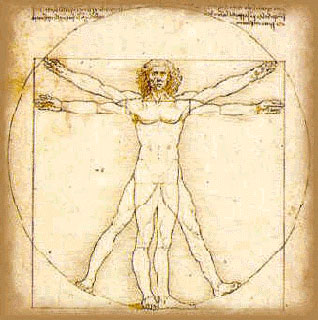
In a yoga class I took yesterday, the teacher made a comment that caught my attention. She said that we live in a personal sphere, the space taken up by outspread arms and legs. As we age and become more fearful of missteps, we shrink into the center of our spheres, shortening our stride, hunching into ourselves.

Even if we’re not to the point where age is making us shrink into that sphere, our sedentary ways certainly do. Here I am sitting at a computer, taking up very little space, making tiny movements of fingers, eyes, head. Not exactly using the whole sphere of my being, am I? So I paused, stretched out my arms, and suddenly I’m not so hunched into my space any more, and I feel a tad more alert.

Grief has the effect of drawing us away from the outer limits of that sphere, too. Life has dealt us the worst blow of all when it removes the one person who connects us to the world, and we shrink from additional punches.

As my grief has waned, I have tried to open myself up to the world, going out to the desert, flinging my arms wide, taking deep breaths, but until now, I’ve never paid any attention to my personal sphere. A beautiful image, isn’t it? Living in our own sphere, on the sphere of the earth, in the sphere of our solar system, on the edge of the sphere of our galaxy. Okay, so the galaxy isn’t a sphere, but still, it’s an interesting concept, all these spheres within spheres.

It doesn’t take any training to live more fully within one’s sphere. All we have to do is unfold our arms, raise our ribcage, lift our head, roll back our shoulders, take longer strides. I tried taking longer strides today while out walking, and it felt good for the first twenty minutes or so, and then — ouch, ouch, ouch. I could feel the painful stretch of my inner thighs. Apparently, without my even being aware of it, I’ve been taking smaller and smaller steps.

I will keep at it and see where this awareness of my personal sphere takes me. Perhaps it will help me live more expansively, maybe even help me think more expansively. At the very least, using more of my personal space will help my posture, and that in itself is not a bad thing.

There is No Journey Through Grief

People often talk of the journey through grief. (I myself have iterated this adage.) During the past few months as my grief is waning, I’ve come to see that there is no separate journey through grief. There is only the journey through life. Grief accompanies us part of the way, maybe even most of the way, though not always with the intensity of new grief. Grief, in fact, has driven me through the steep rocky path of my life during the past few years, first a numbing grief at my life mate/soul mate’s dying, and then later, a soul-shattering grief at his death.

Like many bereft, I was not always sure I want to continue living, but I wasn’t particularly ready for death, either, so I did the only thing I could do — continue my journey, taking each day as it comes, trying new things, finding comfort in knowing that nothing lasts forever.

By sheer waves of happenstance, I’ve been temporarily beached in a residential area that borders the desert. (If you have been following the Second Wind online collaboration called Rubicon Ranch, you will be familiar with this community, though so far, unlike my hapless alter ego, widow Melanie Gray, I have not yet stumbled upon body parts out in the desert.)

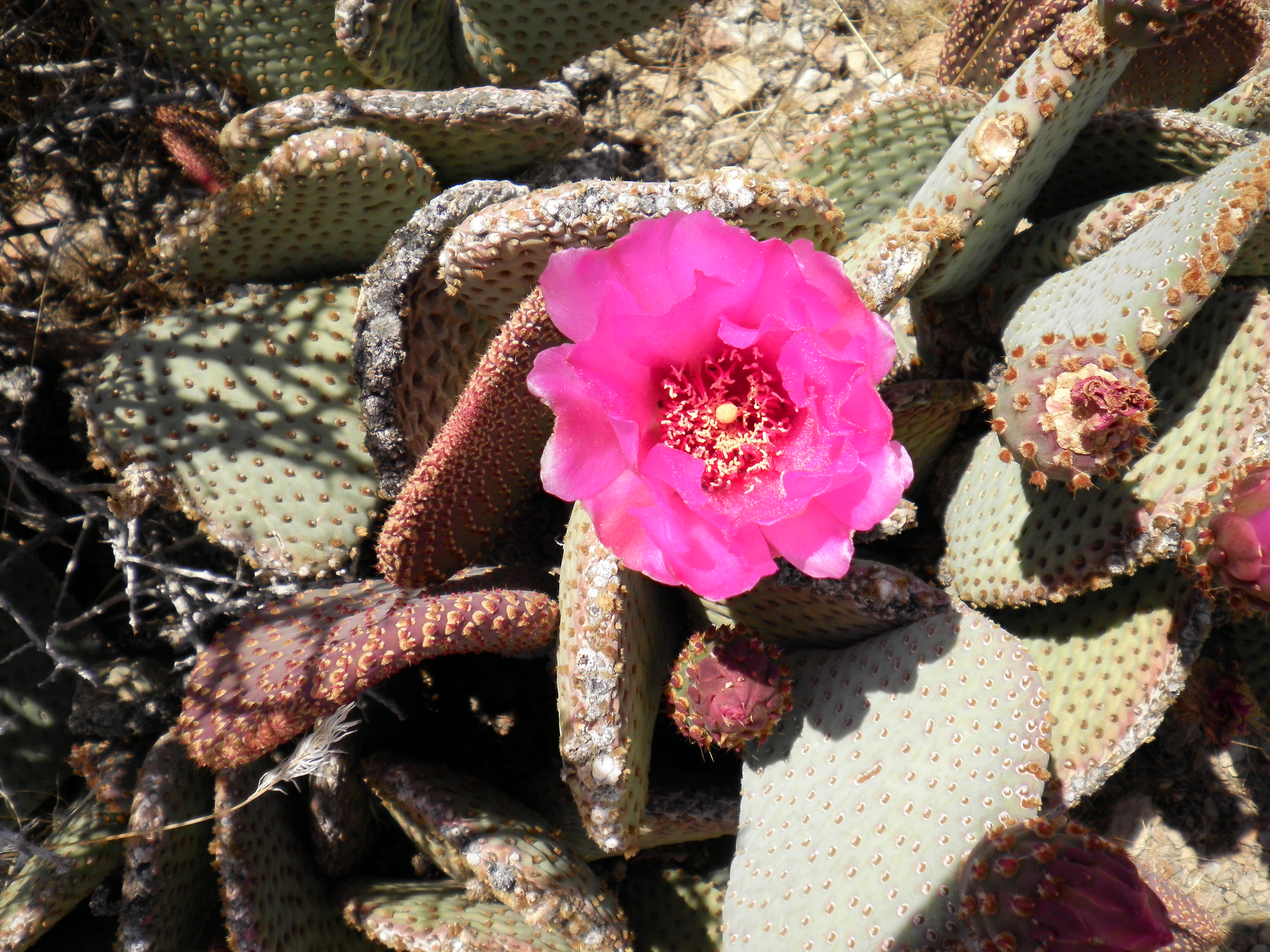
Someday, those waves of chance might sweep me into other climes, so I am making sure I use this opportunity to get to know my desert self. There are few frills in the desert, no vibrant colors or showy flowers (though brilliant cactus flowers do bloom in the spring). There are just stark hills, creosote bushes, hard-packed sandy soil. The bleak landscape suited me when I first came here, sodden with tears and steeped in pain, and it suits me still. There is peace in starkness — no particular sight rivets my attention, no exotic sounds or aromas tantalize my senses. There’s just me, the hills, the air I breathe.

Other waves of happenstance landed me in a yoga class. The teacher has a different approach, focusing not on the forms so much as breathing and being. That, too suits me.

I’ve added a few of those exercises to my morning perambulations. I stand out in the desert, away from the things of humankind, open my arms and breathe in the desert. In that moment, I am happy. There are no shadows of grief, no sad memories or niggling fears. There’s just me, believing I am where I am supposed to be.

Yet Another Saturday, My Sadder Day

Yesterday was Saturday, my sadder day. The love of my life died one Saturday almost two and a half years ago, and I have not yet managed to get completely over it. You don’t ever get over such a grievous loss, of course, but you can come to an accommodation with the absence, develop a new focus, perhaps even find happiness. It just takes a very long time — three to five years, or so I’ve been told. I’m doing well, all things considered, but I still struggle to find my way.

I loved him with all my being, and I continue to love him. My love for him has no outlet — I can no longer do anything for him or with him — so his share of my love fills my heart like a pool of unshed tears. I try to use that love to propel me into my future, knowing he wouldn’t want me to be sad for him, but the truth is, he has no say in the matter. (I don’t always a have a say, either — grief comes and goes as it pleases, following a timetable I seldom understand.) He’s gone, and that goneness continues to shadow my life. I feel his absence like an itch deep in my soul. I feel it in the world around me, in the very air I breathe. I’m practicing being part of the world, planting my feet on the ground, feeling connected to my self and my surroundings. Still, the world feels alien with him not in it.

I’ve come a long way from the shattered woman who screamed her pain to the uncaring winds. I’ve made new friends, seen amazing sites, tried different activities, sampled exotic foods, wrote hundreds of blogs, walked more than a thousand miles. I’ve done the best I can to life fully, but the truth is, I’m tired. I’m tired of his being dead, tired of having to put a positive slant on a situation that has no upside, tired of trying to live whole-heartedly with half a heart. Just . . . tired.

I’m not young anymore, but I’m not old, either. Sometimes the future yawns before me like a bleak and empty landscape. Most times, of course, I can look to the future with hope, though I probably will always be saddened and bewildered by his goneness, especially on Saturday, my sadder day.

A Photo is Not a Living Person (Though Sometimes I Wish it Were)

I only have two photos of my deceased life mate/soul mate. It seems odd in this age of electronic imagery to have so few pictures, but there was no reason to take photos. We were almost always together. We remembered the things we did, the events we participated in, the conversations we had. A camera would have only been an intrusion in our lives.

One of the photos I have is fifteen years old, a formal photo of the two of us, taken at my parents’ 50th wedding anniversary celebration. After he died, his mother wanted a picture, so I took a photo of the picture, cropped me out, and sent it to her. That image of him sat in my computer for over a year without my looking at it. I simply could not bear the pictorial reminder that he was forever gone from this earth. (To be honest, I still cannot bear the thought of his being gone.) Even worse, it didn’t look like him, not the way he looked toward the end (though it had been a perfect likeness at one time), so I barely recognized him. I didn’t want to supplant what images I had of him in my mind with a photo.

About a year ago, however, my memories of him started to fade, and I desperately needed to see him, so I printed out the photo. Somehow, the photo makes him look happy and radiant, as if he were smiling at something only he knew. (Which is odd, because he does not look at all like that in the original photo.)

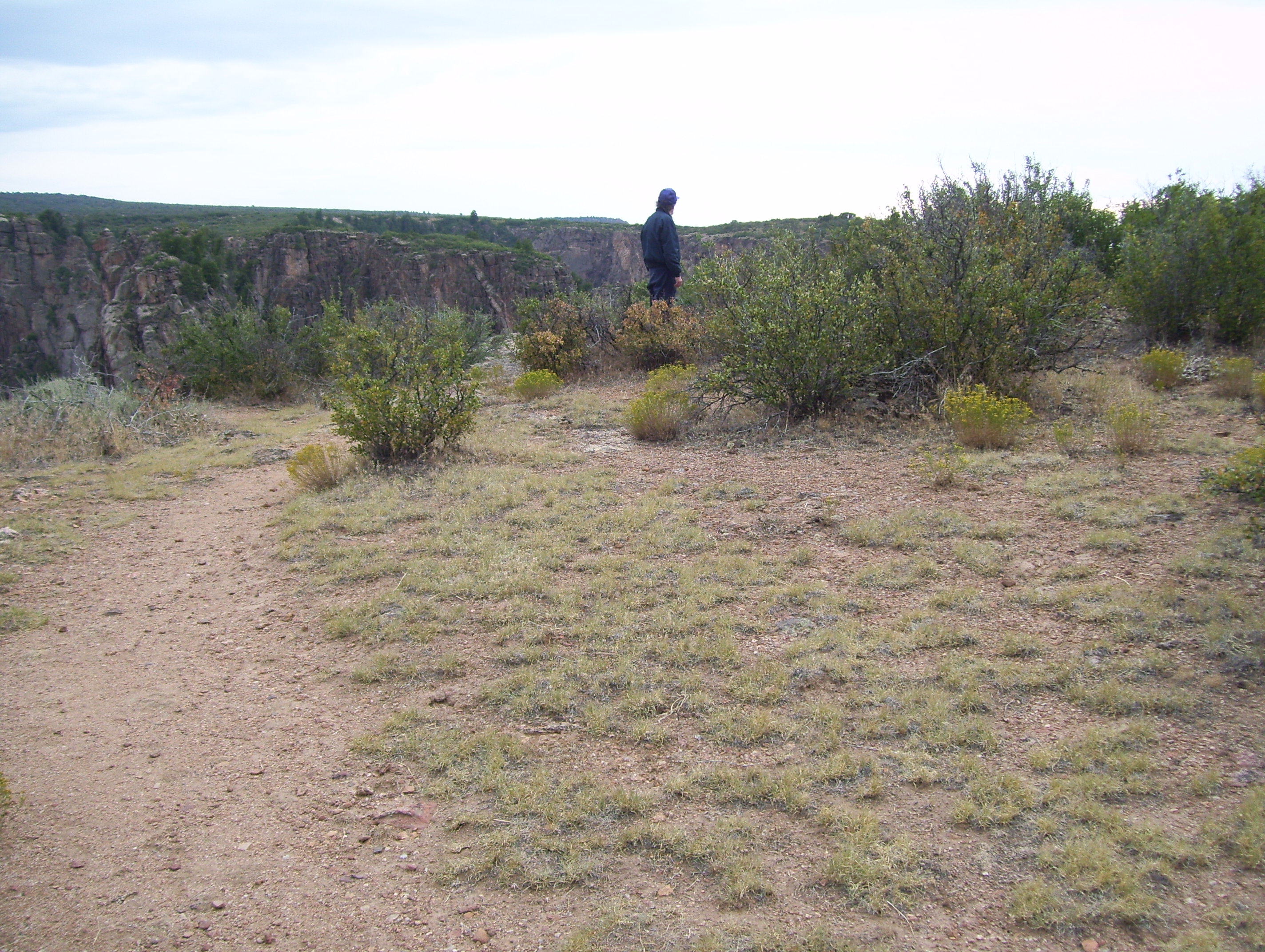
The other photo of him is from a few months before we died. (I can’t believe I made such a typo, but I’m leaving it in because in so many ways, “we” did die.) I’d just come back from a trip in a rental car, and since a rental car is a terrible thing to waste, we took a rutted and sparsely graveled road to the north rim of the Black Canyon of the Gunnison. (Although we lived only twenty miles from there, neither of our old cars could safely make the trip.) I didn’t realize I had a photo of him until months after his death when I went through the pictures I took of the canyon. (By then, I often took photos — seeing life through the lens of a camera was the only way I could deal with his dying and then with his death.) He is standing at the rim of the Black Canyon, his back to me, staring out at . . . eternity? I was able to look at this photo occasionally, for some reason — maybe because I was able to “see” him the way I remembered him.

There is a third photo, one his oncologist took. I’d considered asking for it, but I remember how appalled my mate was when he saw it — he looked old and haggard and gray and very, very ill. I didn’t want to remember him as such, so I never followed through with my inclination.

A few months ago, I put away the photos. I went from not wanting to look at the pictures, to drawing comfort from them, to not wanting the constant reminder he was dead. But yesterday, I set the photos out again. I needed the feeling of connection, no matter how ephemeral. I don’t know how long it will be before I can’t stand to look at them again — perhaps only a day or two. As much as I need to feel connected to him (sometimes that lack of connection is like an itch deep inside), the truth is, a photo is not a living person, and I cannot feel connected to an image on a piece of paper.

No Life in My Life

I am heading toward the two-and-a-half-year anniversary of the death of my life mate/soul mate/best friend. The breath-stealing pain that I endured for many months has dissipated, so much so that I have a hard time believing I ever went through such agony. The all-encompassing loneliness that followed the pain has also dissipated, and I am comfortable with the idea of growing old alone (or if not comfortable, at least tolerant of the possibility).

I’ve even gotten over the horrendous feeling of always waiting. Not waiting for something. Simply waiting. Nothing has changed, of course, except my attitude. I am training myself to be in the present, to be me, to believe that nothing is important but what is right here, right now. It’s working — I am more at peace than I have been in a long time.

But . . . there is no life in my life, no spring in my step, no spark in my spirit.

I’m not a sentimental person. I seldom kept keepsakes and I never chronicled my life with photos, but now I do both to prove to myself that yes, I am alive, and yes, I am doing something with my years. It feels as if I have done nothing but stagnate the past two years, and yet I have that scrapbook of paper memories showing me the truth:

Since October of 2010, when I started keeping the scrapbook, I have spent time on both USA coasts, hiked in the desert and on sandy beaches, climbed lighthouses and rocky knolls, ridden an amphibious vehicle and the world’s largest traveling Ferris wheel, fed ducks and sea gulls, walked along rivers and around lakes, visited ghost towns and overgrown cities, trekked the length of four piers on four different beaches, gone to art exhibits and historical museums, attended fairs and festivals, learned to shoot guns and amazing photographs. I’ve traveled alone and with friends on planes, trains, and automobiles. And I have tasted hundreds of different foods, some delicious, some that can barely be considered edible.

So why do I feel as if there is no life in my life? Do I need to be in love to sparkle with vitality? I hope not. I hate the thought that my well-being rests in someone else’s hands. The truth is probably more prosaic — although I am not actively mourning, I am still grieving, still disconnected from the world. After the death of the one person who connects you to the world, it takes years to find a different way of connecting. All of these experiences I have mentioned are ways to keep me busy while the real work of reconnecting to the world is going on deep inside.

Besides, the experiences were good ones.