Life’s Confusion

The other night I talked to Jeff’s photo, as I sometimes do. I think it was Christmas night, and I was feeling a bit lost. And confused. So much of what has happened to me in the past twelve or thirteen years (the years of his dying and the years of my grief) still doesn’t make sense, but for the most part, I just go on about my life, concentrating on the day I am living.

Even so, sometimes, the confusion makes itself felt. For example, I really do like my house, my life, having a place to call home, but it all came about because Jeff died. If he hadn’t died, my life would have been completely different. I wouldn’t have missed this current life, of course, because I would never have known it existed, but still, the confusion is there.

I also continue to be confused about life and death, what it is, where we go, and all that, but again, generally I don’t think about it, just take it as a fact that he is gone and I am not.

And I’m still confused about a lot that happened that last year we were together. I don’t worry about it much — after all, it was a long time ago — but there is one episode that still makes me feel ashamed.

When people talk about those who care for their dying spouses, we imagine tender care, patience, and the warm glow of love. After all, that’s how it’s portrayed in movies, and movies are a reflection of real life, right?

Well, no. Many of us endure a love/hate relationship — we want to be with them and savor ever moment we have, yet at times we can’t stand the stress, the turmoil, the pain (theirs and ours), the sleepless nights and all else that goes along with trying to survive while your mate is struggling with death. We can’t always be the person we want to be, and even worse, as the months pass and the exhaustion and numbness take hold, we become someone we’d just as soon pretend never existed.

Even during a year where death hovers, life still reigns. So we live. We get impatient and frantic and frustrated and surly. And, even though sometimes we wish they’d die and get it over with, we never really believe they are going to die. We forget that each day might be the last, and so we forget to be patient and kind.

It’s one of those time that still shames me. He was looking at Google Earth and visiting all the places he once knew. I listened to his stories of old Denver for a while, and then suddenly I couldn’t stand it anymore, and I got impatient and left. I still don’t know why I felt that way, so that adds to the confusion. There wouldn’t have been a problem if not for Death. If there had been another time, I would have made a point of drawing up a chair and soaking in the time together, but there wasn’t another time. And I am left with the knowledge of how I am not always the kind and patient and generous person I wish to be.

And I am left with confusion.

So much of that time is gone, out of mind. Even if I wanted to remember it, I couldn’t. I can’t even, at times, remember being with him, even though he was the most important person in my life for decades. Even after he died, he continued to be important because of the grief I experienced.

I don’t think I will ever truly find my way out of the confusion. Despite all my studies and experience and contemplation of dying, death, and grief, so much can’t be known. Most of the time, I can live with the confusion in the same way I live with the knowledge that one day I will die. It’s there, but doesn’t have any meaning on a day-to-day level.

Until, of course, there comes a day when the confusion wells up, and I end up pretend talking to Jeff.

***

Pat Bertram is the author of Grief: The Inside Story – A Guide to Surviving the Loss of a Loved One. “Grief: The Inside Story is perfect and that is not hyperbole! It is exactly what folk who are grieving need to read.” –Leesa Healy, RN, GDAS GDAT, Emotional/Mental Health Therapist & Educator

Preparing for Grief

An online friend who will soon be experiencing grief due the death of a loved one, asked me which of my books I would suggest she read to help her prepare.

To be honest, there is no way to prepare for such a physical, emotional, and spiritual upheaval. No matter how much we are prepared, the actuality of the experience is more than we could ever imagine because there is nothing that compare. Even people who have suffered comparable losses, such as an undesired divorce, are shocked when they have to contend with death as well as all the painful changes they were expecting.

We simply do not have the capacity for understanding death, what it means to the person dying, what their death means to us. When it happens, all we can do is stand at the abyss, and wonder if our grief will carry us over the edge.

The best way to prepare is to try to keep from falling into the pitfalls of regret and guilt, to try to act in a manner that won’t carry an additional burden into grief. I say “try” because there is no way to prevent such pitfalls. Even though a person might be dying, they are still alive, and life carries with it emotions and actions that that seem reasonable at the time and only in memory prove to be problematic. When one of a couple is struggling to live while the other is preparing to die, emotions run strong. The only time Jeff and I ever got into a verbal altercation was three weeks before he died. The problem is, although we know they are dying, we don’t know it. It seems as if forever after, they will be dying, and so we don’t truly fathom that one day they will be gone from our lives.

All we can do is love the person, do the best we can for them and for ourselves, and try to keep up our strength. A dying vigil is exhausting. Death tasks are exhausting. Grief is exhausting.

All that being said, both my books can help a person get through the lonely years that follow.

Grief: The Great Yearning is a compilation of letters, blog posts, and journal entries I wrote while struggling to survive my first year of grief. As one reviewer said, “This is an exquisite book, wrenching to read, and at the same time full of profound truths.” Many people use this book as well as my blog posts as a checkpoint to see if what they are feeling is normal, because the truth is, such grief feels anything but normal. They need to read my story partly as a validation of their own experience and to see that they are not alone in what they feel. Grief is horrendously isolating. Few of us know anyone who has experienced grief. Few of us know anyone who is willing to let us talk about how we feel without trying to “fix” us. Death is simply not fixable. It’s something that must be assimilated. And grief is how we assimilate such a profound loss.

Although the official consensus is that everyone’s grief is different, I have found the opposite to be true. We may actually grieve differently in that some people cry, some scream, some become ill, some refuse to acknowledge their feelings, but the pattern of grief after the loss of a spouse, life mate, soul mate is more or less the same for most of us. So this is not just my story, but the story of many grievers I have encountered during the years after the death of my life mate/soul mate.

Grief: The Great Yearning is a personal look at grief from the inside out. Grief: The Inside Story is look at grief from the outside in, written eight years after the onset of my grief. It’s more of a guide, an explanation of the various permutations of grief and how it changes us than simply one woman’s story. Although the book is obviously personal since my grief is the grief I am most familiar with, other people have allowed me to use their thoughts and experiences to create this guide, this explanation of grief and what the experience entails.

Coping with the death of a loved one can be the most traumatic and stressful situation most people ever deal with — and the practical and emotional help available to the bereaved is often very poor. As the bereaved struggle to make sense of their new situation they often find that the advice they receive is produced by medical professionals who have never personally experienced grief; and filled with platitudes and clichés, with very little practical help. How long does grief last? What can I do to help myself? Are there really five stages of grief? Why can’t other people understand how I feel? Will I ever be happy again? Grief: The Inside Story debunks many established beliefs about what grief is, how it affects those left behind, and how to adjust to a world that no longer contains your loved one.

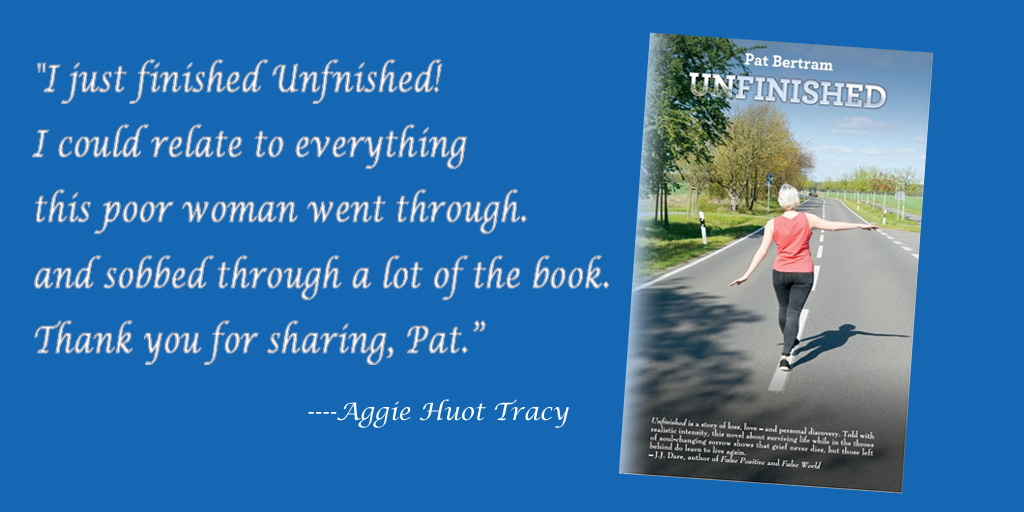
Although I don’t often include it with my grief books because it is fiction, Unfinished is also an important about grief. It shows the emotional instability and practical concerns the woman character experiences while her husband is dying and shows the surreal thinking that she experienced after he was died. One reviewer found it unbelievable that a woman who so loved her husband that she experienced so much mental and physical devastation after he died, would act the way she did, carrying on with another man during that last year. But all that shows me is that she was never there. You truly do not know the skewed way one can think when forced into such an untenable situation.

Would anyone believe, considering all my talk of grief, considering our almost cosmic connection, considering all he had meant to me over the decades we were together, that there were times during that last year of our shared life when I hated him, when I just wished he’d die and get it over with? Many of us have been there, and it is a secret we hold close, seldom admitting it even to ourselves. (Thinking back, I’m sure he knew, and I’m sure he never held it against me, though I did.)

I guess, then, after reviewing all my books, a person who wants to prepare themselves for what is coming, should read Unfinished first, then Grief: The Great Yearning, and finally, Grief: The Inside Story.

Moving On

The first time I’d heard the phrase “moving on” was a few months after Jeff died, and thereafter I heard it frequently.

Although people often think they are helping by urging grievers to get over it and move on with their life, they are merely showing that they themselves can’t handle the griever’s grief; showing that they can’t handle the new person the griever is becoming. Friends and family want grievers to be the way they were before their loss, and the griever can’t be. Loss changes you. Grief changes you.

Sometimes when people urge grievers to move on, they are not expressing insensitivity so much as a misplaced understanding of the nature of grief. (Which is why my book Grief: The Inside Story – A Guide to Surviving the Loss of a Loved One was written both for grievers and for anyone who wants to understand this thing we call “grief.”)

The truth is, grieving is how we “move on.” Grieving for a spouse is a process, a process of change from a person with a mate and shared life to someone who can deal with the absence, loss, aloneness.

“Moving on” or “moving forward” isn’t just used about grief. It’s used for almost everything, and one of these phrases frequently shows up in tarot card interpretations, such as the card I picked today that is supposed to be about overcoming fears and boldly moving forward. The phrase also appears frequently in novels and in discussions about writing, such as moving the plot forward, or the characters moving on from . . . whatever.

All of sudden today it struck me that I don’t even know what that means. “Moving forward” seems to connote a linear path, which might work for writing, given that the plot has to go from beginning to a satisfying end, but in life, there truly is no forward movement except that which we impose on our lives, such as time or age or career success or even traveling. We feel like we’re moving forward when we walk or drive somewhere, but that’s mostly an illusion. Unless we are permanently moving to a new house or new property, we eventually return to where we started, so that turns out not to be a forward motion at all.

The universe seems to be built more on circular motion, atomic particles and heavenly bodies are always in motion, orbiting around each other, making their way around empty space, but not really going anywhere because if there is not really a “here,” there can’t be a “there” to move on to. It seems as if motion is important, but not necessarily forward motion. For all I know, we could be moving backward, and it is just the way our brain interprets things to make it seem as if we are moving forward.

A kaleidoscope comes to mind. If all the energy that ever was exists today, then a turn of the scope brings us to what seems a different place, but is really all the same place. Karma and the idea that what goes around comes around also connotes a circular life. As does a gyroscope.

A tarot card I randomly picked twice in the past three days was about fluctuation and change. It suggested that a person who is in harmony with her life is one who can adapt to all the changes that comes her way, and keep on moving, Like a gyroscope that only holds its position when it is spinning,

But not “moving on”. Just “moving”.

Assuming we are supposed to be moving on, moving forward, moving toward something, where are we supposed to be going? Well, death, we are all moving inexorably toward death, since death is our end on this earth, but is that really a forward movement? After a certain age, it seems more as we are being pushed rather than moving on our own initiative. But other than that, what are we supposed to be moving toward? Enlightenment, maybe, though that brings up the issue of what is enlightenment.

In the case of grief, even though I am not actively grieving and haven’t been for a long time — I seldom even feel nostalgic anymore — I never actually “moved on,” never “got over” it. It’s more that the loss became subsumed into the very fabric of my life.

Admittedly, I might simply be sensitive to the phraseology because of all the people who used these words or variations of them to urge me to get over my grief, but they still seem to be rather meaningless terms no matter how they are used.

***

Pat Bertram is the author of Grief: The Inside Story – A Guide to Surviving the Loss of a Loved One. “Grief: The Inside Story is perfect and that is not hyperbole! It is exactly what folk who are grieving need to read.” –Leesa Healy, RN, GDAS GDAT, Emotional/Mental Health Therapist & Educator
When a Door Opens

People often say things like, “When a door closes another one opens” or “When a door closes, a window opens.” Sometimes people don’t use the passive voice, but have God or the universe opening the door.

I know the intent of the quote — to encourage people to look beyond a failure or a loss or a disappointment and to keep trying because, as Yogi Berra said, “It ain’t over until it’s over.”

As admirable as the intent might be (I say “might be” because no one likes being jollied into a different outlook after a disappointment), the saying itself is beyond idiotic.

The entire door quote, attributed to Alexander Graham Bell, is: “When one door closes, another opens; but we often look so long and so regretfully upon the closed door that we do not see the one which has opened for us.”

Whether you use the long or the short version, the quote completely ignores the nature of a door. When a door closes, you can open it again. That’s the nature of a door. It closes. And it opens.

The worst use of this witless saying is to comfort those who are grieving. (And yes, people do say this to people who lost a spouse or a child or someone else whose death is catastrophic.) Apparently, they think . . . well, no. They don’t think. The loss of a beloved to death is in no way akin to a door closing. An unscalable wall suddenly thrust in one’s path is more like it. Or the sun losing its warmth. Or a tsunami hurling you into a completely different world. There are hundreds of applicable synonyms, but a door? No.

The truth is, though, things do change. Even in a seemingly static neighborhood, every time people open a door to the outside, they see something different. Sun and flowers, perhaps. Or snow and blue skies. Or a car passing. Or shadows that weren’t previously there.

And when someone dies, seemingly destroying your life, you can veer off into a different path and develop a new life.

After all these years since Jeff died, a different path opened up to me — a new town, home ownership, gardening and landscaping. It’s a good path for me, though it’s not one I would have ever chosen if Jeff were still alive. It’s not one that would have ever even entered my mind.

Come to think of it, Bell’s saying is silly on all fronts — not just the door analogy, but not being able to see the newly opened door because we are so fixated on the closed one. The truth is, often we can’t see another way because at that time there is no other way. It took many years, many changes in me and my outlook, several deaths (not just Jeff but parents and siblings) for me to find the new path.

But other than death, from which there is no recourse, when a door closes, just open the dang thing again.

***

Pat Bertram is the author of Grief: The Inside Story – A Guide to Surviving the Loss of a Loved One. “Grief: The Inside Story is perfect and that is not hyperbole! It is exactly what folk who are grieving need to read.” –Leesa Healy, RN, GDAS GDAT, Emotional/Mental Health Therapist & Educator

Betrayal?

Jeff and I had such a deep, seemingly cosmic connection that for many years, I thought I’d be pulled into death when he died. It didn’t seem fair because he was five years older than me, and I thought I’d be cheated out of five years of my life.

About a year before he died, I hugged him and accidentally touched his left ear. I know now cancer had metastasized all the way up his left side and into his brain, but at the time, all I knew was that he pushed me away, wincing in agony. Some part of me closed down at that moment, and a voice deep inside me said, “He might dying, but I have to live.” During that year, we went our separate ways, he to dying, me to living. Then, six weeks before he died, he made the connection with me again. He needed to talk about what was happening to him so he could gather courage to face what was coming, and during that daylong conversation, I remembered why I’d fallen in love with him all those years ago.

Because of the disconnect during our final year, a year where I felt dissociated from him and our life, I didn’t expect to grieve, so the depth of my pain stunned me. I struggled for many years to deal with the wreckage of our shared life. Although he did not pull all of me into death with him, apparently he did pull part of me into the abyss, and that hole — that amputation — will always be a part of me.

During my grief struggles, I felt at times as if I’d betrayed our love because in the end, our connection wasn’t strong enough to keep us together, not in life and not in death. I did get my five years. And more. I continued to grow older than Jeff ever would, to develop my own unshared and solitary life.

As of today, I have lived exactly six years longer than he did. It doesn’t seem right, not that I have lived all these years, but that he didn’t have the choice. Well, neither of us had a choice. That voice inside me didn’t say “I want to live.” It said, “I have to live.’

I no longer feel any sense of betrayal. We each did what we needed to do, both when we were together and when death ripped us apart.

During those last weeks after we reconnected, we tried to support each other, each of us thinking the other was getting the worse of the deal. I thought he had it worse because he had to die in pain; he thought I had it worse because I had to live and suffer through life — and grief — alone. I still don’t know who got the better deal. I had these years, but I will also have to deal with dying one of these days.

But not today. Today I am honoring the six years of life that were given to me, years that were denied to him. It’s not exactly a celebration, but it is something worth reflecting on.

Or not. In the end, we each live our allotted years the best we can, and hope we can meet the end with courage.

***

Pat Bertram is the author of Grief: The Inside Story – A Guide to Surviving the Loss of a Loved One. “Grief: The Inside Story is perfect and that is not hyperbole! It is exactly what folk who are grieving need to read.” –Leesa Healy, RN, GDAS GDAT, Emotional/Mental Health Therapist & Educator

Quantum State of Grief

It’s kind of funny that after all these years after Jeff died, after all the years of grief and then the subsequent years of no grief (at least not more than a momentary pang or two of nostalgia), I still sometimes fall into the magical, quantum state of grief where Jeff seems to be both alive and dead.

I know he’s gone. I feel it in the very depths of my being. But sometimes, when I’m going about my daily life (that doesn’t seem anywhere near as ill-fitting as it once did), I find myself thinking one of those quantum thoughts.

Last night, as I wandered from room to room preparing for the night (checking to make sure the doors are locked, turning down the bed covers, making sure I have a glass of water on the nightstand), I thought that I should call his mother to find out how she’s doing, so I can let him know the next time I see him.

The realization of the illogicality of the thought didn’t send me into a spiral of grief, it just made me wonder why that thought, and why now. (Come to think of it, a friend called and mentioned that a mutual acquaintance inherited the care of her hated mother-in-law, which is probably what put the thought in my mind.)

It just goes to show that even when the pain is gone, the habits of grief and grief-thinking linger. That’s not the only stray thought — on more than a couple of occasions, I have found myself wandering through the house, wondering how and where Jeff would fit when he got here.

Hmm. I see a pattern here. I tend to think these thoughts when I am simply wandering from room to room, but that’s no reason to stay put. I do like wandering around my house, feeling the “home” of it. For so long, after he died, I never felt at home anywhere in particular (he had been my home), though I did learn to feel at home wherever I was because . . . well, because that’s where I was. Back then, I had to break myself of the habit of saying I was going home when I returned to one of the places I was inhabiting because it wasn’t home, just a place to roost. I still catch myself editing out the word “home” until I realize that hey! I have a home! It’s not just a place to go back to, but a place to settle into. A place to make my own.

I do wonder what Jeff would think about all this — my moving here, my owning a house, my getting old. (In three days, I will have lived six years longer than he lived.) But mostly, although he’s in the back of my mind and the back of my heart, thoughts of him and his death and my grief no longer dictate my life. Others things dictate the terms now, such as keeping up the house, keeping up my health, trying to hold back the infirmities of an aging body as long as I can. You know — life. Even though I knew from the beginning (odd that I still call his death and my ensuing grief “the beginning”) that the business of life is living — or do I mean the business of living is life? — I never really felt it. I felt the nearness of death and the winds of eternity more than the importance of my continued life.

But here I am, living, despite the occasional and brief lapses into the magical realism and quantum state of grief.

***

Pat Bertram is the author of Grief: The Inside Story – A Guide to Surviving the Loss of a Loved One. “Grief: The Inside Story is perfect and that is not hyperbole! It is exactly what folk who are grieving need to read.” –Leesa Healy, RN, GDAS GDAT, Emotional/Mental Health Therapist & Educator

After We Said Good-bye

I was looking through some of my old poems to see if I could find inspiration for a peace blog for November 4th, the day thousands people all over the world blog for peace, when I came across a poem I had written shortly after I met Jeff.

you turned around
and waved to me
after we said good-bye
a small gesture
that told me more
than all the words
we had spoken

And suddenly, I remembered that wave as if it were just the other day.

One day in August, forty-four years ago, I stopped by a neighborhood health food store, and there he was. My first reaction wasn’t particularly overwhelming, but my second reaction, which followed less than a minute later, was an internal ping, then a tiny voice inside of me wailed, “But I don’t even like men with blond hair and brown eyes.” Not exactly love at first sight. More like recognition. But recognition of what? I never did know.

I soon became an aficionado not just of natural foods but also of vitamin supplements, because obviously, the more supplements I took, the more excuses I would have to visit him.

I almost stopped going to his store when I encountered a woman talking to him I knew through the fabric store I managed. All of us young women were enthralled with her — she seemed so dramatic, with erect posture, white hair, dark sunglasses, and silence. She almost never talked. Once she realized we shopped at the same health food store, however, she would come into the fabric store and yammer on and on about Jeff and how wonderful he was. I felt foolish, thinking I was just another groupie (he did seem to have an inordinate number of women who shopped at that store) and I decided not to return.

But I had enjoyed talking with him. He was the only person I’d ever met who was interested in the same wide range of subjects I was, and so I ventured back to the store. One day shortly afterward, I stopped by in the morning, and we got to talking as we always did. A little later, when it was time for me to leave, he walked me outside. The two of us were stunned at how dark it was. We’d talked the entire day and far into the night. I started walking away, and then turned back for one last look. He also had turned back. And he waved.

How is it possible that so many years — and tears — have passed since that day? Back then, we were so new, we didn’t even know we would have a relationship. let alone one that would span decades.

But now I know what will happen to those two people. The end to our story has been written. The romance is finished. And I am left alone with only fading memories to tell me that I once loved, that I once was loved.

I don’t know what will happen to me. If I learned anything that far away August, it’s that life can change in an eyeblink. It’s the same lesson that his death taught me — you’re alive, and then, before you can blink, you’re not.

Still, the way things look now, I’ll be living out my life alone. Becoming that pathetic old woman I fear to be — the cat lady sans cats. (Though who’s to say if that cat lady really is pathetic. Maybe she’s living life on her terms the best she knows how.) Even if I — or my life —doesn’t end up being pathetic, I will be an old woman in an ever alien world. The world is already so different from the one Jeff and I lived in that I doubt he’d recognize it. (And if he is at all cognizant of what is going on in this country, I’m sure he’s glad to be done with it since all the things he feared would happen are happening.)

I was lucky for all those years that we were together. That day at this store set the tone for our relationship, and we always talked — about our lives, books, music, history, and oh, too many subjects to list. When the conversations died, I should have realized it was a sign that he, too, would die. (As people near death, they tend to pull away from their loved ones. I don’t know if this is a conscious decision, an unconscious reaction, or simply part of the flow of life and death.)

His voice seemed to have been the soundtrack of my life, and now his voice is silenced forever.

It still doesn’t seem possible that he’s been gone more than ten years. I remember being at his store just the other day. And he waved at me after we said good-bye.

But it wasn’t just the other day. It was decades ago. And that doesn’t seem possible either.

***

Pat Bertram is the author of Grief: The Inside Story – A Guide to Surviving the Loss of a Loved One. “Grief: The Inside Story is perfect and that is not hyperbole! It is exactly what folk who are grieving need to read.” –Leesa Healy, RN, GDAS GDAT, Emotional/Mental Health Therapist & Educator

Happy Thirteenth Bloggiversary to Me!

I created this blog exactly thirteen years ago today, back when I hadn’t yet become a published author, back when I had just acquired my first computer and didn’t even know what a blog was. I had read how important blogging was for authors, both as a way of getting known and as a way of connecting with readers, so I decided to “act as if” I were going to be published in the hopes of making it happen. I had nothing to say, no one to say it to, no reason to say anything, but I didn’t let that stop me. I started blogging on September 24, 2007, and haven’t stopped since.

Did acting as if I were going to get published work? Perhaps, though there is no direct connection that I know of. Still, one and a half years after starting this blog, my first two books were published. I now have eight books available: five suspense novels, one mystery, and two non-fiction books about grief. A ninth book will soon be published, a novel that my publisher said, “is playful, fun and well-written. It spans genres, so I’m not sure if there is an exploitable target audience. I don’t care. I like it.”

Two-and-half years after I started this blog, my life mate/soul mate died, and his death catapulted me into a world of such pain that it bled over into my posts. This blog became a place where I could try to make sense of what I was going through, to offer comfort and be comforted, to find my way to renewed life. And I struck a chord with people who were also dealing with grief. It’s no wonder my top posts are grief related: What Do You Say to Someone Who is Grieving at Christmas? with 82,261 views and The Five Major Challenges We Face During the Second Year of Grief with 38,122 views.

This blog sustained me during the years I cared for my father after Jeff’s death, and it gave me a place to rest when my father died four years later, and I was thrown out into the world, alone and orphaned.

And this blog offered me a place to call home when I set out alone on a five-month, 12,000 mile cross-country road trip, gave me a place where I could talk about all the wonders I was seeing. Often on that trip, when I was between visits with online friends, I thought of William Cowper’s words: How sweet, how passing sweet, is solitude! But grant me still a friend in my retreat, whom I may whisper, solitude is sweet. And this blog became a place where I could whisper, “Solitude is sweet.”

Currently, as I am continuing to settle into a house of my own, it’s nice to know that whatever life throws at me, whatever problems I encounter, whatever challenges and adventures — and joys — come my way, this blog will be here for me.

During the past thirteen years, I have written 2,842 blogs, received 19,481 comments, and garnered 873,352 views. It amazes me that anyone wants to read anything that I write here. This is so much a place for just letting my thoughts roam, for thinking through problems, and (I admit it) for pontificating a bit. It’s been a kick, writing this blog, and I want to thank all of you for indulging my whims and whimsys.

Thank you for reading. Thank you all for your comments, your likes, your support. They have meant more to me (especially this past ten and a half years) than you can ever imagine.

***

Pat Bertram is the author of Grief: The Inside Story – A Guide to Surviving the Loss of a Loved One. “Grief: The Inside Story is perfect and that is not hyperbole! It is exactly what folk who are grieving need to read.” –Leesa Healy, RN, GDAS GDAT, Emotional/Mental Health Therapist & Educator.

Questions About Grief

A friend’s husband died a few months ago, and during this time, she’s been asking me questions about grief. Since some of them are things I haven’t talked about, with her permission, I am posting her questions (in bold letters) and my answers.

I just got back from a visit with a relative. The emptiness is horrible!

Yes, the emptiness is horrible. I wasn’t sure if I should warn you about how awful it would be when you got back to the empty house, but I figured you’d find out soon enough and I didn’t want to ruin your visit. It’s really hard living with grief.

Did you ever have a weekend where you couldn’t stop crying for more than an hour?

Yes, many, many. I cried for twenty-four hours straight once.

How long did it take before you didn’t cry every day?

A long time. Years. Sometimes it was for just a few minutes. Other times it felt as if he had just died, and I cried as I did at the beginning.

I thought it would start to back off by now.

No. Maybe after six months, the time between crying bouts will get a lot longer, but the tears come back. It’s kind of a shock when the tears return after a period of relative peace because we’d begun to believe it was all over. When the tears come and stay too long, about all you can do is distract yourself by going to the store or a museum, but then you often have the problem of DWC (Driving While Crying). Or crying at the grocery store. It’s not fun.

Did you ever see a grief counselor?

Not a grief counselor, but I did go to a support group for about a year. A support group is good because it helps being around people who are going through the same thing you are and who understand. In my case, it also helped because I was new in town and didn’t know anyone.

What did you have the most trouble with the first year?

It was all horrific. I couldn’t breathe. Couldn’t stand the pain and loneliness.

What sort of things helped during really bad episodes?

Walking. Working helped – housework, cleaning, clearing out stuff. Screaming helped. I did a lot of screaming. Writing letters to Jeff helped a lot. It made me feel as if we were still connected somehow.

How do you make yourself not cry for things like doctor’s appointments?

That’s a good question. I don’t know. Sometimes my tears stopped when I was with other people. Sometimes not. If they didn’t, I just told people to ignore them. Also, being at the doctor’s office rather than at home might be a big enough change to stop the tears.

Is nausea one of the signs of grief?

Yes. I was often too sick to my stomach to eat. But pay attention. The nausea could have other causes.

Did you have different food choices the first year?

Oh, my yes! It took me over a year to be able to eat meals Jeff and I fixed. In some cases, it took longer. In fact, there are some foods I still haven’t eaten.

Did you have any trouble with hair, skin, and nails the first year?

Absolutely. My hair turned to straw, my skin dried out, and my nails got soft. It’s because of the stress. Studies have shown that losing a spouse is the most stressful experience a persona has, by a large margin.

Are you ever scared?

Sometimes. At the beginning, I was often terrified. And for a long, long time I was scared of growing old alone. I still am, but having a house helps. Also, I’m to the point where, if I do get afraid of living alone or anything else, I can turn my mind to other things. But yeah, fear does niggle at me.

Living after the death of a husband is really, really, really hard. Don’t let anyone tell you otherwise. It’s not just the pain and horror of grief that’s hard, but having to find a whole new way of living because your old way of life died when he did.

I don’t feel strong enough.

You might not be strong now, but you will find the strength to get through this. I promise.

I’m glad you are so sure.

I am. I know. It’s the way of with all of us who are left behind. We have no other choice but to live one minute at a time. As time passes, we look back and see all the minutes and pain we have survived, which gives us strength to continue. You’re still at the start, so you can’t see yet all you have done since he died.

***

Pat Bertram is the author of Grief: The Inside Story – A Guide to Surviving the Loss of a Loved One. “Grief: The Inside Story is perfect and that is not hyperbole! It is exactly what folk who are grieving need to read.” –Leesa Healy, RN, GDAS GDAT, Emotional/Mental Health Therapist & Educator

You Can’t Imagine

A friend is reading my grief book — Grief: The Inside Story – a Guide to Surviving the Loss of a Loved One — not for herself so much because she is still happily and healthily married, but for those she knows who have had to deal with the death of a spouse or child.

I am impressed with her willingness to try to understand what others have to go through in dealing with such a horrendous loss. Most people don’t want to know. Not that I blame them — I would have preferred not knowing, would have preferred to continue believing I was immune to such wild emotions, would have preferred . . . well, I would have preferred a lot of things. Or rather, I would have preferred them back then. I’ve gotten so used to the way my life now is, I can no longer imagine a different life. I can barely remember, at times, what my life used to be.

My friend and I talked about the book for a few minutes, then, as people often do, she said, “I can’t even imagine . . .” And as I often do, I responded, “You can’t imagine it, so there’s no reason to even try. It truly is an unimaginable experience.”

I was going to offer further words of comfort by mentioning that she is still way to young to have to worry about being a widow. Even though I know people of all ages who have had to deal with the experience, the widows I’ve been meeting since my move here are usually much older, and had long years with their spouse. Not that the length of time with a spouse mitigates the pain, but it seems more . . . fitting? understandable? . . . than the death of a someone still in their middle years.

It wasn’t until much later that I realized this woman friend is only four years younger than I was when Jeff died. I tend to forget how relatively young I was (though I never forget how young Jeff was), probably because by the time I reared my head and looked around after all those dark years of pain and sorrow, I was way older.

I think it was my relative youth that made me so determined to live and thrive, not just survive, after Jeff’s death. Perhaps if I had been older, nearing my own expiration date, I might not have thrown myself into the whole grief experience but just . . . waited. Back then, I figured it was better to experience grief as it came rather than try to fight it off because I didn’t want to have to be dealing with the problems unlived and unresolved grief can cause in later years. (Buried grief can find its way to the surface through illness and emotional problems even decades later.) I wanted to be sure that I would be whole (except for that eternal void deep inside that still remains), that I would be able to experience to the full any happiness I could find. I also wanted to see where grief would take me.

Although I’m glad the pain and sorrow are gone (except for a residual sadness and nostalgia), I am grateful I gave myself over the experience. I never knew, couldn’t even have imagined that a person could experience such a depth of emotion, could experience something so . . . primal.

Now that I am through with that particular experience, I have no idea what I am going to do with my remaining years except continue to apply the lessons grief taught me, such as live each day the best I can, enjoy the good times, endure the bad, and be thankful for any blessings that come my way.

***

Pat Bertram is the author of Grief: The Inside Story – A Guide to Surviving the Loss of a Loved One. “Grief: The Inside Story is perfect and that is not hyperbole! It is exactly what folk who are grieving need to read.” –Leesa Healy, RN, GDAS GDAT, Emotional/Mental Health Therapist & Educator