Telling New Grievers the Truth About Grief

When new widows or widowers ask me about grief, such as how long it took me or when I stopped crying, I never know how much of the truth to tell them. For some people, the idea that grief will be the primary factor in their lives for three to five years before they find some sort of renewal, is a comfort because they know they won’t feel bad forever. For other people, three to five years is an astonishingly long time (which it is, when it comes to grief) and the thought adds to their despair. After the first year, it’s not such a dilemma for me — people have settled into their grief and knowing it will last years more, isn’t such a torment.

Because of my hesitation to tell the whole truth, I’ve gotten into the habit of telling new widows that grief “lasts a long time.” Oddly, when one is on the grief side of those years, it is an immensely long and dreary road, but on this side, the years of grief seem to have been over in an instant, probably because when things don’t seem to change much, when every day seems like every other day, all the emotional memories pile one on top the other like a deck of cards, rather than being laid out on the table so all of it can be seen at once. That sameness is also what gives grief, when one is going through it, a feeling of timelessness, as if we were always grieving and forever after, always would.

But no matter what things feel like, internal changes are being made, and those changes are generally manifested sometime in the fourth year when suddenly, it seems, life seems lighter, more hopeful. (Or it could be we are simply more used to their being gone, because the truth is, one can get used to almost anything, even death and loss and grief.)

Another example of not knowing what to tell is when a friend recently asked me if her going to visit a relative would help. I told her yes, because that is the truth. It’s good to get a respite from the emptiness, even if the effects of that respite don’t linger beyond the visit. What I didn’t tell her, because I didn’t want to ruin her vacation from herself, is the horror of walking into one’s home afterward to find the emptiness waiting to grab hold once more. But she learned the truth when she got home, and oh, my heart goes out to her. It really is a hard thing to deal with — that emptiness, that void, the knowing that for the rest of our lives, we have to live without that one person who gave us a deeper meaning, emotional support, love and companionship.

This same friend asked if the urge to flee would dissipate after she got back from her visit. I said, no. And when she asked how long it would take before that urge disappeared, I told her that everything takes years. It just won’t always be bad. That urge to flee turns into some sort of craving for adventure. And then, even that urge fades away with time.

I never thought “time” was an antidote for grief, since it’s what we do with that time that affects us more than time itself, but time does pass. The void shrinks but never goes away, so that even when we start to lose the memories of living a shared life because of the passing years, we always feel the absence. Do people need to know they will always feel the absence? At the beginning, it’s a burden, but as the years pass, that same void becomes a comfort, a way of keeping the memory even when the memory is gone.

Another lesser reason I hesitate is that the pattern of grief that so many of us deal with isn’t universal. In rare instances widows don’t fall into the black hole of grief but are able to go on, after a few months, as if nothing had happened.

But most of us have to wait until grief is finished with us.

And that takes longer than anyone wants to contemplate. Even ten, fifteen, twenty years later, something will happen (a daughter’s wedding, a grandchild’s birth, a debilitating illness) and grief, as fresh and as agonizing as the day our loved one died, will return.

What I try to emphasize more than anything is that no matter what people feel, no matter how long it takes, it’s normal. In the end, that’s more important that the specifics, because one thing that most new widows and widowers have in common is the feeling they are crazy when their bodies and minds go into overdrive as they try to process the death of the loved one and loss from their life. Death is the great unknowable, and having to confront that unknown as well as dealing with grief puts an unbelievable stress on the body.

People do need to know about that stress so they can do whatever is necessary to combat the stress. In my case, it was long rambling walks. In other cases, it’s sleeping for long hours or reading or keeping a grief journal or even talking to the deceased. It’s all about getting through the days, the weeks, the months, the years until a renewed interest in life asserts itself.

And it will. That I can tell you for sure.

***

Pat Bertram is the author of Grief: The Inside Story – A Guide to Surviving the Loss of a Loved One. “Grief: The Inside Story is perfect and that is not hyperbole! It is exactly what folk who are grieving need to read.” –Leesa Healy, RN, GDAS GDAT, Emotional/Mental Health Therapist & Educator

Gadgets, Gizmos, and the Exasperating Mysteries of Life

I wondered if the smoke alarm’s tendency to chirp at 2:00 in the morning when the battery is old had anything to do with the temperature, so I read a few articles, and apparently I was right. The cooler temperatures in those pre-dawn hours affect the battery output, and if the battery is getting low, the smoke alarm chirps. I was excited at seeing this confirmation of my surmise until it occurred to me that this scenario did not fit with my 2:00 am chirping because I’d turned off the air conditioner, and the temperature at that time was the highest it had been for several hours. Since I know that high temperatures also affect batteries (my car battery went dead in July one year, which is how I found out), it’s possible the high temperature had an effect, but the house had been hotter earlier in the day.

So I’m back to thinking that the early morning chirping is one of those exasperating mysteries of life, like the annoyance of a cricket in the house, the irritation of mosquitoes in the bedroom, the disturbance of a dripping faucet, the nuisance of a running toilet valve.

One of the articles I read was really an ad for a smoke alarm that had a built-in 10-year battery, which is all fine and dandy, but what happens in ten years when the thing starts chirping at 2:00 am and a simple battery substitution doesn’t eliminate the noise? I’ll stick with what I have for now. Maybe the next time I need to replace the smoke alarms, the ten-year devices will last to my expiration date, and will annoy the folks who end up in the house. A present from me, so to speak.

Considering the success I had in changing all the batteries by myself, even to the point of dragging a ladder from the garage into the house, I thought I’d tackle another little project involving a gadget that I’ve been putting off — installing an automatic garage-door closer.

My door is equipped with a non-automatic closer — me! — but since I am preparing for my old age, and since I tend to be a bit absentminded at times, I figured an automatic closer would be nice. I followed all the steps of the instructions, even found the “learn” button on the opener and set up the ladder so I can reach it, but somehow, the closer and opener didn’t connect. I tried again, but got the same non-result, though the two gadgets are supposed to be compatible. Another exasperating mystery.

If I can’t figure out what I’m doing wrong, and if The Bob ever declines enough that travel is again an option for more people, I’ll see if my brother can get the gizmo to work the next time he comes to visit. (The closer was his idea in the first place, so he should be able to.)

Meantime, I am trying to get in the habit of being patient and waiting until the door is completely closed before taking off. Considering that not everyone in the neighborhood is as honest as my immediate neighbors, I figure it’s best not to give the larcenous neighbors an opportunity to sneak in before the door is completely closed. (That’s one of the ways felonious folk break into people’s houses, and even though the garage isn’t connected to the house, I wouldn’t want anyone in my garage illegally anyway.)

Gadgets, gizmos, and the exasperating mysteries of life. What a day!

***

Pat Bertram is the author of Grief: The Inside Story – A Guide to Surviving the Loss of a Loved One. “Grief: The Inside Story is perfect and that is not hyperbole! It is exactly what folk who are grieving need to read.” –Leesa Healy, RN, GDAS GDAT, Emotional/Mental Health Therapist & Educator

Joys of Modern Life

It’s horrendously early in the morning as I am writing this, hours before I generally get up, but I had to deal with a chirping smoke alarm, and now I can’t get back to sleep.

It’s my own fault, really. I should have changed the batteries a month ago since that’s when the alarms were originally installed, or even a week ago when I changed the batteries on the thermostat, but I don’t have a talent for ladders, so I hoped to get someone else to do the job. But I put it off. And there was no one around tonight (this morning!) to stop the chirping but me.

I looked up the instructions on how to change the batteries, and they were more complicated than I wanted to deal with, having to do with danger warnings, shutting off the power, flathead screwdrivers, and removing battery locks. I was sure the person who installed the alarms showed me a battery drawer in the side of the device so I wouldn’t have to dismantle the device before changing the batteries, but when the drawer didn’t easily open, I thought I might be mistaken.

So, YouTube to the rescue.

I was right about the drawer, and I managed to change the batteries on one alarm, but the chirping continued. When two alarms are close together, it’s almost impossible for me to figure out which one is chirping, and I’d picked the wrong one. I got the drawer of the second alarm open, but couldn’t remove the battery. A bit of finagling and a minimum of swear words, and the battery finally came out. Luckily, the new battery slid right in.

Ahhh. Silence.

I still have two more smoke alarms to do, but to get to the one in the back room, I will have to drag a longer ladder in from the garage. The smaller step ladder I’d used for the others won’t work because there is nothing for me to grab hold in that room to help me keep my balance. At least the others were near doorways, which gave me some purchase.

I know these smoke alarms are lifesavers, but do I really need four of them? One is in the bedroom, one in the hallway, and one near the kitchen as is required, but that puts all three of them within a few feet of each other.

Oh, well. There shouldn’t be a problem after this — I’ll write down the date I changed the batteries and will make sure I change them within the year so I can do it at a reasonable time rather than in the middle of the night.

I didn’t have to change the batteries tonight, of course — according to the instructions, I had a week in which to make the change. A week of that chirping? I don’t think so. I couldn’t even deal with an hour.

Now that the adrenaline of being so rudely awakened has drained away, maybe I can get back to sleep.

And so ends another saga of the joys of modern life.

***

Pat Bertram is the author of Grief: The Inside Story – A Guide to Surviving the Loss of a Loved One. “Grief: The Inside Story is perfect and that is not hyperbole! It is exactly what folk who are grieving need to read.” –Leesa Healy, RN, GDAS GDAT, Emotional/Mental Health Therapist & Educator

Just a Kid

Working for a woman who is quite a bit older than I am makes for a rather surreal experience. I am struggling with age-related issues, or at least I think I am — the bum knee could have come about from a simple injury, though I tend to think the poor thing is feeling its age. Even if my complaints don’t stem from age, I can tell I am slowing down — I don’t think as quickly as I once did, don’t move as fast as I once did, don’t make eye-brain connections instantly the way I once did. I also have to be more careful because of that lack of instantaneousness since danger can lurk in the lag time. If I remember correctly, I don’t I remember as well as I used to, either, though that could be a lack of attention rather than a memory issue. I do think I can still connect the dots as well as ever — i.e.: see the big picture from a scattering of images, draw conclusions from data presented — perhaps even better than ever since I’ve seen many more “dots” in my lifetime than I did when I was younger.

Very little if any of this “decline” is apparent to others. The few people I’ve known for many years are also slowing a bit, so my aging wouldn’t show up in relation to theirs. Most people, however, I’ve only met in the last year or two, so they wouldn’t be able to see those subtle long-term signs of aging. They can, of course, see the lines in my face and my graying hair, but those outward signs don’t show my true age; apparently, all things considered, I still seem younger than I am.

But whatever the truth, I am creeping up on the age where I will no longer be able to pretend that “elderly” only applies to others.

And yet, while all this growing into elderliness is happening, the woman I am caring for insists that I am still “just a kid.”

From her perspective, I am just a kid. Even though I often use a trekking pole to help navigate the decaying sidewalks (and sometimes use two when I walk to give me a full-body workout) and even though my knees stiffen when I sit too long, I can still get around easily, can still take care of myself, have no great dependence on doctors or medicines, can handle my own finances. Admittedly, I have no children to take those responsibilities from me — I know people my age and even younger who need one of their offspring to live with them and help them out, so my independence can be one of necessity rather than ability.

But I don’t think so. (Unless, of course, I am connecting the dots wrong and creating a false picture).

I try to take good care of myself, since what I do now will help me in those later years when no one, by any stretch of the imagination, will be able to think of me as “just a kid.” Unfortunately, too often, the spirit is willing, but the flesh is weak. And the rest of the time, the flesh is willing, but the spirit is weak.

At least, if nothing else, I am back to walking a bit — nowhere near what I once did, but still, a mile and a half is not bad when one has a wonky knee. I have a tendency to want to do too much, and then I have to backtrack, so I am erring on the side of “not enough”. I’m keeping my fingers crossed that I can get back to where I was a few months ago. I’ve noticed that a never-healed injury or a badly healed one is the first step into a serious decline, but I think that comes in later years rather than when one is still “just a kid.”

***

Pat Bertram is the author of Grief: The Inside Story – A Guide to Surviving the Loss of a Loved One. “Grief: The Inside Story is perfect and that is not hyperbole! It is exactly what folk who are grieving need to read.” –Leesa Healy, RN, GDAS GDAT, Emotional/Mental Health Therapist & Educator

Volunteers

I’m still finding “volunteer” plants in my yard, plants that show up without an invitation. If the plants are nice, I don’t mind them being there. Too many of the things I planted never sprouted, and if they did sprout, they didn’t grow. (For example, the bulbs I planted last fall. Everyone I talked to and every article I read told me I didn’t have to water them, so I didn’t. I found out recently I should have been watering them every two weeks or so all winter long unless there was substantial snow or other moisture, which there wasn’t.) So it’s nice seeing some flowers in the yard, even if they are considered noxious weeds, such as this Flower of an Hour (aka Venice Mallow and Hibiscus trionum.)

I was delighted to actually find out the name of that weed because too many plants elude me and my identity searches. Still, the idea that I might be harboring noxious weeds doesn’t thrill me, but often the reason they are considered noxious is that they are poisonous to livestock rather than people.

I don’t know anything about this green flowered weed except that it looks like a lilac seedling until it grows up and creates light yellowish green flowers:

Some things I know, such as alfalfa. Apparently, alfalfa doesn’t like acidic soil, so it should feel right at home in my yard. In fact, I’m thinking of planting a small area of alfalfa because . . . well, just because.

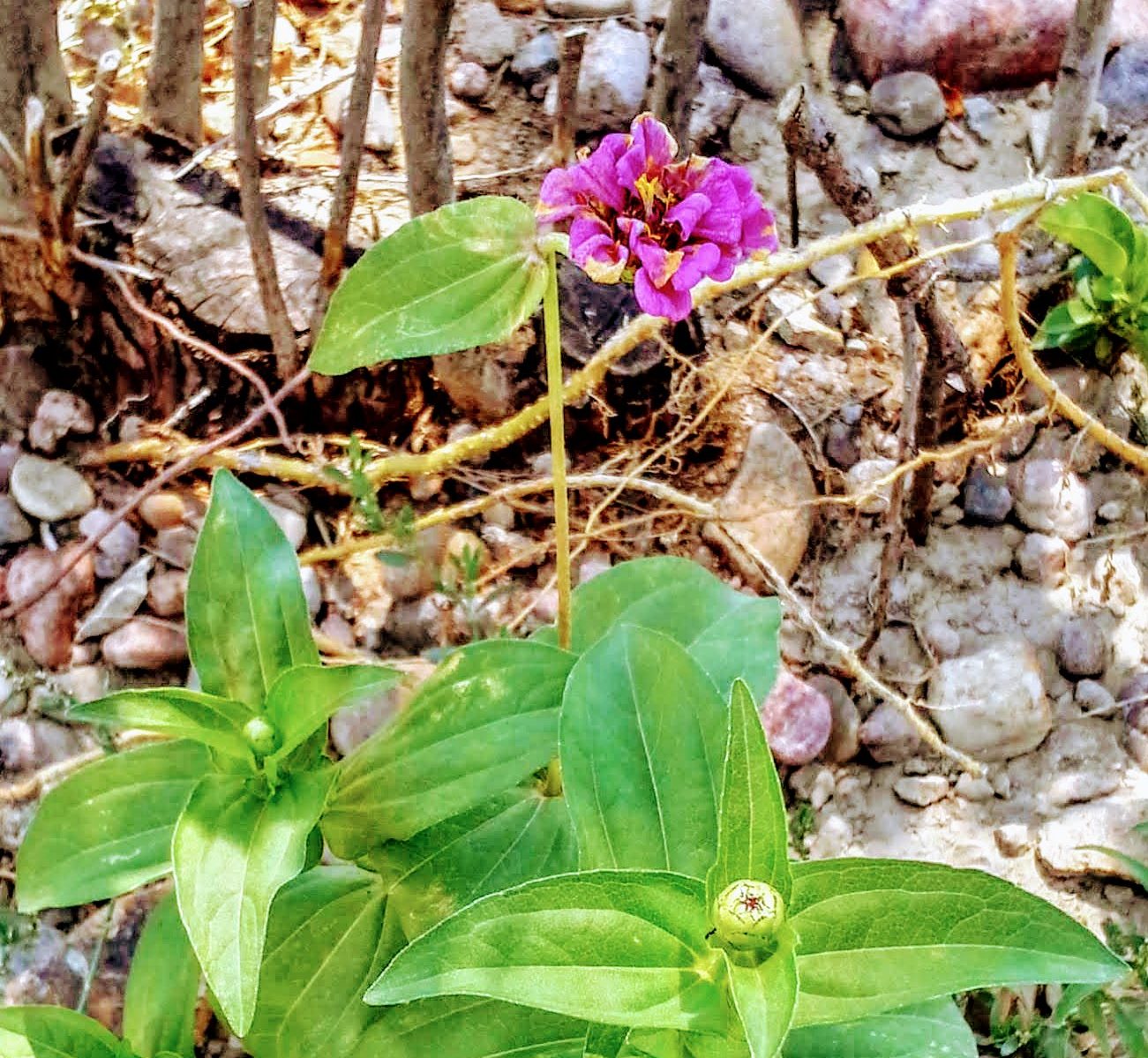
I do know what this little dime-size flower is, thanks to a gardener who reads my blog. Just seeing the photo, which disguises the size of the bloom, it’s easy to see it’s a zinnia, though where it came from, I don’t know. It did make me think that maybe next year I should plant a patch of zinnias since they seem to like it here.

Once we’ve put gravel around the house and planted sidewalks and trails, it will be much easier to control what grows. For now, I have mostly dead yard that seems to attract volunteers.

***

Pat Bertram is the author of Grief: The Inside Story – A Guide to Surviving the Loss of a Loved One. “Grief: The Inside Story is perfect and that is not hyperbole! It is exactly what folk who are grieving need to read.” –Leesa Healy, RN, GDAS GDAT, Emotional/Mental Health Therapist & Educator

Halcyon Days

I try to take each day as it comes because that’s about all a person can do. I have no control over the weather (or anything else, for that matter) so it’s silly to waste time wishing for things to be different. Still, I am getting a bit tired of the heat. The highs are unvarying around one hundred degrees and have been for months. There might have been a day that slipped below ninety, but if so, I don’t remember.

I remember last year about this same time, I got tired of the heat then, too, and looked forward to cooler days. The high temperatures finally cooled into the high eighties and low nineties, and I waited for the seventy-degree days I was sure were coming. But they didn’t come. We slipped into the low eighties, returned to the low nineties for a few weeks, then dropped to the fifties and sixties. And then lower, of course, as winter moved in.

I was astounded at the drop. I know Colorado has — or at least had — a period of halcyon days where one could catch one’s breath after the heat and before the chill of winter. Admittedly, I’m not familiar with the weather patterns of this part of Colorado (living here a little over a year is hardly enough to enable me see any sort of seasonal pattern), but I am familiar with other parts of Colorado, and we always had a spate of windless 70-degree days in the early fall.

I don’t suppose it really matters — the temperatures change throughout the day, climbing to those flaming highs and dropping to the seventies and sometimes even sixties at night, so if I were to set my watch (assuming I had a watch) by temperature rather than solar hours, I would find my seventies.

Now that I’m working again, I have to pay attention to the time (though I have been setting my alarm when I get up in the morning so that I get a reminder when it’s time to get ready to go), but generally, I don’t pay attention to time. So I doubt I’d pay attention if I did have a watch that kept track of the ideal temperature. And anyway, things change, so the ideal temperature would probably have passed before I even noticed.

So what’s the point of this discussion? Nothing, really, though I suppose it reminds me to be grateful I haven’t anything more traumatic to talk about than the unremitting heat.

***

Pat Bertram is the author of Grief: The Inside Story – A Guide to Surviving the Loss of a Loved One. “Grief: The Inside Story is perfect and that is not hyperbole! It is exactly what folk who are grieving need to read.” –Leesa Healy, RN, GDAS GDAT, Emotional/Mental Health Therapist & Educator

More Concrete

I recently got a bill for my car insurance along with a letter. The company was all puffed up with their magnanimity because — as they said in the letter — people were driving less, saving them billions of dollars, so were giving the money back to their customers via discounts. Sounds great, right? And sure enough, the bill did show a discount of $30. But a quick perusal of my previous bill showed that they had raised my rates by $40 for a net increase of $10. If rates are based on the company’s costs and payouts, and if people were in fact driving less and hence getting in fewer accidents and costing the company less, how could my base insurance have gone up? Sounds arbitrary to me, and just another of the many ways big companies look out for us and thank us for our patronage.

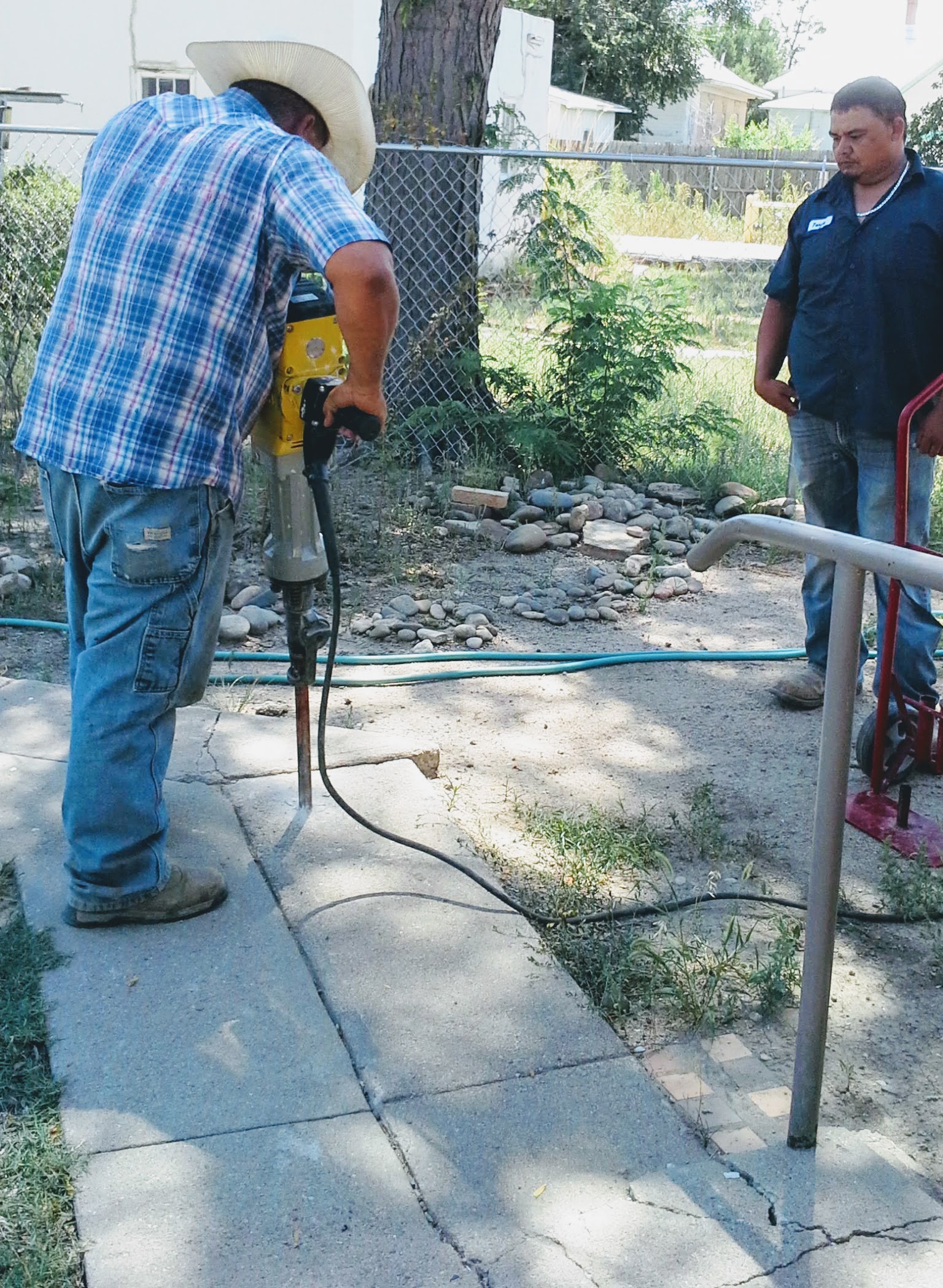
On a less cynical note, the workers finally were able to get the jackhammer to tear up my old sidewalk in preparation for building a new one without bumps and cracks for me to trip over. (Now these people really do look out for me, paying attention to things that might be hazardous around here for me as I get older, and they don’t brag about their magnanimity, either.)

They’re planning on coming back this afternoon to remove the concrete so that tomorrow they will be able to start building the framework for the new sidewalk and stoop, which brings me closer to being able to use the back door. I am so looking forward to not tracking mud into the house! I’d be tracking in some anyway, but I have an area set up in the enclosed porch by the back door for a mud “room” to help keep from tracking the dirt into the rest of the house. (I remove my shoes when I come inside no matter what door I use, but the bigger mats in the back collect more dirt than the smaller ones in front.)

The guys were worried about me inadvertently walking out the back door and damaging myself on the river of broken concrete, but I assured them I am long out of the habit of using that door. (The step is way too steep for my still-healing knee.) Too bad the broken concrete is so dangerous and impractical, because it has a rather appealing artistry to it.

Still, practicality is more important than artistry, and a new sidewalk will be wonderful. It will certainly be more of a boon than any fake discount, and more concrete.

***

Pat Bertram is the author of Grief: The Inside Story – A Guide to Surviving the Loss of a Loved One. “Grief: The Inside Story is perfect and that is not hyperbole! It is exactly what folk who are grieving need to read.” –Leesa Healy, RN, GDAS GDAT, Emotional/Mental Health Therapist & Educator

Wild Life

The wild life in the title of this piece doesn’t in any way refer to my life, which is about as tame and domesticated as one life can be. The wildest I ever get anymore is following the adventures of various fictional explorers who seem to be that fabled “only one man” who can save the world. Do I care that these characters are men rather than women? Absolutely not. It makes no difference to me. The so-called gender bias in such fiction doesn’t affect my life in any way. I still am who I am (whoever that might be) no matter what biases are present in any novel I read. I glean what I need to from the story and then get on with my so very tame life.

The wild life mentioned in the title are, in fact, wildlife, just not the sort of creatures we normally consider wildlife. I haven’t seen any bears or lions, coyotes or even any of the skunks that live around here. My wildlife sightings consist of the daddy longlegs that stared down at me from the ceiling over my bed, the flies that sat on my lap when I perched on my bench outside surveying my kingdom, the feral cats that chased the squirrels eating from the birdfeeder next door, the half-grown rabbits that played tag in the middle of the road, the hummingbirds that sipped from a pink wildflower growing in with my bushes.

(A short diatribe — why is it that with all the books I have on weeds and wildflowers, and with all the resources online, I can never find out the name or nature of any strange plant that shows up in my yard?)

I also saw two turtledoves cuddled on a wire, their heads together as if whispering sweet nothings to each other. I’ve seen photos of turtledoves behaving that way, but never in real life. No wonder they’re considered a symbol of love! I didn’t have my camera with me at the time, and when I went out later, they’d move on to more important bird-ish affairs.

And I saw the first tarantula hawk of the year. Can the tarantula migration be far behind? I have yet to see even a single tarantula since I moved here, even though this area of Colorado is supposed to be tarantula heaven, but perhaps if I get up early sometime next month, I can go on a tarantula hunt.

Meantime, there is always my backyard to entertain me with its myriad wildlife.

***

Pat Bertram is the author of Grief: The Inside Story – A Guide to Surviving the Loss of a Loved One. “Grief: The Inside Story is perfect and that is not hyperbole! It is exactly what folk who are grieving need to read.” –Leesa Healy, RN, GDAS GDAT, Emotional/Mental Health Therapist & Educator

Odds and Ends

Yesterday I got the courage to get down on the floor to do some stretching exercises. Ever since I damaged my left knee, I haven’t ventured to floor in case I couldn’t get back up. Although I am right-handed, I am left-legged, and I didn’t want to stress the knee. It was a bit iffy, but I managed to get back on my feet. Oddly, it was harder getting down than up. I’m not going to try it again for a while. I’ll continue to do other knee exercises, as well as walking. I walked a mile today — walked, not trudged! The muscles around the knee are a bit sore, but I hope that they will soon get back in shape.

Do you care? Probably not. I don’t blame you. Other people’s ills get to be a bore.

I’m sure my talk of the tarot is every bit as boring. The only interesting thing (to me, anyway) is that except for an occasional card warning me not to take things for granted, to accept what comes, to live each day to the fullest, and to make good choices when it comes to opportunity, most of the cards speak of harmony, of peace, of good fortune, of being in the right place. It’s possible I’d read these things into any card because that’s my current situation. Also, if I don’t like the first interpretation I find, I search around for another interpretation. (For example, the ten of swords is a card of death and misfortune, but since I refused to accept such a meaning, I delved deeper and found that the card could also mean a renewal or even simply accepting your present circumstances.)

I mentioned yesterday I’ve been reading a series of spy/adventure novels. I remember back in the days of Glasnost thinking that a whole genre of cold war spy novels, Russia vs the USA, had suddenly become defunct, and that sure seemed to be true. In the following years, spy novels centered more on the Mideast, which killed any interest I had in the genre. But now, all these years later, those old Russia vs. USA novels are current again. And the mention in one of these book about the Chinese and their bioweapons program sure struck a chord.

Come to think of it, at the beginning of The Bob, people talked about the Chinese being held accountable, and then suddenly, that whole topic of news disappeared. I wonder what that’s about? I could create all sorts of scenarios based on these old spy books, but to be honest, it doesn’t really matter where it came from. It’s here, it’s killing people as well as destroying a way of life and the world economy, and no reparations can ever make up for all the problems it caused. (Hmm. I didn’t realize I’d adopted such a laissez faire attitude. Maybe it’s because I’m abstaining from the nastiness of Facebook.)

For some reason, the sun yesterday was exceptionally hot. It seared my skin and desiccated the plants that had been watered the day before. All summer, watering every other day was fine, and yesterday? Not the hottest day of the year, but it sure seemed like it!

Today is supposed to be a bit cooler, though I’m glad I got my walking in early. And my blogging. Now I can sit back and read for the rest of the day.

***

Pat Bertram is the author of Grief: The Inside Story – A Guide to Surviving the Loss of a Loved One. “Grief: The Inside Story is perfect and that is not hyperbole! It is exactly what folk who are grieving need to read.” –Leesa Healy, RN, GDAS GDAT, Emotional/Mental Health Therapist & Educator
Skullduggery

I’ve been reading a series of spy/crime/adventure thrillers. Many of the novels revolve around a race for finding treasure, and all of them incorporate plot devices such as torture, murder, and theft on a grand scale.

While reading this latest book that involves discovery and theft of Incan artifacts going back to Francis Drake days, it suddenly dawned on me that I can’t relate to these folks at all. It might make me seem incredibly naïve, but I simply don’t understand them and their need — their greed — to take things for themselves that belong to others. To steal from a museum so that only they can see the priceless artifact. To kill people if necessary, in order to possess something no one can ever know they own.

I realize there are such people in the so-called real world. In fact, most of the great fortunes were founded by those who became known as “robber barons,” emphasis on “robber.” Even today, no one can make a huge fortune without some sort of skullduggery that skirts legality. Lesser fortunes also often come from some sort of crime before the owners of the fortune go legitimate. It must take an incredibly narcissistic person, as well a sociopathic personality to see nothing, to feel nothing but one’s own desires.

I truly cannot relate to such self-absorption and criminal tendencies, though without ever condoning the crimes, I can sort of understand those who steal on a very small scale.

Supposedly there have been several break-ins and some theft a few blocks from here. The discussion of these break-ins revolves around the myriad pot shops in town (some people say the shops contribute to crime, others say they don’t, though I have a hunch what side of the issue a person is on depends on whether or not the person partakes of the product.) Other people blame the nearby coalition for the homeless where people from all over the state (and even other parts of the country) come to get off whatever substance they are on and find a way back to the homed population. This facility has a distinct effect on the town because people who can’t or don’t want to stick with the program wander away and instead of going back where they come from, they hang around here and add to the problems of this already beleaguered town. Not only do they contribute to the crime rate, but they are also a drag on the city’s limited resources.

These people are desperate for food or a fix, and they are looking for something to sell to sate their elemental needs. Although I’ve never been in that situation, I can understand. Sort of.

I don’t understand, can’t understand, using force to take what one wants, on any sort of scale, especially when it comes to being held up at gunpoint, as happened to me once.

People always say that our differences are what make life interesting, but I don’t agree when those differences revolve around criminal behavior. I think life would be plenty interesting without greed and murder and theft and even unkindness, though I suppose, for most readers, thrillers would be a lot less interesting without skullduggery.

***

Pat Bertram is the author of Grief: The Inside Story – A Guide to Surviving the Loss of a Loved One. “Grief: The Inside Story is perfect and that is not hyperbole! It is exactly what folk who are grieving need to read.” –Leesa Healy, RN, GDAS GDAT, Emotional/Mental Health Therapist & Educator