When the Ugly Duckling is Just a Duck

A couple of women in dance class today were talking about aging and how it was an adjustment when they no longer turned heads. Not a problem, they said. Just an adjustment.

SThese women are still lovely, and I can imagine they were real head-turners when they were young, but not everyone has that same experience. For some of us, the adjustment was not learning we no longer turned heads, but accepting the knowledge that we would never would turn heads.

The lure of the ugly duckling story looms large in girlhood. I suppose even the pretty girls long to be a swan, unable to see until — perhaps it was too late — that they’d been swans all along. (In the case of the two women in class today, they might in fact have been swans of the Swan Lake sort since both had studied ballet for many years.)

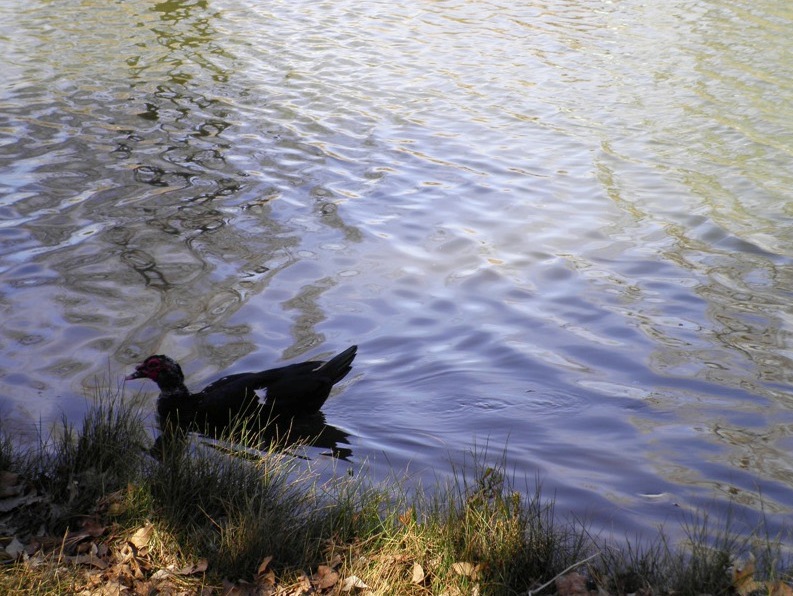
I’m long past the moment when I realized this ugly duckling would never be a swan, long past the days I wondered what it would feel like to be a head turner. There is something to be said (though I’m not sure what, hence this short post) for being an ugly duckling that grows up to be merely a duck. There is beauty in that, too.

***

(Pat Bertram is the author of the suspense novels Light Bringer, More Deaths Than One, A Spark of Heavenly Fire, and Daughter Am I. Bertram is also the author of Grief: The Great Yearning, “an exquisite book, wrenching to read, and at the same time full of profound truths.”)

Building a New World for Myself

When a writer builds a world for her novel, she can either begin with the known earthly world and add details to make it her own, or she can create a world from scratch, building the world from the outside in. First, the broad view of how the world looks, smells, feels. Second how the inhabitants make this world their own with cities, farms, and designated wild areas. Third, the infrastructure of this world — the basic divisions of society including cultural, racial and governmental . Fourth, the creatures of the world and how they relate to their environment and each other. Finally, the minutiae of life in this special world — how and what the inhabitants eat and drink; how they deal with bodily waste, move around, survive, find comfort.

heavenI  frequently think about a writer’s need for worldbuilding now that I am carving my own world out of the known world. I’ll be leaving in a couple of months for a road/camping/hiking trip, and though the first three steps of worldbuilding are already in place (I am going adventuring to see what is there, not creating the environment itself), I hope to find new ways of relating to the world and its creatures. To this end, all the minutia of life in this new world has to be thought out.

For example, when some people take off on such a trip, they acquire a recreational vehicle, a home away from home that is larger and more luxurious than the places most of the world’s population live. Other people go minimal — taking just what they can carry on their backs.

Me? I’m far from wanting the conspicuous consumption of the monster RVs, or even the convenience/inconvenience of a camper, but I’m also not yet ready for a minimalist adventure. I will have a car (though my automobile is rather minimalist, now that I think about it. An ancient VW Beetle is about as minimal as you can get and still be driving an enclosed vehicle). I will stay with friends occasionally or in motels when inclement weather so dictates. But for the rest of it, I have to create my own world. What sort of shelter will I use? How will I stay warm? What will I sleep on? How will I deal with body functions in the middle of a frigid night? What will I wear? What will I eat? How will I cook? How can I create a modicum of comfort?

So many details!

I’m not going off on an expedition to a remote corner of the galaxy, where I need to bring everything for survival. I probably will never be more than an hour or two drive from civilization, where I can rectify any oversight or under buying, but still, the point is to be as self-sufficient as possible. Or maybe not. Maybe the point is to prepare as best as I can and see happens.

One of the things I want to seek on this expedition is darkness, places that are far from the light pollution of cities, where stars are so numerous you feel as if you are falling up into the sky. Last night I had a vision of myself in a lounge chair, lying under the stars, and letting myself fall into the infinite sky. Romantic, I know. The truth is probably more dangerous and uncomfortable — frigid temperatures, no protection from the small creatures of the night, and none from the large bidepal ones. But still, I’ve been searching for a strong and comfortable folding lounge chair to make my vision a reality.

Other details I still haven’t worked out, such as disposal of body waste. I had planned on getting a portable camp toilet since I’m not sure I have the muscle tone to squat for as long as I would need to do to my “duty,”  but so far I haven’t found one I like. Maybe plastic bags and kitty litter would work. And maybe I am stronger than I think.

Some people find my preparations amusing, and to be honest, sometimes I do too. But I also find the mental exercise a challenge — rethinking every part of life to see what the alternatives are.

In this, too, my preparations reflect the way a writer builds her world, because isn’t writing about rethinking life as we know it to see what the alternatives are?

***

(Pat Bertram is the author of the suspense novels Light Bringer, More Deaths Than One, A Spark of Heavenly Fire, and Daughter Am I. Bertram is also the author of Grief: The Great Yearning, “an exquisite book, wrenching to read, and at the same time full of profound truths.”)

Pitching a Tent Without Pitching a Fit

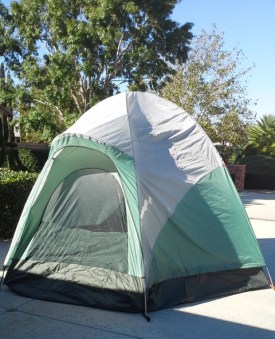
A while back, I ordered a backpacking tent, but since my first camping trip will be more of a car camping expedition, I searched for a second tent. It didn’t need to be big, but I wanted more than just a waterproof coffin to sleep in. I liked the idea of being able to stand up and maybe move around a bit, and I didn’t want to have to scramble out of a miniscule door when I was half-asleep to answer nature’s call. (To be honest, I wanted room so I could set up a camp potty so I wouldn’t have to go scrambling outside in the middle of the night.)

I found what I thought was a tent taller than it was wide (which is how the picture looked) but it turns out the tent is hexagonal and the angle of the photo was deceptive. It turns out the tent was about 10 feet wide and six and a half feet tall.

Still, despite incredulous questions as to why I would want such a large tent (this from people who own humongous RVs), I ordered the tent. Because it was a discontinued model, it was cheap, so if it doesn’t work out, I don’t lose much. In fact, all I have to do is sleep in the tent three or four nights instead of at a motel those nights, and the thing will have paid for itself.

I was worried about setting up the tent — most 6-person tents have more than one person to help with set up, and all I have is me — but the tent it
self was easy. The rainfly was a different matter. I think anyone would have had a problem getting that rainfly up and over the top of the six-and-a-half-foot-tall tent without it sliding off, so I don’t feel bad that my first two attempts didn’t work out. It will be easier in the future because now I know how to toss it over the top of the tent, what the fly actually looks like, and what side faces out.

I’d be sitting in the tent enjoying my accomplishmet if it weren’t so hot in there at the moment. (Almost 100 degrees outside and not a hint of a breeze. Eek.) One good thing about the height of the tent
— if it’s too hot to sit inside, I can always enjoy the shade it provides. (I’m wondering if I slip a space blanket between the rainfly and the tent if it will deflect some of the sun’s heat. Or not use the rainfly, but attach a tarp on the sun side for clear days.) But the tent is mostly for nights. And mostly to keep me from thinking about bugs and small animals pestering me — and festering me — while I sleep.

The tent will fun for a while at least, like the playhouse I never had, and it will give me an idea of what — if anything — I can handle when it comes to intermittent nomadic living. (As much as I can plan anything, at the moment, I am planning a couple of months on the road, then coming back here for a couple of months if I can find a place to live, and then . . . who knows.)

I’ll air the tent out for a bit, then fold it up and pack it away. I have a hunch putting it away is the real challenge! (If the tent looks amateurish, all loose and wobbly, it’s because I didn’t staked it out. It’s hard to pound a stake into concrete.)

It might not seem like much of a step toward adventure, but by such small steps, a new adventure begins.

***

(Pat Bertram is the author of the suspense novels Light Bringer, More Deaths Than One, A Spark of Heavenly Fire, and Daughter Am I. Bertram is also the author of Grief: The Great Yearning, “an exquisite book, wrenching to read, and at the same time full of profound truths.”)

Mini Adventure

Note to self: Do not take empty backpack to grocery store.

I needed a bit of adventure today. Since I don’t seem to see the sense in driving somewhere to walk, I decided to do a sort of hiking tryout starting from the house I am currently sitting. I donned my new hiking socks, new hiking shoes, grabbed my new pacerpoles. At the last minute, I decided to take another campingpair of shoes in case I happened to encounter issues with the stiffly new shoes, so I stuffed the old ones in my backpack (not a daypack) and headed out. The only unpaved area to walk around here is a vast field with paths leading to a shopping center, so I figured while I was there, I would pick up a couple of things at the grocery store. Those “couple of things” turned out to be an assortment of oranges and apples, eggs, a couple of canned goods, a few protein and fruit bars, and various other things my hungry/thirsty self seemed to think it needed. All fit in the pack, but eek. It weighed at least fifteen pounds.

The 2 1/4 mile hike to the store was downhill, and with an empty pack and my new pacer poles, I just skimmed along the pathway. The way back, obviously, was uphill, and with all that weight on my back and hips, I did more plodding than skimming, though I can’t blame it all on the weight of the pack. By the time I headed back, the moderate temperatures had blazed into the high nineties. (I don’t often finish a bottle of water on such a short hike, but I’d drained the whole thing before I got back.)

It turned out I didn’t need the extra pair of shoes. The socks did what they promised and kept me blister free. The pacerpoles also did what they were supposed to, kept me upright, shoulders relaxed and back, and distributed the weight more evenly. The only problem is, now my whole body aches, not just my feet!

I don’t suppose this is much as adventures go, but it satisfied something in me, smoothing out my sorrows, giving me a chance to use the hiking gear I’ve been assembling. I hadn’t planned on starting out walking with a fifteen pound pack — I’d thought eight pounds was more of a beginning weight — but I managed to get back all in once piece and uninjured. Always a good thing!

***

(Pat Bertram is the author of the suspense novels Light Bringer, More Deaths Than One, A Spark of Heavenly Fire, and Daughter Am I. Bertram is also the author of Grief: The Great Yearning, “an exquisite book, wrenching to read, and at the same time full of profound truths.”)

Grief Has No Timetable

It seems strange that after five and a half years of pouring my heart and my grief out onto this blog, I no longer feel comfortable talking about my upsurges of sadness. Grief has no timetable, of course, but still, it seems self-indulgent to continue writing about my sadness, which is one of the reasons I haven’t been saying much the past few days.

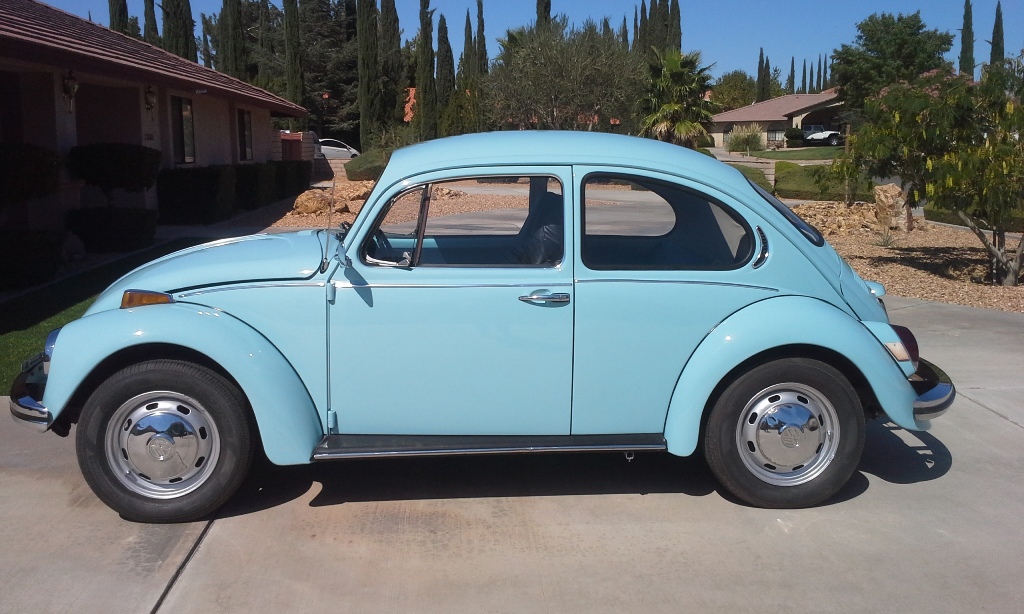
This should be a good time for me — after six months and four days of being without a car, I finally got my bug back, newly restored, and it looks wonderful. Now I’m planning a trip across the southernmost part of the country beginning in the middle of December, which will be a fabulous adventure. I even got an invitation from an old friend to spend Christmas with her.

And yet, here I sit, with tears clouding my vision.

I have no idea Broken-heartedwhat brought on this particular bout of sadness, though it might have something to do with my car.  When my Beetle was in the auto body shop, I didn’t have to worry about anything except getting the car back — it’s as if my life were on hiatus — and now unpalatable truths are descending on me once more. Without a way to get there, I didn’t have to accept that I’m not going home to Jeff, but now that my bug is back in my possession, here it is again, the awful truth of my life — that he is gone and I will never be going home to him.  It could be that after five years of living as if I were well off, another unpleasant truth is sinking in — I will have to go back to work one day. (I haven’t worked in many years. First I took care of Jeff, and then my dad.)  Since I’ve been sitting here lamenting to myself that “it’s not fair,” it’s possible the sadness has to do with being around so many women who have been married for four decades or more, which reminds me that I didn’t have that same opportunity.

More probably, it’s simply time. I go for longer and longer periods without thinking about Jeff, go for several weeks without any sort of grief flashback, but I can never fill the emptiness inside where half my life was amputated. And sometimes the pressure of his goneness builds, pushing sorrow to the surface of consciousness.

I do well on my own. After all, I managed to clear out our home and get here to this town 1000 miles from where he and I lived. I took care of my father, and cleared out his house in preparation for sale. I arranged to get my car restored, took trips even though I didn’t have personal transportation, and . . . well, you know all I’ve done. I’ve certainly made no secret of it.

But still, I have times where I yearn to see Jeff one more time. Yearn to talk with him. Yearn for his smile. (I find myself being greedy for compliments or thoughtfulness from acquaintances, and it’s not hard to figure out what that’s about. I can’t get a single word or smile of approbation from the one person from whom I would like a nod of approval, so I try to fill that lack however I can.)

I’m debating whether to keep this post to myself. It sounds too whiny and ungrateful, but it is also my truth — no matter how long he’s been gone, no matter how well I do on my own, I still miss him, and for as long as I am on this earth, I always will.

***

(Pat Bertram is the author of the suspense novels Light Bringer, More Deaths Than One, A Spark of Heavenly Fire, and Daughter Am I. Bertram is also the author of Grief: The Great Yearning, “an exquisite book, wrenching to read, and at the same time full of profound truths.”)

When a Rhinestone Becomes a Diamond

Let’s say you owned a faded rhinestone necklace, a piece of junk jewelry that you wore everywhere, to get groceries, do other errands, even clean the house or garden. Sometimes you left it out in the sun or rain, and it didn’t matter, because after all, it was just a cheap necklace. Then one day you took it to be cleaned, and when you got it back, it had miraculously become a diamond necklace. What would you do? How would you feel? Would you still wear it everywhere, even to go grocery shopping? Would you still feel comfortable leaving it out in the sun or rain? Would you feel differently about the jewelry? Would you feel differently about yourself?

This is what I am dealing with now that my car has been restored. I really just wanted a cheap paint job, but no one would paint it with the rust. And as it happened, the guy I took it to was a perfectionist, and so now my faded rhinestone car has turned into a diamond, and I don’t know how to react.

I never was one of those folks who loved her car. Never talked to it or gave it human characteristics. Never called it he or she. It was a tool. A sometimes frustrating tool, and sometimes a pleasing tool, but basically, just a thing. And now that thing has become something else.

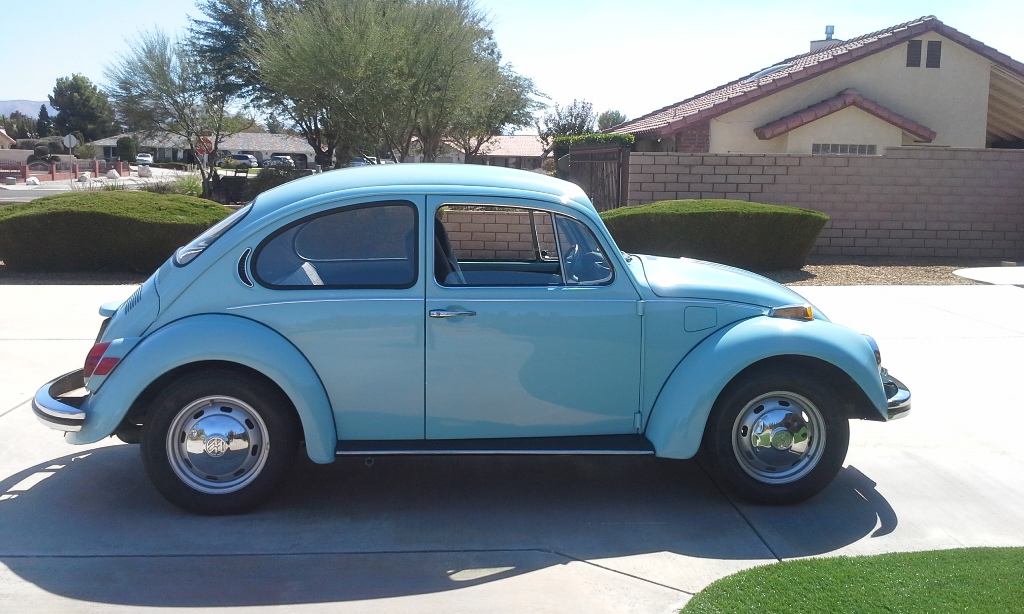
I was awed when I saw the finished car, and am awed again every time I see it. It truly is a work of art, looking as if it just crept out of a time machine from the 1970s, but it doesn’t seem to have anything to do with me. More like an icon that I have been given permission to drive. But I don’t. Drive it, I mean. At least not yet. It’s sitting in the garage of the house where I am presently residing. I open the garage door periodically and look at it. Fiddle with a few things. (The guy who did the upholstery was not a perfectionist, and the seatbelt is all twisted. To untwist it, the window has to be taken out, which is not easy because the new stripping is so tight, the seller had to go to the auto body shop and install it. Then the new headliner has to be rolled back to get to the bolts. So I’m dealing with the twisted seatbelt as best as I can.)

After I look at the car, I shut the door, leaving the bug to its own devices, and I go walking. I don’t know what to think of the vehicle. Don’t know what to think of me. How will it change me? Will it change me? I don’t know.

I like how the vehicle gleams, and I know the first time I drive it in the fierce desert winds, leave it out in the intense sun, or let it get rained on, that gleam will dull a bit. (The paint isn’t baked like a car fresh from the factory, and though it should hold up for many years, it will lose its diamond-like luster, especially if it’s sandblasted by the winds or water-stained from the rain.) Also, as people keep telling me, it’s at risk for theft or being keyed by someone who is jealous of the perfection. The only way to keep that from happening is to keep it in the garage, and the use of the garage is only temporary. When my friends get back, I’ll move on, and the poor car, like me, will be at the mercy of whatever comes its way.

I’m planning on driving today, even leaving the bug in a parking lot for a couple of hours while I go to dance class, but I am keeping an eye on the increasing clouds. If it looks like rain (and rain is forecast) I might change my mind about driving.

Still, no matter how the bug gleams, it is just a car, a tool.

But somehow, I no longer believe that.

***

(Pat Bertram is the author of the suspense novels Light Bringer, More Deaths Than One, A Spark of Heavenly Fire, and Daughter Am I. Bertram is also the author of Grief: The Great Yearning, “an exquisite book, wrenching to read, and at the same time full of profound truths.”)

The Great Reveal!!

I had nightmares last night. In my dreams, I drove helplessly around, got lost, couldn’t see where I was going, which makes sense since my six month hiatus from driving was about to end.

Yep. The VW restoration is complete!

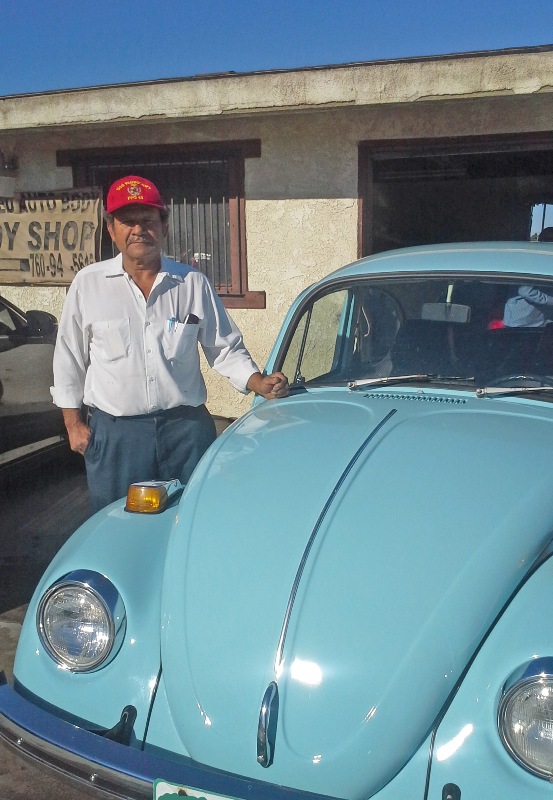
Oddly, I didn’t think I’d feel anything for the finished car — I mean, it is just a car — but when I went to pick it up today, I felt awed and overwhelmed at my first glimpse of the restored bug sitting in front of the auto body shop. I knew Pedro did good work, but it’s one thing seeing other old cars looking new, and something else seeing your own. He truly went over and above what he said he would, partly because he is an artist, and partly he felt bad about how long it took.

The artist who restored my Volkswagen

The artist who restored my Volkswagen

The thing shines! He polished the windows, headlights, hubcaps. Replaced all rubber parts and weatherstipping. This in addition to hundreds of hours of bodywork. No bondo for him! Sheet metal and welds all the way. And he did all the things he said he would such as replace the brake and fuel lines that I’d paid someone else to fix. (He tells me God loves me because I could have been killed in that car. Not only did the cheat not replace the brake lines he was supposed to replace, he cut the rear brake line and plugged the hole for the rear brakes on the brake cylinder. Eek.)

And his upholstery guy did a good job on the interior — new padding and slipcovers on the seats, new headliner, new carpeting throughout.

It’s still an old car, of course, with old car crotchets, but not as many as you would think. The last time I drove the car, it was a rattletrap, a junker. It didn’t really matter what happened to it since it seemed to be on its last legs . . . er, wheels. And now, it’s a near classic, a vintage car of some value. That will take getting used to!

I was worried the car wouldn’t start after not being driven for so long, but it started right up. I was worried about forgetting how to drive, but that wasn’t a problem, either. I drove for a couple of hours today to work out any kinks, but the mechanic who did the repair work seven months ago did a wonderful job. There were no mechanical problems, and the car sounds like new. (Like a new old-style-beetle, that is. Not like a new modern day vehicle.)

I’ve often wondered at my folly for going along with such a protracted and rather costly restoration. (I didn’t envision a restoration — I just wanted to get rid of enough rust so it could be painted.) After all, as people keep reminding me, it’s still an old car, and as such doesn’t have the safety features of the new cars. On the other hand, it also doesn’t have a gazillion electronic parts except for the electronic ignition I had put in. It’s mechanical all the way.

Now I’m glad I went ahead with the restoration. It’s past time for a bit of folly, and besides, it’s nice seeing the old bug looking so good.

Restored 72 VW

***

(Pat Bertram is the author of the suspense novels Light Bringer, More Deaths Than One, A Spark of Heavenly Fire, and Daughter Am I. Bertram is also the author of Grief: The Great Yearning, “an exquisite book, wrenching to read, and at the same time full of profound truths.”)

Keep On Trekking On

I’ve been following a few women’s hiking groups on Facebook, one each for the Appalachian Trail, the Pacific Crest Trail, and the John Muir Trail. I joined these groups when I thought there was a chance I would be thru-hiking one of the trails, but I really don’t think I have the strength, stamina, or will to attempt such a massive project. (The food planning alone is staggering, considering that you have to plan for six months, and in some cases, have to send the food on ahead and hope you get to it before desperation sets in.)

WANDERLUSTThough I’ve set my sights on a smorgasbord of shorter trails, working up to multi-day backpacking trips, I’ve kept up with the groups, because you never know where life might take you. (At least I don’t where life is taking me. You might have a better concept of your path than I do of mine.)

I’ve paid particular attention to discussions about gear. The trouble is, the advice is so conflicting, it’s almost impossible to sort out what would be best for me as opposed to what is suitable for younger, fitter, thinner women. Most of the gear I have purchased I found on my own, though I still don’t know if it will work for me. The tent I got is a backpacker’s dream, lightweight and easy to set up, but a bit claustrophobic for general use, so now I’m looking for something a bit larger for car camping, where perhaps I would have room for some sort of folding lounge chair. Conversely, since the sleeping pad I got is a bit heavy for backpacking, (though that’s what it was intended for), I’m looking for a lighter pad. And a warmer sleep system.

Recently I’ve been researching trekking poles since I need new ones. (I only have one that’s about worn out, and my hikes in the Redwood Forest proved the necessity for two). I’d just about decided to get a couple of the one I am now using when I noticed a brief mention of Pacerpoles in one of the groups. I immediately went to the Pacerpole site, watched the videos, read the theory, and was sold. Oh, my. These poles are completely different from regular hiking poles — they work to keep you upright, better balanced, and better posture, as well as allowing for a normal arm swing. Although the poles are not ultralight, apparently, the way they work, they don’t demand extra strength or energy. But they are only available from Britain.

No problem. They ship anywhere, and shipping costs are included in the price. And PayPal so kindly sent the euros to the Pacerpole folk so I didn’t have to worry about currency exchange. A few minutes ago, the Pacerpole folk emailed me. The poles are coming via Royal Mail. How cool! My first international mail! Well, my first overseas mail — I have had Christmas cards from a friend in Canada.

What cracked me up is the Pacerpole people sent me homework to do while I’m waiting. Videos to watch, information to read, proper body form to practice. Now I just have to wait a couple of weeks until they get here.

Meantime, I’m preparing for my road trip across the southernmost part of the country. I’d hoped to be more spontaneous, just stopping upon whim, but I know me — if I didn’t make plans to stop, I’d get into the car and drive until the car needed to be filled with fuel and my bladder needed to be unfilled. And then I’d just keep driving to the next pitstop. Since that is not what I want on this trip, I am researching various National Parks and Monuments with campgrounds and hiking trails along the way. I might not visit any of those places, but at least I’d have shorter driving goals, with a hike to look forward to if whim doesn’t stop me anywhere else along the way. (For those of you who like to plan, you’d be so proud of me — I have a notebook with maps, camping information, hiking trails, and any other information that would be helpful, such as food storage tips to keep from attracting mountain lions. Eek.)

I’m hoping by the end of the trip, I’ll be a seasoned camper, maybe even backpacker, and then . . . who knows. Probably back to dance class for a while to unkink and restore myself, while I replenish my supplies and get my car tuned up for whatever comes next.

***

(Pat Bertram is the author of the suspense novels Light Bringer, More Deaths Than One, A Spark of Heavenly Fire, and Daughter Am I. Bertram is also the author of Grief: The Great Yearning, “an exquisite book, wrenching to read, and at the same time full of profound truths.”)
A Venue of Vultures

I had the special privilege of seeing one wave of the turkey vulture migration yesterday. The birds kept coming out of a small corner of the northern desert sky, and they continued on toward the south along the Mojave River corridor. Venues (as flocks of turkey vultures are called) gathered overhead, spiraling upward to catch the thermal drafts or perhaps waiting for stragglers to catch up, then that “kettle” would disappear into the glare of the sun. (Apparently these uprising groups are called kettles because they agitate like a boiling kettle.) Then another batch of birds would glide into place, wait for others to show up before they to headed south to catch up to their brethren on their way to San Diego or Mexico or Arizona to spend the winter.

In flight, the buzzards looked lovTurkey vulture migrationely, soaring and gliding like hawks, riding the air currents, then speeding along with just a few slow brushes of their wings (a six-foot span). Since they are also non-aggressive, unable to kill prey, the Hitchcock-like scene was completely misleading. (I never did understand why carrion birds are considered lesser birds, as if their inability to kill makes them evil.)


A flock of smaller birds scurried out of their path (perhaps scurry is not a word that can be applied to birds, but in this case their rapid movements and darting flight made it seem as if they were scurrying).

I must have seen hundreds, maybe even thousands of birds within thirty minutes, but I was so enthralled, I only remembered to takes photos when most of the birds had passed directly over my head, so these photos are pretty lame, though you get an idea of their numbers and the path of their flight.

I smiled all day yesterday. It was nice to be taken out of myself, to replace my funk with something so regal and awe-inspiring as the vulture migration.

Turkey vulture migration

***

(Pat Bertram is the author of the suspense novels Light Bringer, More Deaths Than One, A Spark of Heavenly Fire, and Daughter Am I. Bertram is also the author of Grief: The Great Yearning, “an exquisite book, wrenching to read, and at the same time full of profound truths.”)

Blog Stagnation

I seem to have fallen into a period of blog stagnation. Nothing to say, no noteworthy thoughts, no insights, no adventures. Every day I come here meaning to write something, and every day I end up doing other things. Playing solitaire, researching camping equipment, helping a friend set up the social networking sites for his business, sometimes even typing a bit of the book I started writing. (Just typing, you understand. Not writing anything new.)

I don’t seem to find myself smiling very often, either, and yet just a few weeks ago, I could feel the smile on my face whenever I set out into the woods. There was something so basic about walking among the trees that it felt mystical. Now? Not much of anything going on. It’s too hot to do much walking around here, and anyway, there’s no place interesting within walking distance. (It was less than a mile to the desert from my father’s house, which is why I became so familiar with the desert. If I had to drive, I’d never have bothered. And even if I wanted to drive somewhere interesting, I am still minus a car.) Even dance classes don’t fill me the way they used to, maybe because when the rest of my life was a mess, they provided an escape, and now that I don’t need that escape, well, let’s just say the not-always-pleasant interactions with others are harder to deal with.

(Yep, just got tired of sitting here trying to think of something to say, so I opened a spider solitaire game. I’m hopeless.)

I have a hunch malaise has settled on me because my whole life right now feels as if it’s at the mercy of other people. I can’t just work on those business sites and get the job done, I have to wait for him and the others involved to respond to my requests for the information I need. I can’t just drive to the store to get what I need because my car is still not finished. I could walk, of course, but there is the matter of heat.

Enough whining. I’ll get back to you when I have something more interesting to say.

***

(Pat Bertram is the author of the suspense novels Light Bringer, More Deaths Than One, A Spark of Heavenly Fire, and Daughter Am I. Bertram is also the author of Grief: The Great Yearning, “an exquisite book, wrenching to read, and at the same time full of profound truths.”)