Is It True that Grief Has Limits Whereas Apprehension Has None?

“Grief has limits, where as apprehension has none. For we grieve only for what we know has happened, but we fear all that possibly may happen.” — Pliny the Younger, Roman judge and man of letters 61-113 A.D.

A friend left the above quote on my Facebook profile, and it has made me wonder if Pliny the Younger is right. (Also made me wonder if there is a Pliny the Elder, so I looked it up. Yes, there is, and he is Younger’s uncle. Both men were witnesses to the eruption to Vesuvius, though Elder did not survive the eruption. I knew that. Just forgot it.)

roadI wonder how much Younger grieved his uncle, or anyone, because grief doesn’t seem to have limits. It is true that even profound grief wanes, but the nature of such grief is that when something brings the deceased love one to mind years afterward, reminding us of our loss, our grief can be as raw as it was at the beginning.

Fear, on the other hand, does have limits. As Teach, one of the characters in Daughter Am I, says:

“Mob bosses ran their businesses like fiefdoms—they demanded total loyalty, but felt no need to treat their underlings fairly. They thought they could rule by fear, but when fear is around every corner, people lose their fear of the fear. They sometimes even lose their fear of the ones administering the fear.

“All the bodyguards and all those layers of insulation the bosses surrounded themselves with weren’t just to protect themselves from the law and from their rivals, but also from their own disgruntled employees.”

People have criticized my novel A Spark of Heavenly Fire for my having the characters let go of their fear of both the red death and the quarantine, but the truth is, fear — and apprehension — get so exhausting, it loses its tension like overstretched elastic, and it just lets go of us. We human creatures also have a prodigious capacity to adjust to most circumstances, even fearful ones. Besides, there’s not much of a story if the characters simply hide from their fate. Some have to go meet their fear head on.

I haven’t had to deal with anything truly fearsome in my life, like an epidemic or torture or having hot lava rain down on me, but I am apprehensive at times when I think about having to leave my present situation taking care of my aged father. I don’t know where I am going to go, how I will live, or even where I will live. Still, whatever scenarios my apprehensive mind conjures, none of them can compare in any way to the pain of losing my life mate soul mate.

I am currently grieving the loss of a long time friend, a loss that has come not through death but misunderstanding and heartbreak, and that grief too is worse than any apprehension I might have, especially since I haven’t been able to sort through all that happened in order to make sense of the loss.

It’s possible I simply don’t have a strong enough imagination for apprehension to be greater than grief. Or maybe it’s that I’m learning to take life as it comes. Or perhaps it’s the knowledge that no matter what fearsome circumstances I will face, there I will be. A survivor.

***

Until November 23, 2014, A Spark of Heavenly Fire will be available at 50% off from Smashwords, where you can download the novel in the ebook format of your choice. To get your discount, go here: A Spark of Heavenly Fire and use coupon code ST33W when purchasing the book. (After you read the book, posting a review on Smashwords would be nice, but not obligatory.)

***

Pat Bertram is the author of the suspense novels Light Bringer, More Deaths Than One, A Spark of Heavenly Fire, and Daughter Am I. Bertram is also the author of Grief: The Great Yearning, “an exquisite book, wrenching to read, and at the same time full of profound truths.” Connect with Pat on Google+. Like Pat on Facebook.

Art Imitating Life Imitating Art

ASHFborderI got a call last night from a woman who had recently read my novel A Spark of Heavenly Fire. She didn’t know whether to be excited or appalled at how closely some of the news commentaries about Ebola resemble my story. (Excited because it seemed as if the book had come to life. Appalled because it seemed as if the horrifying events in the novel were coming to pass.)

Quarantines. Possibilities of artificially enhanced viruses. Troops sent to fight the virus and/or troops sent to contain the infected areas. So much drama and controversy! Not only are these the subjects of today’s headlines, they all form the story of A Spark of Heavenly Fire.

Viruses created — or enhanced — in laboratories are nothing new. Well, let’s say the theory of such atrocious diseases are nothing new. I couldn’t swear to the truth of it, and quite frankly, I don’t want to know. Sill, some people believe the 1914 flu originated with biological warfare experimentation gone out of control. Aids has always been accompanied by theories of bioengineering.

In fact, noting that outbreaks of the plague during the Middle Ages were accompanied by strange phenomena such as torpedo-shaped craft emitting noxious mists and men dressed all in black walking through the streets with long instruments that made a swishing sound like a scythe, some researchers have concluded that the Black Death was a purposely created disease. Supposedly, the power elite wanted to cut back the rapidly increasing population and dumb down the human race, or at least stop the furious pace of technology. The alchemists, a greater percentage of the population than anyone imagined, were learning about nuclear fusion and fission. The Arabs were learning about rocketry and jet propulsion. Architecture, as manifested in European cathedrals, was unsurpassed. Along with many other technological inventions, a simple binary machine—a computer—had been created. What would the world have been like without the Black Death?

Forget the Black Death. What would the world be like today without Ebola?

Even worse, what will it be like with it?

If you’re interested in my depiction of a world struggling to deal with a pandemic, I hope you will check out A Spark of Heavenly Fire. The seemingly inhuman measures that take place in the story to keep the non-sick under control are all probable since I based them on executive orders Clinton signed into law.

Art imitating life imitating art.

***

Until November 23, 2014, A Spark of Heavenly Fire will be available at 50% off from Smashwords, where you can download the novel in the ebook format of your choice. To get your discount, go here: A Spark of Heavenly Fire and use coupon code ST33W when purchasing the book. (After you read the book, posting a review on Smashwords would be nice, but not obligatory.)

***

Pat Bertram is the author of the suspense novels Light Bringer, More Deaths Than One, A Spark of Heavenly Fire, and Daughter Am I. Bertram is also the author of Grief: The Great Yearning, “an exquisite book, wrenching to read, and at the same time full of profound truths.” Connect with Pat on Google+. Like Pat on Facebook.
A Wildness of the Heart

We are hungry for new stories that can offer us a way to live more fully in place like a tight, strong rope that will hold our weight while we figure out our next move. We are searching for new terrain… within our own souls that will allow us to find a generosity of spirit, a wildness of the heart that is brave and bold. —Terry Tempest Williams

Not only is the quote a good description of what I am looking for in myself — generosity of spirit and a wildness of the heart that is brave and bold — it is a lovely description of why we love/need stories. Or at least it should be. I do not fully trust authors who say they write only to entertain. There needs to be something else in a story besides merely entertainment or a way of passing the time, something that feeds the soul, something that helps us find the wildness of our hearts. We live in a civilized world, leading civilized lives,  eating civilized foods, and all that civilized-ness starves us. We need lives, food,  places that nourish us. We need stories that feed our wildness and offer hope of something more.

Maybe someday I will be able to write such a story. It’s certainly a goal worth striving for.

book

***

Pat Bertram is the author of the suspense novels Light Bringer, More Deaths Than One, A Spark of Heavenly Fire, and Daughter Am I. Bertram is also the author of Grief: The Great Yearning, “an exquisite book, wrenching to read, and at the same time full of profound truths.” Connect with Pat on Google+. Like Pat on Facebook.

Wonderful Outlook or Being Negative?

It’s a special thing to have written a book that touches people’s lives. When a friend wanted to read Grief: The Great Yearning, I thought it would be uncomfortable for both of us afterward — it is such a personal book, where I turn myself inside out to show the truth of me and my grief, that I wasn’t sure a fledgling friendship could hold up under those powerful revelations, but my fears were unwarranted. She was able to see herself in many of the situations, and was able to understand some of what she has been feeling but was never able to put into words. And she thinks I’m not only a wonderful writer but an incredible person.

Oddly, as much as I appreciate her esteem, (and as much as I wanted to say eagerly, “tell me more!”) I don’t feel as if her opinion of me has anything to do with me.

SayingOnce a long time ago, I saw a plaque, “What others think of you is none of your business.” I thought it a silly saying because of course, what others think of you is your business. What a child thinks of his parents is often a key to his emotional health, so what the child thinks of his parents is definitely the parents’ business. If you are in a romantic relationship, a marriage, or some other long-term coupling, what your loved one thinks of you is your business. If you think yours is a love match and the other only lusts after you or your money, you need to know that so you can make informed decisions about your future. If someone hates you enough to want to harm you, then definitely that is your business.

I often think of that saying now when I get a compliment or a rare insult. If one person thinks I have a wonderful outlook on life and another thinks I am being negative . . . well, the truth probably lies somewhere in between. So neither opinion is truly my business. It is their business what they think of me, just as it is my business what I think of them. It’s not that I think hurtful things, but so often, the things I like or enjoy about someone are the very things they hate about themselves and they would be appalled I noticed their charming (and not so charming) peccadilloes.

We can’t live our lives trying to figure out what others think of us and then work our life around their opinions. We have to consider what we think of us and live life accordingly. Conversely, we often feel the need to tell others what we think of them — simply to help them, of course — but if what we think of them is none of their business, we might as well keep our opinions to ourselves. (And perhaps save a friendship in the process.)

Still, it is nice to get a compliment, and it is especially nice when the compliment concerns such a special book as Grief: The Great Yearning.

***

Pat Bertram is the author of the suspense novels Light Bringer, More Deaths Than One, A Spark of Heavenly Fire, and Daughter Am I. Bertram is also the author of Grief: The Great Yearning, “an exquisite book, wrenching to read, and at the same time full of profound truths.” Connect with Pat on Google+. Like Pat on Facebook.

Excerpt From “Grief: The Great Yearning”

GTGYwpDuring the first horrendous months after the death of my life mate/soul mate/best friend, I was so incredibly lost that sometimes the only way I could deal with my confusion was to write a letter to him in an effort to feel connected. I’ve come a long way in the four years since I wrote the following letter. I still don’t understand the nature of life or death. Still don’t understand the point of it all, but I am embracing life, trying to create my own meaning out of small occurrences. I’ve learned to live without him, but I still miss him, and sometimes I still wish I were going home to him when my current responsibilities end.

 I’m grateful we met and had so many years together. Grateful I once had someone to love. Grateful that when my time comes to die, he won’t be here to see me suffer. Grateful he won’t have to grieve for me.

Excerpt from Grief: The Great Yearning:

Day 197, Dear Jeff,

It’s been a while since I’ve written, but I’ve been thinking about you. Are you glad you’re dead? You said you were ready to die, to be done with your suffering, yet at the very end you seemed reluctant to go.

Despite all the problems with your restlessness and the disorientation from the drugs, I wasn’t ready for you to leave me. I still am not. Nor do I want to go back to where we were that last year, waiting for you to die. We were both so miserable, but honestly, this is even worse. I can live without you. The problem is, I don’t want to, and I don’t see why I have to.

I want to come home. Please, can I come home? I have a good place to stay, but without you, I feel homeless. Sometimes I watch movies from your collection and imagine you’re watching with me, but that makes me cry because I know you’re not here. Your ashes are, but you’re not.

I broke a cup today, one more thing gone out of the life we shared. Our stuff is going to break, wear out, get used up. I’ll replace some of it, add new things, write new books, and it will dilute what we shared. Is there going to be anything left of “us”? I feel uncomfortable in this new skin, this new life, as if it’s not mine. As if I’m wearing clothes too big and too small all at the same time.

There’s so much I hate about your being gone — hate it for me and hate it for you. It might be easier if I knew you were glad to be dead, but so far you’ve been mum about your situation. Just one more thing to hate — the silence of the grave. (Well, the silence of the funerary urn.)

Adios, compadre. If you get a chance, let me know you’re okay.

***

Click here to download 20% free at Smashwords or to buy any ebook format, including Kindle.
Click here to find Grief: The Great Yearning in print or on Kindle from Amazon.
Click here to find Grief: The Great Yearning for the Nook

***

Pat Bertram is the author of the suspense novels Light Bringer, More Deaths Than One, A Spark of Heavenly Fire, and Daughter Am I. Bertram is also the author of Grief: The Great Yearning, “an exquisite book, wrenching to read, and at the same time full of profound truths.” Connect with Pat on Google+. Like Pat on Facebook.

What Is Your Subconscious Obsessed With?

So often when I am at a loss for a blog topic, Facebook comes to the rescue. Today, was such a day. A friend posted a link to a quiz, “What is your subconscious mind obsessed with?”, and I was bored enough to play along.

Like all such quizzes, there were several questions I found impossible to answer, such as what is my favorite cartoon. Considering I don’t ever watch cartoons and have no idea what any of the cartoons were, I just randomly picked one. Another question was food. I have no preference, really, so I again, I just randomly chose. Same with my favorite day of the week. Who has a favorite day of the week? I never even considered such a thing, so I chose Wednesday because today is Wednesday and I had dance classes. Some of the other questions offered options such as “other,” which made it easy not to choose any of the silly options. I did have a hard time with one question — choosing a quality — because I admire most of the qualities, but I chose loyalty as the best of the lot.

My results weren’t at all what I expected. Apparently, my subconscious is obsessed with the need to be loved. They results said, “You need to feel the warmth and appreciation from the people around you. Without a friendly reminder of how much you are loved or appreciated you start to feel as though things have gone awry with the people around you. There’s nothing wrong with this immense need for love. Be proud that you are so compassionate and caring that you respect and welcome these emotions. Not only do you need to be loved, but you enjoy the act of loving as well. You are kind and compassionate. Even simple interactions reveal your tender heart. We’re all humans and need to be loved; you however, have an extra special sense of gratitude when it comes to being loved.”

Seems sort of pathetic, really, being obsessed with the need to be loved, so I redid the quiz. Chose a different cartoon at random. Chose a different food. Chose Tuesday as my favorite day of the week, and perhaps it is my favorite day — that is when my week truly begins because Tuesday is when my dance classes begin for the week. I even chose a different quality — intelligence this time.

I waited eagerly for the results, hoping for something less pathetic than an obsession with needing to be loved. Happiness, maybe. (Most people seemed to get happiness.) Or knowledge. I’ve always been on a quest for the truth. Some people got sadness, which I wouldn’t have been surprised to get. Some got sex or food or responsibility. (Responsibility would also have been a good fit since I am responsible for my 97-year-old father and his house.

So what did I get after all the changed answers?

The same thing: the need to be loved. Sheesh.

***

Pat Bertram is the author of the suspense novels Light Bringer, More Deaths Than One, A Spark of Heavenly Fire, and Daughter Am I. Bertram is also the author of Grief: The Great Yearning, “an exquisite book, wrenching to read, and at the same time full of profound truths.” Connect with Pat on Google+. Like Pat on Facebook.

The Yin-Yang of Friendship

I feel sad today, though I shouldn’t. The weather is lovely — cool with wonderfully clear azure skies. I had a delicious lunch with a friend and afterward we sat beneath a tree by the shores of a lake (human-made, but still a lake) and enjoyed a quiet interlude.

If the sadness isn’t a belated response to my four-and-a-half-year anniversary of grief, and if it isn’t simply a general malaise stemming from the change of seasons, then it could be due to an ongoing disagreement I am having with another friend. This other friend periodically accuses me of being contrary or negative when I resist being taken for granted, and I never know how to yinyanghandle the accusations, so I often make the situation worse by trying to explain my position. This time, I’m not explaining, and perhaps that’s what’s making me sad — I value my friends and I don’t like passing up an opportunity to put things right.

Last year, another friend accused me of being negative. (When most people look at me, they don’t see someone negative but a smiling woman who is doing the best she can with what life throws at her.) I told her I was sorry she felt that way, and that’s pretty much how we left it. We reconnected recently, and she apologized for her behavior, saying I wasn’t negative and she had no idea why she accused me of being so.

I don’t know why she said it, either. To be honest, I don’t know why anyone would accuse a person of being negative. I can’t think of a single instance where I accused someone of being negative, perhaps because I don’t put much faith in being positive. I’m one of those people who don’t care whether the glass is half-full or half-empty. I simply drink what’s there and refill the glass if possible, which could be why I have no idea how to deal with the infrequent person who calls me negative.

The truth is, negativity isn’t necessarily negative. Negativity is simply yin to positivity’s yang. Everything is a duality — complementary forces that interact to form a dynamic whole. Light and dark. Male and female. Hot and cold. Fire and water. Good and bad. Positive and negative. In Taoism, there is no real distinction between these forces that we in the west see as opposites. Since negativity is a matter of perception, the problem lies with the person who perceives me in such a light. And so it goes, the yin-yang of friendship.

Now if the friend had accused me of over thinking everything, I’d have to agree with that. If nothing else, this post is an exercise in over thinking. But I had fun writing this bloggerie and now don’t feel quite so sad — I even have a small smile on my face.

I hope you do too.

***

Pat Bertram is the author of the suspense novels Light Bringer, More Deaths Than One, A Spark of Heavenly Fire, and Daughter Am I. Bertram is also the author of Grief: The Great Yearning, “an exquisite book, wrenching to read, and at the same time full of profound truths.” Connect with Pat on Google+. Like Pat on Facebook.

Being in Two Places at Once

Grief:  The Great YearningThe other day, a friend came early to her dance class and sat reading Grief: The Great Yearning while I danced with my class. I thought I would feel uncomfortable seeing such a new friend read the truth of me, but that didn’t affect me, perhaps because I am used to throwing my emotions out there for anyone to catch and make of them what they wish. Still, it did feel odd, as if I were in two places at once — both in the book where I was so abandoned to grief I could only scream my pain to the wind and in the studio where I was so abandoned to dancing I could only smile.

The emotion in Grief: The Great Yearning is so raw, it is as if I myself reside between the pages of the book, and in fact, the friend also remarked on the strangeness of living my story and feeling my grief and then looking up to see me dancing.

For a long time, I thought I would always be that woman lost in grief, but grief itself changed me. From the first moment grief stole my breath from me, I knew it was important to follow where it led, that it would take me where I needed to be, that it would help me become the woman who could survive the loss of her soul mate.

And so it came to be.

Other people read of my grief now, and the description of my journey helps them to follow their own path of grief, which is one great benefit of having written so passionately about my feelings, but another great benefit is that I don’t have to waste time remembering my grief, don’t have to wallow in it. It exists outside of me now. If I ever want to relive those days, I can simply pick up the book, and there I will be.

As strange as it might seem, years from now I probably will want to read the book. I am losing the memory of him and our shared life, losing the feeling of ever having been profoundly connected to another human being, and I might need to remember that once I loved, once I was so connected to another human being that his death shattered me. Even more than that, I still have a void inside of me where he once was, and someday I might need to remember why it is there.

(PS: If you know of anyone who is experiencing profound grief, please consider gifting them with a copy of Grief: The Great Yearning. It might help them to know that others have been where they are, and survived.)

***

Pat Bertram is the author of the suspense novels Light Bringer, More Deaths Than One, A Spark of Heavenly Fire, andDaughter Am I. Bertram is also the author of Grief: The Great Yearning, “an exquisite book, wrenching to read, and at the same time full of profound truths.” Connect with Pat on Google+. Like Pat on Facebook.

Finding the Wildness

Look what the goddess does when she is sad:
she takes up a tambourine, made of taut skin
and rimmed with castanets of brass,
and she begins to dance. The sound of flutes
blares out wildly, reaching even to the depths
of the underworld, so loud, so clamorous is it.
Look what the goddess does when she is sad:
she finds the wildness in herself, and as she does
she finds that there is joy there too.
~ Greek dramatist Euripides

A reader left this lovely poem as a response to my post In the Presence of Death…, and Euripides’s words are so very apropos. Although I am far from being a goddess, I am hoping to find the wildness within. And I am dancing.

I don’t dance wildly — the classes I take are all classical dances with practiced steps and choreographed movements, but dance does speak to something wild deep inside of me. For someone who’s life has always been about words — both reading and writing — dance is a way of reaching the wordless depths, of finding the woman beneath the trappings of civilization and expectations and other people’s stories. I sense it’s also a way of awakening more of the wildness within, bringing with it the strength and courage to live fully and gracefully.

I once read an article that talked about stream-of-consciousness being the brain’s default mode. The journalist reported that in depression, the default mode network appears to be overactive, that a depressive brain shows a pattern of balky transitions from introspective thought to work that requires conscious effort, and it frequently slips into the default mode during cognitive tasks. A depressive brain also shows especially weak links between the default mode network and a region of the brain involved in motivation and reward-seeking behavior.

This could be the reason why blogging is so easy for me and writing fiction so hard. Blogging for me is stream-of-consciousness writing and brings immediate rewards, while writing fiction is more cognitive and takes more conscious effort than I am sometimes willing to spent. (A fellow writer once described writing as a mental prison, and while most authors seem to find freedom in fiction, I find it restrictive, especially since the rewards of a finished project are delayed for sometimes years.)

But dance . . . ah, that transcends both stream-of-consciousness and cognitive thinking. It’s a matter of concentration and memory, of training the body to do your will (or rather, your teacher’s will). And where there is neither stream-of-consciousness nor cognition, there is no depression, no sadness. Or so it seems.

Although I still have upsurges of sadness when I am alone, I am seldom sad in class and never depressed. I don’t always find dancing joyful. It’s often hard for me and frustrating at times when my body simply will not do what I will it to do, or when I cannot get what seems to be a simple step. But dancing is always compelling, even when it is difficult — especially when it is difficult. The discipline of stretching just a bit further or reaching a new understanding of a movement, helps dig beneath what I know of myself, helps find the wildness in me. There is joy in that, and joy is its own reward.

There is also joy, of course, in dancing in unison with other not-so-young women who are also dedicated to the art, and there is vast joy in having learned a new dance, particularly for someone such as I who never in her life conceived of such a possibility.

During class, after we warm up, before we work on the current dance, we practice the dances we already know. And each time we dance one of those numbers, there comes a point in the dance where I can feel a huge smile on my face as I realize that oh! I am dancing! And for that moment, I feel like a goddess.

***

Pat Bertram is the author of the suspense novels Light Bringer, More Deaths Than One, A Spark of Heavenly Fire, andDaughter Am I. Bertram is also the author of Grief: The Great Yearning, “an exquisite book, wrenching to read, and at the same time full of profound truths.” Connect with Pat on Google+. Like Pat on Facebook.

Is It Fun Being You?

I watched a tape of an old “Boston Legal” show the other night. Although I don’t particularly like the series — it was mostly smugly rich lawyers in a large firm behaving badly — the byplay between William Shatner (Denny Crane) and James Spader (Alan Shore) was riveting. You don’t see many instances of male friendship in movies or on TV, which is compelling enough, but the two characters often talk about matters that are beyond the general fare of television. (Not that I would know — I seldom watch television, though I have a couple of series and a couple of partial series on tape for no other reason than that I have them.)

One such conversation occurred during the show I viewed. Denny, despite his growing Alzheimer’s, had just experienced a triumph over his ilness by having a significant impact on a trial, and afterward while decompressing with Shore on the balcony of Denny’s office, Denny says, “It’s fun being me.” Then he turns to Shore and asks, “Is it fun being you?”

Such a simple question, one I had never considered. Is it fun being me? Although I can’t get the question out of my mind, I truly have no answer to it. I have fun, of course, and while fun is not my raison d’etre, perhaps it should be. Life dumps plenty of sorrow and responsibility on me — I certainly don’t need to heap more problems on myself, and besides, having fun would help balance my life.

But that was not the question. Denny did not ask, “Are you having fun?” He asked, “Is it fun being you?” — which is something completely different.

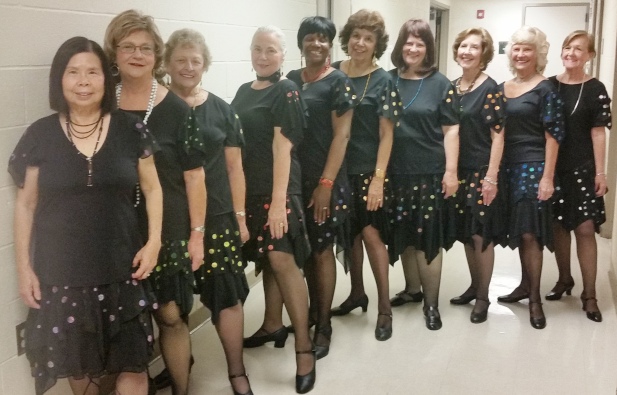
I’m the one in glasses.

I’ve always taken life and myself too seriously to have fun being me. Oddly, Alan Shore once described me when I was young without knowing he was doing so. As he says to one of his female associates, “When I look at you, I see one of those little schoolgirls, running around in her plaid skirt, always to class on time, the first to raise her hand, the neatest of . . . penmanship.” Yup. That was me.

I’m trying not to take things so seriously, though it’s hard when I seem to be always in the middle of other people’s life and death situations. Still, I need a more lighthearted approach than simply not taking life so seriously. Since I will need to find a new focus for the next twenty or thirty years (assuming I live as long as my mother did) perhaps that focus should be not just being me as I’ve been trying to do, but having fun being me.

And I’ve already taken the first step. Dance class is teaching me many things besides dancing: to be accepting of (and maybe even celebrating) imperfections in me and everyone else; to be committed to something life changing outside my normal purview; to find joy in movement, especially synced movement; to be happy in the moment; and most of all, to enjoy being someone who enjoys dancing.

***

Pat Bertram is the author of the suspense novels Light Bringer, More Deaths Than One, A Spark of Heavenly Fire, and Daughter Am I. Bertram is also the author of Grief: The Great Yearning, “an exquisite book, wrenching to read, and at the same time full of profound truths.” Connect with Pat on Google+. Like Pat on Facebook.