The Problem With Grief

The problem with grief is its immensity. If it were only a matter of being sad that the loved one is gone, as I thought grief was, it would still be hard but doable. Instead, grief affects every part of your life. It’s not just a matter of the person being dead, but also all hopes, dreams, plans, expectations that you had with him. If there was a misunderstanding of any kind, it can never be put right. If a person filled many roles in your life, as my lifemate did for me, then all those needs go unmet. And grief is not just about sorrow. It’s about anger, fear, depression, loneliness, despair, and many emotions I have not yet identified.

Grief is also physical. Losing a mate ranks at the very top of stressful situations, and that stress itself causes physiological changes. Sometimes I can barely breathe. I don’t sleep well, though that is nothing new. Food nauseates me. I have trouble concentrating, and I am always exhausted — grieving takes an unimaginable amount of energy.

Grief also affects one’s self-esteem and identity. He was my focus for so many years. Without that focus to give my life meaning who am I? How do I find meaning, or at least a reason to continue living? The irony of this particular aspect of my grief is that I never wanted to be so involved with anyone. I always thought I was independent. And perhaps I once was and will be again, but I apparently I haven’t been for many years.

Because of all these different aspects of grief, grief is ever changing, so one can never get a handle on it, at least not for a long while. And grief grows the further one gets from the loved one’s death, because you see more of the person’s life. In my case, the man he was at thirty, at thirty-five, at forty, are all gone now too. Which is another aspect of grief I had never considered: The sheer goneness of the person.

During my mate’s last years, I’d started doing things on my own, such as finding a new life and friends online, and I thought I was doing well in my aloneness. But there is a vast difference between being alone with someone and being alone with aloneness. As William Cowper said: How sweet, how passing sweet, is solitude! But grant me still a friend in my retreat, Whom I may whisper, Solitude is sweet.

That is one more thing for me to mourn — the friend in my retreat. He is gone. And solitude is no longer sweet. Do I have the courage to grow old alone? The courage to be old alone when the time comes? I don’t know.

Grief changes a person in ways I cannot yet fathom, but one’s nature does not change, and I always tended toward solitude. Perhaps someday I will welcome the solitariness, or at least come to terms with it. As Jessamyn West said, “Writing is a solitary occupation. Family, friends, and society are the natural enemies of the writer. He must be alone, uninterrupted, and slightly savage if he is to sustain and complete an undertaking.”

Until then, I will continue to find a reason to get up each day. And always, I will miss him.

Blogmania — One Day Only. Mark Your Calendar!

On April 30, 2010, I am going to participate in Blogmania, a one day massive blog giveaway.  Picture it as one of those 200 mile long garage sales that attract thousands of shopaholics because of its size. The people who go to those events love the pure adventure of seeing how many miles of garage sales they can personally cover in one or two days. On Blogmania, you don’t have to purchase anything. Nor do you have to wear out your shoes tramping from sale to sale. It’s all online. And every participating blog is giving away something special.

I will be giving away summer traveling companions. Sort of. Everyone who leaves a comment on my blog on April 30 will have a chance to win a print copy of Daughter Am I  — the story of an incredible journey — along with a Burt’s Bees Travel Shower Kit and a journal to record your adventures. Hope to see you at the end of April!

For more information: http://betweenthelinesandmore.blogspot.com/2010/04/blogmania-early-bird-check-list.html

Grief Update

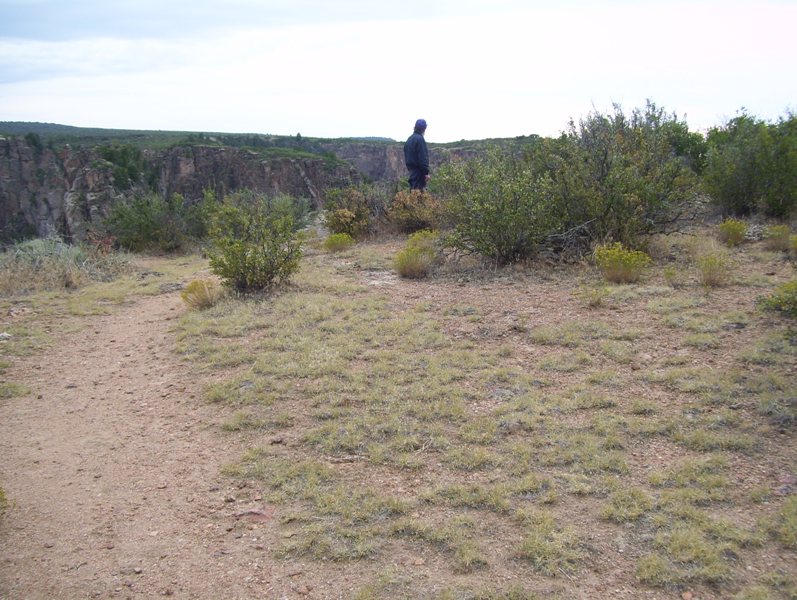
It’s been three weeks since my lifemate died. I feel as if I am in an emotional whirlpool, spinning round and round, never quite knowing where I am or where I am going. I have days of relative calm where I can be glad he is finally at peace, then something happens to remind me of  my loss, and grief pulls me under. Most recently, I was cleaning photos out of my computer when I came across an image of him I didn’t know I had. (We did not take pictures of each other, so the only other photo I have was taken 15 years ago, and it does not look like him at all.) Last August, we took a trip to the north rim of the Black Canyon. (It’s only 20 miles away, but because of the bad road, it might as well have been 200.) The photo I found is of him, alone in that desolate place, with his back to me, looking at . . . eternity, perhaps.

I never expected to grieve so much. He was sick for so long and in such pain that we didn’t have much of a life together the past year or two. I struggled to live while he was dying and thought I succeeded, but nothing prepared me for this total devastation. It turns out that all of it, the good and bad, was part of our life together. In the movie Three to Tango is a film clip of a movie I have never seen — I think it’s Of Human Bondage.  The woman in the clip asks: “Will we be happy?” He answers, “No, but does it matter?” And, for us, it didn’t matter, at least where each other was concerned. We were connected, no matter what. And now that connection is broken. And I feel that I am broken, too.

I know someday I will find my way again. I know someday I will be able to laugh, to find joy in living again. I know that someday I might even find a new love. But for now, I don’t know how to be.

Hospice hosts a grief support group, and I’m thinking of going. If he were alive, I would never consider it — we were always each other’s support group. But if he were alive, I would not be grieving.

I hesitated about posting this — I do not want people to feel I am soliciting sympathy — but this is a writer’s blog, and what is writing if not life?

A New Form of Kidnapping?

I recieved a much forwarded email entitled “A New Form of Kidnapping”. Supposedly, a woman finished shopping, went out to her car and discovered that she had a flat. She got the jack out of the trunk and began to change the flat. A nice-looking man dressed in a business suit and carrying a briefcase walked up to her and said, ‘I notice you’re changing a flat tire. Would you like me to take care of it for you?’

The woman was grateful for his offer and accepted his help. They chatted amiably while the man changed the flat, then put the flat tire and the jack in the trunk, shut it and dusted off his hands. The woman thanked him, and as she was about to get in her car, the man told her that he left his car around on the other side of the mall, and asked if she would mind giving him a lift to his car.

She was a little surprised and she asked him why his car was on other side.

He explained that he had seen an old friend in the mall that he hadn’t seen for some time and they had a bite to eat, visited for a while, and he got turned around in the mall and left through the wrong exit, and now he was running late. The woman hated to tell him ‘no’ because he had just rescued her from having to change her flat tire all by herself, but she felt uneasy.

Then she remembered seeing the man put his briefcase in her trunk before shutting it and before he asked her for a ride to his car.

She told him that she’d be happy to drive him around to his car, but she just remembered one last thing she needed to buy. She said she would only be a few minutes; he could sit down in her car and wait for her; she would be as quick as she could be. She hurried into the mall and told a security guard what had happened. The guard came out to her car with her, but the man had left. They opened the trunk, removed the locked briefcase and took it down to the police station.

The police opened it (ostensibly to look for ID so they could return it to the man). What they found was rope, duct tape, and knives. When the police checked her ‘flat’ tire, there was nothing wrong with it; the air had simply been let out.  It was obvious to them what the man’s intention was, and obvious that he had carefully thought it out in advance. 

This might be the true story it purports to be, but I doubt it. It has all the earmarks of an urban legend. Besides, whoever came up with the story was not a writer — writers cannot get away with such slipshod plotting. She remembered seeing him put a briefcase in the trunk? Why the memory of it? Was it so commonplace for strangers to put briefcases in her trunk that it never struck her as strange until later? And why did he put the briefcase in her trunk? If he was bent on kidnapping her, you’d think he’d need the knives and other paraphernalia to keep her subdued while he did whatever he was going to do to her. And how did the police check her tire? Visually? Many punctures are hidden within the tread. Besides, a perfectly good tire can go flat if a bit of stone gets between the rim and the tire — that has happened to me. And why was it obvious what the man’s plan was? I often carry a brief case full of rope, duct tape, and knives. Well, perhaps not. Still, it’s apparent that the story was not “carefully thought out in advance”. (Excuse me for being picky but isn’t “in advance” redundant?)

Baby Steps

I’ve heard that the death of a mate and the ensuing grief change a person, and perhaps this is true. If one is part of a couple, when he dies, so does the “we.” One cannot be the same after such a splitting apart. The world one lives in cannot be the same.

I feel like a toddler, taking shaky steps in this newly alien and dangerous world. I exercised this morning, took my vitamins with a protein drink, wrote a letter to my deceased mate (the only writing besides blogging I am doing at the moment), and I took a walk. I even managed to eat. The one thing I had never expected was how the thought of his being gone makes me sick to my stomach. When I do eat, I eat healthy, though. I got rid of all snacks a while back, so all that’s in the house is real food.

All these baby steps that I’m taking serve to take me further away from him, deeper into  . . . I don’t know what. I  just wish I could skip the coming months of pain and go directly to the part where I emerge strong, wise, confident, and capable of handling anything. But, ironically, those painful months will be the catalyst.

I never planned to talk about my grief. I thought I would just continue online as if nothing cataclysmic happened offline, but blogging seems to be in my blood. Once I started writing about my grief, I worried that I would become maudlin, but Donna Russell, a true friend on facebook, said:

You’re not being maudlin, Pat; you’re grieving. There is no right or wrong way to do it, no proper time period for it to last, no right or wrong way to feel. I just finished reading The Healing Art of Pet Parenthood by Nadine Rosin. In her book, Nadine makes this observation: “We are so careful in this culture to ignore death and anything associated with it as much as possible; it is so uncomfortable for us to have it in the open. Grief is such an isolating experience in and of itself, it’s a shame that our mores about it are so quick to support and intensify that isolation.” Perhaps if we were all more open and honest about it, as you are being, it wouldn’t be quite so uncomfortable.

What to Say to Someone Who is Grieving

I mentioned to a friend that, after receiving notification of my mate’s death, few people from a certain online group sent an acknowledgement, and she said perhaps it was because they did not know what to say. This is probably true. Most comments posted to me on the various threads began with: “I don’t know what to say.”  Of course, being writers, these people followed that statement with very touching responses, but I also received touching remarks from non-writers. To be honest, all responses mean a lot to me video[7]— grief is such an isolating experience, that any indication of concern helps remind me that people do care, that perhaps I’m not totally alone after all.

If you cannot think of anything eloquent to say in the face of another’s grief, say something simple. Say, “I’m sorry.” Say, “I’m thinking about you.” Say, “My heart goes out to you.” Say, “I shed tears for you.” And there is always the standard, “My thoughts and prayers are with you.”

If you knew the deceased, talk about him. The bereaved (a terrible word, so namby-pamby and doesn’t really connote how truly bereft one is  after such a loss) will find comfort in your memories. If you didn’t know him, you can talk about your own experiences with the death of a loved one, though be aware that grief piled upon grief might be a bit overwhelming for the one left behind. Despite that, the stories people share with me make me realize that though the pain seems impossible to live through, it will eventually become tolerable. At least, I hope it will.

Many people told me to “hang in there,” but although well-meaning it is not, perhaps, the best thing to say to someone who is grieving. Depression is a part of the process, and “hanging in there” makes one wonder “hanging from what? And where?” (If you are one of those who used this expression, I hope I’m not hurting your feelings. Rest assured I took your words in the spirit offered, and was pleased that you thought of me.)

If you truly cannot find words of your own, share a poem that helped you get through your grief. Although grief is such a personal experience, the emotions portrayed in poetry are universal.

If you can’t think of something to say immediately, but eventually think of the perfect thing, say it then. It is never too late. Grief lasts a very long time. As the days, weeks, months pass, others forget, but the person who is grieving doesn’t. Any indication that you are thinking of her in her sorrow is comforting.

In the end, it doesn’t really matter what you say. Extending a bit of comfort, showing that you haven’t forgotten, showing that you care — those are the important things.

***

Pat Bertram is the author of Grief: The Inside Story – A Guide to Surviving the Loss of a Loved One. “Grief: The Inside Story is perfect and that is not hyperbole! It is exactly what folk who are grieving need to read.” –Leesa Healy, RN, GDAS GDAT, Emotional/Mental Health Therapist & Educator.

Like Pat on Facebook.

The Next Big Step

Yesterday when I was out walking, I finally got a sense of where my WIP needed to go. I wasn’t thinking about the story, but apparently it was thinking about me, and after all this time, there it was, the next big step. Grief. (Wonder where that idea came from!)

I always knew my hero was grieving the loss of the civilized world and everything in it, but I was concerned with his following the stages of grief — denial, guilt, anger, bargaining, depression, acceptance. It dawned on me yesterday that he had never actually felt the sorrow and devastation that accompanies grief. So my vision was of his crying. It goes to show that I cannot write what I do not know. Even though J. had been sick for so long, and I had gone through most of the stages of grief, like my hero, I had never actually gone through the emotion of grief. Could never even have imagined the feeling of amputation that accompanies such a life-changing loss. 

I’m not sure where the discussion is in this.  Perhaps: do you have to have experienced the emotions your characters go through to find the truth of the story? Perhaps: what’s the next big step you need to take in your writing, your life? Mine is a move — perhaps temporary — but a  total upheaval. The big challenge will be to find the energy. One of the problems with grief is the accompanying lack of energy. (Which I need to remember when I write my hero’s grief.)

On a more specific topic, the main impetus for my hero leaving the safety of the compound is his participation in a birth. (This story is a reversal of the hero’s journey — in the traditional journey, the hero dies, at least symbolically, and is reborn. In my story he is reborn first, then the person he used to be dies symbolically.) A nurse, his eventual love interest, actually delivers the child, but my hero must participate in some way. What could he do that would be significant enough to be a catalyst? Keep in mind, this is a totally primitive world. Is cutting the cord (with a flint that he found and has been sharpening) enough? Could there be a problem with the birth that he helps with? He owned a pet shop in the old world, selling used pets, but he probably has been around for the birth of puppies and kittens and perhaps even livestock, so he might have some knowledge. Whatever he does, it has to precipitate his next big step.

Live Chat About Writing

I have a chat group on Gather.com that meets  on Thursday at 9:00pm ET. This week (April 8, 2010) we will be meeting here: No Whine, Just Champagne Writing Discussion #105.

I missed the discussions the past couple of weeks. I always enjoy talking about writing even if I’m not actively involved in the pursuit of words, perfect or otherwise.

So, let’s talk. If you can’t attend the live discussion, feel free to discuss your writing here. As I said, I always enjoy talking about writing.

What have you been writing recently? If you haven’t been writing, what are you planning to write? How do the traumas or dramas of life affect your writing? Do make time to write regardless of the horrors life throws at you? Do you find comfort in writing, or does your make-believe world seem trivial in the face of real life traumas? How do you motivate yourself to write in such times, or do you just  . . . not write?  

Death For Dummies

I’ve learned a lot about death recently. Well, not death exactly – only those who have died can know what death is – but I have learned way more than I want to know about the practicalities and obligations of those who are left behind. I considered writing a manual, sort of a Death for Dummies, then I realized when a person is caught in that horror, the last thing one wants to do is read a how-to-guide. Besides, one learns soon enough what needs to be done.

My life mate/soul mate of thirty-fours years died at the end of March, and in between unbelievable bouts of pain and agony, I have been dealing with the practical issues. One thing that came as a surprise to me, though it shouldn’t have, is how heavy a person’s ashes are. They are not ashes, actually, which I already knew. (And so would you if you had read Daughter Am I.) What remains are the inorganic compounds – the minerals, the part that was never alive in the first place – and most minerals are heavy. Those in the funeral business don’t call them ashes. They call them cremains. Sheesh. I could do without the cute name. “Ashes,” at least, connote an offering, or perhaps a resurrection of sorts.

A friend – a minister who has had extensive experience with the dying and the bereaved – suggested I keep the ashes, or some of them, anyway. I had never considered it, but since I couldn’t figure out where to scatter them, and didn’t want to go through the trouble of finding out the local laws on the matter, I followed the minister’s advice. And having the urn with me brings a bit of comfort. (Urn is a misnomer, as is so much in the funeral business. The urn is simply a sealed plastic or brass box.)

Another friend sent me this poem:

Support From Others
Author Unknown

Don’t tell me that you understand.
Don’t tell me that you know.
Don’t tell me that I will survive,
How I will surely grow.
Don’t come at me with answers
That can only come from me.
Don’t tell me how my grief will pass,
That I will soon be free.
Accept me in my ups and downs.
I need someone to share.
Just hold my hand and let me cry
And say, “My friend, I care.”

I’d like to make an addition to the poem:

Don’t tell me to “hang in there.”
Makes me wonder: Hang from what? And where?

What meant the most were those who cried with me. Not enough tears had been shed for him – no amount of tears will ever be enough – so those tears gave me comfort. I don’t mean to be maudlin, but this is a trauma – an amputation of sorts – and it shouldn’t pass lightly.

***

Pat Bertram is the author of the suspense novels UnfinishedMadame ZeeZee’s Nightmare, Light BringerMore Deaths Than OneA Spark of Heavenly Fireand Daughter Am IBertram is also the author of Grief: The Great Yearning, “an exquisite book, wrenching to read, and at the same time full of profound truths.” Connect with Pat on Google+. Like Pat on Facebook.

Searching For Happy Memories

I’ve been searching for happy memories to take the edge off the memory of watching my lifemate die so painfully, and one I’ve been thinking about a lot lately is a day I visited him at the store he owned. We spent hours talking — about life, books, history,  moving from one topic to another as easily as if we’d known each other a lifetime instead of just a few months — and then he walked me outside. This is the poem I wrote when I got home that night:

you turned around
and waved to me
after we said good-bye
a small gesture
that told me more
than all the words
we had spoken

I wish I could have just one more word, one more wave from him.