A Tale of Two Authors

The Fool, one of the major arcana cards in the tarot, symbolizes wanderings, unawareness, naivete, spontaneity, transition, vitality, the beginning of an adventure, the ability to embrace new opportunities. At times, it can also mean recklessness in the face of danger.

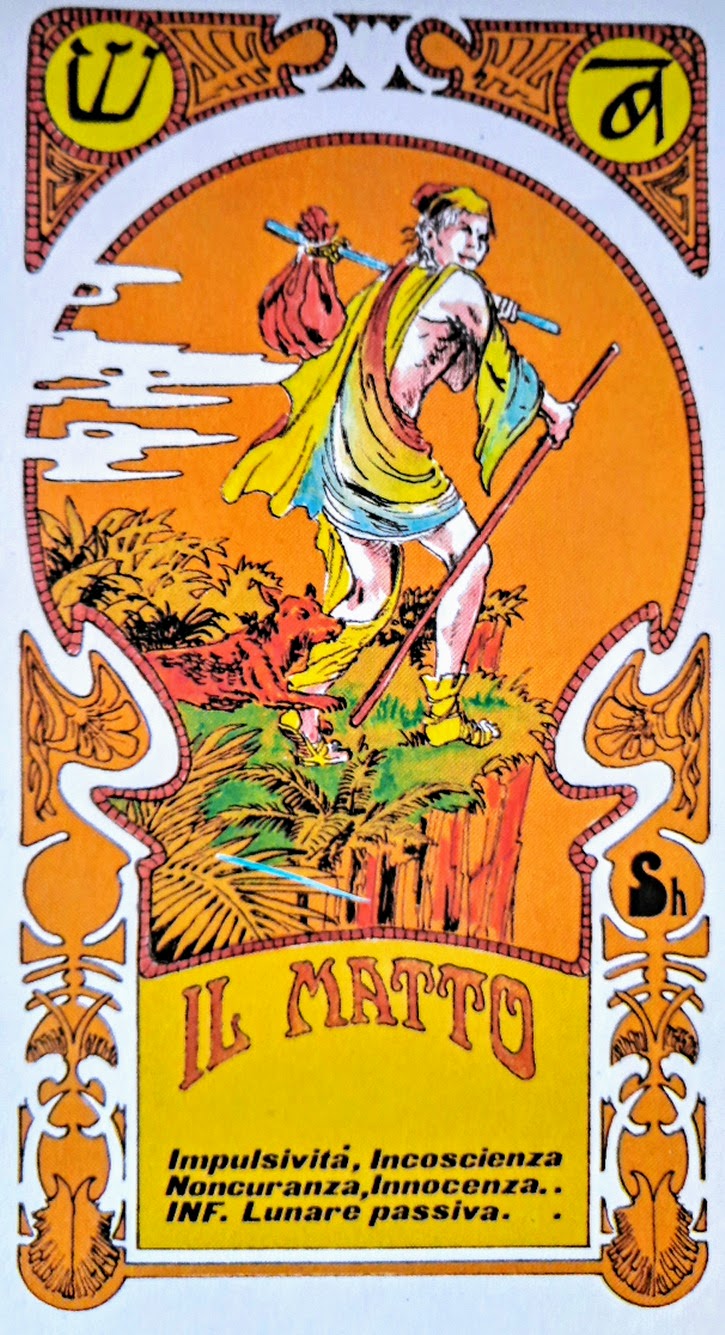
The Fool is often depicted as a young man with a stick, a dog at his heels. (In some tarots, this dog is replaced by a fox, which fits because the fool is often “crazy like a fox.”) He is walking blithely toward a precipice, apparently caring nothing for the possible dangers that lie in his path. He’s almost childish in his approach, believing that there are many opportunities in the world just waiting for him to explore and develop.

In Italian versions of the tarot, the fool card goes by “Il Matto.” In French versions, the card goes by the name of “Le Mat” or simply “Mat.” These versions give the name the connotation of “madman,” though in Arabic it means “a dead person.”

In The Wheel of Time, one of the major characters is named “Mat.” Everyone who meets him thinks he is a fool, and in fact, all through the books, that is the word most used to describe him. I thought he was simply an archetype, but when I studied the tarot, I realized he is definitely based on the Fool card. (And if not, it’s too much of a coincidence to ignore. Since the major characters in The Wheel of Time have tarot equivalents, either Jordan succeeded in writing the “all stories” epic he intended — a reimagining all our myths, legends, cultures — or the tarot itself is representative of “all stories.”) Not only is his name “Mat,” not only is his character based on all that the card symbolizes, not only does his character arc follow that which is outlined above, but he represents the Arabic definition of his name. As he once said, “I’m usually pretty good at staying alive. I only failed one time that I remember.”

The Fool supposedly goes in stages from a naïve country boy to a mentally ill outcast (and because of a cursed dagger, Mat truly did become insane for a while), to becoming one who has greatness riding on his shoulder, which Mat does. And through it all, even while Mat is helping save existence from evil cosmic forces, the other characters continue to see him as a fool.

And perhaps he is a fool. He’s the sort of person who will rush into a burning building to save people, cursing himself the whole time, while others just stand and watch. Most often, he rescues women, but as he has come to learn, “even if a woman needed help, if she did not want it, she made you pay for giving it.”

He’s also a character who has no sense of what he really is. Even as he’s breaking into a dungeon to rescue women who can’t rescue themselves, he insists he’s no kind of hero. He thinks he is selfish, though he is not. He’s a bit of a womanizer, but he only goes after women who want him. Though many women are charmed by him, he sometimes overestimates his charm. In one case, a woman was affronted at a slight given by one of Mat’s companions. “Mat offered her a smile. He knew he could smile most women into feeling soothed.” The woman sniffed at him and turned away, not soothed at all. “Most women, he thought sourly.”

Mat is a special character in the Wheel of Time. He only wants to drink, gamble, and cuddle with women, but instead almost always does what is right even if it lands him in more trouble. That trouble, in certain cases, means becoming a battle commander who garners immense loyalty from his men. He almost never loses a fight though he hates killing; he hates even more getting his men killed.

The humor of this character is subtly created by the disparity between who he thinks he is and what he actually does. This is utterly engaging, making Mat one of the few characters who’s fun to read.

Until . . .

Yep, until the substitute author. That writer has no idea what subtlety is. Has no idea what Mat’s appeal is. Has no idea where the character was headed. By the end of the last book Jordan wrote, poor Mat has grown up, accepts the responsibility he has fought against through all the first eleven volumes, and is truly poised to be the hero he was always meant to be. In fact, we begin to see beneath the “fool” to the tragic figure he is hiding behind that lighthearted mask. As he mused: “Taking responsibility drained all the joy out of life and dried a man to dust. What he wanted right then was a great deal of mulled wine in a snug common room full of music, and a plump, pretty serving maid on his knee, somewhere far from Ebou Dar. Very far. What he had were obligations he could not walk away from and a future he did not fancy.”

But the substitute erased Mat’s entire character arc, turned him back into that naïve fool, dressed him like a county bumpkin rather than the sophisticate he had become. Even worse, the author turned him into a clown without the underlying sadness that made him more than one dimensional. Apparently, the author knew Mat was supposed to be a bit of comic relief but had no idea why. And so poor Mat was set up in situations where he tried to be witty but made puerile jokes, got involved in clownish behavior where he played for laughs, was flippant for the sake of flippancy rather than to hide his true feelings, and often acted boorishly silly. 

The interesting thing is, Mat himself as Jordan wrote him was never funny, not even at the beginning when he was known as the town prankster. He took himself seriously, took life seriously, took his responsibilities seriously (even if he complained all the while), but never cracked a single joke, at least none that appeared on the page. Yet, for all that, he brought some lightheartedness to a series of books that could otherwise be rather dismal.

This is one of the reasons I keep up with my studies of the books even though (as you might have guessed) there is a lot I don’t like and cannot bring myself to reread. Not only is this series a masterclass in creating characters and archetypes with a few bold slashes of words, it’s also a study of the contrast between two authors. Though they are developing the same universe, they have two different writing styles, two different ways of presenting material (one is subtle in the storytelling, one hits you over the head with explanations), two different ways of looking at that world, two different senses of what humor is, two different real-world views that color their writing. (One was a soldier who understood the traumas of war and how soldiers dealt with the horror. The other was simply a writer.)

But the main difference? One, at his best, is brilliant. The other . . . never. Though oddly, (oddly to me, that is), most readers seem to prefer the substitute author.

P.S. Influences Jordan admitted he used to create Mat’s character are the Norse war deity Odin; the trickster gods — Loki, Coyote, and the Monkey king; Math fab Mathonwy, a Welsh figure of good fortune; Rommel, the desert fox; Francis Marion, the swamp fox. These last two reflect the “fox” part of the tarot card.
***

Pat Bertram is the author of Grief: The Inside Story – A Guide to Surviving the Loss of a Loved One.
 

Reflections

I’m continuing with my daily tarot readings, though I have reverted to a single card reading. I’ve also started to use the same deck all the time rather than switching to a different one each month. The Crowley Thoth deck is not one I particularly like, but I do have a great handbook that goes with the deck: Tarot Mirror of the Soul.

As the title suggests, this particular guidebook, more than any other, uses the tarot as a mirror to reflect inner realities without judgment and to offer new perspectives. Ideally, anyway. Admittedly, the tarot itself it a tool for self-exploration, though I have not often found it to be so. This book, though, gives me something to reflect on each day. Often the focus doesn’t seem to reflect my life except in a general way, but other times it accurately reflects what I am thinking.

For example, I’ve been trying to decide if I want to continue with the sole remaining group/club I belong to. At the beginning, it was fun; there were only a few members and I liked them all. A couple of them even became good friends. Because of the busyness of life, this is about the only time I see these people, which is a good reason to keep up with the group. Another good reason is that since it’s the only group I belong to, it’s the only time, other than my job, where I routinely see people.

But, as with all things, over the past couple of years, the group changed. There are a lot more people now, more than I am comfortable being around. Also, with more people come more issues, such as cliques and undercurrents and those who want to make it all about themselves. I get the feeling I’m the only one who senses these things because all the other members seem to have embraced the new people without realizing — or caring — how much things have changed, which make me feel like an outsider.

Unfortunately, the good and the bad seem equally balanced, making the decision of whether to stay with the group impossible.

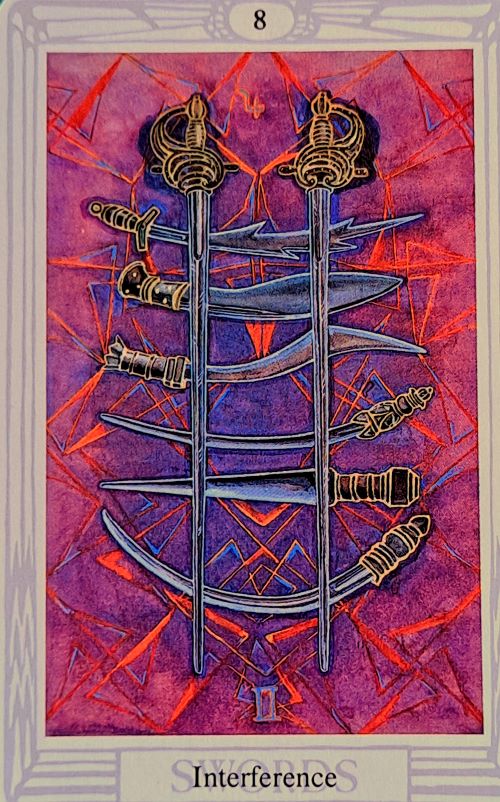
This inner conflict was in the back of my mind when I picked yesterday’s card — the eight of swords. The Mirror of the Soul cautions, “You will not be able to come to a decision analytically. Your doubt, or fears of making the wrong choice, constantly destroys your inner clarity. No matter where you turn, no satisfactory solution seems to exist. The more you try to untangle the ball of yarn, the tighter the knots become.” The Mirror of the Soul goes on to offer this solution to the conundrum: “Relax and let things develop on their own. The problem which seems unsolvable now will find its own solution in its own way.”

Good advice, for sure, and I planned to follow it, though I was so taken with the tarot reading and the way it reflected what I was feeling, that I’d been thinking about how to present both the problem and the tarot’s solution in a blog post. Apparently, the tarot doesn’t think this is good enough because today’s card was the same as yesterday’s, with the same admonition to relax and let things develop on their own.

Something to reflect on, that’s for sure!

***

Pat Bertram is the author of Grief: The Inside Story – A Guide to Surviving the Loss of a Loved One. “Grief: The Inside Story is perfect and that is not hyperbole! It is exactly what folk who are grieving need to read.” –Leesa Healy, RN, GDAS GDAT, Emotional/Mental Health Therapist & Educator.

Daily Tarot Reading

In yesterday’s blog post, I mentioned what I hoped to gain by a daily tarot reading, and it was only afterwards I remembered that the only thing I hoped to gain was a feeling for and a knowledge of the cards. Although I made it sound as if I was looking for a deeper understanding of myself and my life, that isn’t the case. Or at least, it wasn’t. I have no idea now what I’m doing it for.

At the beginning, of course, I did a daily reading more as an homage to my deceased older brother because he was the one who collected the cards. I figured he did so in an effort to understand his life (which was confusing at best, and often horrific). As I’ve become more familiar with the cards, any true reading has to reflect me, my hopes, my life otherwise they are just playing cards.

Still, despite this disavowal, I am looking to them for something since my daily question is “What do I need to know today?” and more often now, “What do I need to focus on?”

I certainly didn’t get into this daily practice to find ways to improve me or to understand more about my life. At this late stage, I’m not sure it matters all that much. So much of what was to be has already been. The past is a long tail on the mote that is today, and today is a mere shadow indicating perhaps what is to come. If I look too far into the future, the end is obvious, so the secret is (perhaps) taking a short long-term view. Or not look into the future at all. And I certainly have no interest in rehashing the past. I’ve done that and have laid it to rest. So to a certain extent, I am a static being suspended in the crucible of today.

I hesitated about inserting “static” in the previous sentence since no one is truly static — we are all changing even if in small ways — but it feels as if I am a done deal. If I could have been smarter, or wiser, or more intuitive, or more radiant, or whatever, I would have thought I would have accomplished that already. Now I so often find myself tired and feeling the weight of my years. It’s hard to find enthusiasm for anything (though I do try, especially when I am posting a commentary here). I’m probably more interested in finding acceptance in myself that in instigating any big change in attitude or attribute.

And yet, there is that daily tarot reading. It’s become such an established procedure of my day that it’s gone long beyond being merely an homage to my brother. Maybe someday I’ll figure out why I continue to do it. Perhaps someday I will even become smarter or wiser or more intuitive. Or not. Who can say? So far, the tarot is remaining mum.

***

Pat Bertram is the author of Grief: The Inside Story – A Guide to Surviving the Loss of a Loved One. “Grief: The Inside Story is perfect and that is not hyperbole! It is exactly what folk who are grieving need to read.” –Leesa Healy, RN, GDAS GDAT, Emotional/Mental Health Therapist & Educator.

Mirror of the Soul

Ever since the summer, I’ve been doing a three-card tarot reading for myself, and it began to seem silly. The only thing I really needed to know was what I needed to know that day. The first two cards only served to muddy the reading — in my mind, anyway — so this month I went back to a one-card reading. Even better, I went back to using the Crowley Thoth deck. It’s not one I particularly like, but I do have a great handbook that goes with the deck: Tarot Mirror of the Soul.

As the title suggests, this particular guidebook, more than any other, uses the tarot as a mirror to reflect inner realities without judgment to give us a new perspective. Ideally, anyway. Admittedly, the tarot itself it a tool for self-exploration, though I have not often found it to be so. This book, though, gives me more of what I need to focus on each day’s lesson.

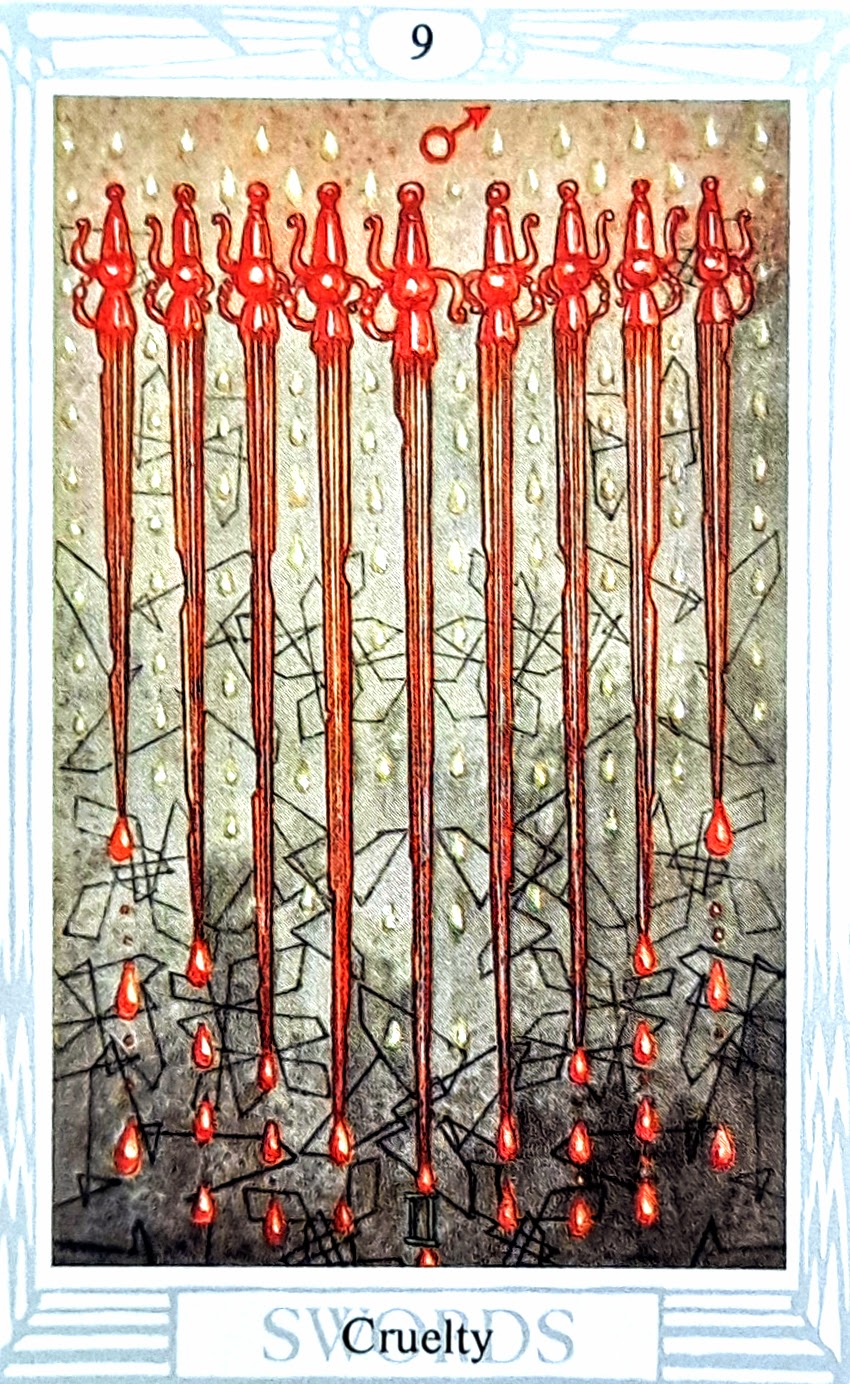
For example, today’s card is the Nine of Swords. It generally means cruelty directed at oneself and points to a tendency to put yourself down. In rare cases, it can mean physical or psychological cruelty by some heartless person, but no one lately is cruel to me. Actually, I’m not cruel to myself, either, though I have recently noticed a tendency to judge myself harshly when (perhaps) I am doing the best I can. Even if I’m not doing the best I can, that judgment call seems to be worse than whatever goals I breeched.

This particular card does seem to suggest that knowing the foible or lack is important — as important as knowing one’s good points, which I tend to ignore. It’s the cruelty of judging oneself that should be done without.

This book doesn’t just describe the symbols on the card and suggest what they mean, but continues with what the card indicates, which, in this case is about the necessity of recognizing the behavior pattern before it can be overcome. Another section is for questions to ask oneself, such as who judged you? And are you now ready to forgive your parents, others and yourself?

The section for the Nine of Swords then ends with an affirmation: I am loved, simply because the I am the way I am. This is something that I really do need to know. Concurrently with my recognition of how often I castigate myself for not being my ideal self, I’ve been wondering why people like me. (I suppose that’s a reasonable question. If I don’t particularly like myself — I don’t dislike myself, either, I just don’t go around patting myself on the back for my good qualities — then it makes sense I wouldn’t understand why they like me.)

People who know the tarot or who are more intuitive in their reading than I am can figure this out all on their own, but I like following along with the Mirror of the Soul. It helps me focus on one thing for the day (or at least for the start of the day because by the time I go about the business of living, I’ve already forgotten what I learned from the tarot that morning).

My plan for learning the tarot had been to pick one card each day for one year, two cards for the next year, three for the third, and so on, but the third year is only about half finished and I abandoned the plan. Eventually, perhaps, I’ll do a real reading with five or more cards once a week or once a month, but for now, this particular practice mirrors what I hope to gain from my daily tarot reading.

***

Pat Bertram is the author of Grief: The Inside Story – A Guide to Surviving the Loss of a Loved One. “Grief: The Inside Story is perfect and that is not hyperbole! It is exactly what folk who are grieving need to read.” –Leesa Healy, RN, GDAS GDAT, Emotional/Mental Health Therapist & Educator.
Terrestrial Triumphs

A little more than two years ago, I started to do a daily tarot reading. I wanted to learn the cards effortlessly (that is, without having to actively memorize each of the 78 cards), and though I’m still at it, I have very little retention of what the cards mean, so after all this time, I still have to look up the meaning of each card. Adding to the confusion, each guide included in most decks offers a different interpretation of the cards, though there is a vague thread of similarity between each of those interpretations. Some of the major arcana seem obvious, such as the Wheel of Fortune or Judgment, but the minor arcana all runs together, especially the court cards (the people cards). These generally refer to the people in our lives, but I have very few people and none of court cards ever seem to have anything to do with them or me.

Actually, the readings themselves never seem to have anything to me except shallowly, the way newspaper horoscopes offer shallow advice or ambiguous prophesy. It’s possible that I am not doing the readings correctly, not opening myself to possible meanings, not meditating on the cards or whatever it is I am supposed to be doing since I am not gleaning anything about myself or my life that I don’t already know. It’s also possible that at this stage of my life there isn’t anything more I can know. That’s not to say I know everything about myself, just that I know what I know and can’t intuit what I don’t know, with or without the help of the tarot.

Still, I continue to do a daily reading, choosing a different deck each month. In the hope that by limiting the number of cards I use, I will be able to better learn the meanings, this month I am using the Glass Tarot, a gorgeous deck reminiscent of stained glass, that’s comprised of only the major arcana. (The title of this blog, terrestrial triumphs, is how the major arcana was once known; hence, the term “trumps” as another name for those cards.)

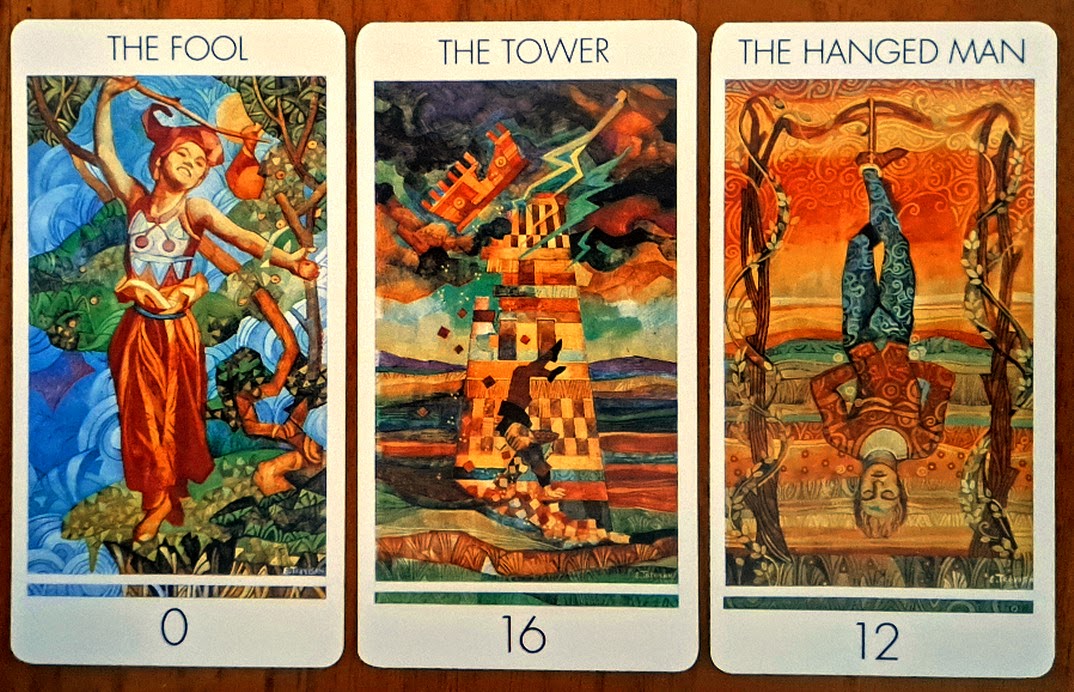
Today’s three-card reading included all cards that I am familiar with, and so my interpretation before looking at what the guide says, is that once I was naïve about certain matters, such as what grief can do to a person (The Fool), but then Jeff died and the world I knew came tumbling down (The Tower), and now I see things from a different perspective (The Hanged Man).

All true, of course, but it doesn’t tell me anything I don’t already know. (My question for the reading was “What do I need to know today?) Going by the definitions in this particular guide, the cards mean something else and deviate a bit from how others interpret the cards.

The Fool: Freedom from concern over material matters, extravagances, follies, light-heartedness, incomprehensible or inexplicable actions.

The Tower: Arrogance, pride, presumptuousness, upset equilibrium, danger, exile, collapse of mistaken convictions.

The Hanged Man: Disinterestedness, altruism, repentance, detachment from matter, moment of transition, utopia, art, punishment.

Even reading my cards from a different angle, perhaps that my follies let to arrogance and now I have to repent, doesn’t tell me much, though it is interesting to see how the same cards are subject to two completely different interpretations.

It does show me, too, that a few cards are sticking in memory, so my daily readings are helping me learn the cards, for whatever that’s worth.

***

Pat Bertram is the author of Grief: The Inside Story – A Guide to Surviving the Loss of a Loved One. “Grief: The Inside Story is perfect and that is not hyperbole! It is exactly what folk who are grieving need to read.” –Leesa Healy, RN, GDAS GDAT, Emotional/Mental Health Therapist & Educator.
Today’s Tarot Reading

Although I continue to do a brief tarot reading every morning for practice, the cards still don’t tell me much of anything. In fact, they generally seem too disjointed to tell any sort of story, whether mine or anyone else’s. Nor do I see a metaphor for my life in the cards, which is what some people believe a tarot reading is — a metaphor for the querant’s life. The querant, for those who don’t know anything about the tarot, is the person seeking answers. In my case, I am both the reader and the querant, so perhaps I’m too close to the querant’s situation to make sense of the cards.

Unlike most people, I don’t ask the cards specific questions; I stick with a generic, “What do I need to know today?”

Apparently, since I don’t glean anything more specific than bad things happened or will happen, or good things happened or will happen, I don’t need to know anything else. But then, that’s pretty much life, isn’t it? Those good and bad things that happened or will happen don’t need to be anything earthshaking because except for a few truly earthshaking moments — births, love, death — most of life is about small happenings.

I suppose I could change my question to see if I get any other sort of result with a different query, but the truth is, I don’t really need the cards for answers to life’s questions. I don’t seek insights into the past because the past is done with. I don’t care to know what will happen in the future because if I live long enough — a day, week, year, whatever — I will experience the future firsthand. I don’t need a metaphor for my life because I am living my life, metaphor or no. I certainly don’t rely on the cards to give me investment advice or anything like that because . . . well, for one thing, I have no funds to invest, and for another, if I have to rely on myself to interpret the cards, I might as well rely on myself to interpret the various investment possibilities.

Still, it’s possible that someday a certain tarot deck, the preponderance of my readings, a greater understanding will all click, and then I will know . . . something.

Meantime, there is my daily practice.

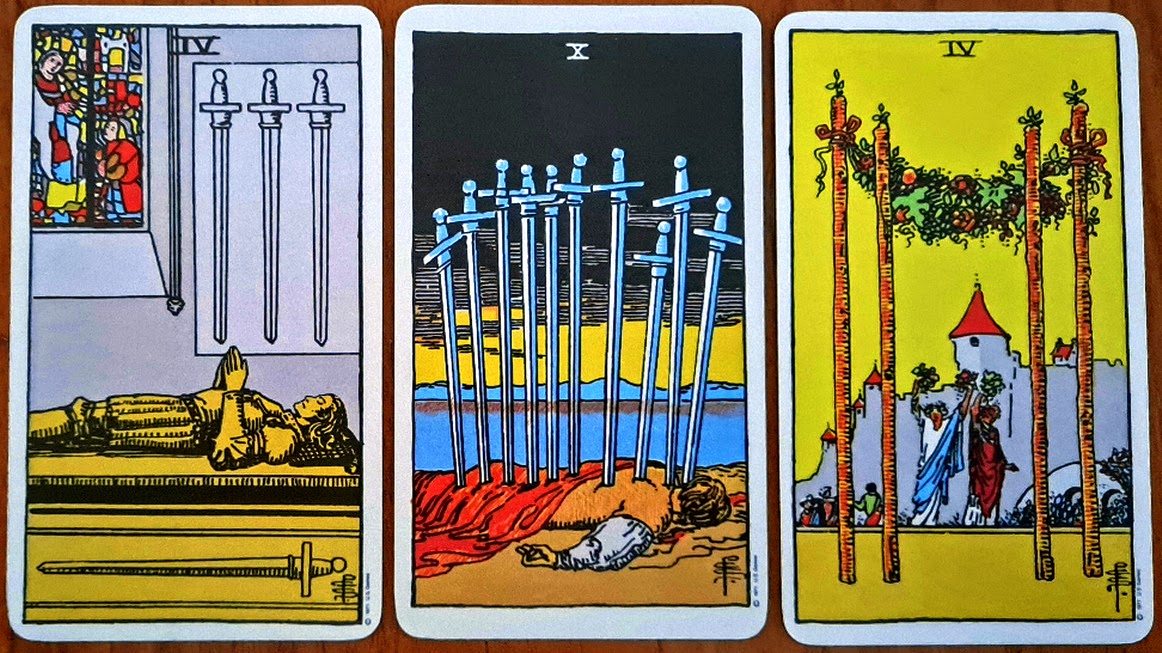
Despite my earlier declaration that the cards generally don’t tell a story, today’s three-card reading did, at least to an extent. The first card, the four of swords tells what happened in the past. (After facing multiple crises, you needed time for solitude and getting ready to face new challenges). The second card, the ten of swords, hints at the results of that past. (Pain, loss, desolation, but in that darkness are the seeds of hope.) The third card, the four of wands, suggests what will happen next or what actions will need to be taken. (Country life, work/life balance, peace, a sense that our projects are a wider expression of who we are.)

Did this reading change anything about my life or tell me anything I didn’t know? Well, no, but it did give me a blog topic, and that’s not a small thing.

***

Pat Bertram is the author of Grief: The Inside Story – A Guide to Surviving the Loss of a Loved One. “Grief: The Inside Story is perfect and that is not hyperbole! It is exactly what folk who are grieving need to read.” –Leesa Healy, RN, GDAS GDAT, Emotional/Mental Health Therapist & Educator.
Telling a Tarot Story

I don’t often deal out tarot readings for myself that make a lot of sense. The cards seldom tell me anything I don’t know, mostly because all I can do is read what I know into the cards. Even leaving me out of the reading, the cards still don’t make sense since they don’t seem to relate to one another. Today’s reading, however, delighted me because the cards all fit together to tell a story.

The deck I’ve been using this month is the Renaissance Tarot Deck, a deck that reflects interests of that period, using deities of Olympus and other mythological gods and goddesses. The ordinary folk, such as the court cards (ordinary in comparison with the classical deities, that is) are dressed in garments from the era.

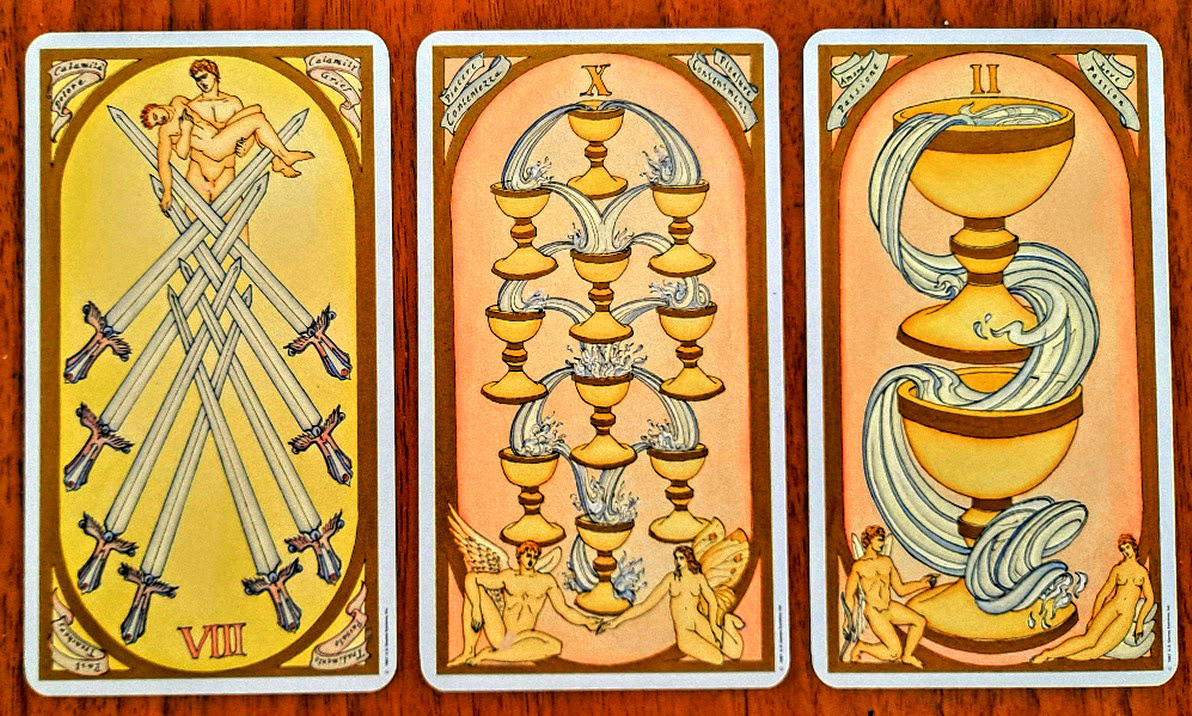
I’ve never used this deck before because I wasn’t sure I liked the anatomically correct nakedness, but I’ve come to appreciate this deck. It helps knowing that the naked people aren’t people at all but various mythological beings. Still, in the photo accompanying this post, I castrated the poor fellows, lest I offend anyone with such “pornography.” (I have a hard enough time with how people perceive this blog without adding fuel to the fire.)

The first card, representing the past, was the eight of swords. The picture is Achilles grieving for his friend Patrocius, who was killed by the spear of Hector of Troy. The meaning of the card is emotional disaster, loss of a beloved person or a valued situation, a sadness that creates new strength and resolve.

The second card, representing the present, is the ten of cups. The picture is Psyche and Eros in perfect happiness, reunited in a marriage feast on Olympus. The meaning, of course, is happiness in love, balance in friendship, and joyful equanimity in oneself.

The third card, representing the future, is the two of cups. The picture is of Eros falling in love with Psyche. The meaning is love at first sight, the invisible and formidable bond between two people.

So, the story of the cards is loss, finding eventual joy and a new balance and, if this were a romance novel, finding a new love. But since this isn’t a romance novel, since the reading is only good until the next reading (tomorrow morning), and since the chances of me meeting and falling in love with someone this afternoon are nil, the future card has to mean that the bond between Jeff and me is still strong, in my own mind if not in fact.

Or something like that.

Whatever the cards actually mean (as opposed to what I say they mean), it does seem as if these particular cards tell a very linear and distinct story.

***

Pat Bertram is the author of Grief: The Inside Story – A Guide to Surviving the Loss of a Loved One. “Grief: The Inside Story is perfect and that is not hyperbole! It is exactly what folk who are grieving need to read.” –Leesa Healy, RN, GDAS GDAT, Emotional/Mental Health Therapist & Educator.
Practicing the Tarot

Tomorrow starts a new month, which means I need to pick out a different tarot deck to use. I still haven’t found one that I have any special affinity for, so I am still in the habit of rotating decks to give me an opportunity to learn each of them. (Each of them in my collection, that is.)

Tomorrow also starts a new year. The first year of doing a daily tarot reading for myself, I picked one card. The second year, I picked two. Starting tomorrow, I’ll pick three, which means that not only do I have to choose a different deck, I have to decide what sort of reading I am going to do since there are an unlimited number of possibilities for a three-card reading.

A few examples:

Past, present, future
Situation, Obstacle, Advice
Opportunities, Challenges, Outcome
Your strengths, your weaknesses, how you can progress
Current situation, action to take, outcome
What will help me, what will hinder me, what is my unrealized potential
How to accept a change, how to care for yourself during the change, how to center yourself,
This happened, this was the result, this is what I need to do now

Lots of choices. Come to think of it, I should have done a reading today to figure out what my next reading should be!

The most common three-card reading is past, present, and future. The past can be anything in the far or near past that happened to affect you, either for good or bad. (If you’re doing a weekly reading, the past is the week since the previous reading, so if I am doing a daily reading, the past could be yesterday.) The present can be the current situation or current challenges. The future can indicate the outcome of the present situation or the direction things are moving. Another way of looking at the past, present, future reading is the final item on my example list: this happened, this was the result, this is what I need to do. That’s the one I am leaning toward, though it’s my game, so I can change the focus of the reading every month if I want so I can learn various three-card spreads.

That’s not the end of the choices. Next I have to decide how to pull the cards for the layout. Up until now, I’ve shuffled the deck, fanned out the cards, and picked the cards — one card the first year, two cards the second year.

I could continue fanning the deck and pulling random cards, or I could cut the deck then deal out the top three cards, or I could split the deck into three piles and then turn over the top card of each pile. I’m leaning toward the final way, though knowing me, I’ll end up just pulling random cards. That’s what I did when I started my two-card reading: split the deck into two piles and then turned over the top card. I don’t remember why I reverted to pulling cards, but that’s how I ended the year.

I’m not really sure why I’m continuing with the daily readings since they don’t seem to be telling me anything about myself or even about the cards overall. (I still don’t know the meaning of the cards individually without looking them up — I’d hoped that the daily use of the cards would help me memorize them, but it hasn’t happened, and I don’t know if it matters.) The main reason I’m starting a three-card reading is that I’m following through on a long-term plan. I’d probably get just as much out of the tarot if I went back to a one-card reading and spent more time figuring out what that card has to do with my life, but I should learn how to fit the cards together. (That’s why I’m leaning toward the final item on my example list — it lends itself easily to telling a story.)

Still, you never know — it’s possible something will come of my daily tarot exercise no matter how many cards I use. And if not, well, I have all those decks and plenty of time, so I might as well keep on practicing the tarot.

***

Pat Bertram is the author of Grief: The Inside Story – A Guide to Surviving the Loss of a Loved One. “Grief: The Inside Story is perfect and that is not hyperbole! It is exactly what folk who are grieving need to read.” –Leesa Healy, RN, GDAS GDAT, Emotional/Mental Health Therapist & Educator.

A Day for Friendship

The first year that I did a daily tarot reading, I used a single card. This second year I used two cards. Next month starts my third year, and I’ll probably graduate to a three-card reading. Not that I’m learning anything much either about the tarot or myself, but you never know. If there’s anything to learn, I’m sure I’ll eventually learn it, and if not, well, it’s as good a way to start the day as any other.

Mostly the reading is rote — I pick the cards, look up their meanings and try to figure out how the two cards fit together. Sometimes there seems no discernable relationship; other times, it’s obvious.

Last night, I dreamt of a wedding. I’m not sure who was getting married, though I tend to think it was one of my sisters. The main thing I remember about the dream, other than the talk of her getting married, is that the bridesmaids dresses were going to be brown. This morning’s tarot cards were the four of wands and the ten of cups. In the deck I am currently using, the Egorov Tarot, the four of wands is about completion, prosperity and satisfaction, and love affairs leading to a wedding. The ten of cups is about true happiness in love and friendship, and weddings.

I must admit, this reading amused me, reflecting, as it did, my dream of an upcoming wedding rather than any real-life experience.

Today was a day for friendships, however, so the cards got that right. One friend stopped by this morning to return a pattern for a paper project that she’d borrowed. We chatted for a while until it was time for me to get ready to host a different friend for tea out in my gazebo. Since today was vastly cooler than the past couple of days, this seemed a good time to try out my new gazebo furniture.

The chairs were comfortable, though after our tea, we took a walk to the dollar store to check to see what sort of cushions they might have. Although I liked the cushions I found, I wasn’t sure I needed them. It just seemed as if they would be more things to have to take care of. We also decided the furniture would be able to withstand the elements better without any cushions, so that’s how we left it.

On my way home, I visited with another friend in the middle of the street. The only time I see this woman, it seems, is happenstance when I’m out walking and she’s out driving. Hence our visits in the middle of the road.

That was the best thing about today — seeing friends.

I still feel a bit sick at the desiccated swath of grass (the only good thing about the desiccation is I’ve finally learned to spell desiccate, just as the only good thing about high temperatures is finally learning how to spell Fahrenheit). I’m pretty sure what happened to that grass is that there are no reserves of water beneath that part of the lawn since that patch of grass is being grown over an area that once was part of a gravel driveway. Although there wasn’t much gravel to be seen when the sod was laid, I have a hunch there were many layers of buried gravel beneath the dirt. So, great drainage, but poor sustainability. I’m not giving up, though. The grass did fine for many months, and if I can get resuscitate it, I’m sure it will again do fine. Meantime, I’ll be watering that patch every day for a while.

Many of the plants that were also affected by those hot, arid winds have recovered though, not surprisingly, the Siberian wallflower had no use for the heat and is struggling.

Still, there are plenty of flowers and greenery to enjoy, especially when I’m sitting in my gazebo, on my new chairs, sipping iced tea with a friend.

***

Pat Bertram is the author of intriguing fiction and insightful works of grief.

Momentous Day

This is turning out to be rather a momentous day. Shortly after I woke up, I heard banging. I kept looking outside at the neighbors’ houses, trying to see what was going on. I even stepped outside for a minute to peek across the alley, but I couldn’t see anyone doing any sort of work.

The banging continued, and then I heard the sound of a pipe reverberating near my house, which made me realize the banging was in my yard. So I went back outside and walked around the house, and there was one of the people who has been sporadically working on my property. He was pounding in the metal edging between the path and the grass to make it easier for me to mow. It was supposed to be done anyway, so it wasn’t a special consideration, but still I was thrilled to see him doing the work today. It’s been a while since anyone stopped by to anything. (The last time was when they came to check the plumbing to make sure a leak didn’t account for my exorbitant water bill.)

He did a few other minor chores while he was here, and we talked about some of the work that needed to be done (apparently, this worker is one that my contractor trusts to do my work). He says he’ll be back, and I’m sure he will . . . some day. Still, I’m delighted that a bit of work was done!

My tarot reading amused me today since it seemed to reflect the work he did: “What was accomplished up to now gets an even greater boost.” A secondary meaning to my reading was: “Everything grows and becomes more abundant.” For sure!! Weeds, anyone? Lots and lots of weeds are growing everywhere.

Adding to the momentousness, today is the birthday of a tree in Denver’s City Park near where I grew up. Shakespeare’s Elm, a tree planted from a scion taken from the tree on Shakespeare’s grave, is 106 years old today. The tree was always special to me. In fact, a friend and I threw birthday parties for the tree many years ago. We’d sent out invitations to friends as well as the media and some city bigwigs, but the only people who showed up besides those we knew were a couple of cops. We made them welcome, gave them green punch and tree cookies, but they weren’t really there to party. They were scoping out the gathering, thinking perhaps it was . . . I don’t . . . some sort of drug rendezvous. Anyway, after about a half an hour, they looked at each other, and one said with amazement in his voice, “They really are having a party for this tree.”

Back then, it was a forgotten historical monument, but over the years, there have been several articles in the Denver newspapers and magazines showcasing that amazing tree.

So all in all, a momentous day, and it’s not even over yet!

***

What if God decided S/He didn’t like how the world turned out, and turned it over to a development company from the planet Xerxes for re-creation? Would you survive? Could you survive?

A fun book for not-so-fun times.

Click here to buy Bob, The Right Hand of God.




