Esoterical Egyptian Tarot

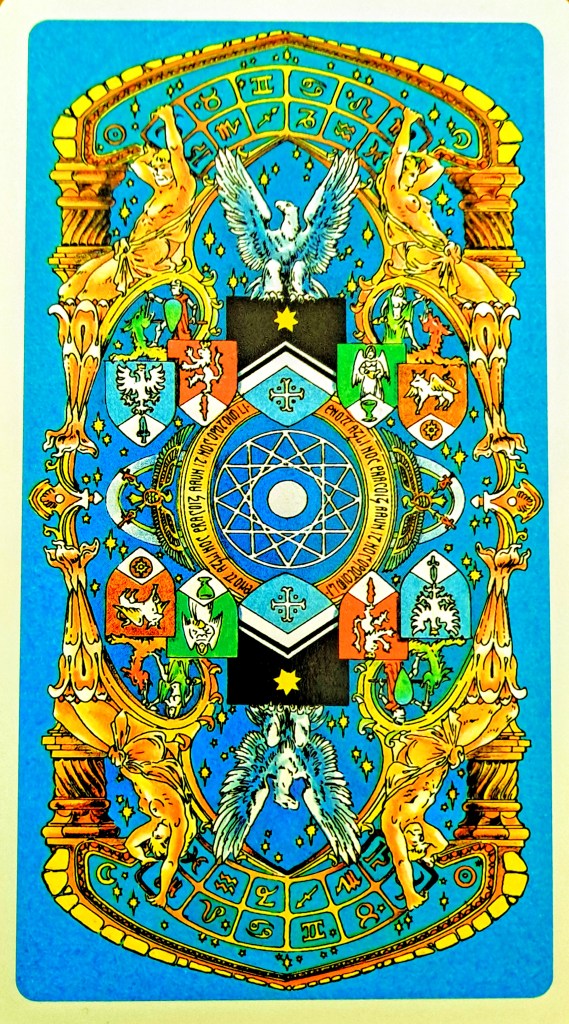
The tarot deck I am using this month is a collector’s item: the 1980 Enoil Gavat tarot, also known as the Tarocco Esoterico Egiziano (the Esoterical Egyptian Tarot). It’s another large deck, though it’s easier to fan out than the one I used last month, and is packed full of every imaginable tarot-related symbol. Supposedly, there are a few jokes hidden in the cards, most notably the name of the deck, which is the artist’s name, Tavaglione, spelled backward.

The word on the back of the card Opotoim is another backward play on words — mio topo — and is in honor of the movie El Topo, written, directed by, and starring the tarot master Alejandro Jodorowsky. The movie is a 1970 Mexican art film and El Topo in Spanish means “The Mole,” though in Italian Mio Tope means “My Mouse.” Another example of the artist’s sense of humor?

My card pick for today was the page of wands, and the main keyword is “stranger” or “foreigner.” A different interpretation of the page of wands mentions that I have a curious mind. And both those meanings are so apropos of today.

When I stepped outside to check the weather as is my habit, I noticed a U-Haul pulled up to the vacant house next door. Later, when my walk took me past the truck, (see where the curious mind comes in?) I got to talking to the fellow and discovered he’s going to be using the place, and the owner’s help, while turning an old school bus into a traveling home. I told him it sounded fascinating (which of course it does) and asked if he minded if I checked on his progress from time to time. He seemed delighted with the idea, though I got the impression it was more for the safety of his tools and such than bragging rights. The more people out and about, the more cautious nefarious folk tend to be. And he’s right to be concerned. There has been an inordinate amount of theft in the area, though I have heard that the main thief now lives in a different neighborhood.

Thievery isn’t the only problem. People also leave things behind, and that’s just as bad as people taking things — this morning, another neighbor had to clear away someone’s “home” — a sleeping back and other paraphernalia from one of the many homeless here in town. (Compliments of the homeless coalition that brings homeless here from the major cities in Colorado and elsewhere, and if people wash out of the program, they move into our alleys and abandoned houses.)

I don’t really see anything mystical in this particular card showing up on this particular day. After all, the law of averages dictates that at least some of the cards would be spot on.

But it is interesting, nevertheless — both the card and the stranger.

***

What if God decided S/He didn’t like how the world turned out, and turned it over to a development company from the planet Xerxes for re-creation? Would you survive? Could you survive?

A fun book for not-so-fun times.

Click here to buy Bob, The Right Hand of God.

Tarot Update

It seems as if this month just started, as if only a couple of days ago I started using a new tarot deck, but in another couple of days, I need to pick a new deck to use during April. Well, I don’t have to use a new deck, but that’s one of the reasons for my picking a card every day and for learning the tarot — to use my deceased brother’s tarot collection.

Although I am getting familiar with the tarot, I still don’t quite see how it fits in my life. It’s supposed to be a way to get to know oneself, and unless I am extremely obtuse, I’m not learning anything I don’t already know. Most people think of the tarot as a way of learning the future, or at least how to decide to go forward into the future, but that also doesn’t seem to fit with my life. Partly, of course, I don’t want to know. And partly, I already know the future, if not in specifics, then in general. If the past is anything to go by, the future will bring good things to my life, and it will bring a lot of not so good things. Either way, the knowing isn’t important — it’s being able to deal with what comes that’s important, and the lessons I’ve learned from grief lessons tell me I’ll find a way to accept whatever happens.

Besides, even if the purpose of the tarot was to learn the future, it’s nothing special. We can all learn what the future holds just by living. I mean, tomorrow is today’s future, and when I wake up tomorrow, I will know what the future holds. To a certain extent, anyway. Sometimes things change drastically from morning until night, witness all the people who woke up fine and ended up with The Bob by the evening.

Still, although a deep psychic connection with the tarot eludes me (perhaps because any psychic powers I might have are rather weak), I am continuing with my studies.

To date, the deck I like the most is this month’s deck, The Tarot of the Stars. It’s larger than most, which was a problem until I figured out how to shuffle them, and they aren’t slick enough to easily fan out, but other than that, they seem to be a quintessential tarot deck, with plenty of symbolism if I ever get into that aspect, as well as a key word to help figure out the meaning.

Today’s card was the magician, which is about knowledge, willpower, ability, eloquence, beginnings. It’s about harnessing the magician’s power to create the world you want. It’s about a lot of other things too, depending on whose interpretation you go by, but this brief interpretation seems to fit this particular card.

I still have a couple of dozen decks to try out to see if they speak to me, but so far, this is the closest. Oddly, it’s also the one I gravitated toward at the beginning when I first unpacked the decks, but since the instruction booklet that came with the deck is in an obscure dialect of Italian, I couldn’t use the cards until I developed my own guidebook. Once I’ve gone through all the decks, once I’ve gone through all the cards (some cards still haven’t shown up in my daily reading, though I’ve been doing this since July), and once I’ve started doing multi-card readings and need something to do on the off days (you’re not supposed to do a daily spread for oneself, though I know why) and need something to do the off days, I might try to translate the book via Word and Google.

Meantime, there are still two more days of enjoying this deck before I have the onerous task of picking a new one.

***

What if God decided S/He didn’t like how the world turned out, and turned it over to a development company from the planet Xerxes for re-creation? Would you survive? Could you survive?

A fun book for not-so-fun times.

Click here to buy Bob, The Right Hand of God.

Twelfth Year

I got through the eleventh anniversary of Jeff’s death without a major upsurge of grief, just a feeling of nostalgia and a bit of sadness. For a moment, before I retired for the night, I wanted to cry if for no other reason than a recognition that he is gone, but no tears came. I think I’m cried out, which in itself is ironic because for so many years, it felt as if the tears would never stop.

I once heard a saying that I didn’t understand until after Jeff died: Nothing changes and then everything changes. For years, nothing changed in our lives. It seemed as if we would always be like that — him struggling with dying, me struggling with living. Then he stopped breathing, and in that moment, everything changed.

Well, not everything. One thing has never changed. After all these years, he’s still the person I most want to talk to. We shared so much over the years, it is bewildering to me that we can’t sit down and get caught up. Or stand up and get caught up — looking back, it seems as if we were always standing when we talked. Who better to help me make sense of our lives both before and after his death? I do talk to him, or rather to his picture, though my comments are nothing more than asides, mentioning my day, maybe listing something for which I am grateful, or asking him how he’s doing. It’s hard to have a deep meaningful conversation when it is all one-sided.

I discovered a strange thing this morning. Although I have picked a tarot card to read the first thing every morning, I noticed a blank spot on my tarot journal where yesterday’s card was supposed to be. My morning routine is quite rigid. I do some stretching exercises, make the bed, fold three origami cranes, then shuffle whatever tarot deck I am using, and pick a card. Somehow, after I folded the cranes, I must have become distracted, and spaced out the whole tarot thing.

It’s nothing major, just a weird lapse, but it makes me wonder if subconsciously I blocked it out. After all, the tarot readings are a sort of memorial to my brother, and he loathed Jeff. Or maybe I simply didn’t want to know what the card would say. Either way, it’s unsettling to me — I don’t like forgetting to do things that I thought had become habit. Though, to tell the truth, this sort of forgetting does happen with me.

When I was in my late twenties, I ran a mile every day for years, and then days would go by, and suddenly I’d remember that I’d forgotten to run. One day I stopped running altogether. I simply forgot. It’s the same reason I am adamant about blogging every day — if I don’t blog every day, the days might pass without my ever writing a word. I have forgotten to blog a couple of days, but remembered sometime the late in the evening, so I was able to do my daily stint. Would it matter if I forgot? Probably not, but I do like the discipline of writing something every day, and if I let a day lapse, and then another and another, chances are I won’t be as willing to get back to blogging. (If I do forget to remember to blog one day, don’t worry. It has happened in the past, and will probably happen again, though I do try to remember not to forget.)

But that’s not important. What is important is that today starts my twelfth year of living without the person I thought I’d grow old with. Well, I am growing old; it’s just that I’m growing old alone. I’m mostly okay with that, at least, today I am. Tomorrow might be different.

***

Pat Bertram is the author of Grief: The Inside Story – A Guide to Surviving the Loss of a Loved One. “Grief: The Inside Story is perfect and that is not hyperbole! It is exactly what folk who are grieving need to read.” –Leesa Healy, RN, GDAS GDAT, Emotional/Mental Health Therapist & Educator

The Tarot of the Stars

The tarot deck I am using this month is a collector’s item: La Porta Celeste — I Tarocchi delle Stelle. The Tarot of the Stars. It was one of the first in my deceased brother’s collection that caught my eye. It’s a beautiful deck, and large — 6″ X 3.5″, and seems as if it’s the sort of deck one would use to do readings. It also seems more mystical than some, since this deck supposedly has its own cabalistic and alchemical system which is unique when compared to western tarot decks. The artist, Giorgio Tavaglione, integrated copious symbolism into his designs, particularly the astronomical information illustrated above each image. The problem with this deck (and the reason I never used it before) is that the book that comes with the deck is written in an archaic Italian dialect, very difficult to translate because it is loaded with magical and alchemical double entendres.

This is from the introduction:

“Tra le piu antiche immagine-peniero, la Spirale e una delle piu profonde e misterose. Nella Spirale vi e il concetto del Lairinto, con la sua entrata e la sua uscita. Nel Labirinto, con la sua entrata e la sua uscita. Nel Labirinto vi e l’idea/senso della Vita, del”evoluzione individual e di tutta la Societa Umna. Dalle inciscioni megalitiche dei Celti a quelle dell’Africa Nera, dalle decorazioni Mayaa e Azteche a quelle Indu, Deva e Asura, sino all doppia spirale Cinese dello Yin-Yang, la Spirale ha expresso ed esprime l’esensione, lEmanazione, la sviluppo nella continuita, ciclica in una Rotazion Creativa. Qesta meravigliosa immagine Cosmica e simbolo del E’quilibrio nello squlibrio dell Ordine all ‘interno del Cambiamento, della Mutaione. Nella Spirale logritmica si ha la permanenza della forma nonsante la crescita assimetrica.”

The following is more or less a translation, via Google and Word:

“The Spiral is one of the most profound and mysterious images. In the Spiral there is the concept of the Labyrinth, with its entry and exit. In the Labyrinth there is the idea / meaning of Life, of the individual evolution and of the whole Human Society. From the megalithic incisions of the Celts to those of Black Africa, from the Mayan and Aztec decorations to the Hindu, Deva and Asura ones, up to the double Chinese spiral of Yin-Yang, the Spiral has expressed and expresses the extension, the Emanation, the development of a continuous cycle of a creative rotation. This is a wonderful cosmic image and symbol of balance within change. The spiral stays formed, notwithstanding its asymmetric growth.”

It would take me forever for me to retype the book and try to translate it, though I might do a bit here and there. This deck is supposed to be similar to Papus, Wirth, and Cagliostro, all of which conform with the scholarship of Eliphas Levi, whoever he is. I do have both a Papus deck and a Cagliostro, which might help. I imagine, if I continue my tarot studies, I’ll eventually be able to figure out some of the symbolism on my own. If not, I can simply use it like I do any tarot deck, referencing my own collected meanings for each card. (I’ve been keeping a notebook where I keep note the meanings of the cards from various sources, sort of a personal key to the tarot.)

Beyond the ludicrousness of including an instructional book that purportedly even modern Italians can’t read, there is another problem: the large cards make them difficult to shuffle, and the matte finish makes it hard to fan out the cards on a table to choose each day’s offering.

It’s still one of my favorite decks, despite all this, mostly because it seems like a quintessential tarot deck. Too bad it’s not going to be one I use frequently, because I have a duplicate deck in case I damaged the cards. Or perhaps I can sell the duplicate; after all, it is a collector’s item.

***

What if God decided S/He didn’t like how the world turned out, and turned it over to a development company from the planet Xerxes for re-creation? Would you survive? Could you survive?

A fun book for not-so-fun times.

Click here to buy Bob, The Right Hand of God

Tarot Update

I’m glad this is a short month, but not for any reason you’d expect. It’s not that I’m especially looking forward to spring; I certainly won’t mind warmer temperatures (though I do dread the wind). And I’m definitely not looking forward to March and the anniversary of Jeff’s death, though I must admit that after all these years, the day doesn’t carry the pain it once did.

The real problem this month is with the tarot deck I’ve been using. Each month for the past nine months, I’ve chosen a different tarot deck from the collection my deceased brother left me, trying to see if any of them resonate with me. I don’t do readings, just ask a question like “what do I need to know today” and then pick a card to study. So far, there hasn’t been any special connection to any deck, though I have liked some more than others.

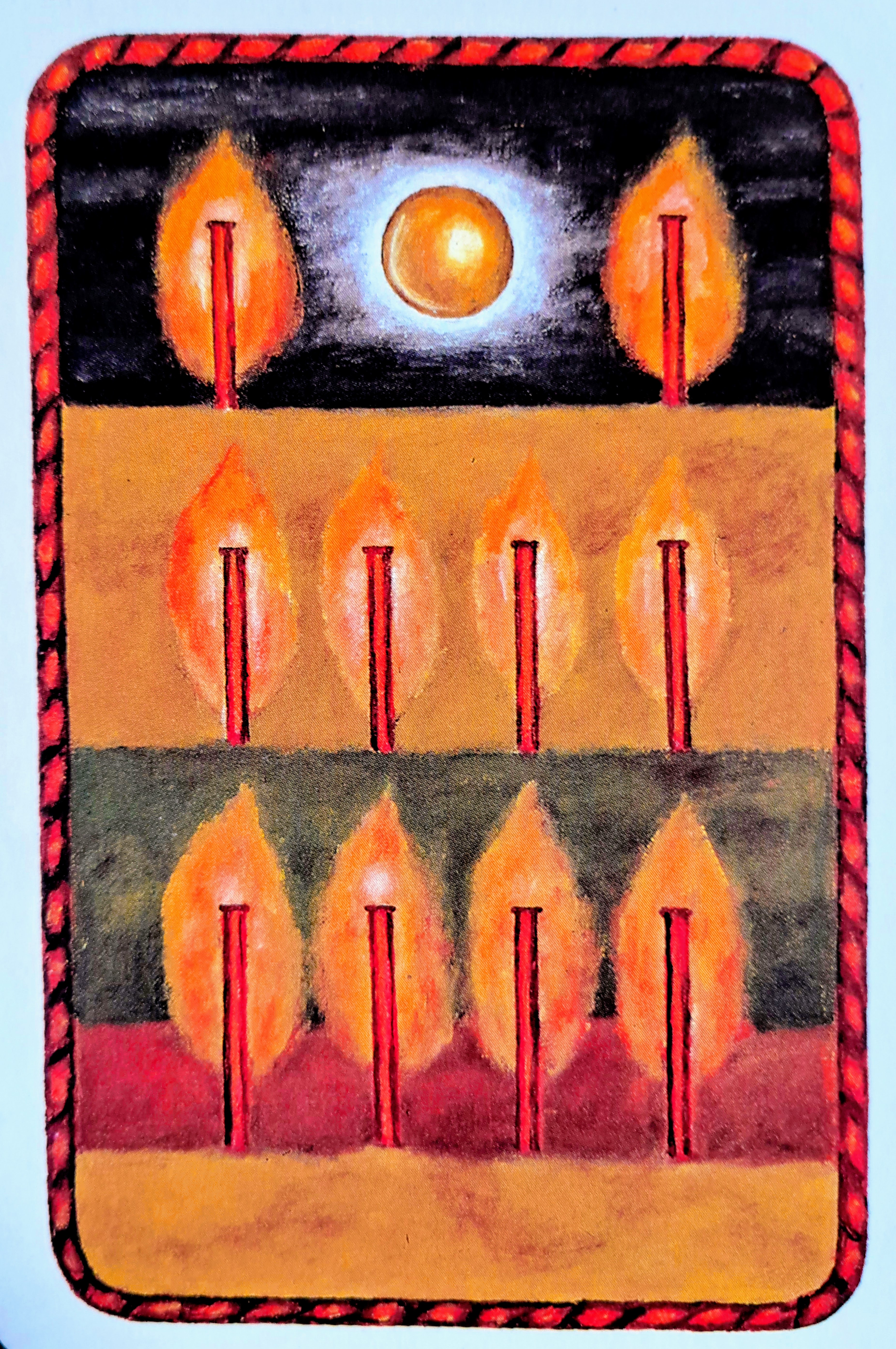
The one I am using this February is the one I like least of the decks I’ve sampled. There are others I dislike so much I won’t use them, such as the witch’s tarot and a renaissance tarot that feature anatomically correct figures, something I don’t particularly need at the start my day. But this one — The Jungian Tarot — seemed interesting in that the cards were supposed to be tied to Jung’s archetypes, but only some of them were archetypal (the Major Arcana and the court cards). Most of the cards I dealt myself were the numbered cards, and they did nothing for me, especially since I kept getting the same card — the ten of wands.

The ten of wands certainly seems to illustrate its meaning — oppression — because it is a particularly oppressive card.

I could, of course, changed decks in the middle of the month, but then I wouldn’t get as good a feel for the cards.

In another three days, I’ll be picking a different deck. I hope that one will be more to my liking.

***

Pat Bertram is the author of Grief: The Inside Story – A Guide to Surviving the Loss of a Loved One. “Grief: The Inside Story is perfect and that is not hyperbole! It is exactly what folk who are grieving need to read.” –Leesa Healy, RN, GDAS GDAT, Emotional/Mental Health Therapist & Educator

Tooting My Own Horn

Today is my 500th day in a row of blogging. I can’t say that I’m proud of everything I’ve written, but I am pleased that I have managed to keep to the discipline of a post a day for so long.

It is also my 222nd day of taroting. I know that’s not a word, but I’m not exactly studying the tarot, nor am I doing what is considered a reading. I am simply picking a card, making a note of all the various interpretations of each card so that when I use a tarot deck where the instructions are in an archaic form of Italian (as a couple of the decks are), I will be able to check my own notes for what each of those cards might mean.

If you don’t know why my interest in the tarot, it’s that I ended up with my deceased brother’s tarot collection, and I started my card-a-day practice as a sort of memorial to him. (In case you missed the posts where I talked about his decks, I have about four dozen different decks, some collectables, some common, some esoteric, and each month I pick a different deck to use to see if there is any one that will speak to me. So far, I haven’t heard a word from any of them.)

And today I’ve folded my 140th origami crane. My intent was to do one a day, thinking that by the end of three years I will have made my senzaburu (1000 origami cranes), but I find myself folding cranes whenever I have a few free minutes because the idea of all those cranes has captured my imagination. The legend is that anyone who folds a thousand origami cranes will have a wish come true or happiness and eternal good fortune. Since I have no particular wish (except to sell thousands of copies of Bob, The Right Hand of God), I’m aiming for eternal good fortune. Though to be honest, I tend to think I have that now, for which I am grateful.

Still, it doesn’t hurt to hedge my bet. Actually, I think the benefit comes in the folding rather than the finished senzaburu, but since it’s early days yet, I don’t know for sure.

I’ve also folded various other birds just for fun. Those I’m thinking of hanging in my garage to let me know where to stop and park.

This is all I have to toot about. These things are nothing special, really, except that I am doing them, and they all add up to a daily discipline, proving . . . I don’t know . . . perhaps that I’m alive and kicking and still going strong.

***

What if God decided S/He didn’t like how the world turned out, and turned it over to a development company from the planet Xerxes for re-creation? Would you survive? Could you survive?

Click here to buy Bob, The Right Hand of God

New Month, New Tarot Deck

Every month I’ve been using a different tarot deck in an effort to see if the deck feels the same as the rest, or if it resonates with me. Although I like a couple of the decks better than any of the others, either because of size or feel or the artistry, I haven’t felt any special affinity with any of the cards.

This month’s choice of decks is the Jungian tarot, which is based on archetypal images designed to activate the imagination. According to the designer of the deck, most of the current values assigned to the various cards were arbitrarily developed in the nineteenth century by occult groups. By contrast, he says the attributions in the Jungian Tarot were painstakingly researched in an effort to relate tarot interpretation to more ancient traditions.

Sounds good, right? Well, today’s card, the ten of wands activates my imagination not at all. The image gives me the impression of being weirdly inappropriate since it seems sinister, and the ten of wands is a rather benign card relating to careful management, functioning within a large organization, success, the loneliness that comes from success, and reacting defensively to badly organized ideas. Which is not a whole lot different from the meanings assigned by other tarot interpreters. Most say the card is about success and the perhaps oppressive responsibilities one has to take on because of that success; a need for prioritizing, delegating, and sharing your burdens. (None of which seem to have any relation to my life at all.)

It almost seems as if the major arcana (the cards most people have heard of, such as the fool, the hanged man, the sun, the moon, etc) are the cards that every tarot artist and interpreter spend most time on, and the others are “also rans.” (Which is why so many readings, such as online readings, use only those twenty-two cards rather than all seventy-eight cards.)

When I do graduate from picking just one card to doing a periodic reading (weekly or monthly), chances are I will only use those twenty-two cards until I get familiar with how the cards fit together to show . . . well, to show whatever it is they are supposed to show. I still don’t know. I do know the tarot isn’t really about foretelling the future; it’s more about communicating with our deepest being, but so far, there’s not a hint of what I might be hiding in my innermost depths. It could be I have no such depths. It could be the cards are not speaking to me, and if they are, I haven’t learned to listen. It could be that the whole thing is hokum.

So far, the only imagination it has activated in me is the possibility of using the cards as story telling cards — using each of the face cards as a character, and surrounding them random cards to see how their lives would unfold. But the idea has gone no further than that. Nor have I deepened whatever intuition I might have or learned anything I don’t already know.

But I have the cards, so it does me no harm to pick one every day just to see what I pick.

***

While sorting through her deceased husband’s effects, Amanda is shocked to discover a gun and the photo of an unknown girl who resembles their daughter. After dedicating her life to David and his vocation as a pastor, the evidence that her devout husband kept secrets devastates Amanda. But Amanda has secrets of her own. . .

Click here to buy: Unfinished

As The World Turns

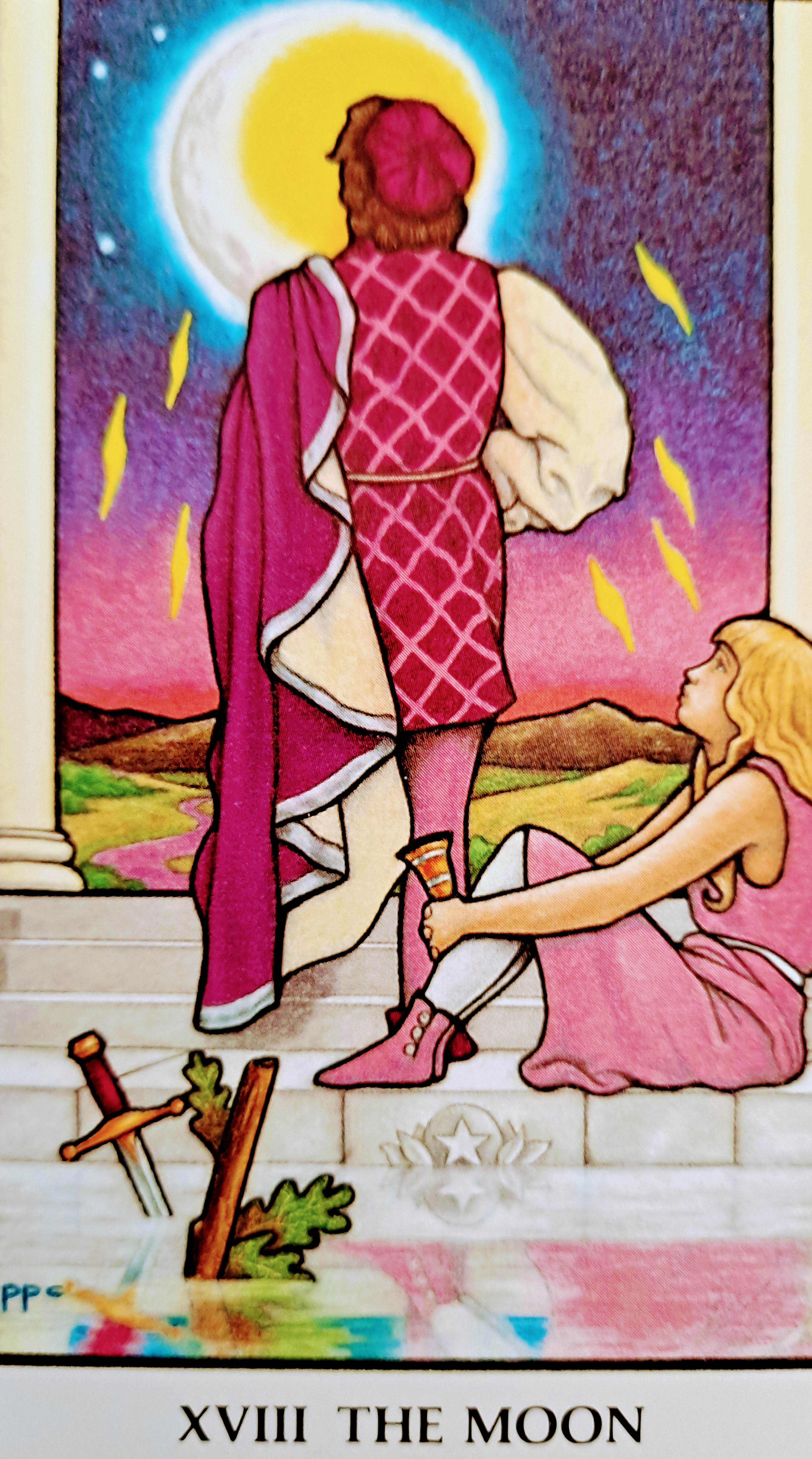
Yesterday was not a good day. Leaving out the national scene and only dealing with my life for now, things were . . . unsettling. Not only did my house insurance rate skyrocket (and this area already is dealing with rates that are way above average), but my Nook died, along with the myriad books I did not purchase from Barnes and Noble. The e-book reader is out of warranty, so there’s not much I can do about. Allergy headaches, tiredness, and crankiness all added to the frustration of the day. (If folding origami cranes is supposed to be restful and meditative, I am here to tell you that so far it only adds to the frustration, but hopefully, as I get more proficient, serenity will come.) With all that, I certainly didn’t need today’s Tarot card (The Moon) to warn me not to be “deceived by apparent security.” I got plenty of real-life reminders!

But that was yesterday.

The tarot, as well almost every other philosophy, teaches that nothing is static. What goes down must also come up. (Physics says that what goes up must come down, though it doesn’t say anything about things that are already down.) The moon card certainly seems fitting today because (at least from a human perspective), the moon goes down, but inevitably, as the world turns, it will come up again. (That’s not to say that one day the earth will stand still; to the best of my knowledge, that has only happened once or twice — according to legend — and eons before my lifetime.)

Though my personal moon is rising, I can’t say much has changed today — the insurance rate remains the same, though my agent will try to find a better rate for me. We’re just at the beginning of the national changes, so the effects of the new regime haven’t struck here yet. I’m still dealing with allergies and my Nook is still retired from service.

There have been changes, however, including the delivery of a small package that had been swallowed up the black hole of the postal system in Denver (they do not like to deliver anything but letters here; everything else seems to be held until for several weeks until the mass of the mail equals the mass of the black hole.)

Most importantly, I went to the library! I recently heard that the library is open by appointment, so today I made an appointment and headed out to search for books. What a pleasure! I was the only one in the place except the librarians, so no other patrons got in my way, and I had my choice of books. (Take that, Nook!)

The sun is out, which also helps. Winter weather returns this weekend, with a possibility of snow, but I don’t put that on the negative side of the scorecard because the moisture is a plus.

And so the world turns . . .

***

“I am Bob, the Right Hand of God. As part of the galactic renewal program, God has accepted an offer from a development company on the planet Xerxes to turn Earth into a theme park. Not even God can stop progress, but to tell the truth, He’s glad of the change. He’s never been satisfied with Earth. For one thing, there are too many humans on it. He’s decided to eliminate anyone who isn’t nice, and because He’s God, He knows who you are; you can’t talk your way out of it as you humans normally do.”

Click here to buy Bob, The Right Hand of God

Moving On

The first time I’d heard the phrase “moving on” was a few months after Jeff died, and thereafter I heard it frequently.

Although people often think they are helping by urging grievers to get over it and move on with their life, they are merely showing that they themselves can’t handle the griever’s grief; showing that they can’t handle the new person the griever is becoming. Friends and family want grievers to be the way they were before their loss, and the griever can’t be. Loss changes you. Grief changes you.

Sometimes when people urge grievers to move on, they are not expressing insensitivity so much as a misplaced understanding of the nature of grief. (Which is why my book Grief: The Inside Story – A Guide to Surviving the Loss of a Loved One was written both for grievers and for anyone who wants to understand this thing we call “grief.”)

The truth is, grieving is how we “move on.” Grieving for a spouse is a process, a process of change from a person with a mate and shared life to someone who can deal with the absence, loss, aloneness.

“Moving on” or “moving forward” isn’t just used about grief. It’s used for almost everything, and one of these phrases frequently shows up in tarot card interpretations, such as the card I picked today that is supposed to be about overcoming fears and boldly moving forward. The phrase also appears frequently in novels and in discussions about writing, such as moving the plot forward, or the characters moving on from . . . whatever.

All of sudden today it struck me that I don’t even know what that means. “Moving forward” seems to connote a linear path, which might work for writing, given that the plot has to go from beginning to a satisfying end, but in life, there truly is no forward movement except that which we impose on our lives, such as time or age or career success or even traveling. We feel like we’re moving forward when we walk or drive somewhere, but that’s mostly an illusion. Unless we are permanently moving to a new house or new property, we eventually return to where we started, so that turns out not to be a forward motion at all.

The universe seems to be built more on circular motion, atomic particles and heavenly bodies are always in motion, orbiting around each other, making their way around empty space, but not really going anywhere because if there is not really a “here,” there can’t be a “there” to move on to. It seems as if motion is important, but not necessarily forward motion. For all I know, we could be moving backward, and it is just the way our brain interprets things to make it seem as if we are moving forward.

A kaleidoscope comes to mind. If all the energy that ever was exists today, then a turn of the scope brings us to what seems a different place, but is really all the same place. Karma and the idea that what goes around comes around also connotes a circular life. As does a gyroscope.

A tarot card I randomly picked twice in the past three days was about fluctuation and change. It suggested that a person who is in harmony with her life is one who can adapt to all the changes that comes her way, and keep on moving, Like a gyroscope that only holds its position when it is spinning,

But not “moving on”. Just “moving”.

Assuming we are supposed to be moving on, moving forward, moving toward something, where are we supposed to be going? Well, death, we are all moving inexorably toward death, since death is our end on this earth, but is that really a forward movement? After a certain age, it seems more as we are being pushed rather than moving on our own initiative. But other than that, what are we supposed to be moving toward? Enlightenment, maybe, though that brings up the issue of what is enlightenment.

In the case of grief, even though I am not actively grieving and haven’t been for a long time — I seldom even feel nostalgic anymore — I never actually “moved on,” never “got over” it. It’s more that the loss became subsumed into the very fabric of my life.

Admittedly, I might simply be sensitive to the phraseology because of all the people who used these words or variations of them to urge me to get over my grief, but they still seem to be rather meaningless terms no matter how they are used.

***

Pat Bertram is the author of Grief: The Inside Story – A Guide to Surviving the Loss of a Loved One. “Grief: The Inside Story is perfect and that is not hyperbole! It is exactly what folk who are grieving need to read.” –Leesa Healy, RN, GDAS GDAT, Emotional/Mental Health Therapist & Educator

Thirty Days Hath . . .

Thirty days hath September, April, June and . . . you guessed it. November!

Since this is the thirtieth, tomorrow starts a new month, and that means a new tarot deck for me. I had a hard time deciding which to use of the dozens I own.

Some of the traditional decks passed down from medieval times are too odd and the images too angular and misshapen for my tastes (deriving as they do from traditional woodcuts), and so are many of the decks based on those old cards.

Some of the newer versions, though intending to seem old, using as they do, images from the Renaissance, are often too . . . natural . . . for my tastes. I don’t need to see anatomically correct pictures (or at least anatomically correct enough to know which cards depict males). It seems jarring, though I’m sure there is symbolism in the nudity, perhaps showing the necessity to put off the falsehood of clothes, and be who we are, but I can get that symbolism with clothed images, too, since the raiment people don is also symbolic. (Even in today’s culture, clothes are symbolic, though I doubt people stop to think what it is they are trying to broadcast with their apparel.)

Some of the decks are simply too symbolic, with more icons and Jewish letters and astrologic signs and qabalistic codes than I wish to study right now. I’m still trying to get comfortable with the cards themselves, as well as trying to find the deck that speaks most clearly to me.

So far, the deck I like the most is The Cosmic Tarot, created by Norbert Losche and printed in Germany in 1988. The cards have a hint of the 1920’s about them, and most seem evocative of something, even if not what was intended. The following is the Queen of Wands from that deck:

The deck I decided to use this month is the Egorov Tarot, a Russian-inspired deck that is so very elegant with shiny gold borders and highlights. (Unfortunately, the gold photographed as brown, but you can still see the vast difference between this deck and The Cosmic Tarot.)

Someday, if I get bored or ambitious, it would be interesting to photograph all the queen of wands from all the decks and see how they compare. Meantime, I’m just glad I made the decision which deck to use during the coming month.

***

Please check out my new book!

“I am Bob, the Right Hand of God. As part of the galactic renewal program, God has accepted an offer from a development company on the planet Xerxes to turn Earth into a theme park. Not even God can stop progress, but to tell the truth, He’s glad of the change. He’s never been satisfied with Earth. For one thing, there are too many humans on it. He’s decided to eliminate anyone who isn’t nice, and because He’s God, He knows who you are; you can’t talk your way out of it as you humans normally do.”

Click here to buy Bob, The Right Hand of God