I’m Not Waiving Any Moral Rights I Have in My Blog!

A couple of weeks ago I got an email from a marketing company doing a social media campaign for a major corporation. Apparently they wanted to get bloggers to do a contest for them, and the winner would receive . . . nope, better not go there. If I told you what the prize would have been, it would be tantamount to telling you who the corporation is, and I’d probably get sued.  For my part in the production, I would have received the same prize, but since I have no use for it, it wasn’t much of an incentive. I like doing online promotions, though, whether for me or someone else, so I was going to do as they asked just for the fun of it.

(It’s a good thing I didn’t. The last contest I promoted got almost no entries, so if you’d like to help me redeem myself as a promoter, you can check out: Free ebook giveaway of the latest thrillers!)

After I said yes, I received a four page contract. I suppose it makes sense — after all, if they were going to give away a couple of items worth two hundred dollars each, they would want to make sure I did what I said I would do. The agreement seemed standard until I go to the part that said: You grant us the right to link to your blog and to reproduce, display and distribute excerpts from your blog, for any purpose, in any media now known or hereafter invented. Like I’m really going to grant them those rights forever.  I told them they could have the rights to any article I wrote on their behalf, but that’s it.

Anyway, they changed that section, and I went through the agreement one last time before signing. In a section about attesting to being over eighteen and being the sole owner of my blog and not defaming the company, etc., I found this: You hereby waive any moral rights you may have in your blog.

What???? I don’t even know what that means. Still, I gave them the benefit of the doubt and said if they removed that line, they had a deal. I never heard from them again.

The contest was supposed to start in two days. I’m keeping my eyes open for contests pertaining to that corporation. I’m curious how many people got suckered into signing away the reproduction, distribution, and moral rights to their blogs.  I hope you weren’t one of them!

Questions About Writing Stories

I received an email the other day from someone who wanted to interview me for a class project. I think he’s for real, but some of the requests I have been getting recently are questionable, so I thought I’d post my responses here to stake my claim. Feel free to respond to any of the questions. If the interviewer does, in fact, read my blog as he said he did, I’m sure he’ll be glad of the additional input.

What, in your opinion, are the essential qualities of a good story?

The most essential quality of a good story is the ability to take readers somewhere else and make them glad they went. It’s also important to make the writing easy to read, which means the writing must be grammatically correct. Nothing takes a reader out of a story faster than having to decipher convoluted sentences with improper punctuation. Ideally, a story should leave readers a bit better off than they were before, either because of what they learned about the world and themselves, or because of the respite from their everyday lives.

Do you keep those qualities in mind while you write?

The only one of these qualities that I keep in mind while writing is to make sure what I write is readable. Other than that, I focus on the story, setting the scene then developing plot and characters into a cohesive whole.

Which of those qualities do you think is the most important, if there is a ‘most important’ one?

Some people think character is most important, others think plot is the most important, but you really can’t separate the two. Plot is what happens to a character, what a character does, or both. You cannot have a character without a plot. To show who or what a character is, you need to show the character acting, and that is plot. You also cannot have a plot without a character. If an asteroid falls to Earth, that might be newsworthy, but it’s not a story until you have characters interacting with the asteroid. Who found it? What did they do with it? What happened to them as a consequence of their actions? That’s what makes a story.

How much of a story do you have in your head before you start writing it?

I know the main characters, I know the beginning of the story, I know the end of the story, and I know how I want the characters to develop, but I don’t flesh out the individual scenes until I start writing them.

Do you do any research for your writing? If so, how do you do it? (searching Internet, magazines, other books, etc.)

The research for Light Bringer, which will be published mid 2010, took me approximately twenty years. The research for my other novels took two to five years each. Sometimes I consulted maps or guidebooks, sometimes people told me what they knew, but mostly I read books on the various subjects.

How do you prefer to start a novel? For instance, do you try to start it out with a ‘bang’, or do you prefer to start out with a low point?

I start with a good hook, sort of a small bang, and I work up to a bigger bang.

How (or when) do you decide that you are done writing a story?

A story is done when it is published. Otherwise, it is never finished. The more one writes, the more one learns, and the more one learns, the more one sees how earlier works can be improved. The only thing that stops this cycle of learning and rewriting is getting published.

Do you have any specific pattern of writing, however subtle it may be, when you write? (Using specific plot devices consistently, for instance)

The only device I use now (though I did not do it in the beginning) is a theme. If I know the theme of a story, I can keep focused on the main concept and not go off on tangents. A story needs to be tightly constructed without extraneous scenes or exposition. If not tightly constructed, a story loses its power and impact, sort of like a comedian who tells a rambling joke without a punch line.

The term ‘well developed characters’ is extremely vague and the definition differs depending on who is asked. What, in your opinion, does it mean?

A well-developed character gives readers a sense of that character’s personality, feelings, and struggles. A well-developed character changes and matures as a result of all that the character experiences during the course of the story.

What is your goal for the story to be when you write? That is, how do you want your stories to say what they say?

My only goal is to write the stories I want to read. If my books do have a message, it’s that nothing is as it seems. We are not necessarily who we think we are, history did not necessarily happen the way we think it did, and what we see is not necessarily the truth. But all that is more of a side effect. Mostly I just want to write good stories with good characters.

Grateful to be an Author

It seems a bit paltry to have a single holiday to give thanks when I have so much for which to be grateful. I am grateful for my online friends and for my fans. (Odd to think I actually have fans!) I am grateful for the readers of my blog, who never fail to offer support and suggestions. I am especially grateful for my publisher, who understands my books better than I do. But I am most grateful for being the author of my novels rather than being a character in them.

It’s an author’s responsibility to put her characters through as many traumas as possible. Readers want to worry about characters, they want to see how characters act when faced with horrendous conditions and dilemmas, and they want the characters to go bravely where they themselves would never go. As an author, I might give readers what they want, but frankly, I would never choose to be in any of the situations my characters encounter. And, although I am trying to be bold and brave in my own life, I will never be as bold as my characters. Nor do I want to be.

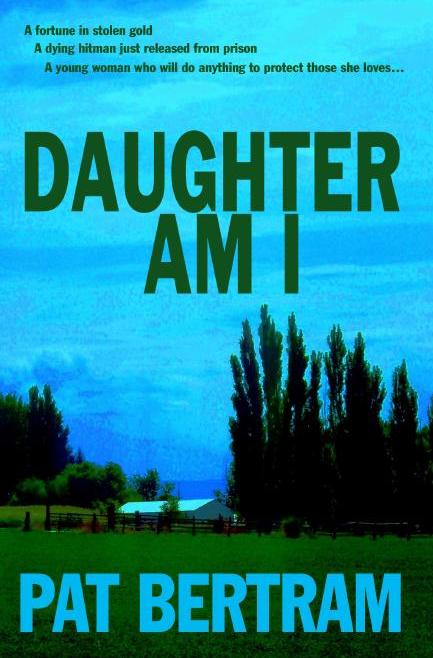
When Mary Stuart, the hero of Daughter Am I discovers she inherited a farm from recently murdered grandparents she never knew she had, she becomes so obsessed with finding out who they were, why someone wanted them dead, and why her father claimed they had died before she was born, that she ends up driving halfway across the country with strangers. That these strangers are all in their eighties might have put her at ease, but when she finds out about their less than lawful pasts, it still doesn’t deter her from her goal. In fact, she heads for Leavenworth, hoping to talk to Iron Sam AKA Butcher Boy AKA Samuel Bornstein, a hit man for the mob who might have known her grandfather.

Um, yeah. Like that’s something I would do! I am grateful that I have never had to deal with such a situation. When Mary discovers that one of the aged crooks is carrying an illegal weapon, she confiscates it and tucks it in her purse. Forgetting for the moment that I don’t carry a purse, having a gun tucked away in a handbag where it might accidentally go off is not high on my list of priorities. (Though I would be interested in firing a gun just once to see how it would feel. Strictly for research purposes, you understand.)

Sneaking onto the property of a connected guy to dig for stolen gold . . . hmmm. Perhaps I might do that, but I’m grateful I don’t know of any such treasure in real life that would put me to the test.

And that’s just one of my books. When I consider all of them, my gratitude is unending. I am grateful I never had to twice attend my mother’s funeral as poor Bob Stark did in More Deaths Than One. I’m grateful I have not yet had to deal with an epidemic so severe that the entire state of Colorado needs to be quarantined as described in A Spark of Heavenly Fire. I am grateful that I am not being held captive in an underground installation run by a quasi-government agency as are my heroes in Light Bringer, which will be released in the spring of 2010.

I am also grateful to Margay Leah Justice for inviting me to be a guest on Moonlight, Lace, and Mayhem, where this post first appeared.

So, what are you literarily grateful for?

Three Chances to Win a Copy of DAUGHTER AM I

You have three chances to win a copy of Daughter Am I. 

1. Eric Beetner, author of One Too Many Blows to the head is sponsoring an ebook contest for the new releases from Second Wind Publishing. To win a Daughter Am I ebook, all you have to do it go to the Second Wind blog and answer the question: “have you ever learned something shocking about your past? Maybe not murder but what rocked your world once you found out?” I know you have learned something that rocked your world — for example, how did you feel when you found out where you (and all babies) came from? See, it’s not so hard! You can also answer another question to win an ebook of One Too Many Blows to the Head by J.B. Kohl and Eric Beetner and a third question to win a copy of False Positive by JJ Dare. 

Click here to find the contest: Free Ebook Giveaway of the Latest Thrillers

2. At A Book Blogger’s Diary, all you have to do is leave a comment saying why you want to read Daughter Am I (because it was written by me, of course!). Click here to find the giveaway: A Book Blogger’s Diary 

3. And finally, you can win the only signed proof copy of Daughter Am I and have fun doing it by going on a treasure hunt. Click here for a chance to win the book: Treasure Hunt! 

Bonus: Download the first 30% of Daughter Am I free at: Smashwords

add to del.icio.us : Add to Blinkslist : add to furl : Digg it : Stumble It! : add to simpy : seed the vine : : : TailRank : post to facebook

Snow White and the Seven Old Fogies

Snow White and the Seven Old Fogies.

Well, sort of.

Mary Stuart, the twenty-five-year-old hero of Daughter Am I, learns that her grandparents have recently been murdered and that she is their sole heir. This comes as rather a shock because her father always claimed they had died before she was born.

Wanting to find out who her grandparents were, why her father had disowned them and why someone wanted them dead, Mary sets out on a journey armed only with her grandfather’s address book. She travels from Colorado to Arizona to Kansas, Omaha, Illinois, searching out people her grandparents knew. Along the way she accumulates a crew of feisty octogenarians:

Kid Rags, a dapper forger, seems to have two interests in life — drinking bourbon and eating copious amounts of food.

Crunchy, an ex-wrestler, threatens to crunch anyone who doesn’t treat Mary well.

Teach, a con man, tells Mary more than she ever wanted to know about gangsters, Wyatt Earp, and life.

Happy, an ex-wheelman for the mob, is ready with his gun though his hands shake too much to aim, let alone shoot.

Iron Sam, a dying hit man just released from prison, has his own, secret agenda.

Spaghetti once owned The Joker, a mob hangout where Mary’s grandparents worked when they were young.

Lila Lorraine, an ex-showgirl, was a friend of Mary’s grandmother and an ex-girlfriend of Iron Sam.

With companions such as these, how can Mary’s journey be anything but fun?

Daughter Am I by Pat Bertram is available from Second Wind Publishing, Amazon, and Smashwords.

add to del.icio.us : Add to Blinkslist : add to furl : Digg it : Stumble It! : add to simpy : seed the vine : : : TailRank : post to facebook

Treasure Hunt!

Daughter Am I is a quest novel — a hunt for truth, a hunt for self, a hunt for gold — so what better way to celebrate the end of my Daughter Am I blog tour than with a treasure hunt! Unlike Mary, you don’t have to travel halfway across the country in the company of seven old rogues (well, six old rogues and one flirtatious old woman). All you to do is hunt for their names. I will even give you a clue. I mentioned the names a couple of times during my blog tour, so all you have to do is find the right article.

When you find all seven names, send an email to secondwindpublishing@gmail.com with your list, and you will be eligible for the real prize — the one and only proof copy of Daughter Am I, signed by the author . . . me. One person chosen at random from all those who send in correct responses will win the book. Who knows, one day it might be a collector’s item, and then you can exchange it for gold. As long as gold remains legal, that is. Teach doesn’t think it will. Oops. I gave away one of the names. So now you only have to find six others.

The hunt is on! Oh, did I mention there were seven octogenarians who accompanied Mary?

The contest ends November 30, 2009 at 11:59pm ET.

add to del.icio.us : Add to Blinkslist : add to furl : Digg it : Stumble It! : add to simpy : seed the vine : : : TailRank : post to facebook

The Mythic Journey Behind Daughter Am I

Today is the last day of my Daughter Am I virtual book tour, and what better place to end it than here, at my own blog. Thank you everyone for your support during the past five weeks. It was a wonderful journey!

Daughter Am I was the combination of two different stories I wanted to write. I’d read The Writer’s Journey by Christopher Vogler, and the mythic journey so captured my imagination that I knew I had to write my own quest story. I also liked the idea of telling little-known truths about the mob, and I settled on the story of a young woman — Mary Stuart — going on a journey to learn about her recently murdered grandparents. Accompanying her are six old rogues — gangsters and conmen in their eighties — and one used-to-be nightclub dancer. As Mary listens to stories the old-timers tell, she gradually discovers the truth of her heritage and of herself. 

Developing so many characters at one time is difficult under normal circumstances, but the mythic journey archetypes helped me create the characters and keep them focused on their roles. Whether gangster or wizard, hit man or Darth Vader, the archetypes — and the power of the archetypes — are the same. 

A hero is the one who grows the most in the story, who gains knowledge and wisdom. Heroism, in the mythic journey sense, is connected to self-sacrifice, risk, and responsibility. The hero must perform the decisive act of the story, though at the beginning, before their transformation, heroes often need to be goaded into action. Mary starts out only wanting to learn about her grandparents, and ends up becoming intensely loyal to the elders in her charge. (If you saw Bed of Roses, you might have met Mary. Mary Stuart Masterson’s character — naïve and intelligent, strong and vulnerable — inspired me to write my Mary.) 

A herald gets the hero started on the journey. Kid Rags, a dapper forger forced into retirement by computer technology, eggs Mary on, challenges her to find out more about her grandparents. Kid Rags is also a mentor, giving guidance and gifts, a role he shares with Teach. Teach is a con man who believes everything is a con, and he is not hesitant about sharing his vision. (You’ve met Teach a hundred times. Remember Charles Lane? I’m sure you do. He started acting in 1926 and didn’t stop until 2005. Well, Charles Lane was my inspiration for Teach.) 

Every mythic journey needs a trickster, a character who embodies the energies of mischief and a desire for change, and who provides comic relief. The trickster in Daughter Am I is embodied by Happy, an ex-wheelman for the mob. Happy always wants to be on the move, is always urging action, and he peppers his talk with morose and unanswerable pronouncements about death. Did I mention that he carries a gun, but that his hands shake too much to be able to aim it properly? Poor sad Happy. 

Tim Olson, Mary’s romantic interest, is the shapeshifter. He doesn’t actually change shape, but he appears to change constantly from Mary’s point of view. He temps, dazzles, confuses her, and makes her question his loyalty. (Tim Daly from The Year of the Comet was my inspiration for Tim Olson. He had some great lines like:  “I never said I didn’t go to MIT.”) 

I could go through the whole list of characters, talking about which archetype each represented, but I don’t want to bore you by with a long discussion about the underpinnings of the story. The main point is that I wanted to use the same “hero’s path” that worked for such disparate stories as The Wizard of Oz, Star Wars, and Tin Cup, but head out on my own journey.

Click here to find the Daughter Am I Blog Tour Schedule Even though the tour is over, it exists forever in the eternal presence of cyberspace, so stop by any time.

DAIClick here to buy Daughter Am I from Second Wind Publishing, LLC. 

Click here to buy Daughter Am I from Amazon.

add to del.icio.us : Add to Blinkslist : add to furl : Digg it : Stumble It! : add to simpy : seed the vine : : : TailRank : post to facebook

Creating Perfection

Today I am at Mark David Gerson’s blog talking “All About Balance,” and he is here with an article about creating perfection. As you know, I’m planning to start writing again, so I am taking special heed of Mark David’s words. Mark David says:

Have no fear of perfection, you’ll never reach it. 
~ Salvador Dali

Are you frustrated? 

Do you struggle to find the perfect words that consummately evoke the depth of your passion or flawlessly paint the fullness of your vision? 

Are you frustrated because the words you have chosen seem inadequate, their ordering unsatisfactory?

You’re not alone. Many writers echo your frustration.

It’s a futile frustration, for language is an approximation. It’s a powerful but often inadequate device for translating experience and emotion into a form others can share.

When I originally wrote these words for an early draft of The Voice of the Muse: Answering the Call to Write, the sun was sliding through a marbled Hawaii sky toward the Pacific, its light skipping across wind-rippled waters.

If I was successful in that description, you will have seen some version of an ocean sunset. Some version, but not mine.

It may approach mine. It may approximate mine. Yet my words, as expertly as I may have deployed them, cannot create a Kodak moment. (Even Kodak can’t create a perfect Kodak moment.) My words are more likely to create an Impressionist moment.

That’s not a bad thing. It gives readers space to have their own experience, to paint their own pictures from the words you have freed from your pen.

Just as you can’t control the words that flow from you, you can’t control your reader’s experience of those words. Nor would you want to.

How often have you been disappointed by a film portrayal of your favorite literary character because your inner director cast the role more astutely than the movie director did?

Empower your readers to have their own experience and recognize that all you can do is translate your experience as heartfully as you’re able into little squiggles on a page. Begin by recognizing that most of the time you’re only going to come close. Continue by knowing that it remains within your power to have your words incite revolution, topple dynasties, overthrow “reality.”

That’s perfect enough for me. How about you?

Can you let go your natural human perfectionism long enough to let your story tell itself to you on the page? 

What are you waiting for? Pick up your pen. Describe what you see, what you feel, what you yearn for, what you love. Don’t try to be perfect.

Don’t try at all. Just allow. And know that from that place of surrender, you are creating perfection.

Mark David Gerson has taught and coached writing as a creative and spiritual pursuit for nearly 20 years and is author two award-winning books, The Voice of the Muse: Answering the Call to Write and The MoonQuest: A True Fantasy. He has also recorded The Voice of the Muse Companion: Guided Meditations for Writers on CD. For more information on Mark David and his books, coaching, workshops, blog and radio show, visit www.markdavidgerson.com.

To rean an excerpt from The Moonquest: A True Fantasy by Mark David Gerson: click here

add to del.icio.us : Add to Blinkslist : add to furl : Digg it : Stumble It! : add to simpy : seed the vine : : : TailRank : post to facebook

My Books, My Way — Yay!

This is the second to last day of my blog tour. I wasn’t sure I’d manage to do all the work — 52 stops in 35 days. When you count the posts I did here to promote the tour, that means I wrote eighty-seven articles in five weeks. Whew! I truly did not intend the tour to be so long and involved — somehow it just took off on its own. I have a lot of sleep to catch up on — too many late nights — but the tour was worth it. Not in sales so much, but in what I learned about my books, me, other blogs. Because of all the interviews, I had to think about where I came from in regards to writing, and where I want to go. It turned out to be quite intensive. I do not recommend such a long tour, however. A week or two is sufficient.

Today I am at Book Reader’s Heaven with Glenda Bixler talking about My Books, My Way: Experiences With a Small Independent Publisher. It’s a bit ironic. Yesterday I started reading Dan Brown’s Demons & Angels for no other reason than I somehow ended up with the book, and it struck me that the main difference between small presses and the large corporate publishers is the distribution capacity the big guys have. It certainly is not quality. I have seen some excellent books published by small presses, and Demons & Angels doesn’t even come close.  There are way too many inconsistencies, both internal and external.

Robert Langdon is supposed to be an intelligent fellow, knowledgable about symbols, yet when he finds out that physicists are trying to answer such questions as where we came from, what life is made of, and the meaning of the universe, he is astounded. Why? That’s what physics is. Or what it does. Any halfway educated person knows that. He’s also astounded when he discovers that a scientist was also a priest. Why? If he knows anything at all about ancient symbols, he would know that many of today’s religious symbols were ancient scientific symbols. He would also know that the “priests” in ancient times were scientists — science was religion, or perhaps religion was science — and that the division between church and science is a relatively new occurence. This post is not supposed to be a dissertation on religion, but a refutation of Langdon’s character. He simply would not have been surprised if he was as smart and knowledgable as he was supposed to be.

Perhaps that example is a bit esoteric. So try this: the scientists explain to Langdon that a bit of anti-matter  is suspended in the center of a container, held there by two magnetic fields. Yet when Langdon looks for the bit of matter, he searches for it on the bottom of the container, and then is surprised to find it suspended in the center of the container. Sheesh. If that’s the kind of writing that is acceptable to corporate publishers, I’m glad not to be a part of it. Though I wouldn’t mind a bit of their cash.

If you want to know why I am glad to be published by a small independent press, you can find the article here: My Books, My Way: Experiences With a Small Independent Publisher.

add to del.icio.us : Add to Blinkslist : add to furl : Digg it : Stumble It! : add to simpy : seed the vine : : : TailRank : post to facebook

Three Discussions with Me!

One of the real joys of my Daughter Am I blog tour has been the people I’ve had a chance to talk to. Dave Ebright, author of Bad Latitude was kind enough to be a host — twice — and he also followed my tour. How cool is that! He sent me a string of questions, and what ensued was a fascinating discussion. Well, fascinating to me. I like knowing how other writers work and how they think.

Dave: A few Qs, Pat – if you don’t mind:
Do you outline 1st?
Do you start at the beginning & write through to the end?
Book signings – Love ’em or hate ’em?
Favorite – 1st draft? Rewrites? Editing? or … uhm… Marketing?
Least favorite???
Character or plot? What do you consider your strength?
Coffee Tea or Vodka? (Kidding)
Thanks Bobby for having Pat as your awesome guest. Good interview.

Pat: How long have you been saving these questions to ask me, Dave?

Dave: Right off the top of my head — I was curious. You seem to really have your act together.

Pat: As for your answers — I don’t outline first. I know the beginning, the end, the general idea of the story. I start at the beginning, thinking out each step of the way as I go. The only time I deviate is that somewhere in the middle I write the end. Don’t know why. Perhaps it gives me the push I need to get through the murky middle.

Dave: That’s exactly how I do it. I make some changes during the rewrite / editing, but the story is the story.

Pat: Book signings — so far I haven’t done one. There are no bookstores around here, and I don’t seem to be able to get together with the librarians to plan an event there.

Dave:  I was scared to death with my first signing (there are pictures on my FaceBook from the one at the St Augustine Lighthouse) Fortunately, I write for kids & relate well (was a coach for many years), so I’m sorta in my element.

Pat: There are only two parts of the whole writing  process that are difficult for me — getting motivated to write and then incessant copyediting after I’ve written the book. Other than that, I enjoy the whole process. Or maybe not. If I did, I’d be writing! I like promotion, but whatever I’m doing doesn’t seem to be effective. At least not yet. I have hopes, though.

Dave: My problem is time – I’m not one for sitting down for only an hour or so. When I get into it — I’m good for several hours. Editing, I’m okay with snippets, but I print everything, mark it up with red pen & then make changes on the word doc. (several times).

Pat: That’s my problem, too. Some people can write in fits and starts, and few minutes here and a few minutes there, but not me. It takes a while for me to get into the proper frame of mind. That’s why getting motivated is so difficult for me — I know that I have to make a real commitment not just on blocks of time but for the year it takes for me to write a novel.

Pat: As for your question about character or plot: character and plot are pretty much the same thing in my books. Character determines plot, plot determines character.

Dave: I get most compliments about characters & plot twists. Love ‘the I didn’t see that coming’ reaction.

Pat: As for what’s my strength, that’s up to my readers to decide. Dialogue is the easiest thing for me to write, though.

Dave: Love dialogue with lots of quips & one liners. Current work includes conversations with a dead pirate (Calico Jack Rackham) which has been a blast to write.

Pat:  What do I drink? No coffee, no tea, no vodka. I’m strictly water with an occasional hot chocolate.

Dave: I am a coffee-holic.

Pat: Whew! I think I answered all your question!

Dave: Sorry – didn’t mean to be a pain. I just admire your ability to provoke thought. I’ve enjoyed your blog tour. Don’t worry though, I’m not a wacko stalker. Hah!

Pat: You weren’t a pain, Dave. This was fun. I’ve liked your impromptu parts of my tour, first the article on your blog, and now this conversation.

Dave: I’m anxious to buy your book. I went online to order from 2nd Wind using my wife’s PayPal account but, since I’m out of town, the shipping address didn’t match up with the account & that, apparently, screwed them up. I’ll be home in a week or so & I’ll order it then.

Keep up the good work Pat. What I’ve read of your work so far is excellent & your blog posts are always entertaining & informative.

Pat: Thank you, Dave! That was fun. If anyone wants to answer Dave’s questions, I’d like to hear your responses!

The second discussion of the day is taking place at James Rafferty’s blog. I met James through an online writing group. We are talking about contests and the difficulty of straddling genres. You can find James and me here: Collaborative Interview with Pat Bertram

The third discussion took place on Gather.com, a now defunct site, so it will remain forever a mystery! 

***

(Pat Bertram is the author of the suspense novels Light Bringer, More Deaths Than One, A Spark of Heavenly Fire, and Daughter Am I. Bertram is also the author of Grief: The Great Yearning, “an exquisite book, wrenching to read, and at the same time full of profound truths.”) Connect with Pat on Google+. Like Pat on Facebook.