Setting the Scene

Sherilyn Winrose, author of Safe Harbor published by Second Wind Publishing, talks about setting the scene:

I find when I’m writing it is like a movie playing in my head and I tend to get wrapped up in the action, dialog and characters, forgetting to paint the scene. So I find myself going back to add visuals later. Often times more than once. Doing sweeps for clothes, decor and so on.

What are my character’s wearing? Do I have the correct styles, fabrics for the period? Do I know the names of the fabrics, styles I’m using? Sometimes I don’t and have to looking for them or have long chunky sentences.

The Costume Gallery

The Fabric Store

Whether it’s a Regency or a Contemporary setting knowing what you are talking about takes a bit of research. 

What a character wears says as much about her as the way she interacts with other characters. Clothes can give subtle hints to things yet to be revealed, or negate the need to explain she’s modest or eccentric or at the top of fashion.

Where do our character’s live? An Arts and Crafts/Californian bungalow or a  Victorian style house. Do you know the different Victorian architecture styles?  As the author it’s your job to be precise in your settings.

Queen Anne is a specific Victorian type not a generic term for the era.  Queen Ann is my personal favorite.

Dave’s Victorian Houses

Are your characters Frank Lloyd Wright, free from clutter, streamlined? Or are they stuck in the eighties with dripping oil lamps and enormous water bed furniture? Or somewhere in between with Gustov Stickley’s clean lines which lend themselves to a homey feeling consistent with the Arts and Craft movement?

FM4 Furniture Styles

Clem Lambine’s Period Homes

As I see it; there should be nothing in a novel which doesn’t serve the purpose of the story. Whether it’s a chintz tea set, Mission style furniture, the color of the walls, carpet or lack there of.

While they might seem inconsequential, what you dress your story with adds layers to characters and the mood of the story. Can you imagine Dracula living in a 70’s split-level? How about Queen Victoria in a sod house?

Knowing what you are talking about can make the descriptive short and unobtrusive. Unless you are in Queen Elizabeth I court it shouldn’t take paragraphs or a page to set the scene or describe a gown.

When I find that I’ve done just that, a lot of it hits the cutting room floor in edits.

So does window dressing happen as you write your first draft?

Do you write in layers, going back to add color to the script?

Is any of the background conscience thought or does it just happen/dictated by the characters themselves?

Do you use back drops and accents as a means to propel the story, or just as fill?

Why NaNoWriMo?

I don’t understand the point of NaNoWriMo. If people spew out 50,000 words in a month, how can any of those words be any good? Unless the writers are very talented, in which case why aren’t they already writing? So why do it? To say they did? I’ve been told that anyone trying to write that fast will write drivel, that the question at the end of the month is: Is it salvagable drivel?

For me, the answer would be no. I’ve been playing around this month with writing quantity rather than quality, and I didn’t get anything except flak from my main character who thinks I should be working harder to get him to safety. It wasn’t pretty. This is the end of the conversation. You can see the whole thing at my Pat Bertram Introduces blog.

Bertram: I really want to know. What would be doing if you weren’t talking to me?

Chip: Going home. I have a cat waiting for me. You’ve left us alone so long, it’s probably gone by now.

Bertram: Not yet, he’s still waiting for you. And he’s doing well. He’s quite a self-sufficient creature, you know.

Chip: It. It’s an it, not a he. “He assumes humanness, and it’s a higher life form than any human I’ve ever met.

Bertram: Okay. It’s waiting for you.

Chip: I hear that patronizing tone in your voice. I don’t have to put up with it.

Bertram: Oh, but you do. I’ve pledged to write 2000 words tonight, and since you’re not giving me anything to work with, we’re going to keep at this until you do.

Chip: What do you need from me?

Bertram: Something to make you real in my head so that I can hardly wait to work on your story everyday. Something that excites me so that I can’t stop thinking about it.

Chip: No one can do that. You’ve read so much you’re jaded, and now you expect me to supply the excitement you once found while reading. But at least you’re working again.

Bertram: But the writing is awful. I can’t use any of it for the book.

Chip: So? I thought the point was to write whatever flows out of your mind.

Bertram: I didn’t expect such drivel. I’d hoped for magic.

Chip: We all hope for magic. Few of us get it.

Bertram: Now we’re getting somewhere. Did you hope for magic?

Chip: Maybe.

Bertram: Then you got it, didn’t you? One day your world was the same as it always was, and the next . . .

Chip: It changed. Nothing is the same. Nothing is real.

Bertram: How does that make you feel?

Chip: What are you, my therapist?

Bertram: Just answer the question.

Chip: It makes me feel frightened. Awed. Unsettled. Lonely. Desperate. Excited. Except for the bugs. I can do without those.

Bertram: You have to admit, it’s interesting for a character who professes to love animals to have an aversion to bugs.

Chip: Big bugs. Two-inch beetles. Seven-foot millipedes. Next thing I know, you’re going to have dragonflies with six-foot wingspans.

Bertram: Great idea, but I don’t want to overdo the bug thing.

Chip: Believe me, I don’t want you to overdo it either. Can I go home now?

Bertram: As soon as you give me something to work with.

Chip: Looks like it’s going to be a very long night.

How do You Solve the Problem of Exposition in Your Writing?

“Exposition is a device for introducing characters, to provide setting, for creating tone, to explain ideas, to analyze background. Exposition should be immediately related to the event that causes its presence. The subject should be relevant to the circumstances, otherwise it’s a distraction that does not contribute.” -Leonard Bishop, Dare to Be a Great Writer

We all know enough about writing to understand that in today’s market, we need to keep exposition should to a minimum. Despite that, we often have to support our premises with facts or explain the reasoning behind that premise.

For my novel Light Bringer, I created a discussion group for people who believed in conspiracies. While each argued for his or pet conspiracy theory, sometimes quite humorously, I was able to expose an alternate view of history without having one character giving a long and boring lecture. The group also functioned as a cast to pull from whenever I needed a character to play a bit part.

For Daughter Am I, I created a character who loved to lecture. Though perhaps he told too much, it did go to character.

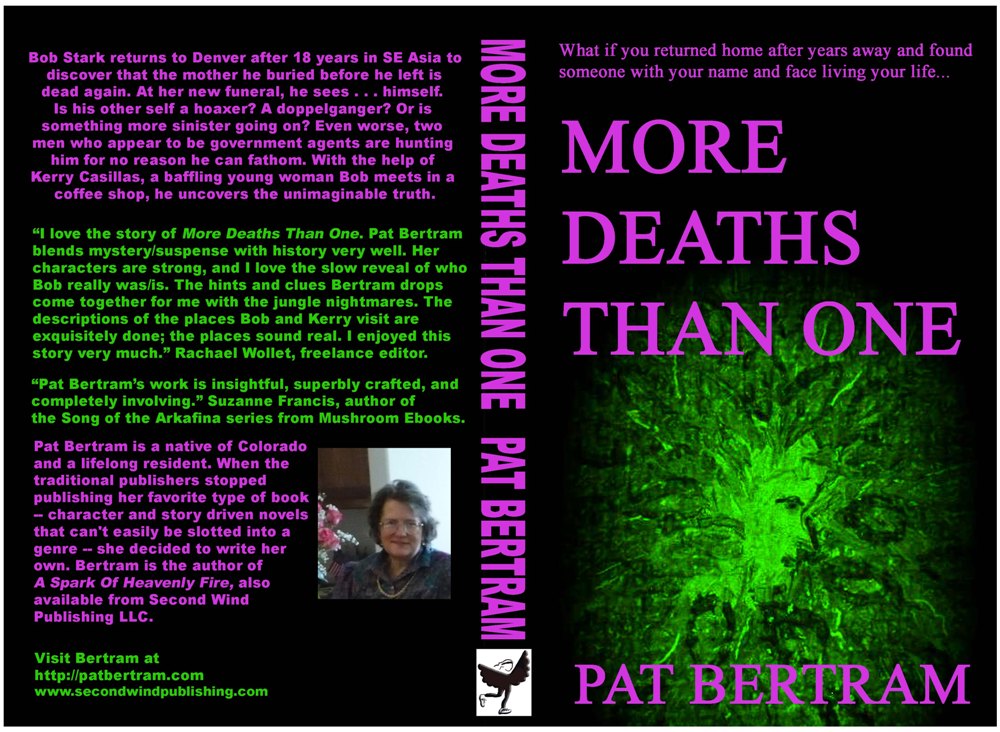
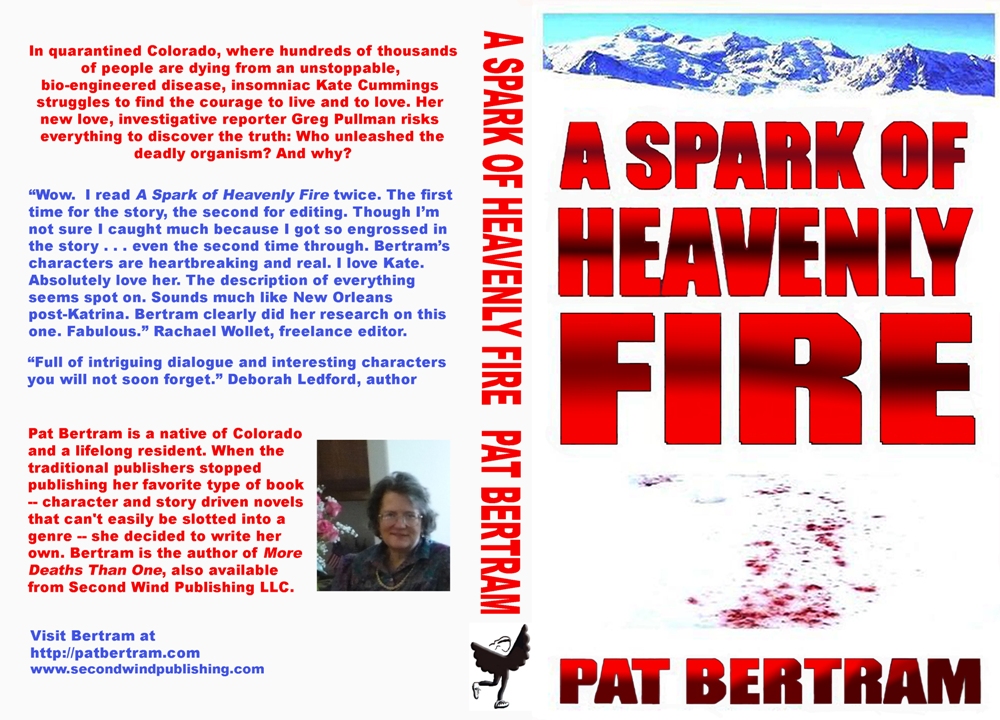
For A Spark of Heavenly Fire and More Deaths Than One, I had characters go in search of the information because I thought that if characters wanted the information badly enough, readers would also want the information and hence tolerate the intrusion of fact.

So how do you solve the problem of exposition? Do you dump it in all at once to get it over with? Do you parcel it out a bit at a time? Do you have one character tell another? Do you have a character seek it out? Do they read it somewhere, such as in an article or online? And how do you make it interesting for the reader?

My writing discussion group No Whine, Just Champagne on Gather.com will exchange ideas about exposition during our Live Discussion on Thursday, October 16 at 9:00pm ET. Hope to see you there!

When a Writer Defaults — Muse on Writing

Karl C. Klein, author of Unnatural Girl soon to be published by Second Wind Publishing, muses about writing:

I cover a lot of ground.
1)defaulting
2)modifiers
3)blonde/blond
4)OK/okay

Reminder: I don’t have the benefit of a formal education. This essay is from my observations. 

The difference between an archetype and a stereotype is vast. The archetype stands as bones upon which we hang flesh — a stereotype is a cardboard cutout we allow our readers to flesh out. I’ve come to call the use of stereotypes defaulting.  

People assume what they assume, shorthanding the world. (I know shorthanding isn’t a word.) We pre-decide many aspects of life. I believe this to be a gift from Darwin, but I’m not going into that aspect. I want to talk about literary fiction.  

When a writer defaults.  

Reading a short story some years ago, I was introduced to many characters. Finally, a new character entered the story. The writer wrote: 

“He was a black man.” 

I wondered about the racial background of all the other characters. I wondered why the writer found it important to mention his race and not the race of the other characters. I wondered: what does he really mean by “He was a black man.” 

The writer used a default. Obviously, all his characters were white, unless otherwise noted. But still, what does he mean by “He was a black man.” I think of the many, many black males I’ve known over the years, their similarities and their differences and realize the statement doesn’t tell me anything worthwhile. After all, Colin Powel and William Drayton (Flavor Flav) are both black men and from where I’m sitting, have little in common. 

“He was a black man” is meant as a default, a stereotype, a cardboard cutout, a straw man merely to take the place where a real character might stand. The reader has the responsibility to hang the flesh on this character based on the reader’s prejudgment of what a black man looks like and how he might act. 

Let’s bring another character into the room: “She was a blonde.” 

OK, now we have a story populated with Will Smith and Brittany Spears. 

Note: Blonde is a person, normally female, with blond-colored hair. This term in many circles is consider derogatory (The color of the hair is not the person. To say, “See that blonde over there” is akin to saying: “See those tits over there?”) To me, in literary fiction, I see ‘Blonde’ as a meaningless term, saying nothing about the character. The term blond refers to a range of colors from sun-faded wicker to light walnut. 

Allow me a copy and paste here, a snippet from a short story, “Remembering the 4th:” 

“Minutes before lunch, I found myself suspended against the lockers outside English class, angry faces like an animated Whitman Sampler pushed shouts at me. The walnut face holding me leached so close, I knew we’d be having pizza for lunch.” 

Let me backtrack a moment and say this: there’s nothing wrong with populating your work with straw men, allowing the reader to flesh them out. It’s been a style growing in popularity, some people arguing we should describe characters and scenes as little as possible, allowing the reader to be more involved in the creation of the story. I have no idea what the style might be called, but I call it ‘reductionism.’  

The rewrite of “Waiting for Godot:” 

The curtain opens, the stage is bare. For sixty minutes the audience stares, waiting for something to happen, imagining what Estragon and Vladimir might do if they were there. Now that’s existentialism.  

OK 

(Note: OK is the preferred spelling over okay, though I prefer okay, I write OK with clenched teeth just like I drop the *@%* comma between two independent clauses connected with a conjunction, though I hate that comma with the passion of 10,000 suns. However, I’ll only give up my comma splices when they peel the pen from my cold, dead hand). 

Anytime we drop something generic on the page, we’re defaulting. When we say ‘his eyes were brown,’ we’re assuming the reader is going to know what we’re talking about when in reality, brown for eyes is a generic color.  

Again, a copy and paste, this time from a book in process I’m editing as she writes, “As Time Goes By:” 

“I thought her eyes should be blue like the midday summer sky, but they were like oiled rawhide with splotches of suede and a baker’s chocolate corona.” 

(there’s that comma I hate with the passion of 10,000 suns) 

Note, too, the ‘midday summer sky’ is a different blue than a winter sky or even a morning sky. 

Another copy and paste from the same work: 

“Uncle Mike’s eyes are dark and rich like winter evergreen in the shadows but with a hint of moist soil. His hair’s black, almost blue with a curl flipping in the front like Superman. I had to look up, standing under him.” 

Let me address modifiers while we’re here. As the writer, we often get in the story and write from our point of view and not the character’s. We want to make a statement like “He was very tall,” which in reality is meaningless to the reader. First off, ‘very’ is not a very good modifier because it doesn’t say much.  

Substitute “damn” every time you’re inclined to write “very”; your editor will delete it and the writing will be just as it should be. —Mark Twain 

“Very” isn’t a very good modifier.

“Very” isn’t a good modifier. 

Both say the same thing. “Very” is great in dialog, particularly with excited tweens, but in narrative, similes and comparisons are better. 

“I had to look up, standing under him.”

is much better than:

“He was very tall.” 

Another example of ‘show’ instead of ‘tell.’ 

Another example from a short story: “Love Letters,” by Kacie Kameron: 

“I had the gift of a perfect love. 

I was fifteen, spellbound by his brown-green eyes, the color of wet cow dung, intoxicated by the moist sea air and hot summer morning.” 

I think when people say a story needs to open with a hook, this is what they’re talking about.  

“wet cow dung” is wonderful. 

Good writing is hard work. Great writing is damn hard work.

Do You Want People Studying Your Book in School?

After watching the movie, “The Jane Austen Book Club,” which followed several couples whose stories mirrored those in Austen’s books, I decided to reread Sense and Sensibility. While plowing through the incredibly long and obtuse introduction to the book, I couldn’t help wondering what Jane would think of it. Did she really mean to say all the things the author of the introduction said she meant to say? How would she feel if she found out that kids were studying her book in school and adults were studying it in book clubs? Did she mean her books to be studied? Or did she mean for them to be read?

I can’t think of anything more terrible than having my books taught in school. Well, of course I can think of a lot of worse things. On the list of world horrors, it comes pretty far down on the list. And, on a personal level, not being read at all would be worse. But still  . . . I think it would be dreadful for kids to sit in a stuffy classroom, bored out of their skulls, trying to figure out what I meant.

On the bizarre off-chance of that every happening, I’ll tell you right now what I meant. I meant for people to enjoy the stories. I meant for people to be taken away from their mundane lives for a couple of hours. I meant for people to read themselves to sleep and to wake up thinking about my world. And after all that, if I got anyone to wonder about the truth of anything my characters say, so much the better.

Did I have a theme? Did I use words in a certain way to create moods? Did I use symbols, such as lemon drops, as shortcuts to explain emotions? Of course I did. But including those was more for me, to keep me focused on the story. Because that is what I write. Stories. Not books to be studied, but stories to be read.

Finding the Dunce in Redundancy

I’m reading a book set in Australia in the early 1800s. Or rather, I was reading it. The author seemed competent, the story flowed, and the characters were engaging. Then all of a sudden I was jerked out of the fictive dream. “She had the intestinal fortitude necessary to help build this new country.” What? Intestinal fortitude in the 1800s? I think not.

First, intestinal fortitude is a ridiculous euphemism for guts. Fortitude is courage. Period. It needs no modifier. And it has nothing to do with intestines. Sure, some people do get cramps or diarrhea when facing fear, but then it’s up to the author to show it rather than relying on the wretched phrase “intestinal fortitude.”

Second, guts meaning fortitude did not make an appearance until the 1930s. Which means that the euphemism intestinal fortitude came later.

There are certain terms I would like to rub out of the English language. Intestinal fortitude is one. Coed is another. What a patronizing term! Coed is short for coeducational and refers to the women who were allowed into previously all male colleges and universities. Perhaps it had meaning back in the nineteen-thirties, but its use today is demeaning. It says men are educated, and women are co-educated. (Like a pilot and co-pilot.) So please, do not use coed. Student is sufficient, or woman student if you have to differentiate.

Another term that grates is excess verbiage. Verbiage means excess words, so excess verbiage is excess excess words. Doesn’t even make sense. Nor does “reiterate again”. Reiterate means to say again and again. Reiterate again means to say again and again, again and again.

The moral of the story? Don’t take any of your words for granted. They are a gift. And a responsibility.

Depth of Character

Sherilyn Winrose, author of Safe Harbor published by Second Wind Publishing, speaks about depth of character:

There are a few things which will make me stop from reading a story.

Cookie cutter, cliché characters is one of them. Or characters who lie flat on the pages like paper dolls.

There is one author I just don’t read anymore, because her characters repeat, repeat, repeat. I gave up on any hope of some miracle of original characters with her. She’s popular and vastly successful in the publishing world. Three pen names last I heard, all of them have best sellers. We should all be so lucky. All the same, she lost me for lack of originality in her characters.

When I approach a story, generally the characters come to me first. I write romance, so there are some things my Hero must have. Momma’s boys, short, no morals, weak of will or ego-driven men need not apply.

Heroine – Pretty much up to the author. I personally refuse to give voice to damsels in distress, clingy, needy types, martyrs, and drama queens.  Heaven save me from weak women!

For supporting characters the sky’s the limit so to speak. I have a lot of fun with my supporting characters.

The ‘complications’ or skills my characters have dictates the amount of research required to make them real.  Some of the complications/skills I have, so it comes pretty easy.  Other times they come to me with things I know nothing about.

How do you bake biscuits in a camp fire?  What would it be like to have the hopes of many rest on your shoulders?  How many miles can two riders and a pack animal travel in the Sierra Nevada?

All of these things add depth and reality to characters.  If your heroin loves and grows roses, please don’t tell me she has a miniature rose growing over an 8 ft arbor..that ain’t gonna happen, and she should know that.

How do you approach your characters, their quirks, skills and inner being? Do you get lost in research? Or find not much is required?

E-publishing , Print on Demand (POD), and Kindle Markets–Are They The Wave Of The Future?

Ms. Danzo writes fiction and has twenty years experience working in Sales and Marketing and has published various articles on a variety of subjects, including articles on professional/fictional writing and marketing. 

E-publishing , Print on Demand (POD), and Kindle Markets–Are They The Wave Of The Future?
by Sia McKye Danzo

For most of us, writing is a driving force within us. A passion. I’ve written and told stories all my life, but have only gotten serious about it the last couple of years. Some of you have been writing for many years.

Our goal, of course, is getting published. Getting noticed by an agent or publisher. We write to entertain others, to take them on a journey. To do that we have to have an audience, which means being published. We’ve worked hard towards that goal. We’ve entered contests, are trying short-stories and articles to build up our credits to get noticed. We’ve used other writers to read our stories and give us back constructive feedback all with the goal of getting published. We’ve queried. We’ve gotten back rejection letters and we sigh. We keep going, yet sometimes it’s discouraging. We get excited about an agent who requests more of our manuscript–almost afraid to hope because haven’t we all been there? Waiting on pins and needles for them to get back to us, hoping that maybe THIS time, it will be the one who gets our story published.

I get discouraged. I know some of you have as well. How many of you have really considered publishing to Print on Demand (POD) publishers or places like Kindle? It’s the wave of the future, I’m sure. One good indication of that is the hoopla with Amazon and e-books. Most major publishing houses have an e-publishing section because of reading the trends. Granted some of the e-books they offer are a bit out there. I know Harlequin has had down loadable stories, for a small price, for some time. I rather think they saw the handwriting on the wall and were testing out the market for e-publishing. They now offer some of their authors through e-publishing and some authors are strictly e-published.

A benefit of e-publishing and POD, is a bigger share of royalties, than with a traditional publisher–but not advances–as a rule. Your work is out there, but not necessarily on the local book store shelves like you pictured in your mind. Unless you are willing to promote yourself and your writing to get it there. You have to market, via blogs, websites, and social networks. Authors have to do that regardless of the medium, but the marketing is pretty much on you rather than assistance from a publisher.

Self-publishing/Vanity Press is where the author paid someone to print their book and not always a good quality of book either in writing style or subject matter. Unfortunately, some negative stigma of Vanity Press books still color people’s perception of e-publishing or Print on Demand publications.

Is e-publishing, not self-publishing, a good thing? Or do you think it’s harmful for an author in the long-run? Some of you have gone that route. What are your experiences now that you’ve done it? Have any of you been approached by an agent or publisher? Have any of you heard of anyone getting picked up by a publisher going this route? Does it count as being published when doing our queries?

Any thoughts?

The Art of Perseverance

My guest blogger today is Gina Robinson, author of Spy Candy, who persevered, and is now a published author. Congratulations, Gina!

The Art of Perseverance
by Gina Robinson

With the release of my debut novel Spy Candy ( Zebra Romantic Suspense, $3.99, ISBN 978-1-4201-0472-1)just weeks away, I’ve been asked to be a guest on a number of blogs. Because it took me years and years…and still more years to become published, talking about perseverance has become my theme. But as I was thinking about perseverance the other day, I realized that I don’t want people to get the wrong impression. To reach the goal of publication, a writer can’t give up. That’s true. Who knows when the call will finally come? But more than that, they can’t stay the same, either.

Persistence is not revising the same manuscript over and over and over, even when it’s been rejected all over New York. Persistence is also not stalking the same editor or agent from conference to conference, query to query, trying to sell them on that same tired old manuscript. Persistence isn’t trying to convince the world that you’ve written the next great bestseller and certain classic and berating the world when they don’t realize it. That’s insanity.

The art of perseverance requires growth. The writer must start a new manuscript, taking what’s been learned on the first and building on it to write a better novel, to discover their unique voice. The writer must look at the market objectively, broadening their search to include new agents, new editors, to take new chances.

Perseverance is a far greater thing than banging on the same door again and again. It’s believing in yourself, your own unique talents and skills, your worth as an individual, and your passion for storytelling. It’s writing for the sheer joy of it, even when it feels like publication will never happen. When you write for the joy of it, magic happens. You’ll feel passion, not frustration. And whether or not you’re lucky enough to ever publish, you’ll be content and have the drive to never give up on yourself. You will truly persevere.

Gina Robinson’s debut novel, Spy Candy, will be available everywhere books are sold on November 4, 2008.

On Writing: Finding the Words

I always thought I would be an author. I loved reading, and I had an affinity for words. I would spend days perfecting a six line poem, finding the perfect word to say what I meant, finding the perfect layout so the visual aspect of the poem adding to the meaning. I also wrote short allegories (that masqueraded as children’s stories). But what I really wanted to do was to write a novel. So I quit my job, stocked up on paper on pens (this was pre-PC), and sat down to write the story of a love that transcended time and physical boundaries, told with sensitivity and great wisdom. To my dismay, I discovered I had an appalling writing style, little wisdom, and absolutely no talent.

Back then I thought that to be a writer, one let the words flow from mind to pen to paper, like a medium transmitting messages from the spirit world. (Puts a whole new meaning on the word medium used as a vehicle for ideas!) But few words came to me. And the ones that did come, conveyed little of the story I wanted to tell.

And then one day no words came. Gone out of my head. Kaput. I lived with that sadness until many years later when I decided that, talent or no talent, I would write. So I did. I put one word on the page and then another. To my surprise, I finished the novel, but it is so terrible that I do not include it when I count the number of books I have written. (It’s a novelized version of my life, written more as therapy than literature, with a single benefit — I no longer have any desire to put myself in any of my books.)

After that, I started to read books about writing, which depressed the heck out of me because I couldn’t understand half of what they said. Rising conflict? Show don’t tell? Beats? The information gradually seeped into my subconscious, and so I learned.

After starting my fifth novel (or sixth if one counts that first autobiographical one) I discovered the internet and so wasted my words on commenting and blogging and emails, which is why I declared October as MyNoWriMo (My Novel Writing Month.) Unlike NaNoWriMo in November, MyNoWriMo does not require me to write 50,000 words in the month. The words do not flow out of me; I have to pull them out one by one. What I do expect from MyNoWriMo is to get back into the habit of writing, to find again the joy in building a story word by word.

And it’s working. Last night, for the first time in months, I felt that excitement of being in the story. I only wrote about 500 words (typical for me) but they are good words. I can hardly wait for tonight!