Happy (Belated) Bloggiversary to Me

I seem to be losing track of dates lately. Not days of the week, of course — I am always aware of what day it is to make sure I don’t miss a dance class — but the days of the month seem to be escaping me.

I’d planned to do a grief update at four and a half years, and although yesterday’s post was coincidentally about grief, the fact that it was my four and a half year anniversary didn’t even register. Nor did it register that it was the 27th. The day that my life mate/soul mate died — the 27th of the month — has always brought with it a special awareness, and yesterday that awareness went missing. It’s possible, of course, that subliminally I did remember, hence the mention of grief, but it could also be that I was simply reaching for a blog topic and seeing a friend reading Grief: The Great Yearning spurred me to write what I did.

Another blog post I’d planned to do was my blog anniversary post. On September 24, 2007, I posted my very first bloggerie, and September 24, 2014 came and went without any sort of awareness of the 7th anniversary of this blog.

Still aballoonsnother post I’d planned to do was a concurrent celebration — the anniversary of three years of daily blogging. During the first four years of blogging, I posted only three or four times a week, but on September 24, 2011, I made a 100-day commitment to post a daily blog, and I continued to post every day once that initial commitment was fulfilled. I was particularly interested in this anniversary because I’d planned to rethink the daily blogging — it’s not always easy to post every day, especially now that the traumas of my life are settling down a bit so that I have less to write about. (And, of course, I’m dancing more, so I have less time to write.) Yet, subliminally, I must have made the decision to continue, because here I am, still blogging each day.

When I started this blog, it was a way of getting a head start on promotion for when/if I got published. After I got published, it was supposed to be a way of promoting my books. But, as I’ve learned, blogging, like all social networking efforts, has minimal effect on book sales.

[Social networking only helps create a web presence. What makes a huge difference in sales is playing Amazon’s algorithmic games, trying to get on one of their seemingly endless bestseller lists and letting the algorithms catapult you to stardom. But, silly me, I am carrying on my own private war with Amazon (I think they exert too much control over the book business) and so, to use a very trite and quite disgusting metaphor, I’ve cut off my nose to spite my face. Facebook works to a certain extent if you join a zillion groups and frequently post links to your books in those groups, but that isn’t networking — it’s spamming.]

Although promotion is no longer a factor (well, not much) in keeping up with this blog I do like writing and publishing my articles. I feel safe here, and that feeling of safety gives me the freedom to say what I want, no matter how personal. Four and a half years ago when my life mate/soul mate died, his death catapulted me into such a world of such pain that it bled over into my posts. This blog became a place where I could try to make sense of what I was going through, to offer comfort and be comforted, to find my way to renewed life. And even though grief is mostly leaving me alone now, I’ve continued the policy of writing about the various traumas and conflicts of my life.

It’s nice to know that whatever life throws at me, whatever problems I encounter, whatever challenges come my way, this blog will be here for me, even if I do forget my bloggiversary.

***

Pat Bertram is the author of the suspense novels Light Bringer, More Deaths Than One, A Spark of Heavenly Fire, andDaughter Am I. Bertram is also the author of Grief: The Great Yearning, “an exquisite book, wrenching to read, and at the same time full of profound truths.” Connect with Pat on Google+. Like Pat on Facebook.
Finding the Wildness

Look what the goddess does when she is sad:
she takes up a tambourine, made of taut skin
and rimmed with castanets of brass,
and she begins to dance. The sound of flutes
blares out wildly, reaching even to the depths
of the underworld, so loud, so clamorous is it.
Look what the goddess does when she is sad:
she finds the wildness in herself, and as she does
she finds that there is joy there too.
~ Greek dramatist Euripides

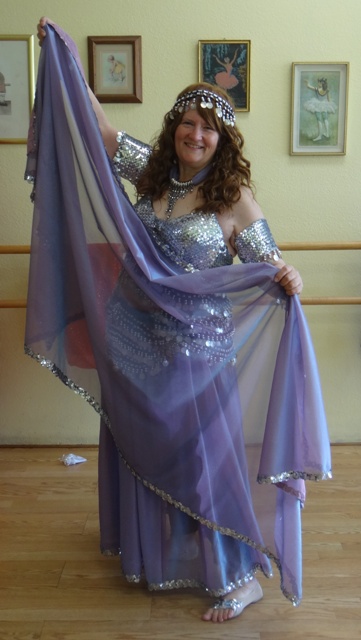
A reader left this lovely poem as a response to my post In the Presence of Death…, and Euripides’s words are so very apropos. Although I am far from being a goddess, I am hoping to find the wildness within. And I am dancing.

I don’t dance wildly — the classes I take are all classical dances with practiced steps and choreographed movements, but dance does speak to something wild deep inside of me. For someone who’s life has always been about words — both reading and writing — dance is a way of reaching the wordless depths, of finding the woman beneath the trappings of civilization and expectations and other people’s stories. I sense it’s also a way of awakening more of the wildness within, bringing with it the strength and courage to live fully and gracefully.

I once read an article that talked about stream-of-consciousness being the brain’s default mode. The journalist reported that in depression, the default mode network appears to be overactive, that a depressive brain shows a pattern of balky transitions from introspective thought to work that requires conscious effort, and it frequently slips into the default mode during cognitive tasks. A depressive brain also shows especially weak links between the default mode network and a region of the brain involved in motivation and reward-seeking behavior.

This could be the reason why blogging is so easy for me and writing fiction so hard. Blogging for me is stream-of-consciousness writing and brings immediate rewards, while writing fiction is more cognitive and takes more conscious effort than I am sometimes willing to spent. (A fellow writer once described writing as a mental prison, and while most authors seem to find freedom in fiction, I find it restrictive, especially since the rewards of a finished project are delayed for sometimes years.)

But dance . . . ah, that transcends both stream-of-consciousness and cognitive thinking. It’s a matter of concentration and memory, of training the body to do your will (or rather, your teacher’s will). And where there is neither stream-of-consciousness nor cognition, there is no depression, no sadness. Or so it seems.

Although I still have upsurges of sadness when I am alone, I am seldom sad in class and never depressed. I don’t always find dancing joyful. It’s often hard for me and frustrating at times when my body simply will not do what I will it to do, or when I cannot get what seems to be a simple step. But dancing is always compelling, even when it is difficult — especially when it is difficult. The discipline of stretching just a bit further or reaching a new understanding of a movement, helps dig beneath what I know of myself, helps find the wildness in me. There is joy in that, and joy is its own reward.

There is also joy, of course, in dancing in unison with other not-so-young women who are also dedicated to the art, and there is vast joy in having learned a new dance, particularly for someone such as I who never in her life conceived of such a possibility.

During class, after we warm up, before we work on the current dance, we practice the dances we already know. And each time we dance one of those numbers, there comes a point in the dance where I can feel a huge smile on my face as I realize that oh! I am dancing! And for that moment, I feel like a goddess.

***

Pat Bertram is the author of the suspense novels Light Bringer, More Deaths Than One, A Spark of Heavenly Fire, andDaughter Am I. Bertram is also the author of Grief: The Great Yearning, “an exquisite book, wrenching to read, and at the same time full of profound truths.” Connect with Pat on Google+. Like Pat on Facebook.

Crooked Paths

twists and turnsIf it is really true that it is better to say nothing at all if you can’t say anything nice, then this is going to be a blank blog because nothing good happened before or after dance class. Nothing really terrible happened either, just a lot of bedevilment.

I don’t believe in evil spirits, especially not the kind that bring misfortune, though many people do. Traditionally, the Chinese believed that evil spirits could only travel in straight lines, hence all their winding roads and curled roofs. So, to be on the safe side, tomorrow I will make sure I travel on non-linear paths and see if my luck changes.

Apparently, these spirits also avoid the light, so here’s wishing you many new lightfully crooked paths!


***

Pat Bertram is the author of the suspense novels Light Bringer, More Deaths Than One, A Spark of Heavenly Fire, andDaughter Am I. Bertram is also the author of Grief: The Great Yearning, “an exquisite book, wrenching to read, and at the same time full of profound truths.” Connect with Pat on Google+. Like Pat on Facebook.
Get Better Acquainted with Your Devil

I don’t follow astrology, but occasionally a friend sends me a link to particularly interesting horoscope of mine, such as this one:

“My definition of a devil is a god who has not been recognized,” said mythologist Joseph Campbell. “It is a power in you to which you have not given expression, and you push it back. And then, like all repressed energy, it builds up and becomes dangerous to the position you’re trying to hold.” Do you agree? I hope so, because you will soon be entering the Get Better Acquainted with Your Devil Phase of your astrological cycle, to be immediately followed by the Transform Your Devil into a God Phase. To get the party started, ask yourself this question: What is the power in you to which you have not given expression?

Even if this particular prognostication isn’t true (and I seldom find horoscopes to mirror anything in my daily life), it is germane to all of our lives. For example: grief. If we repress grief, it assumes an enormous power over us for the rest of our lives, but if we make friends with grief, or at least acknowledge it and let it run its course. Grief isn’t either a god or a devil of course, but it does seem to be a great evil. It can also be a force for good if you let it, helping turn you into the person who can survive an inimaginable loss.

gift2I’m not sure what devil phase I’m in now, what power in me I haven’t yet expressed. Nor do I know what position I’m trying to hold. If this horoscope is true, I will find out soon enough. And if it isn’t true, well, it poses an interesting question. I don’t like repressing any sort of energy, because it takes so much extra energy to keep anything repressed, but if I am repressing something, chances are I wouldn’t know what it is that I am repressing.

Someone once told me I am suppressing my creative energy since I’m not writing fiction, and I suppose it’s possible, but the truth is, there are all sorts of ways to be creating, including blogging and dancing, both of which I am doing. Besides, writing isn’t a god for me — it’s always been an intellectual choice, rather than something I’m compelled to do.

It would be more interesting, of course, if the alleged energy I am repressing is something I don’t know about, because the surprise of finding it and unrepressing it would be fascinating. Unfortunately, I don’t think I’m all that fascinating. Still, I’ll be open to both my Get Better Acquainted with Your Devil Phase and my Transform Your Devil into a God Phase. Could be illuminating.

***

Pat Bertram is the author of the suspense novels Light Bringer, More Deaths Than One, A Spark of Heavenly Fire, andDaughter Am I. Bertram is also the author of Grief: The Great Yearning, “an exquisite book, wrenching to read, and at the same time full of profound truths.” Connect with Pat on Google+. Like Pat on Facebook.

 

Inviting Myself to Dream, Explore, Believe

Yesterday I moved energy around. Today I moved two carloads of stuff around. Took the things to a friend who has a use for them. At least I hope she does, otherwise I’ve just used her as a dump. Of course, she’s also free to move the stuff around. It’s hers now.

Someone used me as a means of moving energy/stuff around — she gave me her tarot cards and the book to help me interpret the meanings of my readings. I’m not really into tarot or any sort of divination for that matter. If we can change the future, then it doesn’t matter what the predicted future is, and if we can’t change it, it doesn’t matter either.

Still, out of curiosity, I did a one-card tarot reading where you ask a question and the cards give you some sort of answer.

Right before Jeff died, he told me things would come together for me. And recently, my publisher said he has a strong feeling things will work out for me. Of course, I’d like to know how they will work out. I mean, personal and financial successes are ways of things working out, but so is death. (That is how things work out for all of us in the end.) But I gave the cards a break and simply asked if things will come together for me.

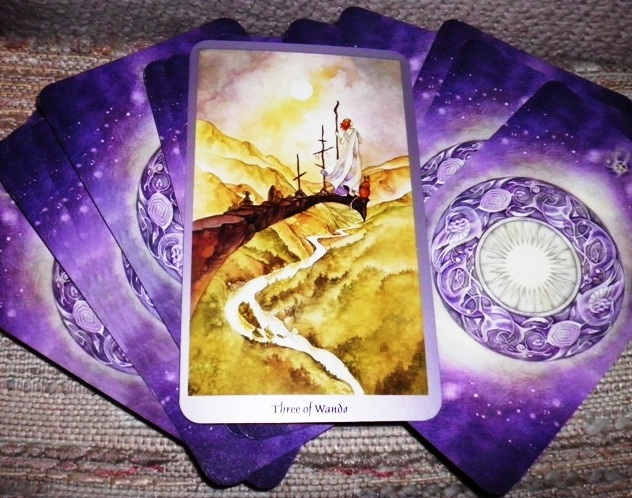
I dealt myself a fantastic card, the Three of Wands, painted by Stephanie Pui-Mun Law. The picture is of a woman accompanied only by a cat, standing on the end of a bridge to the edge of the world. It arcs out across the sky, and ends abruptly, a shimmering river far below. She is obviously standing on the edge of the precipice, wondering where to go. (Sounds familiar, doesn’t it? That seems to be a recurring theme in my wonderings on this blog.)

Knowing that sparkling potential waits for her, she takes a step. And it is not emptiness that meets her unhesitating foot, but sturdy rock and shale. She continues to walk, the bridge growing beneath her feet with every step.

Wooo. Seems apropos, doesn’t it? And so much like an answer to my question. Just go, believe in the journey, and everything will come together when I need it.

The section about the Three of Wands in Shadowscapes Companion by Stephanie Pui-Mun Law and Barbara Moore ends with, “The Three of Wands invites you to explore, seek out the uncharted, expand your horizons. Take a long view of situations and express leadership.”

I’m not sure how much leadership one can express when one is alone at the end of bridge that is being dreamed into existence as one walks upon it, but otherwise, it’s exactly what I’ve been inviting myself to do — dream, explore, believe.

***

Pat Bertram is the author of the suspense novels Light Bringer, More Deaths Than One, A Spark of Heavenly Fire, and Daughter Am I. Bertram is also the author of Grief: The Great Yearning, “an exquisite book, wrenching to read, and at the same time full of profound truths.” Connect with Pat on Google+. Like Pat on Facebook.

Excerpt from LIGHT BRINGER

Description of Light Bringer by Pat Bertram :

LBBecka Johnson had been abandoned on the doorstep of a remote cabin in Chalcedony, Colorado when she was a baby. Now, thirty-seven years later, she has returned to Chalcedony to discover her identity, but she only finds more questions. Who has been looking for her all those years? Why are those same people interested in fellow newcomer Philip Hansen? Who is Philip, and why does her body sing in harmony with his? What do either of them have to do with a shadow corporation that once operated a secret underground installation in the area? And how does Jane fit into the puzzle?

Excerpt from Light Bringer:

Realizing Mac was waiting for her reaction, Jane said in a noncommittal voice, “You saw a UFO.”

Mac winced. “UFO? No. An FO. There was nothing unidentified about it. I knew exactly what I saw.”

“An extraterrestrial space ship,” she said flatly.

“Of course not, and aliens didn’t abduct me, either. It happened right after I closed on this property. Unable to sleep, I drove out here and was leaning against my rental car looking at the stars when the crescent flew directly overhead. I could see it as plainly as I’m seeing you right now.

“The craft was about fifteen feet in diameter, made of a composite ceramic. A remarkably conductive amalgam of the most refined copper and the purest silver coated its underside, turning it into an electrical circuit offering no resistance to the wave of electromagnetic energy it floated on. It was absolutely silent, sweeping in ions from its flight path, like a whale feeding on plankton. The ionized air around it glowed, giving it an unearthly look, but it was very much terrestrial in origin.”

Jane lifted her hands and let them drop. “How could you learn all that from one brief sighting?”

“I was part of a team working on a craft exactly like it, only we hadn’t been able to get ours off the ground, at least not then.”

She regarded him warily.

“I’m not insane,” he said, answering her unvoiced question. “I’m an aerospace engineer, retired from the Jet Propulsion Lab in Pasadena.”

It took a minute or two for the significance of his story to register. “I see. You think Stellar Optics was a cover for a space telescope project, which was a cover for the real project—the development of a flying saucer.”

He didn’t respond, but he didn’t contradict her, either.

***

Where to buy Light Bringer:

Amazon

Barnes & Noble Nook

iStore (on iTunes)

Palm Doc (PDB) (for Palm reading devices)

Epub (Apple iPad/iBooks, Nook, Sony Reader, Kobo)

Update on Writing, Spirits, and Other Matters

Lately I’ve been hearing about all sorts of blatant plagiarism, where “authors” steal another writer’s published book, adding sex scenes or scrambling a few words and passing it off as their own. In one case, a plagiarist stole the exact cover of the book. In this brave new world of publishing where anything goes, it’s harder than ever to keep control of one’s own work. Once it’s in the public eye, the book is available to anyone with a few cents for an ebook download. Chances are, the plagiarized book would be lost in the millions of books now available, and even if the crime was discovered, most self-published authors don’t have the money to fight such infringements, and even if they did, it’s one person’s word against the other. Many self published authors don’t even bother to register their books with the copyright office in their country because once a book is written, it’s automatically covered under copyright laws. But courts are a different matter. They need the official copyright to proceed with trials and repercussions.

bookI’ve never quite known what to do about publishing my work. For now, I have a publisher, but when I get back to writing Ms. Cicy’s Nightmare, a murder mystery based on my dance class, I will continue publishing it on my blog, the way I started. (I am a bit embarrassed that the book is in hiatus after a single chapter, but in my defense, as soon as I cleared the month of July to write, life filled the void with all sorts of traumas and family dramas, which I am only now recovering from.) But when the book is finished? I might or might not get an official copyright. I am not litigious, so chances are I wouldn’t take any copyright infringement to court. Besides, I could easily prove the book is mine since the names of my characters will reflect their real-life personas. At least, that’s the plan. Besides, I don’t much like government intervention of any kind, even if it’s in my best interests.

The ordeals of the last month, including my father’s hospitalization, my brother’s, increased insanity and my trip to return him to Colorado have pretty much numbed my creativity. Since so many of the would-be perpetrators are on hiatus’s of their own — weddings, vacations, illnesses — I don’t have much impetus to write, but soon . . .

As for other updates:

My sister and I drank spirits to the spirits again tonight, if only to bolster our own spirits.

And lastly, I just got an email from Squidoo saying they been purchased by HubPages and that some of my content will be transferred to the HubPages site. Do you have any experience with HubPages? I’m trying to decide if I should just delete my Squidoo account and forget the whole thing or let them transfer my content.

***

Pat Bertram is the author of the suspense novels Light Bringer, More Deaths Than One, A Spark of Heavenly Fire, and Daughter Am I. Bertram is also the author of Grief: The Great Yearning, “an exquisite book, wrenching to read, and at the same time full of profound truths.” Connect with Pat on Google+. Like Pat on Facebook.

Excerpt from LIGHT BRINGER by Pat Bertram

Description of Light Bringer:

LBBecka Johnson had been abandoned on the doorstep of a remote cabin in Chalcedony, Colorado when she was a baby. Now, thirty-seven years later, she has returned to Chalcedony to discover her identity, but she only finds more questions. Who has been looking for her all those years? Why are those same people interested in fellow newcomer Philip Hansen? Who is Philip, and why does her body sing in harmony with his? And what do either of them have to do with a shadow corporation that once operated a secret underground installation in the area?

Excerpt from Light Bringer:

As Special Assistant to the Director of Logistics and Deployment, Teodora, also known as The Fixer, had the best and brightest operatives the department had to offer. Intelligence agencies all over the world recommended their top young agents, hoping to cement their relationship to the powerful organization. The Deputy Director of the FBI himself had written recommendations for Keith Derrick and Hugh Wittier, mentioning their athletic accomplishments, superior scholastic standings at their respective Ivy League Universities, and exceptional performances at the FBI academy.

Teodora studied the two handsome young men visible on the split screen of her computer. They might have impressive pedigrees and extensive training, but they were unskilled liars. She didn’t even need the voice stress analyzer built into her computer to tell her they were deviating from the truth; changes in the size of their pupils and arrested movements of their hands betrayed them. Unfortunately, she could not tell which specific incident they were lying about; their involuntary reactions had begun as soon as Keith opened his mouth to give the report.

They would not be concerned with her knowing they had presented themselves as NSA agents; all her operatives used whatever tools were necessary to get the job done. They would not be concerned with her knowing about the stolen car; they had reported it immediately. They would not be concerned with her knowing the subject had apparently been expecting them or that he had assumed they were interested in the books he read. That left the man—the tall bearded man wearing dark sunglasses and a green tracksuit—who had come out of the bedroom aiming a pistol.

If this gunman did exist, who was he? The subject had no close friends. They only knew about Emery Hill because the operatives found a note wedged in the rear of a desk drawer when they had gone back and combed the apartment.

If the gunman did not exist, how had the subject escaped? And why? Hugh and Keith had been sent simply to ask him what he knew about his mother’s cousin and her ward.

Teodora made a mental note to have her computer technicians look deeper into the subject’s background, then gave the operatives her undivided attention.

Hugh stared out at her from the computer screen. “Why are we looking for these women?”

“They have information.”

“We still have not found out what Hansen knows about them,” Keith said, “and the only item we found in his apartment that might be germane is the photograph album we sent you.”

“Is your fax machine set up?”

Keith nodded.

She faxed them one of the photographs her technicians had altered to show what the females might look like today. Keith reached for the fax, scrutinized it, then handed it to his partner.

A faint line appeared between Hugh’s brows. “I saw the younger woman walk by the coffee shop in Chalcedony.”

Keith snatched the picture and gave it a second look. “I didn’t see her.”

Hugh lifted one shoulder in a barely perceptible shrug.

Teodora made certain that her expression remained blank, but she could not keep her heart from beating faster.

“Find her,” she said.

***

Where to buy Light Bringer:

Amazon

Barnes & Noble Nook

iStore (on iTunes)

Palm Doc (PDB) (for Palm reading devices)

Epub (Apple iPad/iBooks, Nook, Sony Reader, Kobo)

It’s Done

No words. Just tears.

Handmaiden of Death

In June, I finished my started projects, cleaned house, and did everything I could think of to enable me to dedicate July to writing my new novel. I wrote for five days, then life, with a mocking laugh, stole my free time.

My elderly father developed prostate complications, and while he was in the hospital, his general practitioner decided to use the opportunity to do other tests. And since my father decided he had the right to refuse any treatment, he declined to sit in a chair or walk down the hall. And so he developed pneumonia, which extended his hospitalization.

He is home now, but mostly bedridden by choice. He can still walk, but both my sister, who came to help out, and I insist that one of us be there because he refuses to use the walker. Not a problem, really. He prefers to stay in bed except when he feels the need to empty his bowels, and so often, that feeling comes from his body sending him the wrong signal or perhaps he is simply misinterpreting what he feels.

During the past few years, I’ve seen way too many people in the final stages of life — a brother, my mother, my life mate/soul mate, and now my father. The first three died of cancer, and my father is simply wasting away from old age, his once strong body slowly shutting down.

To be honest, I find the end of life horrific, both for the dying and the tortures they endure(d), and for me as a bystander and future victim. I know this is the cycle of life — conception, birth, growth, decline, death — but something in me cannot grasp (or accept) the idea of decline.

heavenOne of my favorite end-of-life scenes is from the movie Soylent Green where the sick and dying are taken to beautiful rooms and treated to a visual and musical montage of forests, wild animals, rivers, and ocean life, scenes that had long disappeared from earth because of human overpopulation. And then the sick folks were gone, peacefully and instantly. That seems a much better and more humane way to die than waiting for the body to eat itself with cancer or to begin decaying while the body is still alive. (In Biblical times, executioners would strap a dead man — the “body of death” — on to the one convicted, and as it began to decay it would begin killing the living man . . . by decomposition. So vastly different from a Soylent Green death!)

In our culture, we basically have no recourse but to let the body do what it will. And rightly so, I suppose. Who among us is wise enough to say who is to live and who is to die? I remember another story I once read where the aged mother had told her daughter she didn’t want to live as a vegetable, and if that ever happened, then she wanted her daughter to end her life. One day the mother did end up paralyzed with no means of communication, but she found a quiet joy in her greatly condensed world. And then her daughter killed her. Ouch.

My sister had a rough time with our father last night, and tonight is my turn to be on call. We got a long-range wireless doorbell and gave him the button to push when he wants us. We women move the doorbell from room to room depending on who is to answer his call. It seems strange to be handmaidens of death, but that is the role we have accepted for now.

Despite all this, I’m still hoping to work on my book a little more this month, though exhaustion — for me, anyway — is not exactly conducive to literary endeavors.

***

Pat Bertram is the author of the suspense novels Light Bringer, More Deaths Than One, A Spark of Heavenly Fire, and Daughter Am I. Bertram is also the author of Grief: The Great Yearning, “an exquisite book, wrenching to read, and at the same time full of profound truths.” Connect with Pat on Google+. Like Pat on Facebook.




