By the Light of the Moon

Last night I went walking by the light of the moon. I was in a group, and we strode on a trail beside a riverbed, so we didn’t have to deal with traffic, which is just as well. Even with the full moon, we would have been invisible to drivers. (I couldn’t see the couple who walked in front of my car as I drove to the rendezvous until I was almost on them. Good thing they were aware of me, though it wasn’t bright of them to be so careless.)

I don’t remember ever taking a moonlit walk before. When I was a young adult, before I got my car (the same one I have now, incidentally) I walked to work, and I often had to hike home alone in the dark. I suppose during many of those city nights there had been a visible moon, but streetlights brought the sky in close, so something as far away as the moon would not have been as impressive or as memorable as the moon last night.

I do remember one particular night walk — it had to have been almost twenty-five years ago when my now deceased life mate/soul mate was still strong and healthy and up for adventure. We were living in a small town. Snow had fallen, and no one was about. No cars were on the road. All was still. Not even a hint of a breeze. We could hear the crunch of pristine snow beneath our feet, and the almost cathedral-like silence. It was bright — we weren’t walking in pitch black — but I don’t know if the light came from a moon or from ambient light reflected off the snow. We only walked a few blocks to a small town square. We stood there for a few minutes, enjoying the magical night, and then we headed back.

I don’t recall any other night walks. We spent the last couple of decades in ranching country, and an irrigation ditch ran in front of the house. Stagnant water. Mosquitoes. Need I say more? Well, maybe I do. I’m sensitive to mosquito venom — the bites always make me sick — so as much as possible I stayed inside when evening came. Besides, I didn’t much like the thought of meeting a coyote or a fox (or even an angry dog) on that empty country road.

So last night was a treat. A cool, clear, autumn evening with a hint of a breeze. A few stars. And a moon so bright in the huge empty sky, it cast our shadows on the pathway.

A walk worth remembering. A walk worth writing about.

***

Pat Bertram is the author of the suspense novels Light Bringer, More Deaths Than One, A Spark of Heavenly Fire, and Daughter Am I. Bertram is also the author of Grief: The Great Yearning, “an exquisite book, wrenching to read, and at the same time full of profound truths.” Connect with Pat on Google+. Like Pat on Facebook.
How Mountains Shape My Stories

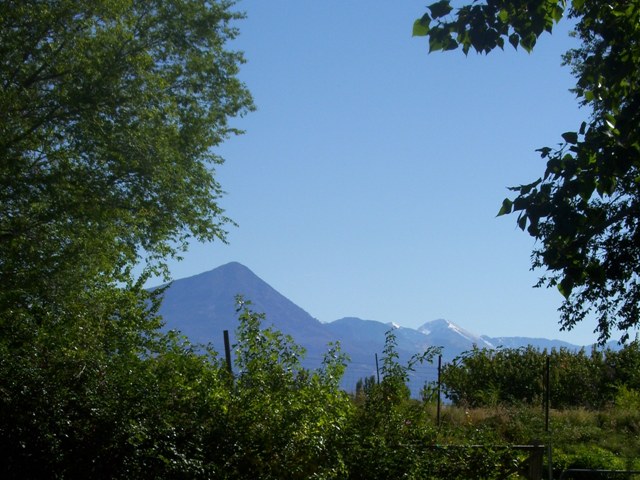
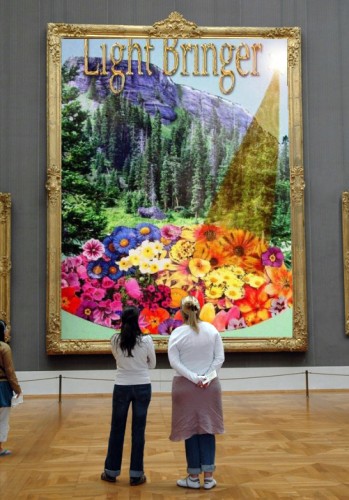
Because I’ve always lived in the shadow of mountains, mountains always shadow my writing. This is especially true in Light Bringer. The story begins when a baby is found on the doorstep of a remote cabin in the shadows of the Rocky Mountains, and continues years later when the foundling, now an adult, returns to the high country to find out who she is. The mountains in my novel are both protective and secretive — the hills protect those who live in their shadow, yet the mountains also harbor terrible and awesome secrets that threaten those same people.

Whenever I needed a hiding place for the secrets of the ages in Light Bringer, I searched maps for isolated mountain ranges, and ended up with a library beneath the Ahaggar Mountains in Algeria, ancient artifacts beneath the Beishanmai Mountains in the Gobi Desert, and experimental spacecraft beneath the McDonnell Ranges in Australia. I’d heard about  the mountains in Australia where the experiments were being done, and in my research I’d come across hints of what lay beneath the Ahaggar Mountains, but the Gobi location was strictly a guess, though later I discovered that in fact, caves deep inside the Beishanmai Mountains were repositories for ancient treasures.

Maybe the mountains themselves were helping with the book.

Excerpt from Light Bringer (Incidentally, though not all the treasures mentioned might have been found beneath the Ahaggar mountains, they do exist):

Of all the extraordinary things Teodora had seen since starting work on her current assignment, the library, deep within the Ahaggar Mountains in Algeria, had been the most stunning. She did not know who had created the library or how it had come into IISA’s possession, but she had the privilege of being one of the few people to have seen the place.

The passageways, dug thousands of years ago, were painted with pictures of cities that had crumbled to dust before history was born. Those tunnels led to a series of vast modernized rooms—climate-controlled, dust-free, computerized.

One room contained row upon row of glass cases, which protected manuscripts and scrolls too fragile to handle. Another room contained an untold number of clay tablets, some written in languages that had yet to be identified. A third room contained crystals and optical discs that held digitalized information, and other discs that gave off holographic images when spun. Though seemingly futuristic, they were relics of an incredibly remote past.

The final room contained bound books, most of which were less than two thousand years old. Tens of thousands of these books were alchemical texts that detailed such things as perpetual lamps, the manipulation of matter to produce force fields, and simple ways of creating sustainable energy. A few also talked about how certain churches in France were linked together to create a message, which pre-dated Christianity. These churches were built on ancient power points that had been mapped by astronomers and geomancers who wanted to warn future generations of the heavenly body that would come to destroy earth.

***

Pat Bertram is the author of the suspense novels Light Bringer, More Deaths Than One, A Spark of Heavenly Fire, and Daughter Am I. Bertram is also the author of Grief: The Great Yearning, “an exquisite book, wrenching to read, and at the same time full of profound truths.” Connect with Pat on Google+. Like Pat on Facebook.

I’m a Guest on the Second Wind Publishing Blog!

I am blogging at my publisher’s blog today, talking about Crashing the (Science Fiction) Party,

Once a long time ago, I crashed a Halloween party. Sounds very bold, doesn’t it? But truly, it was out of character for me, and besides, I was in costume so in a way the person who crashed the party wasn’t really me. I remember that the party was given by a friend of a friend, but I have no idea how or why I decided to go — perhaps as a joke to see how long it would take for people to realize they didn’t know me. Continue reading—>witch

My previous guest post for Second Wind Publishing was Finding the Truth of a Story,

We are steeped in story. From birth to death, story forms our lives. Today, more stories are available to us in more media than ever before in history, including the stories we share with each other and ourselves. What is a daydream if not a story of the future we tell ourselves? And at night, while sleeping, our dreams tell us other stories. No wonder we have such a hard time finding a story that is not clichéd. Continue reading—>

My most popular post on the Second Wind Blog is: What is Your Character’s Favorite Color?

Because colors have meaning, a character’s favorite color can tell us a lot about him or her. Red for an ambitious extrovert. Pink for an affectionate, compassionate person. Yellow for an optimistic artist. Green for a benevolent humanist. Blue for a cool, confident conservative. Purple for an intuitive, spiritually oriented person. Brown for a down-to-earth type. Continue reading—>

***

Pat Bertram is the author of the suspense novels Light Bringer, More Deaths Than One, A Spark of Heavenly Fire, and Daughter Am I. Bertram is also the author of Grief: The Great Yearning, “an exquisite book, wrenching to read, and at the same time full of profound truths.” Connect with Pat on Google+. Like Pat on Facebook.

Writing: Passion or Puzzle?

Most how-to books on writing suggest getting the first draft down as quickly as possible so that the passion shines through. This is good advice, and I would follow it if stories came easy to me, but they never do. I worried about this (for five minutes or so), wondering if my novels would feel dry and unemotional because I approach them as a puzzle, but the only difference between my way of writing and the so-called right way is that I do my thinking as I write rather than as I lbjigsawrewrite.

Is one way better than another? I don’t know, but if we accomplish what we set out to do, both the logical writers and the passionate ones can end up with interesting stories that will evoke emotions in our readers. In my case, during rewrites I get rid of much of the dryness that comes from the puzzle approach. In your case, perhaps, you lose some of that freewheeling passion when you organize what you have written into a more cohesive story.

We all have to find the best way to write. I am not condoning poor grammar, typographical errors, bad plotting, ignorance of story elements, or any of those other rules that new writers rail against. I’m talking about the fun of writing, the passion, the puzzle.

Samuel Johnson remarked, “No man but a blockhead ever wrote, except for money.” I guess that makes most of us blockheads, because we write knowing that except for a select group, there is little money to be made from writing. We need other reasons for spending so much time bleeding words.

For me, it’s the puzzle. As frustrating as it gets, I love figuring out plots, character’s motives, new ways of presenting common thoughts. Beats crossword puzzles any day.

***

Pat Bertram is the author of the suspense novels Light Bringer, More Deaths Than One, A Spark of Heavenly Fire, and Daughter Am I. Bertram is also the author of Grief: The Great Yearning, “an exquisite book, wrenching to read, and at the same time full of profound truths.” Connect with Pat on Google+. Like Pat on Facebook.
When a Writer is Silent . . .

I am not shy around people, though I am more of a listener than a talker, particularly when they are discussing subjects of which I have no interest or knowledge, such as celebrities, TV shows, high profile court cases. Even when people are talking about things I can speak of, I generally don’t fight for the floor except when the conversation sparks a new idea and I want to give it voice.

My propensity for being the “designated listener” has never been a problem because most people seem to prefer to talk, but things are different now when people discover that I am a writer. My silence makes them wonder if I am studying them to use as characters in a book.

Strangely, this never occurred to me. I spend so much time alone that simply being with people is a treat. I bask in their words and the camaraderie no matter what the topic of conversation. I know this is not the case with other writers. They do study people to learn more about how their characters should/could act. They also use people they know as characters in their boFriendsoks. As Anne Lamott said, “You own everything that happened to you. Tell your stories. If people wanted you to write warmly about them, they should’ve behaved better.”

My characters rise out of the needs of the story. If the character needs to be shy, I make him shy. If she needs to be interested in the minutiae of everyone’s life, I make her so. Occasionally, I base a character on an actor in a movie, especially if I need to describe the character to someone. For example, Greg Pullman in A Spark of Heavenly Fire was loosely based on Jack, Bill Pullman’s character from While You Were Sleeping. I wanted Greg to be movie-star handsome as well as nice, and I named him Pullman to remind me of these two characteristics every time I wrote about him. But for the most part, the character of Greg evolved to fit the needs of the story. The same thing happened with Mary Stuart, the hero of Daughter Am I. I based her loosely on Lisa Walker, the character of Mary Stuart Masterson played in Bed of Roses, and I used the name Mary Stuart for my character to remind me that my Mary, like Lisa, was both strong and vulnerable. The name was supposed to be a working name — I planned to change it when I found a better name, but the character and the name evolved together, and could not be separated.

So, if you are ever in a conversation with me, and I am silent, you never have to worry about appearing in one of my books.

Well, hardly ever.

***

Pat Bertram is the author of the suspense novels Light Bringer, More Deaths Than One, A Spark of Heavenly Fire, and Daughter Am I. Bertram is also the author of Grief: The Great Yearning, “an exquisite book, wrenching to read, and at the same time full of profound truths.” Connect with Pat on Google+. Like Pat on Facebook.
I Am Not an Authoress!!!!

Recently, someone called me an authoress, and I could feel the word grate up and down my spine. What an atrocious word to use today! It’s even worse than co-ed, a despicably sexist and patronizing term. (Coed is short for coeducational and refers to the women who were allowed into previously all male colleges and universities. Perhaps it had meaning back in the nineteen-thirties, but its use today is demeaning. It says men are educated, and women are co-educated. Like a pilot and co-pilot. So please, do not use co-ed. Student is sufficient, or woman student if you have to differentiate.)

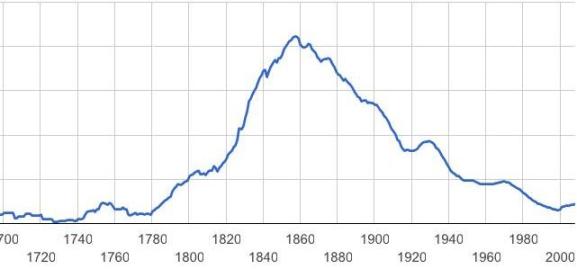
Authoress is an old term and was used as early as 1485. It grew in popularity until the mid 1800’s and found it’s nadir in 1998. Now “authoress” is on the rise again. Why? Not only is it old fashioned, of use only in historical dramas or other historical contexts, it is ugly and demeaning and redundant since “author” includes both males and females. According to the free dictionary, author means a) The writer of a book, article, or other text. B) One who practices writing as a profession.

If I had to describe myself as an “authoress,” I would never admit that I am a published writer. I even refuse to accept a friend request on Facebook from anyone who uses “authoress” as a title before or after her user name. Of course, I don’t friend anyone who uses “author” as a title either because I have doubts about their sincerity in wanting to be a friend.

If I need to describe my writing self, I tell people I’ve written books. I give them my card to show them what books I have written. Sometimes I even tell them I am a writer. Even though I tend to believe that an author is one who makes a living at writing and I have not yet achieved that status, I have even called myself an author once or twice.

But authoress? Never!

Use of "Authoress"

Use of “Authoress”

***

Pat Bertram is the author of the suspense novels Light Bringer, More Deaths Than One, A Spark of Heavenly Fire, and Daughter Am I. Bertram is also the author of Grief: The Great Yearning, “an exquisite book, wrenching to read, and at the same time full of profound truths.” Connect with Pat on Google+. Like Pat on Facebook.

Describing a Scene Through the Eyes of a Character

Description by its nature stops the forward movement of story. No matter how beautifully executed the passage, no matter how well a writer engages the senses, description alone goes nowhere. To be dynamic, it has to be part of the physical movement of the plot or part of the development of the character. This is done by not just describing something, but by showing the effect on the character and how the character reacts.

In the 1980s, bookracks in grocery stores were full of gothic romances. Perhaps you remember seeing those covers: a brooding mansion in the background, a woman in a diaphanous gown running away from the house, looking back at it in fear. Despite their triteness, those were dynamic covers: the pictorial description of the house, the effect on the character (fear), and how the character reacted (running away.) Written description can be as vibrant as those covers; it just means taking the description a step further and filtering it through the senses of a character.

In this example from my novel More Deaths Than One, we get an impression of the hotel in Bangkok from Kerry’s reaction.

Bob opened his eyes, then squeezed them shut against the light. From the heaviness of the air and the brightness of the day, he presumed it was mid-morning. He opened his eyes again and this time managed to keep them open.

He turned his head toward Kerry. She lay on her back, hands behind her head, eyes focused on the ceiling. Following her gaze, he realized she was staring at one of the ubiquitous green lizards. Her body vibrated with excitement.

He smiled to himself. Leave it to Kerry to be thrilled with this small reminder they were no longer in Colorado.

“Isn’t this great?” she said in a hushed voice. “We have our own private watch lizard.”

Bob brushed away a fly buzzing around his head. “We could use a few more.”

Later, the description of the hotel becomes an integral part of the Bob’s worry.

The hotel was built around a courtyard accessible from all the rooms. Bob took his breakfast out to the courtyard, but couldn’t enjoy the fountain, the bushes, the flowers. He kept stealing glances at the windows, wondering if anyone was watching him.

When dark clouds rolled across the sky, pushing a stifling humidity before them, he took refuge in his room. It did not have air-conditioning, but the slowly revolving ceiling fan offered a modicum of relief.

He paced the floor, feeling as if he were a stranger in this land. It didn’t matter that he had lived here for sixteen years, he realized; any place would seem alien when he wasn’t with Kerry. She was his home.

He tried not to worry about her all alone on the streets, but as time passed, the worry grew too strong to ignore.

Then the rains fell. There was no light spattering gradually increasing in intensity as in Colorado, but an abrupt opening of the skies as if someone had turned on a spigot.

Because of the emotions evoked, the brief descriptions in no way stop the forward movement of the story.

Other posts you might be interested in:

Describing a Scene in an Interesting Way
Describing a Winter Scene
Describing a Winter Scene — Again
Describing a Winter Scene — Again. And Yet Again.
Describing the Nondescript

***

Pat Bertram is the author of the suspense novels Light Bringer, More Deaths Than One, A Spark of Heavenly Fire, and Daughter Am I. Bertram is also the author of Grief: The Great Yearning, “an exquisite book, wrenching to read, and at the same time full of profound truths.” Follow Pat on Google+. Like Pat on Facebook.

The Art of Miscommunication

It’s amazing to me that we ever manage to communicate with one another at all.

A couple of days ago, I talked to my artist sister about the purpose of art and writing and what it means in this winner-take-all world. I mentioned that if you’re not one of the people who by chance happen to be discovered and so have a large audience and hence enough money or validation to continue working on your art, it seems that you have to do it for yourself. My sister said, “You think I do art for myself?” The conversation continued without my following through on her remark, but it stuck with me, so the next day I texted her:

If you don’t d531da618f5363c22_mo art for yourself, who/what do you do it for?

She responded: Absolutely. It’s just that we get confused and try to fit art into rigid and societal structures. Art needs to be free. Otherwise it’s not art, not alive.

Me: So you do it for the art?

She: Because it needs to be done and some are called to do it. It’s not my art or yours. Just art. Creative energy manifest. We need art and artists. It’s actually what makes us divine.

Me: Your first response was beautiful, but it didn’t answer my question. What question were you answering?

By then we were both confused, so we talked on the phone. She said she answered my question. I looked at my first text again and again until it finally hit me. What I thought was a direct and simple question had struck her as a statement or a rhetorical question meaning that if we don’t do art for ourselves, there’s no one else to do it for.

Even more than the strange miscommunication, what interested me about the exchange is that I have recently come to the same conclusion. Writing is art, divine, eternal, a way of participation in creation. Selling books is commerce, mundane, a thing of the world.

We need artists, whether painters, sculptors, dancers, or writers even if no one but the artist sees the work. It adds to the total creative energy and happiness of the world, makes us better persons and, as my sister pointed out when we talked on the phone, if you are doing art, you are not out committing crimes or being inhuman to other humans.

***

Pat Bertram is the author of the suspense novels Light Bringer, More Deaths Than One, A Spark of Heavenly Fire, and Daughter Am I. Bertram is also the author of Grief: The Great Yearning, “an exquisite book, wrenching to read, and at the same time full of profound truths.” Connect with Pat on Google+. Like Pat on Facebook.

Looking For Inspiration in My Blog Archives

I looked at some of my earliest posts hoping for inspiration for a guest article — I figured with an archive of 1,380 posts there should be something of interest for me to resurrect and expand on. I was surprised to discover how few of those early posts still had significance. Many were about my efforts to attract the attention of an agent, editor, or publisher, and I have since found a publisher. If ever I found myself unpublished, I’m not sure I’d embark on a quest for re-publication — I had my fill of querying years ago. (Not sure I’d self-publish, either, which would leave me exactly nowhere.)

It’s not only personal posts that time has rendered obsolete, but also posts about the publishing world. Things sure have changed in the six years since I began this blog!

booksSome of my early posts focused on what I had learned about Capturing the Attention of an Editor. We have an image in our heads of editors and editorial assistants eagerly pawing through the slush pile in search of our literary gems. In truth, all they are looking for is a reason to dismiss our manuscripts. If our first words don’t grab them, too bad. That’s all the time they are going to give us. And if by chance our first words do entice them to read further? They are going to be looking for any excuse to stop.

The trouble with this advice is that many writers now go directly to self-publishing without doing any research on how to capture the attention of an editor. As it turns out, what agents, editors, and publishers seem to be looking for are self-published books with a strong following, making my post redundant.

Other of my early posts focused on Basic Tenets for Good Writing, such as using dynamic verbs and concrete nouns; putting the action before the reaction; eschewing passive voice; not being clever for the sake of being clever; and paying attention to spelling, punctuation on grammar. I thought these tenets were undebatable, but all over the internet, writers are debating the necessity of such basics.

Still other posts mentioned what readers look for when they pick up a book, such as Paragraph Size, Italics, and Dialogue. If the paragraphs are too long, they feel that the work will be ponderous; if the paragraphs are too short, they think it will be lightweight. And if all paragraphs are more or less the same size, they get an immediate impression of stagnation. If there are too many italics, readers lose interest because long passages in Italics tell readers those passages can be skipped. As for dialogue, dense paragraphs of dialogue look like preaching, and few readers are interested in sermons, and large sections of one or two-word dialogue looks inane.

This advice, too, is now redundant. With ebooks, readers no longer flip through a book to scan it. They might use the “look inside” feature to read a page or two, they might scan reviews, or they might simply download the book sight unseen.

As it turns out, in a round about way, I found what I was looking for. Although I didn’t find inspiration for a guest post by searching my early blogs, I did find inspiration for this post.

***

Pat Bertram is the author of the suspense novels Light Bringer, More Deaths Than One, A Spark of Heavenly Fire, and Daughter Am I. Bertram is also the author of Grief: The Great Yearning, “an exquisite book, wrenching to read, and at the same time full of profound truths.” Connect with Pat on Google+. Like Pat on Facebook.

Making Stories Come Alive

Our characters are more than just the creatures of our story world, they are the lens through which readers see into that world. It is possible to tell a story without using this lens, but the resulting story world can be gray and lifeless. Characters interacting with that world and each other give it color, make it seem more real.

I learned this the hard way.

I wanted the hero of More Deaths Than One to appear to be an insignificant little man though he was rich, had a couple of influential friends, and once had been a secret agent. Despite several rewritings, I could not make him come alive. He seemed dull and boring rather than the mysterious character I wanted him to be, and when the information about him unfolded during the course of the novel, it too was uninteresting. No matter what I did, I could not make him or his past three-dimensional.

In desperationfireworks, I created a love interest for him. (It seems like an obvious solution, but originally I wanted him to be a loner. Oddly, the love interest made him seem even more of a loner by comparison.) When I began to see him through her eyes and her amazement, all of a sudden he burst into full color.

Using one character’s viewpoint to show another character also allows us to be enigmatic when it comes to characterization. If we as the author/narrator were to describe a character as being kind, he must be so; if another character describes him as being kind, he might be kind, but he also might be kind only to her and mean to everyone else, or he might be abusive to her and she interprets it as being kind because she is not used to having anyone pay attention to her. While learning about him through her eyes, we also learn about her.

In this same way, when we see the story world as the character sees it rather than how we as the creator of the world envisioned it, the scenery comes alive. For example, here is a brief excerpt from A Spark of Heavenly Fire:

Kate jumped out of bed like a child on Christmas morning, ran to the window, and opened the drapes.

It looked as dim as dusk. The sunless sky embraced heavy dark clouds that hung so low she was sure she could reach out and touch them. The howling wind blew a few snowflakes around and rattled her leaky window. The icy draft made her shiver.

She laughed aloud.

What a lovely day!

In this way, we learn about the weather, we learn about the character, and we make the story world come alive for readers. We make readers a part of the story because they identify with the characters. They see the world through our characters’ eyes.

***

Pat Bertram is the author of the suspense novels Light Bringer, More Deaths Than One, A Spark of Heavenly Fire, and Daughter Am I. Bertram is also the author of Grief: The Great Yearning, “an exquisite book, wrenching to read, and at the same time full of profound truths.” Connect with Pat on Google+. Like Pat on Facebook.