Reality and Truth, Fantasy and Lies

untitledvYesterday I proposed the idea that online we are who we say we are, that the truth of us comes out in our writings and postings. This topic is interesting to me because of something else I’ve been thinking about — reality and truth, fantasy and lies. I’ve always wanted to know what is real, but what if nothing really is? Then isn’t fantasy the same as truth?

So many of us still love men or women who are dead. For all practical purposes — since they are not here on Earth and do not respond to our attempts at having a relationship or even just a simple conversation — what is the difference between that and someone creating a fantasy lover for oneself? Or a reader getting immersed in the fantasy of a romance novel? Or a writer falling in love with her hero?

Yes, I know there is a difference on a cosmic level, assuming the person still exists somehow. And even if there is nothing beyond this, there is the difference that they once were real while a fantasy never was. But here, now, in an everyday sense — is there a difference?

The other day I watched the Goldie Hawn/Steve Martin movie Housesitter, and though it gets silly in spots, the story of a woman who created a fantasy life that became real intrigues me.

Hawn’s character changed herself all the time, which made me wonder, do we have to be ourselves, or can we recreate ourselves on whim? And if we do recreate ourselves — recreate the story we tell ourselves of our past, our backgrounds, our way of acting — is it a lie or just a pre-truth?

A corollary to my question is how much truth do we owe people? If we lie to con them or cheat them, of course that is wrong, but is it the lie that is wrong or simply the con that is wrong? If you recreate yourself because it seems like fun or because you’ve come to hate yourself, if the game goes beyond a certain point, do you owe people the truth? But by that time, what is the truth? What if you’ve become the person you were pretending to be?

Sometimes I get the impression that life is eternally elastic, a kaleidoscope of ever dizzying permutations that we rein back with our collective fantasy of life here on earth. If it were possible to break out of that collective fantasy, what then can we become?

***

Pat Bertram is the author of the suspense novels Light Bringer, More Deaths Than One, A Spark of Heavenly Fire, and Daughter Am I. Bertram is also the author of Grief: The Great Yearning, “an exquisite book, wrenching to read, and at the same time full of profound truths.” All Bertram’s books are published by Second Wind Publishing. Connect with Pat on Google+

Being Real Online: The Truth of Me

shadowIn a recent blog interview, someone asked me what I would do differently if I were invisible for a day, and I responded that for all practical purposes I am invisible. “Practical purposes” meaning “offline.” Some people responded that I was very visible, and they are right. I am visible online, but they (and you) don’t know if I’m visible offline, so basically, nothing would change if I were. I’d still be the same person — whoever that is.

I started out online with a certain persona — not fake exactly, but not entirely me. More of a slightly idealized version of me. The odd thing is that over the years, I have grown into that persona, so I don’t know which is the real me any more, but I think the fake one is the real one.

There’s been a lot of talk online lately about the truth of what we hear and see on the Internet, mostly because of Manti Te’o’s story. To be honest, I haven’t a clue he is or what is story is, but it did make me wonder if the people I meet are real.

I tend to take people at face value online, even though I suspect some of them are not who they say they are. For example, there are a few authors portraying themselves as hulking men with biceps and tattoos that I suspect are really women who are using not only pseudonymous names but also pseudonymous personas, but it doesn’t matter as long as they add a bit of color to otherwise staid discussions. And if they really are those men, that doesn’t that matter, either.

If the people who comment frequently on this blog — the ones I have come to think of as online friends — turn out to be not who they say they are, it wouldn’t change anything. Their insights add depth to the conversation and make me think. That is real even if they are not. But I would be willing to bet they are exactly as they seem.

I have met several people offline that I first became friends with online, and they were who and what I expected. In most cases, there wasn’t even a moment of uncomfortableness — we just continued our online relationship offline.

Of course, online we talked about books and writing, ideas and dreams, and that is hard to fake. I mean, if you don’t have ideas it’s hard to pretend that you do, or if you haven’t read books, it’s hard to make an intelligent remark about literary matters.

Maybe the point is that online we are who we say we are. Offline, we get so used to being what we’re not so that we don’t get in fights or so people don’t get angry with us or to get our way or so we can get a promotion or for any number of reasons, but online, what we are really doing is stream-of-consciousness writing, and that taps into the inner us.

If we are creatures made of stardust and electrons, if all our thoughts are particle waves or energy or whatever, maybe it’s easier to plug in to the essential spirit of people online since the Internet is an electronic medium. Online, you get a feel for people, for who they really are, not how they look or what they do for a living. Online, you’re not obese or crippled or ugly. Online, you don’t repel people with your awful smell or your terrible disease. Online, you’re just you.

Sometimes people take the freedom of the internet too far and, hiding behind fake personas, spew invective at the world. But that is true, too. It’s who they are. It’s the real people who are bogus, pretending to be affable when in fact, they are filled with anger and hate.

Are you wondering if I am real? You already know the answer. Whether I’m visible or invisible, fake or real, it’s my words that matter. My words tell you the truth of me.

***

Pat Bertram is the author of the suspense novels Light Bringer, More Deaths Than One, A Spark of Heavenly Fire, and Daughter Am I. Bertram is also the author of Grief: The Great Yearning, “an exquisite book, wrenching to read, and at the same time full of profound truths.” All Bertram’s books are published by Second Wind Publishing. Connect with Pat on Google+

Sharp Writ Book Awards Winner!

GTGYthmbLast night I was notified that Grief: The Great Yearning has been awarded 2nd Place in the 2012 Sharp Writ Book Awards Memoirs / Biography category. They said I’ll be getting a Certificate of Achievement and gold foil ribbon labels stating “Sharp Writ Book Awards Winner” that can be affixed to book covers, but today I got an email telling me it was a mistake, and I’ve been awarded 3rd place, which leaves me feeling ambivalent about the whole thing.

To be honest, I was already feeling ambivalent about winning an award for a book that I wish I’d never had occasion to write in the first place. Still, it’s an important book, and I’m pleased to see it getting any sort of recognition. More than that, I hope the increased visibility for Grief: The Great Yearning will help people find it when they need it. Grief is such an isolating experience, we need to know that whatever we feel, others have felt. Whatever seemingly crazy thing we do to bring ourselves comfort, others have done. And, as impossible as it is to imagine at the beginning, we do survive.

A fellow author and sister in sadness wrote: “Grief: The Great Yearning by Pat Bertram is a book of empathic understanding. How many recently bereft have looked to society’s guidelines for grieving and found these “norms” did not correspond to what they were feeling? How many were left confused and even more depressed because they were not “progressing” like the experts said they should? Bertram’s book is a comfort to those of us tossed into the grief whirlwind of disbelief and agony. The entire book is raw and real. Grief: The Great Yearning is a companion guide from someone who has already been there. It is a forever love letter.” —J J Dare, author of False Positive and False World.

A staunch supporter who works with the bereft wrote: “The grief journey is one of unbelievable pain to the psyche, to every part of our being. It’s a journey of missing the individual; spewing at the injustice of death, our powerlessness over death, our absolute lack of knowing what exists beyond death (despite claims to the contrary); replaying over and over our relationship with the deceased. All the while trying desperately to function in a world forever changed.

“If people were to ask me for an example of how grief can be faced in order for the healthiest outcome I would refer them to Grief: The Great Yearning, which should be the grief process bible. Pat Bertram’s willingness to confront grief head on combined with her openness to change is the epitome of good mental health.” —Leesa Healy, Consultant in Emotional-Mental Health.

***

Pat Bertram is the author of the suspense novels Light Bringer, More Deaths Than One, A Spark of Heavenly Fire, and Daughter Am I. Bertram is also the author of Grief: The Great Yearning, “an exquisite book, wrenching to read, and at the same time full of profound truths.” All Bertram’s books are published by Second Wind Publishing. Connect with Pat on Google+

Interview at the Writer’s Chateau

LisetteI am chatting with Lisette Brodey at her Writer’s Chateau blog about my latest book, my writing, and even a bit about me. I hope you will stop by to visit.

Here are a few teasers from the interview:

How often do your characters surprise you by doing or saying something totally unexpected?

Never. When a story flows, when everything is motivated, it makes sense that some ideas, emotions and themes and even dialogue show up that aren’t planned. If the characters are true, it has to happen. I am not saying that the characters do things that I don’t plan. Their actions are completely planned. But some underlying truths could emerge that I didn’t purposely put there.

Some writers edit excessively as they write; others wait until a novel is finished to do the bulk of the editing. How about you?

I do edit as I go along, but not excessively. Since I’m not a writer who can sit down and let the words flow out of me, I have to choose every word I put on the paper, each one building on the last. If I take a wrong turning, I have to go back and find that wrong turning so I can continue building, otherwise the whole project stalls. Most of the editing is done after I’m finished, though.

Every day brings forth new changes and shifts in the world of publishing. Any predictions about the future?

I don’t know enough about technology to predict changes, but I do know that changes and shifts in technology will be reflected in the world of publishing. For example, people will be reading more on their phones, e-books will eventually become multi-media –- comprising video, social networking, and other elements.

If you could be invisible for a day, what would you do?

My life wouldn’t change much. For all practical purposes, I’m invisible now.

Click here for Lisette Brodey’s CHAT WITH PAT BERTRAM

***

Pat Bertram is the author of the suspense novels Light Bringer, More Deaths Than One, A Spark of Heavenly Fire, and Daughter Am I. Bertram is also the author of Grief: The Great Yearning, “an exquisite book, wrenching to read, and at the same time full of profound truths.” All Bertram’s books are published by Second Wind Publishing. Connect with Pat on Google+

Seven by Seven by Seven

7A fellow author tagged me in a game on Facebook the other day where authors were supposed to “Go to either page 7 or 77 of your manuscript. Count down 7 lines, then copy the next 7 lines to your status. Then tag 7 other writers.”

I don’t like tagging people because it seems rude to include them in a game they didn’t ask to play, but still, all those sevens caught my attention, so I thought I’d play out the game here. Feel free to tag along!

A SPARK OF HEAVENLY FIRE

He ushered her toward a battered red Honda Accord that looked as if it could have been one of the first models off the assembly line.

“It has close to two hundred thousand miles on it,” he said proudly, opening the door for her.

To her relief, the heater worked.

They headed down the long sweeping driveway.

MORE DEATHS THAN ONE

“Then he met you,” Kerry murmured, “and found contentment once again.”

Bob swallowed. “Yes. After he finished telling me the story of the figurines, he said a consortium of Japanese executives had approached him. They wanted The Lotus Room for a conference center, and he decided to sell it to them. He said his dreams of looking for the gold Buddha had faded, but he wanted to find the remains of his wife and child, and give them a proper burial.”

LIGHT BRINGER

“We were inept.” He clamped his mouth shut. The challenging assignments in exotic locales he’d expected when he transferred to Teodora Zaroff’s unit had not materialized, and now it looked as though they never would. He’d have been better off staying in Identification; the work was as elementary, but at least he’d be back in the real world where things made sense most of the time.

DAUGHTER AM I

Once inside, they could barely move around. A folded rollaway bed, a shallow wooden cabinet, a metal desk and chair took up most of the available space.

“A secret room,” Mary breathed. “It’s like something out of Nancy Drew or the Hardy boys.”

“It’s a storage area,” Bill said.

“Then where’s the door?”

***

Pat Bertram is the author of the suspense novels Light Bringer, More Deaths Than One, A Spark of Heavenly Fire, and Daughter Am I. Bertram is also the author of Grief: The Great Yearning, “an exquisite book, wrenching to read, and at the same time full of profound truths.” All Bertram’s books are published by Second Wind Publishing. Connect with Pat on Google+

Why Can’t I Plagiarize Myself?

twinsYesterday I got spammed by someone trying to sell me software to help me keep from plagiarizing myself. Huh? What’s the big deal? Why can’t I plagiarize myself? Who’s going to sue me if I do so — me?

Coincidentally, I’ve been planning to write a facetious post about plagiarizing myself, thinking to be clever — I mean, really. Self-plagiarism? Is there such a thing? I did a bit of research, and it turns out there is an epidemic of self-plagiarism going on. Successful authors who combine bits and pieces from different articles or previous books into one supposedly new article without citing the original sources. Fiction writers who copy and paste descriptions of characters and places from one novel to the next. Academics who use sections of old papers for new ones. (Called double-dipping.) Researchers who recycle old research into new documents. (Called salami-slicing.) Bloggers who repurpose old posts.

If someone is paying for new articles or new books, either as an editor or a reader, and they get recycled hash, there is a matter of ethics involved. But blogging? Who even cares?

A couple of times I have recycled old posts, and that’s what my facetious confession was supposed to be about — going back to some of my early posts that got a few views when they were first published and none since, updating or adding to them, and posting them as new. Why should my old writings go to waste? I wrote some good pieces that no one read. Why should I have to let such treasures get lost in the depths of the blogging garbage dump? They were my words. I should be able to dig them out and recycle them if I wish.

Sometimes I cut and paste a paragraph or so from a previous post to maintain consistency from post to post, especially if I’m writing about how I felt back then. I’d trust my blog posts more than I’d trust my memory. Is that self-plagiarism?

Occasionally, I’ve sent other bloggers an old post to use as a guest post (they knew it was an old post — in some cases they chose the article themselves). Is that self-plagiarism, too?

In my novels, I have been very careful not to reuse any part of one book in another (except in the case of Light Bringer where I paid homage to More Deaths Than One by letting Bob Stark appear briefly). Readers pick up echoes in books — if writers repeat themselves within a novel, readers sense the echo even if they are not consciously aware of it. And readers can pick up echoes from one novel to the next, which is why I don’t like series — too often, the writers recycle bits from one book to the next and the echoes are deafening.

But blogging? Does anyone really care? There are a handful of people who have read almost all 1111 of my posts, but most people who have stopped by read only a few. So who, besides me, would ever even notice if I repeat a section of a previous post for consistency’s sake or rework one of my first bloggeries?

Still, now that I’m aware of the problem, if ever I rewrite an old post, I will either link to it or mention that it’s a revision. You never know — someday I could get litigious and decide to sue myself, and I couldn’t afford the lawyers since I’d have to foot the bills for both sides of the case.

***

Pat Bertram is the author of the suspense novels Light Bringer, More Deaths Than One, A Spark of Heavenly Fire, and Daughter Am I. Bertram is also the author of Grief: The Great Yearning, “an exquisite book, wrenching to read, and at the same time full of profound truths.” Connect with Pat on Google+

Meet Rami Ungar

If you’ve read this blog at all during the past five months, you’ve probably noticed the name Rami Ungar, a writer who has been a daily commenter. Well, now you can learn more about Rami and his writings because I’ve interviewed him for my author blog Pat Bertram Introduces . . . Here is an excerpt from the interview:

cimg1481Hi, Rami. Good to talk to you! What is your book called?

It’s “The Quiet Game: Five Tales To Chill Your Bones”, and it’ll be available later this year as an e-book.

Have you always wanted to be a writer?

At least since I first read “Harry Potter”, though I didn’t realize it till I was around ten or so. At that age you want to be a scientist, a superhero, a firefighter, President. But at ten I realized I wanted to write, and I’ve been writing since.

What writer influenced you the most?

I’d have to say Anne Rice, Stephen King, and James Patterson. I discovered the first two when I was in junior high and high school, and they blew my mind. I knew after reading them, horror was what I wanted to focus on. I discovered James Patterson shortly before graduating high school, and I think he was the one who taught me how to write thrillers. To this day, I think of Alex Cross and James Patterson when I think about how I was able to write my thriller novel “Snake”.

How long did it take you to write your book?

I spent about a week for every short story, so about five weeks. Each story had its own challenges in writing it, but I enjoyed writing each and every one of them. I hope people enjoy reading them as much as I enjoyed writing them.

How long had the idea of your book been developing before you began to write the story?

I basically collected a bunch of ideas that popped into my mind all of the Fall 2012 semester, wrote them down, and then picked the five best ones out of those ideas and worked on them over winter break. I was really surprised how easily some of these short stories came to me, like “Addict”, which is about a guy trying to recover from a sex and porn addiction. I managed to get that one typed out in a day, a record for me with short stories.

Read more . . .

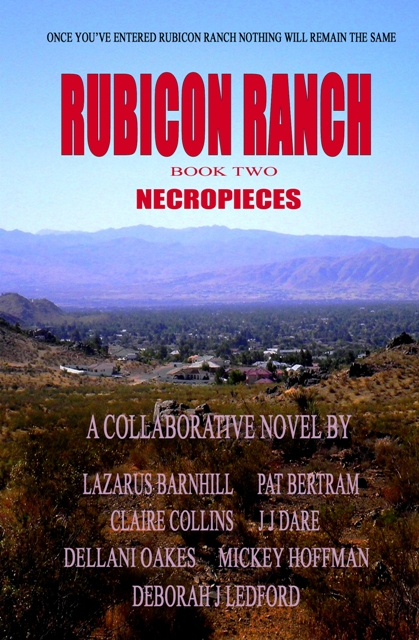
Rubicon Ranch: Necropieces — The Story Continues

Rubicon Ranch is a collaborative and innovative crime series set in the desert community of Rubicon Ranch and is being written online by the authors of Second Wind Publishing. Seven authors, including me, are involved in the current story — Rubicon Ranch: Necropieces.

Residents of Rubicon Ranch are finding body parts scattered all over the desert. Who was the victim and why did someone want him so very dead? Everyone in this upscale housing development is hiding something. Everyone has an agenda. Everyone’s life will be different after they have encountered the Rubicon. Rubicon Ranch, that is.

Although some of the characters were introduced in Rubicon Ranch: Riley’s Story, a previous collaboration, Rubicon Ranch: Necropieces is a stand-alone novel. The first chapter will be posted on Monday, June 11, and one chapter will be posted every Monday after that.

We hope you will enjoy seeing the story develop as we write it. Let the mystery continue! Whodunit? No one knows, not even the writers, and we won’t know until the very end!

Chapter 32: Melanie Gray
by Pat Bertram

Melanie trudged along the left side of the highway, facing traffic, the blister on her heel burning with every step. The sun had come out, and the road was now dry, but her shoes and socks remained wet from slogging through the flooded gutters back in Rojo Duro.

After Sheriff Bryan dropped his bombshell—Why did you do it, Melanie?—he had been called away, leaving the question hanging in the air. Two hours later, he still hadn’t returned, but a kid who looked as if he were straight out of the police academy brought her coffee. She had demanded the use of a toilet, and the young deputy ushered her to the lavatory. He wasn’t waiting for her when she finished, so she had simply walked out of the sheriff’s department. No one stopped her.

She’d now been walking for hours, but was still far from Rubicon Ranch. Maybe she should have returned to the interrogation room and waited for the sheriff, but if he still wanted her, he knew where to find her—at home in about seven more hours.

“See what you’ve done to me, Alexander,” she murmured, tears stinging her eyes. “Not only have you left me alone with only a ghost to talk to, you’ve turned me into an escaped prisoner.” Wearily, she scrubbed away the tears. She was sick of crying, sick of Alexander being gone, sick of the way her life was turning out. Once she’d felt strong, like a warrior, capable of anything. And now? Just a tired widow, at the mercy of her emotions.

A vehicle veered off the right lane, and pulled up alongside her.

“Get in,” Sheriff Bryan commanded.

Melanie wanted to refuse, but oncoming traffic gave her little opportunity to assess the matter, and besides, her blistered heel was throbbing with pain.

She scurried around the tan Navigator and slipped into the front seat. The sheriff stomped on the accelerator. The vehicle shot back into the right lane, narrowly averting a head-on collision with a white Subaru.

“Are you always so reckless?” Melanie asked.

“Are you always so reckless? What do you think you’re doing, walking along the highway like that?”

“Going home, where I would have been all day if your thugs hadn’t arrested me.”

“You weren’t under arrest. I just needed to talk to you, and I couldn’t get away.”

She gave him a narrow-eyed look. “So I’m not a suspect? Then why did you tell my publisher I was?”

He grinned. “It got you a bigger advance, didn’t it?”

She slumped in the seat as much as she could against the restraints of the seat belt, and folded her arms across her chest.

“You have to admit,” Sheriff Bryan said in a softer tone than any she had yet heard issuing from his mouth, “you need help.”

Melanie sat up straight and glared at him. “Help? Help? Who says I need help? Is that why you arrested me? To help me?”

“Now that’s the Melanie I know and love.” He must have sensed the indignant response she was about to hurl at him, because he added quickly, “It’s just an expression.”

Melanie dropped her head into her hands. Why did this man keep her so off balance? Was it that her grief made her vulnerable and any attention would send her reeling, or was there something more going on? Either way, she had to get a grip on her emotions. Warrior, she reminded herself.

She took a deep breath and blew it out slowly. “Why did I do . . . what?”

As cryptic as her comment sounded, he didn’t pretend to misunderstand her reference to the question he had asked in the interrogation room.

He sighed as he had done then. “Why did you shut me out when I poured out my heart to you? I was more open to you than I’ve ever been to any other woman. You could have at least told me you understood, even if you weren’t interested.”

She stared at him in total non-comprehension, and though he glanced at her, she couldn’t pick up any clues as to what he was thinking. She could only see herself in the mirrors of his sunglasses. And then all at once she understood.

During the investigation into little Riley’s murder, the sheriff had taken her to lunch and told her his story. How he’d been the fair-haired boy. President of his class in high school. Pledged the best fraternity in college. Dated a cheerleader and married her after graduation. Went into law enforcement. Hired on at the Greene City Police Department. Became a detective. Got his masters. Went up through the ranks like a shot. Became the youngest captain in the history of the force. Was on the fast track to becoming Chief of Police when he had an affair with a junior officer on the force.

He’d said that his wife knew about the other woman, that she stayed with him because he was the favorite son of Greene City, but when the affair came to light, he lost his job, his status, and his wife—at least temporarily. He claimed that though he was through with her, she wouldn’t give him a divorce because she still believed that one day he was going to be a major police chief, maybe in LA, and she was waiting to get a piece of that large salary in alimony payments.

What Melanie had taken to be a come-on—his letting her know that even though he was married, he was available—he’d apparently meant as a way of opening up to her. And she had run out on him.

But not because of the supposed come-on. Because of Alexander.

“You lied to me,” she said. “You told me you went to the scene where my husband died and came to the conclusion that it had not been an accident. The cops told me it was a hit and run, that someone had rear-ended the car with such force that Alexander crashed head-on into a concrete abutment, but when I went out the scene right afterwards, I didn’t see anything to indicate that another car was involved, so how could you have seen anything weeks later? It’s possible someone had tampered with the car as Riley said, but the only way to find that out was to investigate the vehicle itself. And you didn’t care enough to check it out.”

“Repeat that.”

“You lied to me,” Melanie said.

The sheriff held up a hand. “Not that. Riley.”

“It’s hearsay.”

“This isn’t a court of law. Just tell me.”

“Supposedly, Riley told Moody that she’d seen someone messing with our car.”

“Did she say who?”

“No. Morris accused me of killing Alexander. He said that Riley told Moody she’d seen me messing with our car. When I asked Moody about it, she told me Riley hadn’t mentioned any name, just that she had seen someone. Moody said she didn’t believe that Riley really saw anyone. But she believed it enough to mention it to her father.”

Melanie waited for the sheriff to say, “Aha! So you’re the one who murdered Morris!” But he didn’t say anything. Just rubbed his chin thoughtfully.

“And since we’re talking about Alexander,” Melanie said, “You never returned his cameras to me. I want them back.”

The sheriff turned his mirrored stare toward Melanie. “Cameras?”

“Yes. All of his cameras were in the car. Six of them. I want them back.”

“There were no cameras.”

“Where are they? They were in the car when he left that day. I put them there myself.”

“Ms. Gray, no matter what else you might think of me, I am a great law officer. I know my job. There was no indication in the report of any officers seeing cameras in the vehicle. And the report does not state that Alexander was rear-ended. It was a merely a surmise by one of the state troopers, and he had no business telling you that. Riley was right. Someone did tamper with your car. Someone very knowledgeable and very skillful. The brake lines were cut and the steering wheel loosened. I suspected that when I checked out the scene of the accident and found no skid marks. The car simply plowed into the abutment at a high speed.”

“Maybe the flex lines were worn through. That happened to me once.”

“The car was new. We sent the vehicle to a lab down the hill since we don’t have an automotive lab up here in the high desert, and I just got the results, which is why I wanted to talk to you today. All four metal brake lines were cut so precisely that when Alexander slammed on the brakes, he instantly lost hydraulic pressure in both the front and rear brakes at the same time. With today’s vehicles, cutting the brakes like that is almost impossible for a professional to do, and completely impossible for an amateur.

Melanie clutched her stomach, feeling the same sort of visceral grief as when she heard that Alexander was dead. Alexander . . . murdered? By a professional killer? An assassin?

“It’s not possible,” she said aloud.

“Alexander must have traveled a long way after his brakes failed—the closest brake fluid stain I found was about a mile and a half from where Alexander went off the road.”

“But supposedly when he died, he was texting a woman he was having an affair with. How could he have been texting her if his brakes broke more than a mile away from where he crashed? Wouldn’t he have dropped the phone and tried to control the car?”

“Yeah. I’m having a problem with that scenario, too. We need to talk to the woman, but the number Alexander was texting is out of service. It feels to me as if the phone with the texts was a plant to make everyone think exactly what the official report said—that Alexander lost control because he was texting while driving.”

Melanie put her hands on her head, trying to still the roiling thoughts. “I can’t deal with this right now. Take me home. Please.”

“I’m sorry,” the sheriff said in a soothing tone that might have been practiced but still managed to sound sincere.

For just a second Melanie wished he would stop the vehicle, put his arms around her, and hold her. “There’s just so much death. Alexander. Riley. Riley’s father. The Petersons. Morris.”

“That’s the other thing I need to talk to you about,” Sheriff Bryan said in his official voice. “Morris.”

***

Pat Bertram is the author of the suspense novels Light Bringer, More Deaths Than One, A Spark of Heavenly Fire, and Daughter Am I. Bertram is also the author of Grief: The Great Yearning, “an exquisite book, wrenching to read, and at the same time full of profound truths.” Connect with Pat on Google+

Pat Bertram's avatarPat Bertram Introduces . . .

ASHFbordersmTell us a little about A Spark of Heavenly Fire.

A Spark of Heavenly Fire tells the story of insomniac Kate Cummings who gathers her courage and strength to find new a new life and a new love when all around her people are dying of a bioengineered disease.

What inspired you to write A Spark of Heavenly Fire?

In A Spark of Heavenly Fire, I talk (or rather my characters do) about biological weapons, biowarfare, and bioengineered organisms because I thought the reality was more frightening than fiction. For example, The World Health Organization spent years and a heap of money to eradicate smallpox, yet smallpox in ever more virulent forms is stockpiled in labs all around the world. Spooks the heck out of me! I thought it was an important topic, but mainly I wanted to tell the story of ordinary people who become extraordinary in a…

View original post 991 more words

30 Second Book Trailer For GRIEF: THE GREAT YEARNING

Grief: The Great Yearning is a finalist in the memoir category for the Sharp Writ Book Awards, and they asked me for a 30 second introduction to the book for their “awards ceremony” video. A couple of days ago I posted a draft of this video and here’s the finished video blurb.

After I put this video together, I realized an interesting coincidence: All the photos were taken in August, around the 15th.

The first photo might look like the desert, but it’s a photo of him in Colorado at the Black Canyon of the Gunnison, a few months before he died. I didn’t even know I had the photo, but I found it in a computer file after he was gone, and it shattered what was left of my heart. It looked as if he’d already been moving away from me toward eternity. Oddly, though I didn’t plan it, the three photos I used in the video were all taken within a few minutes of each other on that excursion. The gnarled tree with the stormy clouds, the profound depth of the canyon, the photo of him looking to eternity all now seem to be signs of my unconscious grief.

The photo on the cover of the book is taken in the very same place, exactly a year earlier. The photo of the two of us together (the only photo ever taken of the two of us together) was taken exactly thirteen years earlier than the three photos. And we met exactly thirty-two years before that last trip to the Black Canyon. I had no idea August was such a significant month for me.

***

Pat Bertram is the author of the suspense novels Light Bringer, More Deaths Than One, A Spark of Heavenly Fire, and Daughter Am I. Bertram is also the author of Grief: The Great Yearning, “an exquisite book, wrenching to read, and at the same time full of profound truths.” Connect with Pat on Google+