Joylene Nowell Butler Likes DAUGHTER AM I!

If you haven’t yet met Joylene Nowell Butler online, you should. She is a delightful person, wonderful author (Dead Witness, and Broken But Not Dead), and marvelous blogger. Her blog is a great site to browse. She posts gorgeous photos of Cluculz Lake in Canada. She offers valuable information such as how to beat writer’s block. She often has guests on her blog, other authors you either know or want to know, such as A.F. Stewart, who talked about the 5 best ways to promote your books on a budget during her latest visit.

And she writes insightful book reviews. She says, among other lovely remarks, that my novel Daughter Am I is a character-driven page-turner. Every person has a distinct and endearing voice. Their very persona jump off the page. Even the character of cold-blooded killer Iron Sam comes alive in a way most writers can only dream of creating. The dialogue is sharp and concise and very believable. The descriptions are familiar, yet crisp and original. The prose are smooth and straightforward, and not once did Miss Bertram use terms or language that pulled me out of the story. I was her captive audience for three days. I could have read it faster, but frankly, I didn’t want to say goodbye to these wonderful characters. ” (Read the entire post here: Review of Daughter Am I. Be sure to read the comments! I got such a kick out of seeing people talk about my book.)

How can you not like someone who loves your book? You can find Joylene at her blog, A MOMENT AT A TIME ON CLUCULZ LAKE. Tell her Pat sent you.

Is the Glass Half Full or Half Empty? Who Cares?!

It’s time to bury the glass half-full/half-empty metaphor. Here is the truth of it: If you are filling a glass, when you get to the halfway mark, the glass is half full. If you are emptying a glass, either by drinking it or pouring it out, when you get to the halfway mark, the glass is half empty. The amount of liquid in a drinking glass is an example of action not perception. And you know the truth of this. If I tell you a waitperson brought a bottle of wine and two glasses to the table and that a woman held out a hand when her glass was half full, you immediately presume the server had been filling the glass. If I tell you a waitperson brought two glasses of wine to the table and that a woman waited until her glass was half empty to begin to place her order, you immediately presume she’d been drinking the wine. In neither case does the partial glass of liquid leave you with a perception of optimism or pessimism. It’s merely a result of the action.

Even if it were a matter of perception, why is a “glass half-full kind of guy” considered to be a more upbeat, positive person than a “glass half-empty kind of guy”? Take for example a glass of very rare wine, so rare these are the last few ounces of its kind. While you are savoring every sip, delighting that half of a glass still remains, you can at the same time be experiencing the bittersweet knowledge that this glass of precious liquid is half empty. Which makes every remaining taste even more precious. In this case, the amount of liquid in the glass has nothing to do with positive or negative feelings and everything to do with appreciation.

If a glass with liquid in it is sitting on a table unattended, is it half full or half empty? I don’t care, and you shouldn’t either. You don’t know what it is, how long it has been there, who it belongs to, so it has no bearing on your state of mind. If this orphan glass is your responsibility to deal with or if you are a neat-freak who cannot bear to have unknown liquids lurking about, the glass is half empty because you will pour it out. Unless of course, you are so desperate for a drink you down the liquid despite its dubious origin. In which case, the glass is empty . . .  and so is your stomach after you throw up.

So please, let’s bury this particular metaphor in the graveyard of moribund cliches and be done with it.

Tomorrow is Blog Jog Day!

Blog Jog is a trot around the blogosphere, each blog linked to the next so that you can explore new blogs with a simple click on the link to the next blog. Many participants will be offering giveaways and contests, and so will I. Anyone who leaves a comment on my Blog Jog post tomorrow, August 7, 2011 will be entered into a contest to win a free download of one of my novels, including my latest, Light Bringer.

Light Bringer tells the story of  Becka Johnson, who had been abandoned on the doorstep of a remote cabin in Chalcedony, Colorado when she was a baby. Now, thirty-seven years later, she has returned to Chalcedony to discover her identity, but she only finds more questions. Who has been looking for her all those years? Why are those same people interested in fellow newcomer Philip Hansen? Who is Philip, and why does her body sing in harmony with his? And what do either of them have to do with a shadow corporation that once operated a secret underground installation in the area?

Malcolm Campbell, author of  Garden of Heaven,  Jock Stewart and the Missing Sea of Fire,  The Sun Singer, and  Worst of Jock Stewart had this to say about the novel: Light Bringer is TYPICAL BERTRAM: plots within plots, multiple characters with multiple agendas, fast moving, more than enough mystery and intrigue for everyone, satisfying conclusion.

Author Aaron Lazar has this to say: I’m already a fan of Pat Bertram’s books. I’ve read them all and loved them deeply. But LIGHT BRINGER was something completely new and surprising… surprising in its freshness, originality, its genre bending brilliance. Part thriller, part fantasy, part sci fi, part mystery…its plots were large and complex, encompassing themes that plague us every day; offering social and world commentary blended with weather trend observations (where ARE all those tornadoes and tsunamis coming from??) I do believe Bertram has defined a new genre, and it is a pure delight. Fresh. Original. Riveting. The characters are real and engaging. I particularly enjoyed the bit of romance between Luke and Jane – yes, another subplot. I couldn’t put it down and extend my highest compliments to Ms. Bertram for her supremely smooth writing – there are no hiccups in this book. Very highly recommended.

So stop by tomorrow, leave a comment on my Blog Jog Day blog, and you might win an ecopy of one of my books, including Light Bringer.

***

Click here to download the first 20% of Light Bringer free at: Smashwords

Click here to read the first chapter of: Light Bringer

M.I.C.E. (Types of Stories)

I thought we’d talk about M.I.C.E. No, not the little furry creatures, but Orson Scott Card’s list of types of stories. In How to Write Science Fiction, he says there are 4 types of stories: Milieu, Idea, Character, Event. These are skewed toward Science Fiction, obviously, since he is a science fiction writer, but they seem fit with all stories/novels.

The Milieu is the world — the planet, the society, the weather, all the elements that come up during the world creation phase. Every story has a milieu, but in some stories, the milieu is the point of the story. It follows the basic structure of Gulliver’s Travels — an observer goes to the strange place, sees all the world has to offer, and comes back a new person. The Milieu story obviously starts when the stranger arrives in the world and end when he leaves (or decides to stay for good).

The Idea is about the new bits of information that are discovered in the process of the story by characters who did not previously know that information. Idea stories are about the process of finding the information. The Idea story begins by raising a question; it ends when the question is answered.

The Character story is about the character’s character. It’s about the transformation of the character and the character’s role in society. The attempt to change doesn’t have to be a conscious decision, it can be unconscious, a seizing of an opportunity that takes him in a new direction. The Character story begins when something happens to make the character so dissatisfied with his present role that he begins the process of change. It ends when the character settles into his new role (happily or not) or gives up the struggle and remains in the old role (happily or not).

The Event story is about a change in the universe, a disorder, and the story begins when a new order is about to be established. The Event story begins when when the world becomes disordered and ends when a new order has been established. (Or when the world descends into chaos).

So, are there other basic types of stories? Do your stories/novels fit one of these categories? What is your Milieu, Idea, Character, Event? Most stories have more than one of these elements, so how do they fit together in your stories?

A Great Love Story

I’m working on my grief book, typing up my grief journal entries. I thought this would be a book about grief, but it seems more like a love story, which is so very ironic. Soon after I met my life mate — my soul mate — I quit my job to write. I wanted to tell the story of a great love that transcended time and physical bonds, told with wisdom and beauty. I sat down to write, and  . . . nothing. Back then, I thought all one had to do to write was to sit down, pen in hand, and let the words flow. Well the words didn’t flow. So I put off my dream of being a writer and went about the business of living. Years later, while going about the business of dying (his dying) I started writing again just to get out of my head, to get a respite from my life. I eventually learned how to write, but I always wrote slowly . . . until I started a grief journal and posthumous letters to my mate. Those flowed. And now it turns out that this grief book could be that love story I always wanted to tell. Life sure plays games with us!

Several people have told me they envied me my great love, but I’ve hesitated to tell the truth: it didn’t feel like love. We never had much of a romance. After a few brief years of hope and happiness, our love was sublimated by the constraints of his growing ill-health. It seemed that our cosmic love devolved into the prosaic things of life: cooking meals, doing errands, struggling to keep our retail business alive. And then it devolved further into simply surviving. Getting through the days as best as we could. We thought we’d stopped loving each other. We thought we were ready for the coming separation — he to death, me to life alone.

His hospice nurse, who got to know us both very well, told me she didn’t think he and I knew how much we loved each other. And apparently that was true. That mystifies me — how could we not  have known? We always knew we had a deep connection, though we never understood it and at times we both railed against it in our struggle to maintain our own identities, but we took that connection for granted. And what is that connection if not love?

In my foolish youth, I thought I’d still be able to feel his presence when he was dead, but I only feel his absence, and maybe that’s enough to remind me that love is not all hearts and flowers and passion. It is not what you feel. It is what you do. It is being there for each other. And, until the very end, we always were.

Surviving a New Stage of Grief

I’ve been working on my grief book, typing what I wrote immediately after the death of my soul mate. Suddenly it seems as if the past sixty-two weeks have melted into oblivion and I’m back there again, newly bereft, wandering in a fog of pain, wondering how to cope with the massive changes in my life. I know I have come a long way because the revisited pain seems bewildering to me. Did I really feel all that? Did I really survive such a terrible time? Apparently I did, because here I am, mostly back to normal. I’m still lonely, though, and the loneliness surges unbearably at times.

Loneliness is the newest stage of my grief, as it is for so many who are coming out of the first numbing months of grief. I don’t know how to cope with this vast loneliness, but I didn’t know how to cope with any of the other stages of grief, either. I just embraced the pain, the anger, the sorrow, and waited for a gentler time. So that’s what I will do with the loneliness. Embrace it and wait for it to subside. Waiting is not all I’ve been doing, though. I’ve been making an effort to be with people, which helps, and so does writing. I’d forgotten how quickly the hours go when one is immersed in words.

I still wonder if anyone will want to read this grief book when it is published. It is so intensely personal. And painful. Yet people who have read my blog posts about grief have found some comfort in them, so perhaps this book will serve the same function. Even if no one is interested in reading my daily struggles to come to terms with the death of my mate of thirty-four years, the book is important to me. It’s a way of binding my grief into a neat bundle so I can get on with my life, though I have been told one never truly gets over such a loss. But we do survive, and that is ultimately what my book is about — surviving grief.

R.U.E — Resist the Urge to Explain

There is a maxim in writing called R.U.E — Resist the Urge to Explain. Supposedly, if you show your readers the story rather than explaining it to them, it will allow readers to draw their own conclusions, thereby making readers a part of the story.

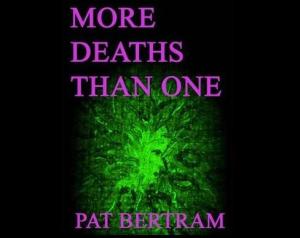
In some ways, my novel More Deaths Than One is a simple story. A man returns home after eighteen years in Southeast Asia to find the mother he buried before he left is dead again. Or rather, he finds her obituary in the morning newspaper, and when he goes to the cemetery, he sees a funeral party. He also sees someone who appears to be . . . himself. With the help of an unfulfilled and quirky waitress he meets in a coffee shop, he sets out to discover the truth.

Beneath that simple story lies the question of what makes us who we are. Is it our memories? Our experiences? Our natures?

And beneath that is the real story — a mythic tale of a man who reflects the people he meets back to themselves. This is the story I did not explain. I wanted readers to discover it for themselves, yet I’ve learned (by way of less-than-stellar reviews) that not everyone sees this story. One reviewer, who thought that the relationships were developed with too little explanation, couldn’t understand why the waitress would run off with someone she barely knew. I thought as readers got deeper into the story and noticed more of the characters seeing themselves in the hero (good guys saw good, evil guys saw evil, victims saw a fellow victim, the artistic saw the artist, the soulless saw a drone) that it would be apparent the waitress’s adventure-starved soul saw in him the fulfillment of her dreams. I guess not.

It’s too late to rewrite the story, and even if I could, I wouldn’t. But . . . here’s the question: should I have explained more? Should I have resisted the urge to resist the urge to explain?

Scribbler’s Retreat Writers’ Conference

Scribblers’ Retreat Writers’ Conference
St. Simon’s Island, Georgia
May 12-14, 2011

Through the years, the abundant beauty of the Georgia coast has inspired artists of every stripe, including poets, novelists and playwrights. You too can find inspiration on this beautiful island while enjoying fellowship with other writers and students. During the two-day conference, ten world-class authors, editors, publishers and other literary professionals will impart their own wisdom in a classroom setting.  Each conference begins with an Opening Ceremonies Banquet Thursday evening and ends with an Evening with the Authors cocktail reception Saturday evening. An added bonus — I’ll be there! As you can see, I am one of the speakers.

Phillip Margolin – How to Write a Novel in Your Spare Time 

June Hall McCash – Writing Historical Fiction

Victor DiGenti – Revving Up Your Narrative Drive

Dr. Anya Silver – Writing Poetry: The Enchanted Craft

Denise Tompkins – Effective Query Letter Writing

Ricki Schultz – Online Presence-Building, Made Easy

Jane Wood – Schools, A Niche Market

Pat Bertram – Creating Incredible, but Credible, Characters

Chuck Barrett – Who’s Point of View is It Anyway? How Not to Confuse Your Reader

 www.scribblersretreatwritersconference.org
800-996-2904
King and Prince Beach & Golf Resort

Advice to Aspiring Writers

I just got an email from my high school, requesting my participation in a Q&A for a magazine that goes to parents and alumni. The question they want a response to in 60 words or less is, “What advice would you give to aspiring writers?” Of course I said I’d participate. The only hard part is distilling ten years of research and experience into so few words.

I could go with a single word: “Write!”

I could be cynical and say, “Don’t write unless you have to. It’s a heartbreaking business.”

I could be business-like and say, “Learn everything you can about good prose, story elements, query letters, promotion, and publishing because the competition is fierce — millions of people have written a book want to write a book. But no matter what happens, keep writing.”

I could be philosophical and say, “Start with a single word. That’s how every book through the ages was written — one word at a time. By stringing single words together, you get sentences, then paragraphs, pages, chapters, an entire book.”

I could be more story-oriented and say, “Ask yourself: what story do you want to write? Why? What do your characters want? Why? How are they going to get what they want? Who is going to stop them getting what they want?”

I could plunge into the action and say, “Sometimes it’s hard to find the confidence to bring complex scenes to life, to juggle the many elements that comprise a compelling scene, so plunge headfirst into action. Write fast and fearlessly; let the words fall where they may. You can always clean up the mess in rewrites.”

So, what advice would you give to aspiring writers? What was the best advice anyone ever gave you? What was the most helpful advice you ever read?

On Writing: Tell, Don’t Show

In Description, Monica Wood commented: Don’t enslave yourself to showing. “Show don’t tell” is a guideline, not a rule. Sometimes telling is more effective and thrilling as long as the prose is interesting and engaging.”

As a reader, one of my pet hates is when one character is talking to another, and they retell the entire story up to that point, so as a writer, when I get to a place where one character has to tell another what the reader already knows, I write something like, “and Sam told Sally about the woman who tried to kill him and how he ran off instead of trying to find out who it was.” Avoiding repetition is one reason telling is so much better than showing at times. Makes the story move faster. Might not be immortal prose, but it moves the story along.

The worst offenders of the tell, don’t show suggestion are lawyer books. They spend the first half of the book laying out the story, then the second half repeating that story in a courtroom setting. If a reader can skip a whole slew of chapters and not miss a moment of the story, the writer has not done his or her job. If the writer wants to do the courtroom scene, then make sure what is shown is new. Otherwise, simply tell what went on in a few short sentence and get to the good stuff.

Another time telling is better than showing is if a scene has no conflict, no surprises, no twists. If a character sets out to do something and accomplishes it without any problems, then showing is a waste. Just tell it. Don’t build up to  . . . nothing.

A way to know if it’s better to show or to tell is to decide what you want to accomplish with a scene. If the immediacy of a scene is important, show it. If the reactions of a character who was not involved in the scene are most important, then it’s possible to have one character tell the other what happened and then show the character’s emotion.

When writing More Deaths Than One, I worried that I was cheating readers by doing the big disclosure  at the end via letter (in other words, telling), but the importance of the scene lay not in finding out the truth of who Bob was but in the different ways Bob and Kerry reacted to the truth. It was about them and their relationship more than the deeds themselves. It was also about the emotion of the person writing the letter and how that emotion bound all of them together. So basically, the letter was all about telling rather than showing the disclosure, and showing rather than telling the emotion it evoked.

When do you tell instead of show? (I mean you personally, not writers in general.) How do you make it effective and thrilling?