Creatures of the Corn

When he entered the cornfield and saw the stalks closing in over his head, his heart beat faster and icy beads of sweat chilled his brow. He wiped his clammy hands on his pants and forced himself to relax.

He looked around. A wide path cut through the corn, and the tall stalks afforded some protection from the incessant wind.

He stopped short. What was that?

He listened, but did not hear anything out of the ordinary.

Man, you’ve got yourself spooked. Get your head straight!

As he hurried to catch up to Pippi, he heard the noise once more.

Was something shuffling through the corn?

He stopped.

Listened.

Heard only the wind rustling the dry corn stalks.

He started walking again. Straining his ears, he thought he could hear the sound of footsteps, not in sync with his but a fraction of a second later, like an echo.

Maybe it was an echo? It couldn’t be. He barely made any noise.

He moved faster; so did the furtive footsteps.

Pippi stopped and waited for him. “Did you hear something?” she asked. “I thought I heard footsteps.”

“Me too.”

She shivered. “It’s like The Children of the Corn.”

He heard a metallic thunk. A rifle being cocked?

Without warning, Pippi took off running.

He hesitated a moment, then he trotted after her.

 *    *   *

That is a scene from my novel A Spark of Heavenly Fire. I’ve been wondering if the characters’ fear was a bit over the top, because it is only a cornfield after all. But now I know I didn’t go far enough.

This year a cornfield has been planted across the lane from where I live, and the corn is tall and dense and very, very spooky. Yes, corn does rustle. And yes there are strange noises. And yes, creatures of all kinds live in the corn. Or at least visit it. I’ve seen deer come charging out of the corn and cross the lane in front of me. I’ve seen birds, cats, skunks. And, most astonishing of all, a fox. Never seen a fox before, but there it was, slinking out of a row of stalks. It started crossing the lane in front of me, stopped, stared at me, then streaked back into the corn. Within a second it had disappeared.

Just to show you how dense the cornfield is, here is a photo of me standing three feet inside the stalks. (I’m in the far left row. You can see the shadow of my head in the bottom left hand corner of the picture.) When I realized how impossible it would be for you to see me, I considered taking another photo. Then I remembered: Startled deer. Foxes. And who knows — maybe even another me.

100_1304c

add to del.icio.us : Add to Blinkslist : add to furl : Digg it : Stumble It! : add to simpy : seed the vine : : : TailRank : post to facebook

Sex SCENE not SEX Scene

One problem new writers have when they approach a sex scene is that they think of it as a SEX scene rather than a sex SCENE. Any effective scene — sex or not – serves multiple purposes. This is especially true of a sex scene, otherwise it will seem unconnected to the story, as if you just threw sex in the mix because you felt it was time to titillate your readers.

One good use of a sex scene is to show character. One of my favorite scenes in my novel A Spark of Heavenly Fire is when Jeremy King, a world famous actor, sleeps with a woman he just met in a bar.

The sound of weeping woke Jeremy. He turned his head toward his companion and saw one trembling shoulder and a tangle of gleaming hair.

He stretched luxuriously. The red hair hadn’t lied. The girl had been all fire, kindling a passion in him he hadn’t felt in years. The memory of it made him hard.

He reached over and pulled the girl into his arms. He smoothed back her hair and kissed away her tears, murmuring, “Honey,” and “Sweetheart,” and “Dear.”

“I’m such a terrible person,” she said, sobbing.

“Shh. Shh,” he whispered between tiny kisses.

Her arms stole around his neck, and her lips sought his. In a surprisingly short time she bucked beneath him, calling out his name.

You’ve still got it, King, he thought exultantly. Then, after one final thrust, he tumbled into oblivion.

I always liked that scene. It’s not very graphic, but it did what I wanted it to — define the characters

Another good use of a scene is to show the ebb and flow of human connection. For example, you could have three scenes spread throughout the story. In the first scene, perhaps, the man climaxes, feeling connected to the woman. When he immediately goes to sleep, she feels disconnected. In the second scene, perhaps he can’t get it up, leaving him feeling disconnected, but since he tries to make it up to her by cuddling her, she feels connected. In the third scene, they climax together, perhaps cuddle afterward, so they both feel connected.

In addition to the sex, then, you show a pattern of connection and disconnection between the couple (in other words, conflict), you show a whole new perspective of the characters, and you show a change in their relationship. You also end up with a subplot that adds to the overall richness of the story. In other words, you end up with a series of sex SCENES, not just SEX scenes.

add to del.icio.us : Add to Blinkslist : add to furl : Digg it : Stumble It! : add to simpy : seed the vine : : : TailRank : post to facebook

Pat Bertram and Malcolm R. Campbell Discuss the Writer’s Journey

Malcolm: I’ve always liked the concept of life as a journey in which each of us walks as a seeker and/or a hero on a winding route to places we don’t yet know or understand. So, I appreciate the invitation to stop by your blog and talk about the writer’s journey.

Bertram: The mythic journey concept has infinite possibilities, both as a story structure and a metaphor for one’s life as an author. Do you make use of the mythic journey structure in your writing?

Malcolm: There are mythic qualities in THE SUN SINGER (2004) which is based on the hero’s path or the mythic journey as you call it. Ditto for the as-yet unpublished GARDEN OF HEAVEN. The upcoming JOCK STEWART AND THE MISSING SEA OF FIRE is unrelated to the others and is sort of a mystery/humor novel about a newspaper reporter.

Bertram: I like your image of writers as seekers walking a winding route to places we don’t yet know or understand. I often mention how hard writing is for me, but that’s because I don’t know how to write the books I want to write. I have to learn how to write each one separately as I’m writing them, and each takes me on a different journey.

Malcolm: My long-time mantra comes from author and teacher Richard M. Eastman’s book Style: Writing as the Discovery of Outlook (3rd edition, 1984):

“You don’t begin to write with a complete message or experience already imagined, which is then to be wrapped in language as a means of sending it to your readers. Writing isn’t so much communication as creation. In a real sense, you don’t have an outlook on anything without first having written on it. This outlook comes into being through the dozens of tests, choices, and unexpected chances which turn up as you write on some engaging topic; and most writers agree that the final creation isn’t anything you could have precisely anticipated when you first set pen to paper.”

Bertram: That makes sense. For me, blogging especially is a way of discovering my outlook on whatever it is that I’m writing about.

Malcolm: This has been true for me whether I was writing a national register application, applying for a grant, writing a feature article or working on my novels, The Sun Singer (2004) or Jock Stewart and the Missing Sea of Fire (coming soon). In each case, I began with a body of knowledge and an opinion that were very different by the time I finished writing.

In terms of subject matter, do you find this to be true with your novels? I’m guessing that regardless of what you knew about pandemics, your understanding of them and their potential impact was much different after you wrote A Spark of Heavenly Fire than it was when you were first thinking about writing the novel.

Bertram: My research into pandemics was actually quite extensive, and so was my research into the government’s response to such an emergency (I based my fictional response on actual executive orders that Clinton signed), so there wasn’t much difference in my understanding during the course of the book, but there was a big difference in my thoughts about what they want us to know and what they don’t. When I learned about Pingfan, the Japanese biological warfare installation where they did horrendous experiments on POW’s and nearby villagers, I thought I’d stumbled onto something really explosive. Yet, as happened to a character in A Spark of Heavenly Fire, the very next novel I picked up used Pingfan as a setting. It got me to thinking about the nature of cover-ups, and many of the discussions in the last half of the book took place while I was writing the book.

Malcolm: We often hear that the writer’s journey has an inner and outer aspect. I see the outer aspect plot as it unfolds with a variety of characters, locations, and challenges. You chose Denver and pandemics for A Spark of Heavenly Fire and I chose the Montana Rockies of an alternate universe for The Sun Singer. Thinking of stories based on the hero’s path schema, from Star Wars to The Matrix to Harry Potter, and Lord of the Rings, the emotional, psychological changes and spiritual growth of the protagonist are viewed as more central and important than his thoughts, words and deeds. In mythic terms, the hero undergoes a transformation by undergoing the trials and tribulations of the outer journey. Robert Adams undergoes a transformation in The Sun Singer just as Jock Stewart is changed by the events in Sea of Fire. Do you feel this way about Kate Cummings and Greg Pullman?

Bertram: All the characters in A Spark of Heavenly Fire undergo transformation, especially the women. I always liked Washington Irving’s quote, and wrote the book using it as the theme: “There is in every true woman’s heart, a spark of heavenly fire, which lies dormant in the broad daylight of prosperity, but which kindles up and beams and blazes in the dark hour of adversity.”

Malcolm: In my life, the deepest part of the writer’s journey comes from how the writing changes me. The Sun Singer and the darker, as-yet unpublished Garden of Heaven were each written over a twenty-year period because, other than the plot and theme the reader sees, these novels dealt with integral issues within my own life. I had a lot to work out!

Bertram: I’m beginning to see that what I write is what I happen to be living. My first four books explored the theme of public lies and hidden truths because that’s what I was studying at the time. My current work supposedly explores the theme of safety vs. freedom, but it’s really about change, and there is a lot of change in my life right now.

You have a book that’s going to be published this summer. You once mentioned that you wrote it differently from the first two.

Malcolm: In Jock Stewart and the Missing Sea of Fire, I opened the floodgates and let the words flow. I wrote quickly and it felt like play because I had turned my wisecracking alter ego loose with no chains or boundaries. When I finished writing and editing the material in less than two months, I felt the good kind of tired one feels after an afternoon at a carnival or a day at the beach. This was energizing because, well, I was still capable of play and the benefits of play. Do you feel this “play value” from certain chapters of your novels or from your short stories?

Bertram: I start out playing with ideas and characters, and then when I start writing and trying to make all the pieces come together, I lose that feeling of play. One of the things I am looking for on my journey as a writer is more playfulness. I don’t know if you can you choose where you want to go on the journey, or if the journey takes you where it wishes, but I would like to experience what you did — opening the floodgates and letting the story flow.

Malcolm: I’m curious about your novel in progress.

Bertram: So am I! For a long time I had no real idea what I was writing — I thought I was writing a whimsically ironic apocalyptic fantasy — then all of a sudden one day it dawned on me I’m writing another story of a mythic journey. As my hero tries to find his place in a world that changes by the minute — cities becoming prairie, oceans appearing out of nowhere — he follows the hero’s path, and becomes transformed.

My third book, which is going to be published in a couple of months, was my first mythical journey story. It’s about a young woman who discovers that her grandparents were recently murdered which came as a shock to her because her father claimed they had died before she was born. She goes on a journey to discover who her grandparents were, why someone wanted them dead, and why her father lied to her. I purposely used the mythic template for the book (wanted an excuse to use it, actually), though her mentors and allies aren’t the typical alien or fantasy characters such as wizards, but are aged gangsters and conmen.

Malcolm: My father’s brother was murdered in Fort Collins before I was born. The case was never solved. From time to time, I wonder what happened. Time and distance are part of the challenge of finding details. It would be a journey to dig into it as your character will do in Daughter Am I. I love the concept of going back to figure out the real story.

Bertram: I do, too. All of my books follow the same underlying story: who are we, really? And how do our experiences change us? Which brings me to another question I want to discuss: does a person write a book or does the book write a person?

Malcolm: Your question reminds me of the difference between a layperson’s view of a complex and a Jungian analyst’s view of a complex. People sometimes admit that they have one complex or another. Jungians see it the other way around, saying that the complex has you.

Perhaps the relationship between author and book is the same for many authors, with the book holding a much greater sway over the author’s life than s/he–and especially his readers–may believe. At best, it’s like a marriage, author and book, and the better the book is, the better that marriage has been.

Bertram: That makes sense. I am at a crossroads in my writing life. I’ve used up the theme that haunted me for many years — public lies and hidden truths. Because of my stories, I seem to have come to an accommodation with the reality, and so I no longer have any desire to write about such things. So now I’m waiting for some other . . . passion, perhaps. Or a transformation. Because it does seem as if writing transforms us.

Malcolm: People often talk about defining moments, good and bad. Afterwards, they see themselves and the world differently. Plunging into the deep waters of a work of fiction in progress is also a defining moment. Writers experience what their characters experience whether it’s the horrors of Pingfan or the joy of my protagonist in The Sun Singer when he reaches the summit of a mountain of visions. We polish these scenes until the horror and the joy are shown to the reader in ways that cause the greatest impact. Doing this, I think, changes a writer just as much as a “real life” experience.

Bertram: In The Writers Journey, Christopher Vogler talks about writing as a perilous journey to probe the depths of our souls, and that the struggles we undergo to write, to sell our work, to deal with rejection seem to kill us, but we are resurrected to write again. And to go on another journey. Best of luck with your next journey, Malcolm.

Malcolm: This has been fun, Pat. Of course, I’m not the same person here at the end of the post that I was when we started. But that’s what it’s like being on the path.

See Also:
The Writer’s Journey
Celebrating Five Years of The Sun Singer

add to del.icio.us : Add to Blinkslist : add to furl : Digg it : Stumble It! : add to simpy : seed the vine : : : TailRank : post to facebook

30% of More Deaths Than One — Free at Smashwords

Both of my novels, More Deaths Than One and A Spark of Heavenly Fire are available at Smashwords. Smashwords is a self-publishing platform and online bookstore for indepedent ebook authors, publishers and readers. They offer multi-format, DRM-free ebooks, ready for immediate sampling and purchase, and readable on any e-reading device. (Kindle, Sony, Palm, Stanza, etc.) Many publishers (including Second Wind) are starting to use their services, which allows them to offer their books in all the ebook formats with little added expense. Why is this so important? As I’m sure you know, ebooks are the wave of the future, even for those traditionally slow to adapt to new technologies, such as the over 50 crowd. (Does this still hold true, I wonder? Most people I meet who enthusiastically embrace computers and the internet belong to that age group.)

The new demographics are:

  • People 50 or older are leading the way in adopting the Kindle, followed by those 18-34
  • People 35-49 prefer using their iPhones to read e-books
  • But most people (48%) are still using their computers or laptops to read e-books
  • While e-books are1.5% of the total book market, ebook sales grew 125% overall in 2008
  • E-book sales grew 183% among seniors aged 65+ and 174% among seniors aged 55-65

So whatever your choice of reading device — printed book, Kindle, Sony, computer — I’ve got you covered. (Do ebooks have covers? Perhaps that wasn’t as clever a word choice as I thought.) And, you can begin reading online immediately.

My Smashwords profile: Pat Bertram
Smashwords: More Deaths Than One
Smashwords: A Spark of Heavenly Fire
Printed Book: More Deaths Than One
Printed Book: A Spark of Heavenly Fire

add to del.icio.us : Add to Blinkslist : add to furl : Digg it : Stumble It! : add to simpy : seed the vine : : : TailRank : post to facebook

Pat Bertram And Lazarus Barnhill Discuss Writing as Destiny

Lazarus: The other day I was marveling at the uncanny string of events—starting with a writing contest on Gather.com—that brought me many wonderful new friends, saw the publication of my first two novels and empowered me to express my artistic vision in ways that I never imagined. When I read Julia Cameron’s book, The Artist’s Way, I began to wonder if in fact what I saw as a lucky string of chance events was really a matter of listening to a still, small voice that has always intended better for me than I could have imagined for myself.

In a nutshell, Julia Cameron says that, whether you call it destiny, the hand of God, or just the creative direction of the universe itself, our purpose is to create and we allow ourselves and others to stymie our creativity.

Bertram: Are we really fulfilling our destiny, though, or does it just feel like it? The solar system seems to be designed perfectly, with the planets constantly moving, yet staying out of the way of the other planets. But it wasn’t always so. At one time they were banging and crashing into all sorts of space debris, and over billions of years they annihilated everything in their path to end up the ordered system we know. So, is our writing destiny the same? Something we see only in retrospect, perhaps, with our brains trying to make sense of chaotic events?

Lazarus: Do you think when you write that you are fulfilling an essential aspect of your truest purpose for existing?

Bertram: I do think the universe itself is a creative power that we tap into, and that we are creative by nature. But . . . if we are all fulfilling our natures as writers, who is fulfilling their natures as our readers? Writers need readers, and now that there are (supposedly) more writers than readers, how can writing really be our destiny? Except personally, perhaps.

Lazarus: Cameron teaches two “sacred acts” in The Artist’s Way. The morning pages (3 pages you write when you first get up in which you allow your inner self to freely express itself) and the artist’s date (essentially, you have to have 2 hours a week in which you go off by yourself and do exactly what you want).

When I first started doing the morning pages, I was correcting my spelling and changing my word choices. All of that was stymieing the child inside me; and if I don’t let that child have a say, he disrupts whatever the grown up Laz wants to do

Bertram: Three pages when you first get up in the morning, just to express yourself? I never could understand how people can dash off the pages like that. It takes me an hour or two to write a single page. I try to be more spontaneous in my blogs, just to let the words and feelings flow, but it still takes me more than an hour to write 300+ words.

Lazarus: Whoa, Pat, sounds as if you’re a “blocked creative”

Bertram: Blocked creative? Maybe I just don’t have any ideas. Or maybe my inner child likes to play with words and sentence structure.

Lazarus: Well, seriously, what would happen if you just started describing how you were feeling at the given moment?

Bertram: Usually when I sit down to write I don’t feel anything but peace. Not a whole lot to say about that. And when I do let the words roll out, I usually end up with a silly character interview or something equally worthless except as a blog post. I really don’t have a lot to overcome. I figure my inner child is my outer child. Pat Bertram was two years old on May 17th. That’s when I started from scratch to create myself as an author rather than just a writer.

Most of my inner demons I let out while writing my first book. I don’t usually acknowledge it as my first book — it was too much me and not enough creativity. To say nothing of terrible writing. Still, it did help me work through the past and allow me to re-emerge as . . . still don’t know, actually. I’m still emerging.

Lazarus: How many stories do you currently have swirling around in your cerebellum?

Bertram: None. I know you don’t believe it, but it’s true. If I had any stories there, I’d be writing them.

Lazarus: How do you know when you’ve heard a worthy idea for a new novel?

Bertram: I don’t know. Mostly I have to put several ideas together. And I don’t have any ideas right now.

Lazarus: Do you often suffer from long “dry spells” in which you don’t have anything to write or you don’t know how to get started?

Bertram: Is it a dry spell if you don’t feel like writing? Or if you’re doing something else instead, such as promoting? Even when I’m writing, I have more non-writing time than writing time. I need to let things percolate.

Lazarus: Yes, I call it “marinating.” How long does it usually take for your stories to percolate. Do they progress in stages?

Bertram: Definitely stages. Even when I know where I am going with a story, I seldom know the details.

Lazarus: But I have the sense that you’re implying you can’t promote and really write creatively. Is that right?

Bertram: I have a one-track mind

Lazarus: But not obsessive?

Bertram: No, not obsessive. I just can’t commit to two projects at once.

Lazarus: Have you ever had the experience of being so hooked, engaged in a story that you turned your back on other pursuits just so you could write?

Bertram: No, not really.

Lazarus: You’ve completed four novels, though you told me Light Bringer is going through a final polish. How long do each of these projects take and usually how much time elapses between them?

Bertram: Light Bringer has been ongoing for eight years. Or thirty-eight if you include the research. It won’t be completely finished until it’s published later this year.

Lazarus: Thirty-eight years of research? So you’re bringing your entire life’s experience to bear on this piece.

Bertram: Yes. Everything I ever learned. And studied. Daughter Am I was the quickest — outlined in one day, written in a year. A couple of months usually elapse between books, mostly so I can type them up. I write long hand.

Lazarus: Pat, does the average reader perceive the deeper messages you conceal in your stories?

Bertram: I don’t know. The books are written so that even if they don’t see anything beyond the basic story, they should still like them. At least that’s the plan.

Lazarus: Had to back up and start over when you said that. So you acknowledge then that your books function at differing levels of depth; that there are meanings to be fathomed that someone reading just for enjoyment might miss?

Bertram: It’s possible that there are meanings people will miss. Heck, I missed some of it! When I proofed A Spark of Heavenly Fire, I saw themes that I didn’t put in there.

Lazarus: You didn’t put there? Is it fair to say that a really well written book will plumb emotional, human themes beyond the writer’s intention? And that’s what’s happened with your books?

Bertram: When a story flows, when everything is motivated, it makes sense that some ideas, emotions and themes show up that aren’t planned. If the characters are true, it has to happen. I am not saying that the characters do things that I don’t plan. Their actions are completely planned. But some underlying truths could emerge.

Lazarus: This is the contradiction in you that is so mysterious: you talk about being methodical, plodding, taking years to write a single piece; and yet at the same time you admit that the story flows from a place deep within you and parts of it emerge unannounced.

Bertram: I have a dual nature: half mystic, half logician.

Lazarus: Did you ever think that you are really “discovering” the story: that some mystical intentionality has dropped the clues of the story in your consciousness, in your experience and intended you to find them and fashion them together?

Bertram: Of course.

Lazarus: Then writing these stories is your destiny?

Bertram: So this is what you were leading up to.

Lazarus: It’s not like you didn’t see it coming.

Bertram: I don’t know if the stories are my destiny, but I do think they wanted to be written.

Lazarus: Yes! Wanted to be written. They wanted to be written by you. And I like the notion of “half way.” They came to you in pieces and only half conceived. They were waiting for you to complete them.

Bertram: But it’s also possible that mystical intentionality is myself.

Lazarus: Okay, that’s a realistic point of view.

Bertram: One thing that’s always puzzled me is that when I sit down to write, my mind goes blank. Other people can write a book a month. They can let the words flow. I have to dredge each word out of my mind. Yet, when my books are finished, there is an inevitability about them as if they were inspired, not perspired (at least it seems that way to me). But I don’t believe that they are “destined.” It’s all the little choices I make along the way that creates the inevitability. When you start writing, you have the entire world to choose from, but as you make choices — genre, setting, characters, plot, etc, etc, it narrows the story world and keeps narrowing it until it seems inevitable. Yet it all comes from the thousands of choices that we made.

Lazarus: I have one other question about the way you create these stories: is it possible it takes so long to write them because it is mentally strenuous for you to overcome your own internal resistance to writing?

Bertram: It’s possible. Yet when I started writing, I had nothing to overcome. I wanted to do it. It was only when I had four unsalable books that the logician in me decided it was silly to keep writing.

Lazarus: So now that you’re published (and selling! Unsalable my eye) can you tell the logician to take the back seat? Though Julia Cameron wouldn’t call it your logician. She would call it your Censor.

Bertram: Right now, the logician really doesn’t have anything to do with it. My problem is I don’t write books I know how to write. I have to learn how to write each book. And the one I’m doing now has me totally flummoxed. It’s truly a ridiculous project. Three distinct parts with distinct themes.

Lazarus: What? I thought you said you didn’t have a story rolling around in your head.

Bertram: It’s not in my head. If it were, I’d be writing to get it out of my head. It’s an incredibly silly/mystical/apocalyptical story. I started it when I thought I couldn’t get published — decided that I would write something totally unpublishable.

Lazarus: “Totally unpublishable.” (translated) “I’m writing this just for myself and the beauty of writing”?

Bertram: For something to do.

Lazarus: Oh, you are so perverse!

Bertram: After I started writing it, I got a computer and had to learn that. Then I got the internet and had to learn that. Then some idealistic publisher (Second Wind Publishing) decided to publish my books, so I had to learn how to promote.

Lazarus: Something else I want to explore. First let me ask if you saw Spielberg’s “Minority Report”?

Bertram: No.

Lazarus: Spielberg is to filmmakers what you are to novelists: intentionally convoluted. He makes these incredibly compelling movies and critics totally don’t even get them.

Bertram: I am not intentionally convoluted!!!

Lazarus: Okay, if you were an intentionally convoluted person and someone called you on it, wouldn’t you say you weren’t?

Bertram: You’re right, an intentionally convoluted person would not say they were convoluted, unless of course it would make them seem doubly convoluted by agreeing that they were.

Lazarus: But we need to tie this back in to your particular talent we’re talking about tonight. In the same way as “Minority Report,” More Deaths Than One is incredibly full of irony. It’s a very gratifying novel, even as it surprises the hell out of you.

Bertram: I’ve been wanting to ask you for months. When we talked that time, I asked if you were disappointed in More Deaths Than One, and you laughed and said no. Why the laugh?

Lazarus: . . . So I’m wrestling. Shall I let you off the hook by letting you ask me a question? Okay, but I won’t stay distracted for long. I laughed because the book was totally unexpected. I knew when I first read the initial chapter during the TruTV Search For the Next Great Crime Writer contest on Gather that it was written lights out. Where you took it in terms of 1) character development; 2) plot twists (I love plot twists); 3) ironic subthemes; and 4) emotional gratification was truly gripping and surprising. I laughed because anyone who knows anything about writing would know how good it is.

Bertram: Tell that to the 200+ people who rejected me.

Lazarus: Steinbeck submitted 40 novels (different novels) before he had one accepted. This says more about the publishing industry than you. Now back to the task at hand: “The devil in Ms. Bertram.”: Your romance vignettes that were published in Love Is On the Wind are the most ironic, humorous and biting pieces I think I’d ever read — but undeniably focused on romance. Beneath them one sensed an incredible bittersweetness. So my question is, why did you write like that? I guess what I mean is, you are a true romantic at heart — but I don’t think you believe in romance.

Bertram: I thought I was just trying to put a twist on a story.

Lazarus: So, what, you think I’m falling for that?

Bertram: Well, you silence me. I have no idea how to respond to that.

Lazarus: Either that or I got a little too close to home.

Bertram: Could be. But I never thought of myself as either romantic or unromantic.

Lazarus: Let me ask it in a more friendly way, . . . thinking . . . How about this: in your heart, there are things you want to say to romance readers, but you don’t really think they’ll hear them. Yes or no.

Bertram: I don’t know, but I don’t think so. I don’t like category romance. I think the stories are generally too trivial to be truly romantic.

Lazarus: Ah — there it is. If what you had written had been logical, dispassionate, then the answer would’ve been “no.” The answer is “yes.”

Bertram: Huh?

Lazarus: What you want to say is, “don’t trivialize love; go deeper.” Right?

Bertram: I guess. I read many books that are well written, but they leave me cold because in the end the stories are trivial. Love shouldn’t be trivial, but they make it so.

Lazarus: Okay. In your two published novels, you manage to take the subject of romance and examine it in a plethora of meaningful ways: pure attraction; devotion in the face of great hardship; true love lost and then recognized for its falseness; rescuing disguised as love. Yet despite the quality of the loving relationships you examine in your stories and the romantic element that is clearly present (and there is nothing trivial about them), you haven’t really give us a romantic story yet.

Bertram: The very first book I ever wrote was supposed to be a romantic story of love that transcended time and physical bonds, told with sensitivity and great wisdom. I quit a job when I was young to write that book, discovered I had no talent for writing and no wisdom, so twenty-five years went by before I tried writing that book again. That’s the one that I don’t acknowledge as a book. Someday I’ll get back to it. I know the basic story, but don’t know how to say what I want.

Lazarus: Have you read my novel Lacey Took a Holiday? It’s an intentional convolution of romance. As we would say in classical literature, “romance turned back upon itself.” The characters are both extremely flawed: the girl is a drunken prostitute; the guy is a bitter, widowed war veteran. They begin their relationship when he kidnaps her out of a brothel.

Bertram: I read it. It’s profoundly moving. The theme that I mentioned earlier that I saw in A Spark of Heavenly Fire was the theme of love in all its guises. You use that theme in your books, too. It’s especially apparent in The Medicine People, though the book is being sold as a mystery, like mine.

Lazarus: Yes, love in all its guises: you make Pippi an incredibly sympathetic character when it would have been so easy to turn her into someone we intensely dislike.

Bertram: Pippi was supposed to be the character I hated. It was supposed to be a silly sub-story about the unattractive woman getting what the attractive one didn’t. A childish theme, really.

Lazarus: Pippi embodies the woman searching for love. She ends up discovering that the only love she can trust is self-love. Suppose you wrote a sequel about Pippi. What would happen to her?

Bertram: I don’t know what will happen to Pippi. Haven’t thought about it.

Lazarus: I never realized it until now, but there is a tremendous comparison between the two women in A Spark of Heavenly Fire. It cannot be characterized simply the way you did: beauty loses out to plain. That’s what the unaware reader will get out of it. It’s much deeper than that. The women drive the story. It’s their strength that carries the day in the face of the plague, the atrocities and the recovery.

Bertram: Yes, the women drive the story. I wrote the book to prove a quote by Washington Irving: There is in every true woman’s heart a spark of heavenly fire, which lies dormant in the broad daylight of prosperity, but which kindles up, and beams and blazes in the dark hour of adversity.

Lazarus: I would like to share another thought about your writing — both your ability and what you’ve achieved. Let me preface it by saying that I’m no critic — which is to say that I really do understand literature as opposed to formulae. I feel what authors are saying in addition to recognizing the beauty in the way they say it.

Thus I feel the need to point out what you might not even acknowledge: you have a marvelous ability to write the longest parables in all of literature. A parable unglues the world as it is perceived and rebuilds it in a wiser and more beautiful way. That’s particularly true in A Spark of Heavenly Fire and even more so in the ironic, visceral More Deaths Than One.

Bertram: Again, you’ve silenced me.

Lazarus: You know, some writers will tell you that they treat their stories/books like children. You don’t do that. It’s something more than that with you. It’s metaphysical. A mystic statement.

Bertram: No, they’re not my children. One thing I have to believe: that these books will find a readership. That they have enough substance for people to talk about them. Do you think that’s possible?

Lazarus: I think your books are really mainstream books. The real difference between a mainstream book and a genre book is that a mainstream book intends to have something of merit to say. I think, with your books, there are several important realities: 1) They’d make damn good movies — which is to say they have great popular appeal and people will read them; 2) They could be studied in literature classes, and in that respect people will talk about them and discuss and learn; 3) I think to really, really get the lessons at the heart of your books you have to be a worldly, mature person. So if I say that people will have a lot to talk about in your work, I’m really implying all three of these things.

Bertram: This has been the most unlikely discussion.

Lazarus: Thank you, Pat, for the conversation. I look forward to being a writing colleague of yours. In the years to come, I anticipate reading many new works that evolve from that place where you have no new ideas, works that really do lurk in your inward being.

See also: The Most Unexpected Truth About Writing

“Where Do You Get Your Ideas?” Silly Question, or Not?

“Where do your stories come from?” A couple of people had a problem with this question in a discussion on Facebook today. One woman thought it was the worst discussion question ever. She said that our ideas come from our heads, and that it was the kind of question asked by an interviewer who hasn’t read the book. Another person agreed, saying that he expected the question from someone who knew nothing about fiction; that it had no single answer.

Whenever a guest on this blog talks about how he or she got his ideas, I get a huge response from readers, so I know it is a good topic — and one I never get tired of discussing — so I was surprised by the responses on the Facebook forum. I truly never understood why writers hate to be asked where they get their ideas, where their stories came from, or how their stories got started. I always thought it was a perfectly sensible question, and now that I am a writer (and published) I know that it’s a perfectly sensible question. Sure, ideas come from our heads, but how? And why does one particular idea take hold when others don’t?

Of course there is no one answer to the question — that’s the beauty of it. Your answer tells who you are as a writer. If you can’t answer it, there is a chance you are one of those writers who can sit down and write without thinking — just let the story flow. If you can answer it, you are probably a writer who needs to know the story before you can write. Either way, it does not negate the validity of the question.

For me, a story usually begins with a series of ideas or a combination of events. For example, after reading Albert Zuckerman’s book about how to create the blockbusting novel, I decided I wanted to write such a book. But stories of major ideas and ideals, personal upheavals and changes generally take place during times of great strife, and so I needed an extraordinary setting for my story of women with “a spark of heavenly fire, which lies dormant in the broad daylight of prosperity, but which kindles up, and beams and blares in the dark hour of adversity.” Not wanting to write a war story, I searched about in my mind and finally settled upon an epidemic so severe that the entire state of Colorado had to be quarantined.

There is no way anyone can have learned that simply by reading my novel A Spark of Heavenly Fire. The evolution of a story is completely separate from the story itself,  and the evolution begins with an idea. And where did my idea come from? I created it from the wild stretches of my imagination, reasearch, and lots of hard work.

So, where do your stories come from?

add to del.icio.us : Add to Blinkslist : add to furl : Digg it : add to ma.gnolia : Stumble It! : add to simpy : seed the vine : : : TailRank : post to facebook

I Enjoy Keeping Men Up Late at Night!

A couple of days ago I received an email from Aaron Lazar, author of Tremolo: Cry of the Loon. He said: “I started A Spark of Heavenly Fire last night and am HOOKED, big time! I read 100 pages (usually I fall asleep when reading in bed after a few pages) and dreamed about it all night. Wonderful! Can’t wait to read more, Pat. You’ve got a winner here.” Today he wrote: “Read another hundred pages last night. I’m mad with you! I didn’t get enough shut eye! HAAAAA!”

I do enjoy keeping men up late at night! I like keeping women up late at night, too. During all these years of wondering what it would be like to have people read my published novels, this is one aspect I never took into consideration — how wonderful it would feel to know that I am keeping people up past their bedtime so they could read a few more pages. Such an awesome power!

In November, I posted a bloggery, “What If People Like My Books?” I had been so focused on getting published, that for some reason until then it never occurred to me to wonder what it would be like if people actually enjoyed my novels. After 200 rejections, I was poised to deal with more of the same, but so far I have received only positive feedback. It’s an incredibly affirming experience to have people peek into your mind, to become intimately involved with your creation, and to get what you’re saying. So much of me is in the books that I thought I would feel exposed, but I don’t for the simple reason that the books no longer belong to me. They belong to anyone who reads and enjoys them.

Wanda H. wrote:  “I’ve now read both books! They were both spellbinding and kept me engrossed until I finished. It was hard to put them down to sleep and not to pick them up again in the morning and instead go and do things.

My favorite is A Spark of Heavenly Fire. I love the characters and the action and the . . .  well, everything. But it only edges out More Deaths Than One by a bit.

I now see what you mean about an unnamed genre. Kind of a big picture conspiracy, behind the scenes machinations and how that affects the little guy (or gal) on the street. You did such a terrific job. I know you’re going to enjoy tremendous success not only with these books but also with the books you’ve yet to write.

Anyway, just to gush a little more…. I love your work! You rock!”

Sheila Deeth, who won the first autographed copy of my book because of her wonderfully imaginative entry for my More Deaths Than One Contest, wrote an incredible review of the book.  She starts out: The first three pages of “More Deaths than One” have to constitute a serious contender for the best opening scene of a novel. Two main characters are introduced, a garrulous waitress and a taciturn hot-chocolate customer. They meet. She talks, a lot. He reads the paper. “And Lydia Loretta Stark was dead. Again.” With two such immediately real and appealing characters, and a line like that, I’d challenge anyone not to want to keep turning the pages. more  . . .

So . . . what if people like my books? I feel honored, and if truth be told, a bit humbled.

add to del.icio.us : Add to Blinkslist : add to furl : Digg it : add to ma.gnolia : Stumble It! : add to simpy : seed the vine : : : TailRank : post to facebook

Developing A Smell-O-Meter: How Do You Tell If What You’ve Written Is Good?

I’m participating in an interesting discussion on Facebook today about  . . . you guessed it! Developing A Smell-O-Meter: How Do You Tell If What You’ve Written Is Good? It’s a topic I’ve been considering a lot now that my books are released and feedback is trickling back to me. I always knew A Spark of Heavenly Fire was good – even when it was bad, I knew it was good. I can’t tell you how I know – probably that smell-o-meter. Or perhaps an ingrained feeling for the flow of a story. That belief kept me going through multiple rewrites and hundreds of rejections. It’s nice to know that agents and publishers do not know what individual readers like. Today, Malcolm R. Campbell, author of The Sun Singer, left me a message on my facebook wall: I just finished reading A SPARK OF HEAVENLY FIRE. When I stay up past my bedtime multiple nights in a row just to read a little bit more, I know I’ve found a winner of a book. Darned good, Pat.

On the other hand, I never got a sense of More Deaths Than One. Even after all the rewrites, it just didn’t seem to be as good as I wanted it to be. I entered it into a contest on Gather.com eighteen months ago, where the first chapter was posted for people to vote on. Lazarus Barnhill, author of The Mecine People and Lacey Took a Holiday, was impressed with that first chapter of More Deaths Than One, and he eventually became one of the book’s first readers. When he finished it, I asked if he was disappointed in the book. He said no and gave a little laugh. When I finally got up the nerve to ask why the laugh, and he said, “I laughed because anyone who knows anything about writing would know how good it is.”

So, apparently my smell-o-meter works only half the time.

As for telling if sentences, words, paragraphs, scenes are any good, it’s mostly a matter of reading them, changing a word, reading them again, changing another word until the piece flows. If the words flow and if the story flows (and if  the story is worth telling), you don’t need a smell-o-meter. It will be good.

add to del.icio.us : Add to Blinkslist : add to furl : Digg it : add to ma.gnolia : Stumble It! : add to simpy : seed the vine : : : TailRank : post to facebook

A Spark of Heavenly Fire Puzzles, Games, Sudoku

My week-long  “HALLELUJAH! MY NOVELS HAVE FINALLY BEEN PUBLISHED! LET’S PARTY!” party continues with more fun and games.

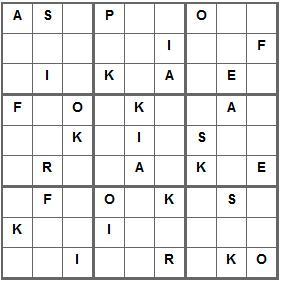
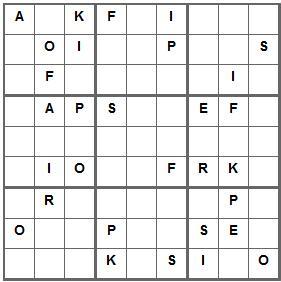
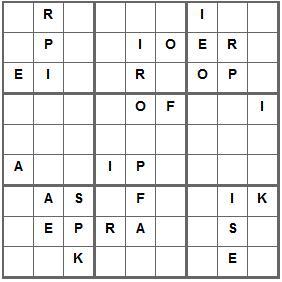
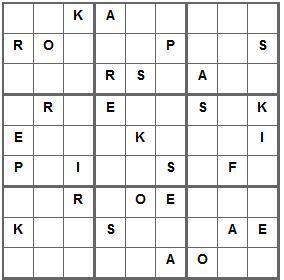
A Spark of Heavenly Fire Sudoku. You work these exactly as you do number Sudoku, but you use the letters from A Spark of Fire. (A, S, P, R, K, O, F, I, E)

ashf-sudoku4ashf-sudoku

 ashfsudoku2                                                                                                 ashfsudoku3

 You can work the sudoku puzzles online:

First Sudoku
Second Sudoku
Third Sudoku
Fourth Sudoku

Click here for solutions:

solution

Cryptogram:

To break the code, look for repeated letters. E, T, A, O, N, R, and I are the most often used letters. A single letter is usually A or I. OF, IS, and IT are common 2-letter words. Try THE or AND for a 3-letter group.

EBGUB CO CY GDGUV EUNG ZLKRY’O BGRUE R OXRUF LA BGRDGYHV ACUG, ZBCLB HCGO ILUKRYE CY EBG MULRI IRVHCMBE LA XULOXGUCEV, MNE ZBCLB FCYIHGO NX RYI MGRKO RYI MHRQGO CY EBG IRUF BLNU LA RIDGUOCEV. (ZROBCYMELY DUDCYM)

More Puzzles:

A Spark of Heavenly Fire Word Scramble

A Spark of Heavenly Fire Gems

A Spark of Heavenly Fire Solitaire

Let’s have some fun
In a different guise.
Click on the cover
For a wonderful surprise.

A Spark of Heavenly Fire - online jigsaw puzzle - 40 pieces

You can find my newly published novels at Amazon:
 
They are also available at a discount from Second Wind Publishing (payable through Pay Pal only):

add to del.icio.us : Add to Blinkslist : add to furl : Digg it : add to ma.gnolia : Stumble It! : add to simpy : seed the vine : : : TailRank : post to facebook

HALLELUJAH! MY NOVELS HAVE FINALLY BEEN PUBLISHED! LET’S PARTY!

QUARANTINED! 


Are you up to the challenge?

Then…

Let’s party!

I brought the fireworks. 


You can find my newly published novels at Amazon:
 
They are also available at a discount from Second Wind Publishing (payable through Pay Pal only):
 
The first fourteen people who order A Spark of Heavenly Fire from Second Wind Publishing will receive a spark of heavenly fire. Perhaps I erred. Perhaps it’s more of a spark of machine-made fire — a dainty crytal pendant — but it’s still free to the first fourteen customers.

Please join me here for a live online celebration all day Tuesday, March 31, 2009. Stop by when you can, but I will be here live from 5:00 pm ET to whenever. There will be dancing, games, eprizes.

add to del.icio.us : Add to Blinkslist : add to furl : Digg it : add to ma.gnolia : Stumble It! : add to simpy : seed the vine : : : TailRank : post to facebook