For a long time, I’ve felt like a poseur, embarrassed to admit I had written books. I’ve hesitated to even look at any of my published works lest I find out how mediocre they are, and proving that yes, I am a poseur. I don’t know when the embarrassment at calling myself a writer took hold. In a blog post in June of 2018, I wrote that “when it comes to writing, I don’t feel like a fraud” so it started sometime after that.
A lot of people, especially successful women, are beset by “imposter syndrome,” where they feel as if they don’t belong in the position they are in, but that isn’t my case. First, I’m not successful, and second, I’m not in any position — I stopped writing books years ago. For many months, I even stopped blogging. Can one be a writer if one isn’t writing anything, isn’t even selling the books that are already written?
Whatever the answer to that, the non-sales of books all these years whispered to me that perhaps I really was simply posing as an author rather than being one in truth. And somewhere deep down, I figured if I admitted I was a non-successful author, then I’d have to admit that maybe I wasn’t a good enough writer after all.
I don’t know where I got the courage (desperation at not having anything to read?), but I’ve been reading my books lately, something I’ve never done once they were published. I’ve been amazed by how good they are. Well written. Interesting stories. Characters that have to deal with life-changing events. Even though I’ve mostly forgotten the stories except for a brief synopsis, it’s possible that something in me recognizes the books as ones I’ve written and so see something that is not there, but I don’t think so. I tend to think they really are as good as they seem.
Unfortunately, they don’t seem like the types of books that will appeal to many people, which makes sense since I started writing them when I could no longer find the books I liked to read. (You’d think that would be a clue to their salability, wouldn’t you?)
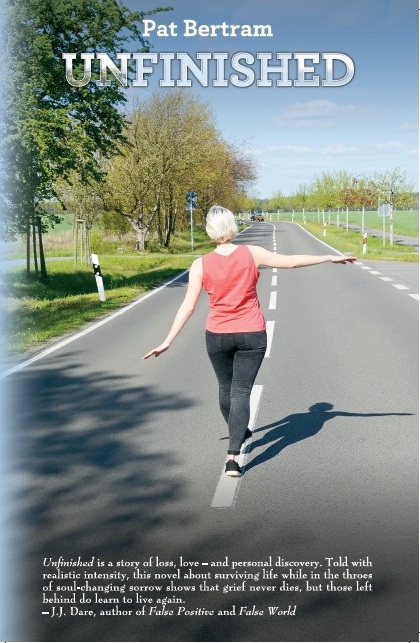
The first two I read, Bob: The Right Hand of God and Light Bringer, are books that take place in familiar earthly circumstances but develop an otherworldly strangeness about them. The last one I read, Unfinished, is very earthly, nothing strange about it except the portrayal of the insanity of new grief. Whenever, as a reader, I’d get annoyed by her tears or frustrated by the disconnect between reality and her perception of it (knowing her husband was dead but still expecting to encounter him alive), the scene and the energy would change to some other facet of her struggle to cope and so keep me interested.
One thing that was well done, I think, was showing how she’d been affected by the horror of her husband’s last year — she’d been left in limbo because he didn’t want anything to do with her and in fact often couldn’t remember who she was and yet, like a child, needed her care. Toward the end of that year, she’d engaged in a cyber affair with a guy who was going through the same thing she was. She thought she was done with grief and was starting over, yet when her husband died, all the feeling she’d been denying descended on her, and there she was, torn between two impossible loves. And finding out her husband had secrets of his own was just topping on that whole unpalatable cake.
I hesitated to read the book, thinking it would be too depressing, but she started to find her way through that emotional mess, and the book ended on a hopeful note.
I really liked the book. Although not a lighthearted story, it was very well written and definitely did what I wanted it to do — show the insanity of new grief.
Luckily, the next book I read will be lighter since one thing I do know is that this was the heaviest of the lot.
It really is an interesting experience reading these books. I know I wrote them, but since I forgot them, I can come at them as if they were written by a stranger. And truly, the author is a stranger; someone I was long ago but no longer am. No wonder I feel like a poseur.
***
Pat Bertram is the author of Grief: The Inside Story – A Guide to Surviving the Loss of a Loved One.








 Bertram's Blog