Intentions and Unintentions

So far most of my New Year’s resolutions are on track, both the intentional ones and the unintentional ones. My plan of taking a walk every day was pretty much buried in the snow a few days ago. Although the snow is melting, there is too much slush to for me to want to be out there; also I’m fighting some sort of allergy or early cold symptom, which gives me even more of an excuse to remain inside. I am doing well staying away from the news, though occasionally the news comes calling with an email or an inadvertent glimpse when I let my attention wander. I’m also staying with the no sugar/no wheat thing, though I am looking forward to some sort of treat when the month is over. (This resolution was only for a month, though the intention of sticking with real food is an ongoing one.)

My unintentional resolution of blogging every day is still on track. Fifteen days and counting! I never really planned to blog every day . . . I just started, and now here I am. It feels good to be back blogging. An additional benefit is that it’s getting me away from playing games on the computer, which is just as well. The hidden object game I play is getting tiresome, though I still log in and play a bit every day just to keep my hand in, but any sense of wanting to work toward game goals has dissipated.

One unvoiced intention this year was to reread The Wheel of Time series by Robert Jordan and try to pick out clues to the real ending, not the ending we ended up with, which I am trying to do. Jordan, the one who created his world out of a mosaic of our history, culture, myths, and legends, died before he could finish, and the author chosen to finish the series did an execrable job. Not only was he at best a serviceable writer, he dumped characters that played a role through Jordan’s writings, ignored many characters’ development and regressed them to the beginning, traded established subplots for new subplots of his own that added nothing to the story, destroyed his own timeline so that things happened in no order (even seemingly having one character in two places at a time and two characters meeting where their timelines couldn’t have intersected).

[What astonishes me about those ersatz books is how protective everyone is of that substitute author. There are no one- and two-star ratings of his offerings, though there are plenty of low ratings when it comes to Jordan’s books. (Admittedly, some of those are deserved. Although much of Jordan’s story is brilliant and shows the ten years he spent researching, and his writing seems epic at times, it could do with a serious editing, including slashing huge sections of a couple of books.) I did find one review that was an honest critique of the last three books, yet the overwhelming response to the thoughtful piece was that the review was “overwrought drivel” written by an angry fan. (Even though the reviewer admitted he wasn’t a fan.)]

I read this series multiple times because after volume 6, I could no long remember what had happened in volume one. Most of the brilliance in the series comes from foreshadowing, and it’s hard to tell when a foreshadowed event occurs when you can’t remember the foreshadowing. So now I am able to remember the story going both ways — what I’ve read and what I’m going to read. Unfortunately, now I can’t forget those last three mishmash books by the substitute author in order to come up with my own ending as foreshadowed by Jordan’s writings.

I am not a fan of these books so much as a student, which is why I want to puzzle out the real ending. (Something to occupy my mind, if nothing else.) Perhaps as I find more of the clues to the ending Jordan intended, I’ll be able to override in my mind the bad ending with one of my own concoction.

Meantime, the year progresses. Already halfway through January! And my intentions (and unintentions) are still holding strong.

***

Pat Bertram is the author of Grief: The Inside Story – A Guide to Surviving the Loss of a Loved One.
The Current Year Will Bring Me Much Happiness

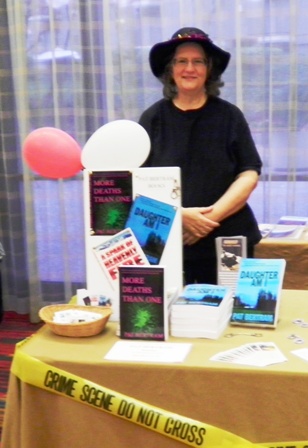
I went to Sacramento for a couple of days to set up my books at a special-ed teacher’s conference. When I opened my suitcase to unpack, I found a little surprise — a note from the TSA telling me they had searched my checked bag. (They also had searched my carry-on bag. Apparently, books are so dense, they show up as fog on the screen.) This was the first time I’d checked a bag — I prefer to travel light, but the suitcase was mostly filled with books, and I knew I’d never be able to lift it up to fit in the overhead bin — so I didn’t know what to expect. Luckily, I didn’t lock the bag. So, no harm done.

We had Chinese food while I was there, and since my friend doesn’t eat sweets, I ended up with both fortune cookies. The first one I opened said, “The current year will bring you much happiness.” That pleased me until it occurred to me that perhaps that particular fortune was meant for my friend. So I opened the second cookie. It said, “The current year will bring you much happiness.” Apparently, this is going to be a good year!

I sold a few books in Sacramento, which was nice. Visited with the friend who had invited me to share her table, which was nicer.

Already my fortune is coming true!

selling books

***

Pat Bertram is the author of the suspense novels Light Bringer, More Deaths Than One, A Spark of Heavenly Fireand Daughter Am I. Bertram is also the author of Grief: The Great Yearning, “an exquisite book, wrenching to read, and at the same time full of profound truths.” Connect with Pat on Google+. Like Pat on Facebook.

Authors Who Reject Publishers

There’s been a lot of talk recently about traditionally published novelists rejecting their publishers and releasing their books themselves. I can see that these novelists don’t like making a pittance on their books, but it seems churlish to dump the very people that made them a success. Without the publicity departments of those publishing houses behind them, there is little chance that these authors would have ever attained their current popularity. If you are one among millions of unknown writers trying to sell your book to an unaware reading public, it doesn’t matter if your book is stellar. It cannot shine without readers.

Many authors have the idea that wonderful books will always find a readership. Once that might have been true, but in today’s book world, where anyone with a computer and bit of time on their hands can write a novel (sometimes in only a few weeks, including editing — yikes) the sheer numbers of available books can keep even a great book from rising above the flotsam.

Interestingly enough, only a couple of these once traditionally published authors wrote truly original novels. If the rest had to make their own way in the ocean of ebooks and self-published books, they would have not have found much of a readership. The major publishers want what I call blue-jeans books — books that are made from the same fabric as all the others in a genre but with a slightly different styling. They don’t want anything too original because it is hard to sell. (I had several editors tell me they loved Light Bringer, my latest novel, which will be released by Second Wind Publishing this March, but they turned it down because they didn’t know how to sell it.) The blue jeans quality that makes books acceptable to editors of major publishing houses is the very quality that makes them unremarkable in the self-publishing or independent publishing world.

I don’t have much use for the traditional publishers, so I don’t really care that these authors are shunning them, but it does give new writers a false idea of can be accomplished by going it alone. The very fact that these authors are dumping their publishers is news. Publicity, in other words. And it’s only newsworthy because readers know their names. And readers know their names because the authors had the benefit of a big corporation’s publicity department.

I might have been unaware of the situation, but one of these authors contacted me via Goodreads, asking me to be part of a promotional effort. He wrote that he’d send me (along with hundreds of others) an ebook if I promised to write a review and post it on a given date. I turned him down. I don’t like his books, and I don’t like being told when to post a review. Not that I would — I still have not learned the art of reviewing books. And if I did do reviews, I’d post reviews of books released by small, independent publishers. The point is, he sent me the ebook anyway. A story about vampires. Sheesh. Still doing the old blue-jeans dance.

I purposely did not mention any names in this bloggery since I don’t want to help promote the authors. And anyway, it doesn’t matter who they are. I certainly don’t care, and there’s a chance in the not-too-distant future no one else will either.

A Thrill of Books

51miDOzhkHL._SX333_BO1,204,203,200_A murder of crows. A quiver of cobras. A charm of finches. A mischief of mice. A tower of giraffes. A scurry of squirrels. To this list of wonderfully evocative group names, I’m adding “a thrill of books.”


When I was young, I used to love coming home from the bookstore or library with an armful of books. I’d study the covers, read the blurbs and acknowledgments, open the book and sample a few words. It was a special thrill, this stack of new worlds that would soon be a part of me. Where would I go? Who would I meet? What challenges would I have to overcome?

The years did their damage, as they always do. Or maybe the culprit wasn’t the passing years, perhaps it was too many trivial stories, too much homogenization of genre, too much corporate policy infringing on the art. For whatever reason, I lost the thrill of having new books to read, and I thought it was gone forever.

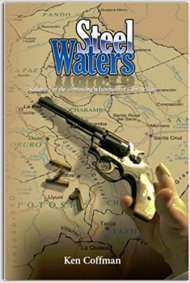
I mentioned in my previous blog that I offered to review a few books, and today I received two of them in the mail: Steel Waters and Toxic Shock Syndrome by Ken Coffman. I looked at the covers (okay, I did more than look, I ran my hand over them, savoring the feel of the brand new books). I read the back covers, the acknowledgements, the author’s signature — “To my friend and fellow writer, Pat Bertram. I wish you all the best with your work.”

Already I could feel the glimmer of that old familiar feeling. Then I opened Steel Waters to the middle and saw, “I looked and smelled like a Bolivian sewer rat.” From comments others had made, I knew this was no homogenized piece of corporate bilge, but right then I felt it — the thrill.

So thank you, Ken, for giving me — one more time — a thrill of books.

See also: Pat Bertram Introduces Glen Wilson, Hero of Five Ken Coffman Novels
On Writing: Style and Cadence by Ken Coffman
A Cheapskate Guide to Creating a Publishing Company by Ken Coffman

***

Pat Bertram is the author of the suspense novels UnfinishedMadame ZeeZee’s Nightmare, Light BringerMore Deaths Than OneA Spark of Heavenly Fireand Daughter Am IBertram is also the author of Grief: The Great Yearning, “an exquisite book, wrenching to read, and at the same time full of profound truths.” Connect with Pat on Google+. Like Pat on Facebook.

The Most Wasted Day of All is That on Which We Have Not Laughed

The first half of a novel comes slowly for me. Some writers can sit down and let the story whoosh out of them, but I have to think of everything, to create everything, to draw in words the images I want readers to see. I castigate myself at times for writing so slowly, but if I finished the book quickly, I’d simply be adding one more unpublished novel to the world. And do we really need that?

So many books seem to be written as a way for writers and then later their readers to kill time. (Odd, how time such an ambiguous villain that we try to kill it while wishing we had more of it.) Perhaps books were always a way of wasting time. I came across this quote the other day: “Most of today’s books have an air of having been written in one day from books read the night before.” I can see you nodding your head in agreement. The interesting thing about this comment is that Nicolas-Sebastien Chamfort wrote it in the eighteenth century. (I don’t know who he is, either, other than that during the French revolution, he was an outspoken writer who botched his suicide. He died in 1794; his last words were, “And so I leave this world, where the heart must either break or turn to lead.”)

I try to write most days, but life tends to get in the way. Is it better to write or is it better to watch a movie with a friend? The friend, of course. And I know Chamfort would agree. He also said, “The most wasted day of all is that on which we have not laughed.”

But I am never far from my work-in-progress. As I watched the movie, Krippendorf’s Tribe, I found myself taking notes on all the things I would have to include in my apocalyptic novel to make my new society believable: rituals, games, dancing, stories. So I covered all the bases: I was with my friend, I laughed, I worked. Not bad for a night spent not writing.

Other nights when I can’t write, I edit. I know we’re told not to edit before we’ve written the entire novel, but if the first pages aren’t quite right, they niggle at me and keep me from continuing. But the words do add up, and by the second half of the novel, I know the characters, I have the story firmly entrenched in my mind, and sometimes, just sometimes . . . whoosh!

Words Yipping at My Heels

I just finished taking a look at two thrillers, both big, slick, well-touted works. Although they had interesting plots, there were so many point-of-view characters and so many incidents that the stories never seemed to go anywhere. I finally got tired of the words yip-yip-yipping at me and closed the books.

Ahh. Silence.

Three-hundred-page manuscripts used to be common, but the size of books grew along with the influence of corporate booksellers. Not only did large books make people think they were getting more for their money, they were well suited for mass displays. As with other merchandise, perception of worth apparently supersedes true value.

Big books are divided into short chapters and those chapters divided into smaller and smaller segments that make the book easy to put down and pick up at odd intervals for attention-challenged readers, but those small segments make it hard for a reader who wishes to identify with a character and be pulled into another reality.

Some books don’t lose anything by being big and thick. Although toward the end I did get a trifle tired of Stephen King’s Duma Key, he managed to keep my attention all the way through. No mean feat. But most big books today can do with some serious editing to better focus the plot and give some depth to the characters and stop that incessant yipping.

One of the more enjoyable books I read recently was a mere two hundred and sixty pages, but it didn’t seem like a short book. The character’s plight engaged my interest, and I didn’t keep flipping pages in an effort to finish the book quickly.

I used to feel guilty that my own books were only about three hundred pages long; obviously something is wrong with me if other writers can churn out words by the hundreds of thousands. But I want my words to signify something, to be worth the time it takes to dig them out of my psyche. And I want my characters to be more than mere types. I don’t know if I will ever become the writer I wish to be, but I know one thing: I won’t be creating overblown, yippy works; the words come too hard. Besides, I would rather readers complain that my books are too short than slam them shut to get a bit of silence.

One Word at a Time. That’s All It Takes.

Writing is all about goals. For most of us, the primary goal is to become a published writer, though we all envision that goal differently. Some dream of being the next Stephen King or John Grisham or (insert name here); some dream of making lots of money, and some just want to make a living at it. Except for a very few, that dream is out of reach, at least for now.

But that is not the only goal. Nor is it the most important. That primary goal beckons, but unless you actually write a book, it is not a goal but a fantasy. So, the next goal is to write a book. (If you have written a book, the goal could be to write another one.) This goal is better than the primary goal, because it is in your hands. You can write a book. But this goal is so general as to be almost worthless.

So, the goal would be to decide what story to write. That goal is easy to achieve. Just think of a character, something that character wants, and who or what is going to keep the character from getting it until the end.

The next goal is to write the book. Now this is more difficult. That empty screen, those blank pages — how do you fill them all? By setting more goals. Decide how many pages you would like to write each day or week or month. That still sounds like too much to get your mind around? Fine. Then decide to write a page, a paragraph, a sentence.

Still too much? Then set your goal to write a single word. I can hear your snort of derision: that’s not much of a goal. But in the end, it is the only goal. How do you think every book all through the ages got written?

One word at a time. That’s all it takes to write a novel.

By stringing single words together, you get sentences, then paragraphs, pages, chapters, an entire book. After that, who knows, you might even reach the pinnacle and become a published author. All because you set your goal to write one word.

Books Are Not Movies

Many writers see their novels as movies, picking a cast to portray their characters, visualizing scenes as they would play on the screen. But books are not movies. A movie set can be seen in an instant and does not detract from the action, while a long passage in a book describing that same scene postpones the action, making today’s readers impatient. (Action in a novel, as I am sure you know, is any forward motion that fosters change in the characters: dialogue, physical interactions, even a simple touch of the hand.)

Nor is a book a movie script. Some novelists are so enamored with envisioning their book as a movie that they omit descriptions altogether. They tell their story mostly by dialogue, which leaves readers untethered, “like water, willy-nilly flowing.”

If two characters are having an argument, for example, it is necessary for readers to know where it is taking place. An argument in a pub is different from an argument in a bedroom, but they don’t need a long description of the bar or the bedroom to get involved with the characters; a few significant details will anchor the scene in their minds. A detailed set is necessary for a movie’s verisimilitude, but those same details negate a novel’s illusion of being true. Do you stop in the middle of an argument to note the contents of the room? If you do, you lose not only your focus, but the argument as well.

Even a short descriptive passage can negate the illusion if the object or setting described has no significance to the story. A lamp may be placed on a side table in a movie set for no reason other than the set designer liked the way it looked, but if an author spends many words describing that same lamp, there has to be a reason. Perhaps it is a source of contention between characters. Or perhaps one character will bash another over the head with it.

So, if you visualize your novel as a movie, don’t describe everything you see. Describe only what is important, (what is important to the characters or to the story, not what is important to you as a writer) and then . . . ACTION!