Whose Book Is It?

We writers do the best we can to tell an engaging story, hoping readers will like what we have written, but often readers see something in the story that we didn’t purposely put there.

Sometimes this “extra” is good. A reader once pointed out that A Spark of Heavenly Fire was about love in all its guises. He was right, that is a major theme, though that hadn’t been my intention. I wanted to write a big book, an important book with ordinary people becoming extraordinary in perilous times. Since I didn’t want to do a war story, I did the next best thing — created an epidemic so deadly that the entire state of Colorado had to be quarantined to prevent the spread of the disease. To “personalize” the catastrophe, I told the story from several points of view, not just character POV, but the various ways the characters viewed the epidemic. And what shone through, by the time all the stories were told, was the theme of love in all its guises.

DAIsmallBut sometimes the “extra” that readers find is not so good. Daughter Am I is the story of old time gangsters. A young woman inherits a farm from murdered grandparents she didn’t know she had — her father had claimed they died before she was born. When she confronts her father with his lie, he merely responds, “They were dead to me.” She becomes obsessed by the mysteries of why her grandparents had been murdered and what they had done that was so terrible their only son cut them out of his life.

She tracks down her grandfather’s friends, most of whom had lived nefarious lives, and she gradually learns who her grandfather was. At the end of the book, her actions mirror what she has learned about her grandfather, and so she learns the truth of him.

This is the book I had written — a young woman searches for her grandfather, and finds him in herself, in her outlook on life, in her dealings with others.

One friend who read the book was reticent to tell me what she thought. She admitted she loved the characters and the writing, but then she finally said, in a hesitant voice, “But the ending isn’t exactly moral, is it?”

In thinking about it, I had to admit it wasn’t strictly moral, but the ending was inevitable since it fit the search-for-identity story I’d written. I didn’t really think anything more about it until I saw a review where someone liked the book and the characters, but didn’t like cynicism of the book — that anything is justifiable as long as you treat your friends right.

These two comments made me wonder about the truth of the story. Was it really cynical? Really immoral? I wasn’t trying to make such points. I merely wanted to tell a “hero’s journey” story about gangsters. And gangsters, by definition are immoral. If they weren’t, if they were law-abiding citizens, they wouldn’t be gangsters, they’d be corporate executives. (Well, maybe that’s a bad example, considering how many stories of larcenous corporative executives end up in the newspaper.)

In the end, it doesn’t really matter what story they read, at least not from my perspective. The truth of any story is in the minds of readers. We writers can only write the story we know how to write, then send them out into the world to make whatever they can of themselves.

***

Pat Bertram is the author of the suspense novels Light Bringer, More Deaths Than One, A Spark of Heavenly Fire, and Daughter Am I. Bertram is also the author of Grief: The Great Yearning, “an exquisite book, wrenching to read, and at the same time full of profound truths.” All Bertram’s books are published by Second Wind Publishing. Connect with Pat on Google+

When a Writer is Silent . . .

I am not shy around people, though I am more of a listener than a talker, particularly when they are discussing subjects of which I have no interest or knowledge, such as celebrities, TV shows, high profile court cases. Even when people are talking about things I can speak of, I generally don’t fight for the floor except when the conversation sparks a new idea and I want to give it voice.

My propensity for being the “designated listener” has never been a problem because most people seem to prefer to talk, but things are different now when people discover that I am a writer. My silence makes them wonder if I am studying them to use as characters in a book.

Strangely, this never occurred to me. I spend so much time alone that simply being with people is a treat. I bask in their words and the camaraderie no matter what the topic of conversation. I know this is not the case with other writers. They do study people to learn more about how their characters should/could act. They also use people they know as characters in their boFriendsoks. As Anne Lamott said, “You own everything that happened to you. Tell your stories. If people wanted you to write warmly about them, they should’ve behaved better.”

My characters rise out of the needs of the story. If the character needs to be shy, I make him shy. If she needs to be interested in the minutiae of everyone’s life, I make her so. Occasionally, I base a character on an actor in a movie, especially if I need to describe the character to someone. For example, Greg Pullman in A Spark of Heavenly Fire was loosely based on Jack, Bill Pullman’s character from While You Were Sleeping. I wanted Greg to be movie-star handsome as well as nice, and I named him Pullman to remind me of these two characteristics every time I wrote about him. But for the most part, the character of Greg evolved to fit the needs of the story. The same thing happened with Mary Stuart, the hero of Daughter Am I. I based her loosely on Lisa Walker, the character of Mary Stuart Masterson played in Bed of Roses, and I used the name Mary Stuart for my character to remind me that my Mary, like Lisa, was both strong and vulnerable. The name was supposed to be a working name — I planned to change it when I found a better name, but the character and the name evolved together, and could not be separated.

So, if you are ever in a conversation with me, and I am silent, you never have to worry about appearing in one of my books.

Well, hardly ever.

***

Pat Bertram is the author of the suspense novels Light Bringer, More Deaths Than One, A Spark of Heavenly Fire, and Daughter Am I. Bertram is also the author of Grief: The Great Yearning, “an exquisite book, wrenching to read, and at the same time full of profound truths.” Connect with Pat on Google+. Like Pat on Facebook.

Creating Incredible but Credible Characters: Dialogue (Part 2)

[This is a continuation of a previous post: Creating Incredible but Credible Characters: Dialogue (Part 1)]

Dialect and regional accents are especially tricky to write. It used to be that writers tried to show dialect and accent through the laborious use of phonetic spellings and a blizzard of apostrophes. Today, though, we readers don’t like having to decipher the author’s personal code. Nor do we writers need to take the time to create the code. It’s better to use colloquialisms and broken language to show regional differences. For example, “I done died and gone to heaven.” Not an apostrophe or phonetic spelling in sight, though you know immediately the speaker is not a high-toned college professor from Boston.

If your character has a foreign accent, you don’t have to bludgeon a reader with it. All that is necessary to portray an accent is to say the character speaks with an accent. If you wish, you can use phrasing to remind the reader of the accent, such as, “We will go to the store. No?”

This snippet from Daughter Am I shows Crunchy’s difficulty with English:

“Mary’s trying to find out about her grandparents,” Kid Rags said. “His name was James Angus Stuart.”

Crunchy shook his head. “Don’t know no James Agnes Stuart.”

“What about Regina DeBrizzi Stuart?” Mary asked.

“Don’t know her neither.”

talkingDialogue is an artificial construct. Dialogue does not mimic conversation but instead gives readers the impression of realistic conversation.

Books on how to write dialogue often suggest listening to people talk to learn how to write dialogue. Seems like good advice, but have you ever truly listened? “We . . . um . . . we, like . . . you know . . . we stammer and like we repeat ourselves and um . . . you know.”

Even when we speak coherently, we don’t converse. We lecture. We tell long, boring, convoluted stories. We interrupt others and talk over them. We use clichés. We tell jokes that take forever to get to the punch line. None of which helps us write dialogue. If characters in books talked the way we talk in real life, who would bother reading? We want our characters to sound like us, just not talk like us. We also want their conversations to be witty, to the point, and conflicted.

In life, most of us cannot come up with that clever quip when we need it—it comes to mind (if at all) late at night when no one is around to be impressed. Our characters don’t have to suffer from that malady because they have us and our late night epiphanies on their side. We can change their words as often as necessary to get it right.

And get it right we must. Good dialogue advances a story and shows character interacting with other characters. Good dialogue makes a reader keep reading. Bad dialogue, no matter how crucial to the story, makes readers go in search of other amusements.

The following is another excerpt from Daughter Am I showing the use of dialogue.

*     *     *

Mary noticed, for the first time, her father’s receding hairline, the deep crinkles at the corners of his brown eyes. Soon he would be as old as Kid Rags, Teach, and Crunchy.

Tears stung her eyes at the thought of her father living alone in a dingy hovel, and she vowed she would not let that happen.

Realizing the silence was stretching out awkwardly, she opened her mouth to speak, but he held up a palm to forestall her.

“I don’t want to know what you’re doing,” he said. “Whatever it is, I know it’s something you feel you have to do. I thought you should be aware you’re upsetting your mother.”

“I don’t mean to.”

He heaved himself out of the chair. “That’s all I came to say.”

“I’m glad you stopped by,” she said. “I planned on calling you later anyway to tell you I’m going to be away for a few days.”

He stared at her for a moment, then shrugged. “I don’t understand what you’re trying to accomplish, but I suppose you know your own mind.”

You are so wrong. I don’t know anything.

He walked to the door, paused with his hand on the knob for a second, then turned to face her.

“I love you,” he said softly.

She swallowed. “Oh, Dad. I love you too.”

He opened the door. “Be careful, okay, honey? You don’t know what you’re getting yourself into.”

***

This article is anthologized in the Second Wind Publishing book: NOVEL WRITING TIPS AND TECHNIQUES FROM AUTHORS OF SECOND WIND PUBLISHING, which was the 100th book released by Second Wind.

“As someone who constantly evaluates novels for publication, I was astonished at the breadth and clarity of the wonderful advice contained in this handbook. It addresses concerns as grand as plot development and as simple but essential as formatting your submission. It offers crucial advice on literary topics ranging from character development to the description of action. Virtually every subject that is of great concern to publishers — and therefore to authors — is covered in this clear, humorous and enormously useful guide.” –Mike Simpson, Chief Editor of Second Wind Publishing

***

Pat Bertram is the author of the suspense novels Light Bringer, More Deaths Than One, A Spark of Heavenly Fire, and Daughter Am I. Bertram is also the author of Grief: The Great Yearning, “an exquisite book, wrenching to read, and at the same time full of profound truths.” Connect with Pat on Google+. Like Pat on Facebook.

Creating Incredible but Credible Characters: Dialogue (Part 1)

One of the hardest techniques for new writers to handle is dialogue. When I first started out, my characters never just said something. They agreed, cautioned, reminded, mimicked, answered, contributed, guessed, explained, responded, admonished, confessed, encouraged, clarified, blurted, pointed, winced, replied, corrected, acknowledged, returned, laughed, challenged, chided, objected, contested, quipped, offered, moaned, complained, repeated, stammered, pleaded, inquired, mumbled, interrupted, confirmed, addressed, countered, advised, completed, allowed, supplied, ordered, asked, continued, chided, answered, whispered, teased, requested, hollered, echoed, declared, informed, spoke, bellowed, spit out, thundered, hissed. All within a few pages. Whew!

Even worse, I would sit and agonize over the way my characters spoke. “He responded sparingly.” “She informed him haughtily.” He mumbled sadly.”

dialogueIt was a joy to discover that modern dialogue relies primarily on “said,” such a common word, the reader’s gaze glides over it as if it were invisible. It was even more of a joy to discover that adverbs are frowned on. The dialogue itself, or the beat—the bit of action accompanying the dialogue—should show the character’s emotion. “I hate you”, she said angrily tells us what the character is feeling. She picked up a rock and threw it at him. “I hate you!” shows us what she is feeling, allowing us to become intimately involved with the character. The only time an adverb is necessary is when the character’s words are at odds with his mood, such as: “I had a great time,” he said sadly. You can also use an occasional “ly” adverb to describe the tonal quality of the character’s voice. “I hate you,” he said softly.

Besides helping identify who is speaking, beats help set the stage, tell us about the character’s personality, and vary the rhythm of the dialogue. Overdone, the beats are as distracting as any other speaker attribute, so the secret is to pay attention to the flow. Do you want short snappy dialogue? Don’t use beats. Do you want to slow things down a bit, keep the dialogue from seeming too disembodied? Use a few beats.

It’s hard to write crowd scenes and keep each character identified without resorting to copious “said”s, but beats keep the scene moving and, if you use beats that are specific to your character, you make the various characters come alive.

This excerpt from my novel Daughter Am I shows the use of beats. The scene is between my hero Mary, a young woman in search of her grandparents’ murderer, and a group of feisty octogenarians who are trying to help.

*     *     *

The man stopped bouncing and let his arms drop to his sides. Now that he stood relatively still, Mary could see he was skinnier than she’d first thought. A gray slouch hat tilted toward one eye, but the baggy pants cinched high above his waist and the bright flowery shirt several sizes too large marred the jaunty effect. His hands shook uncontrollably. Parkinson’s disease?

“You must be Happy,” she said.

Frowning, Happy patted his torso. “Must I be happy?” His voice deepened to what Mary assumed was his normal tone. “Can I be happy? Can anyone truly be happy?”

“His name is Barry Hapworth,” Kid Rags said, flicking a bit of lint off his navy pinstriped suit jacket. “For several obvious reasons, everyone calls him Happy.”

Mary glanced from the bus to Happy. “Were you driving this thing?”

Happy puffed out his meager chest. “Sure was.”

“And did you almost run over Mrs. Werner’s cat?”

“I’ll take the fifth.” Happy paused for a fraction of a second. “A fifth of bourbon.”

“Did someone say bourbon?” Kid Rags removed the flask from his hip pocket, took a swig, and passed it around.

“Who are all these people?” Bill asked from behind Mary.

Mary turned, wondering how she could explain the situation to her fiancé, but Teach saved her the trouble and made the introductions. Arms still folded across his chest, Crunchy nodded to Bill, then stepped close to Mary. Happy punched the air, but stopped when Bill showed no inclination to fight.

Kid Rags shook Bill’s hand. “You’re a lucky man.”

“What are you all doing here?” Mary asked. “I was supposed to pick you up. And why is Happy here?”

“Happy is a friend of Kid Rags,” Teach began, but Kid Rags interrupted him, saying hastily, “Not a friend. Just a fellow I know.”

“Happy knows someone who knows Iron Sam,” Teach continued, “and since we knew your car wasn’t big enough for all of us, we accepted Happy’s offer to drive us in his bus.”

“Who’s Iron Sam?” Bill asked, sounding plaintive.

“Butcher Boy,” Kid Rags said.

Bill’s eyebrows drew together. “Butcher Boy? Mary, are you sure you know what you’re doing?”

Mary laughed, suddenly feeling lighthearted and carefree. “I haven’t a clue.”

***

This article is anthologized in the Second Wind Publishing book: NOVEL WRITING TIPS AND TECHNIQUES FROM AUTHORS OF SECOND WIND PUBLISHING, which was the 100th book released by Second Wind.

“As someone who constantly evaluates novels for publication, I was astonished at the breadth and clarity of the wonderful advice contained in this handbook. It addresses concerns as grand as plot development and as simple but essential as formatting your submission. It offers crucial advice on literary topics ranging from character development to the description of action. Virtually every subject that is of great concern to publishers — and therefore to authors — is covered in this clear, humorous and enormously useful guide.” –Mike Simpson, Chief Editor of Second Wind Publishing

***

Pat Bertram is the author of the suspense novels Light Bringer, More Deaths Than One, A Spark of Heavenly Fire, and Daughter Am I. Bertram is also the author of Grief: The Great Yearning, “an exquisite book, wrenching to read, and at the same time full of profound truths.” Connect with Pat on Google+. Like Pat on Facebook.

Creating Incredible but Credible Characters: Keeping your Characters Consistent

Consistency makes for a good lemon meringue pie—you don’t want globules of lemon ruining the texture of the smooth filling. And consistency makes a good story—you certainly don’t want globules of untruth ruining the texture of your readers’ belief. I admit I’m stretching for an analogy, but still, the point is that readers will forgive a writer almost anything except inconsistencies that interrupt the flow of the story.

I once started to read a book where a man spirited away the Shah of Iran. According to the author, the Shah lived fifteen years beyond his supposed death in 1980. The operation was so secret and so successful that no one knew about it. But… It took only this one very high profile achievement to assure a solid client base for the man. Supposedly, word travels quickly in the very elite circles of power, and so the demand for the man’s services was always in excess of his ability to produce.

What??? If no one knew that the Shah survived his death, how could word travel? And if word did travel, how could high massesprofile clients remain “dead,” especially since most of them were hiding from those in the elite circles of power? The inconsistency took me out of the story, and I never did finish reading the book.

It’s almost impossible to keep inconsistencies from slipping into a story, which is why self-editing, though vital, cannot be the final editing process. We writers see consistency because we see what we meant to say. Others only see the inconsistency. I am grateful to one of my editors for finding one particular inconsistency in Daughter Am I. The editor wrote, “It’s not clear here whether or not Mary completely removed her shirt. If she did, when she stood up and ran to the bathroom, then turned around and had the conversation with Tim, she’d have been completely topless. Given their feelings for each other, and their state of undress, it seems unlikely they would have been able to have such a lengthy conversation without biology taking over sooner.”

Oops. I completely missed that. Mary took off her shirt so Tim could massage her sore back, and when the massage turned heated, Mary (engaged to someone else) runs from her feelings and hides in the bathroom. Inadvertently, I had her brazenly opening the bathroom door, standing half-naked, and starting a casual conversation—not at all what my poor innocent Mary would have done. After traveling halfway across the country in the company of seven old gangsters (well, six gangsters and one aged ex-night hall dancer) she’d lost most of her naiveté, but still, she would not have flaunted her naked breasts.

Naked breasts may pale in comparison with unsecret secret operations, but the inconsistency could have dammed the flow of the story for discerning readers. So, the moral of this tale is, if you remove your heroine’s shirt or other apparel, make sure you remember her state of undress and write accordingly.

***

This article is anthologized in the Second Wind Publishing book: NOVEL WRITING TIPS AND TECHNIQUES FROM AUTHORS OF SECOND WIND PUBLISHING, which was the 100th book released by Second Wind.

“As someone who constantly evaluates novels for publication, I was astonished at the breadth and clarity of the wonderful advice contained in this handbook. It addresses concerns as grand as plot development and as simple but essential as formatting your submission. It offers crucial advice on literary topics ranging from character development to the description of action. Virtually every subject that is of great concern to publishers — and therefore to authors — is covered in this clear, humorous and enormously useful guide.” –Mike Simpson, Chief Editor of Second Wind Publishing

***

Pat Bertram is the author of the suspense novels Light Bringer, More Deaths Than One, A Spark of Heavenly Fire, and Daughter Am I. Bertram is also the author of Grief: The Great Yearning, “an exquisite book, wrenching to read, and at the same time full of profound truths.” Connect with Pat on Google+. Like Pat on Facebook.

Creating Incredible but Credible Characters: Purposely Flawed Characters. Or Not.

Interesting characters make interesting stories, not the other way around. An author develops interesting characters by putting them under pressure, giving them much to lose, and allowing them to change because of their experiences. And the author makes these characters at least a bit larger than life. Who wants to read about characters who sit around watching television all the time or who repeatedly have the same tiresome argument with their children or who can’t resolve their problems? We deal with that every day. We don’t need to read about it. On the other hand, if the traits are too idealized, characters come across as comic book silly.

Depth of character is revealed in the choices a character makes while at risk. Without the element of risk, there is no real story, only a string of episodes. Think what Superman would be like without Kryptonite—totally uninteresting and flawed flawedin his perfection. But Kryptonite is a purposeful flaw, put there to make Superman more interesting, which makes him seem even more of a comic book character. Oh, wait. He’s supposed to be a comic book character!

To offset the problem of idealized characters, many writers try to create a purposely-flawed character, such as a boozing cop or a mother who can’t communicate with her teenager, but this seems an unnecessary distraction unless, of course, it is a vital part of the character’s motivation. So many flawed characters, particularly heroes with a drinking problem, have been done so often they have become nothing but cardboard cutouts. There is a long tradition of hard-drinking detectives, but there has to be a more creative way of giving characters flaws. Or not. Writers are often enthralled with the idea of flawed heroes, that they are missing the point. They don’t have to give their heroes obvious flaws. By making their heroes realistic, the heroes are automatically flawed.

A character must lose occasionally or make mistakes. Where is the suspense if every time a character attempts to do something she succeeds? And in that loss is a shadow of the flaw, because the setback must be realistic. Did the character lose because of arrogance, assuming she knew what to do when she didn’t? Did the character lose because she wasn’t physically fit or knowledgeable enough? Did the character lose because she didn’t plan correctly, because she was unfocused, because of her inner conflicts? Such losses force a fully realized character to change so in the end she can succeed.

In the beginning of Daughter Am I, twenty-five-year-old Mary Stuart has no real direction, no purpose, but when she learns she inherited a farm from her recently murdered grandparents—grandparents her father claimed had died before she was born—she becomes obsessed with finding out who they were and why someone wanted them dead. She drives halfway across the country with a feisty crew of octogenarians, friends of her grandparents, and even though she discovers they all had ties to the mob, she doesn’t let her good sense override her obsession. This understandable obsession is her flaw, and if she didn’t grow during the course of the story, if she didn’t learn from her setbacks, the obsession could have become a fatal flaw. Fatal or not, flaw or not, Mary’s obsession makes her real, makes her a bit larger than life, and makes her interesting.

To be real, a character must have strengths and weaknesses, but it’s not enough simply to assign a special strength or weakness to a character—the quality needs to be tested. You can do this in one of two ways—play on the strength or play on the weakness. For example, if a character is smart but lacks physical strength, you can either place the character in a situation where the character’s intelligence saves the day or you can put him in a situation where he is forced to rely on physical abilities he doesn’t have.

Strengths are arbitrary and can easily become flaws. Independence can become an inability to depend on others, an ability to cope can be seen as indifference, high ethical standards can become intransigency. Which is great for a book—the resulting misunderstandings can cause conflicts among characters allows the plot or subplots to thicken. And your characters become even more credible.

***

This article is anthologized in the Second Wind Publishing book: NOVEL WRITING TIPS AND TECHNIQUES FROM AUTHORS OF SECOND WIND PUBLISHING, which was the 100th book released by Second Wind.

“As someone who constantly evaluates novels for publication, I was astonished at the breadth and clarity of the wonderful advice contained in this handbook. It addresses concerns as grand as plot development and as simple but essential as formatting your submission. It offers crucial advice on literary topics ranging from character development to the description of action. Virtually every subject that is of great concern to publishers — and therefore to authors — is covered in this clear, humorous and enormously useful guide.” –Mike Simpson, Chief Editor of Second Wind Publishing

***

Pat Bertram is the author of the suspense novels Light Bringer, More Deaths Than One, A Spark of Heavenly Fire, and Daughter Am I. Bertram is also the author of Grief: The Great Yearning, “an exquisite book, wrenching to read, and at the same time full of profound truths.” Connect with Pat on Google+. Like Pat on Facebook.

Sample Sunday

If you’ve been wanting to check out my books, now is your chance to read the first chapter of each novel online. Who knows, you might get so intrigued you will want to buy one of the  book to take with you to the beach this summer or read on an airplane. (Or, for my friends in the southern hemisphere, you might decide one is the perfect companion to read by the fire on a chilly winter’s eve.) I hope you will enjoy sampling a “Pat Bertram” book.

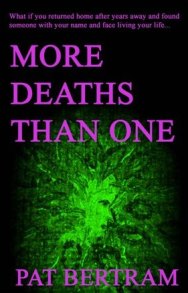
More Deaths Than OneBob Stark returns to Denver after 18 years in SE Asia to discover that the mother he buried before he left is dead again. At her new funeral, he sees . . . himself. Is his other self a hoaxer, or is something more sinister going on?

Click here to read the first chapter: More Deaths Than One

***

A Spark of Heavenly FireIn quarantined Colorado, where hundreds of thousands of people are dying from an unstoppable, bio-engineered disease, investigative reporter Greg Pullman risks everything to discover the truth: Who unleashed the deadly organism? And why?
Click here to read the first chapter of: A Spark of Heavenly Fire

***

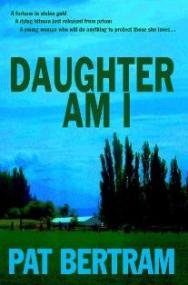
DAIWhen twenty-five-year-old Mary Stuart learns she inherited a farm from her recently murdered grandparents — grandparents her father claimed had died before she was born — she becomes obsessed with finding out who they were and why someone wanted them dead.

Click here to read the first chapter of: Daughter Am I

***

Thirty-seven years after being abandoned on the doorstep of a remote cabin in Colorado, Becka Johnson  returns to try to discover her identity, but she only finds more questions. Who has been looking for her all those years? And why are those same people interested in fellow newcomer Philip Hansen? And what do they have to do with a secret underground laboratory?

Click here to read the first chapter of: Light Bringer

***

Pat Bertram is the author of Light Bringer, More Deaths Than One, A Spark of Heavenly Fire, and Daughter Am I.All Bertram’s books are available both in print and in ebook format. You can get them online at Second Wind Publishing, Amazon, B&N and Smashwords.  At Smashwords, the books are available in all ebook formats including palm reading devices, and you can download the first 20-30% free!
My Favorite of the Books I Have Written

A friend asked me if I had a favorite of the books I have written. The truth is, each is a favorite in it’s own way.

More Deaths Than OneMore Deaths Than One is my favorite because of all the rewrites. I rewrote it four different times, each time making it better, and so I learned to rewrite and to edit. I also liked the ironies that showed up in the book.

Click here to read the first chapter: More Deaths Than One

***

A Spark of Heavenly FireA Spark of Heavenly Fire is my favorite, because halfway through I realized I’d learned how to write, and because it is a solid, classic story of life and love in impossible times.

Click here to read the first chapter of: A Spark of Heavenly Fire

***

DAIDaughter Am I is my favorite because of the fun we (my mate and I) had coming up with the great characters, and because it was the fulfillment of a desire to write a “hero’s journey” story.

Click here to read the first chapter of: Daughter Am I

***

Light Bringer is my favorite because it’s the culmination of a lifetime of research, combining modern and ancient myths into a plausible whole, and because some of the descriptions were stunningly beautiful.

Click here to read the first chapter of: Light Bringer

***

Grief: The Great Yearning is my favorite because writing it helped me get through the worst year of my life, and because unwittingly, it turned out to be the story I always wanted to write, the story of a love that transcended time and physical bonds, told with wisdom and sensitivity.

***

Pat Bertram is the author of the suspense novels Light Bringer, More Deaths Than One, A Spark of Heavenly Fire, and Daughter Am I. Bertram is also the author of Grief: The Great Yearning, “an exquisite book, wrenching to read, and at the same time full of profound truths.” Connect with Pat on Google+

Daughter Am I and The Hero’s Journey

DAIthumbI fell in love with the concept of the mythic quest when I read Christopher Vogler’s book The Writer’s Journey, so much so that I knew I had to write my own quest story. I’m not one for fantasy, either in real life or genre fiction, so I decided to use the hero’s journey structure for Daughter Am I, my contemporary novel of a young woman — Mary Stuart — who goes on a journey to learn about her recently murdered grandparents. Accompanying her are six old rogues — gangsters and con men in their eighties —  and one used-to-be nightclub dancer.

Developing so many characters at one time is difficult under normal circumstances, but the mythic journey archetypes helped me create the characters and keep them focused on their roles. Whether gangster or wizard, hit man or Darth Vader, the archetypes — and the power of the archetypes — are the same.

The hero is the one who grows the most in the story, who gains knowledge and wisdom. Heroism, in the mythic journey sense, is connected to self-sacrifice, risk, and responsibility. The hero must perform the decisive act of the story, though at the beginning, before their transformation, heroes often need to be goaded into action. Mary starts out only wanting to learn about her grandparents, and ends up becoming intensely loyal to the elders in her charge, which changes all of their lives.

A herald gets the hero started on the journey. Kid Rags, a dapper forger forced into retirement by computer technology, eggs Mary on, challenges her to find out more about her grandparents. Kid Rags is also a mentor, giving guidance and gifts, a role he shares with Teach. Teach is a con man who believes everything is a con, and he is not hesitant about sharing his vision.

Every mythic journey needs a trickster, a character who embodies the energies of mischief and a desire for change, and who provides comic relief. The trickster in Daughter Am I is played by Happy, an ex-wheelman for the mob. Happy wants to be on the move, is always urging action, and he peppers his talk with morose and unanswerable pronouncements about death. Did I mention that he carries a gun, but that his hands shake too much to be able to aim it properly? Poor sad Happy.

The shapeshifter is Tim Olson, Mary’s romantic interest. He doesn’t actually change shape, but he appears to change constantly from Mary’s point of view. He tempts, dazzles, confuses her, and makes her question his loyalty.

The shadow represents the energy of the dark side, the villain, and in the case of Daughter Am I, the villain truly is a shadow — Mary and her band of feisty octogenarians never even get a glimpse of him until the very end. Iron Sam, a dying hitman, is also a shadow. Although he is not a villain who has to be vanquished, he represents the dark side of Mary, a sinister balance to her guilelessness.

The story of Daughter Am I lightly follows the stages of the mythic journey, from a glimpse into Mary’s ordinary world, to the call for adventure (her own curiosity as to who her grandparents were and why they were murdered), her reluctance to commit to the journey, meeting her mentors, deciding to take a chance and just head out to talk to others who might have known her grandparents, undergoing tests and ordeals, and ultimately returning home, knowing who she is and what she wants to do.

Although Daughter Am I takes the same “hero’s path” that worked for such disparate stories as The Wizard of Oz, Star Wars, and Tin Cup, the journey is Mary’s own, not a rehash of any of any other quest story.  That is the beauty of the hero’s journey — the structure is infinitely malleable, giving any story a mythic undertone without overshadowing the story itself or confining it into a strict formula.

***

Pat Bertram is the author of the suspense novels Light Bringer, More Deaths Than One, A Spark of Heavenly Fire, and Daughter Am I. Bertram is also the author of Grief: The Great Yearning, “an exquisite book, wrenching to read, and at the same time full of profound truths.” Connect with Pat on Google+

Character as Fate and Fate as Character

Heraclitus believed that a person’s character is their fate. Character — the sum total of a person’s traits — influences the choices a person makes, and the consequences of those choices ultimately become that person’s destiny. Or not. Much of life is luck, happenstance, and totally out of our control, though we tend to believe we have much more control over our lives than we really do. But that’s not an issue here because this is a writing discussion, and in our story worlds everything is under our control, and what our characters do determine their own fate.

This is most obvious in a tragedy — a character comes to an unhappy end because of a flaw in his or her own character, though in today’s stories, because readers like a more optimistic ending, that fatal flaw is often balanced by a special strength. But character/fate works for other types of stories, such as a thriller where a character becomes obsessed with finding the truth, and that obsession leads to both the character’s fate and the end of the story.

For example, In Daughter Am I, a young woman is determined to find out the truth of who her grandparents were and why someone wanted them dead. That determination overrides her usual placidity and takes her on a journey that eventually leads her home again, changed forever. She really did find her destiny because of her character.

I wonder if the opposite is more true (if truth has degrees), that destiny is character. Does what happens to us, both the actions under our control and those beyond our control, determine who we are? Determine who our characters are? This was a theme I explored in More Deaths Than One. So much happened to my poor hero Bob that was not under his control, yet what was under his control — how he handled his fate — made him the man he became.

Any discussion about fate and writing would also have to include the question: does the writer’s fate affect the character’s fate? None of my books have totally happy endings. There is always a pinprick of unease in the background, but the book I am now contemplating — the story of a woman going through grief — is going to have even less of a happy ending. Perhaps because I know the ending of my own love story? Not my story, obviously, since I’m still here, but the story I shared with another. Except for my work in progress (the one that’s been stalled all these years) the stories I’m thinking about writing now all end up with the characters alone.

When I wrote the first draft of my novel More Deaths Than One (and the second draft and the third) I had the hero Bob meandering around his world trying to unravel his past all by himself, and it was boring. Did I say boring? It was moribund. The story went nowhere because there was no one for Bob to butt heads with.

In the fourth draft of More Deaths Than One, I gave Bob a love interest, a waitress he met at a coffee shop. (Hey, so it’s been done before. The poor guy spent eighteen years in Southeast Asia, and didn’t know anybody stateside. How else was he supposed to meet someone?) That’s when the story took off. He had someone to butt heads with, someone to ooh and aah over his achievements, someone to be horrified at what had been done to him.

From that, I learned the importance of writing scenes with more than one character. And yet here I am, once more falling into the black hole of writing characters alone because I can’t visualize them ending up with anyone.

Which leads me to my final question: could the fate of the character also influence the writer’s fate? If so, maybe I should decide where I want to go from here, and write my destiny. Or  I could just wing it and see where destiny takes me and my characters.

***

Pat Bertram is the author of the conspiracy novels Light Bringer, More Deaths Than One, A Spark of Heavenly Fire, and Daughter Am I. Bertram is also the author of Grief: The Great Yearning, “an exquisite book, wrenching to read, and at the same time full of profound truths.” Connect with Pat on Google+