A Retrospective of Grief

Another 27th. This is the 46th twenty-seventh of the month I have survived since the death of my life mate/soul mate death on March 27, 2010. At the beginning of my grief, each minute, hour, day seemed unfathomably long. I felt as if I lived years during that first month. I still don’t understand how I made it through that eon. The pain started out unbearable and got progressively worse. Each breath took such effort that it seemed as if it would be easier to stop breathing altogether. And yet I continued to breathe, one agonizing gulp of air at a time.

For the first three years, I could feel the grief surging as each twenty-seventh crept up on me, but today I only knew the date by the calendar. Even so, I might not have noticed if I hadn’t advanced his perpetual calendar.
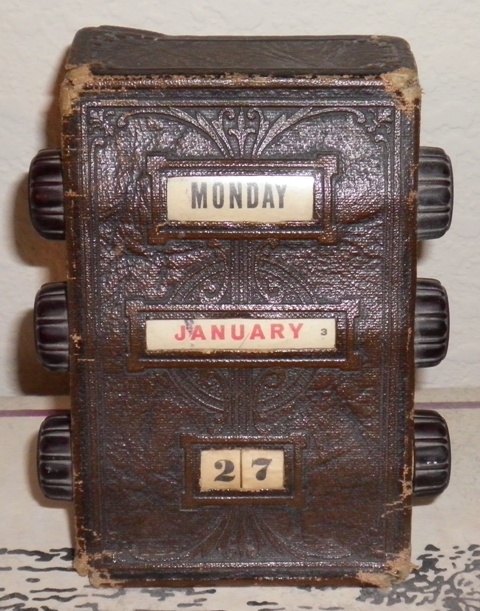
perpetual calendarAbout a month before he died, he told me he wanted me to keep the calendar. It was special to him — a family heirloom and a relic of his childhood — and he didn’t want me to throw it away with the rest of his effects. Which I probably would have done. I thought such calendars silly because if you don’t remember to advance the calendar each day, the calendar loses its effectiveness. He, of course, had the discipline to advance the calendar. No matter where we lived, no matter the state of his health or the stresses of our life, he always advanced the calendar first thing every morning.

And now so do I. It has become a way of honoring his life, of remembering him, of being connected to him in a small way. For a long time, I felt connected to him through grief. (Odd, that. It was the feeling of being disconnected from him that grieved me in the first place.) Now that my grief has waned, there is nothing to connect me to him. Unlike many who have lost someone important to them, I have never had a visitation, a sign, any indication that he still exists somewhere. He is simply gone — gone from my life, anyway.

The tears are gone, too.

It seems strange now that I grieved so deeply. I can barely remember loving someone so profoundly that his death tore me apart. Can barely remember that shattered woman who screamed her pain to the uncaring winds. Was that really me or simply a character in the book of my life? (I meant this as a metaphor, but I did write a book about my life, or rather my life of grief. That seems strange, too.)

We live each day as it comes, deal with each pain and sorrow, and somehow, through the years, we become something other than we were. I am no longer a schoolgirl dealing with the small dramas of grades, cliques, unacceptance. No longer a young woman desperately and radiantly in love with a man. No longer an adult struggling to live while her soul mate was dying. No longer a grieving woman.

At the moment, I am thrust in the role of caregiver for my 97-year-old father and homeless brother, but someday, I won’t be this woman, either. I don’t know what will become of me, don’t know what I will become (other than older), but chances are, I still will be advancing that ancient calendar in honor of the life that meant so much to me.

***

Pat Bertram is the author of the suspense novels Light Bringer, More Deaths Than One, A Spark of Heavenly Fire, and Daughter Am I. Bertram is also the author of Grief: The Great Yearning, “an exquisite book, wrenching to read, and at the same time full of profound truths.” Connect with Pat on Google+. Like Pat on Facebook.

Resuming My Lonely March Into the Future

Sometimes the hardest thing we have to do is keep marching into the future, especially when the person who connected us to the world lives in our past.

My life mate/soul mate meant more to me than anything or anyone else for almost thirty-four years. His death forty-five months ago brought me more pain than I could ever have imagined, and it still brings me pain, particularly when
I remember the reason he’s out of my life — that he’s dead. Death is incomprehensible to me, and maybe always will be. Even more incomprehensibly, he died relatively young. 63. That’s hardly any age at all in a time when so many live into their nineties.

I do well most of the time. I know I can’t live in the past, especially not the past where we were happy. (A lot of the time during the last decade or so as his health declined, we weren’t happy, but it didn’t matter as long as we were together.) I try to concentrate on today, make what plans I can for the future, add new people to my life in an attempt to combat my loneliness. Mostly, I try to become a person who can survive such a tragic loss, maybe even one who can thrive.

And yet, on Christmas afternoon, I couldn’t stop crying.

It’s odd — Christmas didn’t mean much to us. We weren’t big on celebrations or traditions, but by default, we created our own traditions. Since we couldn’t work or run errands or do any of our other usual tasks when the world was shut down, we spent the day watching movies and nibbling on finger foods — cheese, meats, crackers, fruit, vegetables.

I spent a quiet day this Christmas. I fixed a festive meal for my father, went for a walk, then watched a movie with a plate of food in my lap. And that’s when my forward thinking collapsed, and all I could think of was the past.

I’ve signed up for an online dating service, and even have been trying to connect with people, but today I remembered why I’m trying to move on with my life, and something inside of me rebelled. I don’t want to move on. I want what I had. I want to go home to him, ask his forgiveness for whatever I did that made him leave me, see if we can reconnect. But he didn’t leave me, at least not voluntarily. He died.

I’m tired. I’m tired of his being dead. I’m tired of trying to move forward alone. Tired of trying to fill a void that seems endlessly deep.

But what other choice do I have? I allowed myself that time of sadness on Christmas, but now that it has run its course, I’ll steadfastly resume my lonely march into the future.

***

Pat Bertram is the author of Grief: The Inside Story – A Guide to Surviving the Loss of a Loved One. “Grief: The Inside Story is perfect and that is not hyperbole! It is exactly what folk who are grieving need to read.” –Leesa Healy, RN, GDAS GDAT, Emotional/Mental Health Therapist & Educator.

And So Grief Goes . . .

When you lose a soul mate or any person who connects you to the world in a significant way, you are born into the world of grief. At first, like any infant, you count your age in days, then weeks, and finally months and years.

I am long past counting the days and weeks since the death of my life mate/soul mate, though I can figure it out. (In case you’re curious, I calculated that it’s been 1,310 days or 187 weeks.) I’m even past counting the months. Today is an anniversary of his death, but without stopping to figure it out, all I know is that it’s been more than three and a half years but less than four.

numbersThis is a significant development. People who have never had to deal with the death of such an important person in their lives were spooked by my counting the days for so long, thinking I was unhealthily obsessed with the past, but that wasn’t the case at all. The days were milestones, ways of proving to myself that I could get through my grief one day at a time. And I have mostly gone through it. The horrendous pain, angst, and confusion of those first months isn’t even a memory. I can’t imagine anymore what I went through, can’t imagine how anyone could go through such a series of losses and come out the other end stronger and able to face whatever traumas life has in store. (In my case, not only did I lose my life mate/soul mate, I lost shared hopes and dreams, my most devoted fan, my best friend, and my home.)

When I talk about my grief, people assume I mean I still mourn him. To me, grief is the process, the whole spectrum of grief-related advancements including healing and rebuilding one’s life. The spectrum flows from the deepest black of despair to the brightest white of joy. Mourning is the sadness, the tears, the screams, the soul-deep pain — the physical manifestation of grief. I am long past the soul-deep pain, but I am still a long way from joy, so although I seldom mourn him any more, I still consider myself a child of grief.

Someday, that too will pass. Grief has taught me what we already know: things change. I never thought I’d laugh again, never thought I could live again. And yet here I am, all these months later, laughing and enjoying myself on occasion. I never thought I could forget him, and yet he is not always on my mind. For so long, I couldn’t bear the thought of settling down anywhere when I leave here (I am temporarily staying with my 96-year-old father, looking after him so he can be as independent as possible). All I wanted was to keep on the move. Travel See what life has to offer. I still think of leading such a spontaneous and unsettled life, but I am also weighing the possibility of settling down. I used to fear stagnation, but I am surer of myself and my solitary place in the world, and I doubt I would stagnate. I would do . . . something.

And so grief goes . . .

***

Pat Bertram is the author of the suspense novels Light Bringer, More Deaths Than One, A Spark of Heavenly Fire, and Daughter Am I. Bertram is also the author of Grief: The Great Yearning, “an exquisite book, wrenching to read, and at the same time full of profound truths.” Connect with Pat on Google+. Like Pat on Facebook.
Three Years, Three Months, Three Weeks, and Three Days of Grief

It’s been three years, three months, three weeks, and three days since the death of my life mate/soul mate. With all those threes, this should be a mystical day, but it’s a day like any other. I’m not especially grieving, though I’m not ungrieving, either. It’s just me and my normal underlying sadness, my missing him, my wondering about the future.

I’m to the point where I need something more, something beyond the bleakness of my daily life, but that “something more” comes in small doses and is not enough to sustain me. I take quick trips, go out to lunch occasionally, write a little, go walking in the desert. Although my 96-year-old father is doing well and is still quite independent, I am on a short leash (or at least it feels that way) since he likes having someone around in case of emergency.

But, that is just an excuse. The truth is, I don’t know what to do and wouldn’t know what to do even if I weren’t here looking Low tideafter my father. I’d travel, of course, but it seems to me that taking an extended trip by myself would be terribly lonely and perhaps even feel pointless. I drove by the ocean the other day and couldn’t think of a single reason to stop. I’ve been to the ocean, so it wasn’t anything new. Just a lot of water. (In my defense, it was very late and I was very tired.)

I try to be upbeat, try to believe in endless possibilities (because of course, that is the nature of the universe), but I don’t yet see those possibilities in my daily life. I try to think differently, to feel differently, to open myself up to change, but I’m always just me. Alone. Waiting.

Maybe things will be different when I’m totally alone, when I am free of responsibilities, but I no longer know if that will make a difference. I feel self-indulgent at times even mentioning any of this, considering what terrible lives some people are forced to live, but I can’t live any life but my own. And my own feels empty.

If it sounds as if I’m feeling sorry for myself, there’s perfectly good explanation for that. Today I do feel sorry for myself. I have managed to get through three years, three months, three weeks, and three days since his death, and I will continue managing, but I wish I wanted something, was in love with something, felt something besides ever-fading sorrow.

***

Pat Bertram is the author of the suspense novels Light Bringer, More Deaths Than One, A Spark of Heavenly Fire, and Daughter Am I. Bertram is also the author of Grief: The Great Yearning, “an exquisite book, wrenching to read, and at the same time full of profound truths.” Follow Pat on Google+. Like Pat on Facebook.

Nothing is Trivial When Dealing With Grief

It’s amazing to me how the most trivial things can take on significance when it comes to the loss of the person who connected you to the world.

Yesterday I was clearing out a mini in-basket where my life mate/soul mate kept stamps and related items, such as postage rates and receipts. Up until now, I’ve just left the basket intact. In those first months after his death, I couldn’t bear to use the last stamps we ever bought together, so I set the basket aside and ignored it. Enough time has passed that those stamps now seem like ordinary, insignificant postage, so I dug them out, sorted through the papers in the basket, and threw away the outdated rates and receipts.

One of the things I found in the basket was a simple note he had written: 44¢. That’s all it said. He wrote it in green ink on yellow paper about two-and-half-inches square, so that despite his worsening vision, he could see at a glance what the current postage rates were.

I hesitated a moment before tossing out the note. As unimportant as the paper was, it seemed to be a symbol of how bit-by-bit, his erstwhile place in the world and my life was disappearing. Most of his things are gone now, and attrition has eliminated many of “our’ things — towels worn out, spoons lost, cups broken.

The first time I broke a cup, it about devastated me. I remember crying as if it were my heart and not a piece of crockery that had shattered. As I wrote back then, “I broke a cup today, one more thing gone out of the life we shared. Our stuff is going to break, wear out, get used up. I’ll replace some of it, add new things, write new books, and it will dilute what we shared. Is there going to be anything left of ‘us’? I feel uncomfortable in this new skin, this new life, as if it’s not mine. As if I’m wearing clothes too big and too small all at the same time.”

Still, I did throw out the paper. It seemed foolish to keep it, especially considering that postage rates have gone up since then. And I’m no longer newly bereft, clinging to anything of his to bring me comfort.

If the paper had remained in the trash, there would be story, but a little later, I retrieved the paper and put it back in the basket. My rationale was that someday, perhaps, I’d like to know what the postage rate was on the day he died. But grief has no rationality. I simply could not let go of that newly significant slip of paper.

***

Pat Bertram is the author of the suspense novels Light Bringer, More Deaths Than One, A Spark of Heavenly Fire, and Daughter Am I. Bertram is also the author of Grief: The Great Yearning, “an exquisite book, wrenching to read, and at the same time full of profound truths.” Connect with Pat on Google+. Like Pat on Facebook.

Grief Update

I haven’t been posting any grief updates lately because I haven’t had much to tell. There has been no great pain or sorrow, no major traumas or dramas, no new adventures to undertake — just living my every day life of quiet sadness and loneliness.

Although I haven’t had any major grief upsurges for a while, I do often think of my deceased life mate/soul mate, even talk to him. Oddly, now that the agony of grief has mostly subsided, it feels as if he is back at home, waiting for me to finish my present tasks and return to him. I know he isn’t there, of course, but without the pain to simultaneously bind us and separate us, he doesn’t feel quite so gone.

I am still very confused by death. How can he be dead? Where is he? Is he? Perhaps he is waiting for me, perhaps he is simply gone . . . deleted. I won’t know until my life is ended, and perhaps not even then. Whatever exists beyond our cloak of materiality and physicality, beyond our brains and our minds, might have consciousness, or might simply be pure energy that returns to the Everything.

I’ve never known where to put his death in my head. I can’t be glad about it, yet at the same time, he couldn’t have continued to suffer. But more than that, if he is in a better place, why I am still here? And if life is a gift, why was it denied him? I’ve held on to the idea that dying relatively young was unfair to him, that he is missing something, and a lot of my grief was on his behalf, but the other night I realized it truly doesn’t matter whether we are alive or dead. Well, his death matters to me, but it doesn’t matter to the universe, and it probably doesn’t matter to him. Nor does my continued life matter in the vastness of life/death. A few years extra of life is but a dandelion seed in the winds of time. Almost totally matterless. Maybe even meaningless. In which case it truly doesn’t make any difference that I am alive and he is dead. (Well, except for the part where I miss him, but this insight wasn’t about that.)

Even if life is largely matterless and meaningless, I am still alive and at least for now, that does make a difference to me and those I am in contact with. But it’s good knowing I neither have to be glad nor sad for him, that I can continue to live without feeling bad that he is dead. Knowing this also makes it easier to remember him, to recall what we had, to celebrate his place in my life. I am still sad, of course, and maybe I always will be. I miss him, wish desperately for one smile, but gradually I am letting go of my worries for him. He doesn’t need them, and they are an unnecessary relic of our life together. And for all I know, he could be perfectly content, sitting by some cosmic lake, two ghost cats purring in his lap.

Someday, as my grief continues to wane, I might even get to the point where I find renewed life, but I still take comfort where I can find it, and for now I take comfort in thinking that life and death are somehow one.

***

Pat Bertram is the author of the suspense novels Light Bringer, More Deaths Than One, A Spark of Heavenly Fire, and Daughter Am I. Bertram is also the author of Grief: The Great Yearning, “an exquisite book, wrenching to read, and at the same time full of profound truths.” All Bertram’s books are published by Second Wind Publishing. Connect with Pat on Google+

Grieving for the Dead

The conventional wisdom is that we grieve for ourselves, not the person who died, but as with any other idea most people have about grief, it is only partly true. When it comes to a soul mate, we often grieve for him as much as we grieve for ourselves. During our shared time, we cared as much about him, his well-being, his happiness as we did about our own, and that caring does not stop with death.

Many people still feel their soul mate’s presence, sometimes in a beneficial way, as a blessing or as a helping hand, but others feel their mate’s unhappiness. One woman, whose husband spend his last months connected to gastric tubes and other painful devices, continued to feel his anger long after he died. He’d been furious with her for agreeing to procedures that prolonged his suffering, and she was ridden with guilt because of it. (Though what other decisions about his care could she have made? He could not talk, and the doctors assured her he would get better if they performed those operations.) For more than a year after his death, she could still feel waves of anger directed at her. Perhaps the anger was a symptom of her guilt, but perhaps part of him still harbored those feelings. We hope our loved ones are at peace, but what if they’re not?

One of the great agonies of losing one’s soul mate is not knowing where he is, how he is, if he is. I found comfort in believing that my life mate/soul mate wasn’t suffering any more, that he, at least, wasn’t having to deal with the pain of our disconnect, but then one day it struck me that I didn’t know that for sure. Since I had no sense of his continued presence in my life, I had no conception of what he might be experiencing. What if he were feeling just as lost and lonely and bereft as I was?


I had to put such thoughts out of my head because I truly could not bear to think of him in pain. I was still grieving for all the suffering to which he’d been subject during his final days, weeks, months, still grieving for his hopes that never came to fruition, still grieving for the dreams that died with him. Perhaps it was silly of me to grieve for him, since it’s entirely possible he wasn’t grieving for himself, but still, those thoughts were there, complicating my grief.

It’s been a few days more than three years since he died, and sometime during those grief-filled months, I began to disconnect from him, to understand that whatever relationship we had, however much we shared, no matter how much it felt as if we were cosmic twins, we were still two separate people on two separate journeys. This is an important realization and a necessary step to mental health and eventual happiness, but the habit of thinking of him is still strong, and I wonder where he is, how he is, if he is.

I hope he is happy, fulfilled, challenged, radiant. I wish those things for myself, and I can wish no less for him.

***

Pat Bertram is the author of the suspense novels Light Bringer, More Deaths Than One, A Spark of Heavenly Fire, and Daughter Am I. Bertram is also the author of Grief: The Great Yearning, “an exquisite book, wrenching to read, and at the same time full of profound truths.” All Bertram’s books are published by Second Wind Publishing. Connect with Pat on Google+

Three Years of Grief

Today is, unexpectedly, a day like any other. So far, on this, the third anniversary of the death of my life mate/soul mate, I’ve experienced no great upsurges of grief, just that perpetual thread of sadness that bastes my life together.

During those first months of grief, my focus was completely on him, on his absence, on the horrendous feeling of goneness that his death left me with. It was as if by thinking of him, by holding him close in my thoughts, by reliving the horror of his final weeks, that somehow I could undo what had happened to him. But the years have taught me what logic didn’t — that he is gone and nothing I do or think or say or hope or pray will bring him back.

During his last days, he became childlike in his needs and actions (as if the combination of the cancer that spread to his brain and the drugs that kept the pain at bay killed the man, leaving only the inner child behind), which confused the issue in my mind. For a long time after his death, I panicked, wondering how he could take care of himself, wishing I could be there to calm his fears and his restless spirit, longing to hold him in my arms and keep him safe.

It’s only recently that the truth hit me. He was an adult, not a child, and except at the end, was more than capable of taking care of himself. Besides, if he does still exist somewhere, he is ageless, timeless, beyond any need of me and my feeble ministrations. (Feeble because nothing I could do erased a single moment of his pain or kept him alive one more day.)

There is an element of blank to my grief — an incomprehension of what it’s all about. I remember how grief feels, though I’m far enough along in the grief process that I have a hard time believing I was that shattered woman so lost in pain. But I don’t know the truth of life and death, and I’m not sure we humans are capable of understanding. And maybe that’s the way it’s supposed to be. It keeps us focused on our lives and not on . . . well, whatever else is out there.

Although time has insulated me from the rawness of my grief, and although my grief work has brought me to the point where I can once again see possibilities and feel hope, there is one thing I will never lose — that great yearning to see him one more time. To hear his voice. See his smile. To hold him tightly as if I would never let him go. But I have let him go. I let him go three years ago, not allowing my needs to bind him to his life of pain.

And I need to let him go now.

Well, here it is — the upsurge in grief I didn’t feel when I started writing this post. Tears are running down my face. I know I need to let him go, to let go of the grief that binds us together still, but not today. Today I will remember. And grieve.

***

Pat Bertram is the author of the suspense novels Light Bringer, More Deaths Than One, A Spark of Heavenly Fire, and Daughter Am I. Bertram is also the author of Grief: The Great Yearning, “an exquisite book, wrenching to read, and at the same time full of profound truths.” All Bertram’s books are published by Second Wind Publishing. Connect with Pat on Google+

The Eve of My Third Anniversary of Grief

In just a few hours, it will be three years since the death of my life mate/soul mate. It seems impossible I’ve survived so long. It seems impossible he’s been gone so long. Sometimes I feel as if we just said good-bye, as if I could call him up and see how he is doing, as if when I am finished caring for my father, I could go home again. But of course, those are just tricks of the ever-changing grief process.

I’ve been doing well recently, keeping busy, not letting myself get too caught up in the past. The present is complicated enough with my father’s growing dependency (though he has been doing well the past week or so, taking more of an interest in his own care). And the future is becoming more real, not quite as bleak as it has seemed during the past few years.

020smallFor all these months of grief, I’ve been worried about what will happen to me when my present responsibilities end. Oddly, during my mate’s long dying, I never really thought of the future. I just presumed I’d be okay. He told me things would come together for me, and I believed him. But now that I know how life feels with him gone, I’ve been afraid of stagnating, drowning in loneliness, living as quietly and unobtrusively as I’ve always done. The realization that I don’t have to find a place and settle down but can live on the go if I wish destroyed those fears with one clean stroke, and I’ve spent the past week figuring out the logistics of such an adventurous life. It won’t be easy since I have few financial resources and strong hermit tendencies, but the alternative — stagnation — makes such a future seem possible.

Because of all that is occupying my mind, I thought I’d sail right through this anniversary without an upsurge of grief, (though I always miss him; that’s a given) but grief will not be denied. If I don’t acknowledge my loss and sorrow, grief will acknowledge me. A couple of nights ago, I dreamed I was grieving for him. Dreamed I wanted to go home to him. Dreamed I cried for him. And when I woke, I was crying still.

I guess it’s just as well that the next stage of my life’s journey could be a long way off. Apparently I have grieving left to do. Chances are, I always will grieve to a certain extent, but now I’m more concerned about what to do with my life despite the grief. I’d hate to meet him again some day and have to admit that I spent my life awash in tears. He would be disappointed in me, and to be honest, so would I.

But three years. Has it really been so long since I last saw his smile? Last heard his voice? Last felt his arms around me? It’s hard for me to believe, but the calendar doesn’t lie.

***

Pat Bertram is the author of the suspense novels Light Bringer, More Deaths Than One, A Spark of Heavenly Fire, and Daughter Am I. Bertram is also the author of Grief: The Great Yearning, “an exquisite book, wrenching to read, and at the same time full of profound truths.” All Bertram’s books are published by Second Wind Publishing. Connect with Pat on Google+

Grief: New Year’s Day and Beyond

eternityThis past New Year’s Day was the third one I have lived through since the death of my life mate/soul mate. That first New Year’s Day was one of relief. I’d managed to live through the worst year of my life, and I greeted the day with acceptance and looking toward the future, building hopes and creating dreams.

The second New Year’s Day was a day of dread. The last week of that year was one of waiting. No grief, no strong emotion. Just . . . waiting. But with the dawning of the new calendar year came the dread. I still don’t know why (to be honest, I’ve never totally understood the whys and ways of grief), though perhaps the dread came from an awareness of moving further away from our shared life. I could no longer say, “Last year, we . . .” “Last year, he . . .” There was just me, balanced precariously on the precipice of a life alone.

This third New Year’s Day inexplicably began with tears. Grief had been leaving me alone, and I hadn’t had a strong upsurge for a long time — I thought I was through with grief, to be honest — but when the calendar rolled over from 2012 to 2013, grief came calling once again. And once again, I do not know why.

A new calendar year has never meant much to me — it’s such an arbitrary date, beginning at staggered times around the world, and even celebrated on different dates in various countries and religions. Now that I am alone, however, I try to make a ritual of such things, to note the passing of the days. I need to know that I am still here and I am still alive. And despite the arbitrariness of the date, apparently something in me senses a change from one year to the next and reacts to it.

People tell me that it takes three to five years to find joy in life again, or at least to find a new beginning, and three months into this year will be my third anniversary of grief. It feels like a milestone, though I can’t even begin to guess what it will mean to me besides one more year further away from “us” and one more year closer to . . . I don’t know what.

But I can’t think of that now. If I’ve learned anything during these past two years and nine months, it’s the importance of taking life one step at a time. I’ve already taken three steps into this new calendar year. Tomorrow will be another step. Beyond that, the future will just have to take care of itself.

***

Pat Bertram is the author of the suspense novels Light Bringer, More Deaths Than One, A Spark of Heavenly Fire, and Daughter Am I. Bertram is also the author of Grief: The Great Yearning, “an exquisite book, wrenching to read, and at the same time full of profound truths.” Connect with Pat on Google+