I recently finished reading a book that was so unmemorable, just about the only thing I remember is how bad it was. I certainly don’t remember the title or the author. I do remember, however, all the talk of eighteenth-century gardens.
I didn’t know that there were various styles of gardens. I just figured people did what I am doing — create their own garden using the space, the climate, the soil, and their own sense of practicality to best utilize the area.
I started with a gravel border around my house to protect the foundation, which unfortunately didn’t keep one corner from collapsing. Luckily, that’s fixed, now. Whew!
Then I figured out where I would want to walk in the yard, and had pathways put in. When I moved here, there were only weeds and rocks and uneven ground to trip the unwary, so those pathways were important, especially as I knew I wouldn’t be getting any younger. (Though, who knows. Stranger things have happened, I’m sure.)
When the old garage was torn down, the concrete slab in front of that derelict building was left in place, so I used that as a foundation for a gazebo. And where the garage was, I had a raised garden built.

The rest of the yard, I filled in with bushes, grass, a couple of trees, and lots of flowers. That part of the garden is always a work in progress since plants die, seed themselves, and new flowers beg to be planted.
So, there is some balance in my yard: a few distinct areas, a couple of places to sit, grassy areas, places to grow vegetables. Best of all, it gives me something different to look at with every turn of the path.
Apparently, this isn’t the way everyone gardens, or even the way people used to garden. The Hanging Gardens of Babylon were definitely planned out. They weren’t actually hanging gardens (if they even existed), but were “overhanging” gardens, supposedly built as ascending terraces, planted with trees, bushes, and flowers, to create a luxurious green hill.
In the eighteenth century (what all this was leading up to), gardens were geometric, with the various pieces of the geometry shape enclosed by hedges to create outside rooms. A pleasure garden for picnicking. A kitchen garden. flower gardens. Topiary gardens. Gazebos and other outbuildings. Water décor such as fountains and ponds. And tree-lined paths to connect the sections.
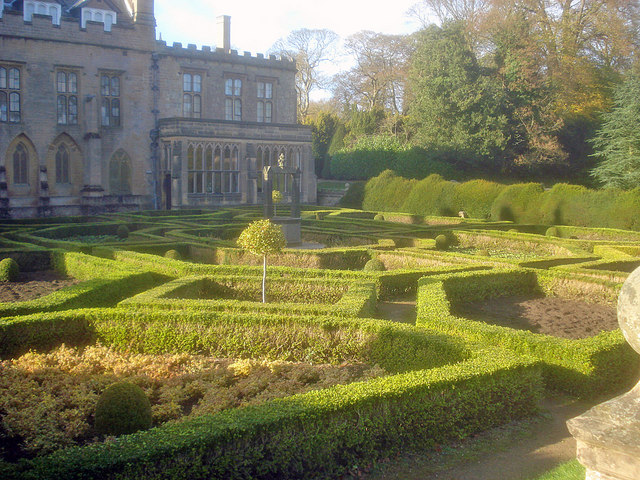
The Spanish Garden at Newstead Abbey by Trevor Rickard is licensed under CC-BY-SA 2.0
Such gardens, as well as gardens before and after, needed architects to get everything correct. Even though in my haphazard way, I have a few elements of an eighteenth-century garden, such as distinct garden areas, paths, and a gazebo. Unlike eighteenth century gardens, I have grassy areas, as well as wild areas. But then, I didn’t set out to create such an historical garden. Didn’t even know they existed, to be honest.
Admittedly, my yard is a lot smaller than the usual eighteenth century garden, and I spent a fraction of the cost, but that was never the point. The point, for me, was . . . Hmmm. I’m not sure what the point was of creating my garden. What I wanted when I moved here was a work-free yard, one that took care of itself. And yet, what I have is . . . well, a mini park that takes a lot of work!

***
Pat Bertram is the author of Grief: The Inside Story – A Guide to Surviving the Loss of a Loved One.








 Bertram's Blog