A Barebones Kind of Writer?

As a project for a writing group, we were supposed to post the last sentence of a couple of our chapters, but it was hard for me to find last sentences that say much. It’s usually my second and third to last sentences that have the meat, with a final, very short sentence to deliver the punch, such as these chapter endings from Light Bringer.

She thrust the magazine at Mac. “This isn’t a picture of my parents.”
But the frantic beating of her heart told her it was.

She turned around slowly, and clutched at her chest.
The ghost cat was inside the house.
And so was something else.

Wisdom lay stretched out on the borrowed couch, eyes closed in feline bliss. The skin on its belly rippled gently as if being caressed by unseen fingers. A chuckle reverberated in its chest.

“Shakespeare was right,” Emery said. “‘Hell is empty. All the devils are here.’”

Still, I did manage to find several ending sentences that were a bit longer than most and even made a sort of sense by themselves:

Lying awake, staring at the dust motes dancing in the moonlight, he thought he could hear voices murmuring in the wind.

After the sun set, they headed home in a rich, warm alpenglow that turned the world to gold.

A skinny, hairless cat with luminous silver eyes sat on the porch and stared at them, a quizzical look on its face.

Could it be that they were all following a script of someone else’s devising?

They were met with a burst of color, a song of pure joy that seemed at odds with the harsh environment of the laboratory they had entered.

Hugh shot them a disgusted look, then he and Keith plunged into the light.

Hmmm. I might have to change my opinion about my writing. I always thought I was a barebones kind of writer, but there seems to be a bit of poesy to my descriptions, especially with longer passages, such as this one:

She looked just as he remembered. The lithe body that moved as gracefully and effortlessly as a song wafting on a breeze. The shoulder-length brown hair that glimmered red and gold in the sunlight. The smile, big and bright and welcoming. Only her clothes—a pale green blouse and cotton shorts—struck a discordant note, as if he were used to seeing her in more exotic attire.

“Hello,” she said when he neared. The single word sounded as musical as an entire symphony.

“Hello,” he said, a goofy grin stretching his face. He felt a harmonic resonance and knew, once again, they belonged together.

After several seconds, her smile faded. “Do I know you?”

“Of course. We met . . .”

He gazed at her. Where had they met? Though it seemed as if he had always known her, they must have met somewhere, sometime; but when, in his pathetic little life, could he have met anyone so special? It slowly dawned on him he couldn’t have—not until this very moment.

Ducking his head, he whispered, “I’ve made a terrible mistake. We don’t know . . . We’ve never . . .”

***

Where to buy Light Bringer:

Second Wind Publishing

Amazon

Barnes & Noble Nook

iStore (on iTunes)

Palm Doc (PDB) (for Palm reading devices)

Epub (Apple iPad/iBooks, Nook, Sony Reader, Kobo)

***

Pat Bertram is the author of the suspense novels Light Bringer, More Deaths Than One, A Spark of Heavenly Fire, and Daughter Am I. Bertram is also the author of Grief: The Great Yearning, “an exquisite book, wrenching to read, and at the same time full of profound truths.” Follow Pat on Google+. Like Pat on Facebook.

Excerpt from LIGHT BRINGER by Pat Bertram

Description of Light Bringer:

Becka Johnson had been abandoned on the doorstep of a remote cabin in Chalcedony, Colorado when she was a baby. Now, thirty-seven years later, she has returned to Chalcedony to discover her identity, but she only finds more questions. Who has been looking for her all those years? Why are those same people interested in fellow newcomer Philip Hansen? Who is Philip, and why does her body sing in harmony with his? And what do either of them have to do with a shadow corporation that once operated a secret underground installation in the area?

Excerpt from Light Bringer:

Where am I? A new foster home?

Philip supported his throbbing head in his hands and wondered if he’d live to adulthood.

Tamping down the pang of self-pity, he raised his head, and everything came clear. Or almost everything.

He knew who he was: the thirty-eight-year-old Philip, dressed in yesterday’s clothes. He knew where he was: the foldout bed in Emery Hill’s den. But he didn’t know how he got there. He remembered being in the car with the creature, flinging himself against the door—no wonder he felt so bruised—and the icy touch on his neck. Had it brought him back here?

He stood, rocking until he caught his balance, then staggered off in search of the coffee he could smell brewing.

When he entered the kitchen, Emery started and dropped the mug he had been removing from a cabinet. It came to rest at Philip’s feet. Wincing, Philip bent to pick it up.

“Jeeminy Christmas!” Emery exclaimed. “You about scared the intellect out of me. What are you doing here? I thought you went back to Denver. See what you’ve done? I’m already turning into a blithering idiot.”

Philip laughed, then cut it off and clutched his head.

“What’s wrong? Hangover?”

“Feels like it, but I haven’t been drinking.” Getting a mug for himself and pouring a cup of coffee, he wondered if he’d been drugged. He took a sip of the brew, which seemed strong enough to soften a stone, and barely refrained from spitting it out. “Tomorrow I make the coffee.”

“Fine,” Emery said absently, regarding Philip with narrowed eyes. “I always know when one of my students is in trouble. It’s time you told me what’s going on.”

“I was never one of your students.”

Emery waved away the remark. “Between the two of us we should be able to solve your predicament.”

“I’m not sure there is a solution. Right before I came here, two NSA agents came to my apartment.”

Emery shook his head as if to clear it. “I must have misunderstood. I thought I heard you say NSA agents.”

***

Where to buy Light Bringer:

Second Wind Publishing

Amazon

Barnes & Noble Nook

iStore (on iTunes)

Palm Doc (PDB) (for Palm reading devices)

Epub (Apple iPad/iBooks, Nook, Sony Reader, Kobo)

Recycling Stories

Please welcome JJ Dare, friend and fellow Second Wind author. JJ writes thrillers (False Positive and False World), and is one of the collaborators on the Rubicon Ranch serial. Her Rubicon Ranch characters amuse me because they are so unrepentently manipulative and unabashedly malevolent. (How can they not be with such a father as Morris Sinclair?)

JJ is here to talk about recycling stories and finding a new purpose for them:

I’m in the midst of going through junk in my house and either trashing it, giving it away, or keeping it. I’m classifying junk as those things I have no immediate use for, things I haven’t used in years or have no idea why I kept them to begin with. I gave the cats an escape clause because they’re just too darn cute to put in the junk category. They’re useless, like a number of stories I’ve written, but I can’t seem to toss either the cats or the stories.

I’ve had some very good advice given to me the last time I bemoaned my many unfinished writings. One that kept coming up was for me to toss everything and start fresh. It sounds so good but it’s so hard to trash the stories I’ve given birth to. It’s like getting rid of a half-finished painting or musical score. I don’t have it in me to do it. I keep telling myself, I’ll finish this . . . one day.

I’ve come up with a solution. I was wondering what I could do with some of my incompletes and I hit upon an idea: I’ll quickly finish the stories that are at least halfway completed and combine two or three of these novellas into a novel. Sounds good on paper. A little harder to do in practice.

I started with three unfinished romances. I’m not a romance writer. I wrote these romances because I wanted to try my hand at every genre. I reread what I’d written and it occurred to me that these stories would be better classified as science fiction or horror.

I’m not a comfortable romance writer. Not because I have been denied romance in my own life, but because I’ve always viewed romance as a very private interaction between two people. To put that on paper unnerves me. When things unnerve me, I get weird. Hence, my romances are all off-beat and quirky. For the most part, though, the violence is low level and not too many characters die.

My comfort zone is action and suspense. I like to be on the go in my writing. For me, romance is a lot of faint female hearts, strong rescuing men and pining on both sides. That’s well and fine because fictional romance should be high illusion and a way to escape into a pleasant dream world where the male and female characters end up happily-ever-after after a reasonable amount of conflict.

For my type of writing, though, I pull from the quirky side of life (sometimes, my life). I love weird. I adore off-beat. Bizarre is a close personal friend of mine. Happy endings annoy me because I want to believe what I’m reading and happiness is a fleeting occurrence for all of us. I want a real-life ending.

I identify with strong male characters and equally strong female characters. I like no-nonsense and have a hard time writing fluff. Lately, my short stories and contributions to online collaborations have been my saving grace. I’m able to write quickly and decisively as long as I don’t have to think too hard about it.

But, I always come back to those things I have hanging around on my laptop. Trash them, give them away or keep them – I need to decide something because it’s gotten to the point where seeing them just sitting there accusingly has become depressing. The best hope, I guess, is to salvage what is salvageable and compile them as a collection.

One day I might broaden these novellas into full-length novels. But today, they will have to be Frankensteined into a patchwork monster of a book.

When you get stuck in a story, what do you do? How many unfinished stories do you have taking up space?

***

J J Dare is the author of two published books, several short stories and triple digit works-in-progress.

Current enthusiasm is sharpening intangible knives and co-authoring at Rubicon Ranch

Facebook addiction

Rubicon Ranch: A Collaboration

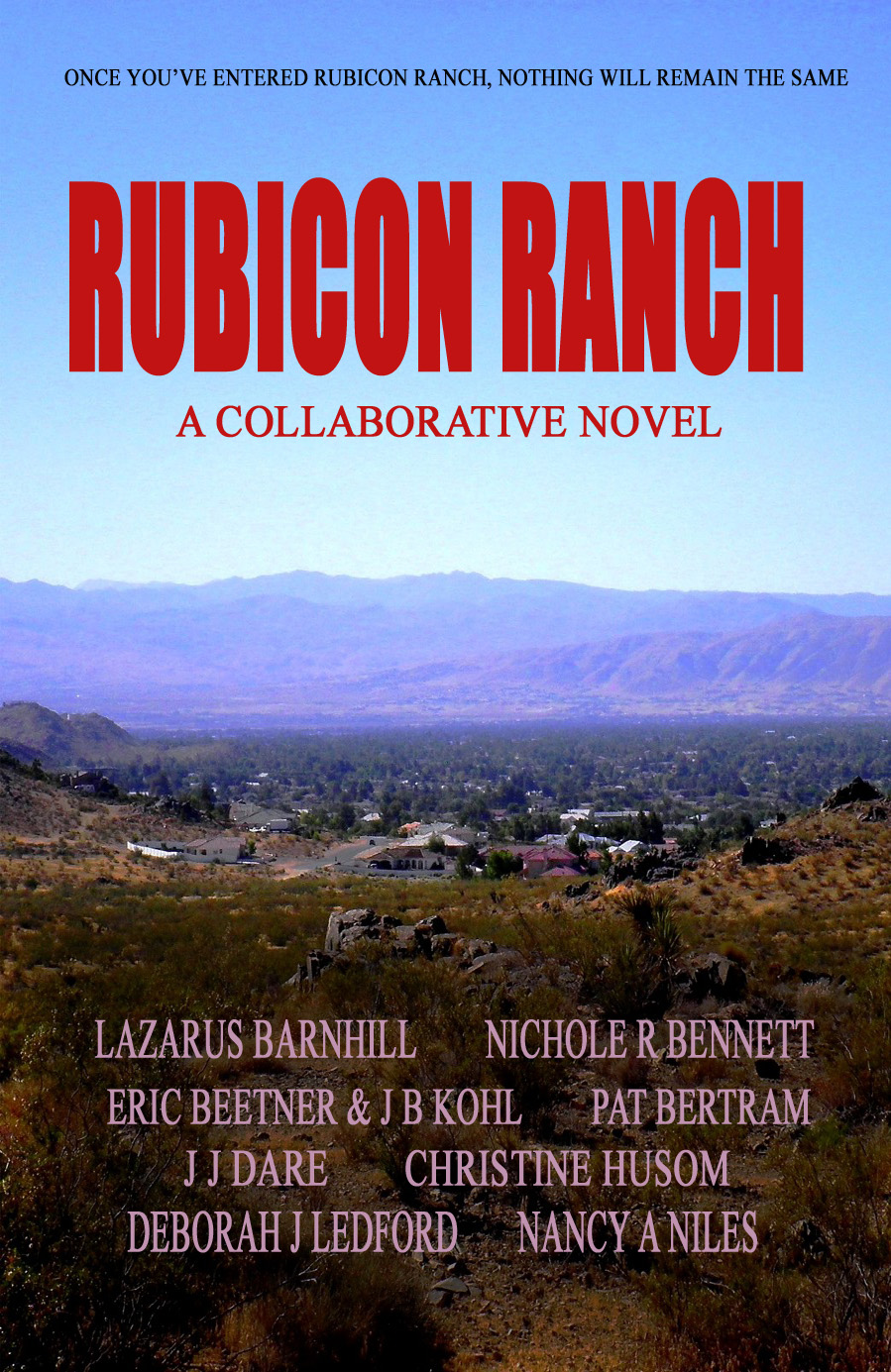
Rubicon Ranch is a collaborative novel I am writing online with eight other Second Wind authors. 

A little girl’s body has been found in the wilderness near the desert community of Rubicon Ranch. Was it an accident? Or . . . murder! But who would want to kill a child? Everyone in this upscale housing development is hiding something. Everyone has an agenda. Everyone’s life will be different after they have encountered the Rubicon. Rubicon Ranch, that is.

If you haven’t yet checked the story out, you can find what we’ve written so far at: Rubicon Ranch.  Here is the current chapter, told from the point of view of my character, Melanie Gray, a recent widow who found the child’s body.

Melanie had taken the long way home from the restaurant, winding for hours through Rubicon Ranch, stopping to shoot exotic blooms in landscaped gardens and dainty wildflowers in unkempt yards. By the time she reached Tehachapi Road, she was exhausted. She half expected the sheriff to come after her, but apparently he’d accepted her brush-off as final — if you can call a full-fledged tantrum a brush-off.

Why did he keep getting under her skin? He wasn’t her type. Not that she had a type. Alexander was the only man she’d ever loved, and she’d fallen for him so hard she could still feel the bruises twenty-three years later.

Tears welled up in her eyes as she remembered her husband when they first met. His hazel eyes had blazed with golden lights as he smiled at her, and young fool that she’d been, she’d been dazzled. They had a great life, or so it had seemed. She’d felt safe with him as they traveled the world over. And free. What need had she of a house, a car, kids when she had him?

Well, now she had nothing but debts. And doubts. Had Alexander ever loved her as she loved him?

“Are you okay?”

The voice startled Melanie. She scrubbed away her tears and looked around. An old woman with tan, leathery-looking skin and dark eyes shaded by a wide-brimmed straw hat was standing by an open mailbox, envelopes clutched in her hand.

“Are you okay?” the woman repeated as she closed the mailbox.

Melanie curved her lips in what she hoped was a friendly smile. “I’m fine. Just hot.”

The woman brushed a forearm across her brow. “Too hot for this time of day, that’s for sure. Tomorrow is supposed to be even hotter if you can imagine that. Well, at least all this sweat is good for the complexion. Keeps one looking young.”

Laughing, the woman minced up the sidewalk to her front door.

Melanie let the smile drop from her face, glad she didn’t have to pretend to be amused at the woman’s feeble joke. Nothing amused her any more. Not the irony of Alexander dying while texting. He hated texting. Said it was creating a new language and a cult of idiocy. Not the sheriff and his unsubtle attempts at flirtation. Not finding a little girl stuffed in a television set. Had that been someone’s idea of a joke? A fitting resting place for a child who watched too much television?

She hastened up Tehachapi, but her footsteps slowed as she reached Delano Road. This neighborhood had never been welcoming, but now it felt threatening, as if unseen storm clouds were gathering above the custom-made houses.

Maybe, finally, the sheriff was going to investigate the murderer instead of investigating her. Maybe, finally, he was going to turn his predatory gaze in the right direction.

She almost felt sorry for the villain.

Light Bringer Has Finally Been Birthed!!

It’s been twice nine months since Light Bringer was accepted for publication, but it has finally arrived!! Born on March 27, 2011, it weighs a mere one pound, and is 8.5 inches tall. Small for a human baby, but just the right size for a newborn book. I counted all it’s Ts and Os, and am pleased to announce they are all there. (One defect did show up, a tiny beauty mark, or rather a lack of one — for some reason, a period was left off on a sentence at the end of a chapter, and all the book’s midwives failed to notice). Still, the newborn is beautiful, and when it has been out in the world for a while, perhaps it will make its mark. It was created out of love, and no matter what its destiny, I am proud of my newborn.

If you would like a chance at winning an ebook of Light Bringer, go to the launch party on the Second Wind blog and tell them you would like to read the book. Leave your comment at: New Release Launch Party.

Click here to read the first chapter of: Light Bringer

Click here to read the back cover copy and an excerpt: Light Bringer

Click here to buy: Light Bringer

Light Bringer is also available from Amazon and Smashwords.

What Do You Do With A Bad Review?

I’ve been getting mostly good reviews for my books, so it came as a shock when I noticed that one woman on Goodreads downrated them. She rated more than 100 books, giving all of them five stars except for a couple of 4-star ratings and three 3-star ratings. And guess whose books were all rated three stars? Mine. I couldn’t understand it — first, because most people who have read my books like at least one of them, and second (and the point that really bothered me), if she didn’t like my writing, why read all three? Why not stop after one or two?

I’d never met the woman, only know of her because we have an acquaintance  in common — someone I met because of my books, not a pre-publication friend. “I doubt she read the books,” this acquaintance told me, “she couldn’t possibly have read them and not liked them; your books are fabulous,” which made the whole thing even more incomprehensible. 

Until . . .

I got a really bad 2-star review for A Spark of Heavenly Fire, which made those three stars seem benign:

Not a bad story…but but but. I love post-apocolyptic stories – but a common mistake authors fall into with it is to immediately lose the sense of horror – their characters hardly react to dead bodies piling up around them – Bertram did this from the get-go. And this book was so badly edited that it is astonishing. Someone made the author chop this up without any concern for the reader’s ability to follow the story and understand the characters…fortunately, I didn’t care enough about any of them to worry about it.
  
Made me doubt myself.  Did I lose the sense of horror? But I never intended there to be a sense of horror (or at least not a sense of ghoulish horror). Nor did I intend to write a postapocalyptic story, which shows you the danger of genre expectations. The whole point was the lack of  bodies. After the first dying, when people died in their cars causing a city-wide traffic jam, people stayed in their houses, so that is where they succumbed to the red death. The only way my characters knew of the continued dying were the orange fluorescent markings appearing on the doors of houses where people had died. To me, that was even more horrible than bodies piling up — just this one simple reminder that people were still dying. Even more horrific was the silent city with soldiers patrolling the streets. That would spook the hell out of me! And no, people would not continue to react to the horror. They would become inured to it. It would become the new normal. And how could the reviewer have missed the hellish scene when two of my characters discovered what was being done with the dead human bodies . . . and the bodies of beloved pets?

Besides, the story was seen through the eyes of a soul-dead nurse, a gung-ho reporter, a self-centered, world-famous actor, and a woman who had that star in her eyes. Would any of them have continued to react to the dying? I doubt it. Still, I did wonder. Should I have shown more bodies piling up?

Then . . .

I was out walking along a residential street yesterday, and there was not a single other person in sight. Not a single vehicle on the road. And I knew I was right. No one would see the bodies if all the people in those houses suddenly died. And maybe they had expired — I had no way of knowing.

So, what does one do with a bad review? Blog about it, of course!! 

Excerpt from Light Bringer by Pat Bertram

Light Bringer is my latest novel, scheduled for release by Second Wind Publishing in March, 2011.

Description of Light Bringer:

Becka Johnson had been abandoned on the doorstep of a remote cabin in Chalcedony, Colorado when she was a baby. Now, thirty-seven years later, she has returned to Chalcedony to discover her identity, but she only finds more questions. Who has been looking for her all those years? Why are those same people interested in fellow newcomer Philip Hansen? Who is Philip, and why does her body sing in harmony with his? And what do either of them have to do with a shadow corporation that once operated a secret underground installation in the area?

Excerpt (Prologue):

Helen Jenks gripped the steering wheel and squinted into the darkness beyond the beam of the Volkswagen’s headlights. Nothing looked familiar. Was she almost home? The snow had stopped falling, but in these hills so far from town, the county didn’t bother to plow. She didn’t know if she drove on the right road, or any road at all. There were no other cars, no tire tracks.

Where was everyone?

She sighed. Home in bed, probably, where she would be if she hadn’t pulled a double shift at the hospital.

Hearing an odd drone, she cupped a hand behind an ear and tried to isolate the sound from the rumble of the Volkswagen engine. Was something wrong with the bug? Oh, please, no.

All at once the sky lit up. She leaned forward for a better view and caught sight of a brilliant star that seemed to throb in time with her heartbeat, growing brighter with each pulsation.

She sat back and rotated her head around her stiff neck. Maybe it was Venus. Hadn’t she read that at certain times of the year, under certain conditions, Venus could be as big and as bright as the moon?

Leaning forward again, she saw the star pulse one last time, then wink out. As she became used to the darkness it left behind, it reappeared, darted toward the horizon, and vanished. So, not Venus. Perhaps a meteor or two.

She listened for the drone, but no longer heard it. Good.

Ten minutes later, she noticed a pin prick of light in the distance: her porch light. Her car slid to the side, and she gripped the steering wheel harder. Be careful, she cautioned herself. You’re not safe at home yet.

When at last she parked in front of her old frame house, she pried her fingers off the steering wheel and stumbled out of the car. Except for the dings and pops of the cooling engine, the world was silent, appearing so new and un-touched, she hesitated to mar the opalescent expanse with her footprints. Then her eyebrows drew together. The snow wasn’t untrodden after all. Tracks led to the house where a small gray creature huddled against the door.

She clapped her hands. “Shoo. Shoo.”

The creature did not stir.

“Go on. Get,” she shouted.

The creature still didn’t move. Was it dead? This wouldn’t be the first time a dying animal had been attracted to the warmth seeping from beneath the front door.

She approached gingerly, relaxing when she saw what appeared to be an old gray blanket that had somehow ended up on the stoop. She bent over to collect the wad of fabric, then straightened. Bad idea. Who knew what vermin had taken refuge in the folds.

Before she could figure out what to do, the blanket moved. She jumped back and stared at it. The blanket moved again, giving her a glimpse of a coppery curl.

She lifted the bundle, cradled it in her arms, and drew back the blanket. Two dark eyes, shining with intelligence, gazed at her.

She sucked in a breath. An infant, no more than nine months old.

As the infant continued to gaze at her, its eyes brightened to gleaming amber. Then it beamed at her—a welcoming smile, both joyous and knowing, as if it had recognized a dear friend.

Helen’s face felt tight. “Who are you?”

The baby chortled in response.

“And who left you here?” She glanced at the tracks. They led in only one direction—toward the house.

Feeling dizzy, she crouched to examine the tracks more closely.

They were footprints. Tiny footprints in the snow.

Finding Inspiration From Uninspiring Sources

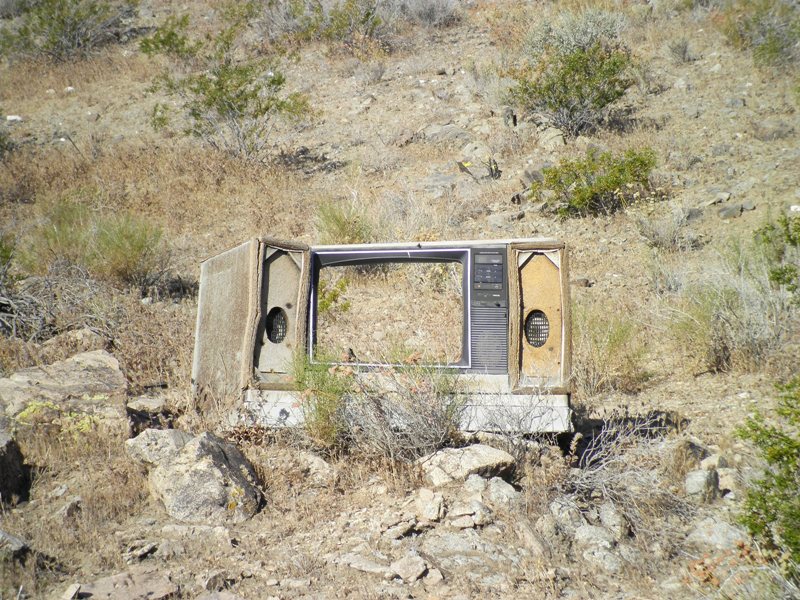
Deserts have traditionally been mystical places where one goes to find inspiration, themselves, the meaning of life, but nowadays people use the desert as a park, a place of recreation rather than re-creation. They whiz by on dirt bikes and all-terrain vehicles, they honk their dogs (let the dogs out of the vehicle and and follow along behind, honking whenever the creatures go to far astray), they have drunken parties, and they dump trash, including old furniture.

I used all of these bits to set the scene for the first chapter of Rubicon Ranch: A Collaborative Novel, a novel being written online by me and eight other Second Wind authors, especially the discarded furniture. I do believe I have seen enough old furniture in my walks to furnish a living room, but the piece that most captured my imagination was the television sitting out in the middle of nowhere. No road led to the television, just a footpath. Yet there it was. And so it appears in my chapter:

She turned around to get shots of the trail she’d just climbed and saw a glint of metal reflecting the sun. She squinted. What was that? A television? She found herself smiling—her first smile since Alexander died. She scrambled back down the trail. The television had been dumped a long time ago judging by the creosote bushes that had grown up around it, but footprints leading to the box suggested it had been visited recently. She took several shots from the trail, about fifteen yards from the television, then moved closer. The television had no screen, and she could see that something had been stuffed inside. A doll? She crept closer. Ten feet away, she stopped to take another photo, and the truth washed over her. Not a doll. Crammed inside the console was a child, a girl, her eyes half-eaten by some desert predator.

We’ve now posted the first six chapters of Rubicon Ranch, the latest one by Christine Husom, author of the Winnebago Mystery Series.  The most fun of a project such as this is that we do not yet know who killed the little girl (if in fact, she was killed) and we won’t know until all but the final chapter has been written. I hope you will enjoy following our story as we write it.

  • Chapter 1: Melanie Gray — by Pat Bertram
  • Chapter 2: Seth Bryan — by Lazarus Barnhill
  • Chapter 3: Jeff and Kourtney Peterson — by J B Kohl and Eric Beetner
  • Chapter 4: Dylan McKenzie — by Nancy A. Niles
  • Chapter 5: Mary “Moody” Sinclair — by JJ Dare
  • Chapter 6: Cooper Dahling — by Christine Husom
  • Rubicon Ranch Preview

    I am working on my next chapter for Rubicon Ranch, the collaborative novel I am writing online with eight other Second Wind authors. If you haven’t yet checked the story out, you can find what we’ve written so far at: Rubicon Ranch.  JJ Dare’s chapter is especially chilling. My chapter isn’t due for a while, but I need to get a head start, since who knows what writing projects I will be involved with when my turn rolls around again. Here’s a bit of what I wrote today:

    The sheriff poured two cups of coffee from an urn on a rosewood sideboard, set them on the table, and slid into a chair opposite Melanie.

    “What do you want with me?” she asked.

    He gave her an innocent look as if he didn’t know what she meant. “I just want to feed you.”

    “Yeah, feed me to the sharks,” she muttered.

    “You’re very clever, aren’t you?”

    She sat up straight. “What?” The word came out almost as a shriek. She modified her tone, but did not try to conceal her anger. “Are you suggesting that I had something to do with that little girl’s murder?”

    “Why do you assume she was murdered?”

    “You’re saying she wasn’t murdered?”

    “Did you know the girl?”

    “No. I might have seen her, but I didn’t pay much attention to what went on in the neighborhood. Wait! I bet she’s the one Alexander told me about. Right before his accident, he caught a little girl snooping around in our backyard.”

    “I never saw the report.”

    “Report? Oh, police report. He didn’t turn her in. Professional courtesy, he said. He was a bit of a snoop himself. Supplemented our income with photos of celebrities.”

    “Did he ever take photos of your neighbors?”

    Something in his expression—an added alertness—alarmed her. “Are you thinking Alexander might have been killed?”

    “Why do you ask that?”

    She shot him an exasperated look. “Having a conversation with you is like trying to talk to a four-year-old who has an attention disorder.”

    Excerpt From My NaNo Novel

    My grieving woman novel is taking shape. Amanda and her twenty-nine-year-old daughter Thalia are having problems that seem to antedate her husband’s death. I’m not sure why the daughter has such a problem with her mother, but perhaps we don’t need to know. It could just be more of the unfinished business the woman has to deal with.

    In the scene I wrote today (keeping to my writing schedule, yay!), the daughter accuses her mother of hastily redoing her old bedroom:

    “This doesn’t look at all like my room any more,” Thalia said. “There’s not a trace of me here. You could hardly wait to get rid of me.”

    Amanda opened her mouth to reply, but for a few seconds, no words came out. She’d completely forgotten that when they first came to this parsonage, Thalia had been a sulky thirteen-year-old. Trying to put a smile on her daughter’s face, she’d promised Thalia she could decorate the room any way she wished. Amanda hadn’t expected pink paint and eyelet ruffles, but she’d been appalled by the black walls and red curtains that gave the impression of dripping blood. The posters of movie vampires and band members who looked as if they’d crawled out of a crypt seemed almost cheerful by comparison.

    When Thalia went to college, David claimed the room for a den, but it had been Amanda who been cajoled into doing the work. “Shouldn’t we at least wait until Thalia’s out of college?” Amanda pleaded. For once, David had not been thinking of their daughter. “I need a place to work here in the house. We can put in a sofa bed. Thalia can use it during the summer.” But Thalia had never come back, and secretly Amanda had not blamed her.

    “I wish this house were bigger,” Amanda said. “Then we could have kept your room for you.”

    “Yeah, right.” Then, sounding like the little girl she had once been, she added, “couldn’t you have turned the parlor into Dad’s den? Nobody has a parlor and a living room anymore.”

    “I wanted to, but Dad said he needed a place for receiving visitors. He always thought it was important to keep the living room for us, so we could have some privacy as a family.

    “I’m glad he had a place to get away from you.”

    Amanda flinched at her daughter’s words, but didn’t bother to correct them. When David had moved out of their shared bedroom into this room after his diagnosis, it had been to spare her his relentless pacing and allow her to sleep undisturbed, not to get away from her. Or so he said.

    Could Thalia be right? Maybe he’d mentioned something to her that he wouldn’t say to Amanda. The two often excluded her from their conversations. She used to worry about feeling jealous of her daughter, but she hadn’t been jealous, not really. She’d liked that David and Thalia got along so well. She and her father had been virtual strangers.