Shenanigans of the Political Class

I find it ironic that politicians who scream about citizens making (ie: creating) too much money and profess the need to confiscate that wealth through punitive taxes, never once promise to give back the millions that have stuck to their fingers during their tenures as “servants” of the people. The mega-millionaires in Congress seem to be the loudest of the “eat the rich” contingent yet don’t see themselves as one of the problems. Apparently, their money is theirs. And so is everyone else’s money.

Too many people agree because they don’t understand that created wealth — wealth that is invested in business and creating thousands of jobs — is not the same as money in the bank. They complain that the wealthy don’t pay their fair share of taxes, and yet if everyone were taxed at the same rate, those same people would be complaining about their tax bill. The richest pay around 35% of their income in federal taxes. The middle group pays about 15%. The workers at the lowest end either pay minimal taxes, or they don’t pay into the system at all but are instead given money via Earned Income Tax Credits. (There is a wide range in each of these categories, but these are the averages I found.)

An even bigger irony comes from those communist mayors (calling them democratic socialists doesn’t change the nature of their rhetoric) who have never held a job in their life, led affluent lives because of family wealth, and yet now pretend to be bringing about a better life for working people while a) making things worse, and b) somehow getting richer.

I’ve never understood why working-class people listen to such hypocrites, except perhaps that they think that when the billionaires are taxed to death, then some of the money will be parceled out to them. I certainly don’t understand this push toward turning the United States into a communist country; it’s the surest way for everyone to go broke. Except for those at the top, of course.

A current scheme is a wealth tax, which never worked in the countries that tried it, but apparently, people still think it’s a good idea. But the trouble is, if they tax unrealized capital gains, then the owners of the company will have to sell off part of the company, which means people losing their jobs, which means fewer taxes overall. Also, all sorts of retirement funds that are invested in those companies lose money, because the sell-off will lower the value of the stock, which means the vulnerable also lose out. And of course, the politicians won’t bother giving a rebate for the loss of the rich person’s wealth when the stocks go down. And yet, when the stocks go back up again, they will again tax those unrealized gains, which means double tax on the same money. So bizarre!

I guess the moral of the story is that one doesn’t need to know economics to be in congress — or a mayor — though it should be a requirement. But then, it’s never about the truth, just the perceived truth. At least as long as it gets them reelected.

Which brings me to the biggest irony of all — that I, who have always had a head-down approach to the shenanigans of the political class, am not only aware of such doings but am blogging about it.

I might have to do something about that — not the shenanigans, which I have no control over, but the writing.

 

***

Pat Bertram is the author of Grief: The Inside Story – A Guide to Surviving the Loss of a Loved One

Snowdrop in the Snow

I’m certainly no snowdrop, remaining steadfast and sprightly in the snow. Instead, I brew a cup of tea and huddle over the warmth of my computer and ignore the snow. Except, of course, a moment now and again to look out the window and enjoy the whiteness of the day.

Well, that’s not exactly true. I did sweep the snow off the ramp leading to the house. I’m not expecting either a package or a visitor, but on the off chance someone would need to come to the door, I wouldn’t want the fates of irony to get into the act. (As much as I appreciate irony, having someone slipping on the wheelchair ramp and ending up in a wheelchair is one example I can live without.)

Then, even though I have a car cover, the snow still needed to be brushed off. It’s been a long time since I had to do that — the last time was a year and a half ago when I got caught in a snowstorm on a road trip. And the last time before that was . . . I don’t know. Maybe a decade or so ago. Even though I haven’t had a workable garage since I moved back to snow country, I do have a carport, but the foundation for the new garage blocks off access. Hence, snow removal.

And then, of course, I had to take a photo of that resolute little bloom in the snow.

This is Tuesday, and as usual, almost all my activities for the week were scheduled for today but, apparently, I am taking a snow day. There can be no work on the garage, a stint of volunteer work at the library was cancelled, I lost track of time and missed the third activity, and I simply don’t feel like going out into the snow and dark for a meeting tonight.

So here I am, a cup of tea at my elbow, the computer shining brightly in front of me, contemplating how not like a snowdrop I am.

***

Pat Bertram is the author of Grief: The Inside Story – A Guide to Surviving the Loss of a Loved One. “Grief: The Inside Story is perfect and that is not hyperbole! It is exactly what folk who are grieving need to read.” –Leesa Healy, RN, GDAS GDAT, Emotional/Mental Health Therapist & Educator

Fund Me Too

The original concept of crowdfunding was to get people to fund artistic ventures like movies, and not, as it has become, a way to get others to help with the expense of everyday choices like moving.

To my surprise, when I wrote about being appalled by this high-tech panhandling — getting others to fund things we choose to do — many people agreed. In fact, some readers went one step further and included Facebook’s fundraising platform as an example of this egregious exploitation, and I have to admit, those readers have a point. Like them, I don’t understand the reasoning behind setting up a fundraiser for one’s birthday (it sounds too much like asking for a gift), but considering the number of such fundraisers that end up in my FB feed, many people don’t find the practice objectionable.

What I didn’t realize was that one could use the FB fundraising platform to try to get money for anything. All you have to do is set it up in a few easy stages. Just what I need — more people asking for money I don’t have.

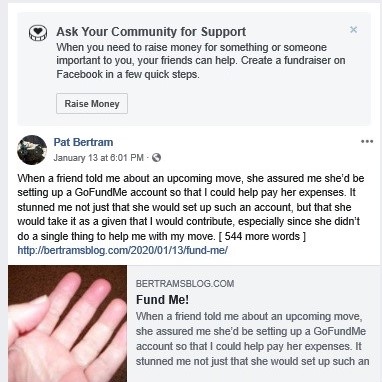
In a wonderful show of irony, Facebook flagged my article about crowdfunding with a note suggesting I ask my community for support with a fundraiser on FB, which shows that their bots pick up words in articles but not necessarily intent. Below is the screenshot of this note above my fundraising post:


Needless to say — or rather, “needful to say” since I’m saying it — I won’t be taking FB up on their kind offer.

***

Pat Bertram is the author of Grief: The Inside Story – A Guide to Surviving the Loss of a Loved One. “Grief: The Inside Story is perfect and that is not hyperbole! It is exactly what folk who are grieving need to read.” –Leesa Healy, RN, GDAS GDAT, Emotional/Mental Health Therapist & Educator.

Merry Thanksgiving

Merry Thanksgiving!

***
Pat Bertram is the author of the suspense novels UnfinishedMadame ZeeZee’s Nightmare, Light BringerMore Deaths Than OneA Spark of Heavenly Fireand Daughter Am IBertram is also the author of Grief: The Great Yearning, “an exquisite book, wrenching to read, and at the same time full of profound truths.” Connect with Pat on Google+. Like Pat on Facebook.