Moving the World

A friend and I recently discussed the Walk for Peace and what we thought would happen now that it’s finished and the monks back home. She thinks it will have a lasting effect and will make a big difference to the world.

Me? Not so much. People tend to get caught up in the spirit of the moment, especially big moments, and they hold on to that feeling of peace or commitment or awe or whatever for a while, but then life happens. And keeps happening. And the feeling that they thought would last forever dissipates and eventually gets put away, only to be remembered long afterward as a curiosity. For sure, some people’s lives were changed. Some people will follow through with the daily affirmation that was handed out during the walk: “Today will be my peaceful day.” Some will practice mindfulness as the monks urged, doing only one thing at a time. Some will even set their phones down for a while and just live in the offline moment.

Those things are important. After all, that was the monks’ message and their hope — that people would find inner peace. But will it change the world in the long run? Interestingly, the monks didn’t set out to change the world. They merely set out mindfully on a walking meditation with no announcement, no big production, no online presence. Just twenty monks walking. (Nineteen human and one canine.) That was it. They thought a few people would pause for a moment to watch and perhaps be moved to find their own inner peace, but they had no expectations beyond placing one foot in front of the other.

And yet people found them. Because of the interest, monks who stayed behind set up a map, websites, social sites, made and uploaded videos. The news of the walk spread, and hundreds of thousands of people stopped their lives to stand by the road and watch the monks walk by. Millions all around the world participated vicariously through videos and live streaming. During those months, there was a vast outpouring of kindness, compassion, harmony, love, and hope. All that energy would have to go somewhere since energy can’t be destroyed, so maybe there was enough power generated to move the world.

I keep thinking about a certain episode in The Wheel of Time books. The weather in their world has gone out of whack due to the Dark One’s effort to destroy the world and even humanity. But a couple of the girl heroes (“witches” some call them) have managed to find the ancient, long-lost bowl the sea faring people once used to control the weather, and these heroes as well as the sea people — Windfinders — get together to change the weather back to the way it’s supposed to be, pouring into the bowl huge amounts of the power only they can wield.

Afterward, they collapsed from exhaustion, but there was no immediate discernible difference in the weather. One of the heroes asks belligerently, “All of that, for what? Did we do anything or not?”

‘The Windfinder struggled to her feet. “Do you think Weaving the Winds is like throwing the helm over on a darter?” she demanded contemptuously. “I just moved the rudder on a skimmer with a beam as broad as the world! He will take time to turn, time to know he is supposed to turn. That he must turn. But when he does, not the Father of Storms himself will be able to stand in his way.”’

Is it possible my friend is right and the walk for peace will have this sort of effect? Is it possible peace will ripple through the world, changing things in ways we can’t even imagine? Maybe in ways we can’t discern but are still subtly effective? Despite my rather cynical view of people, I would like to think the walk for peace will make a difference.
***

Pat Bertram is the author of Grief: The Inside Story – A Guide to Surviving the Loss of a Loved One.
 

Seeing and Being Seen

When I watched the videos of people watching the monks walk for peace, I noticed how many had tears in their eyes. I imagine the in-person experience was overwhelming because just watching videos of those terracotta-robed men walking barefoot or wrapped up against the snow and wind was powerful in itself. But I think it was more than that. I think the watchers felt seen.

I bet many bystanders were surprised by that “seeing,” because after all, they stood, sometimes for hours, simply waiting to see the monks go by, but as the monks passed, the walkers looked at their watchers and the watchers were seen. It worked both ways. The monks themselves admitted they felt witnessed, not simply watched as if they were a parade, and it touched them. Hence, the tears from both the walkers and the watchers.

In the movie Shall We Dance, Beverly Clark (Susan Sarandon) says: “We need a witness to our lives. There’s a billion people on the planet . . . I mean, what does any one life really mean? But in a marriage, you’re promising to care about everything. The good things, the bad things, the terrible things, the mundane things . . . all of it, all of the time, every day. You’re saying ‘Your life will not go unnoticed because I will notice it. Your life will not go un-witnessed because I will be your witness.’”

Admittedly, this walk wasn’t a marriage (and a lot of marriages don’t work like Beverly Clark’s anyway). I didn’t mention the quote for the marriage part but for the witnessing part. (Though, in a way, that brief connection between walker and watcher could be construed as a marriage in the sense of a combination of two or more elements, but still, not important to this discussion.)

I think so many of us are hungry to be seen, not simply as a body standing by the side of the road, but as a person, an individual, perhaps as someone who wants to participate in something greater than ourselves. And those wise Buddhist eyes saw. And those bright Buddhist smiles drew everyone into the heart of their mission.

By the time the walkers reached Washington, so much of that “witnessing” aspect of the walk had disappeared. (At least on video. I have no idea what those thousands upon thousands of bystanders experienced.) The crowds were too huge, for one thing, and for another, members of congress showed up, with cops helping them bulldoze their way through the crowd, wanting merely to be seen seeing the monks. (To me, that was the most bizarre part of the whole walk, even more bizarre than the people who followed the monks through several states, heckling them and exhorting them to convert.)

I have a hunch this need to be seen is why the social aspect of the internet is so immense. Or maybe not — too many people hide behind user names and seem more interested in creating havoc than in merely being witnessed, but who knows. It could be why I write this blog, but again, who knows.

What I do know is that for one hundred and twenty days, people saw and were seen, and lives were changed.

***

Pat Bertram is the author of Grief: The Inside Story – A Guide to Surviving the Loss of a Loved One.

Choosing Peace

Dean Koontz often used a dog as a major character in his books, whether as a naturally superior intelligence, an enhanced intelligence, an alien from another planet, or even as an angel. Those books were not among my favorites because I couldn’t really relate to those dog characters. Although I seldom admit it, because in today’s world not being a dog afficionado is almost a sacrilege, I don’t connect to animals the way other people do. Of course, I don’t connect to many humans, either, but that’s beside the point.

As I’ve been watching dozens and dozens of video clips of the monks on their walk for peace, accompanied by their dog Aloka, I can’t help but think of Koontz. Although his dog characters are always golden retrievers and Aloka is an Indian Pariah dog, a street dog from India, I see a strong correlation between Koontz’s almost-an-angel dogs and Aloka.

In his own way, it seems, Aloka is bringing peace to the multitudes that pause in the strife of their daily lives to watch the monks and their dog pass by. The dog seems as happy and as calm and as peaceful as his companions, just going about his day walking, being mindful of his surroundings. What’s interesting to me, and what is so Koontz-y is that Aloka chose the monks. He started following them in 2022 during a 100+ day peace walk in India. Many other dogs also followed, but Aloka stayed, a quiet companion to the walkers, as if he knew what they were about and wanted to be a part of it.

When the monks decided to make their next walk here in the United States, they brought Aloka with them. And together, they fulfill their mission. No big pronouncements. No noise. Just walk. Be present. Be at peace. Aloka seems to have an additional job or two, showing absolute loyalty, and even though he is recovering from a January surgery, he seems to still take his job as protectant seriously, staying focused and watching over the monks from a support vehicle.

Apparently, some people follow Aloka more than the monks, but that, too, seems part of this incredible journey.

I came late to the walk for peace because I don’t really like videos, and besides, the first videos I saw were of various preachers trying to convert the monks, which seemed . . . inappropriate. But now I’m as mesmerized as everyone else.

Until I gave up consistent blogging, I used to participate in a blog-for-peace project every November 4th. Although I didn’t believe world peace was possible (because whatever the world leaders say, they really don’t want it), I thought it was important to stress that peace starts with us. The monks’ walk (and Aloka’s) reminds me so much of what the peace bloggers wanted — just to show that peace is possible.

And apparently, peace is possible. It is all in our minds, especially when we live in the present moment. Like Aloka, we just have to choose it. My wish for us is the same one the monks have left for us: “May we all find our way back to the present moment.”

***

Pat Bertram is the author of Grief: The Inside Story – A Guide to Surviving the Loss of a Loved One.
Balance

I got caught in a time warp where I watched videos of the Buddhists walking for peace. I call it a time warp because I thought I was online for just a few minutes, but when I finally looked away, hours had passed, and I had tears in my eyes. The scenes were that mesmerizing and that touching — not just the serene marchers in their distinctive clothing treading on matching flower petals, but the hundreds of thousands of people silently watching them pass by or joining their walk for a while. Oh, there were those who didn’t appreciate what they were seeing and wanted to divert the walkers from their “satanic” path, but from the vast majority, there emanated a feeling of awe, perhaps reverence. A sense of history being made. Even from those who went to see the walkers simply out of curiosity, there was still a great deal of respect for the monks.

It was such a huge disconnect for me because what I’d been seeing online was something completely different. Chaos, screaming, hatred. Crowds that were anything but respectful. In that hostile environment, peace seemed a thousand miles away. Um no. Not seemed. It was literally a thousand miles away since the Buddhists were walking a thousand miles to the south of the chaos.

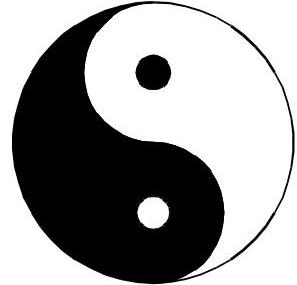
As I was thinking about these two events, all of a sudden, I didn’t see them as disconnected but as two parts of a balanced whole. This amused me — not the events, of course, but my idea of a balanced whole. Apparently, I’ve spent too much time in the dual cosmology of the Wheel of Time world, where opposing forces work against each other and with each other to create a balance in the world. Light and dark, male and female, good and evil, yin and yang. (It’s no wonder that when these books were made into a television series, the creators of the show changed Jordan’s world to erase the duality, which, considering today’s flexible morality, they ostensibly thought a weakness of the story rather than its very foundation.)

It also showed me something else. In the books, it seems as if “walking in the light” is the default setting; one must expressly go against the light to choose the darkness. Going by the numbers of people I’ve been seeing in the southern videos, it seems as if the default setting in this country is peace, or at least a desire for peace. Lawfulness. A need to get along without major confrontation. Maybe even a need to share something spectacular with one another. (Come to think of it, I’ve always thought peacefulness was our default setting. For example, while some people fudge on traffic laws, most people do follow close enough to the law that traffic flows smoothly without chaos, and the vast majority of drivers arrive at their destination safely. And though it’s long forgotten, the citizens of this country had to be dragged kicking and screaming into the world confrontations the leaders of the first half of the twentieth century got us into.)

Lately, I’ve had to fight a sense of sadness that borders on doom, as if we’re balancing on the brink of . . . something. It’s possible this is a result of my Seasonal Affective Disorder or even my sinus issues (allergies always make me depressed, but not as depressed as allergy medications), but seeing those beautiful monks? Well, to be honest, that made me sad, too, but in a different way, as if the peace they engendered is what life should always be but isn’t.

Still, for today, it was nice to participate in their walk — and its meaning — if only vicariously.

Grateful

Daily writing prompt
How do significant life events or the passage of time influence your perspective on life?

I’ve experienced many significant life events and life-changing experiences that influenced my perspective on life, but I don’t have any interest in rehashing any those past traumas. Nor do I have any present traumas to talk about since, luckily, I’m going through a rather static time right now. No major life experiences. I am still enamored with the experience of owning my own home and landscaping the yard, but that’s become simply my life.

What does affect me, and does more every day, is the passage of time. I’ve reached the age of no return — my body no longer heals itself quickly, and so small infirmities will begin to add up leading inevitably to a frailer old age than I might have envisioned. If I’m careful, I might not become as frail as I fear, so that’s the big way that time influences my perspective on life now —carefulness. Mindfulness.

Mindfulness is not some sort of esoteric practice, but a very practical way of approaching the end of the road — being careful. I used to move quickly, but now I move deliberately, mindful of where I place my feet. Too many older people have lost their independence because of a fall, and I’ve already destroyed enough of my body by falling (fake elbow, multiple pins in my wrist and forearm). I tend to think I’m still too young to have to worry about losing my independence, but things can happen in an instance, and I am not taking a chance. At least I’m trying not to.

I take care of myself as best as I can, though I admit, it’s not as good a job as I did when I was younger. I might also be coddling myself more than I should, using any small malady as an excuse not to exercise, but maybe coddling is a necessary a part of taking care of oneself.

I also do things like find chores in the kitchen while I’m cooking so that I don’t get distracted and walk away from a potential hazard. And I pay attention to the sort of accidents that happen when people get older so that I can protect myself, if at all possible, from that happening to me. (Not that we can protect ourselves from everything, but being careful means at least trying.)

Mostly, I’m grateful. Grateful for everything I can do. Grateful for every day I wake up. Grateful for every pain-free moment. Grateful I can still read and understand what I’m reading. Grateful I can still eat what I like. Grateful for the friends I have and the companionship they give me.

Just . . . grateful.

***

Pat Bertram is the author of Grief: The Inside Story – A Guide to Surviving the Loss of a Loved One.