No Regrets

Daily writing prompt
Describe a risk you took that you do not regret.

I don’t like taking risks. Too often I’ve seen people taking risks, such as with their investments, because as “everyone” knows, the bigger the risk, the greater the rewards. Except, of course, when those risks don’t deliver the sure thing people are expecting. Quite frankly, I’m not sure “everyone” knows what a risk is — if they don’t get the outcome their bravery at taking the risk seems to call for, then they’re shocked and they get upset. But that’s what a risk is — you take a chance, and it might work out or it might not.

In my case, I never take a risk if I can’t handle the negative outcome. Which means, I don’t take risks.

And yet . . .

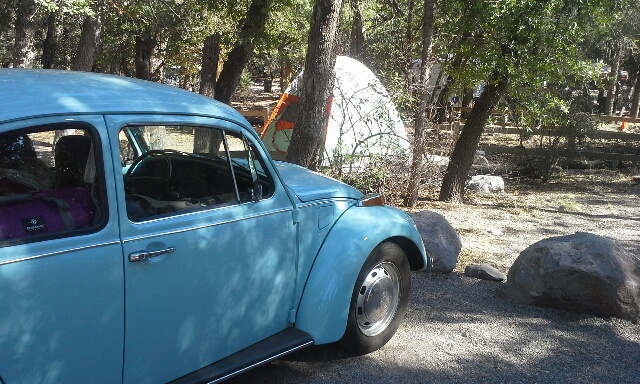
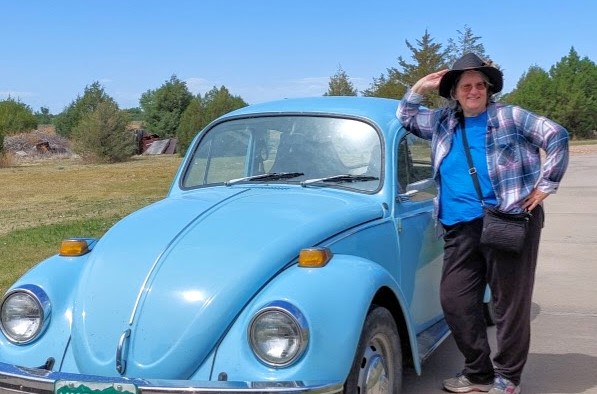
I’ve done a few things that other people considered extremely risky, though I didn’t. Ten years ago, when I planned a cross-country trip in my vintage VW bug, people were horrified and kept telling me I couldn’t do it, that it was too dangerous for me to go alone. Of course, none of those people offered to go with me to mitigate the danger, but it wouldn’t have mattered. The point was for me to do it by myself.

I wasn’t foolish about the trip. I had my car restored, a new engine put in, bought reliable camping equipment, and stocked up on emergency supplies for when unexpected and perhaps dangerous things might happen. And dangerous things did happen, but I handled whatever came along. To me, it was all part of the adventure, that willingness to go wherever the road took me and to live with the uncertainty (and consequences) of each day. Even more than that, it was a way of reclaiming my life after the death of both Jeff and my father. (After Jeff died, I was left homeless, so I went to take care of my father, and after he died, I was left homeless again.)

Perhaps the trip was a risk, but I didn’t see it as such. I wouldn’t do a long trip again, though just writing this I think maybe . . . someday . . . Still, the car is ten years older, as am I, and I’m not willing to put myself in the danger a trip could bring, not just the driving danger, but the uncertainty of the situations I might encounter — the USA isn’t the same as it was ten years ago, and even back then there were times I wasn’t sure what country I was in.

Besides, I’m homeful now, not homeless, so there is a lot more at risk than there was a decade ago.

Another risk I took was when I bought this house sight unseen. I’d seen photos, of course, and had an inspector check out the house, but I never saw it as a risk. The way I figured, it was my house, and I’d do whatever needed to be done. Other people were appalled at what they thought was my lackadaisical outlook, and the realtor made me sign a document absolving her of any responsibility if things didn’t work out.

I don’t regret either of these risks. Both worked out, but however they would have worked out, they would have worked out. I’m just glad, and so very thankful, to have had both these experiences.

Nope, no regrets at all!

Blogging

Daily writing prompt
How do you use social media?

The only way I use social media is by blogging. I do check out a couple of people who scavenge the internet for pertinent news articles. Since it’s difficult to do the work myself, it’s nice to have someone else find the kernels of truth (or maybe the grains of wisdom) in that teeming chaos. But for what I myself post online? It’s this blog.

For the past nineteen years, this blog has been there for me when I needed an outlet, whether it was to talk about the writing process, promote authors, discuss books I’ve read, help me find a way forward during my years of grief (and coincidentally helping others as I helped myself), tell about my experiences as a first time home owner, showcase my garden, or express gratitude for my life even while my body is slowly declining into old age.

I’ve seldom considered why people read this blog (or why they don’t when they don’t). Sometimes I know, though, especially when people come to read my grief articles to find out that they’re not alone or to find out why they are going through what they are going through. Others use this blog as a way to keep track of me, not in a creepy stalker sort of way, but as a concerned friend. All too often, we let life separate us from our friends, and so this blog shows them that I’m still around and doing okay. But for the rest? Their reasons for reading belong to them, and really have no part in why I write.

Today I found a comment on an article I wrote back in February about my current run of daily blogging, where the commenter asked if blogging every day makes us confuse quality with quantity, and if it’s narcissistic to think that people want to read every day what one writes.

For the most part, I don’t write for others. I write for myself, and anyone who wants to can come along for the ride, so I responded: I suppose one has to ask if the blogger cares what people think of their blog. Sometimes it’s for the bloggers — keeping to a discipline, clarifying their ideas, telling their truth to a (perhaps) uncaring world.

And their rebuttal: Well, when you publish something it’s for a public. If you need an exercise for your discipline keep it to yourself and don’t publish it.

I don’t understand the point of this exchange. People always write for themselves. Even if the writing is published, it’s still for themselves. If bloggers didn’t get anything from writing, published or not, they wouldn’t do it. And just because bloggers publish their articles, no one has to read them. In my case, it’s not as if I’m chaining readers to my computer.

Do I want to be heard? Of course I do. Although I say I write for myself, I consider blogging to be a form of communication, a longer way than simply posting a comment on some other social site or sharing someone else’s commentary. And communication, even in such a sideways fashion as this, is important to one who spends most of her waking hours alone. Do I consider this blog to be narcissistic? Since it’s centered on me and my life (who else do I know well enough to write about?), I suppose it could be considered narcissistic, but then everyone who writes would by definition be narcissistic. And even if it is narcissistic, who cares? If what I write doesn’t resonate with anyone, they simply stay away. At least I’m not heaping more outrage on an already outraged world, not spewing hatred or trying to make anyone believe what I want them to believe. More than anything, it seems as if I show appreciation for whatever the day brings.

As for quality vs quantity, again, what difference does it make? I sometimes have interesting ideas. Sometimes I’m just letting a piece of my day slip out into the open. And always, I write to the best of my ability, proofreading until the piece is as well written as possible. (This is also part of the discipline factor, something I would not do if I were simply jotting entries into a for-me-only journal).

I might be getting away from the blog prompt of how I use social media and getting into the why of it, but it still comes down to the same thing: the only way I use social media is by blogging.

***

Pat Bertram is the author of Grief: The Inside Story – A Guide to Surviving the Loss of a Loved One.

In Ten Years

Daily writing prompt
Where do you see yourself in 10 years?

Where do I see myself in ten years? Alive. I hope.

My mother died at the age I will be in ten years, as did her mother, which makes me wonder if that’s an age written in my genes. My father’s family was long-lived, so that might be a mitigating factor, but I take after my mother more than I do him, so we’ll see. Of course, life might have other plans for me, so that ten years might not be a given. Still, I have what I always have . . . today.

Oddly, we don’t seem to be able to project the view of ourselves into an aged, weakened state, so the way I truly see myself in ten years is mostly the way I am today: knees that don’t always cooperate as well as they did when I was younger, foods that don’t always agree with me, but for the most part, my body works well. My mind, too, works well (at least as well as anyone can judge their own mental workings).

I see myself still living alone, still working in my garden, still grateful for my house, and still grateful for my life.

I can only hope that I really will be as I see that self. I’m to the age where the body doesn’t recuperate as well as it once did, and so minor ills will tend to add up to an eventual fragility, but I can’t “see” that. I suppose it’s a good thing we can’t even imagine what we will feel like and what we will be like when we are very old — it would make life feel . . . frantic, maybe, as we try to fit in everything we want to do before that decline. Or perhaps it would make life feel defeating as we try to overcome thoughts of our end.

So, unless there’s a blog prompt asking me where I see myself in ten years, the overriding factor is that I can’t see myself that far in the future. I don’t even bother to try.

I’m just glad I can see myself here today.

***

Pat Bertram is the author of Grief: The Inside Story – A Guide to Surviving the Loss of a Loved One.

Being Silly

Daily writing prompt
Describe something you learned in high school.

In high school, specifically the first couple of years, I learned to be silly. I’d always been serious, spending whatever time I could manage with a book, but then things changed. I changed.

I went to a high school where I knew only a couple of people, and we were in different classes, so I no longer carried the burden of eight years of being a social outcast. It was freeing, to say the least.

One friend I made seemed to bring out the silly in me. Our high school had a long, straight hand rail on the steps leading to the building, and one day we decided to slide down the banister. Unfortunately, it wasn’t slick enough. So the next day we brought some wax paper, which brings me to another thing I learned in high school — wax paper is a good polisher. After we polished that railing, we went sailing! I don’t remember if we got in trouble or not, but I vaguely remember a disapproving frown or two.

When Christmas came around, we got our photos taken with a department store Santa. I remember giggling about that, and even today, it brings a smile to my face.

She and I often talked about what we would do when we were grown up, and we thought that it would be fun to open a restaurant in Georgetown and sell things like Alferd Packer pancakes and Democratic sausages. That, too, makes me smile.

I managed to be silly on my own for a while after high school. One of my first jobs was at a fabric store. We got in a collection of appliques, and one of a smiling frog tickled me, so I bought it and pinned it on my dress. I wore that frog every day until I stuck myself with the pin. When people asked why I stopped wearing it, I told them that it bit me. I thought it was funny, but my boss didn’t. She thought I was crazy as in certifiably insane, but luckily, I managed to keep my job when I finally convinced her I was just playing and that I didn’t think the silly frog was real.

Like most lessons I learned in high school, I eventually forgot what I learned. Or maybe too many people like that boss helped quash the impulse, and I again became the serious person I was as a child. Occasionally I consider doing something silly, but it just seems too . . . silly. And anyway, being silly by oneself is no fun, to say nothing of the energy it takes.

***

Pat Bertram is the author of Grief: The Inside Story – A Guide to Surviving the Loss of a Loved One.

Rereading and Re-rereading

Daily writing prompt
What book could you read over and over again?

I’ve spent the past couple of years rereading various mystery series from start to finish so I could get the full story of the character. Normally, I just picked books at random so sometimes a character is married, sometimes is just meeting the love of his/her life, sometimes is in full parental mode. All while being a cop or agent or private detective, of course.

After reading more than twenty thousand novels (plus thousands of non-fiction books), I’ve found a sameness to the stories, characters, situations, so that novels tended to overlap, which is why I didn’t think it would matter if I read these series again. Unfortunately, I didn’t enjoy the books as much as I thought I would since (for me, anyway) most novels don’t have a lot of depth. What you see is what you get. I even went back and read books I’d read over and over when I was young, but the stories didn’t have the same pull for me now that they did back then. Of course, I’m not the same person now as I was back then, either.

Lately I’d been rereading the first eleven books of The Wheel of Time. (I have no interest in ever rereading the last three books by the makeshift author. Although readers seem to prefer them to the first eleven books, I find them to be overhyped drek.) There are so many layers to the books that Robert Jordan himself wrote, there are so many inspirations from and references to real life, so many interlocking characters to keep track of, that it’s taken me a long time to piece it all together. I’d think the difficulty of remembering in book ten what happened in book two would be a failing of my aged memory, but I do know one thing — I would not have had the patience for these books when I was younger, so any comparison is irrelevant. Nor would have read them then — I never liked that whole good vs. evil theme. It always seemed contrived. Besides, I know more of the world and its culture now than I did then, so the underpinnings of the story are more obvious to me, and those that aren’t are fun to discover.

I’m to the point, though, where I might have gleaned as much of the meaning and found as much of the puzzle as possible, so I might have to pack the books away, but for now, they still sit prominently on my book shelf while I read The Kingkiller Chronicle. Only the first two books of that Patrick Rothfuss trilogy have been published, but I’ll probably reread these books, too. Although there doesn’t seem to be much referencing to our myths and legends, there is a lot of inworld referencing that I’ll need to piece together someday.

I’ve been trying to find more rereadable books and series that I can sink my life into, but so far, no luck. The problem is, I’ve developed an aversion to going to our library (I’ve searched those shelves a thousand times and just can’t force myself to look even once more), so I will have to find rereadable books if I want to continue my lifelong habit of reading. There are a few other books on my shelf to go through, and there are the books I’ve written, of course, which are enjoyable to reread. (Though I have to confess, I’m a bit embarrassed by the reviews I posted here of those books. Talk about self-aggrandizement! So not my thing. Besides, every author feels the same way about their books, which makes those reviews even more cringeworthy.)

And after I’ve finished reading and rereading the books on my shelf? I don’t know. With any luck, I’ll find books to serve my reading needs.

On a completely different slant about these two series: I found a chapter-by-chapter outline by a reader showing where the final book of the The Kingkiller Chronicle might be going, which would be a good way to conclude the series if the author doesn’t ever manage to do it. I’d hoped to find something similar for The Wheel of Time, where the fans outlined what they hoped would happen, but I suppose having the finale written, no matter how badly, put the kibosh on any such online project. And anyway, I pretty much created my own ending, if only in my mind.

***

Pat Bertram is the author of Grief: The Inside Story – A Guide to Surviving the Loss of a Loved One.

We Are Who We Are

Daily writing prompt
If you could be a character from a book or film, who would you be? Why?

If I could be a character from a book? That’s not a hard question for me because I am already a character in a book: Madame ZeeZee’s Nightmare, a novel about a murder that took place in a dance class. Sure, I wrote the book, but I am still a character in the story — the narrator, the one who set the murder in motion, the one who found out who the murderer was, the one who persevered while dealing with her own issues. And one of the dancers!

I discovered something interesting while writing that book — it’s much easier to write a novel when you’re the protagonist rather than making up a person to fill the role. I never had to figure out what the character thought — I knew exactly what she was thinking. I never had to create special internal conflicts for her because I have them galore. I never had to figure out her flaws because — well, I don’t have any flaws.

That started out as a joke, but it’s the truth. I don’t have flaws: I have personality traits and character traits that might not be the most admirable, but they are not “flaws.” They are part of what constitutes . . . me.

It’s why I hate the whole “flawed character” story structure. Authors don’t need to create explicit flaws for their characters. If the characters are real, they have traits that make up their personas. So what if they’re prideful or refuse to see anyone else’s point of view even to their own detriment? Those are still not flaws — they are intrinsic parts of who the characters are. They are what makes the characters come alive. If a peculiarity or failing is a part of the character, it can’t be a flaw because a flaw is a defect or a mistake or an imperfection, and since the traits an author gives a character are purposeful, they aren’t mistakes. And if the trait makes the character perfect for their role, then it can’t be an imperfection. Besides, who has the right to say that a certain trait is a defect? One person’s defect could be another person’s hard won survival mechanism.

As you can see, I take issue with that whole “flawed character” thing.

Luckily, I am not a flawed character! (Neither are you, if the truth be told. We are who we are.)

If I weren’t already a character in a book, who would I be? I wouldn’t. I have a hard enough time imagining me as me; imagining me as someone else would take more brainpower than I have at my disposal.

***

Pat Bertram is the author of Grief: The Inside Story – A Guide to Surviving the Loss of a Loved One.

Pets: The Good and the Bad

Daily writing prompt
What animals make the best/worst pets?

I can think of a lot of animals that would make the worst pets. Even without really thinking, the wooly mammoth, the saber tooth tiger, and the pterosaur come to mind. Truly, not good pets. For one, their size would make them hard to house. Sure, you could keep them as outside pets, but you’d still have the problem of feeding them. A mammoth eats about 400 pounds of vegetation a day, which would be complicated even in the country, but in the city? Couldn’t be done. And then there’s the pterosaur. With a wingspan of 35 feet and an exceedingly high metabolism, they need to eat continually. And they eat meat. So what happens when they run out of meat, when your neighbors have all mysteriously disappeared, and there’s only you left? I tend to think there wouldn’t be a whole lot of affection going on. Same with saber tooth tigers — high metabolism, voracious meat eater, and oh, yeah — those teeth.

Good thing all those creatures are extinct. But there are some extant creatures that would be every bit as bad. A blue whale, for example. It weighs more than thirty elephants. Yikes. Where would you keep such a thing? I imagine a goldfish bowl would be a tad small. A hippopotamus is much smaller than the blue whale, but due to their bite force and jaw structure, they’re considered one of the most dangerous creatures in the world, so not good pet material. The mosquito, not surprisingly, is the most dangerous creature of all, killing as many as a million people a year. (Humans only manage to kill about a half a million.) Besides the lethality, there doesn’t seem to be any way to domesticate a mosquito, so when considering the worst animals for pets, the mosquito would have to top the list. They might be easy to feed — I’m sure you have a bit of blood to spare — but keeping them caged would present a problem.

The best pets, at least in my opinion, are the legendary kind. Dragons. Unicorns. Griffins. Pegasi. Even though some of those creatures are said to be dangerous (red-hot breath anyone?) their non-corporeal aspects make them easy to take care of. And ignore. I’m not one to enjoy sharing my space with other creatures — large or small — so for someone like me, any of these fantastic entities would make a good pet.

For you and everyone else, the best pet, of course, is the one you love the most.

***

Pat Bertram is the author of Grief: The Inside Story – A Guide to Surviving the Loss of a Loved One.

The Bob

Daily writing prompt
How have you adapted to the changes brought on by the Covid-19 pandemic?

I was going to make this a lighthearted post because I’ve adapted well to the changes brought on by the “Bob.”

In case you don’t know, I call it the “Bob” after an excerpt in my novel, A Spark of Heavenly Fire, where protagonist Greg, and his boss, Olaf, are discussing research papers. Olaf says:

“Convoluted writing and obscure terms are a way of intimidating the uninitiated, keeping the profession closed to non-scientists, and adding to the scientific mystique. Just think, if diseases had names like Bob and Carol and Ted and Alice, doctors wouldn’t make anywhere near the amount of money they do now.”

Greg laughed. “That’s an idea. They do it for hurricanes, why not everything else?” He mimed seizing the phone and dialing. “Mr. Olaf? I can’t come in today. I’ve got the Bob.” He hung up his imaginary receiver and looked inquiringly at his boss.

Olaf nodded. “Works for me.”

All during the worst of the shutdown, I hated giving the malady — both the physical ailment and the widespread cultural and financial ill — the hated name. I didn’t want to grant the horror more power than it already had and, too, I didn’t want to surrender to the fearmongering. At least, not for myself. I don’t get the flu, and besides, I’d made a vow never allow myself to get caught up in another scarifying scheme such as happened with the Swine Flu fiasco of 1976. Outwardly, I made a point of following their dictates. I stayed home. (Yay!! Such a good excuse to take a break from socializing.) I made sure to stay 6 feet away from anyone I did happen to see. (Again, yay!! I’ve never liked people standing on my heels while waiting in line.) I wore the mask. (Another yay! I liked the anonymity.) And I always made sure I had an easy answer when asked if I’d gotten the vaccine. (It wasn’t a lie, but not the strict truth, either.) And even though we’ve been paying for the stimulus checks with inflation for the past few years (each of us has probably spent more in inflationary dollars than we ever received for “free”), they were a nice bonus for me at the time.

So, for me, it wasn’t a hardship. The worst thing, I think, was keeping from getting caught up in the fear. And the best thing was having an excuse to be alone, and that still holds true to this day.

So why did I change my mind about a lighthearted post? Because other people weren’t so lucky. I know several women who lost their husbands and subsequently their way of life. (Too often widows end up in financial straits, as if losing that one special person isn’t trauma enough.) I know others who have lost beloved family members. And I know still others who have become lost in a cycle of never-cured illnesses.

If this had been a naturally occurring illness, there might be some sense of fatalism to help with acceptance, but I doubt there’s anyone out there who still believes it “just happened.” We (the people) might never know the truth. Might never know who to blame. Might always be shadowed by the spector of “if they did it once, they can do it again.”

One thing I do know: we — individually and as a people — will always be changed forever by the “Bob.”

***

Pat Bertram is the author of Grief: The Inside Story – A Guide to Surviving the Loss of a Loved One.

What My Life Is Like Today

Daily writing prompt
What’s something most people don’t understand?

Today is the sixteenth anniversary of Jeff’s death. I’m sitting here mindlessly playing a game and scrolling through a few articles, trying to decide if I want to write about this anniversary. I will remember him, of course, and think of him and all he brought to my life, but I’m not sure it’s something I should still be talking about it. After all, his death belonged to him, not me. Still, I suppose I should at least mention the anniversary — for years I wrote about my grief, laid it all on the line (laid it online?), so it’s only fair that I talk about what my life is like today.

Life, that’s what it’s like.

Too many people bury their grief, letting others tell them how long they should grieve, how long it’s acceptable to talk about their feelings, how long they’re allowed to feel whatever it is they feel. But that is a disservice to grievers. I truly believe it’s important to feel all the myriad emotions, physical sensations, and mental fogs so that the body and mind can work its way through the changes to end up . . . renewed. Or if not renewed, then at least able to go through life without holding in the stress of grief like a too-tight girdle.

Despite the importance of that message, I still wavered about doing another grief post until I happened to notice today’s blog prompt: What’s something most people don’t understand? Such a blatant sign shouldn’t be ignored, especially since there is something I know about that most people don’t understand — Grief, especially grief at the death of child, a spouse, a soul mate.

Everyone thinks they understand grief because most people have felt sadness and despair and even shed tears at the loss of an acquaintance or a job or something else important to them. But not all grief is the same. Not all losses are the same.

The reality is, the most stressful event in a person’s life by far is the death of a life mate or a child. The reality is, such a death is so devastating that the survivor’s death rate increases by a minimum of 25% percent. The reality is, such grief brings about brain chemistry changes and lowers the capacity to function. Someone who hasn’t gone through the trauma of dealing with all the losses those deaths bring about — not just the body and mind changes, but the loss of identity, one’s way of life, sometimes income, and a thousand other changes — cannot understand and so has no business telling anyone how long to grieve or how to grieve. Grief belongs to the griever, not to the onlookers to people’s grief. Admittedly, no one likes to see others in pain, but that pain is often made worse by having to hide it to keep from bothering others.

People who are allowed and who allow themselves to go through the process of grief — because, at its most basic, grief is a process, a way of moving a person back into a semblance of life — end up able to simply live.

For years, I felt as if I were living as a reaction to Jeff’s death or in spite of it, felt as if grief bound me to him and to a way of life that had died with him, but now — I feel as if I am simply living. Maybe I’m just used to that deep undercurrent of sadness, but even so, it doesn’t change the fact that after sixteen years, what my life is like today is . . . life.

***

Pat Bertram is the author of Grief: The Inside Story – A Guide to Surviving the Loss of a Loved One.

Creating a Peaceful Place

Daily writing prompt
Describe the most ambitious DIY project you’ve ever taken on.

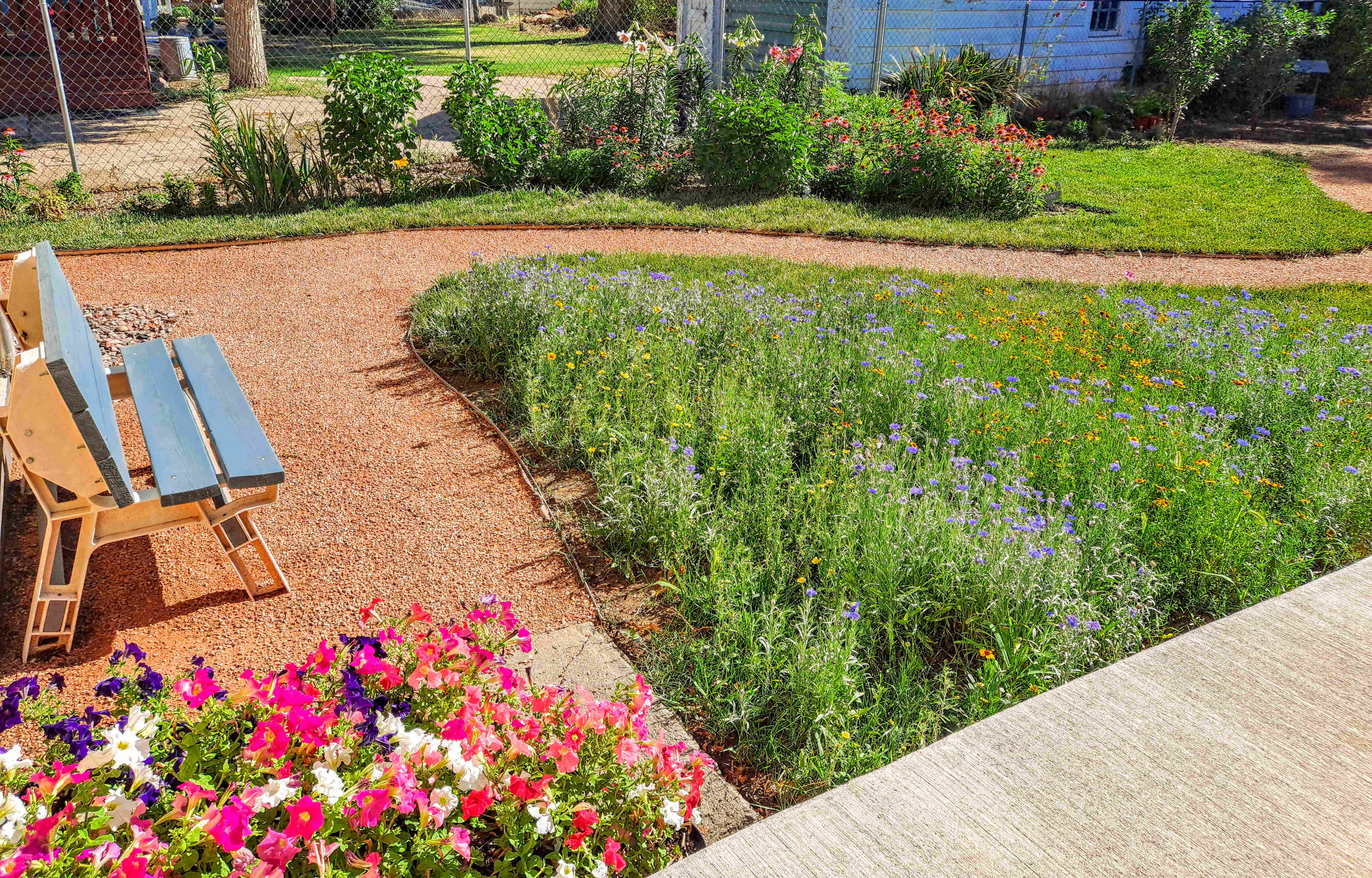
The most ambitious DIY project I’ve ever taken on? That’s easy. Landscaping my yard.

When I moved here, the yard was dirt and weeds. It looked okay because the weeds had been cut down to make the house look good when it was put on the market, but still, just weeds. I hadn’t planned on doing anything to improve the property because I didn’t want to have to take care of a yard, but there were things that needed to be done, such as rocks laid around the house to protect the foundation. Then, when I found out I was tripping on all the holes and rocks among the weeds, I decided I needed walking paths of crushed rock to keep from falling and breaking my neck. Or a hip, anyway.

Admittedly, I didn’t do any of the rock labor, but the finished work gave me a sort of yard pride that seemed to demand further work. So gradually, I planted a few bushes, a few flowers, filled in some of the gardens that were created by the walkways, and things escalated from there.

I had a lawn mower, so I put in a bit of a lawn since I didn’t want the mower to go to waste (a silly reason for a lawn, I know, but it’s the truth). I had sod put in, but when that all died (the people I hired put in the wrong grass), I dug it up and planted a more heat-resistant strain of grass.

And so it goes . . .

What makes this DIY project so ambitious is that there doesn’t seem to be an end to it. There’s a lot of work just involved in maintenance, so that keeps me outside for a couple of hours each day, which makes me see how much more I can improve. I can see spots that need to be filled in or bits of color that will improve the looks of one of the gardens. And then there are container gardens and hanging pots to be replanted every year.

Yep, an unending project when in fact, what I had wanted was a yard that took no work.

Oh, well, there are worse things than a garden demands attention. And truly, I can’t think of a better use of my time than creating this peaceful place.

Besides, there all are the surprises I find, like this morning. Look! Crocuses!

***

Pat Bertram is the author of Grief: The Inside Story – A Guide to Surviving the Loss of a Loved One.