Why Mistakes Happen

I worked hard to make More Deaths Than One typo-free, but there are at least two errors in the published novel.

        “I’m Kerry. Kerry Casillas.” She eyed the obit-
ary. “How many of those children are yours?
Bob massaged the back of his neck. “None.”

And:

“I thought you were in the jungle of your nightmares.”
Bob laid a had on top of hers. “I was.”
“Then let’s get you out of there. Finish the story.”

Errors in copyediting are easy to make. One website, Regret the Error: Mistakes Happen, capitalizes on this, chronicling the editing mistakes and corrections in newspapers around the world. If professional proofreaders and editors have such a hard time, what hope is there for the rest of us? Perhaps not much. And it’s not due to carelessness so much as the way we are made.

According to Joseph T. Hallinan, author of Why We Make Mistakes, we have a very narrow angle of good vision, perhaps a thumb’s worth, which is why our eyes constantly flicker back and forth — they are trying to focus on a larger area. What this means for us is that we see the beginnings of words, pick up clues, and automatically fill in the rest —  such as the e at the end of the. Hallinan writes, “people were asked to read a text and cross out the letter e every time they saw it. It turned out that the later the e appeared in a word, the more likely it was to remain undetected. Not only that, the e in the word the was very likely to be missed — 32 percent of the time.”

I also know from doing puzzles such as Word Finds that we tend to see the middle of the page more than the top and bottom lines, and we tend not to see the far sides of the text. If ever I can’t find a word, I know to look at the periphery of the puzzle. More often than not, that’s where I find the missing word. (I seldom do such puzzles any more. They’ve lost their allure after all the copyediting I’ve done this past year.) And this is where the typos in More Deaths Than One are. The first error occurs on the periphery of the page, the other error occurs in the second line from the top. (It’s easy to see here, because it occurs in the very middle of the excerpt.)

We also see what we expect to see, and the better we are at something, the more likely we are to skim. Hallinan tells the story of a distinguished piano teacher and sight reader, Boris Goldovsky, who “discovered an misprint in a much-used edition of a Brahms capriccio — but only after a relatively poor pupil played the printed note at a lesson.” Since the kid didn’t know how the piece was supposed to be played, she played it the way it was printed, not the way the experts misread it.

So what does this mean for us amateur copy editors? Go slowly, word by word. Resist the urge to skim. Double-check the first couple of lines on a page and the last couple of lines. Check the far sides of the text. And if all else fails, have your kid proofread the book for you.

***

(Pat Bertram is the author of the suspense novels Light Bringer, More Deaths Than One, A Spark of Heavenly Fire, and Daughter Am I. Bertram is also the author of Grief: The Great Yearning, “an exquisite book, wrenching to read, and at the same time full of profound truths.”)

Catapulting Me Into BetterSellerdom

In the past week, I received a couple of emails from people asking my advice on how to promote various online activities, I received an invitation to host a seminar on promotion, and I received an invitation to participate in a BlogTalkRadio discussion about creating a successful Facebook group. Apparently, I’m making a name for myself, (albeit slowly) but not as an author. Am I doing something right? Am I going about my self-promotion in the wrong way? I don’t know.

The interesting thing — to me, anyway — is that contrary to appearances, I still don’t know much about promotion. Sure, I am creating a presence on Facebook, I’m playing around with GoodReads, I blog and tweet. I’m even going to do a presentation at the local library about the brave new world of publishing. But those are the same things everyone else is doing, and I know that to be effective, promotion has to be creative, unique, and personal.

The odds of selling a truckload of books are miniscule to none, but I have never played the odds. I’m not giving up on my first books — A Spark of Heavenly Fire and More Deaths Than One — but in the next couple of weeks my third book — Daughter Am I — will be released, and I will need to figure out how to promote it. And who to promote it to.

When Mary Stuart, my twenty-five-year-old hero, discovers she inherited a farm from her murdered grandparents — grandparents her father claimed had died before she was born — she sets out on a journey to find out who they were and why someone wanted them dead. So is this a book that will appeal to readers in their twenties and thirties? Maybe. Along the way, Mary accumulates a crew of feisty octogenarians — former gangsters and friends of her grandfather. So is this a book that will appeal older readers? Perhaps. Mary also meets and falls in love with Tim Olson, whose grandfather shared a deadly secret with her great-grandfather. So is this a book that will appeal to romance readers? Probably not. There is no real romantic conflict in the book. The conflict belongs more in the mystery category, because Mary, Tim, and the octogenarians need to stay one step ahead of the killer who is desperate to dig up that secret. So is this a book that will appeal to mystery lovers? Could be.

If I had to do it over again, I would probably be more careful to write books that fit a particular genre to make them easier to promote. Oh, hell, who am I trying to kid. If I had to do it over, I’d write the exact same books. I like telling stories the way they should be told, without adhering to the boundaries of genre or niche marketing.

So, until I come up with a creative, unique, and personal idea of how to catapult me into bestsellerdom (or even bettersellerdom) it’s a matter of continuing to make a name for myself. Even if it is as a promoter.

If you want to know what I know about promotion, check out Book Marketing Floozy. Everything I know about marketing I got from there.

add to del.icio.us : Add to Blinkslist : add to furl : Digg it : Stumble It! : add to simpy : seed the vine : : : TailRank : post to facebook

It’s a Birthday Party!

No, it’s not my birthday, it’s the birthday of Second Wind Publishing, LLC. The first book was published exactly one year ago today, and now there are almost thirty, including two of mine (with a third on the way.)


I have no doubts of the success of Second Wind. Mike Simpson has the uncanny ability of getting his authors involved in the business, challenging us to expand our abilities beyond the scope of writing. He’s gotten die-hard thriller writers to edit romances. He’s gotten shy authors to do book signings. And somehow (still don’t know how) he’s gotten me to become Second Wind’s promotion co-ordinator. Okay, I do know how. He genuinely likes the books he publishes, and says the most wonderful things about them. In an introduction to my 100-word stories that were included in the romance anthology, Love is on the Wind, Mike wrote: “Pat Bertram, author of the newly released duo of suspense novels, More Deaths Than One and A Spark of Heavenly Fire, is a writer who defies categories, a literary maverick whose stories transcend genre and transport readers to beguiling worlds filled with compelling characters.”

So, stop by and join the celebration!

Ten Lessons I Learned (The Hard Way): A Publisher’s Reflections on the First Year
What Second Wind Book Do You Wish to Read? You Might Get Your Wish!
Introducing the authors of Second Wind!

add to del.icio.us : Add to Blinkslist : add to furl : Digg it : Stumble It! : add to simpy : seed the vine : : : TailRank : post to facebook

30% of More Deaths Than One — Free at Smashwords

Both of my novels, More Deaths Than One and A Spark of Heavenly Fire are available at Smashwords. Smashwords is a self-publishing platform and online bookstore for indepedent ebook authors, publishers and readers. They offer multi-format, DRM-free ebooks, ready for immediate sampling and purchase, and readable on any e-reading device. (Kindle, Sony, Palm, Stanza, etc.) Many publishers (including Second Wind) are starting to use their services, which allows them to offer their books in all the ebook formats with little added expense. Why is this so important? As I’m sure you know, ebooks are the wave of the future, even for those traditionally slow to adapt to new technologies, such as the over 50 crowd. (Does this still hold true, I wonder? Most people I meet who enthusiastically embrace computers and the internet belong to that age group.)

The new demographics are:

  • People 50 or older are leading the way in adopting the Kindle, followed by those 18-34
  • People 35-49 prefer using their iPhones to read e-books
  • But most people (48%) are still using their computers or laptops to read e-books
  • While e-books are1.5% of the total book market, ebook sales grew 125% overall in 2008
  • E-book sales grew 183% among seniors aged 65+ and 174% among seniors aged 55-65

So whatever your choice of reading device — printed book, Kindle, Sony, computer — I’ve got you covered. (Do ebooks have covers? Perhaps that wasn’t as clever a word choice as I thought.) And, you can begin reading online immediately.

My Smashwords profile: Pat Bertram
Smashwords: More Deaths Than One
Smashwords: A Spark of Heavenly Fire
Printed Book: More Deaths Than One
Printed Book: A Spark of Heavenly Fire

add to del.icio.us : Add to Blinkslist : add to furl : Digg it : Stumble It! : add to simpy : seed the vine : : : TailRank : post to facebook

Pat Bertram And Lazarus Barnhill Discuss Writing as Destiny

Lazarus: The other day I was marveling at the uncanny string of events—starting with a writing contest on Gather.com—that brought me many wonderful new friends, saw the publication of my first two novels and empowered me to express my artistic vision in ways that I never imagined. When I read Julia Cameron’s book, The Artist’s Way, I began to wonder if in fact what I saw as a lucky string of chance events was really a matter of listening to a still, small voice that has always intended better for me than I could have imagined for myself.

In a nutshell, Julia Cameron says that, whether you call it destiny, the hand of God, or just the creative direction of the universe itself, our purpose is to create and we allow ourselves and others to stymie our creativity.

Bertram: Are we really fulfilling our destiny, though, or does it just feel like it? The solar system seems to be designed perfectly, with the planets constantly moving, yet staying out of the way of the other planets. But it wasn’t always so. At one time they were banging and crashing into all sorts of space debris, and over billions of years they annihilated everything in their path to end up the ordered system we know. So, is our writing destiny the same? Something we see only in retrospect, perhaps, with our brains trying to make sense of chaotic events?

Lazarus: Do you think when you write that you are fulfilling an essential aspect of your truest purpose for existing?

Bertram: I do think the universe itself is a creative power that we tap into, and that we are creative by nature. But . . . if we are all fulfilling our natures as writers, who is fulfilling their natures as our readers? Writers need readers, and now that there are (supposedly) more writers than readers, how can writing really be our destiny? Except personally, perhaps.

Lazarus: Cameron teaches two “sacred acts” in The Artist’s Way. The morning pages (3 pages you write when you first get up in which you allow your inner self to freely express itself) and the artist’s date (essentially, you have to have 2 hours a week in which you go off by yourself and do exactly what you want).

When I first started doing the morning pages, I was correcting my spelling and changing my word choices. All of that was stymieing the child inside me; and if I don’t let that child have a say, he disrupts whatever the grown up Laz wants to do

Bertram: Three pages when you first get up in the morning, just to express yourself? I never could understand how people can dash off the pages like that. It takes me an hour or two to write a single page. I try to be more spontaneous in my blogs, just to let the words and feelings flow, but it still takes me more than an hour to write 300+ words.

Lazarus: Whoa, Pat, sounds as if you’re a “blocked creative”

Bertram: Blocked creative? Maybe I just don’t have any ideas. Or maybe my inner child likes to play with words and sentence structure.

Lazarus: Well, seriously, what would happen if you just started describing how you were feeling at the given moment?

Bertram: Usually when I sit down to write I don’t feel anything but peace. Not a whole lot to say about that. And when I do let the words roll out, I usually end up with a silly character interview or something equally worthless except as a blog post. I really don’t have a lot to overcome. I figure my inner child is my outer child. Pat Bertram was two years old on May 17th. That’s when I started from scratch to create myself as an author rather than just a writer.

Most of my inner demons I let out while writing my first book. I don’t usually acknowledge it as my first book — it was too much me and not enough creativity. To say nothing of terrible writing. Still, it did help me work through the past and allow me to re-emerge as . . . still don’t know, actually. I’m still emerging.

Lazarus: How many stories do you currently have swirling around in your cerebellum?

Bertram: None. I know you don’t believe it, but it’s true. If I had any stories there, I’d be writing them.

Lazarus: How do you know when you’ve heard a worthy idea for a new novel?

Bertram: I don’t know. Mostly I have to put several ideas together. And I don’t have any ideas right now.

Lazarus: Do you often suffer from long “dry spells” in which you don’t have anything to write or you don’t know how to get started?

Bertram: Is it a dry spell if you don’t feel like writing? Or if you’re doing something else instead, such as promoting? Even when I’m writing, I have more non-writing time than writing time. I need to let things percolate.

Lazarus: Yes, I call it “marinating.” How long does it usually take for your stories to percolate. Do they progress in stages?

Bertram: Definitely stages. Even when I know where I am going with a story, I seldom know the details.

Lazarus: But I have the sense that you’re implying you can’t promote and really write creatively. Is that right?

Bertram: I have a one-track mind

Lazarus: But not obsessive?

Bertram: No, not obsessive. I just can’t commit to two projects at once.

Lazarus: Have you ever had the experience of being so hooked, engaged in a story that you turned your back on other pursuits just so you could write?

Bertram: No, not really.

Lazarus: You’ve completed four novels, though you told me Light Bringer is going through a final polish. How long do each of these projects take and usually how much time elapses between them?

Bertram: Light Bringer has been ongoing for eight years. Or thirty-eight if you include the research. It won’t be completely finished until it’s published later this year.

Lazarus: Thirty-eight years of research? So you’re bringing your entire life’s experience to bear on this piece.

Bertram: Yes. Everything I ever learned. And studied. Daughter Am I was the quickest — outlined in one day, written in a year. A couple of months usually elapse between books, mostly so I can type them up. I write long hand.

Lazarus: Pat, does the average reader perceive the deeper messages you conceal in your stories?

Bertram: I don’t know. The books are written so that even if they don’t see anything beyond the basic story, they should still like them. At least that’s the plan.

Lazarus: Had to back up and start over when you said that. So you acknowledge then that your books function at differing levels of depth; that there are meanings to be fathomed that someone reading just for enjoyment might miss?

Bertram: It’s possible that there are meanings people will miss. Heck, I missed some of it! When I proofed A Spark of Heavenly Fire, I saw themes that I didn’t put in there.

Lazarus: You didn’t put there? Is it fair to say that a really well written book will plumb emotional, human themes beyond the writer’s intention? And that’s what’s happened with your books?

Bertram: When a story flows, when everything is motivated, it makes sense that some ideas, emotions and themes show up that aren’t planned. If the characters are true, it has to happen. I am not saying that the characters do things that I don’t plan. Their actions are completely planned. But some underlying truths could emerge.

Lazarus: This is the contradiction in you that is so mysterious: you talk about being methodical, plodding, taking years to write a single piece; and yet at the same time you admit that the story flows from a place deep within you and parts of it emerge unannounced.

Bertram: I have a dual nature: half mystic, half logician.

Lazarus: Did you ever think that you are really “discovering” the story: that some mystical intentionality has dropped the clues of the story in your consciousness, in your experience and intended you to find them and fashion them together?

Bertram: Of course.

Lazarus: Then writing these stories is your destiny?

Bertram: So this is what you were leading up to.

Lazarus: It’s not like you didn’t see it coming.

Bertram: I don’t know if the stories are my destiny, but I do think they wanted to be written.

Lazarus: Yes! Wanted to be written. They wanted to be written by you. And I like the notion of “half way.” They came to you in pieces and only half conceived. They were waiting for you to complete them.

Bertram: But it’s also possible that mystical intentionality is myself.

Lazarus: Okay, that’s a realistic point of view.

Bertram: One thing that’s always puzzled me is that when I sit down to write, my mind goes blank. Other people can write a book a month. They can let the words flow. I have to dredge each word out of my mind. Yet, when my books are finished, there is an inevitability about them as if they were inspired, not perspired (at least it seems that way to me). But I don’t believe that they are “destined.” It’s all the little choices I make along the way that creates the inevitability. When you start writing, you have the entire world to choose from, but as you make choices — genre, setting, characters, plot, etc, etc, it narrows the story world and keeps narrowing it until it seems inevitable. Yet it all comes from the thousands of choices that we made.

Lazarus: I have one other question about the way you create these stories: is it possible it takes so long to write them because it is mentally strenuous for you to overcome your own internal resistance to writing?

Bertram: It’s possible. Yet when I started writing, I had nothing to overcome. I wanted to do it. It was only when I had four unsalable books that the logician in me decided it was silly to keep writing.

Lazarus: So now that you’re published (and selling! Unsalable my eye) can you tell the logician to take the back seat? Though Julia Cameron wouldn’t call it your logician. She would call it your Censor.

Bertram: Right now, the logician really doesn’t have anything to do with it. My problem is I don’t write books I know how to write. I have to learn how to write each book. And the one I’m doing now has me totally flummoxed. It’s truly a ridiculous project. Three distinct parts with distinct themes.

Lazarus: What? I thought you said you didn’t have a story rolling around in your head.

Bertram: It’s not in my head. If it were, I’d be writing to get it out of my head. It’s an incredibly silly/mystical/apocalyptical story. I started it when I thought I couldn’t get published — decided that I would write something totally unpublishable.

Lazarus: “Totally unpublishable.” (translated) “I’m writing this just for myself and the beauty of writing”?

Bertram: For something to do.

Lazarus: Oh, you are so perverse!

Bertram: After I started writing it, I got a computer and had to learn that. Then I got the internet and had to learn that. Then some idealistic publisher (Second Wind Publishing) decided to publish my books, so I had to learn how to promote.

Lazarus: Something else I want to explore. First let me ask if you saw Spielberg’s “Minority Report”?

Bertram: No.

Lazarus: Spielberg is to filmmakers what you are to novelists: intentionally convoluted. He makes these incredibly compelling movies and critics totally don’t even get them.

Bertram: I am not intentionally convoluted!!!

Lazarus: Okay, if you were an intentionally convoluted person and someone called you on it, wouldn’t you say you weren’t?

Bertram: You’re right, an intentionally convoluted person would not say they were convoluted, unless of course it would make them seem doubly convoluted by agreeing that they were.

Lazarus: But we need to tie this back in to your particular talent we’re talking about tonight. In the same way as “Minority Report,” More Deaths Than One is incredibly full of irony. It’s a very gratifying novel, even as it surprises the hell out of you.

Bertram: I’ve been wanting to ask you for months. When we talked that time, I asked if you were disappointed in More Deaths Than One, and you laughed and said no. Why the laugh?

Lazarus: . . . So I’m wrestling. Shall I let you off the hook by letting you ask me a question? Okay, but I won’t stay distracted for long. I laughed because the book was totally unexpected. I knew when I first read the initial chapter during the TruTV Search For the Next Great Crime Writer contest on Gather that it was written lights out. Where you took it in terms of 1) character development; 2) plot twists (I love plot twists); 3) ironic subthemes; and 4) emotional gratification was truly gripping and surprising. I laughed because anyone who knows anything about writing would know how good it is.

Bertram: Tell that to the 200+ people who rejected me.

Lazarus: Steinbeck submitted 40 novels (different novels) before he had one accepted. This says more about the publishing industry than you. Now back to the task at hand: “The devil in Ms. Bertram.”: Your romance vignettes that were published in Love Is On the Wind are the most ironic, humorous and biting pieces I think I’d ever read — but undeniably focused on romance. Beneath them one sensed an incredible bittersweetness. So my question is, why did you write like that? I guess what I mean is, you are a true romantic at heart — but I don’t think you believe in romance.

Bertram: I thought I was just trying to put a twist on a story.

Lazarus: So, what, you think I’m falling for that?

Bertram: Well, you silence me. I have no idea how to respond to that.

Lazarus: Either that or I got a little too close to home.

Bertram: Could be. But I never thought of myself as either romantic or unromantic.

Lazarus: Let me ask it in a more friendly way, . . . thinking . . . How about this: in your heart, there are things you want to say to romance readers, but you don’t really think they’ll hear them. Yes or no.

Bertram: I don’t know, but I don’t think so. I don’t like category romance. I think the stories are generally too trivial to be truly romantic.

Lazarus: Ah — there it is. If what you had written had been logical, dispassionate, then the answer would’ve been “no.” The answer is “yes.”

Bertram: Huh?

Lazarus: What you want to say is, “don’t trivialize love; go deeper.” Right?

Bertram: I guess. I read many books that are well written, but they leave me cold because in the end the stories are trivial. Love shouldn’t be trivial, but they make it so.

Lazarus: Okay. In your two published novels, you manage to take the subject of romance and examine it in a plethora of meaningful ways: pure attraction; devotion in the face of great hardship; true love lost and then recognized for its falseness; rescuing disguised as love. Yet despite the quality of the loving relationships you examine in your stories and the romantic element that is clearly present (and there is nothing trivial about them), you haven’t really give us a romantic story yet.

Bertram: The very first book I ever wrote was supposed to be a romantic story of love that transcended time and physical bonds, told with sensitivity and great wisdom. I quit a job when I was young to write that book, discovered I had no talent for writing and no wisdom, so twenty-five years went by before I tried writing that book again. That’s the one that I don’t acknowledge as a book. Someday I’ll get back to it. I know the basic story, but don’t know how to say what I want.

Lazarus: Have you read my novel Lacey Took a Holiday? It’s an intentional convolution of romance. As we would say in classical literature, “romance turned back upon itself.” The characters are both extremely flawed: the girl is a drunken prostitute; the guy is a bitter, widowed war veteran. They begin their relationship when he kidnaps her out of a brothel.

Bertram: I read it. It’s profoundly moving. The theme that I mentioned earlier that I saw in A Spark of Heavenly Fire was the theme of love in all its guises. You use that theme in your books, too. It’s especially apparent in The Medicine People, though the book is being sold as a mystery, like mine.

Lazarus: Yes, love in all its guises: you make Pippi an incredibly sympathetic character when it would have been so easy to turn her into someone we intensely dislike.

Bertram: Pippi was supposed to be the character I hated. It was supposed to be a silly sub-story about the unattractive woman getting what the attractive one didn’t. A childish theme, really.

Lazarus: Pippi embodies the woman searching for love. She ends up discovering that the only love she can trust is self-love. Suppose you wrote a sequel about Pippi. What would happen to her?

Bertram: I don’t know what will happen to Pippi. Haven’t thought about it.

Lazarus: I never realized it until now, but there is a tremendous comparison between the two women in A Spark of Heavenly Fire. It cannot be characterized simply the way you did: beauty loses out to plain. That’s what the unaware reader will get out of it. It’s much deeper than that. The women drive the story. It’s their strength that carries the day in the face of the plague, the atrocities and the recovery.

Bertram: Yes, the women drive the story. I wrote the book to prove a quote by Washington Irving: There is in every true woman’s heart a spark of heavenly fire, which lies dormant in the broad daylight of prosperity, but which kindles up, and beams and blazes in the dark hour of adversity.

Lazarus: I would like to share another thought about your writing — both your ability and what you’ve achieved. Let me preface it by saying that I’m no critic — which is to say that I really do understand literature as opposed to formulae. I feel what authors are saying in addition to recognizing the beauty in the way they say it.

Thus I feel the need to point out what you might not even acknowledge: you have a marvelous ability to write the longest parables in all of literature. A parable unglues the world as it is perceived and rebuilds it in a wiser and more beautiful way. That’s particularly true in A Spark of Heavenly Fire and even more so in the ironic, visceral More Deaths Than One.

Bertram: Again, you’ve silenced me.

Lazarus: You know, some writers will tell you that they treat their stories/books like children. You don’t do that. It’s something more than that with you. It’s metaphysical. A mystic statement.

Bertram: No, they’re not my children. One thing I have to believe: that these books will find a readership. That they have enough substance for people to talk about them. Do you think that’s possible?

Lazarus: I think your books are really mainstream books. The real difference between a mainstream book and a genre book is that a mainstream book intends to have something of merit to say. I think, with your books, there are several important realities: 1) They’d make damn good movies — which is to say they have great popular appeal and people will read them; 2) They could be studied in literature classes, and in that respect people will talk about them and discuss and learn; 3) I think to really, really get the lessons at the heart of your books you have to be a worldly, mature person. So if I say that people will have a lot to talk about in your work, I’m really implying all three of these things.

Bertram: This has been the most unlikely discussion.

Lazarus: Thank you, Pat, for the conversation. I look forward to being a writing colleague of yours. In the years to come, I anticipate reading many new works that evolve from that place where you have no new ideas, works that really do lurk in your inward being.

See also: The Most Unexpected Truth About Writing

I Enjoy Keeping Men Up Late at Night!

A couple of days ago I received an email from Aaron Lazar, author of Tremolo: Cry of the Loon. He said: “I started A Spark of Heavenly Fire last night and am HOOKED, big time! I read 100 pages (usually I fall asleep when reading in bed after a few pages) and dreamed about it all night. Wonderful! Can’t wait to read more, Pat. You’ve got a winner here.” Today he wrote: “Read another hundred pages last night. I’m mad with you! I didn’t get enough shut eye! HAAAAA!”

I do enjoy keeping men up late at night! I like keeping women up late at night, too. During all these years of wondering what it would be like to have people read my published novels, this is one aspect I never took into consideration — how wonderful it would feel to know that I am keeping people up past their bedtime so they could read a few more pages. Such an awesome power!

In November, I posted a bloggery, “What If People Like My Books?” I had been so focused on getting published, that for some reason until then it never occurred to me to wonder what it would be like if people actually enjoyed my novels. After 200 rejections, I was poised to deal with more of the same, but so far I have received only positive feedback. It’s an incredibly affirming experience to have people peek into your mind, to become intimately involved with your creation, and to get what you’re saying. So much of me is in the books that I thought I would feel exposed, but I don’t for the simple reason that the books no longer belong to me. They belong to anyone who reads and enjoys them.

Wanda H. wrote:  “I’ve now read both books! They were both spellbinding and kept me engrossed until I finished. It was hard to put them down to sleep and not to pick them up again in the morning and instead go and do things.

My favorite is A Spark of Heavenly Fire. I love the characters and the action and the . . .  well, everything. But it only edges out More Deaths Than One by a bit.

I now see what you mean about an unnamed genre. Kind of a big picture conspiracy, behind the scenes machinations and how that affects the little guy (or gal) on the street. You did such a terrific job. I know you’re going to enjoy tremendous success not only with these books but also with the books you’ve yet to write.

Anyway, just to gush a little more…. I love your work! You rock!”

Sheila Deeth, who won the first autographed copy of my book because of her wonderfully imaginative entry for my More Deaths Than One Contest, wrote an incredible review of the book.  She starts out: The first three pages of “More Deaths than One” have to constitute a serious contender for the best opening scene of a novel. Two main characters are introduced, a garrulous waitress and a taciturn hot-chocolate customer. They meet. She talks, a lot. He reads the paper. “And Lydia Loretta Stark was dead. Again.” With two such immediately real and appealing characters, and a line like that, I’d challenge anyone not to want to keep turning the pages. more  . . .

So . . . what if people like my books? I feel honored, and if truth be told, a bit humbled.

add to del.icio.us : Add to Blinkslist : add to furl : Digg it : add to ma.gnolia : Stumble It! : add to simpy : seed the vine : : : TailRank : post to facebook

My First Review!!!!!!!

Steven Clark  Bradley, author of Patriot Acts, has written such a marvelous review of my novel More Deaths Than One, that I can’t keep it to myself. I want to shout it to the world! I knew it would be a good review, because several days ago he messaged me on Facebook. This is a transcript of our conversation:

Steven: (4/19/09 10:37 pm) Hi Pat, I wanted to let you know that I am deeply into your book and it is fantastic. You have a great hook, at least it certainly hooked me! You have a natural talent. I usually read a book really quickly when I am going to post it and review it, but your book has my total attention and it reads very well. If you can get a large number of people to know of it, I know you could have a best seller there. Once again, free of flattery, you are one of the smartest writers I have met. I promise, you’ll love what I write about More Deaths Than One.

Pat: (4/20/09 11:51 am) What a wonderful thing to say! I am thrilled you like More Deaths Than One. You’re one of the very few people who have started reading it, so your encouragement is much appreciated.

The question that has haunted me for months is how do I get a large number of people to know of the book. Perhaps someday I will find the answer. Your review will help, that’s for sure!

Steven: (4/20/09 12:14 pm) The only word that comes to mind is Superb! I read until 1:00 Am last night and forced myself to go to bed! Great work!

I think your characters are so interesting and human. I feel I know them well now. Could we call it “What about Bob?” ;>) you’re a really great writer and no reason why you cannot sell thousands of books.

Steven: (4/22/09 1:21 am) Hi Pat, Sorry I have not written, but I have been busy finishing one great novel . . . written by you! I have already posted a review for your novel. I have not read a book that enjoyable in a very long time. You are a natural. I hope you like what I wrote and every word is the truth. I am happy to be your first posted review on Amazon. That gave me great pleasure. Have a great night and thank you for allowing me to share in the mind of Pat Bertram.

Pat: (4/22/09 12:17 pm) Steven, I am sitting here trying to figure out how to thank you for the fantastic review and the wonderful presentation on your blog, but  am touched beyond words. Still, you deserve the words: thank you. Your review was so well done that even I am now anxious to read More Deaths Than One!

Steven’s review: More Death’s Than One

add to del.icio.us : Add to Blinkslist : add to furl : Digg it : add to ma.gnolia : Stumble It! : add to simpy : seed the vine : : : TailRank : post to facebook

Developing A Smell-O-Meter: How Do You Tell If What You’ve Written Is Good?

I’m participating in an interesting discussion on Facebook today about  . . . you guessed it! Developing A Smell-O-Meter: How Do You Tell If What You’ve Written Is Good? It’s a topic I’ve been considering a lot now that my books are released and feedback is trickling back to me. I always knew A Spark of Heavenly Fire was good – even when it was bad, I knew it was good. I can’t tell you how I know – probably that smell-o-meter. Or perhaps an ingrained feeling for the flow of a story. That belief kept me going through multiple rewrites and hundreds of rejections. It’s nice to know that agents and publishers do not know what individual readers like. Today, Malcolm R. Campbell, author of The Sun Singer, left me a message on my facebook wall: I just finished reading A SPARK OF HEAVENLY FIRE. When I stay up past my bedtime multiple nights in a row just to read a little bit more, I know I’ve found a winner of a book. Darned good, Pat.

On the other hand, I never got a sense of More Deaths Than One. Even after all the rewrites, it just didn’t seem to be as good as I wanted it to be. I entered it into a contest on Gather.com eighteen months ago, where the first chapter was posted for people to vote on. Lazarus Barnhill, author of The Mecine People and Lacey Took a Holiday, was impressed with that first chapter of More Deaths Than One, and he eventually became one of the book’s first readers. When he finished it, I asked if he was disappointed in the book. He said no and gave a little laugh. When I finally got up the nerve to ask why the laugh, and he said, “I laughed because anyone who knows anything about writing would know how good it is.”

So, apparently my smell-o-meter works only half the time.

As for telling if sentences, words, paragraphs, scenes are any good, it’s mostly a matter of reading them, changing a word, reading them again, changing another word until the piece flows. If the words flow and if the story flows (and if  the story is worth telling), you don’t need a smell-o-meter. It will be good.

add to del.icio.us : Add to Blinkslist : add to furl : Digg it : add to ma.gnolia : Stumble It! : add to simpy : seed the vine : : : TailRank : post to facebook

More Deaths Than One Book Trailer, Fun, and Games

Fun and games!

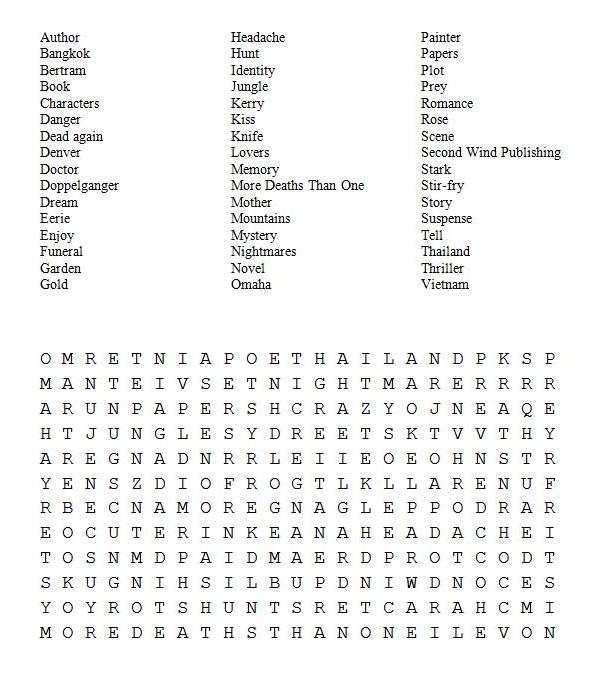
More Deaths Than One Word Seek Puzzle:

wordfind

Click on the cover for a Jigsaw Puzzle:

Cover MDTO - online jigsaw puzzle - 40 pieces

You can find More Deaths than one at Amazon:
The print version is also available at a discount from Second Wind Publishing:

HALLELUJAH! MY NOVELS HAVE FINALLY BEEN PUBLISHED! LET’S PARTY!

QUARANTINED! 


Are you up to the challenge?

Then…

Let’s party!

I brought the fireworks. 


You can find my newly published novels at Amazon:
 
They are also available at a discount from Second Wind Publishing (payable through Pay Pal only):
 
The first fourteen people who order A Spark of Heavenly Fire from Second Wind Publishing will receive a spark of heavenly fire. Perhaps I erred. Perhaps it’s more of a spark of machine-made fire — a dainty crytal pendant — but it’s still free to the first fourteen customers.

Please join me here for a live online celebration all day Tuesday, March 31, 2009. Stop by when you can, but I will be here live from 5:00 pm ET to whenever. There will be dancing, games, eprizes.

add to del.icio.us : Add to Blinkslist : add to furl : Digg it : add to ma.gnolia : Stumble It! : add to simpy : seed the vine : : : TailRank : post to facebook