Mirror of the Soul

Ever since the summer, I’ve been doing a three-card tarot reading for myself, and it began to seem silly. The only thing I really needed to know was what I needed to know that day. The first two cards only served to muddy the reading — in my mind, anyway — so this month I went back to a one-card reading. Even better, I went back to using the Crowley Thoth deck. It’s not one I particularly like, but I do have a great handbook that goes with the deck: Tarot Mirror of the Soul.

As the title suggests, this particular guidebook, more than any other, uses the tarot as a mirror to reflect inner realities without judgment to give us a new perspective. Ideally, anyway. Admittedly, the tarot itself it a tool for self-exploration, though I have not often found it to be so. This book, though, gives me more of what I need to focus on each day’s lesson.

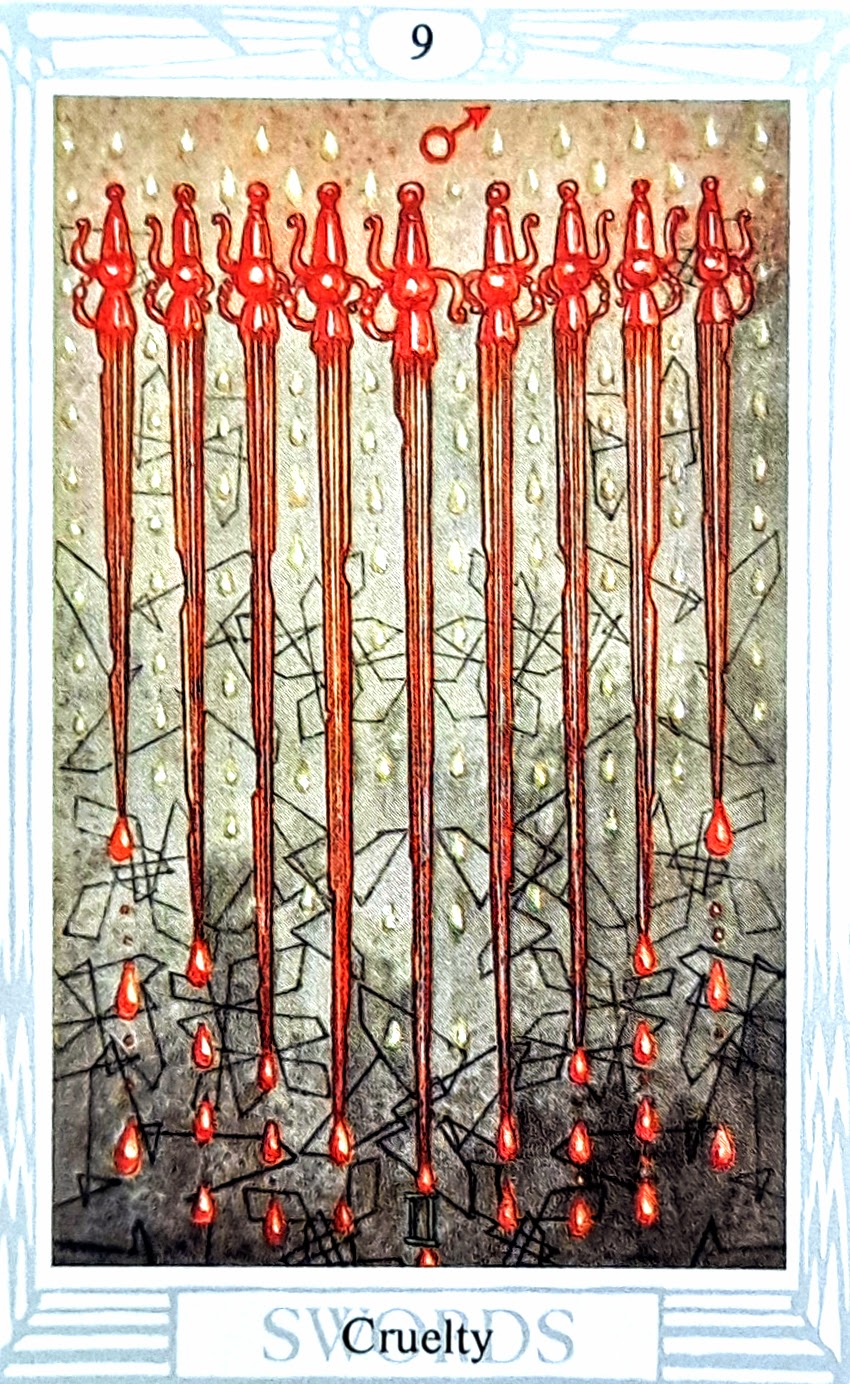
For example, today’s card is the Nine of Swords. It generally means cruelty directed at oneself and points to a tendency to put yourself down. In rare cases, it can mean physical or psychological cruelty by some heartless person, but no one lately is cruel to me. Actually, I’m not cruel to myself, either, though I have recently noticed a tendency to judge myself harshly when (perhaps) I am doing the best I can. Even if I’m not doing the best I can, that judgment call seems to be worse than whatever goals I breeched.

This particular card does seem to suggest that knowing the foible or lack is important — as important as knowing one’s good points, which I tend to ignore. It’s the cruelty of judging oneself that should be done without.

This book doesn’t just describe the symbols on the card and suggest what they mean, but continues with what the card indicates, which, in this case is about the necessity of recognizing the behavior pattern before it can be overcome. Another section is for questions to ask oneself, such as who judged you? And are you now ready to forgive your parents, others and yourself?

The section for the Nine of Swords then ends with an affirmation: I am loved, simply because the I am the way I am. This is something that I really do need to know. Concurrently with my recognition of how often I castigate myself for not being my ideal self, I’ve been wondering why people like me. (I suppose that’s a reasonable question. If I don’t particularly like myself — I don’t dislike myself, either, I just don’t go around patting myself on the back for my good qualities — then it makes sense I wouldn’t understand why they like me.)

People who know the tarot or who are more intuitive in their reading than I am can figure this out all on their own, but I like following along with the Mirror of the Soul. It helps me focus on one thing for the day (or at least for the start of the day because by the time I go about the business of living, I’ve already forgotten what I learned from the tarot that morning).

My plan for learning the tarot had been to pick one card each day for one year, two cards for the next year, three for the third, and so on, but the third year is only about half finished and I abandoned the plan. Eventually, perhaps, I’ll do a real reading with five or more cards once a week or once a month, but for now, this particular practice mirrors what I hope to gain from my daily tarot reading.
***

Pat Bertram is the author of Grief: The Inside Story – A Guide to Surviving the Loss of a Loved One. “Grief: The Inside Story is perfect and that is not hyperbole! It is exactly what folk who are grieving need to read.” –Leesa Healy, RN, GDAS GDAT, Emotional/Mental Health Therapist & Educator.
Puzzling out the Tarot

Although I see myself as a bit of a mystic, I’ve never been into tarot, or any sort of divination for that matter. I always figured if we can change the future, then it doesn’t matter what the predicted future is, and if we can’t change it, then the prediction especially doesn’t matter.

If ever a thought of the tarot crossed my mind, it would have been in the same mental classification as astrology, Ouija boards, and fortune cookies. I used a Ouija board once when I was kid, know my astrology sign and will read my horoscope when it’s in front of me (though the horoscope never seemed to have any relation to anything going on in my life), and enjoy fortune cookies, but that was the extent of my interest. Oh, I did read up on the occult since I have always been one to try to get a peek into the secrets of the universe, but charlatans so often dominated the field, that I stuck with more scientific gateways, like particle physics and quantum mechanics. (Yep, I was one of those who read such books for fun.)

I’m still not sure there is anything for me in the tarot, but considering that it is supposed to be a way to get insights into one’s inner being, it’s worth studying for now. And besides, it seems a message from my brother. Admittedly, this collection of tarot cards hadn’t been specifically earmarked for me, but that mass of decks sure struck a chord with me, so it felt as if he meant me to have them.

So here I am, trying to make sense of a massive amount of contradictory information. For example, the card I picked this morning to answer my question of what I needed to know today, was the nine of swords. Swords are supposed to be a bad luck sort of card, without a lot of happiness attached, and the nine of swords especially so. One interpretation talks about fears, vulnerability and inner turmoil and suggests that I learn what the source of those fears are. Another interpretation talks of depression and suffering, scandal and loss.

But swords relate to consciousness at a mental level, and reflect an individual’s thoughts, beliefs, and overall attitude. They also point to fears and worries, but don’t necessarily put a whole lot of weight on those fears, because the sword is two-edged, which connotes a balancing act to stay positive.

And nines are about nearing completion, maybe about reaching a plateau, because what looked like the end hasn’t quite arrived.

All that seems positive to me, so instead of the nine of swords telling me I’m depressed and fearful and need to figure out what my trouble is so I can get into a more benign state, my own take on the matter is I’m already there. Or almost. That I’m doing well balancing my fears and staying positive, even though I can do better.

See what I mean about contradictory information?

And this isn’t even taking into consideration the whole ancient elements matter — water, fire, air, earth. According to the most common tarot tradition, swords mean air, but some decks and some scholars indicate that swords are fire. (As you can see, in my own interpretation, I left off any mention of air or fire because the element question muddles an already muddled situation.)

On a different note completely, as I was reading about the elements, I happened to open the book to another page that was defining the “fool” card, and I had to laugh. Apparently, in Italy and Austria, The Fool goes by the name “Mat,” which is an Arabic word meaning “a dead person.” In The Wheel of Time, one of the major characters is a fellow everyone thinks is a fool. I thought he was simply an archetype, but he is definitely one of the major arcana characters from the tarot. Not only is his name “Mat,” but as he says, “I’m usually pretty good at staying alive. I only failed one time that I remember.”

Now I’m going to have to re-reread The Wheel of Time again to look for additional tarot references. As well as to continue puzzling out the tarot itself.

***

Pat Bertram is the author of Grief: The Inside Story – A Guide to Surviving the Loss of a Loved One. “Grief: The Inside Story is perfect and that is not hyperbole! It is exactly what folk who are grieving need to read.” –Leesa Healy, RN, GDAS GDAT, Emotional/Mental Health Therapist & Educator.




