Rubicon Ranch: Secrets — My Current Chapter

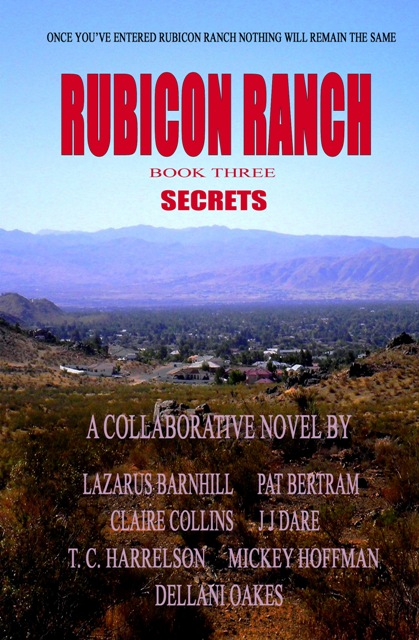
RRBookThreemidsizeRubicon Ranch is a collaborative and innovative crime series set in the fictional desert community of Rubicon Ranch and is being written online by the authors of Second Wind Publishing.

In the current story, the  body of a local realtor is found beneath the wheels of an inflatable figure of a Santa on a motorcycle. The realtor took great delight in ferreting out secrets, and everyone in this upscale housing development is hiding something. Could she have discovered a secret someone would kill to protect? There will be suspects galore, including a psychic, a con man, a woman trying to set up an online call-girl service, and the philandering sheriff himself. Not only is the victim someone he had an affair with, but he will also have to contend with an ex-wife who has moved back in with him and a jilted lover, both with their own reasons for wanting the realtor dead.

We hope you will enjoy seeing the story develop as we write it. Let the mystery begin! Whodunit? No one knows, not even the writers, and we won’t know until the very end! If you don’t want to miss further chapters, please go to the blog and click on “sign me up” on the right sidebar to get notifications of new chapters.

(If the Christmas theme seems unseasonal, well . . . considering how long it takes to write a book at the rate of a chapter a week, in a few months, the season will catch up to us!)

Chapter 25: Melanie Gray
by Pat Bertram

Sunday, December 24, 9:00am

Melanie stayed up most of the night sending emails to people on Alexander’s and her contact lists, asking what they knew about her husband. She told them—untruthfully—that she planned to write his biography, and so needed to know anything that could help explain his life and especially his death

She didn’t really expect to discover his secrets this easily, but she hoped that she could at least find a place to start looking for answers. The immediate responses were condolences from those who hadn’t known about his death and from those who hadn’t taken the time to write five months ago when he’d died in what had seemed to be a car accident. A few responses included an anecdote about Alexander, but no one dropped a hint about what he could have done to trigger an assassination.

Only one response surprised her. She’d expected their agent to gush with delight at the prospect of the book, but Dottie wrote: Are you sure this is a wise idea, darling? You might not like what you find out. And isn’t it better to remember him as a real man rather than a character in a book, even one as brilliant as I’m sure yours would be?

Too tired to think of a response to her agent’s message, Melanie dragged herself to bed. She dozed off but jerked herself awake to escape the shadowy creatures who chased her into a building with no windows and no way out.

She thought she’d been asleep for only a few minutes, but the brightness of the room told her she’d slept far into the new morning. She lay in bed, unwilling to face another day in the horror that Rubicon Ranch had become, when she realized she heard something strange for this neighborhood—silence.

She jumped out of bed, ran upstairs to her loft office, and glanced out the window. No tour buses, no streams of cars with gawking passengers, no young people (or old people for that matter) dressed as Halloween ghouls. The only things out of the ordinary were the sheriff’s department vehicles cruising the street—at least four of them. One of the tan vehicles pulled up to the curb in front of her rented house, and Sheriff Seth Bryan climbed out.

Melanie dashed down the stairs to the bathroom, splashed water on her face, ran a brush through her hair, and grabbed a dress from the closet. The off-shoulder peasant dress wouldn’t have been her choice for the first encounter with the sheriff in two months, but she didn’t have time to rummage in her closet for something more appropriate.

The doorbell rang. Barefoot, she went to answer it.

The sheriff’s jeans and white shirt still fit his lean, flat-bellied body as if they’d been tailored for him. As when they first met, he wore a blue ball cap with “Sheriff” embroidered in yellow, but his hair curled around the cap as if it had been awhile since he’d taken the time to get it cut. For once he’d left off the mirrored sunglasses, and he looked as if he’d aged two years since she’d seen him last. Apparently, his attempt to make his marriage work hadn’t succeeded. Or maybe the marriage was succeeding, and his haggard expression and weary dark eyes came from too much time in bed with his wife.

Why do you care?

“Good morning, Ms. Gray,” Sheriff Bryan said, his tone as formal as his words.

“Good morning, sheriff.” Melanie stepped outside, put a hand above her eyes to shade them, and made a show of peering up and down the street. “What happened?”

“The people’s right to free expression and lawful assembly destroyed our crime scenes and impeded our investigation, so we cleared the area of anyone who didn’t live here.”

The chill of the concrete crept up Melanie’s bare legs, but she held herself in place. “You call that lawful assembly? So, if there hadn’t been a murder, you’d have just let all those necrophiliacs continue overrunning the neighborhood?”

“Not murder, Ms. Gray. Murders—two of them. And arson.”

“How did you get rid of all the ghouls and gawkers?”

“We have a deputy stationed on Delano Road and Tehachapi, checking to make sure only people who belong here enter the street. And those who were already here—well, we told them we’d arrest them as accessories to murder. When that didn’t work, we reminded them that tomorrow was Christmas, and that Santa didn’t deliver presents to bad little boys and girls in jail.”

“So, you’re the UnSanta Claus?”

The sheriff quirked one eyebrow as if surprised to discover she had a sense of humor, but Melanie had to admit to herself that in their relationship—if a few meetings and a couple of meals could be called a relationship—there’d been no room for humor. There’d been too much death, too much pressure, too many unanswered questions.

“Have you found out anything more about Alexander’s assassination?” Melanie asked.

“We’re doing what we can, Ms. Gray, but there’s nothing to go on. Just skid marks on an open road.”

“What about Alexander’s missing cameras? If someone stole them from the car right after the accident, there might be a witness.”

“We haven’t found a witness, but if a bystander took the opportunity to steal what you said were expensive cameras, I’m sure he or she wouldn’t be interested in informing us of that fact. Have you looked for the cameras? Maybe they’re inside the house somewhere.”

Melanie wanted to stamp her foot, but she refrained. She didn’t want the sheriff to see her acting so childishly, especially since he was being so damned formal. Besides, it would hurt her bare foot. “I told you. I put the cameras in the car myself.”

“Did he drive off immediately?”

Melanie gazed at the driveway where the car had been parked that morning. She’d put the cameras in the trunk. Alexander had yelled at her from inside the house that she had a phone call. She’d slammed the trunk shut and hurried inside.

The call had been from Dottie, their agent, wanting to know if they’d get the book done by the deadline. Melanie had been annoyed with Alexander for not talking to their agent himself because it would have taken him less time to assure Dottie than to shout for Melanie.

When she hung up the phone and went outside, she found that Alexander had left. She never saw him again, never got to say good-bye.

“Ms. Gray?”

The sheriff’s voice, smooth as melted chocolate, startled her.

“Stop calling me that,” she snapped.

“What would you like me to call you?” he asked.

“Nothing. Stop using my name every sentence as if you’re some kind of used car salesman with a lemon you want to get off your hands.”

“Yes, ma’am.”

Melanie clamped her mouth shut, refusing to rise to the bait.

The sheriff smirked, and the haggardness disappeared from his face. “I need you to tell me what you know about Nancy Garcetti, Clark Bailey, and the fire.”

Melanie glanced back at the door of the house, wondering if she could slip inside for shoes to warm her icy feet, but she didn’t want to have to invite the sheriff into the house. It would feel too much like a fly inviting a spider to visit.

“Go put your shoes on, I’ll wait out here.”

Melanie ran inside, put on socks and shoes, and then sedately ambled back outside. The sheriff hadn’t moved.

“I wish I could help you, sheriff,” she said. “But I don’t know much.”

“I asked you once to call me Seth.”

Melanie shook her head. “Not exactly appropriate.”

“Ah, yes, I’d forgotten how very ‘appropriate’ you always were.”

Melanie narrowed her eyes, wondering if that had been a dig, but he continued as if unaware of her reaction.

“Had you ever met Nancy?”

Melanie tried to remain as still as the sheriff. Or was that the wrong way to act? Did her stillness indicate guilt? Crap, being a maybe murderer was hard.

“I met her once, but we only exchanged a few words.” I know you killed your husband.

“And what about Clark Bailey?”

Melanie relaxed, knowing she had nothing to do with anyone by that name. “Never met him.”

“Oh, but you did. You met him last night. After the fact, so to speak. He’s the man you found wearing the Santa hat.”

“I guess maybe I should have called it in—”

“Ya think?” the sheriff interjected.

Melanie winced at his sarcastic tone. “But I just could not face being known once again as the cadaver dog. I suppose Moody had no choice but to tell you.”

Sheriff Bryan gave her an avuncular smile. “Moody didn’t tell us. She left you out of it. Be careful. She has her own agenda, and she eats innocent women like you for breakfast.”

Melanie straightened her shoulders. “I can take care of myself.”

“Perhaps. Be careful, anyway.” The sheriff turned to leave, then glanced back. “What do you know about Lydia Galvin?”

“Lydia Galvin?” Melanie frowned. “Your Lydia?”

“It’s not how I’d put it, but yes, that Lydia.”

“I don’t know anything about her. Why, is she here?” Melanie laughed, feeling suddenly lighthearted. “She is, isn’t she? Oh, poor Seth. All his chickens coming home to roost. Your wife. Now Lydia. Maybe you’re the one who needs to be careful.”

When Seth cut across her property to the Sinclair house, Melanie realized he hadn’t asked her about the arson. He didn’t forget such matters. Like Moody, he had his own agenda, kept his own counsel.

Melanie went inside, locked the door behind her, and climbed the stairs to the office to see if she’d received any new emails. There was just one from an unfamiliar gmail address:

You never know when to leave well enough alone, do you? Alexander Gray is dead. Let him rest in peace.

***

Pat Bertram is the author of the suspense novels Light Bringer, More Deaths Than One, A Spark of Heavenly Fire, and Daughter Am I. Bertram is also the author of Grief: The Great Yearning, “an exquisite book, wrenching to read, and at the same time full of profound truths.” All Bertram’s books are published by Second Wind Publishing. Connect with Pat on Google+

Happy Bloggiversary To Me!

I created this blog exactly six years ago today, back when I hadn’t yet become a published author, back when I didn’t even know what a blog was. I’d read how important blogging was for authors, both as a way of getting known and as a way of connecting with readers, so I decided to “act as if” I were going to be published in the hopes of making it happen. I had nothing to say, no one to say it to, no reason to say anything, but I didn’t let that stop me. I started blogging on September 24, 2007, and haven’t stopped since.

Did acting as if I were goinballoons1g to get published work? Perhaps, though there is no direct connection that I know of. Still, one and a half years after starting this blog, my first two books were published by Second Wind Publishing. They have now published five of my books — four suspense novels and one non-fiction book about grief. More importantly — at least blog-wise — I am still blogging, still making connections, still making friends. Still having fun.



One thing I never expected when I set up Bertram’s Blog, is how much I would like writing and publishing my articles. I feel safe here, away from the constant promos, ideological ravings, and mindless ratings on other sites, and it gives me the freedom to say what I want, no matter how personal. Three and a half years ago, my life mate/soul mate died, and his death catapulted me into such a world of such pain that it bled over into my posts. This blog became a place where I could try to make sense of what I was going through, to offer comfort and be comforted, to find my way to renewed life.

It’s nice to know that whatever life throws at me, whatever problems I encounter, whatever challenges come my way, this blog will be here for me.

Although I’d planned to post every day, during the first four years I only managed to blog three or four times a week, but exactly two years ago today, I made a 100-day commitment to post a daily blog, and I continued to post every day once that initial commitment was fulfilled. (Which makes this a double anniversary — 6 years for blogging, 2 years for daily blogging.)

It amazes me that anyone wants to read anything that I write here. This is so much a place for just letting my thoughts roam, for thinking through problems, and (I admit it) for pontificating a bit. It’s been a kick, writing this blog, and I want to thank all of you for indulging my whims and whimseys.

Thank you for reading. Thank you all for your comments, your likes, your support. They have meant more to me (especially this past three and a half years) than you can ever imagine.

***

Pat Bertram is the author of the suspense novels Light Bringer, More Deaths Than One, A Spark of Heavenly Fire, and Daughter Am I. Bertram is also the author of Grief: The Great Yearning, “an exquisite book, wrenching to read, and at the same time full of profound truths.” Connect with Pat on Google+. Like Pat on Facebook.

Rubicon Ranch: Secrets — My Newest Chapter

RRBookThreemidsizeRubicon Ranch is a collaborative and innovative crime series set in the fictional desert community of Rubicon Ranch and is being written online by the authors of Second Wind Publishing.

In the current story, the  body of a local realtor is found beneath the wheels of an inflatable figure of a Santa on a motorcycle. The realtor took great delight in ferreting out secrets, and everyone in this upscale housing development is hiding something. Could she have discovered a secret someone would kill to protect? There will be suspects galore, including a psychic, a con man, a woman trying to set up an online call-girl service, and the philandering sheriff himself. Not only is the victim someone he had an affair with, but he will also have to contend with an ex-wife who has moved back in with him and a jilted lover, both with their own reasons for wanting the realtor dead.

We hope you will enjoy seeing the story develop as we write it. Let the mystery begin! Whodunit? No one knows, not even the writers, and we won’t know until the very end! If you don’t want to miss further chapters, please go to the blog and click on “sign me up” on the right sidebar to get notifications of new chapters.

(If the Christmas theme seems unseasonal, well . . . considering how long it takes to write a book at the rate of a chapter a week, in a few months, the season will catch up to us!)

Chapter 15: Lydia Gavin
by Pat Bertram

Sunday, December 23, 5:25pm

Seth sat tall behind the desk in his tidy office, like a king receiving a subject. “What are you doing here?”

Lydia Galvin leaned back in the uncomfortable metal chair and gave the sheriff a serene smile, surprised to find that she felt no fear at facing him. “Your deputies brought me here.”

Seth glowered. “You know that’s not what I meant.”

“You want the whole story? I needed to get some groceries, so I walked up Delano Road to where I’d parked my car, and apparently your deputies found it and staked it out, because even before I could unlock the door, they jumped out of their vehicle, arrested me, and brought me here.”

“They didn’t arrest you. They just offered you a ride. I wanted to talk to you.” Seth gave Lydia one of his oh-so-familiar looks, the one that said she meant no more to him than an annoying insect.

“How did you know I was in the area?” Lydia kept her voice neutral, not wanting to seem confrontational. No point in arousing the beast in him until absolutely necessary.

“We checked out the bystanders’ videos of the burning crime scene, and there you were.” He drew in a quick breath as if upset with himself for responding. “But you’re supposed to be answering my questions. What are you doing in Rubicon Ranch?”

“Having fun. It’s quite a spectacle out there, you know.” Lydia crossed her legs, and felt a flash of satisfaction when he cut a glance at her thighs. All that running since she’d been fired had paid off—she now had the body she’d always wished for.

He remained calm, but his thinned lips and tensed shoulders told her how much that unruffled air cost him. “Why did you come to Rubicon Ranch?”

“Why do you think I came? To see what other lives you were ruining, of course. I had no intention of staying, I just wanted to check out Melanie Gray—according to the newspapers you two were quite a team—but then I met Nancy and when she let slip that you and she were sleeping together, I thought I’d hang around to see how you got out of that affair when it turned against you.” Lydia made a show of inspecting a fingernail. “I guess I’m lucky. You only ruined my career. Poor Nancy ended up in the morgue.”

“You think I killed Nancy?” Seth cocked his head like an eagle and stared at Lydia for a moment. Then he nodded. “I see. You think that by accusing me, I will assume that you’re innocent, because if you believed I killed her, then you couldn’t have.”

“Did you kill her?” Lydia waited for an answer that didn’t come. “She would have ruined you. She loved nothing but herself and power and money. She loved secrets, too, of course, but only because the secrets gave her power over people and were a source of great income. She said she used to be an actress and a model, but once when we had a few drinks, she admitted that was a front. She’d really worked as a call girl. I figured she gave up the life when she realized how much more lucrative secrets were than her body.”

Seth rose to his feet and paced the office. “You say she would have ruined me. Like you ruined me?”

Lydia forced out a small laugh. “I ruined you? No. You manipulated me. You began by treating me as if I were the most important woman in the world. You flattered me, paid attention to me, offered me words of love and the endearments I hungered for. When I was hooked, you stepped back, left me feeling bereft. And every time I spoke of leaving you, you’d pay attention to me again.” She felt tears beginning to gather behind her eyes. He doesn’t matter. Think of fire. Flames. Heat.

She drew in a deep breath, surprised Seth didn’t jump in to defend himself. He kept pacing the office as if she weren’t even there, which made it easier for her to confess. “You were my grand passion. I know you don’t believe that, but it’s the truth. I never expected you to leave your wife. I just wanted you to notice me. To put me first once in a while.”

Seth stood over her, his eyes icy as they locked onto hers. “But you turned me into the department. Said I misused my authority.”

“You did abuse your authority. I never wanted an affair with you. I had enough trouble with my husband. I didn’t need another abusive man in my life. You never knew about my husband, did you?” Lydia didn’t even try to modulate her bitter tone. “The great detective never noticed that his girlfriend had a husband who beat her. I wouldn’t have told your wife about us. Even though I threatened to tell her, I couldn’t have made our affair public. My husband would have beat me when he found out. And after you dragged your wife to my house so she could confront me, my husband did beat me. I had to go to the emergency room that time. But oh, no, everything that happened was my fault.”

“Good story,” Seth said. “Too bad none of it is true.”

“The all-wise Seth Bryan says it isn’t true, so that means it isn’t true?” Lydia shook her head sadly. “The law might be about what you can prove, but life isn’t like that. Some things are true no matter how much we don’t want to believe them.” Things like her husband’s abuse. Things like Seth’s disregard. Things like death and fire. “You men are all so blind you can’t see what’s in front of your eyes. I loved you but you threw me away, calling me a vituperative bitch. Yet Nancy, who didn’t love you at all and who truly was a vituperative bitch, you kept. But I’m through with all of you now.”

Seth sneered. “Turning into a lesbian?”

“That’s beneath even you, Seth, my love.”

“True. Perhaps the only true thing you’ve said today.” The phone rang. Seth took two long strides to the desk, and grabbed the receiver. “Yes?” A pause, then, “She’s home now? Stay there. Make sure she doesn’t leave. I’ll be there in just a few minutes.”

He hung up the phone, and turned to face Lydia.

She quirked her lips in an unamused smile. “Still on your wife’s leash? I’m surprised you haven’t killed her, too.”

“Just go,” he said wearily. “Keep my office informed of your whereabouts. We still have lots to talk about.”

Lydia rose, straightened her skirt, and settled the strap of her purse firmly on her shoulder. “There’s nothing left to say but good-bye. I didn’t kill Nancy. You did. But don’t worry, I won’t testify against you.

***

Pat Bertram is the author of the suspense novels Light Bringer, More Deaths Than One, A Spark of Heavenly Fire, and Daughter Am I. Bertram is also the author of Grief: The Great Yearning, “an exquisite book, wrenching to read, and at the same time full of profound truths.” All Bertram’s books are published by Second Wind Publishing. Connect with Pat on Google+

Creating Incredible but Credible Characters: Sex Scenes (Part 3)

[This is a continuation of previous posts Creating Incredible but Credible Characters: Sex Scenes (Part 1) and Creating Incredible but Credible Characters: Sex Scenes (Part 2)]

Each book I write has less sex in it than the last. In Light Bringer, my fourth novel, the characters didn’t have sex at all. But what can you expect from aliens? Still, it never occurred to me that I had left off any mention of sex until a reader pointed it out to me, because my characters connected in a way that served the story, as the following voyeuristic scene shows.

TLBeodora went still. The moment she’d been waiting for had finally arrived. Ninety-nine and a half percent of the subjects’ DNA tested as human, but the remaining half percent remained unidentified. Now, perhaps, she would see that unidentifiable half percent in action.

On the other side of the one-way window, the female cocked her head, and her face took on a rapt expression as if listening to a distant melody. When the male entered, her incandescent smile seemed to brighten the room.

The two subjects moved toward each other. The light became more radiant. They stopped an arm’s length apart. For a second Teodora thought she saw a rainbow between them, then they were in each other’s arms. An auroral glow drifted and whirled around them.

Something as delicate as a spray of perfume touched Teodora. Her skin drew tight, and she felt an immense thirst. She fixed the feelings in her mind so she could take them out and analyze them later, then she set them aside and concentrated all her attention on the subjects.

Hearing a faint thread of music, she held her breath. The music seemed to swell into a heart-breaking song of joy. The colors dancing around the subjects grew in intensity, colors she had never seen before. A distillation of rubies. A blue moon shimmering on restless waters. A green so pure it might have come out of the earth itself.

In the spaces where the colors overlapped, Teodora knew she was seeing the color of love, the color of total harmony and acceptance.

The colors echoed in Teodora’s emptiness, and she felt herself crying deep within her soul. This was something she wanted, but could not have. Maybe no human could.


Later, Teodora discusses the episode with her boss, the head of International Institute of Scientific Advancement.

“It was not like watching humans,” Teodora told Berhard Petri after reporting what she had learned about the subjects.

His eyebrows shot up, and she realized he’d caught the unusual touch of animation in her voice.

She modulated her tone. “It was like watching a higher form of life.”

“It hasn’t been established that they’re a higher form,” Petri said. “They could be a devolution.”

“You did not see. Theirs was an interaction on a higher plane, not about individual parts, but harmony of the whole. With humans, it is all about the body parts, the physical attributes. They do the act, but there is no resonance, no color, no song. It is as if humans have an ancestral memory of seeing the gods in love, and now they are trying to have what they had once seen, but only managing the visceral part. Like the ancient Egyptians trying to emulate the pyramid builders from an earlier age, they cannot get it right.”


Sex scenes don’t need to be deeply meaningful to be effective. Sex scenes can simply bring the couple together or show the intensity of a relationship. Sex scenes can create a change of pace, either as a diversionary tactic or as a quiet time between hectic scenes. A sex scene can be a fast-paced action sequence to get the reader’s blood roiling. A sex scene can even be playful or humorous. What it cannot be is a scene thrown in there just because you thought it was time for a sex scene. Such scenes need to be as germane and as necessary to the story as a plot twist or a revelation. If the scene can be removed from the book without leaving a hole, it should be removed or rewritten—unless of course you are writing erotica or another genre that demands lots of titillating sex. In which case, you are probably making a fortune and have no need for these tips.

***

This article is anthologized in the Second Wind Publishing book: NOVEL WRITING TIPS AND TECHNIQUES FROM AUTHORS OF SECOND WIND PUBLISHING, which was the 100th book released by Second Wind.

“As someone who constantly evaluates novels for publication, I was astonished at the breadth and clarity of the wonderful advice contained in this handbook. It addresses concerns as grand as plot development and as simple but essential as formatting your submission. It offers crucial advice on literary topics ranging from character development to the description of action. Virtually every subject that is of great concern to publishers — and therefore to authors — is covered in this clear, humorous and enormously useful guide.” –Mike Simpson, Chief Editor of Second Wind Publishing

***

Pat Bertram is the author of the suspense novels Light Bringer, More Deaths Than One, A Spark of Heavenly Fire, and Daughter Am I. Bertram is also the author of Grief: The Great Yearning, “an exquisite book, wrenching to read, and at the same time full of profound truths.” Connect with Pat on Google+. Like Pat on Facebook.

Creating Incredible but Credible Characters: Sex Scenes (Part 2)

[This is a continuation of a previous post: Creating Incredible but Credible Characters: Sex Scenes (Part 1)]

The most explicit sex scenes I’ve written are in my first novel, More Deaths Than One. My character, Bob Stark, is stark in everything he does, but the more one learns about the character, the more extraordinary he seems. His first sex scene is with a stranger. Her manner seemed to be that of a person who had decided on a course of action and now wanted to get it over with as quickly as possible, but Bob turned out to be something of a pro at satisfying women. Since the skill seemed so out of character, I explained it with a flashback, though I do not advocate flashbacks during a sex scene. Of all scenes in a book, sex scenes are the most immediate, and should be done in the present, but in this case I followed an even more important rule: everything in service to the story.lovescene

He moved in her, slowly, steadily. He caught the scent of frangipani in her perfume. All at once sixteen years disappeared, and he was back in Thailand, the first time he’d gone to Madame Butterfly’s.

The sex scene that followed is graphic, too graphic to add here, but the point is the perfume. Smelling the frangipani catapulted him into a reverie, where the woman beneath him became unimportant, but later in the book when he makes love with a significant woman in his life, the scent has a completely different effect on Bob.

Twining her arms around his neck, she brought his mouth to hers. The kiss was hard and short, but immediately her lips sought his again.

He gathered her closer. Their kiss deepened.

All at once she pulled away and hopped out of bed. “Omigosh!”

“What?”

“I forgot. I have a present for you.” She flashed an impish smile and darted into the bathroom. She emerged a few minutes later wearing a dark rose cheongsam that accented the swell of her breasts and the taper of her waist. “I bought it in Chinatown. What do you think?”

He couldn’t speak, couldn’t breathe. She looked flushed, radiant, beautiful.

She jutted out a hip. The side slit parted, giving him a glimpse of shapely leg.

He felt a shock that started in his groin and radiated upward. From the glint in her eyes, he knew she was aware of the effect she had on him.

He slid off the bed and moved toward her, stepping slowly and carefully as if he were in danger of falling off a precipice. As he neared her, he smelled her new perfume—frangipani. From now on, he knew, whenever he caught a whiff of that scent, it would remind him of this moment, of her, of the teasing look in her eyes.

***

This article is anthologized in the Second Wind Publishing book: NOVEL WRITING TIPS AND TECHNIQUES FROM AUTHORS OF SECOND WIND PUBLISHING, which was the 100th book released by Second Wind.

“As someone who constantly evaluates novels for publication, I was astonished at the breadth and clarity of the wonderful advice contained in this handbook. It addresses concerns as grand as plot development and as simple but essential as formatting your submission. It offers crucial advice on literary topics ranging from character development to the description of action. Virtually every subject that is of great concern to publishers — and therefore to authors — is covered in this clear, humorous and enormously useful guide.” –Mike Simpson, Chief Editor of Second Wind Publishing

***

Pat Bertram is the author of the suspense novels Light Bringer, More Deaths Than One, A Spark of Heavenly Fire, and Daughter Am I. Bertram is also the author of Grief: The Great Yearning, “an exquisite book, wrenching to read, and at the same time full of profound truths.” Connect with Pat on Google+. Like Pat on Facebook.

Creating Incredible but Credible Characters: Sex Scenes (Part 1)

Many new writers (and even some published authors) have a difficult time writing sex scenes. They worry about how their friends and family will deal with idea that their son/brother/daughter/mother knows about sex. They worry about when and where to insert a sex scene, and they worry about how graphic to get. One thing writers don’t seem to worry about is the purpose of their sex scene, and that is something they should worry about.

Some romance genres require a lot of hot sex, other genres, like science fiction, don’t put much emphasis on sex, so be sure to find out the expectations of your genre. Even when titillation is the goal, the scene should also fulfill a story need, should respond to the demands of the story.

An effective scene—sex or not—serves multiple objectives. Scenes advance the story, show us more about the characters, show us how the action changed the hero or show a change in the relationship between the participants. Scenes are always about change, about action and about reaction.

Once you know the objective, you can write a fitting action/reaction sequence (which is the basic building block of a scene). If comfort is the objective, you can show the couple together at the beginning, close the door during the action, and show them cuddling afterward. If tenderness is the objective, you can show a bit of the action in addition to the before and after. And of course, if their desperation for each other is the objective, you will need to leave the door open during the scene.

As with all resonating scenes, when it is over there must be some reaction, some change to the character or the direction of the story. And the objective dictates that reaction. If the scene is about bringing comfort to the characters, we need to know whether they found comfort or failed to find it, and we need to know the characters’ emotiosex scenenal response to the success or failure of that objective. This reaction, in turn will help set up the next scene.

A good use of a sex scene would be to show the ebb and flow of human connection. For example, you could have three scenes spread throughout the story. In the first scene, perhaps, the man climaxes, feeling connected to the woman. When he immediately goes to sleep, she feels disconnected. In the second scene, he can’t get it up, leaving him feeling disconnected, but since he tries to make it up to her by cuddling her, she feels connected. In the third scene, they climax together, perhaps cuddle afterward, so they both feel connected.

In addition to the sex, then, you show a pattern of connection and disconnection between the couple (in other words, conflict), you show a new perspective of the characters, and you show a change in their relationship. You also end up with a subplot that adds to the overall richness of the story. In other words, you end up with a series of sex scenes, not just sex scenes.

Scenes help show who the characters are, and where better to do this than when the characters are at their most vulnerable. One of my favorite scenes in A Spark of Heavenly Fire is when Jeremy King, a world famous actor, has sex with Pippi O’Brien, a woman he just met in a bar.

The sound of weeping woke Jeremy. He turned his head toward his companion and saw one trembling shoulder and a tangle of gleaming hair.

He stretched luxuriously. The red hair hadn’t lied. The girl had been all fire, kindling a passion in him he hadn’t felt in years. The memory of it made him hard.

He reached over and pulled the girl into his arms. He smoothed back her hair and kissed away her tears, murmuring, “Honey,” and “Sweetheart,” and “Dear.”

“I’m such a terrible person,” she said, sobbing.

“Shh. Shh,” he whispered between tiny kisses.

Her arms stole around his neck, and her lips sought his. In a surprisingly short time she bucked beneath him, calling out his name.

You’ve still got it, King, he thought exultantly. Then, after one final thrust, he tumbled into oblivion.

That scene might not be very graphic, but it did what I wanted it to—define the characters, Jeremy especially. Pippi called out his name, but he didn’t care enough about her to think of her by name. He cared only about himself and his performance. It shouldn’t come as any surprise that, during other times of vulnerability in the story, he also thought only of himself.

A sex scene is a good time to show a character confronting her essence, to play on her self-concept (the treasured idea the character has of herself). What if a character were making love to a person other than a spouse? Would this lovemaking enhance his or her self-concept, or would it go against it? If the scene enhanced the character’s self-concept, we would learn much about the character. Perhaps she sees herself as a great lover, in which case nothing mattered except the lovemaking—not her marriage vows, not her husband, not her children—and so we would learn kind of character she is. If the scene went against the character’s self-concept, then we have a character with inner conflicts. Perhaps the character sees herself as a faithful, till-death-do-us-part wife. In which case, no matter how exciting or tender the scene, it leaves her in turmoil.

In the previously quoted scene from A Spark of Heavenly Fire, Pippi is obviously experiencing turmoil. She had been in the bar to meet her boyfriend, Greg Pullman, to accept his marriage proposal, and instead she ran off with Jeremy. She’d been dazzled by the actor’s star power and hadn’t given poor Greg a single thought, but in the night, after her passion diminished, she confronted her truth.

***

This article is anthologized in the Second Wind Publishing book: NOVEL WRITING TIPS AND TECHNIQUES FROM AUTHORS OF SECOND WIND PUBLISHING, which was the 100th book released by Second Wind.

“As someone who constantly evaluates novels for publication, I was astonished at the breadth and clarity of the wonderful advice contained in this handbook. It addresses concerns as grand as plot development and as simple but essential as formatting your submission. It offers crucial advice on literary topics ranging from character development to the description of action. Virtually every subject that is of great concern to publishers — and therefore to authors — is covered in this clear, humorous and enormously useful guide.” –Mike Simpson, Chief Editor of Second Wind Publishing

***

Pat Bertram is the author of the suspense novels Light Bringer, More Deaths Than One, A Spark of Heavenly Fire, and Daughter Am I. Bertram is also the author of Grief: The Great Yearning, “an exquisite book, wrenching to read, and at the same time full of profound truths.” Connect with Pat on Google+. Like Pat on Facebook.

Creating Incredible but Credible Characters: Dialogue (Part 2)

[This is a continuation of a previous post: Creating Incredible but Credible Characters: Dialogue (Part 1)]

Dialect and regional accents are especially tricky to write. It used to be that writers tried to show dialect and accent through the laborious use of phonetic spellings and a blizzard of apostrophes. Today, though, we readers don’t like having to decipher the author’s personal code. Nor do we writers need to take the time to create the code. It’s better to use colloquialisms and broken language to show regional differences. For example, “I done died and gone to heaven.” Not an apostrophe or phonetic spelling in sight, though you know immediately the speaker is not a high-toned college professor from Boston.

If your character has a foreign accent, you don’t have to bludgeon a reader with it. All that is necessary to portray an accent is to say the character speaks with an accent. If you wish, you can use phrasing to remind the reader of the accent, such as, “We will go to the store. No?”

This snippet from Daughter Am I shows Crunchy’s difficulty with English:

“Mary’s trying to find out about her grandparents,” Kid Rags said. “His name was James Angus Stuart.”

Crunchy shook his head. “Don’t know no James Agnes Stuart.”

“What about Regina DeBrizzi Stuart?” Mary asked.

“Don’t know her neither.”

talkingDialogue is an artificial construct. Dialogue does not mimic conversation but instead gives readers the impression of realistic conversation.

Books on how to write dialogue often suggest listening to people talk to learn how to write dialogue. Seems like good advice, but have you ever truly listened? “We . . . um . . . we, like . . . you know . . . we stammer and like we repeat ourselves and um . . . you know.”

Even when we speak coherently, we don’t converse. We lecture. We tell long, boring, convoluted stories. We interrupt others and talk over them. We use clichés. We tell jokes that take forever to get to the punch line. None of which helps us write dialogue. If characters in books talked the way we talk in real life, who would bother reading? We want our characters to sound like us, just not talk like us. We also want their conversations to be witty, to the point, and conflicted.

In life, most of us cannot come up with that clever quip when we need it—it comes to mind (if at all) late at night when no one is around to be impressed. Our characters don’t have to suffer from that malady because they have us and our late night epiphanies on their side. We can change their words as often as necessary to get it right.

And get it right we must. Good dialogue advances a story and shows character interacting with other characters. Good dialogue makes a reader keep reading. Bad dialogue, no matter how crucial to the story, makes readers go in search of other amusements.

The following is another excerpt from Daughter Am I showing the use of dialogue.

*     *     *

Mary noticed, for the first time, her father’s receding hairline, the deep crinkles at the corners of his brown eyes. Soon he would be as old as Kid Rags, Teach, and Crunchy.

Tears stung her eyes at the thought of her father living alone in a dingy hovel, and she vowed she would not let that happen.

Realizing the silence was stretching out awkwardly, she opened her mouth to speak, but he held up a palm to forestall her.

“I don’t want to know what you’re doing,” he said. “Whatever it is, I know it’s something you feel you have to do. I thought you should be aware you’re upsetting your mother.”

“I don’t mean to.”

He heaved himself out of the chair. “That’s all I came to say.”

“I’m glad you stopped by,” she said. “I planned on calling you later anyway to tell you I’m going to be away for a few days.”

He stared at her for a moment, then shrugged. “I don’t understand what you’re trying to accomplish, but I suppose you know your own mind.”

You are so wrong. I don’t know anything.

He walked to the door, paused with his hand on the knob for a second, then turned to face her.

“I love you,” he said softly.

She swallowed. “Oh, Dad. I love you too.”

He opened the door. “Be careful, okay, honey? You don’t know what you’re getting yourself into.”

***

This article is anthologized in the Second Wind Publishing book: NOVEL WRITING TIPS AND TECHNIQUES FROM AUTHORS OF SECOND WIND PUBLISHING, which was the 100th book released by Second Wind.

“As someone who constantly evaluates novels for publication, I was astonished at the breadth and clarity of the wonderful advice contained in this handbook. It addresses concerns as grand as plot development and as simple but essential as formatting your submission. It offers crucial advice on literary topics ranging from character development to the description of action. Virtually every subject that is of great concern to publishers — and therefore to authors — is covered in this clear, humorous and enormously useful guide.” –Mike Simpson, Chief Editor of Second Wind Publishing

***

Pat Bertram is the author of the suspense novels Light Bringer, More Deaths Than One, A Spark of Heavenly Fire, and Daughter Am I. Bertram is also the author of Grief: The Great Yearning, “an exquisite book, wrenching to read, and at the same time full of profound truths.” Connect with Pat on Google+. Like Pat on Facebook.

Creating Incredible but Credible Characters: Dialogue (Part 1)

One of the hardest techniques for new writers to handle is dialogue. When I first started out, my characters never just said something. They agreed, cautioned, reminded, mimicked, answered, contributed, guessed, explained, responded, admonished, confessed, encouraged, clarified, blurted, pointed, winced, replied, corrected, acknowledged, returned, laughed, challenged, chided, objected, contested, quipped, offered, moaned, complained, repeated, stammered, pleaded, inquired, mumbled, interrupted, confirmed, addressed, countered, advised, completed, allowed, supplied, ordered, asked, continued, chided, answered, whispered, teased, requested, hollered, echoed, declared, informed, spoke, bellowed, spit out, thundered, hissed. All within a few pages. Whew!

Even worse, I would sit and agonize over the way my characters spoke. “He responded sparingly.” “She informed him haughtily.” He mumbled sadly.”

dialogueIt was a joy to discover that modern dialogue relies primarily on “said,” such a common word, the reader’s gaze glides over it as if it were invisible. It was even more of a joy to discover that adverbs are frowned on. The dialogue itself, or the beat—the bit of action accompanying the dialogue—should show the character’s emotion. “I hate you”, she said angrily tells us what the character is feeling. She picked up a rock and threw it at him. “I hate you!” shows us what she is feeling, allowing us to become intimately involved with the character. The only time an adverb is necessary is when the character’s words are at odds with his mood, such as: “I had a great time,” he said sadly. You can also use an occasional “ly” adverb to describe the tonal quality of the character’s voice. “I hate you,” he said softly.

Besides helping identify who is speaking, beats help set the stage, tell us about the character’s personality, and vary the rhythm of the dialogue. Overdone, the beats are as distracting as any other speaker attribute, so the secret is to pay attention to the flow. Do you want short snappy dialogue? Don’t use beats. Do you want to slow things down a bit, keep the dialogue from seeming too disembodied? Use a few beats.

It’s hard to write crowd scenes and keep each character identified without resorting to copious “said”s, but beats keep the scene moving and, if you use beats that are specific to your character, you make the various characters come alive.

This excerpt from my novel Daughter Am I shows the use of beats. The scene is between my hero Mary, a young woman in search of her grandparents’ murderer, and a group of feisty octogenarians who are trying to help.

*     *     *

The man stopped bouncing and let his arms drop to his sides. Now that he stood relatively still, Mary could see he was skinnier than she’d first thought. A gray slouch hat tilted toward one eye, but the baggy pants cinched high above his waist and the bright flowery shirt several sizes too large marred the jaunty effect. His hands shook uncontrollably. Parkinson’s disease?

“You must be Happy,” she said.

Frowning, Happy patted his torso. “Must I be happy?” His voice deepened to what Mary assumed was his normal tone. “Can I be happy? Can anyone truly be happy?”

“His name is Barry Hapworth,” Kid Rags said, flicking a bit of lint off his navy pinstriped suit jacket. “For several obvious reasons, everyone calls him Happy.”

Mary glanced from the bus to Happy. “Were you driving this thing?”

Happy puffed out his meager chest. “Sure was.”

“And did you almost run over Mrs. Werner’s cat?”

“I’ll take the fifth.” Happy paused for a fraction of a second. “A fifth of bourbon.”

“Did someone say bourbon?” Kid Rags removed the flask from his hip pocket, took a swig, and passed it around.

“Who are all these people?” Bill asked from behind Mary.

Mary turned, wondering how she could explain the situation to her fiancé, but Teach saved her the trouble and made the introductions. Arms still folded across his chest, Crunchy nodded to Bill, then stepped close to Mary. Happy punched the air, but stopped when Bill showed no inclination to fight.

Kid Rags shook Bill’s hand. “You’re a lucky man.”

“What are you all doing here?” Mary asked. “I was supposed to pick you up. And why is Happy here?”

“Happy is a friend of Kid Rags,” Teach began, but Kid Rags interrupted him, saying hastily, “Not a friend. Just a fellow I know.”

“Happy knows someone who knows Iron Sam,” Teach continued, “and since we knew your car wasn’t big enough for all of us, we accepted Happy’s offer to drive us in his bus.”

“Who’s Iron Sam?” Bill asked, sounding plaintive.

“Butcher Boy,” Kid Rags said.

Bill’s eyebrows drew together. “Butcher Boy? Mary, are you sure you know what you’re doing?”

Mary laughed, suddenly feeling lighthearted and carefree. “I haven’t a clue.”

***

This article is anthologized in the Second Wind Publishing book: NOVEL WRITING TIPS AND TECHNIQUES FROM AUTHORS OF SECOND WIND PUBLISHING, which was the 100th book released by Second Wind.

“As someone who constantly evaluates novels for publication, I was astonished at the breadth and clarity of the wonderful advice contained in this handbook. It addresses concerns as grand as plot development and as simple but essential as formatting your submission. It offers crucial advice on literary topics ranging from character development to the description of action. Virtually every subject that is of great concern to publishers — and therefore to authors — is covered in this clear, humorous and enormously useful guide.” –Mike Simpson, Chief Editor of Second Wind Publishing

***

Pat Bertram is the author of the suspense novels Light Bringer, More Deaths Than One, A Spark of Heavenly Fire, and Daughter Am I. Bertram is also the author of Grief: The Great Yearning, “an exquisite book, wrenching to read, and at the same time full of profound truths.” Connect with Pat on Google+. Like Pat on Facebook.

Creating Incredible but Credible Characters: Change

Change is the reason for a story. Without change, you have an anecdote, perhaps a description of a life or a time, but no story.

Whenever there is change during the course of the story and—more immediately—during a chapter, a scene, a page, even a paragraph, it advances the story. These changes should be interesting and compelling in themselves, but they should also worsen or improve the status of a character, raise new questions in readers’ minds as to the story’s outcome, and prepare for scenes to come.

Changes can be major alterations in a character’s life, such as the death of a loved one, or they can be as subtle as the touch of a hand. Changes can jolt the reader or give them a false sense of security so you can hit them with a major changechange later to better effect.

Writing doesn’t just happen, nor does it happen in a vacuum. Our stories change us every bit as much as we change our stories, in an ever tightening spiral. We create episodes of change so that the characters will change, which in turn change the plot, which in turn change the whole focus of the story, which in turn changes our relationship to the story.

While writing A Spark of Heavenly Fire, I researched Pingfan and the human experiments that were being done there (some on American POWs) and I thought I’d found something that few others knew. Afterward, in every novel I picked up, there was a mention of Pingfan, so I had to change the focus of the book, which in turn changed the characters and how they got to the end. (The end was a given—I’d written that chapter about halfway through — I just needed to find a way to get there.) Many of the conversations I had about this Pingfan oddity ended up in the book, which gave the story an added depth.

Some psychologists say we never change in any basic way, that our characters and essential personalities are our foundation. We can only change in small ways, such as changing our habits, changing our focus, changing our perspective. This is at odds with those who say that a character must do a complete about face. That about face is possible if it is motivated, if there is a reason for your character’s basic change. Normally, a smart person doesn’t become stupid overnight and a stupid person doesn’t become smart, though abnormal situations can create such changes. Flowers for Algernon, for example, or Regarding Henry.

Although change is important, many characters don’t change—take detective novels, for example. Most of the classic detectives were the same from the first page to the last. But other characters in the stories change, and the situations change, which keep the detectives changing direction and focus. So while they themselves didn’t go through any sort of metamorphosis, the stories still seemed to be about change. And perhaps the truth, as uncovered in a detective story, is a change in itself.

Sometimes a character’s inability to change is the story. For example, if a character was tortured and despite the horrors, never changed, it would tell you a lot about the character, and how his non-change changed the world around him. Forrest Gump comes to mind.

Almost anything can bring about a change. Lies can bring about change, the truth can bring about change, a knock on the door, a trip. Even something so simple as losing weight. I had a friend, a lively teenager who was quite obese. Everyone kept telling her she would be pretty if she lost weight. She did lose a lot of weight—started a diet before school let out and spent the whole summer being active and eating right. She wasn’t more attractive. And she wasn’t more popular. This broke her heart. She became sullen and morose. And depressed. And regained all the weight. Which is an example of another type of change—where the character changes but ends up the same as at the beginning.

Here are some questions to ask yourself if you need to delve deeper into the changes that occur during the course of your book:

  • What changes do your characters undergo?
  • Do you keep the changes coming at an ever dizzying rate or do you throw small changes at your characters, changes that add up over time?
  • Are your characters the same at the end of all these changes? Is their situation the same?
  • Is the final outcome a major upheaval for the character or merely a change in focus?
  • Do all your characters change, or just the main character?
  • How do you bring about the changes?
  • Are these changes logical and believable?
  • Are the changes an intrinsic part of the story or just thrown in for the sake of change?

***

This article is anthologized in the Second Wind Publishing book: NOVEL WRITING TIPS AND TECHNIQUES FROM AUTHORS OF SECOND WIND PUBLISHING, which was the 100th book released by Second Wind.

“As someone who constantly evaluates novels for publication, I was astonished at the breadth and clarity of the wonderful advice contained in this handbook. It addresses concerns as grand as plot development and as simple but essential as formatting your submission. It offers crucial advice on literary topics ranging from character development to the description of action. Virtually every subject that is of great concern to publishers — and therefore to authors — is covered in this clear, humorous and enormously useful guide.” –Mike Simpson, Chief Editor of Second Wind Publishing

***

Pat Bertram is the author of the suspense novels Light Bringer, More Deaths Than One, A Spark of Heavenly Fire, and Daughter Am I. Bertram is also the author of Grief: The Great Yearning, “an exquisite book, wrenching to read, and at the same time full of profound truths.” Connect with Pat on Google+. Like Pat on Facebook.

Creating Incredible but Credible Characters: Keeping your Characters Consistent

Consistency makes for a good lemon meringue pie—you don’t want globules of lemon ruining the texture of the smooth filling. And consistency makes a good story—you certainly don’t want globules of untruth ruining the texture of your readers’ belief. I admit I’m stretching for an analogy, but still, the point is that readers will forgive a writer almost anything except inconsistencies that interrupt the flow of the story.

I once started to read a book where a man spirited away the Shah of Iran. According to the author, the Shah lived fifteen years beyond his supposed death in 1980. The operation was so secret and so successful that no one knew about it. But… It took only this one very high profile achievement to assure a solid client base for the man. Supposedly, word travels quickly in the very elite circles of power, and so the demand for the man’s services was always in excess of his ability to produce.

What??? If no one knew that the Shah survived his death, how could word travel? And if word did travel, how could high massesprofile clients remain “dead,” especially since most of them were hiding from those in the elite circles of power? The inconsistency took me out of the story, and I never did finish reading the book.

It’s almost impossible to keep inconsistencies from slipping into a story, which is why self-editing, though vital, cannot be the final editing process. We writers see consistency because we see what we meant to say. Others only see the inconsistency. I am grateful to one of my editors for finding one particular inconsistency in Daughter Am I. The editor wrote, “It’s not clear here whether or not Mary completely removed her shirt. If she did, when she stood up and ran to the bathroom, then turned around and had the conversation with Tim, she’d have been completely topless. Given their feelings for each other, and their state of undress, it seems unlikely they would have been able to have such a lengthy conversation without biology taking over sooner.”

Oops. I completely missed that. Mary took off her shirt so Tim could massage her sore back, and when the massage turned heated, Mary (engaged to someone else) runs from her feelings and hides in the bathroom. Inadvertently, I had her brazenly opening the bathroom door, standing half-naked, and starting a casual conversation—not at all what my poor innocent Mary would have done. After traveling halfway across the country in the company of seven old gangsters (well, six gangsters and one aged ex-night hall dancer) she’d lost most of her naiveté, but still, she would not have flaunted her naked breasts.

Naked breasts may pale in comparison with unsecret secret operations, but the inconsistency could have dammed the flow of the story for discerning readers. So, the moral of this tale is, if you remove your heroine’s shirt or other apparel, make sure you remember her state of undress and write accordingly.

***

This article is anthologized in the Second Wind Publishing book: NOVEL WRITING TIPS AND TECHNIQUES FROM AUTHORS OF SECOND WIND PUBLISHING, which was the 100th book released by Second Wind.

“As someone who constantly evaluates novels for publication, I was astonished at the breadth and clarity of the wonderful advice contained in this handbook. It addresses concerns as grand as plot development and as simple but essential as formatting your submission. It offers crucial advice on literary topics ranging from character development to the description of action. Virtually every subject that is of great concern to publishers — and therefore to authors — is covered in this clear, humorous and enormously useful guide.” –Mike Simpson, Chief Editor of Second Wind Publishing

***

Pat Bertram is the author of the suspense novels Light Bringer, More Deaths Than One, A Spark of Heavenly Fire, and Daughter Am I. Bertram is also the author of Grief: The Great Yearning, “an exquisite book, wrenching to read, and at the same time full of profound truths.” Connect with Pat on Google+. Like Pat on Facebook.