Desert Revelation: Dealing with Life on My Own

People often tell me how sorry they are that I’ve had no signs from my dead life mate/soul mate, but the truth is, even if he does still exist somewhere, there is no reason for him to try to contact me. A sign from him wouldn’t change anything, not his life, not his death, not my missing him. And it wouldn’t change my life.

I am not an Ebenezer Scrooge who needs to be shown the effects of my evil ways, nor am I a George Bailey who needs to be shown the effects of my benevolent ways. I do the best I can each day, trying to be kind to others, trying to be kind to myself.

All my life, I’ve studied religions, philosophies, mythologies. I’ve even had strong beliefs at various times, and have lived accordingly, though those beliefs have shifted through the entire spectrum of theological thought. I haven’t just been living haphazardly with nothing in my head but me me me. Whatever lies beyond this life, whether we retain our individuality or our energy becomes part of the “everything,” it isn’t germane to my life here on Earth since this is the only life I know. Understanding the truth of my existence won’t change anything I do.

I still question, of course, because that’s what my life is all about — quest(ion)ing. As with all quests, it’s the journey that counts, not the elixir of truth you find at the end. Even if you were shown the truth ahead of time, until you become the person who understands that truth, the truth remains obscure.

And so is this blog post — obscure. But I don’t mean it to be. I’m just trying to put today’s desert revelation into words. I am still prone to strange and mystical thoughts on my daily walks in the desert, though the thoughts could be the result of heat baking my brain instead of true insights. But this one feels true.

As much as I would like to talk to my mate, to find out how he’s doing, to know if he’s glad he’s dead, it wouldn’t change anything. I call him my soul mate because while he was alive, we had an incredibly strong connection, but I don’t think he’s actually sharing my soul. He’s his own person, on his own quest, and the further I get from our shared life, the more I feel the truth of that. Besides, I have my own quest to deal with, and it’s all I can handle right now.

Weeping For Those Who Are Newly Born Into The World Of Grief

Someone stopped by my blog this morning to comment that her husband passed away fourteen days ago, and I started crying. I wept for her, for me, for all of us who have had to deal with the soul-breaking and heart-shattering pain of new grief. (Sometimes the only way I had to keep from bursting with the pain was to scream. I’d never screamed before, but I often screamed during the first weeks of grief.)

I don’t know how any of us survive such agony and angst, but somehow we manage to keep taking one breath at a time. As the months pass, the pain does lessen, though according to others further along in the grief process, the sadness never completely goes away. And always, we revisit grief on the anniversary of the death.

There are so many sad anniversaries for me to remember now. May 24. July 23. July 26. March 7. March 27. October 14. All days when someone who was very loved died and left a grief-stricken soul mate behind. I’ve seen much pain these past couple of years from my fellow bereft but even more courage. It takes courage to continue to live, courage to struggle to accept the changes that death brought, courage to strive for understanding, (especially for those who wish to be done with life).

Sometimes I see only the pain of grief — eyes blank, bodies tensed, hearts bleeding — but sometimes I am privileged to see the light shining through the grief as the bereft find new hope and new meaning.

Where does grief lead us? I don’t know. People often equate grief to a journey, which makes us think we are going somewhere, but grief seems to be more of a process, turning us inside out, stretching our minds, souls, psyches so that we can learn to live with our new reality and find peace (and maybe even happiness) alongside the continued sadness.

Despite whatever dubious benefits and insights I have gained through the experience, I would not wish this process on anyone, and so I weep for those who are newly born into the world of grief.

Grief — Two Years Minus Five Hours

In five hours, it will be exactly two years since my life mate/soul mate died of inoperable kidney cancer. He and I shared so much that even as I am getting to where I can accept the situation, even accept that I might find peace or possibly happiness, I can’t forget that it’s at his expense. I wonder what this feels like from his perspective. I know he wants me to go on, to get what I can from life — he told me that — but still, where is he in all this? At some point, our separation has to be complete, doesn’t it? I have to realize that whatever I say or think or do has no affect on him — it can’t change anything that happened. It can’t bring him back. And I don’t want him back — his death was too hard-won.

Iron Sam, the dying hit man in my novel Daughter Am I, told my hero Mary that a person experiences death only once. Well, my mate’s dying was my experience of death. The utter undoableness of it — the finality — shocked me to my core (and still gives me that falling-elevator feeling of panic when I think of his being dead). That shock must be what can only be experienced once. A prognosis of my own death probably won’t have the same impact on me as his diagnosis. Will I have his strength, his courage? I won’t have him, and that might not be a bad thing. Maybe my death will be easier to handle if I know I’m not going to devastate anyone when I go. (I think about that, how hard it must have been on him to know he wouldn’t be here to comfort me after he was gone.)

People always talk about finding someone to grow old with (and oh! I so do not want to grow old alone), but I’m not sure growing old with someone is a blessing. Lately, I’ve been seeing a lot of very old couples (this area is filled with hospitals, doctors offices, oncology clinics, pain treatment centers, nursing homes) and I try to imagine what it would be like for the two of us to deal with each other’s old age infirmities. I’m glad he’ll be spared that. It was hard enough for him to die without having to worry about my dying, too.

I wish he were waiting for me on the other side of grief so we could start a new life together, and in a way he will be there — he is still so much a part of me. Maybe literally a part of me. If we’re all made of stardust, if everything is commingled, how much more commingled are we who spent so many decades in each other’s company! The biorhythms of people who live together ebb and flow in sync. Benign and not so benign viruses carry cell information from one to the other, intermingling physical bodies on a cellular level. As one of my fellow bereft reminded me yesterday, “The heart puts out an electrical field which is measurable and it intertwines with the electrical field of the other loved one and when that is gone, the body knows it and feels the loss.”

I’ve heard that every seven years a person’s cells completely turn over, so that in seven years you become a different person. In seven years, then, maybe I won’t feel such yearning for him since he will no longer be written into the fabric of new cells. But beyond the physical commingling, there are all the movies we watched together, the books we shared, the thousands upon thousands of hours of electric conversation, the ideas we developed, the businesses we created — all those are part of me.

But  there is so much that will never be part of my life again. His smile nourished my soul, his laughter warmed my heart, his voice soothed my ears, his wise counsel eased my mind.

How have I survived such enormous losses? One day a time, that’s how. Sometimes one tear at a time. And so two years (minus five hours) have passed.

Introduction to “Grief: The Great Yearning”

Grief: The Great Yearning, the book about my first year of grief has finally been published. I wrote this article during the summer following my life mate/soul mate’s death, long before I ever knew my writings about grief would be published, but with the addition of the last paragraph, it made the perfect introduction to the book. Grief: The Great Yearning is available from Amazon, Second Wind Publishing, and in various ebook formats from Smashwords.

Death came in the spring.

At the beginning of March, the doctors said that Jeff, my life mate—my soul mate—had inoperable kidney cancer and that he had six months to live. He had only three weeks. We’d spent thirty-four years together, and suddenly I was alone, unprepared, and totally devastated. I couldn’t even begin to comprehend the wreckage of my life. It wasn’t just he who died but “we.” There was no more “us,” no more shared plans and dreams and private jokes. There was only me.

Other losses compounded the misery. I had to sort through the accumulation of decades, dismantle what was left of our life, move from our home. We bereft are counseled not to make major changes during the first year after a significant loss—one’s thinking processes become muddled, leaving one prey to faulty logic and rash decisions—but I needed to go stay with my father for a while. Although he was doing well by himself, he was 93 years old, and it wasn’t wise for him to continue living alone.

I relocated from cool mountain climes to the heat of a southwestern community. Lost, heartbroken, awash in tears, I walked for hours every day beneath the cloudless sky, finding what comfort I could in the simple activity. During one such walk, I turned down an unfamiliar city street, and followed it . . . into the desert.

I was stunned to find myself in a vast wilderness of rocky knolls, creosote bushes, cacti, rabbits, lizards, and snakes. I’d been to the area several times during my mother’s last few months, but I’d spent little time outside. I hated the heat, the constant glare of the sun, the harsh winds. After Jeff died, however, that bleak weather, that bleak terrain seemed to mirror my inner landscape. Wandering in the desert, crying in the wilderness, I tried to find meaning in all that had happened. I didn’t find it, of course. How can there be meaning in the painful, horrific death of a 63-year-old man? I didn’t find myself, either. It was too soon for me to move on, to abandon my grief. I felt as if I’d be negating him and the life we led.

What I did find was the peace of the moment.

Children, most of whom know little of death and the horrors of life, live in the moment because they can—it’s all they have. The bereft, who know too much about death and the horrors of life, live in the moment because they must—it’s the only way they can survive.

During the first year after Jeff’s death, I lived as a child—moment to moment, embracing my grief, trying not to think about the future because such thoughts brought panic about growing old alone, trying not to think about the past because such thoughts reminded me of all I had lost.

And so went the seasons of my soul. The spring of death gave way to the summer of grief, and grief flowed into the fall and winter of renewal.

Grief: The Great Yearning is not a how-to but a how-done, a compilation of letters, blog posts, and journal entries I wrote while struggling to survive my first year of grief. As you journey through grief, I hope you will find comfort in knowing you are not alone. Whatever you feel, others have felt. Whatever seemingly crazy thing you do to bring yourself comfort, others have done. And, as impossible as it is to imagine now, you will survive.

Counting Down to the Second Anniversary of Grief

And so begins the countdown to the two-year anniversary of my life mate’s death.

I don’t know why the second anniversary of his death has me so spooked. I can’t imagine there are many surprises left for me when it comes to grief, though everything about grief up to this point has shocked me. I was shocked that I even felt grief — he’d been sick for so long, and I’d been looking forward to an ending for his pain that it never occurred to me that I would feel more than relief at his death. I was shocked by the severity of my grief and its global nature, affecting as it does, body, mind, emotions, equilibrium. I was shocked by the recurring violent upsurges of grief that made it seem as if he’d left the earth that very moment instead of months previously. I was shocked by how long grief takes. And mostly I’ve been shocked and continue to be shocked by how very gone he is.

His goneness still affects me, still bewilders me. We spent most of our time together for thirty-four years, and now he’s . . . gone. He’s not just gone from my life, he’s gone from the earth. If he were still here, maybe living with a new love, I’d miss him, and probably would be furious at him for what he put me through, but I could understand that. What I can’t understand is his total goneness. There is a void where he once was, a blankness that my mind cannot comprehend.

Still, this noncomprehension is something I am getting used to. The rough edges of the void are smoothing out, and I don’t always bang my mental shins on that enormous mindblock, though I do occasionally get a freefalling-elevator feeling when the thought hits me . . . again . . . that he is dead.

The countdown to the first anniversary of his death was very painful. It was as if I were reliving the last weeks of his life, feeling everything that I couldn’t let myself feel when I lived through it. This countdown to the second anniversary is mild compared to that, so why am I dreading the anniversary itself? I don’t know, unless I’m afraid grief still has more surprises. Or maybe I’m afraid that it holds no more surprises, and for the rest of my life I will be moving further and further away from our shared life into . . . what? I still don’t know.

For thirty-four years I was constantly aware of his presence. Even if we weren’t in the same room, I was aware of his nearness. For the past twenty-three months, I have been constantly aware of his absence. Even when I don’t consciously remember that he’s dead, there is that subliminal feeling of blank.

This blog might make you think that I have done nothing for the past twenty-three months but sit around and feel sorry for myself, and that is far from the truth. From the beginning, despite the overwhelming agony of my grief, I have taken life into my hands and run with it. I relocated a thousand miles from where we lived to help care for my 95-year-old father. I’ve traveled to new cities, made excursions to museums, fairs, expositions. I’ve walked thousands of miles, lifted weights, eaten in dozens of restaurants, sampled new foods. I’ve written hundreds of blog posts, participated in several different writing projects, read hundreds of books, made new friends.

Yet, here I am, counting down the days to the second anniversary of his death, and I still don’t know where I am going, or if I am even going anywhere. Still don’t know how to live with his ever-present absence in my life.

People keep telling me I need to focus on others, that doing volunteer work and such is how one gets through this, but I’m wondering if perhaps I need to focus on myself. He may be absent, but I am still here.

***

Pat Bertram is the author of Grief: The Inside Story – A Guide to Surviving the Loss of a Loved One. “Grief: The Inside Story is perfect and that is not hyperbole! It is exactly what folk who are grieving need to read.” –Leesa Healy, RN, GDAS GDAT, Emotional/Mental Health Therapist & Educator.

Grief: Being Ripped in Two

One of the truly bizarre aspects of having lost a life mate/soul mate is that his death rips you in two. It’s as if the person you were with him still exists, always bereft, always lost and lonely and amputated from him. At the same time, a new person comes to life: the person you are to become without him.

In the beginning, the person-becoming is so new you’re barely aware of her birth. You’re only aware of being the person-bereft, someone so awash in grief she sees no reason to live. Gradually, the person-becoming gains strength as you learn to live without your mate. You do new things, eat new foods, have new experiences. And all of these take you further away from the person you once were.

For a while — perhaps for several years after the first horrors of new grief have passed — you toggle between the person-bereft and the person-becoming. Eventually, you remain mostly the person-becoming, though the person-bereft is always there, shadowing you. Certain events, such as anniversaries, or new milestones, such as the birth of a grandchild, catapult you right back into person-bereft, and your loss feels fresh and raw and real.

If you’ve lost your mate, you know exactly what I’m talking about. If you haven’t lost such a significant person, this splitting apart sounds bizarre, and it is. How can you be two people, both a person who looks forward to continued life and a person who wants only to be with their mate?

I had a terrible realization while walking in the desert the other day: he died so I can live. Perhaps his death wasn’t as purposeful as that sounds, but our shared life had become a hell. As the cancer spread, the metastases in his brain grew larger and the drugs dosages became stronger. He kept getting weaker and more disoriented, and he turned into a stranger. There were moments that last year when I feared he would last for a very long time, slowly draining my life away. (Not an admirable admission, perhaps, but an understandable one considering the circumstances.)

Twenty-two months and two days ago, he died. And now I have the gift of life. His death gave me that. As much as the person-bereft wishes the whole thing were over with, the person-becoming sees glimmers of . . . not hope exactly, but possibility. I don’t know what I will do with this gift, but someday, somehow, I need to find a way to live so that I don’t waste his death.

Grief: Looking at the World Through a Camera Lens

My publisher suggested adding photos to my soon-to-be-published book about grief, and I jumped at the chance. I’d recently read David Ebright’s YA novel Reckless Endeavor, and was impressed by how much veracity just a couple of photos gave his story, so I was glad of the opportunity to do the same for my book. The only problem is, I have almost no photos of me and my life mate. We simply did not take photos — not of the places we lived, and not of each other. It’s not that we weren’t visually inclined, it’s that we lived in the moment. If you take a photo of the moment, the shoot becomes the moment and you lose the moment itself.

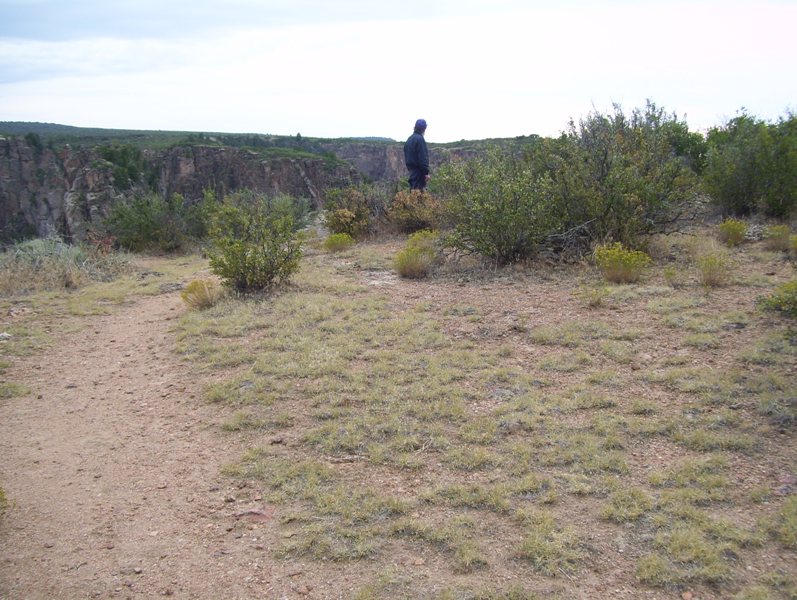
A couple of years before he died, I was gifted with a digital camera, and I took hundreds of photos of trees, animal tracksa cattle drive, some yaks in a nearby field, wildflowers (well, weeds) along the lane where I walked. It helped me get through what I thought were the worst years of my life, the years of his dying. Oddly, during all that time, I only took one photo of him, and that was by accident. We always wanted to see the north rim of the Black Canyon of the Gunnison, but since the road leading to the canyon was gravel, it was too hard on our old cars. We promised each other that if we ever had the use of a rental car, we would take the trip. That August, I rented a car so I could visit my brother, and when I returned, I suggested we finally go see the north rim of the canyon. He didn’t want to make the trip since he was so sick, but at the last moment, he agreed to come with me. It’s a good memory. Just him and me and the ground that fell away just beyond our feet. I had my camera, and since I knew I’d never be back, I snapped a few photos, and he ended up being in one of those pictures. It still makes me cry, that photo. He’s standing with his back to me, staring at  . . . eternity, perhaps. Did he know he had just a few more months to live? I sure didn’t, or perhaps I was simply refusing to face the truth.

The year after he died (which actually was the worst year of my life), I took thousands of photos. The world had turned black and white, and it was only through the lens of a camera that I could see color and life. I roamed the neighborhood and the nearby desert, looking for visual treasures.

And then suddenly, a few months ago, I stopped carrying my camera around. Apparently, despite my continued sadness, I’m back in the moment, living life at full strength rather than diluted through the lens of the camera. I didn’t even realize how far I’d come until I started hunting photos for my book and realized I’d stopped taking pictures.

(I did manage to scrounge a few photos for the book, though not as many as my publisher wanted. And we’ll be using the only photo of the two of us for the back cover even if it is fifteen years old.)

The Power of Grief

Even though grief has been with me on and off for twenty-one months, I still don’t understand where it comes from or where it gets its power.

Like most people, I used to assume that grief was merely the deep sadness we feel after the death of someone we loved, and that any feelings beyond that came from an innate weakness, an inability to cope, self-pity, or a desire to create drama and importance in one’s life. When my brother died, and then a year later when my mother died, I felt what I expected to — deep sadness but nothing more, which enforced my idea of what grief is.

But all deaths do not affect us the same. During my life mate/soul mate’s long illness, I thought I’d become inured to the idea of his death. I’d even looked forward to the end of his suffering. I knew I’d feel sad and lonely, but I had no concerns about being able to continue my life. I’m strong and independent, and have never minded being alone.

And then he died.

At first, I was glad his suffering was over. I just sat there numb, waiting for the funeral director to come and collect his body. But then, like an ever-growing tsunami, grief washed over me — grief such as I never knew existed. The continuous onslaught of intense emotions, physical reactions, and psychological torments, along with the inability to understand how totally gone he was made it impossible to sort out any one feeling from the global trauma.

I started blogging about grief when I realized most novelists got it wrong. (I can’t tell you how many times writers have dismissed the grief of their characters with a simple: He went through the five stages of grief. Sheesh. For most of us, the Kübler-Ross grief model doesn’t even begin to explain what we are going through.) I continued blogging about grief when I realized how important it was for me and my fellow bereft to try to understand what we are experiencing and why.

None of us are weak. None of us lack the ability to cope. None of us are self-pitying. None of us are self-indulgent, wallowing in grief for the sake of making ourselves feel important. None of us are drama queens, wanting to draw attention to ourselves or make people feel sorry for us. (We don’t feel sorry for ourselves, at least not often, so why should anyone feel sorry for us?) Nor have any of us chosen our grief. It was thrust on us with such power that we still reel from it months and perhaps even years later. We aren’t dwelling on our grief. It’s dwelling on us. Or in us.

Although everyone’s grief is different, grief does follow patterns of ebb and flow. For many of us in our second year, the eighteen month mark came with a huge upsurge in grief. And now the end of this year — the end of the first full year without our loved ones — is causing another upsurge. I do not know why this is so, I just know that it’s the latest manifestation of the process.

I’ve passed many (maybe most) of grief’s milestones, though I’m sure future milestones will surprise me as I continue this journey through grief. I can deal with these milestones. They come. They go. But no matter how I feel — sad or unsad — he is still and will always be dead. I can understand that he is out of my life, but I cannot understand his total goneness from this earth. Perhaps that unknowableness is where grief comes from. Perhaps that unknowableness is where grief gets its power.

***

Pat Bertram is the author of the suspense novels Light Bringer, More Deaths Than One, A Spark of Heavenly Fire, and Daughter Am I. Bertram is also the author of Grief: The Great Yearning, “an exquisite book, wrenching to read, and at the same time full of profound truths.” Connect with Pat on Google+. Like Pat on Facebook.

Grief Update: Twenty-one Months

Twenty-one months ago, my life mate/soul mate died. How much is a month in grief time? A year? If that’s the case, then today I have reached my 21st birthday in the world of grief. Sometimes it feels as if twenty-one years have passed since his death, our shared life so distant that it could be a dream conceived in present-day loneliness. Other times, it seems as if a mere twenty-one days have passed, as if he recently left — or I did — and soon I will be going home to resume my life with him. Sometimes the pain of separation feels old, as if it is a long-faded scar, other times it feels fresh and raw. Sometimes I see him as clearly as if we’d just parted, other times I have to struggle to remember what he looked like.

During the first year after he died, I was focused on getting through the pain so I could start a new and wonderful life. Somewhere deep inside, beneath thought, resided the feeling that only a great good could offset such a trauma, and I wanted to be ready to embrace my new life. Perhaps something wonderful will happen, but so far, I’m still struggling with the same old life, still struggling with a vast and unending loneliness.

I’ve been making friends, trying to assuage my loneliness, but always I feel his absence. He was the only person who ever truly listened to me, listened beyond my words to the truth of what I was saying, and no matter what I said, he never filtered it through his own  prejudices, opinions, and emotions, but could talk dispassionately and intelligently about even the most passionate subjects. Electric energy crackled between us when we went on one of our ping-ponging conversational excursions from history to music to movies to philosophy to books to science and back again to history.  I know I should be grateful for having him as long as I did, and I am grateful. I should be glad we were able to converse the way we did since that is something so few people have. And I am glad. But still, life is bleak without his being here to pong my pings, conversationally speaking.

I’m trying not to think about where to go from here, trying to trust in the rightness of my path wherever it will take me, but to do so somehow makes me complicitous in his death, as if I’m agreeing it was right that he died. Oddly, back then, I was glad he died. He’d suffered enough, and death was the only way to end his agony. The further away I get from his death, the worse it gets because I only remember that he died. How can he be dead? I don’t even know what “dead” means, just that he is gone from this earth, and has been gone for twenty-one months.

Grief is a Gift

I did not choose grief. Grief was thrust on me. To be honest, I never expected to grieve. My life mate/soul mate had been sick for so long I thought I was used to the idea of continuing life alone. I thought we’d untwinned our lives and had set out on separate journeys, him to death, me to continued life. His death, however, opened a hole in the universe and the cold breath of eternity has seeped into my soul. I don’t know if the hole can ever be patched. I don’t know if I want it to be. I for sure don’t want to push thoughts of him out of my mind. Such thoughts, though they still bring sadness, help bridge the gap between his presence and his absence. (Absence is such a mild term to describe the unfathomable “goneness” of someone who is dead.)

I’ve come to view grief as a gift. Not many people agree with that, but for me, it is very much of a bequest, the last present he ever gave me. I’ve always been a truth-seeker, always wanted to see what was beyond the veil of everyday reality. (If you’ve read any of my books, you can see the pattern. Each of my novels seeks to reveal the lies that hold our culture together, from so-called conspiracy theories to biological warfare, from human experimentation to old time gangsters. Despite the disparate stories and themes, they are all united by my need for the truth.)

This hole that grief has opened, both into the universe and into the human psyche, might bring me to the truth I seek. And even if it doesn’t take me where I want/need to go, it’s still a gift. Not many people are privileged to find their cosmic twin, to be connected to another human, soul to soul, as we were, and grief is the price I have to pay. Sometimes the price seems too high and I’d like to fling the gift back where it came from, but other times, it almost makes sense, as if the universe is unfolding the way it should be.

From the beginning, even when the pain of his absence made it almost impossible to breathe, I’ve trusted my grief to guide me through the days, weeks, months. Despite the insanity of the feelings grief creates, I knew I was sane and well adjusted, and so I felt free to follow the wild and agonizing ride. I’ve learned much these past twenty months on how to survive, how to find sense in the senselessness, how to find peace within the sadness. I’ve found courage, patience, compassion, and a strength I didn’t know I had. I still don’t know where I am going — I can’t see the end of the road. For all I know, there might not be an end. The journey could be all there is.

My talk of grief gives people the wrong impression. I’m not sure that what I am feeling right now is strictly grief, at least not the way most people think of grief. But it’s not “not grief” either since I do still have upsurges of tears and sadness and loneliness. Most of the time I’m just . . . me. In fact, since I stopped watching the movies and television shows he taped for us, which caused horrendous upsurges in grief since we’d always watched the tapes together, I’ve been in sort of a limbo. Until we find another word than grief for the long-term effects of having lost someone important in our lives, I will continue to use the word “grief,” because whatever I do, whatever I feel is part of my grief journey.

And it’s all a gift.

I just hope I remember that during my next upsurge of grief.