Humor Metamorphosing into Horror Metamorphosing into Allegory

Of all the books I’ve written, my current work-in-progress is by far the most fun. Part of it, I am sure, is due to the past months of reviewing and being reviewed. I am more confident of myself as a writer, more accepting of my style, and even though the words still come slowly (I average about a page of keepers a night; the rest ends up in the trash) they are coming easier. They don’t fight me as much as they did in the past. I don’t spend as much time agonizing over the perfect speaker attribute or trying to come up with an original metaphor, which I would end up getting rid of anyway, because they always sound trite to me.

Another part of the fun comes from knowing where I am going. Because of the blogs I did on creating the character, I know who is his, what he wants, what his internal and external conflicts are, which in my previous works didn’t show up until after I’d written about fifty pages.

But the most fun is how the mood of the story keeps changing. It started out as a whimsically ironic apocalyptic novel, metamorphosed into horror, and now it has become something completely different: an allegory. A biblical allegory, which is itself ironic because . . . well, just because.

Chip, my hero, and the torments that beset him are reminiscent of the book of Job, or so it seems. It’s been many years since I’ve even looked at a bible, so I can’t give you specifics. But the overall feeling is the same.

How did this happen?

Details. Although I know the story and my character, I don’t necessarily know the day-to-day minutiae until I write them, and the story is in the details. Each action, no matter how small, has a reaction. Each reaction is motivated. How does Chip react to what is happening to him, and why? Why are the things happening in the first place? By such little steps – the hows and the whys — the story builds. And deepens. And metamorphoses.
Characters Butting Heads

When I wrote the first draft of my novel More Deaths Than One (and the second draft and the third) I had the hero Bob meandering around his world trying to unravel his past all by himself, and it was boring. Did I say boring? It was moribund. The story went nowhere because there was no one for Bob to butt heads with.

As an aside: this is my current metaphor for a good story — characters butting heads with each other and spinning off in new directions. Too many authors today have their characters butting heads, moving straight back and butting heads again. If the characters don’t ricochet off into a different direction each time, you have characters that don’t change and hence you have a static story.

In the fourth draft of More Deaths Than One, I gave Bob a love interest, a waitress he met at a coffee shop. (Hey, so it’s been done before. The poor guy spent eighteen years in Southeast Asia, and didn’t know anybody stateside. How else was he supposed to meet someone?) That’s when the story took off. He had someone to butt heads with, someone to ooh and aah over his achievements, someone to be horrified at what had been done to him.

From that, I learned the importance of writing scenes with more than one character.

So why am I mentioning this?

Well, I’ve hit a hole in my work-in-progress, a possible weakness. The hero of this whimsically ironic apocalyptic novel, Chip, loses one person after the other until he is alone. (I’m not giving anything away here. I already told you the work was apocalyptic.) There will be plenty of conflict as he contends with his new environment, but it might get boring without other characters for him to interact with.

There will be no problem once he ends up in the human zoo in the second part — his problem there (though not mine as the writer) is that he will have too many people to contend with. The same holds true for the third part of the book when he escapes. So there will be only about sixty pages where he is alone.

I do have one thing in my favor. I am a much better writer than I was when I wrote the first draft of More Deaths Than One, so perhaps I can keep the story going with Chip alone. (Saying I am a much better writer now is not necessarily saying I am a good writer. The first draft of More Deaths Than One was laughably bad. That I found an agent for it says more about the agent than it does my writing. No surprise — he couldn’t sell it.)

Chip does have to be alone at the end of the first part; he has an important step to take and must be by himself to take it. He also has to go through some experiences alone because they are essentially in his mind (or at least he thinks they are), but who will he be butting heads with the rest of the time? I’ll have to think about this.

If you want to take a look at the first chapter of More Deaths Than One, click on My First Chapters off to your right.

It will not be on the test.

Sex in Books is Like Serial Killing

Thomas Harris’s book Red Dragon really blew me away when I read it years ago. It was the first book of its type, or at least the first of its type that I read. Since then, hundreds of books about serial killers have been published, each one more grotesque than the last in an effort to excite the interest of a jaded public. Thomas Harris’s Hannibal, written years after the Red Dragon, was so bizarre it was almost ridiculous.

Sex in books in like serial killing in books. In an effort to make what is essentially a reproductive act ever more interesting, authors keep coming up with different positions, different euphemisms, different ways to describe the act and the necessary anatomy. At times, the descriptions are more gruesome than titillating.

Maybe I’m jaded, too, but I find myself skipping over the sex scenes in books. And, since I have a strict rule not to write what I don’t read, each book I write has less sex in it than the last. In fact, in Light Bringer the characters didn’t have sex at all. But what can you expect from aliens? Still, it never occurred to me that I left off any mention of sex until it was pointed out to me. (I also left out the violence. Hmmm. No sex or violence. Is this a clue as to why I can’t find a publisher?)

Last night I had the hero of my work-in-progress, Chip, go out on a date and they ended up at his place. (His mother was finally gone, hallelujah! I was getting a bit bored with her. She really wasn’t nice.) Chip and the girl weren’t in love, though they knew each other; so without the love/romance angle all that was left was sex. And since I couldn’t think of a single thing new to say about it, I closed the door and left them alone.

Maybe when Chip does meet his life mate, I will let them be intimate, make love, copulate, possess each other, sleep together, but until then, poor Chip will need his strength. The world is about to come to an end.

Dialogue Envy

Books on how to write dialogue often suggest we listen to people talk. Sounds like good advice, but have you ever truly listened? “We . . . um . . .  we, like . . . you know . . . we stammer and like we repeat ourselves and um . . . you know.”

Even when we speak coherently, we don’t converse. We lecture. We tell long, boring, convoluted stories. We interrupt others and talk over them. We use clichés. We tell jokes that take forever to get to the punch line. None of which helps us write dialogue. If characters in books talked the way we talk in real life, who would bother reading? We want our characters to sound like us, just not talk like us. We also want their conversations to be witty, to the point, and conflicted.

Many authors seem to think bickering is a way of showing that conflict, or maybe they think it is witty and to the point, but it isn’t. At least not for me. I find it distracting, especially if the two bickerers are supposed to be a romantic couple. The more they insult each other, the less it seems like foreplay and the more it seems like plain old-fashioned meanness.

Last night I watched But Not for Me, a romantic comedy written by Rob Lipton, starring Clark Gable, Lilli Palmer, and Lee J. Cobb. And I got dialogue envy. Every word those three spoke shimmered brightly. When the romantic couple got together at the end, even though they’d been in conflict during the entire movie, I could believe they were in love.

Watching the movie, I discovered a few things about Lipton’s writing. He did not write dialogue that rambled, going nowhere. He did not write dialogue that distracted from the story; it was the story. And he most assuredly did not write dull dialogue.

Now if only I could figure out what he did write, rather than what he did not!

Imploding Lifeless Descriptions

Although I am not a fan of long descriptive passages, or even short ones that add nothing to the story, I do think that setting is important. We readers need to know where we are, and why. We need enough description to get our imaginations flowing, though not so much that we feel the story is the author’s alone; we want to be a participant in the process.

Setting need not be static. It can be a character with its own personality, scars, weaknesses, strengths, emotions, and moods. Like the other characters in the story, we should get to know it little by little, not in big chunks of exposition. And, like the characters, it should change; or at least our perception of it should change.

As I mentioned in my previous post, the space given to description should be in relation to its importance. There is no point in writing a long description of a setting that will disappear from the book before the readers have fixed it in their minds. For one thing, it delays the action unnecessarily; for another, readers won’t forgive the false impression.

For my work in progress, I envisioned a fabulous pet store. It was a standalone building with its own parking lot. The building was in the shape of a U, with the main room across the front and two wings. Because it was once a doctor’s office, there were several little rooms in each wing. My character, Chip, created special habitats in the rooms, like a mini forest for the owl and a large terrarium for the reptiles. In the center of the U was a courtyard that the doctors once used for an outdoor eating area, but Chip had enclosed it with wire mesh, filled it with exotic plants and small trees, and used it as a retreat for the birds and small animals.

As I was designing the store, I encountered several problems: the birds were tropical, and would not have done well outside in Denver’s harsh climate. The terrariums for the reptiles would turn into charnel houses because the creatures would eat each other. But even with the problems, I was loath to implode my store; I spent a lot of time creating it and I thought it was a great idea.

Then I started writing it. To make it more than a lifeless description such as the one here, I had to give it several paragraphs and for what? Within a few short chapters the store would disappear (along with the entire neighborhood). It didn’t make sense to give so much space to something that was obviously unimportant when a plain old store would work just as well and with fewer descriptive words to delay the action. Besides, anything the fabulous store said about Chip was more entertainingly portrayed by his relationship with the animals.

While my setting — Denver in the not too distant future — is important, the store wasn’t. Whatever words I would have wasted on the store, I will spend creating a living, changing, vital setting for Chip to interact with. Because of that interaction, I won’t need long descriptive passages for readers to skim over.

That’s the plan, anyway.

Books Are Not Movies

Many writers see their novels as movies, picking a cast to portray their characters, visualizing scenes as they would play on the screen. But books are not movies. A movie set can be seen in an instant and does not detract from the action, while a long passage in a book describing that same scene postpones the action, making today’s readers impatient. (Action in a novel, as I am sure you know, is any forward motion that fosters change in the characters: dialogue, physical interactions, even a simple touch of the hand.)

Nor is a book a movie script. Some novelists are so enamored with envisioning their book as a movie that they omit descriptions altogether. They tell their story mostly by dialogue, which leaves readers untethered, “like water, willy-nilly flowing.”

If two characters are having an argument, for example, it is necessary for readers to know where it is taking place. An argument in a pub is different from an argument in a bedroom, but they don’t need a long description of the bar or the bedroom to get involved with the characters; a few significant details will anchor the scene in their minds. A detailed set is necessary for a movie’s verisimilitude, but those same details negate a novel’s illusion of being true. Do you stop in the middle of an argument to note the contents of the room? If you do, you lose not only your focus, but the argument as well.

Even a short descriptive passage can negate the illusion if the object or setting described has no significance to the story. A lamp may be placed on a side table in a movie set for no reason other than the set designer liked the way it looked, but if an author spends many words describing that same lamp, there has to be a reason. Perhaps it is a source of contention between characters. Or perhaps one character will bash another over the head with it.

So, if you visualize your novel as a movie, don’t describe everything you see. Describe only what is important, (what is important to the characters or to the story, not what is important to you as a writer) and then . . . ACTION!

Humor Metamorphosing into Horror

My work in progress, a tongue-in-cheek apocalyptic novel, is metamorphosing into a horror story. I study my words trying to figure out where I went wrong, but they seem to be behaving properly. Does this mean that I am losing control of my story? No. The problem is in the details.

Plausibility in a story depends on the accumulation of consistent, accurate details. Those details are even more important for a fantasy than they are for other types of books, such as police procedurals. An author of a police procedural can summarize or even skip some of the boring details. After all, any person who reads crime novels, follows detective shows on television, or watches documentaries about modern forensic techniques knows many details of a criminal investigation, and can fill in the blanks. For example, early police procedurals gave details about taking fingerprints from a suspect, but today most readers know how fingerprints are taken, probably even had one taken for a driver’s license, so few authors waste words on that particular detail.

On the other hand, only the author of a fantasy knows all the details of his or her world. For those details to seem real, the characters must act consistently with their history, experiences, and psychological profiles.

Although I might find it incongruous and therefore amusing to have a saber-tooth lion spring out of a dark alley in modern Denver, the character experiencing this is not amused. To him, it is unimaginable horror; therefore, to the reader who is experiencing the world through the eyes of the character, it is also horror. A character who finds an attacking saber-tooth lion to be funny is not a believable character, unless somehow I can make the reader believe that the character will react in such a way, which still proves that plausibility is in the details.

Since I am writing to my specifications and not to a publisher’s, it does not matter whether I am writing humor or horror. That the details are consistent and accurate within my story world does matter, and of that, I am in control.

Blogging is Morning, Writing is Evening

I was afraid that when I got involved with writing my new novel I would have to stop blogging, but here I am. I discovered that blogging and writing are two entirely different types of composition, using different parts of my brain, so one does not supersede the other.

Blogging is my morning writing, which I do on the computer. It is linear, logical, and entire of itself. The beginning and ending not only bracket the body; they reflect each other like sunrise and sunset or birth and burial. Because I keep it short, knowing how difficult it is for some people to read online, I can see the article all at once, which makes reblogging easy. (If good writing comes from rewriting, why shouldn’t good blogging come from reblogging?)

Writing is my evening composition. It is linear and logical in that every reaction I write is preceded by an action and every action is motivated, but the process of writing is anything but logical. A hand/mind connection comes into play at night when I sit in a cocoon of light, pen in hand, paper before me, that doesn’t seem to apply during the day or when I am at the computer. That is the time when magical things happen on the page, when subconscious ideas come to fruition. Sometimes the ideas come slowly and the words come hard, in which case I go to bed early. Other times my hand can’t form the words fast enough, and I lose the idea. Those nights I go to bed early, too. But sometimes, oh sometimes, the ideas come, the words flow, and the night goes on forever.

Of course, when morning comes, my linear mind takes over, and I chuck some of that immortal prose into the trash. But I do keep a few of the pages, rewrite others, and the story grows.

I write for myself, more so now that the possibility of never getting published is finally sinking in, but who do I blog for? Myself, too. This journal is a message from the blogging part of my brain to the writing part and if it pays attention, my writing should improve. At the very least, I am developing a database of writing hints for when I (or you) need help.

Our Prose is Immortal Prose — Not

Who decides if your dialogue is meaningless, you or your readers? You may believe that what you are writing is immortal prose, but if your readers don’t agree, then perhaps it’s time to rethink parts of your story. Getting rid of long descriptions is easy — go through the passage, pick out one or two telling details, and scrap the rest. Getting rid of inane dialogue is harder. You know that all the information you are giving your readers is important. The problem is, they don’t know that what they are reading is vital to the story. All they know is that they are bored.

Dialogue is not conversation; it is action and as such must propel the story forward. To keep your dialogue from hindering the action, from stopping the forward motion of your story, it must be in conflict or it must help define your characters, preferably both.

According to Sol Stein, author of Stein on Writing, you should examine every bit of dialogue. Ask yourself the following questions: What is the purpose of this exchange? Does it begin or heighten an existing conflict? Does it stimulate the readers’ curiosity? Does the exchange create tension? Does the dialogue build to a climax or a turn of events in the story or a change in the relationship of the speakers?

Once you have determined that the conversation is conflicted and does propel the story forward, you need to look at every line of the dialogue and ask yourself: Is it fresh, colorful? Is it the cleverest thing the character can say?

Writing is not life. In life, most of us cannot come up with that clever quip when we need it; it comes to mind (if at all) late at night when no one is around to be impressed. Your characters don’t have to suffer from that malady because they have you and your late night epiphanies on their side. You can change their words as often as necessary to get it right.

And get it right you must. Good dialogue makes a reader keep reading. Bad dialogue, no matter how crucial to the story, makes readers go in search of other amusements. Because, face it: to readers, our prose is not immortal, it is simply entertainment.

Describing a Winter Scene

One of the most common reasons people come to my blog is to find out how to describe a scene. A subcategory of that is how to describe a winter scene. I can tell you one thing: you do not learn how to describe a winter scene by Googling it. You go outside. Stand still. Observe.

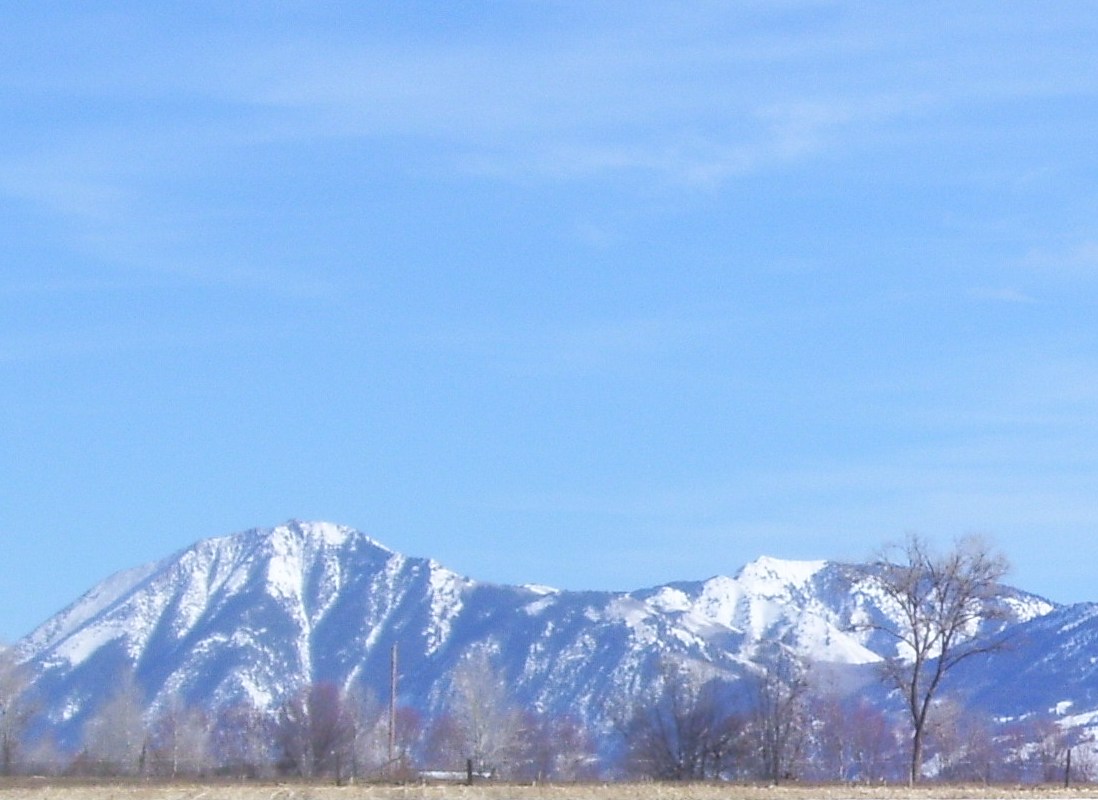
When writing about a place, we have a temptation to describe it all at once, but it’s more effective to begin at a distance, then 100_0876bmove in for the smaller details. So there you are out in the snow and cold. What is the panoramic view? What specifically do you see in the distance? What sounds are coming to you from far away?

Bring your focus in a little closer. Pick out a few details from the middle distance. Now bring your focus in to your immediate area where all your senses come into play.

How do you feel? You are probably shivering because you thought you’d be outside for just a minute and didn’t put on a coat. Make a note of that and whatever else you feel. Touch the ice or snow or slush. Is there anything you can say about it besides its temperature? If not, forget it. Everyone knows what cold feels like.

What do you smell? Taste? Perhaps a low-pressure system is keeping the car exhaust from dissipating and it is so thick you can taste it. Or perhaps the smoke from wood burning stoves is choking you, and you can taste it in the back of your throat.

What do you hear? Cold engines idling? Birds calling? Children laughing? Ice crackling?

Finally, what do you see? Focus on the small details. Are dead leaves or blades of grass poking up through the snow? Are there mice or deer tracks? Is a perfect feather lying at your feet? Is a nest visible in the bare tree branches?

When you have absorbed as much sensory information as you can, you are ready to write the scene. Resist the urge to string together adjectives — too many can diminish the power of your description — and resist the urge to use everything you learned. It is better to pick one or two exceptional details that give an impression of the whole rather than attempting to describe the entire scene. Most readers today do not want to sit through long descriptions. They want to get a quick sense of the place and then move on to the action.

Better yet, couple your description with action; give it movement. Have snow crunching beneath running feet. Have a character dodging around a stalled car. Have the blood of a victim staining winter-dry leaves.

Most importantly, if you can’t think of a single original thing to say about the scene, don’t describe it at all. Why waste your time and your readers’ by telling them what they already know?

***

Pat Bertram is the author of the suspense novels Light Bringer, More Deaths Than One, A Spark of Heavenly Fire, and Daughter Am I. Bertram is also the author of Grief: The Great Yearning, “an exquisite book, wrenching to read, and at the same time full of profound truths.” Connect with Pat on Google+. Like Pat on Facebook.




