My Sort-of Interview with Author Michael Palmer

(Email conversation between Pat Bertram and Michael Palmer)

Bertram: Mr. Palmer: Would you like to be a guest on my blog? Forgive me if I’m being presumptuous, but you are on Facebook and have joined my Suspense/Thriller Writers group for some reason.

Michael Palmer: hi, pat……thanks for the invite……i am a cyber neophyte and was probably signed up by my publicist……

i would be happy to do your blog……i have the paperback of the first patient coming out 1/2/09 and the hardcover of the second opinion coming out 2/19/09…..would you rather work closer to those?

whatever you say……

Bertram: If I have my choice, I’d rather do it as soon as possible to make sure it gets done. I can always post an update at the beginning of January to remind people your books are coming out; that way you get a two-fer.

Sorry about the “Mr.” I know you’re a Dr. — I’ve read most of your books.

Michael Palmer: yeah, it’s doctor, and don’t you forget it!……actually, after all these years i still get terrified by two words: doctor……and dad……

such responsibility……

i’ll be back monday from playing in the north american bridge championships (more responsibility)……we can do your blog after that……

Bertram: Sounds great! I’m looking forward to it.

(A week later)
Bertram: Are you still interested in guest blogging? (Sorry to add to your responsibilities!) How did your bridge championship go?

Michael Palmer: hi…..i played decently, but in such tournaments, mistakes are magnified, and i made too many of those……

tell me how long a blog you want and i’ll see what i can do…..except for a brief, terrible blog attempt on amazon i’ve never written one…..

Bertram: Michael, In all these years that you’ve been a writer, you’ve never written an article? Wow. Of course, a writer who spends too much time writing articles has little time to write the important things, like a bestselling novel. There is no length requirement, but it should be at least 300 words so it has some meat to it.

Michael Palmer: hi….the blog is first on my list after finishing chapter 3—later this afternoon

Michael Palmer: here it is….call me if you need anything

How cool is that? I will be posting Michael Palmer’s article on Monday, December 15th, so be sure to stop by and say hi.

Discussion of Elmore Leonard’s Ten Rules For Writing Fiction

Elmore Leonard is hosting our discussion. He doesn’t know it, of course, but we had so much fun with Kurt Vonnegut’s Eight Rules, I thought we’d use Leonard’s rules this time.)

Ten Rules of Writing by Elmore Leonard:

These are rules I’ve picked up along the way to help me remain invisible when I’m writing a book, to help me show rather than tell what’s taking place in the story. If you have a facility for language and imagery and the sound of your voice pleases you, invisibility is not what you are after, and you can skip the rules. Still, you might look them over.

1. Never open a book with weather.

If it’s only to create atmosphere, and not a character’s reaction to the weather, you don’t want to go on too long. The reader is apt to leaf ahead looking for people. There are exceptions. If you happen to be Barry Lopez, who has more ways to describe ice and snow than an Eskimo, you can do all the weather reporting you want.

2. Avoid prologues.

They can be annoying, especially a prologue following an introduction that comes after a foreword. But these are ordinarily found in nonfiction. A prologue in a novel is backstory, and you can drop it in anywhere you want.

There is a prologue in John Steinbeck’s “Sweet Thursday,” but it’s O.K. because a character in the book makes the point of what my rules are all about. He says: “I like a lot of talk in a book and I don’t like to have nobody tell me what the guy that’s talking looks like. I want to figure out what he looks like from the way he talks. . . . figure out what the guy’s thinking from what he says. I like some description but not too much of that. . . . Sometimes I want a book to break loose with a bunch of hooptedoodle. . . . Spin up some pretty words maybe or sing a little song with language. That’s nice. But I wish it was set aside so I don’t have to read it. I don’t want hooptedoodle to get mixed up with the story.”

3. Never use a verb other than “said” to carry dialogue.

The line of dialogue belongs to the character; the verb is the writer sticking his nose in. But said is far less intrusive than grumbled, gasped, cautioned, lied. I once noticed Mary McCarthy ending a line of dialogue with “she asseverated,” and had to stop reading to get the dictionary.

4. Never use an adverb to modify the verb “said” . . .

. . . he admonished gravely. To use an adverb this way (or almost any way) is a mortal sin. The writer is now exposing himself in earnest, using a word that distracts and can interrupt the rhythm of the exchange. I have a character in one of my books tell how she used to write historical romances “full of rape and adverbs.”

5. Keep your exclamation points under control.

You are allowed no more than two or three per 100,000 words of prose. If you have the knack of playing with exclaimers the way Tom Wolfe does, you can throw them in by the handful.

6. Never use the words “suddenly” or “all hell broke loose.”

This rule doesn’t require an explanation. I have noticed that writers who use “suddenly” tend to exercise less control in the application of exclamation points.

7. Use regional dialect, patois, sparingly.

Once you start spelling words in dialogue phonetically and loading the page with apostrophes, you won’t be able to stop. Notice the way Annie Proulx captures the flavor of Wyoming voices in her book of short stories “Close Range.”

8. Avoid detailed descriptions of characters.

Which Steinbeck covered. In Ernest Hemingway’s “Hills Like White Elephants” what do the “American and the girl with him” look like? “She had taken off her hat and put it on the table.” That’s the only reference to a physical description in the story, and yet we see the couple and know them by their tones of voice, with not one adverb in sight.

9. Don’t go into great detail describing places and things.

Unless you’re Margaret Atwood and can paint scenes with language or write landscapes in the style of Jim Harrison. But even if you’re good at it, you don’t want descriptions that bring the action, the flow of the story, to a standstill.

And finally:

10. Try to leave out the part that readers tend to skip.

A rule that came to mind in 1983. Think of what you skip reading a novel: thick paragraphs of prose you can see have too many words in them. What the writer is doing, he’s writing, perpetrating hooptedoodle, perhaps taking another shot at the weather, or has gone into the character’s head, and the reader either knows what the guy’s thinking or doesn’t care. I’ll bet you don’t skip dialogue.

My most important rule is one that sums up the 10.

If it sounds like writing, I rewrite it.

Or, if proper usage gets in the way, it may have to go. I can’t allow what we learned in English composition to disrupt the sound and rhythm of the narrative. It’s my attempt to remain invisible, not distract the reader from the story with obvious writing. (Joseph Conrad said something about words getting in the way of what you want to say.)

If I write in scenes and always from the point of view of a particular character-the one whose view best brings the scene to life-I’m able to concentrate on the voices of the characters telling you who they are and how they feel about what they see and what’s going on, and I’m nowhere in sight.

What Steinbeck did in “Sweet Thursday” was title his chapters as an indication, though obscure, of what they cover. “Whom the Gods Love They Drive Nuts” is one, “Lousy Wednesday” another. The third chapter is titled “Hooptedoodle 1” and the 38th chapter “Hooptedoodle 2” as warnings to the reader, as if Steinbeck is saying: “Here’s where you’ll see me taking flights of fancy with my writing, and it won’t get in the way of the story. Skip them if you want.”

“Sweet Thursday” came out in 1954, when I was just beginning to be published, and I’ve never forgotten that prologue.

Did I read the hooptedoodle chapters? Every word.

Do you agree with these rules? Which, if any do you follow? Which, if any, do you not follow? Which, if any of these rules, do you think are hooptedoodle?

The group No Whine, Just Champagne will exchange ideas about these rules during our live discussion on December 11, 2008 at 9:00pm ET. Feel free to join us, or to leave your comments here.
Building a Story from the Inside Out

Jordan Dane, national bestselling and award-winning thriller writer, is guesting my blog today. I know guesting isn’t a word, but I’m still pleased that she consented to be my guest blogger. She is also hosting a discussion on my Suspense/Thriller Writers  group on Facebook, so stop by and add your bit to the onion, or leave a comment for her here. Jordan writes:

Ever thought about building an onion from the inside out? (Come on. Humor me!!)

This little exercise of writing the dialogue first came from having to split my time between my day job and writing. On my special writing days, I’d grab lunch by myself and take a notepad with me. (I wasn’t really alone. Like Sybil, writers never are. Oh, I just scared myself.)

People would always comment that my scenes jumped right into the action with pace, sharp concise narratives and to-the-point dialogue. In trying to explain to another writer how I do this, I had to understand it myself. That’s when I realized how much my little lunchtime exercise had trained my brain to think this way-in terms of breaking down elements to any scene.

I had broken apart the dialogue from the rest of the narrative as a more efficient use of my time before I got home that night to finish the scene. Consequently, the dialogue got my full attention. And I usually tend to visualize the scene in my head as a TV program or movie. Visualizing it like a movie stirred my thoughts on the scene and helped orient me into the characters’ motivation too.

I later learned aspects of this method are called LAYERING. You can use it to build that onion as I describe below or use it to add more emotion or tension or atmosphere to your scenes-whatever you want more of-even after you think that scene or book is finished. Layering is one of the last steps I use when I’m doing my final edits on a novel. I read through the book and punch up the various scenes until I’ve come to the last page.

1. FIRST-Use dialogue as the framework for the scene (like a screen writer)

Consider writing the dialogue first so you can concentrate on it (Use this as an exercise only. Once you get this down, you won’t need to do this time and time again.)

Make the dialogue important-There’s nothing like witty banter or a clever verbal skirmish between two adversaries

If your character confronts someone at a high school reunion that they haven’t seen in twenty years when they buried a body after Prom, you better have them say more than, “Gee, nice sweater.” Chitchat would never happen in real life, given this situation, unless these two people are guiltless serial killers. Too much introspection can kill the impact of their first meeting. Personally, I like a challenge like this. And don’t get me started on the whimsical world of the serial killer. But think about it-what WOULD they say to each other?

2. SECOND-Body Language/Action

Body language can be fun, especially if it contradicts what the character is saying in dialogue-Use it! Manipulate it!

Be concise and not too wordy with action, but keep it REAL. If guns are blasting, remember your characters are dodging bullets, not witty banter. Bullets stop for no man…or woman!!!

3. THIRD-Mood & Setting-Use it to accentuate what’s happening.

I LOVE LOVE LOVE the mood created with a great setting. It can embellish the emotion in a scene or add an underlying tension (ie an escalating storm or a well-placed gust of wind against a silk blouse or skirt). The beauty is in the details.

4. LAST-Emotional layering-Introspection

Give your character a journey through the scene. Don’t just repeat the same old thoughts over and over in different ways no matter how clever you are. Have their introspection grow or change.

Too much introspection, for me as a reader, slows the pace. But if an editor wants it, read my first point over again and build upon the emotional layers with new material. Insights into a character can be a wonderful gift to your reader.

5. THEN STAND BACK AND TAKE A LOOK-What’s there? Do you have a whole ONION or a lemon?

Make every scene into a tight mini-story with a hook beginning and a memorable page-turning end. Or end it with a beautiful image a reader will remember and feel long after they’ve put the book down.

Or stop in the middle of the action and continue it on the top of the next chapter.

You are in control of your story’s layout. Make it interesting.

NOTE: For more writer resources, please check out my website FOR WRITERS page for craft tips, promotion ideas, and other articles like my “First Sale” story or “How to Make a Book Trailer FOR FREE”.

Immigration of Characters

I was sitting here trying to figure out what to write — I’ve had so many guest bloggers lately, I’m out of the habit of writing my own bloggeries — when I received an email from a friend with an attached article that she wanted me to check over. It was so clever and true it made me smile. We all have characters who deserve to immigrate to a better place than in our heads or on our computers. More to the point, she’s letting me post her article, saving me the trauma of having to think of something to write. Here’s what my friend Sylvia McKye say sabout the immigration of characters:

I write, as do many writers, because I enjoy writing.  I take pleasure in telling stories and taking people on adventures via my stories.  I have voices and ideas in my head.  It gets crowded in there; I need these clamoring characters to immigrate.  Onto my computer screen is the perfect new world for them. Rarely are they happy there, though.  They want a larger world.  They want to travel; they want to see and be seen.  These characters are determined; they have visions of the wide world of places like Barnes and Noble in which to sow their wild oats.  A few are truly ambitious and, having a high opinion of themselves, dream of traveling to New York and make the rounds socially-on the ‘A’ list, of course.  One or two have even mentioned being on the ‘A’ list will help them realize another dream, living on the silver screen.  Once they’ve done that, then they want to settle down on a nice little cozy bookshelf somewhere. 

So what’s a beleaguered writer to do?  Help them immigrate, of course. 

As a writer, I’ve in effect given birth to them and I’m emotionally attached to them.  I’ve raised them to be tough and strong, to set goals and dream.  I applaud their ambition.  I love my characters, so I start the paper trail to help them realize their dreams and ambitions.  However, immigration laws for characters have become tough in the past ten years.  There’s so much red tape involved.  Character immigration is a tough business all around. Getting through to the Character Immigration Officers is daunting.  

I get frustrated because some of these CIO’s reject my characters without even giving them a chance.  I polish them, provide my characters with a new wardrobe, take care with accessories-because appearances are everything in this world-and try again.  I provide them with the right background and setting and still they get rejected.  Some of these CIO’s want clear-cut categories to pigeonhole them.  A certain background.  Some of my characters don’t fit into a particular category-they are people after all-much less a set background.  Some of my characters do, but still aren’t accepted.  My characters are upset and I’m frustrated.  Because I’m attached to them, it bothers me when they’re rejected.  Meanwhile, I have a small town of characters living on my computer, and more in my head.  Will I stop creating?  No.  Will I stop trying to help my characters to immigrate?  No, again.  

I have invested in some tough Rhino skin for my characters and myself.  It’s survival.  I have no intention in giving up on finding homes for my characters.  But rejections hurt you as an author.  They can’t help but hurt us because we have created these characters and invested time and emotion in them.  Rejections are a normal process of the querying your novels and stories.  Some published authors say they’ve received enough rejection letters they could’ve papered their bathroom walls.  That’s a lot of rejections. 

Some of these published authors made it through the red tape of Agents and Editors and gotten their stories published with traditional publishing houses, others investigated smaller publishers and went that route, and still others have settled in nicely with POD publishers.  They did this because they believed in their abilities to tell an entertaining story and a desire to take readers on an adventure.  They enjoy writing. 

The point is, these are published authors and they didn’t give up. They obviously invested in some tough Rhino skin as well so as not to be discouraged to the point of not writing or querying their stories.  Persistence has its rewards.   They’ve networked and marketed aggressively. Even after getting a contract, they continue working on building and keeping a strong reader base by perfecting their skills as a storyteller. 

For these published authors, their characters have emigrated from the world in their heads and their computers to New York and hit the ‘A’ list-the Best Sellers list.   Some of the authors have had their books optioned and have seen their characters make it to the movies. Some of their characters have starred in TV movies or series. Their characters have happily found homes in Borders and Barnes and Noble.  Others are happily ensconced on a nice cozy bookshelf in someone’s home.  

There are many success stories out there.  The question is, will you stay the course and help your characters immigrate?  Where will your characters end up?  Will they immigrate or end up spending their life with you?

As for me, I’m determined to help my characters immigrate.

Meaningful Names

I just finished reading a book where the men’s first names were North, West, and Laine, and the women’s first names were Whitney and Blaire. Forgetting for the moment the silliness of naming two unrelated males in a book after directions, whatever happened to simple names? Names with meaning? Like Andrew (which means manly) and Louis (which means famous warrior) or Bonnie (which means pretty) and Mildred (which means gentle hope). I suppose Mildred is too old-fashioned for a child of today, but I do like what it means. Maybe someday I will name a character Mildred — I can see her now, a quiet little girl with long dark hair, who resembles the great-grandmother she was named after.

Whether it’s for a character in a book or for a baby, a name can become destiny, so it needs to mean more than a direction.

Other meaningful names:

Alden: Old friend
Alfred: Good counsel
Arnold: Power of an eagle
Basil: Kingly, royal
Bernard: Bold as a bear
Carmen: Song
Clement: Merciful
Curtis: Courteous
Cyril: Lordly
David: Beloved
Dennis: God of wine
Derek: Ruler of the people
Dexter: Fortunate
Donald: World leader
Earl: Warrior
Edgar: Spear of wealth
Edward: Guardian of wealth
Felix: Happy, prosperous
Gregory: Vigilant
Hector: Holding fast
Hubert: Bright in spirit
Ira: Watchful
Jason: Healer
Leonard: Strong, brave
Leroy: Royal
Lionel: Young lion
Maynard: Bold in strength
Merle: Blackbird
Morgan: Dweller on the sea
Nathan: Gift
Raymond: Wise protection
Richard: Strong in rule
Robert: Strong in fame
Solomon: Peaceful
Winfred: Joyous peace
Wolfgang: Path of the wolf

Abigail: Source of joy
Adelaide: Of noble rank
Alma: Cherishing
Amy: Beloved
Audrey: Noble strength
Beatrice: She that makes happy
Bernice: Bringing victory
Bertha: Bright
Bonita: Pretty
Celeste: Heavenly
Cherie: Dear
Clara: Bright
Dorcas: Gazelle
Esther: Star
Ethel: Noble
Eunice: Happy Victory
Evangeline: Bringing good news
Felice: Happiness
Florence: Bloom, prosperity
Hilda: Battle
Irene: Peace
Iris: Rainbow
Leila: Dark as night
Letitia: Gladness
Mabel: Lovable
Melanie: Blackness
Nadine: Hope
Naomi: Pleasant
Phoebe: Shining
Regina: Queen
Sylvia: She of the forest
Vera: Faith

***

Pat Bertram is the author of the suspense novels Light Bringer, More Deaths Than One, A Spark of Heavenly Fire, and Daughter Am I. Bertram is also the author of Grief: The Great Yearning, “an exquisite book, wrenching to read, and at the same time full of profound truths.” Follow Pat on Google+. Like Pat on Facebook.

A Terrible Writing Accident

I was watching a movie the other day, (or rather, listening to it) when I heard one character tell another, “He died in a terrible writing accident.” Okay, so I heard wrong — he died in a terrible riding accident, but I couldn’t get the thought of a writing accident out of my head. I thought I shouldn’t be alone in such a state so I’m posting it here so you too have to deal with the image.

How does one die in a terrible writing accident? These are what I came up with:

1. Commit seppuku by falling on a pen. After all, the pen is mightier than the sword. (To be accurate, this would not be an accident since seppuku is a willful act, but I couldn’t resist.)

2. One’s brain can burst with ideas.

3. One can be choked with emotion.

4. One can get beaned with writer’s block.

5. One can write themselves into a hole and be unable to get out.

Feel free to add to my list!

Writing Dialogue Isn’t an Exact Science

My guest blogger today is John Evans, author of The Fallen. Evans says:

From the first moment we enter the public education system, we are berated for a number of things. Whether it’s the hard slap of the ruler across our desk, followed by a stern, “Pay attention!” or the ever familiar punishment of writing, “I will not throw spit wads at the teacher during class” on the blackboard, our student lives are constantly inundated with rules of conduct. This is no different when writing in the English language. We are taught from a young age that there is a right way, and there is a wrong way to write. This, above every rule set forth by the education system, is the greatest pitfall a writer can face. 

By the rules and standards of the so-called “experts” of the English world, grammar must be perfect for a piece to effectively convey a thought or idea. At best, this may be true in expository writing, but on the whole “perfect” grammar is the final nail in the coffin of would be authors. The reason? Dialogue. 

Dialogue composition is a particularly difficult craft to master because unlike traditional writing, there are no concrete guidelines on how to go about teaching one’s characters to speak. The aspiring writer should know that dialogue is surrounded by quotation marks, followed by, so-in-so said. Simple enough, but what is typically overlooked is that humans don’t all speak in one set way. For example, Joe may have a Southern accent that needs the use of “yall”, yet the writer may instinctively write, “You all” because the mechanics of grammar demand it. Unfortunately, the act of doing so causes poor Joe to lose that quality that makes him a proud Southerner, and relegates him to a generic manner of speech. This in turn takes away from the overall quality of the story, and may even discourage the reader from going any further if Joe speaks in exactly the same fashion as somebody who is supposed to be from a completely different part of the world.  

My first novel, The Fallen, serves as living testament to my own struggles with the demons wrought forth by perfect grammar. I, like many aspiring writers who have come before me, fell into the trap of perfect grammar. This was especially apparent in the character of Aaron Yardovich. As his last name implies, he is supposed to be a Russian. Yet, in the first draft of the manuscript, he came off speaking like an automaton. There was no life in the character’s speech, and thus no life in the character. He was bland, boring, and otherwise insignificant. 

Which begs to question, how does one escape this dire pitfall when composing dialogue?  In a word, research. Most great authors will tell you to, “Write what you know.” This is horrible advice, unless one is willing to expand what he or she knows. To refine Aaron’s dialect, I had to enter the mindset of a Russian. To do this, I simply listened to my Russian physics lab instructor during my first year of college. In no time I turned the doldrums of Aaron’s computerized voice, to that of a stern talking Russian remnant of a Second Cold War.  

Of course this practice applies to writing in regional dialects as well. If one is to write in a character that is from Maine , then that character must be in possession of a Maine accent. This means that words like “compartment” could be written as “compautment”, as this is the nature of the Maine dialect. Moreover, it is necessary to take certain idiosyncrasies take into account.  For instance, what many of us call “dinner” is actually “supper” in certain parts of a country. Taking such minute details into account help to contribute to the overall believability of the character; however, this is not to say that one must butcher the English language to get the point across that a character is from a certain part of the world. There are other ways to emphasize this, and methods vary from writer to writer. The important thing is to make the reader believe that the character in question is indeed from a specific part of the world. 

Finally, the nature of sex in dialogue. Too often, a man’s way of speaking shows little difference from a woman’s in writing, and vice versa. A female character must possess a feminine quality about her speech for us to acknowledge she is a woman, just as a man must possess masculine qualities, but many writers fall short of this. A writer is either a man or a woman, and as such either writes as a man or a woman. 

The bottom line here is that dialogue isn’t an exact science. It is the art of giving one’s writing a soul, and thus giving it meaning. Mastering this truly challenging art form takes hard work, and years of perfection. But when it is mastered, it will serve the writer well, and take his or her craft to a level far greater than he or she ever thought possible.

Style: The Search for a Voice — NWJC Writing Discussion #44

My writing group on Gather.com — No Whine, Just Champagne — meets every Thursday at 9:00pm ET for a live discussion, and you are all invited. Tonight’s host is Suzanne Francis, author of the Song of the Arkafina series from Mushroom Books, and her topic is Style: The Search for a Voice. Suzanne writes:

Where do you find it? Is it lurking in the keyboard, in the classroom, or in the back of your mind? How do you know when you have a voice to call your own?

Today’s discussion will focus on how we, as authors, find authentic style.

Style begins with competence. (Unless you want to be known as one of those writers for whom ineptitude seems to be a defining trait. I won’t name names…)

One of my friends, a teacher, once told me that competence has four levels.

They are:

1. Unconscious Incompetence–This is where I started. I wrote and wrote, thousands of words a day, and I thought every one of them was pure gold. I was surprised and offended when my critiquers pointed out that there were flaws, inconsistencies, poorly constructed sentences, flabby paragraphs etc. etc. Sadly, many writers these days seem to be published while they are still in this stage.

2. Conscious Incompetence–The great eye opener. You realize that your work is mostly crap. Some people quit here, because they don’t want to do the work of objectively editing their work down into something readable. But if you keep at it, you’ll eventually graduate to…

3. Conscious Competence–I like to think that I am here, on a good day. I can see when the pace drags, when I am telling instead of showing. I work hard, examine my prose, recognize the flaws and fix them! I don’t get them all, but when my writing buddy finds something else I fix that too.

4. Unconscious Competence–Sometimes, very rarely, I get to visit this place, but I don’t live here. I’m sure you have had those moments when the words just pour from your fingers. Perfect fully formed sentences spring forth like Athene from the forehead of Zeus. I imagine there might be some writers who are able to keep this up long term, but I am not one of them. 

So once you have achieved level 3, or level 4 if you are very talented, do you have a style?

Nope.

Now you have to do a little detective work–look at your writing and listen to your instincts. Which words sing out from the page? Where do the characters say just what they need to? What settings add heft and bedrock to the action, or transcendent beauty?

That is where your style is hiding. Read those passages again and again. Zero in on what makes them tick; why they are so successful. Then, slowly, carefully, begin to put those discoveries to use in other places. The more you do it, the easier it gets. And eventually you find your style, a distillation of your very best writing, enriching every page.

Let me make one thing clear…

Style isn’t about following rules, despite what I said about competence earlier. We have all read things that were grammatically correct and well-structured, but still left us cold. The warmth in writing comes from our ability to know when to break a convention in order to add impact. It takes time, and the patience to write and read many, many thousands of words. There is no substitute for the hard work involved. But the moment we realize that we have written something that is recognizably ours and ours alone, can be very rewarding.

So–how and when did you discover your own style?  Do you think style should be dictated by genre, ie hard boiled for mystery, flowery for romance?  Are there any authors whose style you particularly admire?  Is your style evolving and if so, in which direction?


The group No Whine, Just Champagne will discuss these questions and more during our Live Discussion on Thursday, December 4th at 9:00pm ET. Hope to see you there! (A reminder: to participate, you need to be a member of gather, but it’s free. And to see the discussion, you will have to keep refreshing the page. It’s not like IM.)

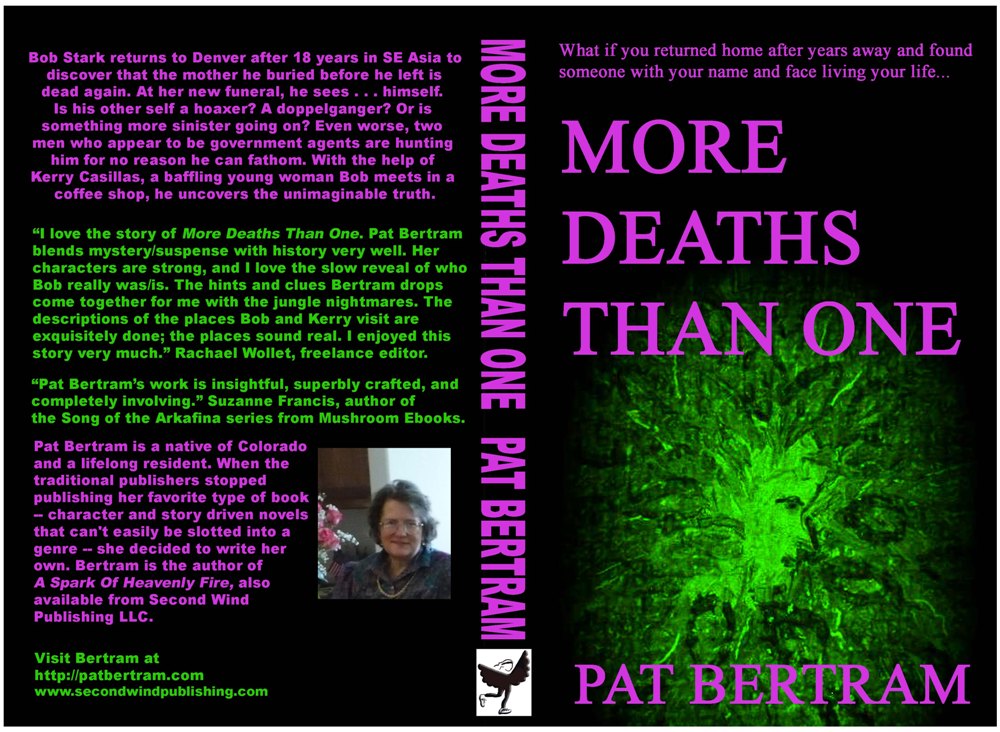
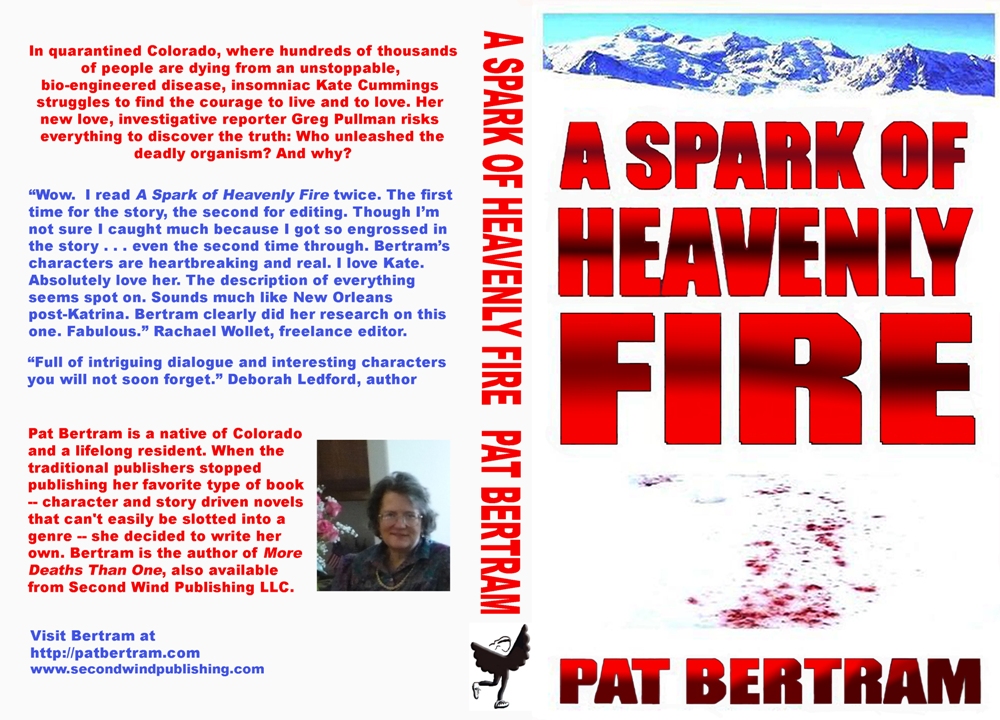
Sneak Preview of My Book Covers.

Front and Back Covers of More Deaths Than One

Front and Back Covers of More Deaths Than One

Front and Back Covers of A Spark of Heavenly Fire

Front and Back Covers of A Spark of Heavenly Fire

Heart of Diamonds

My guest blogger today is Dave Donelson, author of Heart of Diamonds, a romantic thriller with roots in reality. Donelson says: 

There has been a great deal of discussion about reality versus imagination in memoir, but something that’s often overlooked is the role real events and people can play in fiction. 

That is especially true in a novel like Heart of Diamonds, my high-concept romantic thriller about blood diamonds in the Congo. The plot concerns the White House, the President of the Democratic Republic of Congo, and an American televangelist in a diamond smuggling scheme that is uncovered by an enterprising TV reporter, Valerie Grey.

One of the main characters in Heart of Diamonds is Gary Peterson, the American televangelist who owns the diamond mine. He’s a fabulously successful man of God, a close pal of the President of the United States, and utterly devoted to making a quick buck or two if the opportunity presents itself. He also has a right hand man, missionary Thomas Alben, who runs the diamond mine for him and does most of the dirty work in the operation.

All of these characters are fictional, of course, but they had their genesis in the real world. The whole concept for Heart of Diamonds sprang from an article I read in Time Magazine about the cozy relationship between Pat Robertson, the famous American televangelist, and Mobutu Sese-Seko, the dictator who raped the Congo for thirty years. When I found out Robertson owned diamond mines and timber concessions in the Congo-making profits from slave labor, no less –I  simply had to write a book about it.

The Robertson-Mobutu connection is fascinating. Mobutu was essentially put in office by the CIA. He ran the country for three decades and stole literally billions of dollars. During that time, he had one of the worst human rights records in Africa.

The other member of the tag team is Pat Robertson, one of the most successful evangelical preachers of all time. He founded the 700 Club, ran for President of the United States, and has millions of followers around the world who subscribe to his version of Christianity. You wouldn’t think these two men would be buddies, but they were.

Robertson had many business interests in the Congo-and it just wasn’t possible to operate there at the time without the direct approval of Mobutu. It was also well-known that you didn’t get that approval for free. Apparently, Robertson and Mobutu got along famously. The Time article reported that one time, Robertson and his wife and their entourage were flown from Paris to Kinshasa on one of Mobutu’s personal Boeing 707s. In Zaire, Mobutu himself took them on the presidential yacht on a ride up the Congo River to visit one of his estates.

Robertson had a relief program in the Congo that is still functioning, Operation Blessing, as well as a private concern called the African Development Company, which made investments in mining, lumber, agriculture, transportation and power generation, supposedly with an eye to plowing the profits back into humanitarian efforts. One of those investments was a diamond mine in a small town south of Tshikapa near the Congo’s border with Angola. That’s the site of the diamond mine in Heart of Diamonds.

One of the men who ran ADC for Robertson was Bill Lovick, a former minister of the Assemblies of God who was dismissed by the church in 1985 for questionable fund-raising practices. Readers of Heart of Diamonds may find some interesting similarities between these men and some of the characters in the novel, notably televangelist Gary Peterson, the missionary Thomas Alben who runs the diamond mine, and Moise Messime, the President of the Congo.

The more I learned about these guys and the things they were doing in the Congo in the name of Jesus Christ, the more intrigued I became. Heart of Diamonds isn’t their story-the smuggling scheme, the connection to the White House, the U.S. military involvement, and many other elements are completely fictional. The characters are figments of my imagination, too, although they certainly have personality traits similar to some real individuals.

What is very real in Heart of Diamonds is my portrayal of the terrible plight of the people of the Democratic Republic of Congo, which is the direct result of the unadulterated greed of people trying to control the vast natural resources of the country. Mobutu may be long gone and Pat Robertson’s business interests gone with him, but the brutality continues.




