Tomorrow is Blog Jog Day!

Blog Jog is a trot around the blogosphere, each blog linked to the next so that you can explore new blogs with a simple click on the link to the next blog. Many participants will be offering giveaways and contests, and so will I. Or rather, my publisher will. Anyone who leaves a comment on my Blog Jog post tomorrow will be entered into a contest to win a copy of every title Second Wind Publishing releases in 2011, which will include my book Light Bringer, scheduled to be published in the spring of 2011. So be sure to stop by tomorrow and leave a comment!

Malcolm Campbell, author of  Garden of Heaven,  Jock Stewart and the Missing Sea of Fire,  The Sun Singer, and  Worst of Jock Stewart had this to say about my upcoming book: Light Bringer is TYPICAL BERTRAM: plots within plots, multiple characters with multiple agendas, fast moving, more than enough mystery and intrigue for everyone, satisfying conclusion. I really enjoyed Light Bringer and feel privileged seeing a pre-publication copy.

Light Bringer tells the story of  Becka Johnson, who had been abandoned on the doorstep of a remote cabin in Chalcedony, Colorado when she was a baby. Now, thirty-seven years later, she has returned to Chalcedony to discover her identity, but she only finds more questions. Who has been looking for her all those years? Why are those same people interested in fellow newcomer Philip Hansen? Who is Philip, and why does her body sing in harmony with his? And what do either of them have to do with a shadow corporation that once operated a secret underground installation in the area?
No Wisdom, Just Words

I’ve been sticking to my self-imposed writing schedule this month, doing a blog a day (sorry to all my subscribers who have been getting an email each day announcing a new post. I promise I’ll go back to my more sporadic posting next month). I’m also racking up the word count on my novel for NaNoWriMo.

I normally don’t obsess over word counts. The way I figure, I either write or I don’t, the scenes are either workable or they’re not. But this month, it’s about the word count. I hoped that by writing so quickly I couldn’t stop to think, I’d stir up my depths, and words of wisdom would automatically appear on the page. Nope. No wisdom yet. Just words.

I did have an odd experience this morning, though. I sat down to write a scene for my grieving woman book, and ended up writing a scene for my poor old work-in-pause, an apocalyptic allegory.

Makes sense, I guess. That novel has been rattling around in my head for years. I started writing it months before I started this blog. Since then, I’ve dealt with three deaths (none of them mine), learned how to use a computer, learned how to navigate the internet, made dozens of online friends, started a dozen blogs (most of which are now clogs — abandoned blogs clogging cyber space), participated in hundreds of writing discussions, gotten three books published, edited those three books plus a fourth (which will be published in the spring), spent hundreds of hours trying to promote those books without actually promoting them (the only thing more annoying that a full email inbox is an inbox full of annoying emails), and  . . . well, you get the point. I’ve been doing everything imaginable except working on my WIP. So today — ta da! A couple of scenes for that book appeared instead of the one I planned to write for my grieving woman book.

I always liked the idea of working on whatever book stood out most in my mind when it time to write each day, but I never tried it before. It might help put the fun back in writing, and who knows what I’ll end up with!

There’s Plenty of Grief to Spread Around

I’m participating in NaNoWriMo, trying to find a new way and new reason to write now that my life has been turned upside down. I never liked wasting my writing — I liked to think that whatever scene I wrote had a place in the story. Writing comes hard for me (even when I’m playing the quantity game rather than the quality one) so writing for writing’s sake was never on my agenda.

This month, though, is all about the words, so it doesn’t matter whether the scene works or not. It doesn’t even matter if I scrap most of the book. It’s important just to write something so that when it comes time to put the story together, I will have bits and pieces to work with.

I always knew the mother and daughter in my story didn’t get along. The mother needs someone who will argue with her, someone who has no sympathy for her grief. I’ve been assuming that the daughter found out about her mother’s cyber affair and accused the mother of being a hypocrite, and that is how I wrote the scene. Now I know that when it comes to grief, there’s enough strife to spread around, so I could probably leave the daughter in the dark about the affair.

Real mothers and daughters (not just storybook mothers and daughters) don’t see eye to eye when it comes to grief. Daughters often feel as if their mothers are carrying on too much, since grown children may come to terms with their loss easier than spouses do. Grown daughters often feel as if they’ve lost both parents when the mother becomes steeped in sorrow. Sometimes the conflict goes the other way, with the mother feeling estranged from the daughter especially if the daugher did not visit the sick father very often. (Not everyone can handle seeing a person dying slowly and in great agony and would prefer to remember the person as healthy and vital.) 

Grief should bring families together, but often it tears them apart. All that anger surfacing. The denial. The recriminations and guilt. Not everyone goes through the stages of grief in the same order. Nor do they go through them at the same time or with the same intensity.

With so much emotion to deal with, it does seem as if the daughter doesn’t need to know about the affair. In fact, I’d just as soon she didn’t come to visit her father while he was dying, at least not toward the end. A friend of the mother’s stopped calling too, which left her to deal with her dying husband without much of a support group. Which is why she had to find it online. Which is where she found her cyberlover.

If the daughter doesn’t know, though, I’m not sure how the mother will explain to the daughter why she’s taking off to meet the guy, but maybe the estrangement between the mother and daughter is such that no explanation is necessary. I’ll guess I’ll have to wait to see what happens when I finish the book.

Ready or Not, Change is Coming Your Way

Most of my internet hangouts and hang-ups (meaning obstacles to smooth progress for those of you who are too young or too erudite to be familiar with the term) are going through massive changes. I checked in with MySpace (one of the aforesaid hang-ups — it never seemed to be worth the effort) and didn’t have a clue where I was or what I could or should do once I arrived. I did like some of the changes — it’s easier to find things, but the constant barrage of ads is enough to give one a headache. Still, it might have possibilities, though many long-time MySpace fans seem to be abandoning the site. They say Facebook is easier.

Facebook itself is going through major changes. Not only did they revamp the group feature, which will eventually undo everything I have accomplished on the site, it makes it virtually impossible to keep control of your identity. Anyone can add you to a group without your consent, and that means that their friends and the friends of their friends have access to your information. For me, that’s not a problem. I go by the assumption that everyone in the world will see what I post on the site, and so only post what I want people to see. So far, no one seems overly impressed.

Facebook is unveiling a new message system, which supposedly combines email, facebook messaging, instant messaging, and texting, which means you can interface with anyone, anytime, anywhere. Quite frankly, I have a hard enough time keeping track of the people I am connected to. Most of them I’ve never met, so gradually I’m checking them all, and weaning out those I would never, could never be friends with. Perhaps a page, with it’s unlimited number of potential fans, replaces the facebook profile, but so far I don’t see the point. I do have a fan page, but haven’t figured  out how to make it work for me. Maybe frequent status updates? Or even unfreqent ones?  I do know sending an update (a type of message, not a status update) does not work. No one reads them. Or at least very few. How do I know? I sent out a coupon for a free ebook and to over 1400 fans and only three people took advantage of it. Of course, that could be me — maybe none of my fans want a free ebook. In which case, I’m back to wondering why I even have a Facebook fan page.

WordPress is undergoing changes. They retired the theme I used when I set up the Second Wind Blog. Perhaps the new one will work. I’d like to add book covers to the sidebar to make it more like a website and offer visual-oriented people something to look at besides the header, and the new theme has an extra sidebar. My main problem with the change is what it portends. I did not know Wordpress retired old themes. What if they retire the theme I use for my many blogs? I always liked the color variations I created (green, blue, purple, red, orange) and I would not be pleased with a forced change. I don’t know that I’ve ever seen another blog that uses this theme, which I always thought was wonderful since I could be unique. But unique means obsolete in cyberspace. I guess I’ll just have to wait and see.

Twitter is also making changes. I like my twitter profile, and even left space for my fourth book, Light Bringer, which will be coming out in the spring of 2011, but now twitter has added more features, the main section where the tweets show up is off-center (I prefer my main reading pane to be smack-dab in the center of the screen), and my custom made screen is defunct.

The friends I’ve made online remains the best thing about the internet. I’m hoping that will never change.

Grief: Denying Denial

I never really had a choice about feeling my grief. It wasn’t so much that I embraced it, but that it embraced me. It took hold of my life and didn’t let go, though it is easing enough so that I am able to see the process for what it is.

People talk about denial as if it’s a bad thing. If I’d been able to deny grief and just go on living as if my mate of thirty-four years hadn’t died, I’d probably have done so. Grief is debilitating, disorienting, causes innumerable physical and emotional reactions, makes one susceptible to cancer, accidents, and other closer-to-death encounters and on top of that, it’s just downright painful.

So why deny denial? Because in the end, it’s better to embrace grief, to learn to live with the pain (which does diminish, though according to comments left on this blog from others who have also lost their mates, it never goes away completely. It can resurface even years later). By embracing grief, by learning how to cope with it, you can learn how to feel deeply again, look forward to the future, and embrace life. This in no way negates your loss, but allows you to honor his death with your life.

Another reason to deny denial is that grief will affect you whether you embrace it or not, but the effects of denied grief are not overt ones such as crying, eating too much or too little, sleeping too much or too little, feeling as if you’ve been kicked in the gut, feeling as if half your heart is missing. Instead, grief that goes underground can create in you long-term problems, including the symptoms of post-traumatic-stress disorder. Two friends — both of whom lost their husbands a few month ago, both of whom are deluged with family and family obligations that give them no time to grieve  — were diagnosed with PTSD after days of internal quivering that only responded to drugs. They do not have time to spare for grief, but grief is not sparing them.

Grief is stressful, which is why crying, screaming, beating up on defenseless sofas are necessary — they help relieve that pent-up stress. You can go into denial and hold grief in, but it’s like holding in your stomach for years on end — you can never think of anything else but your stomach. If you hold yourself tightly against memories, dreams, unexpected encounters with photos, you have no time for living. Perhaps you don’t see a purpose for living now, but if you do your grief work (and grief is work, there’s no doubt about that) chances are you will regain your desire to live. You might even be able to love fully again, and that means risking more pain, but after dealing with your grief, you will be strong enough to accept the risk.

At least, that’s the way I’ve interpreted the grief process. You might see different reasons for either denying grief or denying denial.

Introducing Rubicon Ranch: A Collaborative Novel

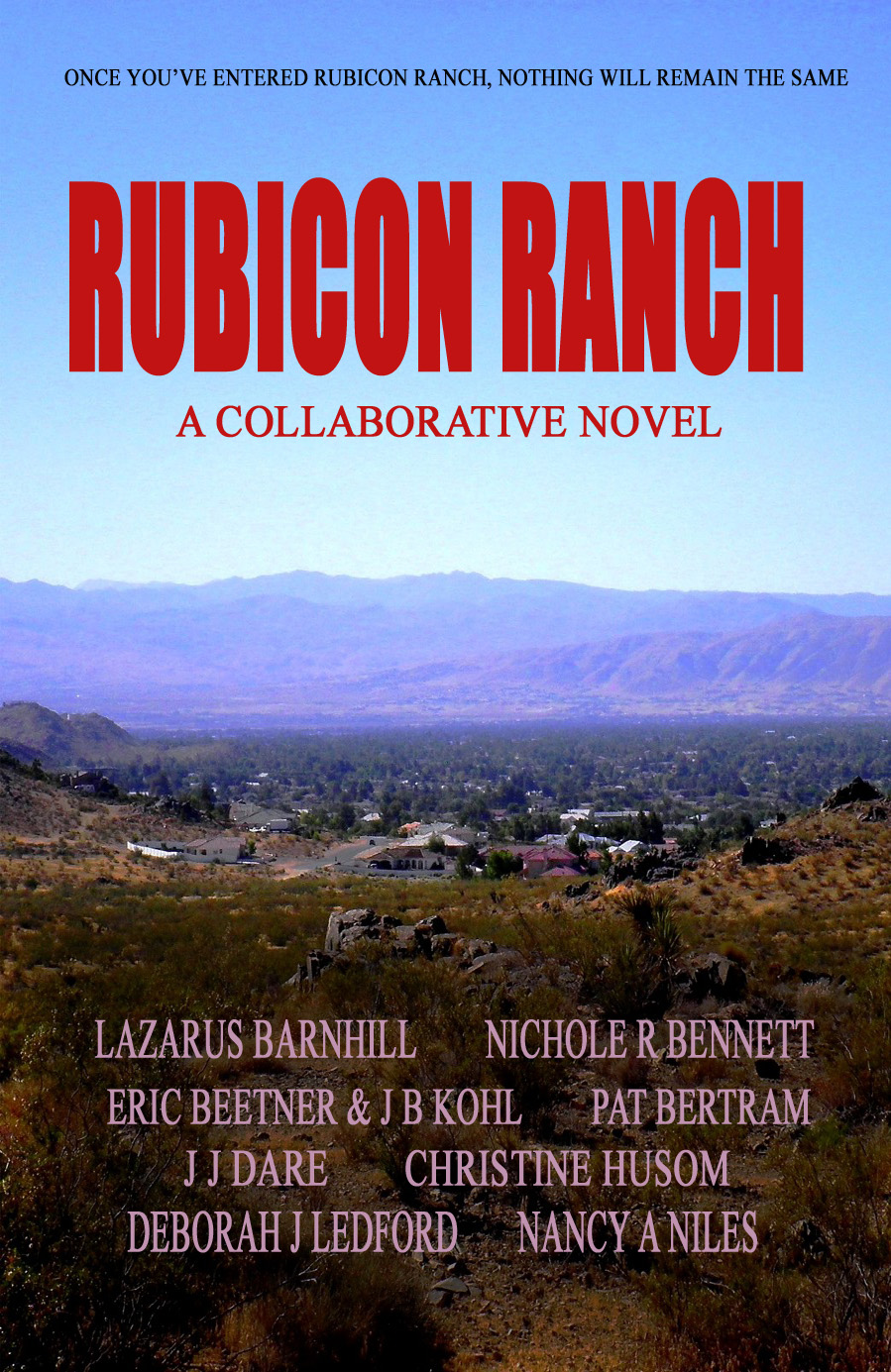
I am involved in a wonderful project with eight other Second Wind authors. Rubicon Ranch is an ongoing collaborative novel that we are writing online. It is the story of people whose lives have been changed when a little girl’s body was found in the wilderness near the desert community of Rubicon Ranch. Was it an accident? Or . . . murder! But who would want to kill a child? Everyone in this upscale housing development is hiding something. Everyone has an agenda. Everyone’s life will be different after they have encountered the Rubicon. Rubicon Ranch, that is.

Each of us writers is responsible for the development of our own characters. My character is Melanie Gray. She has traveled the world with her husband, a world-renowned photographer. Together they authored many coffee-table books (she did the writing, he the photographs). One of the books told about mountains of the world, one about rivers, one about oceans, one about forests, and now they have a contract to do deserts. After they rented a house in Rubicon Ranch to begin their in-depth study of the southwestern deserts, he died in a car accident.

Now, not only does she have to deal with the pain of losing her husband and figuring out what she’s going to do for the rest of her life, she needs to fulfill the publishing contract or she’ll have to reimburse the publishers, which she cannot do because the advance is all but spent. Since she is not a photographer, she roams the desert bordering on Rubicon Ranch, taking hundreds of photos, hoping that a few of them will accidentally end up being as brilliant as her husband’s photos always were. She finds the child’s body and takes photos of the scene after calling 911. At first she is a suspect but once the Sheriff has ruled her out, he requests her help in reading the desert and desert-related clues. Still, the sheriff does not trust her completely, thinking she is hiding something.

These chapters have already been posted:

An additional chapter will be posted every Monday. Please join in the adventure — it should be fun! We don’t even know whodunit and won’t know until the end.

Grief: All Things Considered . . .

Another Saturday gone, thirty-three of them since my life mate died. Saturday — his death day — always makes me sad. Even if I’m not consciously aware of the day, my body still reacts, as if it’s been marking the passing weeks. For some reason grief hit me hard this past Saturday. Perhaps it was the lovely weather we’ve been having, weather he will never enjoy. Perhaps it was the homesickness for him that has been growing in me again. Perhaps it was just time for another bout of tears to relieve the growing tension of dealing with his absence. Grief doesn’t need a reason, though. Grief has an agenda of its own and comes when it wishes.

I’ve been mostly doing okay, moving on with my life — walking in the desert, writing, blogging and doing various internet activities, making friends both online and offline — but nothing, not even my hard-won acceptance changes the fact that he is dead. At times I still have trouble understanding his sheer goneness. My mind doesn’t seem to be able to make that leap, though I am getting used to his not being around. I don’t like it, but I am getting used to it. Maybe that’s the best I will ever be able to do.

Someone asked me the other day how I was doing. “I’m doing okay all things considered,” I responded. His witty and wise response: “Then don’t consider all things.”

I’ve been taking his advice, and trying not to consider all things — trying to consider just enough to get through the day, especially on Saturday.

I don’t expect much of myself on Saturdays. Often, I spend the afternoon and evening watching movies my life mate taped for us. It makes me feel as if we are together, if only for a few brief delusional minutes. I try not to consider that he’ll never watch his tapes again. I try not to consider the long lonely years stretching before me. I try not to consider that I’ll never see his smile again, or hear his laugh. I concentrate on the movies, and so Saturday passes.

By Sunday, I usually regain a modicum of equanimity, but Saturday always comes around again.

Writers: Be Bold!

When writing, it’s important to be decisive. Passive storytelling, passive events, passive motivations, passive characters, passive verbs, all lead to a story without risk or conviction, full of missed opportunities.

Get rid of the unnecessary qualifying words (quite, a bit, a little, some, somewhat, I guess) and non-specific words (someone, everything, huge, handsome, very, really). Such words detract from the authority and decisiveness of your writing.

Too many flashbacks rob a story of drive, give it a sense of aimlessness. So does a lack of focus. Thank heaven for rewrites! The grieving woman in my NaNoWriMo story keeps reflecting on the past, which makes sense, because for her there doesn’t seem to be much of a future. Still, it does seem aimless since she’s thinking instead of doing something. When I rewrite it, I’m going to take away the aimlessness by having the story revolve around a theme to give it focus.

The worst offense for indecisive writing is backing off from a major scene, skipping it entirely, or doing it in flashback. Many new writers don’t feel they are capable of writing dynamic action scenes, so they skim past it and hope readers won’t notice. Or they have a character other than the hero commit the final act, such a man showing up at the end to rescue the heroine in women-in-peril novels. This isn’t as common as it once was, which is good. If the woman is the hero, she needs to put herself on the line during the final scene and not expect someone else to do it for her.

In More Deaths Than One, it might seem as if I passed the buck — the solution to the mystery of Bob’s identity came in a letter rather than his doing the work himself — but the point of the scene was for him to interact with the waitress, not interact with the villain. I wanted to show her emotion on his behalf, show his reaction to her as together they learn the truth. It was the immediacy of their reaction that I needed. How a character feels, reacts, or emotes, is every bit as important as what a character does.

It’s important to trust yourself as a writer. Trust that you will be able to recognize the truth of your scene and what you want to accomplish (as I did with More Deaths Than One). Trust that when it comes time to rewrite and edit, you will know what you need to do to create a dynamic story, and that you will be able to do it.

Most important of all, don’t skirt around the story. Get right to the heart of the action. Be bold.

Amanda, Amanda, Amanda

Since writing during this month is about word count, not producing a finished work, I haven’t spent a lot of time or thought on visuals to ground potential readers in the scene, I just jumped in with the character and started writing. During rewrites, I’ll go back and add the setting — it’s not a good idea to start every every scene with the character’s name (though many writers do it). Here are some of the sentences I temporarily used to open new scenes. Poor Amanda.

Amanda opened her husband’s closet and stared at his clothes, wondering if she’d ever be able to get rid of them.

Amanda pushed the grocery cart through the aisles, looking for foods that didn’t remind her of meals with David, but every time she reached for a can, bottle, or box, her stomach clenched. 

Amanda checked her emails.

Amanda went from eating nothing but yogurt to eating cookies, candy, cake, crackers, chips — anything she could grab and eat without cooking or having to sit at a table to dine.

Tired of crying, of holding the shattered pieces of herself together, Amanda hugged David’s robe-wrapped ashes one more time and climbed out of bed.

Amanda stared at her reflection in the mirror. The woman looked familiar, as if she had known her intimately long ago, but the woman seemed to have nothing to do with her todays.

Amanda felt her life, her love for David rewinding.

Amanda checked to make sure the box was empty.

Amanda woke to light seeping in from between the slats of the closed blinds.

Amanda wandered through the house, seeing not the shabby furniture, the shelves overloaded with books, the 20-inch out-of-date television, but the home she and David had created.

Frenzied with grief-induced adrenaline, Amanda yanked open the door to David’s closet and slammed his underwear into a garbage bag.

Don’t Mess With a Grieving Woman

This is an excerpt from my NaNoWriMo novel:

Amanda was fumbling in her purse for her keys when a voice said, with low-toned menace, “Give me your purse or I will kill you.”

She jerked her head up. Standing between her and her Corolla were two men who looked barely old enough to shave. One jiggled from foot to foot like a child who needed to go to the bathroom, but the other stood firm, his hands steady on a gun.

The scene didn’t seem quite real. Perhaps she’d wandered onto a movie set? She looked around. No cameras. Just the two men standing before her in broad daylight.

Was there such a thing as narrow daylight? She giggled at the thought. Then stopped abruptly. I really am going crazy.

“What’s with you, bitch?” screamed the man with the gun. “Gimme your purse or I’ll kill you.”

“Promise?” Amanda said, clasping her purse to her chest.

The jiggling man lifted his hands and pointed a finger at her like a gun. “Yeah, we’ll kill you, bitch.”

“Okay.” Amanda stared at them, hope blossoming in her chest. God provides, David had been fond of saying. Maybe God was providing a way out of her grief.

The hand with the gun began to waver.

“Do it, man,” yelled the jiggler.

“Yes, do it,” Amanda said softly.

“I’m out of here.” The gunman took off running.

The jiggler danced in place. “Where are you going?”

“She’s crazy. Or a cop.” The words floated back to them from between a pick-up and a mini-van.

The jiggler looked longingly at Amanda’s purse, hesitated, then trotted after his companion.