After the thrill of seeing what plants return from their winter hiatus comes the payback. A seedy garden. Not seedy as in disreputable or sleazy. Literally seedy. As in going to seed.
There are still a few columbines blooming, particularly the bright late-blooming ones, but the blue/purple columbines are already past their first bloom and are going to seed.

The orange wallflower stopped blooming, and the larkspur, always a joy in their purple majesty, are also going to seed. The snapdragons are still blooming, and might continue to bloom throughout the summer, but the first blossoms are going to seed. One of the few flowers brightening the snapdragon garden is this single California poppy that came from who knows where.
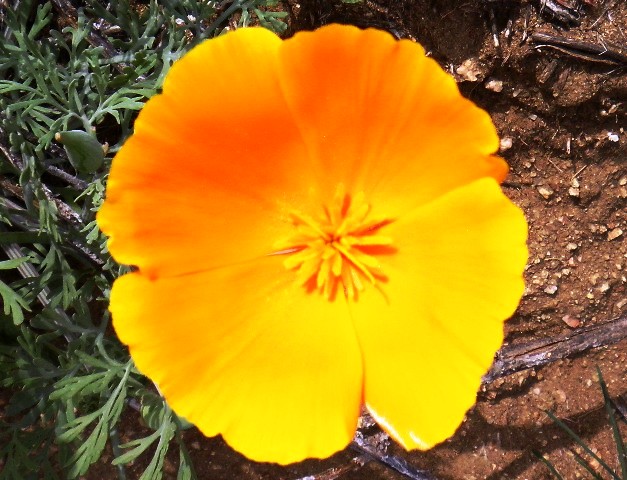
If I were a real gardener with a show-piece garden, I’d be pulling up the seedy annuals and deadheading the perennials, but being an amateur who’s just winging it, I let all the plants go to seed, though perhaps I will deadhead the snapdragons if I get the inclination because at the moment, a lot of the plants look terrible. Mostly, I let the seeds scatter where they will; others I harvest in case there comes a year when the larkspur and other colorful spring growers decide not to come back. Also, it’s great to have seeds to share.
The seedy part of the garden is only half the story. Other plants are coming into their own, such as the cottage pinks, which come in various shades from white to fuchsia.

The various penstemon are also starting to bloom, though this bright pink one is already in full bloom. The penstemon and the cottage pinks sure do complement each other.

The cheerful coreopsis are just beginning their summer odyssey. It’s no mystery why they look like yellow daisies — though of different genera, both belong to the Asteraceae (Aster) family.

The following is one of my favorite photos so far this year. I love the juxtaposition of those primary colors: the yellow snapdragons, the bright red firecracker penstemon and the last of the larkspur. Even better, each of those three plants is a miracle. Around here, snapdragons are a tender perennial, mostly coming back by reseeding themselves, but this year, the plants themselves survived the winter. The larkspur self-seeded, and while the penstemon didn’t self-seed, it came from a seed that had been planted years before and somehow decided this was the time to grow.

As always, the lawn is an issue — although the highest temperatures so far have only been in the nineties, low humidity and sun intensity have been drying out the grass, but so far, except in patches, it’s doing well.

In a couple of weeks, after I harvest the larkspur seeds and pull up the dead stalks, a whole other layer of plants will be revealed. Luckily, there’s always something new to keep my interest that makes the vast amount of work worthwhile.
***
Pat Bertram is the author of Grief: The Inside Story – A Guide to Surviving the Loss of a Loved One










May 25, 2026 at 5:11 pm
Your garden is so cheerful with its wonderful splashes of colour! I have only two columbines–one blue/pale purple, and the other a two-toned pink–both of which have gone completely to seed during the past week. I’ve cut the seed pods off now, leaving just a couple late blossoms. I did put bedding plants in a few summer baskets for the back deck and put some wax begonias in the front planter, so they’re starting to provide a few bits of early colour, One of our two rose bushes has just started blooming and peony buds are ready to pop, but otherwise there isn’t much colour in our yard except the evergreen shrubs. I’d love some real ‘splashes’ of colour. I’m trying to be patient! LOL.
May 25, 2026 at 6:12 pm
Color sure does cheer one up! Usually by summer, most of my spring flowers are gone, the autumn ones nowhere close to blooming, so I rely on petunias. They were never my favorite, but they are so perfect for this area that I’ve become quite fond of them. It’s interesting how we can’t all have the same splashes of color at the same time. Nature dictates!
May 27, 2026 at 2:57 pm
I love your garden. Just spent the morning trying to tidy one small corner of mine–the corner where the thistles were preparing to invade next door.
May 27, 2026 at 5:38 pm
Always fun! (That’s irony, in case you couldn’t tell.)