Gardening is certainly a strange avocation. What has happened year after year isn’t guaranteed to happen again this year, and what has never happened isn’t guaranteed to continue never happening.
This year, a few years after the seeds had been planted, hollyhocks suddenly decided to grow. Why? I don’t know. Snapdragons survived the winter intact, and at a time when they should just be getting started for the season, they are already finished blooming. The moss rose and marigolds seeded themselves as they sometimes do, but this year, even though I thinned them dramatically, they are still coming in so strong that I’ll have a jungle, especially considering that I’d already put in petunias. The poppies are a no show — none of the red corn poppies came back and only a single California poppy put in an appearance. Blanket flower is one of those plants that are supposedly impossible to get rid of, but one of my blanket flowers decided to get rid of itself. As in previous years, I’ve been blessed with an abundance of larkspur, but most are not going to seed the way they should. Also, a swath of them are lying flat, as if some animal used them for a wallow. Some other plants were flattened by the wind, but the larkspur are in a protected area, so who knows what’s going on.
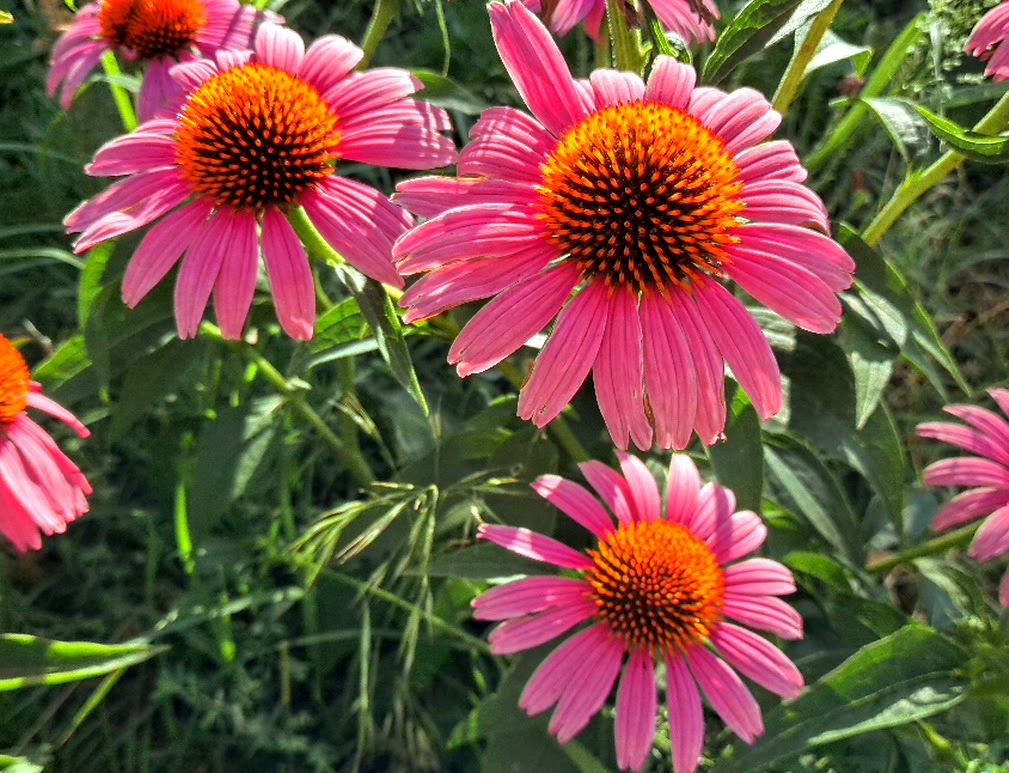
Some things are going along as they should be — the lily tree garden is taller than ever and is filling in with offspring plants, though the flowers are budding a month early. The daylilies also seem to be spreading nicely, but oddly, one of the plants already had a flower, also a month early. The purple magnus echinacea are growing extremely well, but the flowers are now pink — some bright pink, some pale pink. (As soon as I’ve cleaned up my garden areas to ready them for summer, I might have to see where I can move some of them. It’s truly great having a ready source of transplantable plants, especially ones that do so well around here, and pink is always a cheery color.)
The yarrow was another plant that seemed to have been used as a wallow. It’s possible it’s been getting too much water, though it’s hard to believe that anything around here gets too much moisture. And anyway, I’ve been treating it the way I’ve always done. Still, this might be another plant that needs to be moved.
As you can see, in a garden, there’s always something different. The larkspur surprised me — I don’t know why they aren’t going to seed, but luckily I’ve saved seeds from previous years to make up for the lack. And, since I don’t have to wait for the seeds to mature to pull up the dead stalks, I can go ahead and plant other flowers now instead of in July as I normally have to, which is great. It’s hard to get anything to grow from seed in July around here — the ground dries out too fast.
I almost forgot to mention the bees! There are way more this year than normal. Some days my yard is buzzing from the sound of dozens of big black and yellow fuzzy bumblebees feasting on the larkspur. I’m hoping they’ll like other plants as well so they will stick around for a while. There’s something so pleasant and right-with-the-world to have bees in a garden.
All this and summer isn’t even here. More changes from previous years are on the way, I’m sure. But it’s all good. It’s a garden, after all.
***
Pat Bertram is the author of Grief: The Inside Story – A Guide to Surviving the Loss of a Loved One








 Bertram's Blog
June 4, 2026 at 1:25 pm
I hope the bees arrive here soon! I’m always afraid their numbers have been too decimated and one day they won’t. I rejoice when they do. I still haven’t seen one this spring, although dandelions have been blooming for a week.
June 4, 2026 at 1:29 pm
I’ve read that the bees are recovering. I hope it’s true.
June 4, 2026 at 7:50 pm
What a happy garden report. And the summer will be full of more surprises! Have fun!
June 5, 2026 at 6:18 am
Thank you.
June 4, 2026 at 8:38 pm
There’s something quietly beautiful in how you hold both the predictability and unpredictability of the garden without trying to force it into explanation. The way things show up early, vanish unexpectedly, or refuse to behave “as they should” feels a lot like life itself, uncooperative, surprising, and still somehow generous.
June 5, 2026 at 6:25 am
I hadn’t thought of that, but yes! So much like life itself.