Pre-Probate Party

There is a probate hearing next week to rule on the administration of my father’s will. Since this is the last weekend I know for sure I have a place to stay (though I guess I’ll be here at least another month), I am celebrating with a pre-probate party. Nothing fancy, just a taco bar with three kinds of taco shells, three kinds of filling (one vegan, all gluten free), all sorts of toppings and garnishes, and homemade brownies made with butter and extra chocolate for desert. Alas, the brownies are neither vegan nor gluten-free, so those with special needs will have to choose between fruit or ice cream.

If you are in the high desert area, you are invited! Just let me know. Should be fun. I know that a least a few people will be here (maybe more!), so that is a big step above the last party I gave where no one showed up. (But that was so long ago, I’m not sure it even counts.)

balloons1

***

Pat Bertram is the author of the suspense novels Light Bringer, More Deaths Than One, A Spark of Heavenly Fire,andDaughter Am I. Bertram is also the author of Grief: The Great Yearning, “an exquisite book, wrenching to read, and at the same time full of profound truths.” Connect with Pat on Google+. Like Pat on Facebook.

Phones and Other Connections

When did talking to someone on the phone become something that people did while doing something else?

I have a friend who calls me only while she is walking. I have another friend who calls me only when driving. I just talked to someone who put me on the speaker so she could make her bed while we chatted. I know several people who play computer games while on the phone. In other words, no one really talks to anyone anymore. They justphone seem to be filling in what might otherwise be almost-empty time.

I no longer feel slighted by this disregard as I once did, but I am egotistical enough to want people to want to talk to me, to want them to want to connect on a more personal level rather than using me to keep from being boring by mundane activities. (Or — perish the thought!! Could they be doing those other things to keep from being bored by me?)

I do realize time is at a premium in this insanely busy world, that sometimes people can only converse during barely-used moments, but still, it would be nice to feel as if what I have to say — or what people have to say to me — is important enough to experience unaccompanied by the huffs and puffs of the walkers, by muttered comments to other drivers, by computer beeps and dings.

We’ve come a long way from the days of being tethered to stationary phones, but still, it seems as if we’ve gone too far. Just because we can drive and talk on the phone, or walk and talk on the phone, play games or do housework and talk on the phone, it doesn’t mean that we should.

Or maybe I’m being too unrealistic and should be grateful for any moment of another person’s attention, no matter how divided.

***

Pat Bertram is the author of the suspense novels Light Bringer, More Deaths Than One, A Spark of Heavenly Fire, and Daughter Am I. Bertram is also the author of Grief: The Great Yearning, “an exquisite book, wrenching to read, and at the same time full of profound truths.” Connect with Pat on Google+. Like Pat on Facebook.

Happy National Hat Day!

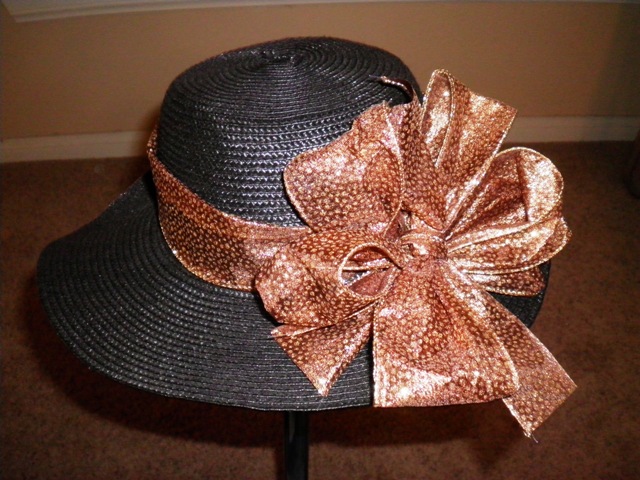
Ever since I came to stay in this dusty desert community, I’ve worn hats to ward off the glare and to protect myself from the ravages of the sun. When my old straw hat wore out, all I could find was a hat that looked like a gardener’s hat, so I spruced it up with a fancy ribbon that had once adorned a gift. Realizing how fun it was to wear lavish hats, I’ve become somewhat of a collector — not just of hats, but hat trimmings. For example, my basic black indestructible hat is currently bedecked with the ribbon from the gift basket I received this Christmas.

????????????????????

Usually I try to match the decoration to my outfit (I hesitated over the choice of the word since what I wear can’t actually be called an “outfit.” If I’m walking to or from dance class, I generally wear black leggings, a black t-shirt and some sort of bright scarf to add color, otherwise I wear whatever is handy.)

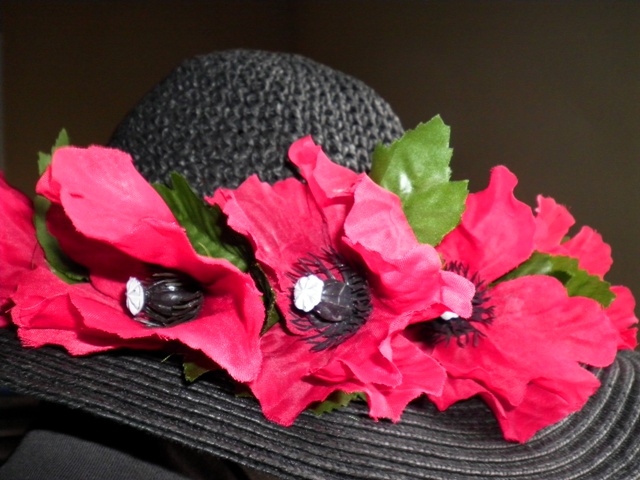
Sometimes, if I feel a need for a bit of silliness in my life, I don a quirky hat, such as this crown of crows, though I have to admit, I usually wear a single crow because two is just a tad too zany even for me.

zany hat

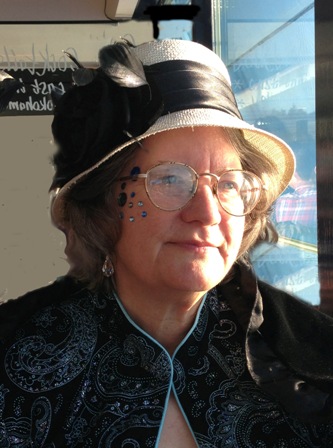
This lovely, very expensive chapeau seems to suit me — sedate and whimsical all at once — though I seldom wear it. It seems more fitting for soirees and teas than for cutting through empty lots on the way to dance class. Besides, it’s so light, I’m afraid it would blow away in the frequent winds .

Pat Bertram

I also have a couple of very broad-brimmed hats, a cowboy hat and a wool Irish walking hat that used to belong to Jeff, a cotton hat that used to be my father’s, two cowgirl hats, an assortment of insignia-less ball caps, a red stocking cap so long it wraps around my neck, and various other hats.

So, what hat did I wear on this day set aside to celebrate hats?

None. I drove to the dance studio because I had to run an errand afterward, and since I didn’t need to worry about protecting myself from the sun, I left my hat behind.

***

Pat Bertram is the author of the suspense novels Light Bringer, More Deaths Than One, A Spark of Heavenly Fire, andDaughter Am I. Bertram is also the author of Grief: The Great Yearning, “an exquisite book, wrenching to read, and at the same time full of profound truths.” Connect with Pat on Google+. Like Pat on Facebook.

As Long As We Are Alive, We Are Alive

During the last months of my life mate/soul mate’s life, his brain was so riddled with cancer, he lost the ability to hold a thought long to enough to have a conversation, so his communications seemed more like lectures than exchanges. I remember bristling during those lectures — gritting my teeth and clenching my fists. It seemed as if he were being paternalistic, as if he didn’t trust me to take care of myself.

I knew he was ill, of course, though at the time, I didn’t know how bad off he really was. He’d been ailing for so long, I thought that’s the way it would always be, his getting weaker and weaker, maybe for many more years. But he died, shocking me to my core. And then guilt and regret descended on me. How could I not have listened to every single word he spoke during the time of his dying? How could I not have treasured his concern for me? How could I have been so impatient, so irritable, so resistant to what he had to say?

In the five years since Jeff’s death, I’ve worked through my guilt and regrets, even came to the realization that it wasn’t he I was resisting but his dying. Still, it wasn’t until my father’s death when my personal history repeated itself that I truly understood the dynamics of what had happened between Jeff and me. (In the case of my father’s last days, he wasn’t lecturing me so much as expecting to be waited on, and I simply did not want to do for him what he could do for himself.)

In my writing, I’ve been calling the last months of both men’s lives “the time of his dying,” but it was only their “dying” in retrospect. It was actually still a time of living for them, which makes my less than perfect behavior understandable. We were still involved in our relationships and roles, and it was only death that made my reactions seem horrific. If they both had continued to live, of course I could not have tolerated spending many years being lectured to or being expected to wait on someone who was able to do things for himself. These are just normal conflicts of living. And though they dying, they were still alive. Still living. And so was I.

I remember crying to the hospice social worker after Jeff died, lamenting his ill health. “He never had much of a life,” I wailed. She said, “He had a life. Being sick was his life.”

It seemed like such a terrible thing to say, but now I understand what she meant — that he was alive until he wasn’t.

This is one case where understanding can’t change anything. If I am ever thrust into such a situation again, I’d still do the same thing — carry on as if the person were alive and going to be alive for a long time. The one change will be that I won’t have regrets. Although my regrets over Jeff loomed large, I have no regrets over anything I did or did not do for my father. We were involved in playing out our roles the best way we could up to the end. And there is nothing to regret in that, nothing to feel guilty about.

I did learn something from both men, though, and that is to live until the very end. As long as we are alive, we are alive.

***

Pat Bertram is the author of the suspense novels Light Bringer, More Deaths Than One, A Spark of Heavenly Fire, and Daughter Am I. Bertram is also the author of Grief: The Great Yearning, “an exquisite book, wrenching to read, and at the same time full of profound truths.” Connect with Pat on Google+. Like Pat on Facebook.

Stepping From The Known Into The Unknown

Ever since I came to look after my nonagenarian father after the death of my life mate/soul mate, I’ve been looking forward to a time when I would be free of all responsibility and would be able to do whatever I wanted (within the bounds of my meager resources). I’ve daydreamed about living a nomadic life, traveling around in some sort of camper or van or even a car with a comfortable back seat. I’ve daydreamed about epic walks, imagining myself thru-hiking the Pacific Crest Trail, the California/Oregon/Washington coastal trails, the breadth of the USA. I’ve daydreamed about just heading out and letting the path form before my feet as I journeyed into the unknown.

Ventura Pier at SunsetNow that my father is gone and I’m on the brink of that new life, I’ve been trying to figure out what exactly I expect to gain from an adventurous life (particularly since I am anything but adventurous). It wasn’t until a mentor left a comment on my A Little of a Lot of Things blog post that I realized what I wanted.

She wrote: Listing priorities is something you’ll be doing the rest of your life. You have plenty of time. Beginning with familiar things is a good step, as it’s always easier to step from the known into the unknown than to springboard into a whole life of new things all at once. You’re doing fine. Trust your instincts.

I realized I don’t want to start with familiar things. I want to jump off the precipice of the known and land gently in the middle of a whole new life filled with amazement, joy, and wonderful new things.

Such a childish wish! Not easy to do and probably not feasible, either. I know we take ourselves with us wherever we go, but I’d hoped an epic journey with all its challenges would change me into something . . . other. Other than what I am now, I mean. Other than a sad woman who has endured too much loss too fast. Other than a lonely woman who is neither jaded nor bored, just . . . tired. Other than an earth-bound woman who seems to have misplaced her power of uplift.

But life doesn’t work that way. We are always who we are. I’ve lived a creative life and lived life creatively. That will never change. But I’d like to be uplifted, amazed, excited, entranced by life once more. Cripes, it sounds like I want to be young again, doesn’t it? But I don’t. I just seem to have lost the power to feel the daily miracles. I can still be appreciative, still be grateful, but how many times can one feel totally uplifted and awed by a sunset before it becomes ordinary? A hundred? A thousand? Ten thousand? How many times can one feel the new grass beneath her toes and feel the wonder of being on this earth? After a while, it simply feels like . . . grass.

The older we get, the quicker things go from awesome and new to comfortable and familiar, from comfortable and familiar to entropy and stagnation. I’m sure my efforts at living creatively will stave off both entropy and stagnation, but I want more than a life spent staving.

The alternative to springboarding into a completely new life would be to take things one step at a time, savoring each new step into the unknown until it becomes comfortable, then taking another step into a  new unknown. And that is doable.

Today marks the beginning of a new year. Think about it, and you’ll realize it’s true. The calendar might not change, the year number might have already changed, but this is the beginning of the year 1/13/15 to 1/12/16.

So happy new year! Wishing all our dreams begin to come true, one step at a time.

***

Pat Bertram is the author of the suspense novels Light Bringer, More Deaths Than One, A Spark of Heavenly Fire, andDaughter Am I. Bertram is also the author of Grief: The Great Yearning, “an exquisite book, wrenching to read, and at the same time full of profound truths.” Connect with Pat on Google+. Like Pat on Facebook.

We Are Not Our Stuff

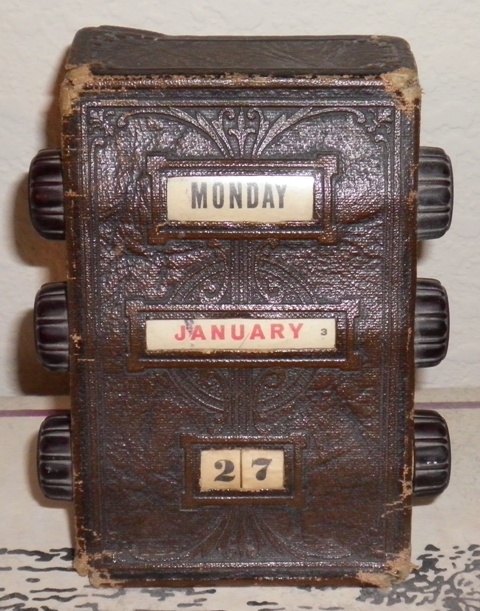
Strange day today. I packed what was left of Jeff’s things, both the items he asked me to save and the items I still can’t get rid of such as the sweater he was wearing when we met and his “new” jacket. I’ve had his antique perpetual perpetual calendarcalendar and several of the smaller items on my dresser ever since I got here to my father’s house. They brought me comfort then, and I thought I would feel sad now that they are packed away, but it just seems part of the process of my moving on.

Only two things caught me off guard. I have two original copies of his death certificate, and I opened the envelope to pull out one so I could put it with my papers to make it more accessible if I need it, and in the envelope I found the certificate of cremation. Did I ever read it? Did I ever know it was there? I can’t remember, but oh, the pain when I read those stark words today. “This is to certify that the remains of ____________ were cremated by authority of Pat Bertram.” Cripes. Even worse was the label they gave me to put on the urn if I ever traveled with those remains: This package contains the remains of _______________ whose body was cremated on March 31, 2010. Apparently, it’s illegal to travel with unmarked human remains. Well, that’s just too bad. One of these days, I will figure out what to do with those remains, and I sincerely doubt I will be labeling him (it? them?) like a commonplace parcel. (Unless you are on the human remains regulatory committee, then of course I will be labeling them.)

But the pain of dealing with his remains is reserved for another day. Today, after I packed up what is left of his possessions, I hesitated, not sure how to label the box. If he were alive, of course, I’d just put his name on the carton, but I didn’t want it to seem (even to me) as if he were inside that box. We are not our stuff. In the end, I just wrote, “J’s things.”

One amusing note (amusing to me, anyway). When I came here after Jeff’s death, a local mover gave me a great rate since his driver was going to be passing this town, and he had empty space in his moving van. I asked him if he would come pick the stuff up when I was ready to leave, and mentioned that there would be less to move back. He laughed and said, “That’s what everyone says, that they are going to get rid of things, but they always end up with more.” Not me. I have done a good job of getting rid of stuff. By the time I figure out where I want the stuff moved, I hope I will have gotten rid of even more.

***

Pat Bertram is the author of the suspense novels Light Bringer, More Deaths Than One, A Spark of Heavenly Fire, andDaughter Am I. Bertram is also the author of Grief: The Great Yearning, “an exquisite book, wrenching to read, and at the same time full of profound truths.” Connect with Pat on Google+. Like Pat on Facebook.

A Little of a Lot of Things

Hurray for blogging! I’ve been on my feet all day, and if it weren’t for my wanting to continue the discipline of daily blogging, I’d be on my feet still.

I’ve been sorting and packing, which I’m sure seems as ludicrously long a task to you as it does to me since I’ve been working at getting packed for more than four months now. I don’t even have much personal stuff, maybe two dozen boxes of household goods, office supplies, and personal items, and that’s it. Well, three dozen if I include Jeff’s video collection and his VCRs, which I’m keeping for now. I have no furniture, no massive shoe collection, no clothes dating back to my youth, no vast number of books (no shelves to put them on, you see).

But when you’ve done a little of lot things for decades, you end up with a little of a lot of things. And that’s what I am having to deal with — a little of a lot of things and a lot of little things.

handmade miniature rosesToday I sorted through a few boxes of flowers and flower-making supplies and condensed it all down to two boxes. Took me all day. I can see the frown on your face. Why would that take so long, you’re wondering. Well, the flowers are very, very small. To show you how small, I took a photo of this pot of roses sitting on a quarter. Each petal of each rose was individually made, and if you look closely, you can probably see my fingerprints.

I don’t know if I will ever make any more flowers or flower arrangements, but I’m not about to toss out or give away the thousands of hours of work I have stored in those two boxes. And that’s just one of the many things I have had to sort through during these past months.

For most of my life, I made crafty things for a living (a sparse living, but what the heck. I never starved), and I got good at creating unique items. Because of this, I can do anything within a very narrow range. (Successful marketing, unfortunately, is outside that range.) My two or three remaining wholesale customers for miniature cloth dolls (1-1/2” tall, fully clothed) want me to keep making the dolls. My few fans and my publisher want me to go back to writing. The people who have seen my jewelry, think I should go back to plying my pliers. Those who have seen my various scale miniatures think I should go back to trying to make a living at it. (Strangely, though thousands have seen the only piece of art I ever did — a one-inch-tall oil painting — no one has ever suggested I go back to painting. Do you recognize the painting? I tweaked it and used it for the cover of More Deaths Than One, which some people have called the ugliest cover of all time.)

The problem is I don’t want to go back to anything. I want to go forward to . . . I don’t know what. I keep hoping that someday my fingers will fill in the “I want” so I can look at it in amazement and say, “Aha! Why didn’t I think of that?” (My dance teacher wants me to keep dancing, as do I, but we both know there is no career in dancing in my future. Dancing is one of those things that if you start in your teens, you’re already too old.)

Meantime, I am sorting, clearing out what I know I will never use (and of course, those discards could be the very things I will need, but I’m okay with that), and packing the rest until I can figure out what to do with the stuff — or even better, until I can figure out what to do with me.

***

Pat Bertram is the author of the suspense novels Light Bringer, More Deaths Than One, A Spark of Heavenly Fire, and Daughter Am I. Bertram is also the author of Grief: The Great Yearning, “an exquisite book, wrenching to read, and at the same time full of profound truths.” Connect with Pat on Google+. Like Pat on Facebook.

Catfishing

Today I got a friend request from someone I knew online. I thought I’d friended her on Facebook years ago, but I couldn’t remember. I don’t see everyone I’m friends with since Facebook chooses what shows up in my newsfeed, and besides, I’d received a couple of other requests from people I was friends with, but who were separating out their personal connections from their author connections, so it seemed normal to me.

I accepted the friend request, and almost immediately got a message from her. “Hello.” Nothing else just the one word.

I responded, “Hi. I didn’t know you weren’t on facebook. Welcome!”

She: am sorry for me resending you a friend request it is just that i got a trojan virus on my old profile so this is my new account now

I got the gist at one glance — resending me a friend request, trojan virus — and didn’t pay particular attention to the construction of the message other than to wonder if she were using her phone to respond and didn’t bother to be grammatical. So I wrote back, “No problem – about sending me a request that is. A virus and having to start over are big problems. I’m sorry. How are you doing? No new physical ailments I hope.

I unfriended the original her since Facebook has a cap on the number of friends you can have, and there is no point in padding one’s friend numbers with defunct accounts. Then I got this message from the new account:

She: Am good and very much happy now. Do you know Agentofficer Adeniyi morgan?

I started to feel a bit uneasy. This friend would never have said she was happy now. Not that I ever knew her to be either happy or unhappy, but she would simply not have used the word in such a way. She would have offered me a bit of wisdom, would have made a philosophical remark, would have mentioned specifically how she was doing, or would have asked about how I was doing after the death of my father. A bit hesitantly, I typed, “No don’t know that person. I’m so glad you’re happy.

She: Agentofficer Adeniyi morgan? Who work for fedgov to help and support the young and old retired people, in the community department of compensation they are really helping do you got yours from him?

Now I knew something was wrong. This friend is an educated, literate woman, who writes spectacular historical novels, and she would never be so slipshod. Besides, the construction sounded similar to the spam messages I get on my blog as if the translation program the person used was faulty. So I wrote, “Email me, okay?” And then I googled Agentofficer Adeniyi morgan, found out the scoop, emailed my friend and told her what was going on. But she already knew.

I got one final fake message: “Really but i did tallk to him, because when the ups man came to deliver mine for me i did saw your name on the list of those that are going to get it too thats why am telling you if you have got yours from them?”

Apparently, this Agentofficer Adeniyi morgan or whoever is using that name, uses photos from someone’s profile (I thought he/she/it was cloning the account, but apparently it’s simpler than than that), sends friend requests to that person’s friends to try to scam money out of them. This person is offering $150,000 if you make a tax payment of $1000, and is targeting older people both online via Facebook and even by phone. So, beware of Agentofficer Adeniyi morgan or anyone offering you such an improbable deal.

This sort of scam my friend and I got caught up in is called catfishing after the 2010 documentary Catfish about an online romance that turned out to be something other than it was purported to be. Predators use catfishing as a way to trick the unsuspecting into romantic relationships, and as you can see, scammers use it as a means of trying to get money.

Actually, only the name catfish is new, the schemes and scams are old.

***

Pat Bertram is the author of the suspense novels Light Bringer, More Deaths Than One, A Spark of Heavenly Fire, and Daughter Am I. Bertram is also the author of Grief: The Great Yearning, “an exquisite book, wrenching to read, and at the same time full of profound truths.” Connect with Pat on Google+. Like Pat on Facebook.

Letter to Jeff, Day 434

Hi, Jeff.

It seems so damn pathetic that after all the trauma of your dying, all the grief, all I’ve done in the past fourteen-and-a-half months, all the striving to fill my life with newness, I’m still basically the same I was before you died. I tried to explain this to my grief group today when they were talking about the changes that a death brings, but after I spoke, they backtracked and said that death brought changes to our lives, not us. That we didn’t change. Shouldn’t we? More specifically, shouldn’t I? After all I’ve gone through, how can I sroadtill be so much the same?

They talked about the importance of hope at the meeting, too. For all these months, I have had hope. Hope for a new direction in life, hope for success, hope for some sort of personal growth (and I don’t mean a tumor). But now it seems as if all my hopes have died stillborn.

If my continued survival isn’t about hope, if it’s causing me more pain than happiness, what’s the point? I’m curious how this hand will play out, and that’s what’s keeping me going. Maybe it’s enough, particularly since I think people are wrong about needing hope. It’s easier (and less hurtful) to live without hope. So many of my dreams never came to fruition. So much of my grief was about hopes that were never fulfilled. Wouldn’t it have been better if I hadn’t hoped for anything in the first place? Sometimes I wonder if what I miss is what I never had. It’s just too damn sad — you, me.

Adios, compadre.

***

Pat Bertram is the author of the suspense novels UnfinishedMadame ZeeZee’s Nightmare, Light BringerMore Deaths Than OneA Spark of Heavenly Fireand Daughter Am IBertram is also the author of Grief: The Great Yearning, “an exquisite book, wrenching to read, and at the same time full of profound truths.” Connect with Pat on Google+. Like Pat on Facebook.

Collaborating on an International Novel

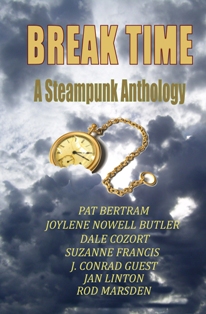
Yesterday I wrote about collaborating on the Rubicon Ranch mystery series, but that wasn’t the only collaboration I’ve done. I also worked on Break Time with authors I met online, some of whom were good friends of mine even though we have never met. Break Time was supposed to be similar to the Rubicon Ranch series, where the authors took turns writing chapters, with each round of chapters delving deeper into the mystery and the relationship with the deceased and the other characters. Because we had decided on a time travel and Steampunk theme for Break Time, the characters lived in different eras. It was hard to intermix the individual stories as we did for Rubicon Ranch, so in the end, Break Time was published as an anthology, with each story being connected by my character’s story.
Break TimeMy character, Flo Giston was the widowed daughter-in-law of the time traveler. She is grieving the loss of her husband Robert, but when she goes back to the past for the second time, she is shocked to realize how her feelings have changed. In this excerpt, she is standing outside the house, watching her husband, her past self, and the Gistons:

So far, the Gistons hadn’t noticed her, and perhaps it was just as well. Robert had never seemed to be able to handle one of her; two might overtax his feeble imagination.

Horrified at the direction of her thoughts, Flo slipped back into the lab. She’d loved Robert dearly, had mourned him twice, so what prompted her to be so dismissive of him now? Remembering how besotted she’d been, she wondered if love hadn’t been the blessing she’d always presumed it to be, but had instead been a prison, keeping her emotionally shackled to a man for whom she had little respect.

They’d had a good life, though, and had only lived with the older Gistons for two years until Robert had saved enough to buy a starter home in Sun City, a new village on the eastern plains of Colorado. Robert appreciated the proximity to his parents’ place, but Flo loved the house itself with all its new appliances run by steam from a nearby plant.

The sex had also been good. She’d always enjoyed the small buzz of pleasure she’d felt in her husband’s arms. Then an appalling idea hit her. What if the sex hadn’t been good? Robert had been the only man she’d ever made love with, so she had nothing to compare the experience to except the romance novels he hated her reading. She’d always suppressed her passionate impulses since Robert had been satisfied with a quick in and out every Saturday night, but what if there were more to love—and life—than what she’d shared with her husband?

She put a hand to her mouth to stifle a gasp. What would the rest of her life be if death hadn’t parted them? Would she have been the anxious dowd she saw on the porch with Robert, or would she have turned into her mother-in-law, hiding her intelligence and passion behind increasingly vibrant raiment?

While all the authors of the Rubicon Ranch writers were from the USA, the Break Time authors spanned the English-speaking world — Canada, Australia, New Zealand and Britain, western USA, central USA, southern USA. Now that I think of it, Break Time was an incredible accomplishment — a truly international book. You can buy Break Time at Amazon.

About the authors of Break Time:

Joylene Nowell Butler, Metis Canadian, lives in Cluculz Lake in central BC with her husband and six stray cats. In her spare time, she teaches T’chi.

Dale Cozort, a computer programmer, lives in a college town near Chicago with his wife, daughter, three cats and a lot of books. He is a long-time science fiction fan and writer.

Suzanne Francis has written two series of novels set in a fantasy universe of her own creation. British born, she presently makes her home in Dunedin, New Zealand.

J. Conrad Guest lives in Michigan and is the author of seven novels including the time travel novels, January’s Paradigm, One Hot January, and January’s Thaw.

J J Dare is a native of Louisiana and has been an author since age seven. Love for the amazing worlds the written word opens up keeps Dare writing, mostly mysteries, thrillers, and dramas.

Rod Marsden was born in Sydney, Australia. He has three degrees; all related to writing and to history. His stories have been published in Australia, England, Russia and the USA.

Pat Bertram is the author of the suspense novels Light BringerMore Deaths Than OneA Spark of Heavenly Fireand Daughter Am IBertram is also the author of Grief: The Great Yearning, “an exquisite book, wrenching to read, and at the same time full of profound truths.” Connect with Pat on Google+. Like Pat on Facebook.